Research in Plant Disease
The Korean Society of Plant Pathology pISSN 1598-2262, eISSN 2233-9191
Research Article Open Access http://dx.doi.org/10.5423/RPD.2014.20.3.189
Disease Occurrence in Transgenic Rice Plant Transformed with Silbene Synthase Gene and Evaluation of Possible Horizontal Gene Transfer to Plant Pathogens
Sang-Mi Yu 1 , Ui-Seon Jeong 1 , Ha Kyung Lee 1 , So Hyeon Baek 2 , Soon Jong Kwon 3 and Yong Hoon Lee 1,4 *
1
Division of Biotechnology, Chonbuk National University, Iksan 570-752, Korea
2
Department of Rice and Winter Cereal Crop, National Institute of Crop Science, Rural Development Administration, Iksan 570-080, Korea
3
Department of Agricultural Biotechnology, National Academy of Agricultural Science, Rural Development Administration, Suwon 441‐707, Korea
4
Advanced Institute of Environment and Bioscience, and Plant Medical Research Center, Chonbuk National University, Iksan 570-752, Korea
Genetic engineering is being used to enhance disease resistance and nutritional value of crops including rice plant. Considering the fast-growing agricultural biotechnology and rapidly increasing global area of transgen- ic crops, the risk evaluation on environment is necessary. In this study, we surveyed the difference of disease occurrence between transgenic rice variety, Iksan526 transformed with peanut stilbene synthase gene and non-transgenic rice varieties, Dongjin and Nampyeong in the field. Moreover, the possibility of gene transfer from transgenic rice to bacterial and fungal pathogens was investigated. The results of this study indicated that there was no significant difference in the occurrence and severity of the diseases between Iksan526 and Dongjin or Nampyeong. In addition, the results suggested that rice pathogen, such as Xanthomonas oryzae pv. oryzae, Rhizoctonia solani and Magnaporthe grisea did not take up stilbene synthase and bar genes under natural conditions. Moreover the transformed DNA was not transferred to the pathogens even in repetitive contacts.
Keywords : Gene transfer, Piceid, Resveratrol, Stilbene synthase, Transgenic rice
Introduction
Rice (Oryza sativa L.) is one of the most important staple foods for the increasing world population, especially in Asia. Plant breeders are still trying to develop rice cultivars having high quality and quantity value. Nowadays, genetic engineering is among the various methods being used to enhance nutritional or functional value of rice plants, and confer resistance to patho- gens (Stark-Lorenzen et al., 1997; Ye et al., 2003).
A number of previous studies demonstrated the toxic activity of resveratrol on fungal and bacterial pathogens (Adrian et al., 1997; Maddox et al., 2010; Yu et al., 2005). Resveratrol (trans- 3,4,5-trihydroxy-stilbene) has also been shown to extend lifespan
of yeast (Saccharomyces cerevisiae), worm (Caenorhabditis elegans), and fly (Drosophila melanogaster) under standard full diets, and also extend lifespan and improve health of a short- lived fish (Nothobranchius furzeri) and mice on a high-fat diet (Agarwal and Baur, 2011). Hence, a stilbene synthase gene from peanut was transformed to rice variety, Dongjin, and transgenic rice variety, Iksan526 which synthesizing resveratrol and piceid (5,4’-dihydroxystilbene-3-O-b-glucopyranoside) was developed to produce resveratrol-containing grain at National Institute of Crop Science, Rural Development Administration, Korea.
However, the increasing exploitation of transgenic plants has generated concerns over the ecological impact of engineered heterologous genes as these can be replicated and disseminated in the environment (Nielsen et al., 1997a, 1997b). The extensive use of antibiotic resistance genes as selectable markers in plants has further raised questions about the possible transfer of the
*Corresponding author Tel : +82-63-850-0841 Fax: +82-63-850-0834
E-mail: [email protected]
Received May 2, 2014
Revised July 23, 2014
Accepted July 28, 2014
resistance genes to microbes in the environment. Prerequisites for natural transformation under soil conditions are the avail- ability of free DNA, the development of competence, and the stable integration of the captured DNA into the genome of microorganisms. Hence, long-term persistence of even a small percentage of the released plant DNA is assumed to enhance the likelihood of transformation processes (Gebhard and Smalla, 1999). However, experimental evidence that horizontal gene transfer of genetic material from plants to microorganism can occur is still limited (Broer et al., 1999; Nielsen et al., 1997a, 1997b). It can be hypothesized that bacteria growing on rot- ting plant materials which allow a close contact between de- caying plant cells releasing transgenic DNA and actively grow- ing bacterial cells could be another scenario for horizontal gene transfer (Bertolla et al., 1997, 2000; Gebhard and Smalla, 1998; Lorenz and Wackernagel, 1994).
Diseases causing annual yield losses conservatively estimated at 5% (Song and Goodman, 2001) are among the most signifi- cant limiting factors that affect rice production. Thus, there is a need to develop strategies providing durable resistance against the diseases (Adrian et al., 1997; Maddox et al., 2010). In view of the importance of disease resistance, the transgenic rice plants developed to produce a certain ingredient need to be evalu- ated on the changes of resistance empirically.
This study was aimed to assess the difference of disease occurrence between transgenic rice variety, Iksan526 trans- formed with stilbene synthase gene (Baek et al., 2013) and non- transgenic rice varieties, Dongjin and Nampyeong in the field.
Moreover, in view of the concerns about the transfer of engi- neered DNA from genetically engineered crop to plant patho- gens, we investigated the possibility of horizontal gene transfer in natural or artificial infection conditions.
Materials and Methods
Plant materials and cultivation in the confined field. The transgenic rice variety Iksan526, which was transformed with stilbene synthase gene in variety Dongjin and non-transgenic rice varieties, Dongjin and Nampyeong, were cultivated from May to October 2012 and 2013 in confined rice fields of National Institute of Crop Science, Iksan, Korea. Rice seeds were sown on a nursery bed at April, and the seedlings were transplanted to the plots in mid-May. The other managements, such as irrigation and drainage, fertilization, and pest control were performed following Korean conventional practices for paddy rice plant cultivation.
Survey of disease occurrence. For the comparison of the difference of disease resistance between transgenic and non- transgenic rice cultivars, the disease incidence was evaluated from June to September. The average percentage of bacterial grain rot was surveyed by counting infected panicles during ripening stage. The incidence of sheath blight was scored by
counting the infected culm and measuring the lesion length of the culum. The number of spots and percentage of infected leaves was also calculated to survey leaf blast and brown spot.
Isolation of pathogens from transgenic rice variety in the field. The possibility of horizontal gene transfer was primarily in- vestigated by isolating bacterial and fungal pathogens from in- fected symptoms of transgenic rice plants. The grains showing grain rot was collected from transgenic rice variety, Iksan526, grounded with a sterile mortar and pestle, and then diluted with distilled water (DW). The 100 ml from each dilution was evenly spread on the plate of Burkholderia glumae differential medium S-PG (Tsushima et al., 1986) with 3 to 4 replications.
Single colony was picked 3 days after incubation (DAI). The pathogen was identified following Fang et al. (2009).
For the isolation of Rhizoctonia solani and Bipolaris oryzae, the infected tissues having distinctive symptoms were collected, surface sterilized with 2% sodium hypochlorite for 2 min, and washed with sterilized DW. The surface sterilized samples of plant tissue were placed on water agar. The single isolates of the fungal pathogens were preliminarily obtained and identified by observing mycelia and spores.
Repetitive inoculation of pathogens to transgenic rice variety. To assay horizontal gene transfer, we inoculated pathogens to the transgenic rice variety Iksan526, isolated the pathogens from the inoculated plants, and then re-inoculated the isolated pathogens, which was performed several times (hereafter repetitive inoculation). The seeds of Iksan526 were sown in pots filled with nursery bed soil (Pungnong, Korea), and seedlings were raised in plant growth room (light/dark, 16/8 h, 28 ± 1
oC), watered daily, and 20 ml of 1/3 (v/v) strength Hoagland’’s solution was poured once a week. Xanthomonas oryzae pv. oryzae was inoculated following the procedures described by Kauffman et al. (1973). Briefly, the races (K1, K2, and K3, KACC10332, 10312, and 10860, respectively) of X. o. pv.
oryzae were cultured on peptone sucrose agar at 28
oC, ad- justed to 10
8colony forming unit (CFU)/ml. The four-week old- seedlings were clip inoculated with sterile scissors dipped in the bacterial suspensions. The inoculated plants were covered with a polythene hood for 24 h, and the seedlings were grown as de- scribed above. Xanthomonas oryzae pv. oryzae (X. o. pv. oryzae) was re-isolated 10 to 14 DAI, and stored in -70
oC until used for the repetitive inoculation and genomic DNA (gDNA) isolation.
R. solani was inoculated following Park et al. (2008) with small
modifications. Briefly, agar blocks (8 mm diameter) were cut
from the outer edge of the culture grown on potato dextrose
agar (PDA) for 7 days at 28
oC. The agar block was placed on
the beneath of the leaf sheath of 4-5 weeks old rice plant. The
inoculated sheath was covered with aluminum foil, which was
removed when typical lesions appeared after 3 days. The infect-
ed plants were left in a humidity chamber to allow for disease
development, and the fungal pathogen was re-isolated around
14 DAI, and stored in PDA slants at 4
oC until used for the further experiment.
The Pyricularia grisea (Teleomorph; Magnaporthe grisea) was cultured on rice flour agar and incubated at 25
oC under fluores- cent lights with a 12 h photoperiod for 2 weeks (Naureen et al.
2009). Spores were harvested and adjusted to 5 × 10
5spores/ml.
Three weeks old rice plants were inoculated by spraying spore suspensions, and the inoculated plants were covered with a polythene hood for 24 h in the dark. The blast fungus was re-isolated around 14 DAI, and stored in PDA slants at 4
oC until used for the next experiment. Each experiment included two replicates per treatment.
Isolation of gDNA from the pathogens. For the isolation of gDNA from bacterial pathogens, each isolate of X. o. pv.
oryzae was incubated in LB broth overnight, and 1 ml of cells was pelleted by centrifugation at 13,000 g for 5 min. The cell pellets were resuspended in 1 ml of sterile DW and centrifuged again. DNA was isolated from the pelleted bacterial cells using the QIAamp DNA Mini Kit (Qiagen, USA) following the manufac- turer’s instructions.
For the isolation of gDNA from fungal pathogens, R. solani and P. oryzae were cultured in Erlenmeyer flasks (250 ml) con- taining 50 ml of potato dextrose broth (PDB) at 25
oC for 7 days.
Mycelia were harvested by filtration through two layers of cheesecloth. Extraction buffer (0.2 ml, 3% SDS (w/v) containing 0.5 mM EDTA, 1.0 M NaCl, and 0.1 mM Tris-HCl, pH 8.0) was added to 10 mg of each fungal mycelium and the suspension shaken vigorously for 15 s. Chloroform-phenol mix (0.2 ml) was slowly added and incubated at 65
oC for 5 min. The lysate was centrifuged at 10,000 g at 4
oC for 15 min. The supernatant was transferred to fresh tubes. An equal volume of isopropanol was added to each sample, mixed well, and samples were incubated at -0
oC for 10 min. Samples were then centrifuged for 20 min at 4
oC, at 6000 rpm. The pellet was washed twice with 75% etha- nol and centrifuged at 10,000 g, at 4
oC for 5 min. The DNA pel- lets were air dried and resuspended in 100 ml of 1 × TE (10 mM Tris-HCl, 1 mM EDTA) buffer, pH 8.0. Concentration and quality of the isolated DNA were assayed using nanodrop (Shimadzu, Japan).
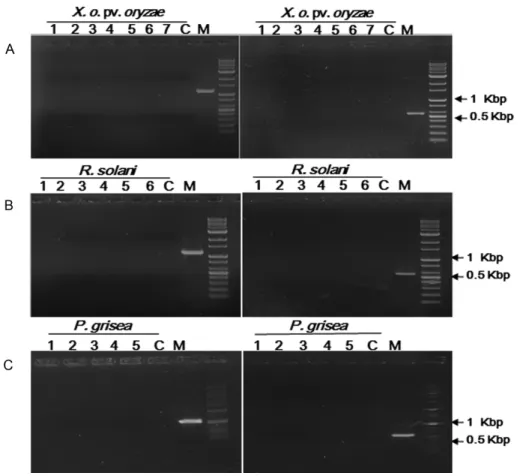
PCR conditions. The DNA amplification reactions were performed in volumes of 25 ml in a PTC100 thermocycler (Bio- Rad, USA). The primer sets, RV-F (5’-ATGGTGTCTGTGAGTG- GAATTC-3’) and RV-R (5’-CGTTATATGGCCACACTGC-3’), and BarF (5’-ATGAGCCCAGAACGACGCCCG-3’) and BarR (5’-TCA- GATCTCGGTGACGGGCAG-3’) were designed to specifically amplify 1,172 bp and 552 bp product by annealing to stilbene synthase and bar gene, respectively. The cycling conditions for PCR were as follows: preincubation at 95
oC for 5 min; 30 cycles consisting of dsDNA denaturation at 95
oC for 30 s, primer annealing at 60
oC for 30 s, primer extension at 72
oC for 30 s;
final elongation at 72
oC for 10 min. All amplification products
were resolved in 1% agarose gel and stained with ethidium bromide. The 1-KB plus DNA ladder (Invitrogen, USA) was used as molecular size marker.
Results and Discussion
Overview of disease occurrence in the field. In the pres- ent study, to compare the differences of disease resistance between transgenic rice and non-transgenic rice cultivars, we surveyed the incidence of rice diseases, such as bacterial grain rot (caused by Burkholderia glumae), bakanae disease (Fusarium moliniforme), brown spot (B. oryzae), sheath blight (R. solani), false smut (Ustilaginoidea virens), and leaf blast (P. grisea) from June to September in the confined rice filed for 2 consecutive years. The average temperature from June to August was 2-3
oC higher compared to climatological normal at both years. In ad- dition, because of frequent rainfall, the amount of precipitation at August in 2012 and July in 2013 was higher compared to cli- matological normal. Despite of the deviation from the normal, the climatic conditions during the survey period at Iksan have been considered optimal to survey the disease resistance of rice plants in the cultivated area.
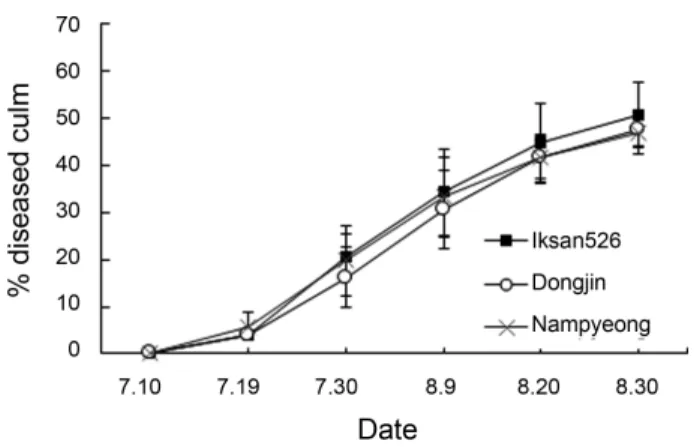
Diseases are considered as major constraints for rice produc- tion. Among the major diseases, bacterial grain rot, bacterial leaf blight, sheath blight, blast, and brown spot cause a significant loss in quality and quality of rice. Among them, sheath blight affects grain filling and panicle emergence, and about 28 to 30% yield reduction was estimated in susceptible cultivars. In this study, the percentage of infected culum was 50.7%, 47.6%, and 47.1% at August 30 in Iksan526, Dongjin, and Nampyeong, respectively (Fig. 1). In spite of application of fungicides which was conventional cultivation practice, the prevalent infection by R. solani at the vegetation stages has resulted from high
Fig. 1. Comparison of sheath blight occurrence between transgenic rice plant (Iksan526) and non-transgenic rice plants (Dongjin, Nampyeong).
The severity of the disease was surveyed at the confined field for the experiment of genetically modified plants in Iksan, 2012 and 2013.
The surveyed date was 7.10, 7.19 (7.20 in 2012), 7.30 (31), 8.9 (10),
8.20, and 8.30. The bars indicate standard deviations.
temperature and constant excessive relative humidity from July to August. The results of this study indicated no significant dif- ference in the periodical incidence and lesion length of sheath blight between transgenic and non-transgenic rice varieties.
The percentage of infected leaves by B. oryzae at September 10 was amount to 29.3%, 27.8%, and 19.0% in Iksan526, Dongjin, and Nampyeong, respectively (Fig. 2). There was no significant difference in the percentage of infected leaves between Ik- san526 and Dongjin which is the mother plant for the Iksan526.
However, Nampyeong showed significantly low infection ratio, which indicate that Nampyeong is more resistant to brown spot compared to Iksan526 and Dongjin. Overall, though the incidence of brown spot was too low (0.01-0.05%) to compare the difference of disease severity, the periodical incidence of brown spot showed similar pattern of increase between trans- genic variety Iksan526 and non-transgenic rice variety, Dongjin.
The average percentage of infected panicles by bacterial
grain rot at September 10 was lower than 4-5% in all surveyed cultivars (Table 1). Though the occurrence of bacterial grain rot was not severe, there was no difference in the disease sever- ity among the cultivars. In addition, leaf blast, false smut, and bakanae disease was in low amount without any differences among the varieties. The incidence of other diseases have not detected in all rice varieties.
Resveratrol inhibited conidial germination of Botrytis cinerea (Adrian et al., 1997) and exhibited inhibitory activities against Xylella fastidiosa (Maddox et al., 2010). In addition, the expres- sion of a stilbene synthase gene increased resistance to B.
cinerea in transgenic tobacco, barley, and wheat plants (Hain et al., 1993; Leckband and Lorz, 1998; Serazetdinova et al., 2005).
Furthermore, Stark-Lorenzen et al. (1997) reported that rice plants transformed with the grapevine stilbene synthase gene exhibited enhanced resistance against the rice blast pathogen P.
oryzae. However, in transformed tomato, the stilbene synthase gene did not enhance resistance against B. cinerea (Kobayashi et al., 2000). Considering the data, the results for resistance by transforming with stilbene synthase gene are variable. Hence, the activities in transgenic plants must be evaluated empirically.
The results of this field study indicated that there was no significant difference in the incidence and prevalence of the major diseases between transgenic rice variety and non- transgenic varieties. The results of this study indicated that the production of stilbene may not induce any changes of mecha- nisms to increase disease resistance.
Assay for possible horizontal gene transfer to pathogens.
Considering the possibility of horizontal gene transfer of ge- netic material from transgenic plants to microorganisms, much more favorable conditions could be encountered in plant tis- sues in which invading pathogens multiply actively (Bertolla et al., 1997, 2000; Gebhard and Smalla, 1998; Nielsen et al., 1997a, 1997b)). However, experimental evidence that horizontal gene transfer of genetic material from plants to pathogens can occur
Table 1. Disease incidence in the confined fields at Iksan during 2012 and 2013
Disease Survey
date
a% occurrence
Plants Culms Leaves (area) Panicles
Bacterial grain rot Sep. 10 <4-5% - - <0.5
Sheath blight Aug. 10(9) 90-100% 20-45% - -
Aug. 30 100% 45-55% <0.1%
Leaf blast Aug. 20 0-3% - 0 -
Brown spot Aug. 20 10-40% 1-15%
Sep. 10 55-100% 10-60% 2-35% -
False smut Sep. 10 <0.1 - - -
Bakanae disease Sep. 10 <0.1 - - -
a
The occurrence of the disease was surveyed at the confined field from June to September in Iksan, Korea, 2012 and 2013. Disease severities at the representative dates for each disease are shown at here. The dates for survey in 2013 are designated in parenthesis.
b