DOI 10.17480/psk.2018.62.3.195
Candida albicans 기인성 뇌감염에 대한 로즈마리 정유의 항진균효과
한용문#·유정임
동덕여자대학교 약학대학 면역·미생물학교실
(Received March 30, 2018; Revised June 25, 2018; Accepted June 27, 2018)
Antifungal Effect of Rosemary Essential Oil against Brain Infection due to Candida albicans
Yongmoon Han and Zheong-Imm Rhew
Department of ImmunoMicrobiology College of Pharmacy, Dongduk Women's University
Abstract — Recently, the number of cases of fungal brain infections has been rising caused by Candida albicans. In this present study, we determined effect of rosemary essential oil (REO) against fungal brain infection due to C. albicans. In experiments, REO extract contained of α-pinene, β-pinene, 1,8-cineole, camphor, and verbenone as main essential oils as analyzed by GC-MS. The REO inhibited C. albicans growth under in-vitro condition. This antifungal activity was dose dependent. Thus, REO was then assessed in the animal model of brain infection. BALB/c mice were pre-treated intra- peritoneally with anti-CD4 mAb. Forty-eight hours later, the mice were infected intravenously with C. albicans (Day 1) and these animals received REO every other day for 3 times (Day 1, 3, & 5). At Day 12, their brains were harvested and CFU (colony forming units) values in the brains were measured. Results showed that REO treatment reduced CFU values up to approx. 65% when compared to CFU values of control mice (P < 0.01). Similarly, the REO treatment improved whirling motion in mice, which served as an indicator for the presence of a brain infection. Amphotericin B, a positive control, had similar activity as REO. Therefore, our observations indicate that REO appears to be effective against fungal brain infections caused by C. albicans.
Keywords rosemary essential oil, C. albicans, antifungal, anti-CD4 mAb, murine model of brain infection, amphotericin B
다양한 허브추출물과 정유(essential oil)는 화장수와 샴푸제조 에 주요한 첨가물로 사용되며, 혈액순환과 기분전환을 보조하는 대체의약품으로서 활용되어 왔다. 최근에는 허브에 함유된 성분 들의 약물학적 효능을 조사하기 위한 다양한 연구도 진행되고 있 다. 이러한 연구추세에 따라, 본 연구실에서도 허브의 약물효능 에 관한 연구를 진행하였고, 그 연구결과로 카모마일이 Candida albicans 진균 기인성 관절염에 치료효과가 있음을 학회에 보고 한 바 있다.1)이 연구에서 로즈마리 또한 그 정도는 매우 미미 하지만 관절염에 효과가 있음이 확인되었고, 더불어 항진균효과
의 가능성도 예견되었다. 로즈마리(Rosmarinus officinalis)는 꿀 풀과(Labiatae)에 속하는 다년생 약용식물로 원산지는 지중해 지 역이지만, 현재는 전 세계에 분포되어 있다.2,3)전통적으로 로즈 마리는 식음료의 향신료로 많이 사용되어 왔으며, 요즘에는 대 체의약품으로서 소화불량, 속쓰림과 같은 위장관계 질환과,4)경 련성 신장염,5)그리고 쓸개급성통증6) 등에 사용된다. 로즈마리의 약물학적 효능에 관한 최근의 연구 결과에 따르면 진통효과,7)항 염효과,7-9)항산화효과10,11), 항종양효과,12)항궤양효과,13,14)항세
균효과,15,16) 그리고 간보호작용17)등 다양한 효과가 규명되었다.
하지만, 아직까지 로즈마리의 항진균효과에 대한 구체적인 연구 결과는 알려진 바가 없으며, 더욱이 진균 기인성 뇌감염에 대한 효과 연구는 전무하다.
미국국립보건연구소의 발표에 의하면, C. albicans는 원내 감 염 원인균으로서 병원성 세균 및 진균을 총 망라해서는 4위를, 병원성 진균으로는 1위를 차지하는 균이다.18-19)특히, 당뇨병과 같은 소모성질환자와 암환자에게는 생명을 위협하는 치명적인
#
Corresponding Author Yongmoon Han
Department of ImmunoMicrobiology College of Pharmacy, Dong- duk Women's University Seoul 136-714, Korea
Tel.: 02-940-4521 Fax.: 02-940-4195
E-mail: [email protected]
Short Report
종설균이다.17-19)뿐만 아니라 건강한 여성에게도 질감염을 유발하여 세계 전체 여성의 70% 이상이 일생에 한번은 C. albicans 기인 성 질감염의 경험이 있다고 한다.22,23)또한, 최근에는 신생아들 에게 혈행 캔디다 뇌막성뇌염(HCME, hematogenous Candida meningoencephalitis)을 유발하여 정신박약, 간질, 중추신경장애 등을 초래하고 사망률 또한 매우 높다.24-26)현재 임상에서 HCME 치료를 위해 광범위 항진균제인 amphotericin B를 주로 적용하 지만 이 항진균제의 신장독성 부작용과 낮은 뇌혈관장벽(brain- blood barrier) 투과성 때문에 치료에 제한이 있다.27,28) 그러므로 진균 뇌감염 치료에 적합한, 부작용이 적은 새로운 약물의 개발 이 필요하다.
이에, 본 연구에서는 REO의 C. albicans 기인성 뇌감염에 대 한 효과를 조사하였다. 먼저, REO를 로즈마리 잎에서 추출-분리 하여 함유된 정유의 종류을 GC-MS 방법으로 분석하였고, 이 REO의 항진균효과를 검색하였다. 그 검색결과를 바탕으로, C.
albicans 기인성 뇌감염에 대한 REO의 효능을 동물모델에서 평 가하였다. 본 연구실에서 고안한 이 동물모델은 항CD4 단항체 를 사용하여 면역력을 저하시킨 동물(생쥐)에 진균의 숫자를 조 절하여 접종함으로써 일정한 관측기간 안에 뇌감염이 유발되도 록 하였다. 이 모든 연구결과를 통해서 REO의 진균성 뇌감염에 대한 항진균효과를 제시하였다.
재료 및 실험방법
C. albicans 및 배양조건
본 연구실의 기 연구에서 특성이 규명된 C. albicans CA-1 균
주29,30)를 본 연구에 사용하였다. 배양조건은 기 연구에서 사용한
동일한 방법을 적용하였다.31) GYEP (glucose - yeast extract - peptone) 액체배지에 배양된 C. albicans 세포는 인산완충용액 (DPBS; Dulbecco's phosphate-buffered saline solution, Sigma, St. Louis, Mo, USA)으로 3회 세척하고, hemocytometer로 세 포수를 계수한 후 DPBS (pH = 7.4)에 희석하여 사용하였다.
실험동물
본 실험에서는 6 주령의 BALB/c 암컷 생쥐를 중앙실험동물(주) 에서 구입하여, 본 대학교의 동물사용윤리규정에 근거해 사용하 였다(허가번호: 동덕#2016). 구입한 생쥐는 공기여과장치가 완 비된 동물사육실 안에서 1주일간 적응시킨 후 사용하였다. 그리 고 멸균된 사료와 물은 자유롭게 먹게 하였다. 사육실의 환경은 온도 20±2oC, 상대습도는 50±10%로 유지하고 조명은 12시간 간격으로 주야를 조절하였다.
로즈마리 정유(rosemary essential oil, REO)
로즈마리는 경동약령시장에서 구입하였으며, 로즈마리에서의
정유추출은 타 연구자가 사용한 기법을 이용하였다.31)이 방법 을 간략히 기술하면, 건조한 로즈마리 잎 200 g을 가루로 분쇄한 다음에 추출용 유리 플라스크에 넣고 3시간 동안 수증기증류법 으로 REO를 분리 수집하였다. 이 REO에 함유된 정유 종류를 검색하기 위해 GC-MS 기법으로 분석하였다.
GC-MS(gas chromatography-mass spectroscopy)에 의 한 REO 분석
본 GC-MS 분석은 5% PHME siloxane HP-5MS capillary column (30 m×0.25 mm; film thickness 0.25 μm)으로 교차 연 결된 가스 chromatograph (Hewlett Packard 6890)을 사용하였 으며, 검출기는 Hewlett Packard 6890 MS를 사용하였다. 작동 조건은 유속 2 ml/min; 컬럼 온도 60-275oC; 주입 및 검출은 280oC; 검체물(REO) 주입부피는 0.1 μl 이었다. MS의 작동은 이 온화 전위는 70 eV, 이온화 전류는 2 A, 그리고 이온화 온도는 200oC 조건하에서 시행하였다.
항진균효과 검색
C. albicans에 대한 REO의 항진균효과의 검색은 본 연구실의 기 연구에서 사용한 액체배지희석법에 의한 감수성시험을 시행하였 다.32) 이 시험법에서는96 well plate에 RPMI 1640 medium (RPMI)으로 희석한 C. albicans 세포를 각 well에 100 μl씩 접종하 고, RPMI에 Tween 80(Sigma; 최종농도 = 0.2%)을 첨가한 용액으 로 순차적으로 희석한 REO을 지정된 well에 첨가한 뒤 37oC, 5%- CO₂배양기(Vision Scientific Co, Korea)에서 배양하였다. REO의 시험농도는 10, 20, 40 μg/ml 이었다. 배양 후, 각 well의 배양액 일 정량을 수거하여 계대희석한 다음, GYEP 고형배지에 pour plating 방법으로 접종, 배양하였다. 생성된 colony forming unit (CFU)을 계측하여 음성대조군에서 생성된 CFU 숫자와의 비교를 통해 항 진균효과를 측정하였다. 양성대조군으로는 amphotericin B(Sigma) 를 사용하였고, 사용농도는 5 μg/ml 이었다.
C. albicans 기인성 뇌감염 동물모델 고안 및 뇌감염에 대한 REO 효과검색
진균 감염 시, T 임파구의 역할은 매우 중요하다. 즉, T 임파 구 -CD4+T와 CD8+T-의 증식을 통해서 항균효과가 있는 IFN- γ의 생성을 증진시킬 수 있다.33-35)그러므로, T 임파구의 부재 또는 감소로 인해 면역력이 저하된 상태에서 감염이 발생하면 뇌 에서 진균의 성장이 증가하게 된다.33)이러한 문헌고찰을 통해 서 본 연구에서는 실험동물(생쥐)의 면역력을 약화한 후에 C.
albicans를 정맥으로 감염시켜 뇌감염을 유발하는 방법을 고안하 였다. 이와같이 고안된 방법에서 REO의 뇌감염에 대한 효과를 검색하였다. 즉, 6 주령의 BALB/c 암컷생쥐에게 DPBS로 희석 한 1.5 mg/ml 농도의 항CD4 단항체(Ligocyte, Montana, USA)
200μl(=300 μg 항CD4 단항체/mouse)를 복강경로로 투여하고, 48시간 후에 이들 생쥐에게 C. albicans (1×10⁵ yeast cells/
200μl/mouse)를 꼬리정맥으로 접종하였다. 진균 접종 직후에, 2.5 mg/ml 농도로 제조된 REO 200 μl(=0.5 mg REO/mouse)를 이들 생쥐의 복강으로 주사하고(Day 1), 이틀 간격으로 2회 REO 를 추가 접종하였다(Day 3, 5). REO 주사제는 Tween 80(최종 농도 0.2%)를 혼합한 DPBS(DPBS-T)에 REO를 첨가하여 제조 하였다. 양성대조군의 생쥐들에게는 REO 대신에 AMB(20 μg/
mouse)를 주사하였고, 음성대조군의 생쥐들에게는 동일용량의 DPBS-T 용액만을 주사하였다. 관찰기간 12일째에 생쥐들의 몸 통회전여부를 기록하고 이들 생쥐의 뇌를 적출하여 1 ml의 DPBS 가 담긴 유리 동질기(glass homogenizer, Wheaton, Millville, NJ)에 넣고 분쇄-균질화하였다. 뇌균질액 100 μl를 계대희석하여 GYEP 고형배지에 접종하고 24 시간 배양한 후, CFU 숫자를 계 측하여 약물(예: REO)투여군과 비투여군(음성대조군)의 CFU 수 치 차이에 따라 REO의 효능여부를 평가하였다. 또한, 남은 뇌균 질액의 일부를 취하여 wet-mounting 기법으로 명시야 현미경 (bright microscope, Nikon, Japan) 하에서 C. albicans의 존재여 부를 확인하였다.
통계
실험결과는 평균±표준오차로 계산하였으며 각 실험군 간의 유 의성 검증은 Student's t-test를 사용하였다. P 값이 5% 미만일 때 유의성이 있는 것으로 판정하였다.
실험 결과
REO에 함유된 정유
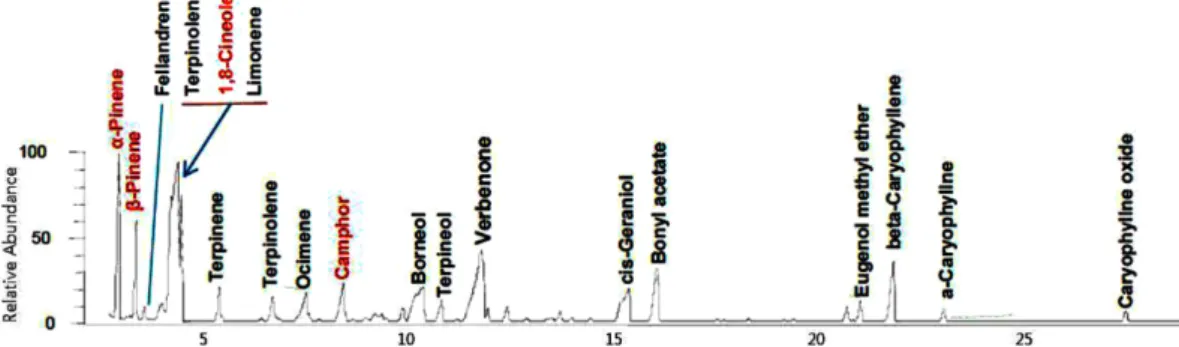
GC-MS 분석결과에 의하면, REO에 함유된 주요 정유 성분으 로는 α-pinene, β-pinene, 1,8-cineole, camphor, verbenone 등 이 검색되었다(Fig. 1). 그리고 1,8-cineole, terpinolene, 그리고 limonene이 거의 단일 peak로 합쳐져 REO에 가장 많이 함유된
정유성분으로 확인되었다(Fig. 1). REO에 함유된 정유성분의 구 성물은 타 연구자가 다른 여러 국가에서 제조·판매되는 로즈마 리 정유를 분석한 데이터와 유사하였다.2)
REO의 항진균효과, in-vitro
REO의 항진균효과를 in-vitro 실험조건에서 검색한 결과, C.
albicans 세포를 REO로 처리한 실험군의 CFU 수치가 REO로
Fig. 1 − Fingerprints of rosemary essential oil (REO) extracted from the air-dried rosemary (Rosemarinus officinalis) leaves by hydrodistillation. The GC-MS analysis of the REO displayed the presence of various types of essential oils. The major essential oils in REO appears to be α-pinene, β-pinene, 1,8-cineole, camphor, and verbenone.
Fig. 2 − The REO resulted in the inhibition of C. albicans growth
as determined by in-vitro susceptibility test. Compared to
the negative control that received no REO ( *), at 40 μg/ml
(#) had CFU values that were 82.2% lower (P < 0.01). This
growth-inhibitory activity was dose-dependent. These
results demonstrate that REO has antifungal activity. The
antifungal activity of REO was much less effective than
that of AMB at 5 μg/ml. This experiment was done three
times. REO, rosemary essential oil; AMB, amphotericin
B; Bars, S.E.
비처리된 음성대조군의 CFU 수치에 비해서 농도의존적으로 감 소하였다(Fig. 2). 일예로, 40 μg REO/ml 농도(#)에서 검색된 항 진균효과를 음성대조군(*)과 견주어 보았을 때, CFU 수치가 약 82.2% 감소하였다(P < 0.01) (Fig. 2). 하지만, 양성대조군으로 사용된 amphotericin B(AMB)의 항진균효과와 비교하면, REO 의 항진균효과는 농도를 고려하였을 때 상대적으로 매우 저조하 였다(Fig. 2).
C. albicans 기인성 뇌감염 동물모델 평가
정상 생쥐에게 항CD4 단항체를 투여하여 면역력을 감소시킨 다음 C. albicans로 전신감염을 일으켜 일정한 기간 안에 뇌감염 이 유발될 수 있도록 하는 적정한 수효의 진균 감염농도를 설정 하기 위하여 반복 실험을 실시하였다. 그 결과, 진균의 수효가 지 나칠 경우에는 실험동물들이 급사하여 후속실험이 어려운 반면 에 수효가 너무 적은 경우에는 뇌감염 유도까지의 관측기간이 2 개월 이상 장기화되는 경향이 있었다. 이러한 반복된 실험을 통 해서 선택된 적절한 균주의 수효는 1×10⁵ C. albicans yeast cells/mouse 이었다. 이 수효의 균주로 실험동물(생쥐)을 감염시 킨 후 10일~14일의 관측 기간 사이에 생쥐의 꼬리를 잡고 공중 으로 들어 올리면 생쥐 스스로가 몸통회전을 하는 등의 이상행 동이 관찰되었다. 이때, 이들 생쥐에서 적출한 뇌의 분쇄-균질액 을 현미경으로 검색하였을 때 C. albicans 가 관측되었다(Fig. 3).
이에, 본 연구에서 고안한 동물모델에서 생쥐의 몸통회전 여부 를 통해 생쥐의 뇌가 C. albicans로 감염되었음을 확인할 수 있 었다.
C. albicans 기인성 뇌감염에 대한 REO의 효능
본 연구에서는 항CD4 단항체로 면역력을 저하시킨 생쥐를 사 용한 뇌감염 동물모델에서 REO효능을 검색하였다. 먼저, CFU 수치 비교에 따른 REO의 효과검색을 위해 뇌를 적출하기 직전
(= 관측 12일째)에 각 그룹 생쥐들의 몸통회전 여부를 측정하였 다. 그 결과, 음성대조군의 모든 생쥐(7 마리)는 몸통회전(body whirling motion)을 한 반면에, REO 또는 AMB를 투여 받은 그 룹에서는 각각 2 마리와 1 마리만이 몸통회전을 하였다(Table 1).
CFU 수치 감소 여부에 따른 REO 효과 평가에서, 음성대조군(*) 에서 측정된 CFU수치[50.7(평균)±2.9(S.E.) CFU/ml]와 REO를 투여 받은 실험군(#)의 CFU수치[(17.7±2.1) CFU/ml]를 비교할
Fig. 3 − Microscopic examination confirms the presence of C. albicans
in a homogenized brains of mice. The liquid portion of a homogenized brain of a C. albicans-infected mouse examined under a microscope. Note that the arrow indicates the budding of C. albicans. Scale bar, 10 μm
Table I − REO may prevent the whirling motion by inhibiting growth of C. albicans in the brain
Treatments Numbers of whirling mice/
Numbers of total test mice
REO
*1-untreated 7/7
REO-treated 2/7
AMB
*2-treated 1/7
Note:
*1rosemary essential oil;
*2amphotericin B used as a positive control
Fig. 4 − REO treatment reduced of severity of the fungal brain infection due to C. albicans. There was a significant reduction (approx. 65%) of the CFU values [(17.7±2.1) CFU/ml]
(mean±S.E.) when compared to CFU values [(50.7±2.9) CFU/ml] of REO-untreated mice (** P < 0.01). The AMB- treated mice group, used as a positive control, also had lower CFU values than the negative control group.
However, AMB appeared to be more potent than REO.
Thus, these data indicate that REO has an effective antifungal activity against fungal brain infections as does AMB. Each group contained 7 mice. AMB, amphotericin B;
Bar, S.E. This experiment was repeated three times.
때, 약 65% 이상의 CFU 수치가 감소하였다(P<0.01) (Fig. 4).
AMB 처리군(양성대조군)에서도 음성대조군에 비해서 CFU의 감 소가 있었으며, 이 감소효과는 REO보다 더 우수하였다(P<0.01) (Fig. 4).
고찰 및 결론
면역력이 결핍되기 쉬운 만성질환자, 암환자, 노인 인구 등의 증가로 인하여 병원균 감염에 대한 대처가 매우 중요한 이슈 (issue)가 되고 있다. 특히, 최근에는 세균감염증 못지않게 진균 감염증 문제가 심각하게 대두되고 있으며, 조산아를 포함한 신 생아에서의 진균감염 또한 새로운 문제로 부각되고 있다. 문제 를 야기하는 대표적 진균으로는 C. albicans를 손꼽을 수 있다.
C. albicans 기인성 뇌감염 치료에는 amphotericin B가 선택적 항진균제로 사용되고 있지만, 이 항진균제는 약물투과성이 매우 저조하며 신독성을 유발한다는 단점(부작용)이 있다.24-26,27)이에, 새로운 항진균제로서 뇌감염에 효능이 있는 약제의 개발이 필요 하다. 이런 관점에서, 항진균효과가 있는 천연성분의 발견은 매 우 중요하게 간주되고 있다. 이에 본 연구실에서는 15년여간 약 용식물에서 항진균 효능이 있는 성분을 조사하는 과정에서, 강 력한 향을 통해 뇌의 활동력을 높여준다고 알려진 로즈마리2)에 대해 조사한 바 있다.
본 연구에서는 수증기증류법을 이용하여 로즈마리에서 직접 정유를 추출-분리하였다. 분리한 로즈마리 정유(REO)를 분석한 결과, 가장 많이 포함된 성분으로 α-pinene과 1,8-cineole이 확 인되었다. 이 결과는 프랑스산, 스페인산, 그리고 호주산 로즈마 리 정유에 함유된 성분의 분포도와 거의 유사하였다(our unpublished data). 타 연구자의 보고에 의하면 α-pinene와 g- terpinene 성분이 C. albicans에 대한 항진균효과를 보고한 바가 있다.36)그 다음으로 분리한 REO의 항진균효과를 in-vitro 조건 하에서 조사하고자 하였다. 고형배지에서 확산법을 통해 REO의 항진균효과를 검색하는 초기 실험에서 탁월한 항진균효과가 확 인되어(our unpublished data), 이에 사용농도에 따른 효과를 좀 더 세밀하게 조사하기 위해서 액체배지희석법을 시행하였다. 확 산법에서 관측되었듯이 REO는 C. albicans 성장 억제에 매우 우 수한 효과 있음을 확인할 수 있었다.
그 다음 단계로, REO의 이러한 항진균효과가 과연 C. albicans 기인성 뇌감염에도 효과가 있는지 여부를 뇌감염 동물모델을 통 해 확인하고자 하였다. 뇌감염을 유도하기 위해 시험동물(토끼) 의 뇌 속으로 진균을 주사하는 방법25)을 문헌조사를 통해 확인 하였으나, 진균 감염시 뇌에 직접 감염되는 경우는 매우 드물다 는 사실에 비추어 볼 때 이것은 지나치게 인위적인 접종경로로 사료되어 본 연구에서는 C. albicans 뇌감염 동물모델을 새롭게 고안하였다. 본 동물모델에서는 생쥐에 항CD4 단항체를 투여해
서 면역력을 저하시킨 다음, 본 진균을 정맥주사하여 전심감염 을 유도한 후 뇌감염으로 이행시키는 방법을 택하였다. 이때 가 장 중요한 점은 감염균주의 숫자인데, 숫자가 너무 많으면 뇌감 염으로 이행되기 전에 다른 장기의 손상으로 동물들이 급속히 죽 게 되고, 반대로 균주의 숫자가 너무 적으면 뇌감염 유도에 2개 월 이상의 장시간이 소요되는 단점이 있었다. 반복된 실험을 통 해서 적정 균주의 농도를 규명하였으며, 이러한 실험 조건하에 서는 생쥐의 뇌감염이 2주 이내에 발생하였고, 이 때 생쥐들의 이상 행동 또한 목격되었다. 이는, 생쥐들의 꼬리를 잡고 공중으 로 들어 올리면 생쥐 스스로가 몸통회전을 하는 것인데, 아마도 뇌에서 생성된 염증과 압박으로 인한 통증에 의한 것으로 추정 된다. 이때, 뇌를 적출하여 C. albicans의 존재를 현미경을 통해 확인 시 모든 검체에서 100% 본 진균이 검색되어, 생쥐의 이상 행동(whirling motion)은 뇌감염의 지표로 간주될 수 있을 것으 로 판단되었다. 이 동물모델에서 REO를 투여했을 때, 뇌 속에서 C. albicans 균주가 음성대조군에 비해 감소하였고, 이 관측은 진 균성 뇌감염 치료에 가장 빈번하게 사용하는 amphotericin B의 효능과 유사하다는 점에서 매우 고무적이었다.
결론적으로, 본 연구에서는 진균 기인성 뇌감염 동물모델을 새 롭게 고안했으며, 이 동물모델에서 REO가 뇌감염에 대한 항진균 효과가 있음을 규명하였다. 본 연구의 이러한 결과는 최초의 연 구로 사료된다. REO에 함유된 다양한 정유들 중에서 어떤 성분 이 본 효과를 발현하는지는 앞으로 추가연구가 더 필요할 것이다.
감사의 말씀
이 논문은 2018년도 동덕여자대학교 학술연구비 지원에 의하 여 수행된 것으로 이에 감사드립니다. REO를 제공해주신 서울 대학교 약학대학 김영식 교수님께 감사를 표합니다.
References
1) Kim, J. H., Kim, S. Y., Hong, Y. N., Kim, Y. S. and Han, Y. : Effect of Chamomile Flower Extract on Septic Arthritis due to Candida albicans. Yakhak Hoeji. 58, 343 (2014).
2) Woo, J. H., Mok, M. G., Han, K. W., Lee, S. Y. and Park, K. W. : Aroma components and antioxidant activities of pure rosemary essential oil goods produced in different countries. kor. T. Hort.
Sci. Technol. 28, 696 (2010).
3) Iranian Ministry of Health & Medical Education Publications, Iranian herbal pharmacopeia scientific committee : Iranian herbal pharmacopeia, Rosemary (Rosmarinus officinalis L.).
334 (2002).
4) Al-Sereitia, M. R., Abu-Amerb, K. M. and Sena, P. : Pharmacology of rosemary (Rosmarinus officinalis Linn.) and its
therapeutic potentials. Indian J Exp Biol. 37, 124 (1999).
5) Gilani, A. H. and Rahman, A. U. : Trends in ethnopharmacology.
J Ethnopharmacol. 100, 43 (2005).
6) Nusier, M. K., Bataineh, H. N. and Daradkah, H. M. : Adverse effects of rosemary (Rosmarinus officinalis) on reproductive function in adult male rats. Exp Biol Med. 232, 809 (2007).
7) Takaki, I., Bersani-Amado, L. E., Vendroscolo, A., Sartoretto, S.
M., Diniz, S. P., Bersani-Amado, C. A. and Cuman, R. K. N. : Anti-inflammatory and antinociceptive effects of Rosmarinus officinalis L. essential oil in experimental animal models. J Med Food. 11, 741 (2008).
8) Minaiyan, M., Ghannadi, A. R., Afsharipour, M. and Mahzouni, P. : Effects of extract and essential oil of Rosmarinus officinalis L. on TNBS-induced colitis in rats. Res Pharm Sci. 6, 13 (2011).
9) Altinier, G., Sosa, S., Aquino, R. P., Mencherini, T., Della Loggia, R. and Tubaro, A. : Characterization of topical anti- inflammatory compounds in Rosmarinus officinalis L. J Agric Food Chem. 55, 1718 (2007).
10) Inatani, R., Nakatani, N. and Fuwa, H. : Antioxidative effect of the constituents of rosemary (Rosmarinus officinalis) and their derivatives. Agric Biol Cehm. 47, 521 (1983).
11) Stefanovits-Banyai, E., Tulok, M. H., Hegedus, A., Renner, C.
and Varga, I. S. : Antioxidant effect of various rosemary (Rosmarinus officinalis L.) clones. Acta Biol Szeged. 47, 111 (2003).
12) Cheung, S. and Tai, J. : Anti-proliferative and antioxidant properties of Rosmarinus officinalis. Oncol Rep. 17, 1525 (2007).
13) Dias, P. C., Foglio, M. A., Possenti, A. and Carvalho, J. E. : Antiulcerogenic activity of crude hydroalcoholic extract of Rosmarinus officinalis L. J Ethnopharmacol. 69, 57 (2000).
14) Alkofahi, A. and Atta, A. H. : Pharmacological screening of the anti-ulcerogenic effects of some Jordanian medicinal plants in rats. J Ethnopharmacol. 67, 341 (1999).
15) Oluwatuy, M., Kaatz, G. W. and Gibbons, S. : Antibacterial and resistance modifying activity of Rosmarinus officinalis.
Phytochemistry. 65, 3249 (2004).
16) Ghannadi, A., Sajjadi, S. E., Abedi, D., Yousefi, J. and Daraei- Ardekani, R. : The in vitro activity of seven Iranian plants of the Lamiaceae family against Helicobacter pylori. Niger J Nat Prod Med. 8, 40 (2004).
17) Galistco, M., Suarez, A., Del Pilar Montilla, M., Del Pilar Utrilla, M., Jimenez, J., Gil, A., Faus, M. J. and Navarro, M. C. : Antihepatotoxic activity of Rosmarinus tomentosus in a model of acute hepatic damage induced by thioacetamide. Phytother Res.
14, 522 (2000).
18) Schaberg, D. R., Culver, D. H. and Gaynes, R. P. : Major trends in the microbial etiology of nosocomial infection. Am. J. Med.
16, 72 (1991).
19) Edwards, J. E. : Invasive Candida infections - Evolution of a fungal pathogen. N. Engl. J. Med. 324, 1060 (1991).
20) Gow, N. A., Brown, A. J. and Odds, F. C. : Fungal morphogenesis and host invasion. Curr. Opin. Microbiol. 5, 366 (2002).
21) Bodey, G. P. : The emergence of fungi as major hospital pathogens. J. Hosp. Infect. 11, 411 (1988).
22) Sobel, J. D. : Epidemiology and pathogenesis of recurrent vulvovaginal candidiasis. Am. J. Obstet. Gynecol. 152, 924 (1985).
23) Sobel, J. D. : Pathogenesis and epidemiology of vulvovaginal candidiasis. Ann. N. Y. Acad. Sci. 544, 547 (1988).
24) Benjamin, D. K., Poole, J. C., Steinbach, W. J., Rowen, J. L. and Walsh, T. J. : Neonatal candidemia and end-organ damage: a critical appraisal of the literature using meta-analytic techniques. Pediatrics. 112, 634 (2003).
25) Petraitiene, R., Petraitis, V., Hope, W. W., Mickiene, D., Kelaher, A. M., Murray, H. A., Mya-San, C., Hughes, J. E., Cotton, M. P., Bacher, J. and Walsh, T. J. : Cerebrospinal fluid and plasma (1-->3)-beta-D-glucan as surrogate markers for detection and monitoring of therapeutic response in experimental hematogenous Candida meningoencephalitis.
Antimicrob. Agents Chemother. 52, 1421 (2008).
26) Benjamin, D. K., Stoll, B. J., Fanaroff, A. A., McDonald, S. A., Oh, W., Higgins, R. D., Duara, S., Poole, K., Laptook, A. and Goldberg, R. : Neonatal candidiasis among extremely low birth weight infants: risk factors, mortality rates, and neurodevelopmental outcomes at 18 to 22 months. Pediatrics. 117, 84 (2006).
27) Goldman, R. D., Ong, M., Wolpin, J., Doyle, J., Parshuram, C.
and Koren, G. : Pharmacological risk factors for amphotericin B nephrotoxicity in children. J. Clin. Pharmacol. 47, 1049 (2007).
28) Groll, A. H., Giri, N., Petraitis, V., Petraitiene, R., Candelario, M., Bacher, J. S., Piscitelli, S. C. and Walsh, T. J. : Comparative efficacy and distribution of lipid formulations of amphotericin B in experimental Candida albicans infection of the central nervous system. J. Infect. Dis. 182, 274 (2000).
29) Han, Y. and Cutler, J. E. : Antibody response that protects against disseminated candidiasis. Infect. Immun. 63, 2714 (1995).
30) Han, Y., Morrison, R. P. and Cutler, J. E. : A vaccine and monoclonal antibodies that enhance mouse resistance to Candida albicans vaginal infection. Infect. Immun. 66, 5771 (1998).
31) Ghannadi, A. R., Sajjadi, S. E. and Beigihassan, A. : Composition of the essential oil of Ferula ovina (Bioss.) Bioss. from Iran.
DARU J. Pharm. Sci. 10, 165 (2002).
32) Han, Y. and Lee, J. H. : Berberine synergy with amphotericin B against disseminated candidiasis in mice. Biol. Pharm. Bull.
28, 541 (2005).
33) Pietrella, D., Lupo, P., Perito, S., Mosci, P., Bistoni, F. and Vecchiarelli, A. : Disruption of CD40/CD40L interaction influences the course of Cryptococcus neoformans infection.
FEMS Immunol Med Microbiol. 40, 63 (2004).
34) Grewal, I. S. and Flavell, R. A. : CD40 and CD154 in cell- mediated immunity. Annu. Rev. Immunol. 16, 111 (1998).
35) Subauste, C. S., Wessendarp, M., Sorensen, R. U. and Leiva, L.
E. : CD40-CD40 ligand interaction is central to cell-mediated immunity against Toxoplasma gondii: patients with hyper IgM
syndrome have a defective type 1 immune response that can be restored by soluble CD40 ligand trimer. J. Immunol. 162, 6690 (1999).
36) Rivera-Yañez. C. R., Terrazas, L. I., Jimenez-Estrada, M., Campos, J.
E., Flores-Ortiz, C. M., Hernandez, L. B., Cruz-Sanchez, T., Garrido- Fariña, G. I., Rodriguez-Monroy, M. A., and Canales-Martinez, M. M.
: Anti-Candida Activity of Burseramorelensis Ramirez Essential Oil and Two Compounds, α-Pinene and γ-Terpinene-An In Vitro Study.
Molecules. 5, 22 (2017).