DOI 10.17480/psk.2021.65.1.17
종 설(Review)
Strain, Age, and Gender Differences in Response to Lipopolysaccharide (LPS) Animal Model of Sepsis in Mice
Ivan Gahima*
,†, Eric Twizeyimana*
,†, Edson LuckGonzales*, Chilly Gay Remonde*, Se Jin Jeon*, and Chan Young Shin*
,#*School of Medicine and Center for Neuroscience Research, Konkuk University
(Received October 16, 2020; Revised December 10, 2020; Accepted January 21, 2021)
Abstract Sepsis is an excessive and irregular host response against existing infection, wherein pathogen invasion is primarily responsible for the resulting damage. However, sepsis-related damage is substantially caused by excessive uncontrolled host response. The purpose of this study was to investigate the differences in immune response based on the strain, age, and sex of mice by examining the survival rate and latency following immune challenge. The results showed that there was no significant difference between strains (ICR and C57BL6) following lipopolysaccharide (LPS) treatment.
Adolescent male mice (8 weeks old) had a higher survival rate and longer latency to death compared to those of adult mice (13 weeks old) following LPS treatment. Moreover, the onset of death in adolescent mice occurred substantially later compared to that in adult mice. Females displayed longer latency to death and higher survival rates compared to their male counterparts following immune challenge. Thus, the differences in survival rate and latency between young and adult mice and between male and female might contribute to age- and sex-specific adaptive host immunity, respectively. Our findings highlight the importance of considering the age, sex and strain of animals in experimental models of sepsis and provide a rationale to evaluate susceptibility in specific designs of sepsis immunotherapy. The clinical relevance of this study awaits further studies.
Keywords Lipopolysaccharides, Sepsis, Survivability, Gender, Age
Introduction
Sepsis is defined as a systemic inflammatory response to infection and found in 10 of 1000 hospitalized patients. Approximately 30% of these patients develop multiple organ dysfunction syndromes, mortality is observed in 20% of sepsis patients and 60-80% of patients with septic shock. In terms of host response, sepsis is defined as the excessive and irregular response of the host against an existing infection. Systemic inflammatory response syndrome (SIRS), wherein excessive pro-inflammatory conditions occur at the beginning, is followed by compensatory anti- inflammatory response syndrome (CARS), wherein excessive anti- inflammatory conditions occur. While SIRS results in shock-based mortality, immunosuppression in the advanced phase of CARS and sepsis leads to mortality due to secondary lethal infections.
For many years, pathogen invasion is believed to be responsible for the damage resulting from sepsis. However, it is evident that this damage is substantially caused by excessive uncontrolled host response.
1)Researchers have worked intensively to develop effective treatment regimens for sepsis. This process depends heavily on experimental animal models,
2)and various types of animals, including rodents such as mice and rats and larger animals like rabbits, have been used for these experiments. Among these, mice have been most commonly used in animal models because of advantages such as genomic similarities with human.
3)To ensure the ease and reproducibility of experiments, genetically identical mice have been produced, and different mouse strains with genetic modifications have been generated.
4)Because each mouse strain has unique biological characteristics, using only one to establish a model may lead to inaccurate experimental conclusions or interpretations. Therefore, it is important for researchers to carefully choose the proper mouse model to fulfill the purpose of their study.
5)In sepsis, bacterial products such as lipopolysaccharide (LPS) from gram-negative bacteria, peptidoglycans and lipoteichoic acid from gram-positive bacteria, lipoarabinomannan from mycobacteria,
†
These authors equally contributed to this work.
#
Corresponding author
Chan Young Shin, Ph.D., School of Medicine, Konkuk University, NeungDong-Ro 120, Gwangjin-Gu, Seoul, Republic of Korea Tel: +82-2-454-5630, Fax: +82-2-2030-7899
E-mail: [email protected]
fungal antigens, and prokaryotic DNA enter blood circulation and initiate an immune response.
1)Recent findings suggest that differences in acute stress and immune response between young and adult male and female mice can provide mechanistic insight into the enduring behavioral alterations following LPS exposure.
6)While LPS treatment increased the serum concentration of corticosterone in all young and adult male and female mice, adult females showed the highest increase two hours after treatment. Exposure to LPS also resulted in an increase in c-Fos expression in many brain regions in adult mice but not in young mice two hours following LPS treatment.
6)Furthermore, senescent mice went more sensitive to LPS lethality and produced significantly elevated plasma levels of tumor necrosis factor (TNF)-α, IL-1α, and IL-6 in comparison to young mice.
7)Similarly, middle-aged mice displayed exaggerated peripheral and central immune responses for TNFα, IL-6, and IL- 1β production in their microglia and spleens compared to adolescents following LPS treatment.
8)Immune response is accompanied by sickness symptoms such as hypothermia, fever, anorexia (i.e., decreased food intake), and cachexia and if left untreated, death can occur based on the severity of the infection.
For example, female mice recovered significantly faster from an LPS-induced body temperature drop and body weight loss relative to their male counterparts.
6)Similarly, in clinical practice, female patients infected by the Ebola virus showed a higher survival rate whereas males experienced longer hospitalization periods.
9)Although experimental mouse models are widely used to study sepsis, little is known about the effect of strain, age, and sex on LPS-induce sepsis. In the present study, we examined the differences in immune response based on animal strain, age, and sex by examining latency to death and survivability at various time points following LPS treatment.
Methods
Animals
Two strains of mice ICR males at the age of 8 weeks and 13 weeks and C57 BL/6 males and female mice at the ages of 13 weeks were used to conduct the study. The mice were provided by OrientBio (Seongnam-si, Gyeonggi-do, Korea) and housed in Plexiglas cages in groups of five with access to food and water.
Female and male mice were housed in separate rooms. The animals were maintained on a 12 h-12 h light/dark cycle with lights on at 7 a.m. before and after treatment at a constant temperature of 22±2ºC and 55±5% humidity. During each experiment, handling, caring, anesthesia, and drug administration were carried out by strictly following the Principle of Laboratory
Animal Care (NIH publication No. 85-23, revised 1985). All processes were approved by the Institutional Animal Care and Use Committee of Konkuk University KUIACUCU, Korea (KU19180).
LPS Treatment
LPS from Escherichia coli 0111: B4 was purchased from Sigma-Aldrich (St. Louis, MO, USA) and diluted in sterile saline before injection. Before the experiment, a preliminary investigation was carried out on 30 male mice (aged 13 weeks, n=10 per group) using LPS. The drug was injected intraperitoneally at 50, 30, and 20 mg/kg and the state of the animals was monitored every 1-2 hours after injection. The second preliminary investigation was carried out on 24 male mice (aged 13 weeks, n=12 per group) using 15 and 10 mg/kg of LPS to determine the optimal dose for the subsequent experiments. After two successive experiments using different doses of LPS, 20 mg/kg was determined to be the most appropriate dose for use in our study (Fig. 1).
Effect of mouse strain on LPS-induced immune response Male C57BL/6 and ICR mice aged 8 weeks were purchased.
After five weeks, when the mice were 13 weeks old, they were treated intraperitoneally with 20 mg/kg LPS and monitored as described above. To confirm our results, we performed this experiment twice and the data from the two experiments were combined for statistical analysis.
Effect of age on LPS-induced immune response
Male ICR mice aged 8 and 3 weeks were purchased. After five weeks, when the mice were either 13 or 8 weeks old, they were treated intraperitoneally with 20 mg/kg LPS. The animals were monitored as described above and survivability was examined after 72 h. To ensure the consistency of our results, the experiment was performed twice in the same way.
Effect of gender on LPS-induced immune response Male and female C57BL/6 mice aged 8 weeks were purchased.
After 5 weeks, when the mice were 13 weeks old, they were treated intraperitoneally with 20 mg/kg LPS. The demise of the animals was observed after 1-2 hrs after LPS injection and the survivability was confirmed after 72 hrs. To obtain a consistent result, we replicated our findings one more time.
Data analysis
To examine the effect of age (8 and 13 weeks), sex (male and
female), and strain (ICR and C57BL6/J) on LPS-induced immune
response, Kaplan Meier survival curves were generated from survivability and latency data using GraphPad Prism software (version 7.04). This was followed by a comparison of survival and latency using the log-rank (Mantel-Cox) test and unpaired t- test, respectively. For all tests, the criterion for statistical significance was set at p<0.05.
Results and Discussion
LPS treatment at 50, 30, and 20 mg/kg induced death in 13- week-old ICR mice in a dose-dependent manner. Although the onset of death in mice receiving 20 mg/kg LPS was later (16 h) than that in mice receiving 50 and 30 mg/kg LPS (10 and 14 h, respectively), all mice died by 28 h (0% survival). At 16 h, the death rate of mice treated with 50, 30 and 20 mg/kg LPS was 80%, 20%, and 10%, respectively. Based on our observations, 20 mg/kg was selected as the desired LPS concentration for our experiments (Fig. 1A and 1B).
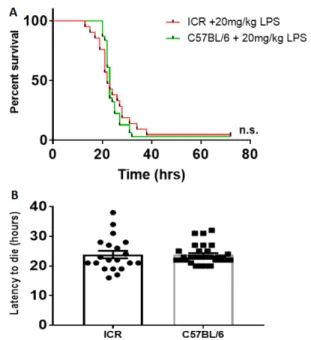
To investigate the difference in susceptibility to LPS-induced sepsis between C57BL/6J and ICR mice, both strains were subjected to LPS treatment. To this end, animals from both strains were intraperitoneally injected with an identical single dose of
LPS (20 mg/kg). As illustrated in Fig. 2A, there was no statistical significance in mortality (p>0.05). The latency to death in the two strains is shown in Fig. 2B.
To explore the effect of age on susceptibility to LPS-induced sepsis in ICR mice, both adult and adolescent male mice (aged 13 and 8 weeks, respectively) were subjected to LPS treatment. At both ages, the animals were intraperitoneally injected with an identical single dose of LPS (20 mg/kg). As shown in Fig. 3A, adult mice were more susceptible to LPS-induced sepsis compared with adolescents (p<0.05). The latency to death was significantly different between the two age groups, shown in Figure 3B (p<0.05).
To study the effect of sex on susceptibility to LPS-induced sepsis in C57BL/6 mice, both male and female mice aged 13 weeks were subjected to LPS treatment. Both male and female animals were intraperitoneally injected with an identical single dose of LPS (20 mg/kg). As shown in Figure 4A, female mice were more resilient against LPS-induced death than were male mice (p<0.05). The latency to death of the two groups is shown in Fig. 4B, with no statistical significance (p>0.05).
The results of our study revealed that mice exhibited important sex- and age-dependent differences in LPS-induced immune response, as measured by survival rate and latency to death. LPS Fig. 2. Survival rate of ICR and C57BL6 mice following LPS treatment. (A) LPS treatment at 20 mg/kg induced no significant difference in survival between 13-week-old ICR and C57BL6 male mice. LPS was injected intraperitoneally into the mice and the survivability was observed after 72 h. Kaplan-Meier survival curves are shown; n.s=no significant difference (p>0.05). (B) Latency to death following LPS treatment. Animals that were still alive at 72 h were excluded from the latency data.
Fig. 1. Survival rate of 13-week-old mice following LPS treatment
at different doses. (A) LPS treatment at different doses (50, 30, 20,
15, and 10 mg/kg) induced death in a dose-dependent manner in 13-
week-old male ICR mice. LPS was injected intraperitoneally into the
mice and the survivability was observed after 72 h. (B) Latency to
death following LPS treatment. Animals that were still alive at 72 h
were excluded from the latency data.
induced a greater response in adult male mice than in their female counterparts. Adolescent male mice showed higher survival and latency in response to LPS than their adult counterparts. Taken together, these data suggest that mice with varying age and biological sex exhibit different responses to immune challenge.
Our findings are consistent with previous observations showing that the intensity of infection tend to be lower in females than in males.
10)The results also suggest that the discrepancy in immune response between male and female could be caused by physiological differences. At the present study, the mechanic underpinning of gender-difference immune response against LPS is not clear. One of the possible explanations could the role the sex hormones.
Many studies, both experimental and correlational, have been conducted to test the relationship between immune function and the sex hormones testosterone in males and oestrogen in females.
it is suggested that testosterone suppresses immune function in general and while oestrogen response is varied depending the immune measured used.
11)Our results also show age differences in LPS-induced death and latency using LPS lethal dose (20 mg/kg) between adolescent (aged 8 weeks) and adult mice (aged 13weeks) following
exposure to an immune challenge. Our results are comparable with those of previous reports demonstrating that senescent mice were more sensitive to LPS-induced lethality and produced significantly higher plasma levels of TNF-α, IL-1α, and IL-6 compared to young mice.
7)Our results suggest that senescent and adult mice (13 weeks) constitute vulnerable groups against septic stress. Furthermore, in experimental sepsis, older mice experience greater degrees of acute inflammation, which directly correlates with higher mortality.
12)In human studies of healthy volunteers infused with LPS, older age was associated with prolonged inflammation, particularly in terms of TNF-α and TNF receptor-1 levels.
13)It remains to be determined whether the neonatal or juvenile group may show yet another response against systemic LPS stimulation. Regarding differences in sex, previous studies have revealed that female mice recovered significantly faster from an LPS-induced body temperature drop and body weight loss relative to their male counterparts.
6)This finding is also consistent with clinical studies showing that female patients infected with the Ebola virus showed higher survival rates, whereas male patients experienced longer hospitalization periods.
9)Nevertheless, most clinical studies failed to show consistent differences in the outcome Fig. 3. Survival rate of young and adult ICR male mice following
LPS treatment. (A) LPS treatment at 20 mg/kg induced a significant difference in survival between adult and adolescent (aged 13 and 8 weeks, respectively). LPS was injected intraperitoneally into the mice and the survivability was observed after 72 h. Kaplan-Meier survival curves are shown; **p<0.05. (B) Latency to death following LPS treatment in mice showed an age-dependent relationship. Animals that were still alive at 72 h were excluded from the latency data.
Fig. 4. Survival rate of male and female mice following LPS treatment. (A) LPS treatment at 20 mg/kg showed a significant difference in survival between 13-week-old female and male C57BL/
6 mice. LPS was injected intraperitoneally into the mice and the
survivability was observed after 72 h. Kaplan-Meier survival curves
are shown; *p<0.05. (B) The latency to death in female and male
C57BL6 mice following LPS treatment. Animals that were still alive
at 72 h were excluded from the latency data.
of sepsis with regard to gender. A study on patients admitted to the intensive care unit showed slightly higher odds of mortality in females than in males (OR 1.11) in the subgroup with severe sepsis.
14)We showed that there was no difference between two multi- purpose and widely used inbred and outbred laboratory mouse strains (C57BL/6J and ICR, respectively) in terms of susceptibility to LPS-induced sepsis. Previous studies have shown differences between ICR and C57BL6 in response to viral infection.
Surprisingly, our study showed no difference in LPS-induced death between these two strains at a lethal dose of 20 mg/kg. This is in contrast to a previous study, wherein zymosan-induced generalized inflammation resulted in poorer survival rates in C57BL/6 mice, consistent with lower serum levels of the Th1 cytokine interferon (IFN)-γ than in ICR mice. Likewise, ex vivo exposure of C57BL/6J splenocytes to zymosan and bacterial LPS resulted in lower IFN-γ secretion compared to that in ICR mice
15)