Journal of Internet Computing and Services(JICS) 2015. Feb.: 16(1): 01-08 1
UWB/WiFi 모듈 기반의 내시경 카메라용 무선전송 설계☆
Design of UWB/WiFi Module based Wireless Transmission for Endoscopic Camera
심 동 하1 이 재 곤2 이 재 선3 차 재 상1 강 민 구4*
Dongha Shim Jaegon Lee Jaeson Yi Jaesang Cha Mingoo Kang 요 약
본 논문에서는 초광각 무선 내시경을 제안하고 구현하였다. 내시경은 초광각 카메라 모듈과 무선전송 모듈로 구성된다. 162도의 초 광광 렌즈와 이미지 센서 및 카메라 프로세서가 3x3x9 cm3 크기의 케이스에 함께 패키지 된다. 무선전송 모듈로 UWB 기반 및 WiFi 기반 의 플랫폼을 각각 구현한다. UWB 기반 모듈은 의 고화질 영상을 MJPEG로 압축하여, 2048x1536 (QXGA)의 해상도에서 15 fps의 속도로 영상을 전송하며, 최대 데이터 전송속도는 41.2 Mbps에 달한다. 구현된 내시경은 의료용 내시경의 화각과 해상도 수준을 가지며, 상용 고성능 WiFi 내시경과 비교할 때 ~3X의 화각과 16X의 해상도를 갖는다. WiFi 기반의 모듈은 640x480 (VGA)의 해상도에서 30 fps의 속도로 영상을 스마트 기기로 스트리밍 하며, 최대 1.5 Mbps의 데이터 전송속도를 보여준다. 구현된 모듈은 저가격의 의료용 무선 전자 내시경 의 구현 가능성을 보여주며, U-헬스케어, 응급처치, 가정의료, 원격진료 등에 효과적으로 활용될 수 있을 것으로 기대된다.
☞ 주제어 : 초광각, 렌즈, 화각, 해상도, 카메라, UWB, WiFi, 내시경, MJPEG, 전송속도.
ABSTRACT
Ultra-wide-angle wireless endoscopes are demonstrated in this paper. The endoscope is composed of an ultra-wide-angle camera module and wireless transmission module. A lens unit with the ultra-wide FOV of 162 degrees is designed and manufactured. The lens , image sensor, and camera processor unit are packaged together in a 3x3x9-cm3 case. The wireless transmission modules are implemented based on UWB- and WiFi-based platform, respectively. The UWB-based module can transmit HD video to a computer in resolution of 2048x1536 (QXGA) and the frame rate of 15 fps in MJPEG compression mode. The maximum data transfer rate reaches 41.2 Mbps. The FOV and the resolution of the endoscope is comparable to a medical-grade endoscope. The FOV and resolution is
~3X and 16X higher than that of a commercial high-performance WiFi endoscope, respectively. The WiFi-based module streams out video to a smart device with th maximum date transfer rate of 1.5 Mbps at the resolution of 640x480 (VGA) and the frame rate of 30 fps in MJPEG compression mode. The implemented components show the feasibility of cheap medical-grade wireless electronic endoscopes, which can be effectively used in u-healthcare, emergency treatment, home-healthcare, remote diagnosis, etc.
☞ keyword : Ultra-wide angle, lens, FOV, resolution, camera, UWB, WiFi, endoscope, MJPEG, transmission speed.
1. Introduction
Traditional optical endoscopes has a complicated structure
1Seoul National University of Science & Technology, Seoul, 139-743, Korea.
2Dept. of Digital Design, Catholic University of Daegu, Gyeongsangbuk-do, 712-702, Korea.
3Haesung Optics Co., Ltd., Suwon, Gyeonggi-do, 441-813, Korea
4Division of Inform. & Telecomm., Hanshin Univ, 447-791, Korea
*Corresponding author ([email protected])
[Received 14 October 2014, Reviewed 27 October 2014, Accepted 3 December 2014]
☆ This research was supported by Hanshin University, and Korea government(Ministry of Trade Industry and Energy, #A0043 00013)
☆ A preliminary version of this paper was presented at APIC-IST 2014 and was selected as an outstanding paper.
due to relay lens and optical fibers to transmit images and light, respectively [1]. This degrades the quality of images and increases the cost of endoscopes. With the development of CCD (Charge Coupled Device) image sensor, images could be transmitted electronically. However optical fibers has been widely employed to transmit light. Recently all-electronic digital endoscopes have been developed with the advances of CMOS image sensors and LED (Light Emitting Devices) technology [2]. The electronic endoscopes can be implemented with lower costs, yet have higher performance and reliability.
Recently some wireless endoscopes becomes commercially available for industrial applications [3]. The FOV (field of view) of a high-performance product provides the FOV (field ISSN 2287-1136 (Online)
http://www.jksii.or.kr
of view) smaller than 60 degrees and VGA resolution (640x480) [4]. The performance is not enough for medical applications considering that a popular medical endoscope has the 140-degree FOV and HD-level resolution [5].
This paper demonstrates a medical-grade wireless endoscope with an ultra-wide FOV and HD resolution. The schematic of the proposed ultra-wide-angle wireless endoscopic platform is shown in Figure 1. The endoscope is composed of the camera module, the wireless transmission module, and the communication cable. An ultra-wide-angle lens unit is designed and manufactured. An endoscopic camera module also includes LED light sources, an image sensor, a camera processor. The performance of the UWB module is analyzed while transmitting video to a monitoring server (computer). A WiFi wireless transmission module is also implemented to make the camera module a network device with an independent IP. The video from the WiFi module is streamed to be displayed in a smart device.
(Figure 1) Schematic of the proposed ultra-wide-angle wireless endoscopic platform.
2. Design of Endoscopic Camera Module
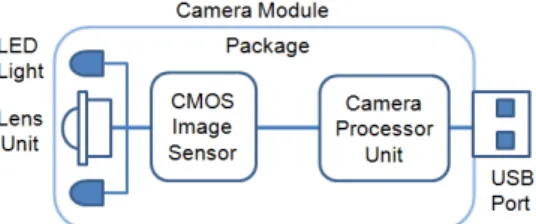
Figure 2 shows the schematic diagram of the endoscopic camera module. The module includes a ultra-wide-angle lens unit, CMOS image sensor, camera processor unit, and LED lights. All components are packaged in a cylindrical case. The camera module is connected to the following wireless transmission module using the USB interface.
An ultra wide angle lens is designed and manufactured
[6-8]. The lens is designed using various techniques like Raytracing, MTF (Modulation Transfer Function), Through Focus MTF, Field Curves, etc [9-10]. Six lenses are employed in the lens module. Three of them are made of plastic, and the rest are made of glass. Only one of the lenses has an aspheric shape to reduce costs in design and manufacturing.
The designed FOV and F-number of the lens is 162 degrees and 2.5, respectively. Figure 3 shows 3-D modeling of the ultra-wide-angle lens for the proposed wireless endoscope.
Important parameters of the designed lens including a focal length and TV distortion are summarized in Table 1. Figure 4(a) shows front-side and back-side of the manufactured ultra-wide-angle lens unit.
(Figure 2) Schematic diagram of the endoscopic camera module.
(Figure 3) 3-D modeling of the ultra-wide-angle lens for the proposed wireless endoscope.
(Table 1) Design parameters of the ultra-wide- angle lens.
Lens parameter Design value Field of View (FOV) 162 degrees
F-number 2.5
Focal Length 1.5 mm
TV Distortion 25%
Iris Fixed
A commercial CMOS image sensor, OmniVision OV3640, is employed for the camera [11]. The OV3640 is a high-performance 3.1 Megapixel (2048x1536) CMOS camera chip in a 1/4-inch optical format. The OV3640 image array operates at up to 15 frames per second (fps) in the resolution (QXGA). The sensor also contains an integrated compression engine simplifying bandwidth limited interface.
The image sensor is mounted on a small PC (Printed Circuit) board and enclosed by a plastic lens base. A circular IR-cut filter is placed on the rectangular image sensor to prevent colour distortion of images as the human eye sees.
The lens module rotationally couples with lens base. An assembled camera module including the lens module and the image sensor is shown in Figure 4(b). A 24-pin FPC (Flat Printed Cable) connector is employed to connect the camera unit and the following camera processor module.
(a)
(b)
(Figure 4) (a) Manufactured ultra-wide-angle lens unit. (b) Assembled camera unit with 24-pin FPC
connector.
The camera processor unit provides a system interface and the processing capability to connect raw image sensor to a following device. The developed camera unit is connected to a commercial camera processor (OmniVision OV538) to enables high-speed transfer of camera image data [12]. The OV538 is a low cost, enhanced single-chip processor for USB 2.0 PC camera applications supporting up to 2-mega pixel sensors.
A PC board is designed and manufactured to include the OV538, regulators, a crystal oscillator, a memory, passive devices, etc. The regulators generate multiple supply voltage levels for the image sensor. Figure 5 shows the photograph of the manufactured camera processor module. The size of the board is 70x20 mm2. The camera unit is connected to the camera processor unit using A 24-pin FPC (Flat Printed Cable) as shown in Figure 5.
The camera module is packaged inside a cylindrical Aluminum case (Figure 6). The camera module can be directly connected to a wireless transmission module without a USB cable. The size of the packaged camera module is 3x3x9 cm3. Two white LED are employed to implement the light source for the endoscope. Each LED draws 10 mA from the 5-V DC supply lines of the USB interface.
(Figure 5) Camera module with the camera unit and camera processor unit.
(Figure 6) Packaged camera module inside a cylindrical Aluminum case.
3. Design of UWB-based Wireless Transmission Module
3.1 Design and implementation
Ultra-Wideband (UWB) is a communications technology that employs a wide bandwidth (typically defined as greater than 20% of the centre frequency or 500 MHz) [13-14]. UWB communications are characterized by ultra-low power, high speed, and short range. UWB radios operate at such tiny transmit power that they do not cause interference with electronic devices or other types of radios [15].
The wireless transmission of huge high resolution video data from a camera in real-time is challenging. The high-speed WUSB (Wireless USB) technology based on UWB should a good solution. Since UWB technology has no interference with Wi-Fi or Bluetooth, the proposed camera can sustain its performance even in the environment overcrowded by various wireless devices [16].
A commercial wireless adaptor module (Alereon AL5616) is used to implement the UWB transmission module [17]. The module includes two main chips: RF transceiver chip (AL5100) and baseband/MAC chip (AL5301) [18]. AL5616 is a precertified UWB radio card that can be used for both host side and device side applications. The UWB module employs multiband orthogonal frequency division multiplexing (MB-OFDM).
(Figure 7) Schematic diagram of UWB transmission module for the ultra-wide-angle wireless
endoscope.
A Li-polymer battery, power management unit (PMU), switch, and UWB module are packaged to implement a
stand-alone communication module for the endoscopy system.
The PMU mainly boosts the output voltage of the battery (3.7 V) to 5 V to drive the UWB module using the USB interface [19]. The other function of the PMU is to charge the battery from a 5-V voltage source. The assembled UWB module is shown in Figure 8. The module size is 3.0x3.5x7 cm3.
(Figure 8) Photograph of UWB-based transmission module for the wireless endoscope.
3.2 Measurement results
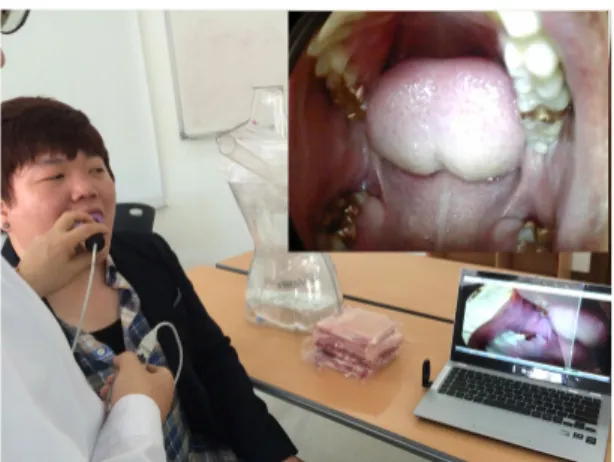
The performances of the camera are evaluated in an indoor environment. The resolution, frame rate, and data transfer rate of real-time video are measured. The camera module is connected with the UWB transmission module using a USB cable as shown in Figure 9. The UWB module is packaged using a transparent shrink tube. An oral cavity is observed using the endoscope to evaluate its performance.
The teeth and tongue in the relatively dark environment are clearly seen due to the LED lights.
(Figure 9) Photograph of UWB transmission module connected to the packaged camera module
using a USB cable.
(Figure 10) Observation of an oral cavity using the UWB-based endoscope module.
A video with a higher resolution can be transmitted at a substantially lower data rate using a video compression technique. The image sensor of the proposed camera (OV3640) supports the MJPEG (Motion JPEG) mode. Each video frame or interlaced field of a digital video sequence is compressed separately as a JPEG image in the video compression format [20].
Table 2 summarizes the measured performance of the camera using MJPEG image compression at the distance of
~1 m. The camera can support up to QXGA resolutions (2048x1536). The maximum data transfer rate reaches 41.2 Mbps for the resolution of 15 fps. The data rate goes up with the resolution as expected. The resolution, frame rate, and data rate are measured using VLC (VideoLAN), a free and open source cross-platform multimedia player and framework [21].
The endoscope shows the performance comparable to a medical-grade one [5].
(Table 2) Measured performances of the camera in MJPEG compression mode.
Resolution Frame rate Data transfer rate
640x480 30 fps 6.2 - 14.3 Mbps 1024x768 30 fps 10.4 - 27.0 Mbps 2048x1536 15 fps 20.2 - 41.2 Mbps
4. WiFi-based Wireless Transmission Module
4.1 Design and implementation
Due to the prevalence of WiFi networks and communication devices, a WiFi-based wireless endoscope can have higher flexibility than the UWB counterpart. For example, endoscopy images can be monitored in a remote place as far as WiFi network is available. Another advantage should be the connection with various smart devices with WiFi function as well as normal computers.
The WiFi transmission module is implemented using a credit card-sized single-board computer (Raspberry Pi: Model B) and WiFi modules (adaptor and router) [22]. The transmission module make the camera module a network device with an IP address. Figure 11 shows the schematic diagram of the proposed WiFi-based endoscope. The operating system, Raspbian, is installed in the SD card (32GB). The video data from the camera are processed by a library installed in the computer. Then the processed data are streamed to the WiFi router and displayed in a smart devices or a computers with WiFi function. Multiple devices can access the video simultaneously using the streaming technique.
Figure 12 shows the photograph of the implemented WiFi-based endoscope. The camera module is connected to the transmission module using a USB cable. “ipTIME mini”
and “ipTIME N100 mini” is used for the WiFi adaptor and router, respectively [23].
(Figure 11) Schematic diagram of WiFi-based wireless endoscope.
(Figure 12) Photograph of WiFi transmission module connected with the endoscopic camera module.
4.2 Measurement results
An ear is observed to evaluate the performance of the WiFi-based endoscope. The transmitted video images are displayed in a smart phone. Figure 13 shows a clear image of the ear transmitted by the WiFi-based module. The maximum date transfer rate supported by the module is estimated to be 1.5 Mbps at the resolution of 640x480 (VGA) and the frame rate of 30 fps in MJPEG compression mode.
The performance is measured using VLC. The UWB-based transmission module should provide much better video quality since the resolution and the data transfer rate is 16X and ~30X higher than that of WiFi one, respectively. However, the WiFi-based endoscope has better flexibility and expandability due to easy connections with various devices through extensive WiFi networks.
(Figure 13) Observation of an ear using WiFi-based wireless endoscope.
5. Conclusion
A ultra-wide-angle wireless endoscopes is demonstrated in this paper. The lens module is designed to provide FOV of 162 degrees and F-number of 2.5. The lens unit is assembled with an image sensor. The camera unit and camera processor are packaged to a camera module. The wireless transmission is implemented using UWB or WiFi communication.
Measurements show that the UWB-based transmission module can transmit HD video in the resolution of 2048x1536 (QXGA) and the frame rate of 15 fps with the maximum data transfer rate of 41.2 Mbps in MJPEG compression mode. The resolution is 16X higher than that of a commercial high-performance WiFi endoscope. The performance is comparable to a medical-grade endoscope. A WiFi-based transmission module is implemented using the Raspberry Pi and a WiFi adaptor. The maximum date transfer rate of 1.5 Mbps is achieved at the resolution of 640x480 (VGA) and the frame rate of 30 fps in MJPEG compression mode.
These results show the feasibility of cheap and convenient medical-grade wireless endoscopes, which can be extensively employed in u-healthcare, emergency treatment, home- healthcare, remote diagnosis, etc.
Reference
[1] J. M. Edmonson, “History of the instruments for gastrointestinal endoscopy,” Gastrointestinal endoscopy 37 (2 Suppl): S27-S56, 1991.
http://dx.doi.org/10.1016/S0016-5107(91)70910-3 [2] (2012) Endoscopes Quick Reference Guide. Texas
Instruments. http://www.ti.com/lit/sl/slyy030/slyy030.pdf [3] Supereyes C001. http://www.supereyes.cc
[4] Generaltools iBorescope DCiS1.
http://www.generaltools.com/DCiS1--iBorescope-Wifi-E nabled-Real-Time-Video-Capture_p_1937.html [5] Pentax Medical, “The i10 endoscope series”.
http://www.pentaxmedical.de
[6] J. S. Lee, M. G. Kang, J. H. Kim, and H. J. Song, “Design of Wideangle based small Endoscopic Lens Module with UWB Interface,” in The 9th APIC-IST 2014, KSII, Nepal, Jul. 2014. http://apicist.org/2014/
[7] D. Shim, J. Kim, M. Lee, H. Kim, S. Hong, J. Lee, and J. Cha, “A Wide-angle Wireless Camera Package using Ultra Wide Band Communication,” Proceedings of International Conference on Contents, Platform, Network and Device, Busan, Korea, 2014, p. 41.
http://eng.iibc.kr/iconf/iccpnd2014/
[8] J. G. Lee, M. G. Kang, I. K Kim, and K. T. Lee, “Design of High-resolution Wide-angle Lens Module, and Image Distortion Compensation for Smart NUX,” KICES, Vol.7, No.5, pp. 999-1004, Oct. 2012.
http://www.koreascience.or.kr/article/ArticleFullRecord.j sp?cn=KCTSAD_2012_v7n5_999
[9] R. Kingslake, Lens Design Fundamentals, Academic Press, 1978.
http://www.sciencedirect.com/science/book/97801237430 15
[10] E. Fullerton, Lens Calculation - Do the Math, Milestone White Paper, 2009. http://vdss.ca/milestone/12.pdf [11] OmniVison OV3640 (CMOS image sensor). [online].
Available:
http://www.ovt.com/uploads/parts/OV3640_PB(1.02)_we b.pdf
[12] OmniVision OV538 (Camera bridge processor). [online].
Available:
http://www.ovt.com/products/ip_detail.php?id=9
[13] K. Siwiak and D. McKeown, Ultra-wideband Radio Technology, Wiley, 2004.
http://onlinelibrary.wiley.com/book/10.1002/0470 859334
[14] IEEE 802.15 Working Group for WPAN.
http://www.ieee802.org/15/
[15] E. Ayar. (2010). UWB Wireless Video Transmission Technology in Medical Applications. NDS, CA.
http://www.ndssi.com.cn/data/uploads/pdf/Surgical/Zero Wire/Wireless-Video-Transmission-in-Medical-Applicati ons.pdf
[16] Wireless USB (WUSB) Documents. http://www.usb.org/
developers/wusb/
[17] Alereon AL5616 (UWB Radio Card Adapter).
http://www.alereon.com/products/reference-design-board s/al5616-worldwide-wireless-usb-adapter.
[18] Alereon AL5100/AL5301 (UWB Chipset). http://www.al ereon.com/products/chipsets/al5100al5301-chipset [19] Hanjin battery charger/ 5V boosting module. http://www.
eleparts.co.kr/EPX3CFF6
[20] MJPEG (Motion JPEG). http://en.wikipedia.org/wiki/Mot ion_JPEG
[21] VLC Media player. http://www.videolan.org/vlc/index.k o.html
[22] Raspberry Pi. http://www.raspberrypi.org/
[23] ipTIME. http://www.iptime.co.kr
◐ 저 자 소 개 ◑
심 동 하 (Dongha Shim) 1996년 서울대학교 원자핵학과(공학사) 1998년 서울대학교 대학원 전기공학부(공학석사)
2011년 플로리다대학교(Univ. of Florida) 대학원 전기공학과(이학박사) 1998~2005년 삼성전자 종합기술원
2011~현재 서울과학기술대학교 MSDE전공 교수 관심분야 : 집적회로, 초고주파 응용, 고속무선통신.
E-mail : [email protected]
이 재 곤 (Jaegon Lee)
1998년 서울대학교 산업디자인과(미술학사) 2005년 서울대학교 대학원 디자인학부(미술학석사) 2007~2010 국민대학교 시각디자인학과 전임강사 2011~현재 대구가톨릭대학교 디지털디자인과 조교수 관심분야 : 인터랙션디자인, 피지컬컴퓨팅
E-mail : [email protected]
이 재 선 (Jaeson Yi) 2001년 연세대학교 경영학과(경영학사) 2001~2003 한글라스 SPDI 해외마케팅팀 2004~2005 삼성전자 구매전략팀 2005~현재 해성옵틱스(주) 대표이사
관심분야 : 결상광학, 카메라모듈, 영상신호처리 E-mail : [email protected]
차 재 상 (Jaesang Cha)
2000년 일본 東北(Tohoku)대학교(공학박사)
2000~2002년 한국전자통신연구원(ETRI) 무선방송 기술연구소 선임연구원 2002~2005년 서경대학교 정보통신공학과 전임강사
2008년 미국 Florida University, Visiting Professor
2005~현재 서울과학기술대학교 전자IT미디어공학과 부교수
관심분야 : LED통신, 조명IT융합신기술, LBS, ITS, UWB, 무선 홈네트워크, 무선통신 및 디지털방송, etc.
E-mail : [email protected]
강 민 구 (Mingoo Kang) 1986년 연세대학교 전자공학과(공학사) 1989년 연세대학교 전자공학과(공학석사) 1994년 연세대학교 전자공학과(공학박사) 1985년~1987년 삼성전자 연구원 1997년~1998년 일본 오사카대학 Post Doc.
2000년~현재 한신대학교 정보통신학부 교수 관심분야 : 디지털방송, 방송통신융합기술 Email: [email protected]