한국산 쑥속의 체세포 염색체수에 의한 분류학적 연구
박명순·장진·정규영*
안동대학교 생명자원과학부
A taxonomic study of Korean Artemisia L. using somatic chromosome numbers
Myung Soon Park, Jin Jang and Gyu Young Chung*
School of Bioresource Science, Andong National University, Andong 760-749, Korea
적 요: 한국산 쑥속
20분류군의 분류를 위하여 체세포 염색체수를 조사하였다
.본 연구에서 취급된 분류군 들의 체세포 염색체수는
2n = 16, 18, 34, 36, 50, 52, 54로서 기본 염색체수는
x=8, 9, 10, 13, 17이었으며
,실 제비쑥
(A. japonica
var.angustissima
; 2n = 36)의 체세포염색체수는 본 연구에서 처음으로 밝혀졌다
.사철쑥
(
A. capillaris
; 2n = 18),섬쑥
(A. japonica
var.hallaisanensis
; 2n = 36),갯제비쑥
(A. japonica
subsp.littoricola
; 2n = 36),개똥쑥
(A. annua
; 2n = 18),개사철쑥
(A. carvifolia
; 2n = 18),큰비쑥
(A. fukudo
; 2n = 16),맑은대쑥
(A. keiskeana
; 2n = 18),넓은잎외잎쑥
(A. stolonifera
; 2n = 36),그늘쑥
(A. sylvatica
; 2n = 16),물쑥
(A. selengensis
; 2n = 36),산쑥
(
A. montana
; 2n = 52),뺑쑥
(A. lancea
; 2n = 16),산흰쑥
(A. sieversiana
; 2n = 18)등의
13분류군의 염색체수는 기존 보고와 일치하였으며
,기존 보고와 다르게 파악된 종류는 제비쑥
(A. japonica
var.japonica
; 2n = 18, 36 vs 2n = 36),더위지기
(A. sacrorum
; 2n = 18, 54 vs 2n = 54),덤불쑥
(A. rubripes
; 2n = 16, 34 vs 2n = 16),쑥
(A. indica
; 2n = 34, 36 vs 2n = 34),참쑥
(A. codonocephala
; 2n = 18, 50, 54 vs 2n = 50),황해쑥
(A. argyi
; 2n = 34, 36, 50 vs 2n = 34)의
6분류군이었다
.한국산 쑥속의 체세포 염색체수는 제비쑥
,더위지기
,참쑥
,황해쑥
,산쑥
,그늘쑥의 분류에 매우 유용한 형질이었다
.주요어: 쑥속
,체세포 염색체수
ABSTRACT: Somatic chromosome numbers for 20 taxa of Korean Artemisia L. were investigated for the pur- pose of classification. Somatic chromosome numbers of treated taxa were 2n = 16, 18, 34, 36, 50, 52, 54, and therefore their basic chromosome numbers were x = 8, 9, 10, 13, 17. The chromosome number of A. japonica var . angustissima is being reported for the first time in this study. The chromosome numbers of 13 taxa were the same as in previous reports; A. capillaris (2n = 18), A. japonica var. hallaisanensis (2n = 36), A. japonica subsp.
littoricola (2n = 36), A. annua (2n = 18), A. carvifolia (2n = 18), A. fukudo (2n = 16), A. keiskeana (2n = 18), A. stolonifera (2n = 36), A. sylvatica (2n = 16), A. selengensis (2n = 36), A. montana (2n = 52), A. lancea (2n = 16), A. sieversiana (2n = 18); however, the chromosome numbers of 6 taxa were different; A. japonica var. japonica (2n = 18, 36 vs 2n = 36), A. sacrorum (2n = 18, 54 vs 2n = 54), A. rubripes (2n = 16, 34 vs 2n = 16), A. indica (2n = 34, 36 vs 2n = 34), A. codonocephala (2n = 18, 50, 54 vs 2n = 50), A. argyi (2n = 34, 36, 50 vs 2n =34).
The somatic chromosome numbers of Korean Artemisia are thought to be good characteristics for classifying some taxa such as A. japonica var. japonica, A. sacrorum, A. codonocephala, A. argyi, A. montana, A. sylvatica.
Keywords: Artemisia L., somatic chromosome number
쑥속
(
ArtemisiaL.)
은국화과(Asteraceae)
국화족(Anthemideae)
에 속하며
,
전 세계적으로 종과 종하분류군을 포함하여200
여분류군혹은500
여분류군이상이분포하며(McArthur, 1979; Ling, 1991, 1992a,b, 1995a, b),
주로북반구에넓게분포하지만
,
남반구에도몇몇 종들이 분포하는 것으로 알려 져있다(Bremer and Humphries, 1993).
쑥속은원추화서,
수*Author for correspondence: [email protected]
상화서
,
총상화서,
또는 산방상원추화서에 수 개의 작은두상화서가달리며
,
두상화서는수 개의이형화를 포함하 고 있다.
주변화는1
줄 드물게2
줄로배열하며 통상화로 된자성화이며,
중앙화는통상화로된양성화로이루어져있 고,
화탁은인편이없지만몇몇종들은털이존재하며,
수과는관모가없는 특징에의해 국화족의다른 근연분류군들 과구분된다
(Ling, 1982).
쑥속의속이하분류에대하여
Besser(1829, 1831, 1834, 1835)
는 Seriphidium절,
Abrotanum절,
Dracunculus절의3
절을신설하여구분하였으며
, Candolle(1837)
는두상화서의주변에 있는임성인자성화,
중앙에불임성인양성화,
화탁에털이없 는특징을가진Dracunculus절,
두상화서의주변에임성인자 성화는없고,
임성인양성화만을가지며,
화탁에털이없는특징을가진Seriphidium절
,
두상화서의주변에임성인자성화
,
중앙에임성인양성화,
화탁에털이없는특징을가진Abrotanum절
,
두상화서의주변에임성인자성화,
중앙에임성인양성화
,
화탁에털이있는특징을가진Absinthium절의4
절로구분하였다.
최근여러학자들이아속,
절,
아절,
열의 분류체계를제시하였으며(Poljakov, 1961; Ling 1982, 1988, 1991, 1992, 1995a, b),
특히Torrell et al.(1999)
은분자생물학적인 연구를 통해AbsinthiumDC.,
Artemisia(=
AbrotanumBesser),
DracunculusBesser,
SeriphidiumBesser,
Tridantatae(Rydb.) McArthur
의5
그룹에대하여분류를시도한바있지만,
현재 까지세계적으로만족할만한분류체계는미흡한실정이다.
Watson et al.(2002)
과Hayat et al.(2009)
은보다명확한자연분류체계를 위해선 세계적인쑥속의 분류군들에 대한 명확한인식과 더많은과학적 준거자료들을포함해야한 다고지적한바있다
.
현재쑥속에대한연구는두상화서의형태에의해명확히구분되어지는상기
5
그룹의자연분류체계의 정립이 주를이루고 있다
.
하지만 분류군간의 형 태적인유사성으로동정이어려울뿐만아니라지리적혹은 같은 집단 간에서도 외부형태학적변이가다양하여,
분류 군에대한한계설정의문제로학명에대한이견또한다양한 실정임에도불구하고종간혹의종하분류군에대한연구는 거의없는실정이다.
쑥속의염색체연구는최근쑥속의자연분류체계정립을 위한하나의준거자료로서
,
다수의학자들에의해보고된바있으며
(Kawano et al., 1995; Volkova and Boyko., 1986;
Nishikawa, 1988; Suzuka, 1952; Kawatani 1964; Arano, 1962;
Stepanov and Muratova, 1992; Masumori, 1977; Hoshi et al., 2003; Wang and Li, 1995; Garcia et. al., 2006; Pellicer et. al., 2007), Torrell et al.(1999)
은명확한배수체와dysploidy
는분류 군간의 분화관계를증명할 수있다고 언급한 바 있다.
쑥 속의기본염색체수는다른국화족의식물들과 마찬가지로X = 9
가 가장일반적이고,
그 다음으로X=8
이며(McArthur and Sanderson 1999), X = 7
이 보고된 바 있다(Wiens and Richter, 1966).
국내에서의쑥속에대한분류학적연구는주로도감등의 기재정도이며
,
염색체수에대한보고는이(1967)
에의해사철쑥
(
A. capillaris),
제비쑥(
A. japonicavar.
japonica),
섬쑥(
A. japonicavar
. hallaisanensis),
갯제비쑥(
A. japonicasubsp
. littoricola),
맑은대쑥(
A. keiskeana),
넓은잎외잎쑥(
A. stolonifera),
쑥
(
A. asiatica)
에관한보고가있었을뿐이다.
따라서본연구에서는한국산쑥속의종합적이고체계적 인분류학적연구의일환으로분류군의한계가명확하다고 판단되는
20
분류군에대하여염색체수를조사하였다.
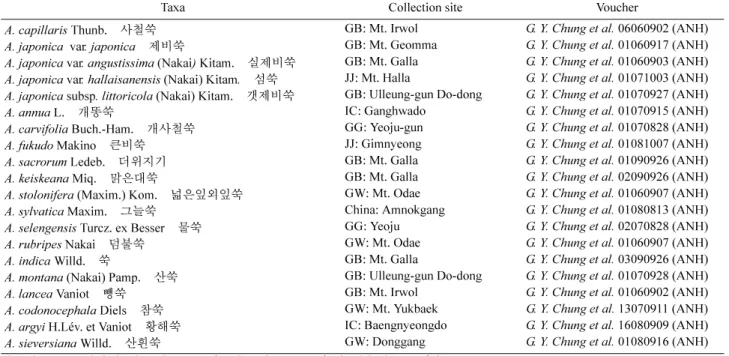
Table 1. Materials and collection data of genus Korean Artemisia .
Taxa Collection site Voucher
A. capillaris Thunb. 사철쑥 GB: Mt. Irwol G. Y. Chung et al. 06060902 (ANH)
A. japonica var . japonica 제비쑥 GB: Mt. Geomma G. Y. Chung et al. 01060917 (ANH)
A. japonica var . angustissima (Nakai ) Kitam. 실제비쑥 GB: Mt. Galla G. Y. Chung et al. 01060903 (ANH) A. japonica var . hallaisanensis (Nakai) Kitam . 섬쑥 JJ: Mt. Halla G. Y. Chung et al. 01071003 (ANH) A. japonica subsp . littoricola (Nakai) Kitam. 갯제비쑥 GB: Ulleung-gun Do-dong G. Y. Chung et al. 01070927 (ANH)
A. annua L. 개똥쑥 IC: Ganghwado G. Y. Chung et al. 01070915 (ANH)
A. carvifolia Buch.-Ham. 개사철쑥 GG: Yeoju-gun G. Y. Chung et al. 01070828 (ANH)
A. fukudo Makino 큰비쑥 JJ: Gimnyeong G. Y. Chung et al. 01081007 (ANH)
A. sacrorum Ledeb. 더위지기 GB: Mt. Galla G. Y. Chung et al. 01090926 (ANH)
A. keiskeana Miq. 맑은대쑥 GB: Mt. Galla G. Y. Chung et al. 02090926 (ANH)
A. stolonifera (Maxim.) Kom. 넓은잎외잎쑥 GW: Mt. Odae G. Y. Chung et al. 01060907 (ANH)
A. sylvatica Maxim. 그늘쑥 China: Amnokgang G. Y. Chung et al. 01080813 (ANH)
A. selengensis Turcz. ex Besser 물쑥 GG: Yeoju G. Y. Chung et al. 02070828 (ANH)
A. rubripes Nakai 덤불쑥 GW: Mt. Odae G. Y. Chung et al. 01060907 (ANH)
A. indica Willd. 쑥 GB: Mt. Galla G. Y. Chung et al. 03090926 (ANH)
A. montana (Nakai) Pamp. 산쑥 GB: Ulleung-gun Do-dong G. Y. Chung et al. 01070928 (ANH)
A. lancea Vaniot 뺑쑥 GB: Mt. Irwol G. Y. Chung et al. 01060902 (ANH)
A. codonocephala Diels 참쑥 GW: Mt. Yukbaek G. Y. Chung et al. 13070911 (ANH)
A. argyi H.Lév. et Vaniot 황해쑥 IC: Baengnyeongdo G. Y. Chung et al. 16080909 (ANH)
A. sieversiana Willd. 산흰쑥 GW: Donggang G. Y. Chung et al. 01080916 (ANH)
GB: Gyeongsangbuk-do, GW: Gangwon-do, IC: Incheon, JJ: Jeju-do, GG: Gyeonggi-do
재료 및 방법
본연구에사용된재료는
2006
년부터2009
년까지생육지로부터채집하여실험포장에이식재배한재료에서충실한근 단을적출하여
3
차증류수로4
oC
에24-28
시간전처리한후, Aceto-alcohol (1 : 3)
에24
시간냉장보관하였다.
고정된시 료를3
차증류수로수세후, 1N HCl
에서해리한다음, 3
차증 류수로수세하고Feulgen
과2% Aceto-carmine
으로이중염색 하였다.
염색된 시료를 분산 및 압착을 하여관찰,
촬영(Olympus AX-70, Japan; Olympus DP2-BSW, Germany)
하였다.
결과 및 고찰
한국산쑥속식물
20
분류군의체세포염색체수를관찰한 결과(Table 2), 2n=16
인분류군으로큰비쑥(
A. fukudo; Fig. 1-8),
그늘쑥
(
A. sylvatica; Fig. 1-12),
덤불쑥(
A. rubripes; Fig. 1-14),
뺑쑥
(
A. lancea; Fig. 1-17), 2n = 18
인 분류군으로사철쑥(
A.
capillaris; Fig. 1-1),
개똥쑥(
A. annua; Fig. 1-6),
개사철쑥(
A. carvifolia; Fig. 1-7),
맑은대쑥(
A. keiskeana; Fig. 1-10),
산 흰쑥(
A. sieversiana; Fig. 1-20), 2n = 34
인분류군으로쑥(
A.indica
; Fig. 1-15),
황해쑥(
A. argyi; Fig. 1-19), 2n=36
인분류군으로 제비쑥
(
A. japonicavar
. japonica; Fig. 1-2),
실제비쑥(
A. japonicavar
. angustissima; Fig. 1-3),
섬쑥(
A. japonicavar.
hallaisanensis
; Fig. 1-4),
갯제비쑥(
A. japonicasubsp.
littoricola; Fig. 1-5),
넓은잎외잎쑥(
A. stolonifera; Fig. 1-11),
물쑥(
A.selengensis
; Fig. 1-13), 2n = 50
인 분류군으로 참쑥(
A.codonocephala
; Fig. 1-18), 2n = 52
인 분류군으로 산쑥(
A.montana
; Fig. 1-16), 2n = 54
인 분류군으로 더위지기(
A.sacrorum
; Fig. 1-9)
가관찰되었다.
본연구에서취급한 분류군을국내문헌 및해외다수의
문헌과 비교해본 결과
(Table 2),
기준표본산지가 한국인실제비쑥
(2n = 36)
은 본 연구에서 염색체의 수가 처음으로 밝혀졌으며
,
개똥쑥(
A. annua),
개사철쑥(
A. carvifolia),
큰비쑥
(
A. fukudo),
더위지기(
A. sacrorum),
그늘쑥(
A. sylvatica),
물쑥
(
A. selengensis),
덤불쑥(
A. rubripes),
산쑥(
A. montana),
뺑쑥
(
A. lancea),
참쑥(
A. codonocephala)
,황해쑥(
A. argyi),
산 흰쑥(
A. sieversiana)
의 체세포 염색체수는 국내산에 대하여처음으로밝혀졌다
.
사철쑥
(2n = 18),
섬쑥(2n = 36),
갯제비쑥(2n = 36),
개똥 쑥(2n = 18),
개사철쑥(2n = 18),
큰비쑥(2n = 16),
맑은대쑥(2n=18),
넓은잎외잎쑥(2n=36),
그늘쑥(2n=16),
물쑥(2n=36),
산쑥
(2n=52),
뺑쑥(2n=16),
산흰쑥(2n=18)
은기존의문헌과일치함을보였으며
,
제비쑥,
더위지기,
덤불쑥,
쑥,
참쑥,
황해쑥은기존의문헌과다소차이를보였다
.
제비쑥의경 우, 2n=18, 36
등으로알려져있으나,
본연구에서는2n=36
으로일정하게나타났다
.
더위지기의경우현재학명의이견이많은분류군으로A. gmelini, A. sacrorum, A. iwayomogi의 학명을 혼용하여 사용하고 있으며
,
대륙간의 종하분류군의한계또한불분명한문제점에의해연구자마다다른 개수의염색체수가보고되고있는것으로판단된다
.
한국산 더위지기는일본산과같은2n=54
로관찰되었다.
기준표본 산지가한국인덤불쑥은다수의문헌과동일하게본연구에서도
2n=16
개가관찰되었으며,
최근일부문헌에서2n=34
개를보고한것
(Hoshi et. al., 2003)
은오동정에의한것으로 판단된다.
참쑥은 A. lavandulaefolia, A. codonocephala, A.umbrosa의학명이혼용되고있으며
,
각종들마다염색체수가다르게보고되고있으나
,
국내에서는2n= 50
으로일정하였다
.
황해쑥은기존의문헌에서2n=36, 50
개로보고되고있으나
,
최근에2n=34
로보고되고있으며(Hoshi et al., 2003),
본연구에서는
2n=34
로관찰되었다.
산쑥은국내의여러도 감에서 자생지가전국에 분포한다고알려져있지만,
생체수집및표본조사결과
,
울릉도에제한적으로분포하는것 으로 나타났으며,
이는기준표본산지인일본산의염색체 수가일치함을보였다.
그늘쑥또한전국에분포한다고알려 져있지만 표본조사결과,
모두 넓은잎외잎쑥을오동정한것으로서
,
주분포지역은이북지역인것으로판단된다.
본연구에서취급한쑥속의기본염색체수는일반적으로
X = 8, 9
로서기본염색체수가X = 9
로2
배체(2n = 18)
인것은 사철쑥,
개똥쑥,
개사철쑥,
맑은대쑥,
산흰쑥, 4
배체(2n=36)
인것은제비쑥
,
실제비쑥,
섬쑥,
갯제비쑥,
넓은잎외잎쑥,
물 쑥, 6
배체(2n=54)
인것은더위지기에서관찰되었다. X=8
로2
배체(2n=16)
인것은큰비쑥,
그늘쑥,
덤불쑥,
뺑쑥에서관 찰되었으며,
그외에X=10
으로5
배체(2n=50)
인것은참쑥,X = 13
으로4
배체(2n = 52)
인것은 산쑥, X = 17
로서2
배체(2n = 34)
인것은쑥,
황해쑥에서관찰되었다.
기본염색체 수가
X = 17
인 분류군에 대하여Vallès and McArthur(2001)
는기본염색체수X=8, 9
사이에서aneuploidy
(
이수체성)
와dysploidy
에 의한 배수성의가능성을 언급하였으며
, Matoba et al.(2007)
는핵형분석을통해상기의견을 뒷받침한바있다.
이러한견해를근거로쑥,
황해쑥의2n=34
에대하여쑥속내
2n=18 (x=9)
인분류군과2n=16(x=8)
인분류군간의자연잡종일가능성
, x=9
이며4
배체인2n=36
에서상동염색체한쌍이소실되었을가능성
, x=8
이며4
배체인
2n=32
에서어느상동염색체가쪼개졌을가능성등을고려해볼수있다
.
또한,
참쑥은중국에서는A. lavandulifolia에A. umbrosa를이명처리하면서동일종으로처리하고있으
며
(Ling, 1992), Wang and Li(1995)
은2n = 50, Xiong et al.
(1995)
은2n = 54
개로보고된 바있다.
반면,
러시아에서는A. lavandulifolia와 A. umbrosa를 독립된종으로처리하고 있으며
(Poljakov 1961), Hoshi et al.(2003)
은A. lavandulifolia는2n=18,
A. umbrosa는2n=50
개로보고하고있다.
특히Pellicer et al.(2007)
은A. umbrosa에대하여2n=50
개로보고하면서X=8, 9
사이에서발생한dysploidy
보다는2n=54
개의집단에서 이수체에의한것이라고언급한바있다.
따라서국내의참쑥의체세포염색체수가
2n=50
인점과학명이A. codonocephala, A. lavandulifolia, A. umbrosa가혼용되고있는점등을고려할Table 2. The chromosome numbers of 20 Korean Artemisia taxa .
Taxa Previous record (2n) Present results
Basic chromosome
number 2n Polyploidy
A. capillaris Thunb. 18 Lee(1967) Kawano et al.(1995) 9 18 diploidy
A. japonica var. japonica
18, 36 18 36 36
Lee(1967)
Volkova and Boyko(1985) Volkova and Boyko(1986) Nishikawa(1988)
9 36 tetraploidy
A. japonica var . angustissima (Nakai) Kitam. - 9 36 tetraploidy
A. japonica var . hallaisanensis (Nakai) Kitam . 36 Lee(1967) 9 36 tetraploidy
A. japonica subsp . littoricola (Nakai) Kitam. 36 36 36
Suzuka(1952) Kawatani(1964) Lee(1967)
9 36 tetraploidy
A. annua L. 18
18 Nagl and Ehrendorfer(1974)
Volkova and Boyko(1986) 9 18 diploidy
A. carvifolia Buch.-Ham. 18
18 Arano(1962)
Kawatani(1964) 9 18 diploidy
A. fukudo Makino 16
16 16
Shimotomai(1946) Masumori(1961) Arano(1963)
8 16 diploidy
A. sacrorum Ledeb. 18
54 54
Kaul and Bakshi(1984) Nishikawa(1986)
Stepanov and Muratova(1992)
9 54 hexaploidy
A. keiskeana Miq. 18
18 18
Lee(1967)
Volkova and Boyko(1986) Nishikawa(1984)
9 18 diploidy
A. stolonifera (Maxim.) Kom. 36
36 36
Lee(1967) Masumori(1977)
Volkova and Boyko(1985)
9 36 tetraploidy
A. sylvatica Maxim. 16
16
Volkova and Boyko(1986) Probatova and
Sokolovskaya(1988) 8 16 diploidy
A. selengensis Turcz. ex Besser 36 Volkova and Boyko(1986) 9 36 tetraploidy
A. rubripes Nakai 16
16 34
Volkova and Boyko(1985) Nishikawa(1986) Hoshi et al.(2003)
8 16 diploidy
A. indica Willd. 34, 36
34 34 34
Lee(1967) Nishikawa(1986) Suzuka(1950) Arano(1962)
17 34 diploidy
A. montana (Nakai) Pamp. 52
52 Kurosawa(1982)
Nishikawa(1980) 13 52 tetraploidy
A. lancea Vaniot 16 Volkova and Boyko(1989) 8 16 diploidy
A. codonocephala Diels 50
54 50 18 54 50
Wang and Li(1995) Xiong et al.(1995) Hoshi et al.(2003) Hoshi et al . (2003) Garcia et al.(2006) Pellicer et al.(2007)
10 50 pentaploidy
A. argyi H.Lév. et Vaniot 34
36 50
Hoshi et. al . (2003) Volkova and Boyko(1986) Yan et al.(1989)
17 34 diploidy
A. sieversiana Willd. 18
18 Kawatani(1964)
Kaul and Bakshi(1984) 9 18 diploidy
때 명확한 분류군 한계설정등의 세부적인 연구가 필요 한 것으로 생각된다
.
산쑥의 염색체수는2n = 52
개로서(Kurosawa, 1982; Nishikawa, 1980),
기본염색체수에관한 언급은없었으나, Heywood and Humphries(1977)
에 의한보고된국화족내의
X = 9, 8, 10, 13, 17
의기본염색체수에비추어
X = 13
일 가능성이 있으나,
그 기원에 대하여서는분자생물학적인 방법 등을 통해추후 연구되어야 할 것 으로판단되었다
.
Fig. 1. Photographs on the somatic chromosomes of Korean Artemisia . 1. A. capillaris; 2. A. japonica var. japonica ; 3. A. japonica var . angustissima ; 4. A. japonica var . hallaisanensis ; 5. A. japonica subsp . littoricola ; 6. A. annua ; 7. A. carvifolia ; 8. A. fukudo ; 9. A. sacrorum ; 10. A. keiskeana ; 11. A. stolonifera ; 12. A. sylvatica ; 13. A. selengensis ; 14. A. rubripes ; 15. A. indica ; 16. A. montana ; 17. A. lancea ; 18. A.
codonocephala ; 19. A. argyi ; 20. A. sieversiana
사 사
본 연구는 산림청 ‘
산
림과학기술개발사업(
과제번호: S120909L020110)
’의지원에의하여이루어진것입니다.
인용문헌
Arano, H. 1962. Cytological studies on subfam. Carduoideae of Japanese Compositae (VI). Karyotype analysis in the genus
Artemisia
. Bot. Mag. (Tokyo) 75: 356-367.Arano, H. 1963. Cytological studies in Subfamily Carduoideae (Compositae) of Japan XIV. The karyotype analysis on genus
Artemisia
(3). Bot. Mag. (Tokyo) 76: 459-465.Besser, W. 1829. Synopsis
Absinthiorum
. Bull. Soc. Imp. Natural- istes Moscou. 1 : 219-265.Besser, W. 1832. Tentamen de Abrotanis seu de sectione da
Arte- misiarum
L. Bull. Soc. Imp. Naturalistes Moscou. 3: 1-92.Besser, W. 1834. De Seriphidis seu de sectione IIIa
Artemisiarum
L. Bull. Soc. Imp. Naturalistes Moscou. 7: 1-46.Besser, W. 1835. Dracunculi seu de sectione IVa et ultima
Arte- misiarum
L. Bull. Soc. Imp. Naturalistes Moscou. 8: 1-95.Bremer, K. and C. J. Humphries. 1993. Generic monograph of the Asteraceae-Anthemideae. Bull. Nat. Hist. Mus. London (Bot.) 23: 71-177.
Candolle, A. P. 1837. Prodromous systematis naturalis regni veg- tabilis, pars VI. Treuttel et Wurtz, Paris.
Hayat, M. Q., M. Ashraf, M. A. Khan, T. Mahmood, M. Ahmad and S. Jabeen. 2009. Phylogeny of
Artemisia
L.: Recent devel- opments. Afr J. Biotechnol 8: 2423-2428.Heywood, V. H. and C. J. Humphries. 1977. Anthemideae-Sys- tematic review.
In
The Biology and Chemistry of the Com- positae. Heywood, V. H., and C. J. Humphries and Turner, B.L. Turner (eds.), Academic Press, London. Pp. 852-898.
Hoshi, Y., K. Kondo, A. A. Korobkov, I. V. Tatarenko, P. V.
Kulikov, V. P. Verkholat, A. Gontcharov, H. Ogura, T. Funamoto, G. Kokubugata, R. Suzuki and H. Matoba. 2003. Cytogical study in the genus
Artemisia
L. (Asteraceae) from Russia.Chrom. Sci. 7: 83-89.
Kaul, M. K. and S. K. Bakshi. 1984. Studies on the genus
Artem- sia
L. in north-west Himalaya with particular reference to Kashmir. Folia Geobot. Phytotax. 19: 299-316.Kawano, S., Y. Nagai and S. Hoshiya-Ushida. 1995. A study on the natural hybrid swarms of two
Artemisia
species,A. capil- laris
andA. japonica
(Compositae) in Central Honshu, Japan, with special reference to its biological status. J. Phytogeogr.Taxon. 42: 133-153.
Kawatani, T. and T. Ohno. 1964. Chromosome numbers in
Arte- misia.
Bull. Natl. Inst. Hyg. Sci. (Tokyo) 82: 83-193.Kurosawa, S. 1982. Cytotaxonomical studies on the flowering plants of the Oze district.
In
Scientific Researches on the Highmoor in Central Japan. Hara, H. (ed.), Japan. Society for the Promotion of Science, Tokyo. Pp. 135-139.Lee, Y. N. 1967. Chromosome numbers of flowering plants in Korea. J. Korean Res. Inst. Ewha Women’s Univ. 11: 455-478.
Ling, Y. R. 1982. On the system of genus
Artemisia
L. and the relationship with its allies. Bull. Bot. Lab. N. E. Forest. Inst.(Harbin) 2: 1-60.
Ling, Y. R. 1988. The Chinese
Artemisia
Linn.-The Classification, Distribution and Application ofArtemisia
Linn. in China.Bull. Bot. Res. 8: 1-61.
Ling, Y. R. 1991a. The old world
Seriphidium
(Compositae). Bull.Bot. Lab. N. E. Forest. Inst. (Harbin) 11: 1-40.
Ling, Y. R. 1992b. The old world
Artemisia
(Compositae). Bull.Bot. Lab. N. E. Forest. Inst (Herbin) 12: 1-10.
Ling, Y. R. 1992. Compositae-Anthemideae (2). In Ling Y. and Ling Y. R. (eds.). Fl. Reipubl. Popularis Sin. 76: 1-321.
Ling, Y. R. 1995a. The new world
Artemisia
L.In
Advances in Compositae Systematics. Hind, D. J. N., C. Jeffrey and G. V.Pope (eds.), Roy. Bot. Gard. Kew. Pp. 255-281.
Ling, Y. R. 1995b. The new world
Seriphidium
(Besser) Fourr. L.In
Advances in Compositae Systematics. Hind, D. J. N., C.Jeffrey and G. V. Pope (eds.), Roy. Bot. Gard. Kew. Pp. 283-291.
Masumori, S. 1961. Cytological studies on
Artemisia
I. Karyo- types of five diploid species. Bull. Fac. Educ. Yamaguchi Univ. 11 (Pt. 2): 43-56.Masumori, S. 1977. Karyotype analysis on
Artemisia japonica
andA. stolonifera
. Bull. Fac. Educ. Yamaguchi Univ. 26: 77-84.Matoba, H., K. Nagano and Y. Hoshi. 2007. The Tendency of Chromosomal Evolution in Some Japanese
Artemisia
using Numerical Analysis of Karyotypes. Cytologia 72: 181-188.McArthur, E. D. 1979. Sagebrus systematics and evolution.
In
Sagebrush Ecosystem Symposium. Anonymous (ed.), Logan, Utah State University.McArthur, E. D. and S. C. Sanderson. 1999. Cytogeography and chromosome evolution of subgenus
Tridentatae
ofArtemisia
(Asteraceae). Amer. J. Bot. 86: 1754-1775.Nagl, W. and F. Ehrendorfer. 1974. DNA content, heterochroma- tin mitotic index and growth in perennial and annual Anthemi- dae (Asteraceae). Pl. Syst. Evol. 123: 35-54.
Nishikawa, T. 1980. Chromosome counts of flowering plants of Hokkaido (4). Rep. Taisetsuzan Inst. Sci. 15: 23-28.
Nishikawa, T. 1984. Chromosome counts of flowering plants of Hokkaido (7). J. Hokkaido Univ. Educ. : Section IIB. 35: 31-42.
Nishikawa, T. 1986. Chromosome counts of flowering plants of Hokkaido (10). J. Hokkaido Univ. Educ. : Section IIB. 37: 5-17.
Nishikawa, T. 1988. Chromosome counts of flowering plants of
Hokkaido (11). J. Hokkaido Univ. Educ. : Section IIB. 38: 33- Pellicer, J., S. Grarcia, T. Garnatje, O. Hidalgo, A. A. Korobkov, S.40.
Dariimaa and J. Valles.2007. Chromosome counts in Asian
Artemisia
L. (Asteraceae) species: from diploids to the first report of the highest polyploid in the genus. Bot. J. Linn. Soc.153: 301-310.
Poljakov, P. P. 1961. Genus
Artemisia
L.In
Flora SSSR. (Izv. Akad.Nauk SSSR, Ser. Biol.) Vol. 25. Shishkin, B. K. and E. G. Bobrov (eds.), Moskva, Leningrad. Pp. 425-631.
Probatova, N. S. and A. P. Sokolovskaya. 1988. Chromosome numbers in vascular plants from Primorye Territory, the Amur River basin, north Koryakia, Kamchatka and Sakhalin. Bot. Zhurn.
(Moscow & Leningrad) 73: 290-293.
Shimotomai, N. 1946. The polyploidy in the genus
Artemisia.
Jap.J. Genet. 21: 56.
Stepanov, N. V. and E. N. Muratova. 1992. Chromosome numbers in some species of higher plants of flora of the Krasnoyarsk region. Bot. Zhurn. (Moscow & Leningrad) 77: 125-126.
Suzuka, O. 1950. Chromosome numbers in the genus
Artemisia.
Jap. J. Genet. 25: 17-18.
Suzuka, O. 1952. Chromosome numbers in
Artemisia
L. Rept.Kihara Inst. Biol. Res. (Yokohama) 5: 68-77.
Torrell, M., N. Garcia-Jacas, A. Susanna and J. Valles. 1999. Infrage- neric Phylogeny of the genus
Artemisia
L. (Asteraceae, Anthemi- dae) based on nucleotide sequences of nuclear ribosomal DNAinternal transcribed spacers (ITS). Taxon 48: 721-736.
Valles, J. and E. D. McArthur. 2001.
Artemisia
systematics and phylogeny: Cytogenetic and molecular insights.In
Shrubland Ecosystem Genetics and Biodiversity: Proceedings. Mcarthur, E. D. and D. J. Fairbanks (comps.), Provo, UT, June 13-15, 2000. Pp. 67-74.Volkova, S.A. and E.V. Boyko. 1985. Chromosome numbers in some species of the family Asteraceae from the southernpart of the Soviet Far East. Bot. Zhurn. (Moscow & Leningrad) 70: 1000- 1001.
Volkova, S.A. and E.V. Boyko. 1986. Chromosome numbers in some species of Asteraceae from the southern part of the Soviet far east. Bot. Zhurn. (Moscow & Leningrad) 71: 1693.
Volkova, S.A. and E.V. Boyko. 1989. Chromosome numbers in representatives of some families of the flora of the Soviet far east. Bot. Zhurn. (Moscow & Leningrad) 74: 1810-1811.
Wang, C. and R.-j. Li. 1995. Chromosome numbers of
Artemisia
(Compositae) in northeast China. Amer. J. Bot. 82: 169.Wiens, D. and J. Richter. 1966. A.
Artemisia pattersonii
: a 14- chromosome species of alpine sage. Amer. J. Bot. 53: 981-986.Xiong, X., Ling, Y.-r. and L. Jiang. 1995. Studies on the chromosome numbers and karyotype of six species of
Artemisia
(Compositae).J. Trop. Subtrop. Bot. 3: 23-29.
Yan, G.-x., S.-z. Zhang, J.-f. Yan, X.-q. Fu and L.-y. Wang. 1989.
Chromosome numbers and geographical distribution of 68 species of forage plants. Grassland of China 4: 53-60.