Vol. 19, No. 7 pp. 112-124, 2018
유아의 숲동화 구연학습이
자기감정조절과 공동체의식 함양에 미치는 효과
강영식1*, 마지순2
1
충남대학교 교육학과 교육대학원 유아교육,
2원광보건대학교 유아교육과
The Effect of Oral Narration Learning for Children's Forest Fairy Tale on Self-Emotional Regulation and Community Spirit Cultivation
Kang Young-sik
1*, Ma Ji-soon
21
Dept. of Early Childhood Education, Graduate School of Education, Chungnam National University
2
Dept. of Early Childhood Education, Wonkwang Health Science University
요 약 본 연구는 유아의 숲동화 구연학습이 자기감정조절과 공동체의식 함양에 미치는 효과를 밝히는데 목적을 갖고 S시소
재 유아 40명을 대상으로 8주간 16회기 실험 연구 하였다. 연구결과 전체적으로 숲동화 구연학습을 한 실험집단이 통제집단
보다 높게 나타나 실험집단의 숲동화 구연학습의 유용성을 입증해주었다. 특히 공동체의식 요인의 기본생활 습관과 공동체 의식, 사회성발달, 자기인식에서 모두 실험집단이 비교집단에 비해 높게 나타났다. 이는 숲 체험 활동에서의 자연과에서 소통 과 함께 동화소재를 자연 속에서 읽으면서 듣고 직접 체험함으로써 유아들이 동화를 통해 주의 집중하고 자연과의 교감 속에 자연 그대로 느끼는 순수한 감성을 바탕으로 또래와 함께 상호 협력하고 공존을 위한 관계 향상은 물론 원칙과 질서를 지키 고 이를 실천하려는 소중한 마음이 동화 속 이야기와 함께 자기감정조절까지 증가시킴을 실증해준 것으로 볼 수 있다. 이 같은 결과는 숲 활동에 있어 단순한 놀이나 교육 중심에서 벗어나 숲동화 연계 활동을 통해 감정조절 뿐만 아니라 공동체의 식 향상에도 긍정적인 교육효과를 가져다 줌에 따라 이의 활용이 보다 확산될 필요가 있음을 시사한 것으로 평가할 수 있다.
Abstract This study examines the effect of oral narration learning for children's forest fairy tales on self-emotional regulation and community spirit cultivation. To achieve this aim, experiments were conducted involving 40 children in S city during 16 sessions over a period of 8 weeks. Findings showed that the experimental group with oral narration learning regarding forest fairy tales was higher than the control group, confirming the usefulness of oral narration learning for forest fairy tales. In particular, the experimental group was higher than the control group in basic lifestyle, community spirit, sociality development and self-awareness of community spirit factors. In other words, children can focus their attention on fairy tales by reading, listening and directly experiencing fairy tale materials in nature as communication with nature in forest experience activities, and can collaborate with peers based on their emotional connection with nature. Their ability to practice principles and order as well as to improve relationships with peers and increase self-emotional regulation is enhanced through experience with fairy tale stories. Such results imply that the utilization of forest fairy tales needs to be enhanced, as forest fairy tale-linked activities have a positive educational effect on community spirit cultivation as well as self-emotional regulation.
Keywords : Forest Fairy Tale, Oral Narration Learning, Self-Emotional Regulation, Community Spirit, Story larning, Play learning
*
Corresponding Author : Young-Sik Kang(Chung-Nam National Univ.) Tel: +82-10-5433-4050 email: [email protected]
Received May 30, 2018 Revised June 27, 2018
Accepted July 6, 2018 Published July 31, 2018
1. 서론
숲은 식물, 동물이 공존하는 감각적이며 풍부한 시각 자료들이 생생하게 가득 차 있는 세상으로 숲에서는 무 엇보다 자연 소재가 충분하게 곳곳에 널려 있어 유아의 호기심을 자극한다[1]. 때문에 유아들은 숲에 가서 놀이 하며 곧 심취하게 되는 이유며 숲에서 다양한 것을 발견 하면 감각기관을 활용하여 주변 환경을 파악하려 하고 이를 질문한다.
숲에서의 놀이활동을 통하여 유아들은 자연과 인간과 의 자연스러운 조화의 관계를 배우면서 정신과 신체를 성장 시킨다[2]. 즉 숲에서의 숲 체험 활동은 유아들이 물, 흙, 돌, 꽃 등을 가지고 노는 놀이의 대상으로서 즐겁 게 자연에서 뛰어 노는 과정을 통해 유아 스스로 흥미를 느끼며 신체적 욕구를 충족시키고 감정조절기능을 향상 시킨다[3].
유아기는 전체적으로 균형 잡히고 조화로운 성장을 위한 가장 중요한 시기이므로 유아들에게 있어서 하루의 일과 중 깨어 있는 시간의 대부분을 놀이활동을 하면서 생활의 전부를 보낸다. 이런 유아시기에 어른들은 지식 정보화에 대한 조바심으로 유아기부터 자연을 통한 숲 체험 활동보다 인지적인 학습에 치중하려는 경향이 강하 다. 숲에서 마냥 뛰어 놀며 배우던 교육은 아날로그식 교 육이라고 경시하며 디지털식 교육을 강조하는 경향이 갈 수록 증가하고 있다[4]. 이러한 시대적인 상황 속에서도 자연을 쉽게 접할 수 있는 숲동화 구연학습은 유아들에 게 최고의 감정조절기능과 함께 공동체의식을 갖게 하는 장이라 할 수 있다[5].
숲에서의 체험활동은 자연의 공간에서 사물을 이해하 려는 탐구심을 가지고 자발적으로 감성을 자극하게 한 다. 또한 자신이 상호작용에서 느끼는 감정을 환경을 통 해 사고하며 내용을 유감없이 표출하게 한다. 숲에서의 경험은 감정의 정화는 물론 자연과의 교감을 통한 심미 적 즐거움을 제공 하며 유아들에게 자연에 동화된 인성 함양으로 풍부한 자유로움을 느끼게 해 준다[1-2,4,7].
특히 유아들의 숲활동과 동화연계 유용성과 관련한 선행연구를 볼 때 김희연, 이문옥[8]은 생태동화를 활용 한 유치원-가정 연계 활동이 유아의 환경 친화적 태도에 미치는 영향에 관한 연구를 통하여 유아의 환경 친화적 인 태도를 향상 시킬 수 있는 효율적인 방법임을 제안한 바 있다. 그리고 임예지, 김민진[9]은 생태 그림책을 활
용한 책 만들기 활동이 유아의 환경 친화적인 태도에 미 치는 영향을 연구하였다. 이를 위하여 경기도 남양주시 에 위치한 병설유치원의 만5세 유아 40명을 실험집단 으로 각20명씩 선정한 후 그림책을 읽은 후 책 만들기 를 하는 집단과 그림책에 관한 이야기 나누기를 하는 집 단으로 나누어 비교하였다. 그 결과 책 만들기를 한 실험 집단의 유아가 환경 친화적인 태도에서 앞서는 것을 밝 혔다. 채영란, 임성혜, 박유영[10]은 환경 동화에 기초한 극놀이 활동이 유아의 환경 친화적 태도 및 환경 보전 지식에 미치는 영향을 분석하였다. 이를 위하여 G시에 위치한 유치원의 만5세 유아 44명을 실험집단과 비교 집단으로 나누어 극놀이 활동과 자유 토론 활동을 실시 한 후 환경 동화에 기초한 극놀이 활동이 유아의 환경 친화적 태도 및 환경 보전 지식에 긍정적인 영향을 미친 다는 것을 확인하였다. 신미숙, 박성혜, 조형숙[11] 또한 들풀 프로젝트를 활용한 환경 친화적 태도 향상에 관한 만5세 유아를 대상으로 들풀 프로젝트 활동을 실시하고 참여 관찰 결과 비교 집단에 비하여 자연 친화적인 태도 와 환경 보존적 태도에서 긍정적인 변화가 나타나는 것 을 관찰하였다. 이와 같이 유아의 숲활동은 환경친화적 태도뿐만 아니라 감정조절과 공동체의식 증진까지도 향 상될 수 있음을 유추할 수 있다.
즉 바람직하고 긍정적인 상호작용을 통한 숲동화 구 연학습은 유아의 자기감정조절과 발달에 영향을 줄 수 있으며 이 영향력은 유아가 성인이 된 후까지 지속되어 바른 공동체의식을 형성하는 중요한 요인으로 작용한다 는 점에서[1-6] 숲동화 구연학습을 적극 활용할 필요가 있다. 그러나 지금까지 수행된 숲활동 연구를 보면, 숲 유치원에 대한 동향 및 현황 파악 관련 연구들은 지속적 으로 이루어지고 있으나, 인식 및 요구에 대한 연구와 숲 체험 교육을 통한 자연친화적 태도 개선 관련 연구가 주 류를 이루고 송주은[12], 이용수[13], 이명환[14]의 연구 에서도 유아의 동화를 대상으로 한 연구[12-13]는 두 편 에 불과한 실정이며 특히 숲동화를 통한 감정조절과 공 동체의식 효과를 밝히려는 연구는 매우 미비한 실정이다 [6-7]. 따라서 본 연구에서는 숲동화 구연학습이 유아의 감정조절과 공동체의식 함양에 어느 정도 영향력을 갖는 지 이들 인과관계를 밝혀 학제적 시사점을 제안 하는데 본 연구의 목적을 갖는다.
2. 연구방법
2.1 연구대상
본 연구의 대상은S시에 위치한 T어린이집에서 재원 중인 만4~5세 유아 20명을 실험집단으로 하며 또한 비 교 집단으로T어린이집에 재원중인 만 4~5세 유아 20명 을 비실험집단으로 같은 지역의 다른 반으로 임의 구성 하였다.
2.2 연구도구
본 연구에서 사용된 유아의 감정조절기능과 공동체의 식 함양 측정을 위한 도구는 다음과 같다.
2.2.1 유아의 감정조절기능 측정 도구
유아의 감정조절에 미치는 효과를 알아보기 위하여 Daniel Goleman[15]의 EI(Emotional Intelligency)에 관 한 검사지를 기반으로 하여 수정한 박해수[16]의 검사지 를, 다시 유아의 수준에 맞게 신뢰도 및 타당성을 검증하 여 사용한 김경애[17]의 교사용 감정조절기능 척도를 사용하였다. 여기서 감정조절 검사는 유아의 감정조절을 측정하기 위한 검사도구로서, ‘자기감정 인식, 자기감정 조절, 타인감정 인식, 자기동기 부여’ 4개의 하위요인으 로 구성되어 있으며, 하위요인의 조작적 정의는 Table. 1 과 같다. 검사문항은 하위 요인별로 6문항씩, 총 24문항 이다. 각 문항은 5점 척도(1=전혀 아니다,2=아닌 편이다, 3=그저 그렇다, 4=그런 편이다, 5=아주 그렇다)로 측정 하였다. 점수의 총점이 높을수록 감정조절기능이 높은 것을 의미한다.
Table 1. Operational Definition and Reliability of Emotion control function
Subarea Operational Definition Reliability (α)
Question Number Self-Emotional
Awareness
Ability to aware of one's
emotions .609 6
Self-Emotional Control
Ability to process and change perceived one's emotions
appropriately
.839 6
Awareness of Others' Emotion
Ability to feel and read others'
emotions as if they is one's own .788 6
Self-Motivation
Positivity/Optimism of looking at life brightly and Happiness of knowing how to be satisfied with
life
.699 6
감정조절기능 검사도구의 신뢰도를 분석한 결과 검사 도구의 전체 신뢰도는.873로 높은 편이었다. 하위요인 별로 살펴보면 ‘자기감정인지’ 요인의 신뢰도가 (α
=.609)으로 낮았지만, 자기감정 조절 (α=.839), 타인 감 정 인식 (α=.788)의 신뢰도는 높은 편이었고 자기동기 부여(α=.699)의 신뢰도는 자기인식능력보다 조금 높은 편으로 나타났다.
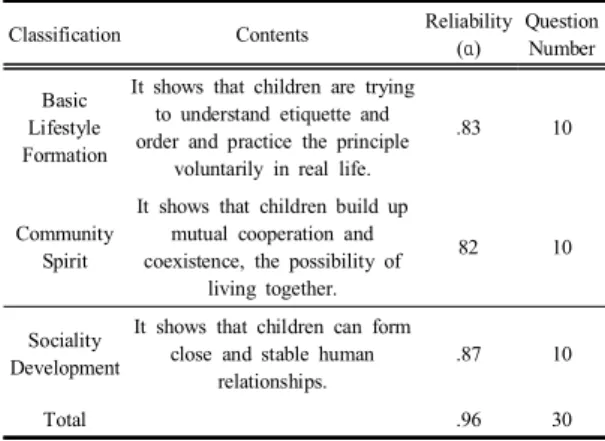
2.2.2 공동체의식 검사도구
유아의 공동체의식 측정 도구는Conners[18]의 검사 를 기초로 권오정[19]이 제작한 학부모용 평정 척도를 수정하여 교사용으로 만든 배윤진[20]의 평정척도를 사 용하였다. 이 척도는 5개의 하위영역(기본생활습관 형 성, 자아확립, 공동체 의식, 신체발달, 사회성 발달) 총 50문항으로 구성되었다. 본 연구에서는 자아확립성, 신 체발달영역, 2문항은 삭제해도 본 연구에서 요구되는 유 아의 공동체의식 덕목을 측정하기에 적절하다고 판단했 기에 그 문항을 제외하고 본 연구에 적합한 문항으로 수 정·보완하여 검사를 진행하였다.
Table 2. Character Cultivation Virtue and Reliability
Classification Contents Reliability
(α)
Question Number
Basic Lifestyle Formation
It shows that children are trying to understand etiquette and order and practice the principle
voluntarily in real life.
.83 10
Community Spirit
It shows that children build up mutual cooperation and coexistence, the possibility of
living together.
82 10
Sociality Development
It shows that children can form close and stable human
relationships.
.87 10
Total .96 30
이 검사도구의 각 문항은 전혀 그렇지 않다(1점), 그 렇지 않다(2점), 보통이다(3점), 그런 편이다(4점), 아주 그렇다(5점)의 5단계 Likert척도로 이루어져 있고 검사 자가 유아의 행동과 일치하는 정도에 따라 평정하도록 되어 있다. 점수가 높을수록 공동체의식 수준이 높음을 의미한다. 검사도구의 부정적 문항은 역점수로 처리하도 록 구성되어 있다. 본 검사의 전체 신뢰도는 .96으로 나 타났다.
2.2.3 검사절차 및 채점방법
검사 및 채점은 교사와 유아간1:1 개인 면접을 통해 조용한 공간에서 유아와 교사의 상호작용을 통하여 실험 처치 기간 동안 교사가 관찰한 결과를 종합하여 실시하 였으며, 통제집단 또한 유아 와 1:1 개인면접을 통해 관 찰한 결과를 통하여 실험집단과 같은 방법으로 실시하였다.
2.3 연구절차
숲동화 구연학습을 통한 유아의 감정조절과 공동체의 식 함양에 미치는지 알아보기 위한 전체적인 연구 절차 와 과정은 다음과 같다.
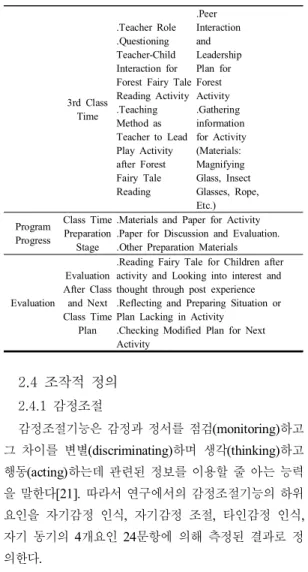
본 연구는 연구를 위해 예비검사1주간, 교사교육 1주 간, 사전검사를 위한 준비가 이루어졌고, 1주간의 사전 검사를 거쳐8주간의 16회기 실험처지, 실험처치 후 1주 간의 사후검사 순으로 이루어졌다. 예비검사는 본 연구 를 실시하기에 앞서 본 연구에 사용될 검사도구의 적절 성과 문제점을 파악하고 검사시간, 검사방법의 효율성 등을 파악하기 위해 실시하였다. S시의 T 유아교육기관 에서1주에 거쳐 만 5세반 유아(남아 5명, 여아 5명)을 대상으로 실시하였다. 실시결과 검사도구의 적절성여부 와 검사 시 질문요령 등을 파악한 결과 유아들이 검사문 항을 어려워하지 않고 대답하는 것으로 보아 유아의 발 달단계에 적합하다는 검사도구로 판명되었다. 본 연구의 교사훈련은1주 동안 3회에 걸쳐 30분씩 연구자가 실험 집단 교사, 비교집단 교사 2인보조교사를 대상으로 실시 하였다. 연구자는 교사에게 본 연구의 주제, 목적, 교수- 학습 방법, 교사의 역할, 유의점 등에 대하여 인쇄자료를 제공하고 교사교육을 실시하였다. 교사교육의 내용은 다 음과 같다.
2.4 조작적 정의 2.4.1 감정조절
감정조절기능은 감정과 정서를 점검(monitoring)하고 그 차이를 변별(discriminating)하며 생각(thinking)하고 행동(acting)하는데 관련된 정보를 이용할 줄 아는 능력 을 말한다[21]. 따라서 연구에서의 감정조절기능의 하위 요인을 자기감정 인식, 자기감정 조절, 타인감정 인식, 자기 동기의4개요인 24문항에 의해 측정된 결과로 정 의한다.
2.4.2 숲동화 구연학습
본 연구에서의 숲동화는 공동체의식 덕목인 배려, 존 중, 협력, 나눔, 질서, 효의 내용을 주제로 실천중심의 교 육활동을 숲 놀이와 조화롭게 이루어진 동화를30개 문 항에 의해 측정된 결과로 정의한다.
Classification Training
Contents Materials Time
Before Program Application
1st Class Time
.Forest-Related Theory and Basic Concept .Concept of Forest Fairy Tale
Actual PPT to Help the Understanding of Teacher Training
q30 Minutes 2nd Class
Time
Guidance on Forest Play Activity, Fairy Tale Reading Awareness and Role
.Teacher Training Plan for Forest .Fairy Tale Questionnaire for This Study
Table 3. Training Course and Contents for Early Childhood Teachers
3rd Class Time
.Teacher Role .Questioning Teacher-Child Interaction for Forest Fairy Tale Reading Activity .Teaching Method as Teacher to Lead Play Activity after Forest Fairy Tale Reading
.Peer Interaction and Leadership Plan for Forest Activity .Gathering information for Activity (Materials:
Magnifying Glass, Insect Glasses, Rope, Etc.) Program
Progress
Class Time Preparation
Stage
.Materials and Paper for Activity .Paper for Discussion and Evaluation.
.Other Preparation Materials
Evaluation
Evaluation After Class and Next Class Time
Plan
.Reading Fairy Tale for Children after activity and Looking into interest and thought through post experience .Reflecting and Preparing Situation or Plan Lacking in Activity
.Checking Modified Plan for Next Activity
Topic Selection 2017. 6.1 ~ 6.9.
Program Composition and
Preliminary Research 2017. 6.12 ~ 6.16
Preliminary Test 2017. 6.19 ~ 23
Teacher Training 2017. 6.26 ~ 6. 28
Pretest 2017. 6. 28 ~ 7. 3
Program Implementation
(Experimental Treatment) 2017. 7,3~ 8. 25
Table 4. Contents of Research Procedure
2.4.2.1 예비검사
본 연구를 실시하기 전에 유아의 감정조절기능과 공 동체의식 함양 검사지의 적절성 활동의 전개과정 및 소 요시간을 검증해보기 위해 실험연구 대상이 아닌 다른 집단 만4~5세 중 5명을 대상으로 2017월 6월 19일~6월 23일 까지 예비검사를 실시하였다.
2.4.2.2 예비실험
예비실험에서는 숲동화의 구연학습을 통해 유아의 반 응과 흥미 수업시간 등을 관찰 기록하고 진행하여 분석 후 문제점을 검토하여 검사지의 수정·보완을 통해 숲활 동에 반영하였다.
2.4.2.3 교사교육
본 연구를 위해2017년 6월 26일 ~ 6월 28일 까지 교 사훈련을 실시하였다.
본 연구는2017년 6월 1일부터 8월 30일에 걸쳐 사전 검사, 실험처치, 사후검사의 순서로 실시하였다.
2.4.2.4 사전검사
사전검사는2017년 6월 28일 ~ 7월 3일 까지 실험집 단과 비교집단 유아들을 대상으로 사전검사를 실시하였 다. 감정조절기능 검사도구와 공동체의식 함양 검사 도 구는 숲동화 구연학습 활동 전 교실에서 일어나는 행동 과 반응, 언어적 표현을 관찰 하여 실험집단과 비교집단 의 담임교사가 각각 평정하도록 교육하였다. 사전검사를 하기전에 담임교사에 검사방법과 주의할 점 등을 인지할 수 있도록 교사 훈련을 통하여 지도했다. 교사에게 유아 의 일상생활 속에서 행동이 어떠했는지 반응을 물어보고 평소의 일상생활 행동에 더 초점을 두고 기록하였다.
2.4.2.5 숲동화 선정
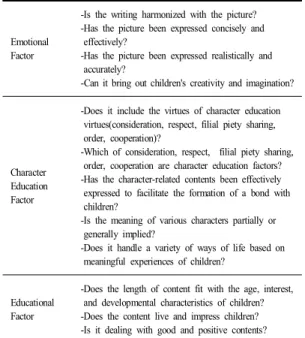
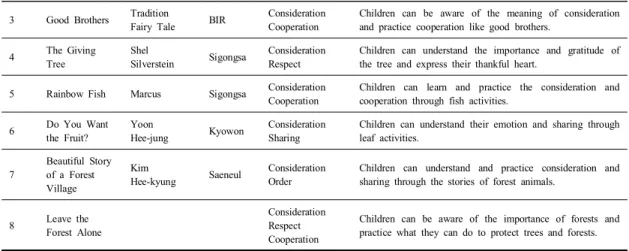
본 연구에서 사용된 숲동화는 교육과학기술부[16]가 제안한(배려, 존중, 나눔, 질서, 협력) 5가지 공동체의식 덕목으로 동화책을 선정하고 누리연계 주제를 배경으로 선정을 하였다. 숲동화를 활용한 예술경험 활동이 유아 의 감정조절기능과 친사회적 행동에 미치는 영향[23], 동화 활용 역할놀이가 유아의 공동체의식 함양에 미치는 효과[24]를 참고하였다. 숲동화의 평가준거의 타당도와 신뢰도 프로그램의 내용과 교수학습 방법은 유아교육 전 공교수 자문을 구하여 숲동화를 읽어주고 숲에서 놀이하 기의 적절성과 타당성을 재 검수 받고, 숲동화 총 20권 을1차로 선정하고, 2차적으로 누리교육과정을 연계하 여 실시할 실험처치를 위해 현장에서 근무하고 있는 최 종적 지도와 자문을 구하여8권을 선정을 하였다. 선정 된 기준은 다음과 같다.
Table 5. Selection Criteria of Forest Fairy Tale
Table 6. List of Character Fairy Tales
Emotional Factor
-Is the writing harmonized with the picture?
-Has the picture been expressed concisely and effectively?
-Has the picture been expressed realistically and accurately?
-Can it bring out children's creativity and imagination?
Character Education Factor
-Does it include the virtues of character education virtues(consideration, respect, filial piety sharing, order, cooperation)?
-Which of consideration, respect, filial piety sharing, order, cooperation are character education factors?
-Has the character-related contents been effectively expressed to facilitate the formation of a bond with children?
-Is the meaning of various characters partially or generally implied?
-Does it handle a variety of ways of life based on meaningful experiences of children?
Educational Factor
-Does the length of content fit with the age, interest, and developmental characteristics of children?
-Does the content live and impress children?
-Is it dealing with good and positive contents?
Posttest 2017. 8.. 28.~8. 31
Data Analysis 2017.9. 4~ 9. 8
Sessi on
Fairy Tale
Book Tile Author Publisher Content Expected Effect
1 I Will Help You
Elizabeth
Bennett Kidsm
Consideration Respect Cooperation
Through the various obstacles during the picnic in the bear and the mouse, children can learn consideration for and cooperation with each other
2 Fox and Crane Aesop's Fable Daekyo Consideration Understanding
Children can know how to think and behave from the
perspective of other people while understanding someone
else's heart well.
2.4.2.6 숲동화 연계 숲활동
첫째, 1차시에는 유아들의 발달 수준에 따른 누리교 육과정 연계 숲동화를 숲에서 유아들과 함께 읽어주고 동화의 내용을 회상한 후 그와 관련된 사후 활동으로 숲 동화에 대한 유아들의 생각을 창의적으로 표현해 보고, 숲활동을 하였다.
둘째, 2차시에는 숲동화 회상하기를 통해 누리연계 교육과정과 연계 사후활동으로 교실에 자신의 숲 놀이 경험으로 생각과 느낌을 연계하여 표현하는 워크북활동 을 진행하였다. 워크북활동 후에는 숲동화 확장 활동으 로 실내 숲 자유놀이를 하였다.
매주 2회 숲동화 읽기를 연계한 누리연계 숲활동은 동화를 감상한 후 동화 속 주인공들의 감정조절 요소와 관련된 유아들의 경험이나 생각을 이끌어 내어 자신을 표현해 보도록 한 후 교사가 유아들과 모둠 수업을 통해 이끌어 나갔다.
Table 7. Daily Schedule Operation of Experimental Group Class and Comparative Group Class(Example)
2.4.2.7 실험 처치
본 연구는2017년 7월 3일부터 8월 25까지 총 8주 간 16회에 걸쳐 총 8권의 숲동화로 구성하여 계획하였다.
유아들과 함께 숲동화 듣기를 통해 이야기 나누기 활동 후 동화 내용 연계 숲활동을 진행 도입-전개-마무리- 평 가를 통해 숲동화 내용을 숲활동과 연계하여 활동하였 다. 유아들과 교실에서 들어와서 관련 워크북 활동으로 내용을 다시한번 유아들과 회상하였다. 시간은 오전 10 시20분 ∼ 11시 00분까지 진행하였으며 비교집단은 같 은 시간에 누리과정 연계 동화를 듣고 실외 자유놀이를 실시하였다.
Time Experimental Group Comparative Group
09:00 ~ 09:40
Attendance and Free Choice Activities
Attendance and Free Choice Activities
09:40 ~ 10:00
Organizing Snacks and Going to Toilet
Organizing Snacks and Going to Toilet
10:00 ~
10:20 Sharing Plans and Stories Sharing Plans and Stories
10:20 ~ 11:00
.Reading Nuri Curriculum-Linked Forest Activities(Forest Fairy Tale)
.Forest Play
.Reading Nuri Curriculum-Linked Theme Fairy Tales
.Free Play
11:00 ~ 12:00
.Recalling Evaluation .Workbook Activities
.Nuri Curriculum-Linked Forest Fairy Expanding Forest Play
Outdoor Free Play
12:00 ~ 12:40
Lunch and Free Choice Activities
Lunch and Free Choice Activities
12:40 ~
14:40 Characterization Activities Characterization Activities
14:40 ~ 15:00
Snacks and Homecoming Guidance
Snacks and Homecoming Guidance
15:00~
19:30 Integrated Child Care Integrated Child Care 3 Good Brothers Tradition
Fairy Tale BIR Consideration
Cooperation
Children can be aware of the meaning of consideration and practice cooperation like good brothers.
4 The Giving
Tree
Shel
Silverstein Sigongsa Consideration Respect
Children can understand the importance and gratitude of the tree and express their thankful heart.
5 Rainbow Fish Marcus Sigongsa Consideration
Cooperation
Children can learn and practice the consideration and cooperation through fish activities.
6 Do You Want
the Fruit?
Yoon
Hee-jung Kyowon Consideration
Sharing
Children can understand their emotion and sharing through leaf activities.
7
Beautiful Story of a Forest Village
Kim
Hee-kyung Saeneul Consideration
Order
Children can understand and practice consideration and sharing through the stories of forest animals.
8 Leave the
Forest Alone
Consideration Respect Cooperation
Children can be aware of the importance of forests and
practice what they can do to protect trees and forests.
Annual Theme Nuri Curriculum/ Forest/ Character
Month Theme/
Week Sub-theme Selected
Fairy Tale Nuri Area Activity Name
Character Virtue
Preparation Material
Place
Group Expected Effect
7 Cool
Summer
1 Summer's
Appearance I Will Help You
Social Relationship Communication
‘I Will Help You’
(Helping Each Other)
Consideration
Character Children's Song CD, Character Fairy Tale ‘I
Will Help You’
Forest Classroom Large Group
Through the various obstacles during the picnic in the bear and the mouse,
children can learn consideration for each other.
Natural Inquiry Communication
Interviewing Tree
Consideration Sharing
Tree Cloths, Recorder, Microphone,
Reporter Necklace, Model Camera, Question List
Maple Tree Forest &
Small Geoup
Children can know how to love the tree from the perspective of it while understanding its heart well.
2
Healthy Summer Survival
Fox and Crane
Social Relationship Communication
‘Fox and Crane’
I understand my friend's
feelings!
Consideration, Understanding
Character Children's Song CD, Character Fairy Tale
‘Fox and Crane’
Forest Classroom Large Group
Children can know how to think and behave from the perspective of other people
while understanding someone else's heart well.
Physical Exercise Health Communication
Becoming Forest Animals and
Plants
Consideration Understanding
Headband (Forest Animals and
Plants)
Maple Tree Forest &
Large and Small Group
Children can become forest animals and plants with interest to understand them.
3
Enjoyable Water Play
Ⅰ
Good Brothers
Social Relationship Communication
Good Brothers (Consideratio
n)
Consideration
Character Children's Song CD, Traditional Fairy Tale
‘Good Brothers’
Forest Classroom Large Group
Children can be aware of the meaning of consideration and practice cooperation like
good brothers.
Communication Art Experience Nature Inquiry
I give thanks to my family(brothe
rs and sisters).
Consideration Sharing
Natural Object, Writting Tool,
Wood Glue, Etc.
Maple Tree Forest &
Large and Small Group
Children can give their thankful heart to their family(brothers and sisters)
with natural objects.
4
Enjoyable Water Play
Ⅱ
The Giving
Tree
Communication Social Relationship
The Giving Tree
Consideration Sharing
Character Children's Song CD, Character Fairy Tale
‘The Giving Tree’
Forest Classroom Large Group
Children can understand the importance and gratitude of the tree and express their
thankful heart in puppet plays.
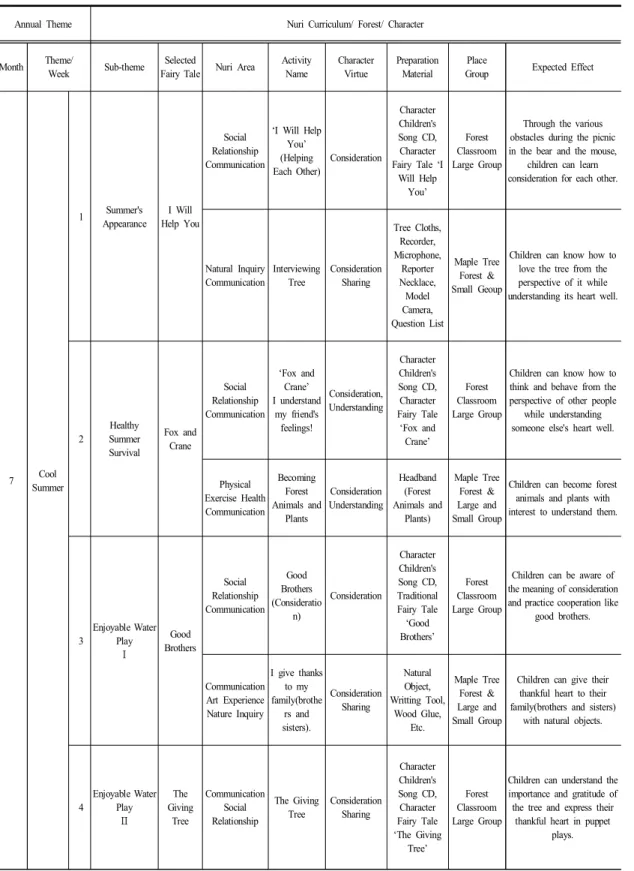
Table 8. Program of Nuri Curriculum-Linked Forest Play Activities(16th Class Time)
Communication Social Relationship Nature Inquiry
The Village Protecting
Tree
Consideration Respect
Camera, Tree Picture, Drawing Tool
Tree Grandfather
Pavilion
Children can develop their attitude to value and protect the tree with an interest in it.
8 Traffic
and Safety
5 My Curious Transportation
Rainbow Fish
Communication
Art Experience Rainbow Fish Consideration Sharing
Character Children's Song CD, Character Fairy Tale
‘Rainbow Fish’
Forest Classroom Large Group
Children can learn and practice the consideration and sharing through fairy tales while appreciating them in a right posture.
Communication Social Relationship Nature Inquiry Art Experience
Making Leaf Fish
Consideration
Sharing Natural Object
Maple Tree Forest &
Large and Small Group
Children can express the fish with various leaves while observing them.
6
Convenient Transportation
Facilities
Do You Want the Fruit?
Communication Social Relationship
Do You Want the Fruit?
Consideration Sharing
Character Children's Song CD, Character Fairy Tale ‘Do You Want the
Fruit?’
Forest Classroom Large Group
Children can know the benefits that forests and
trees give to us.
Nature Inquiry
Art Experience Forest Friend Consideration Sharing
Various Bird Songs
Maple Tree Forest &
Large and Small Group
Children can feel the beauty to consider and understand each other while listening to
the birds.
7 Future
Transportation Beautiful Story of Forest Village
Communication Social Relationship
Beautiful Story of Forest Village
Consideration Sharing
Love
Character Children's Song CD, Character Fairy Tale
‘Beautiful Story of Forest
Village’
Forest Classroom Large Group
Children can understand and practice consideration and sharing through the stories
of forest animals.
Physical Exercise Health
Nature Inquiry
Waking through the
Forest (Have Fun)
Consideration Order
Various Rhythm Instruments
Maple Tree Forest &
Large and Small Group
Children can walk while controlling their body to the
sound.
8
Safe Transportation
Culture
Leave the Forest Alone
Communication Nature Inquiry
Social Relationship
Leave the Forest Alone
Consideration Respect
Character Children's Song CD, Character Fairy Tale
‘Leave the Forest Alone’
Forest Classroom Large Group
Children can be aware of the importance of forests and practice what they can
do to protect trees and forests.
Communication Nature Inquiry
Nature Conservation
Campaign
Consideration Respect
Megaphone, Picket, Shoulder Band, Leaflet
Near Kindergarten
Around Forest
Children can learn and practice how to protect the
forests while finding out
where they are polluted.
2.4.2.8 사후검사
사후 검사는 효과 검증을 위해 2017년 8월 28일 ∼ 8월 31일에 사전검사와 동일한 방법으로 실험집단과 비 교집단의 담임교사 감정조절기능 검사도구와 언어표현 검사도구의 사후검사를 동일한 방법으로 실시하였다.
2.5 자료처리
본 연구의 통계처리는SPSS/WIN 통계프로그램22.0 을 활용하였으며 분석방법은 다음과 같다.
첫째, 본 연구에 사용된 척도의 신뢰도 검사를 위해 Cronbach′s α 계수를 산출하였다.
둘째, 숲동화 읽기 활동이 유아의 감정조절기능과 언 어표현 행동에 미치는 효과를 살펴보기 위해 대 응표본 t-test와 독립표본 t-test를 실시하였다.
4. 실증분석
4.1 집단 간의 동질성 검정
공동체의식 항목과 감정조절기능에 대한 실험 전 실 험집단과 비교집단 두 집단이 4개 항목 기본생활습관, 공동체의식, 사회성발달, 자기인식에 있어 동질적인 집 단으로 구성되어 있는지 확인하기 위하여Levene 분산 의 동질성 검정을 실시하였다.
분석 결과, 유아들의 숲동화 활동을 구성하는 4개의 요인들의 실험집단과 비교집단 간의 차이가 통계적으로 유의하지 않은 것으로 나타나 두 집단은 유의수준.05에 서 기본생활습관(p=.068), 공동체의식(p=.269), 사회성 발달(p=.575), 자기인식(p=.064)로 모두 동질의 집단임 을 확인하였다.
Table 9. Homogeneity Test
Classification Levene df1 df2 p
Basic Lifestyle 3.534 1 37 .068
Community Spirit 1.259 1 37 .269
Sociality
Development .320 1 37 .575
Self-Awareness 3.640 1 37 .064
Test Significant Level p=.05
4.2 숲동화 활동 전, 후 차이 검정
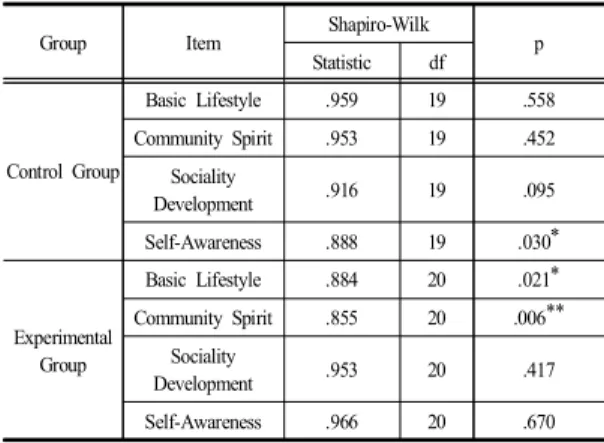
숲동화 활동 전과, 후의 차이를 검정하기 위해 먼저 전-후 차이에 대하여 실험집단과 통제집단을 나누어 Shapiro-Wilk의 정규성 검정을 실시하였다.
Shapiro-Wilk 통계량의 경우 표본의 수와 상관없이 가장 높은 정규성 검정력을 가진다[27]. 이를 기준으로 본 연구의 표본의 정규성을 검토한 결과 통제집단에서는 기본생활습관, 공동체의식, 사회성발달 항목은 유의수준 .05에서 정규성을 따르며, 자기인식은 정규성을 보인다 고 할 수 없다. 실험집단은 사회성발달, 자기인식에 대하 여 정규성을 따르지만 기본생활습관 및 공동체의식에 대 하여 정규성을 따른다고 할 수 없다. 이를 Table. 10에서 확인할 수 있다.
Table 10. Normality Test Based on Shapiro-Wilk Statistic
Group Item Shapiro-Wilk
Statistic df p
Control Group
Basic Lifestyle .959 19 .558
Community Spirit .953 19 .452
Sociality
Development .916 19 .095
Self-Awareness .888 19 .030*
Experimental Group
Basic Lifestyle .884 20 .021*
Community Spirit .855 20 .006**
Sociality
Development .953 20 .417
Self-Awareness .966 20 .670
Significant Probability : * p<.05, ** p<.01, *** p<.001
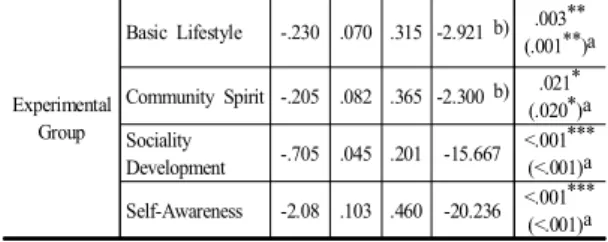
숲동화 활동 전과 숲동화 활동 후의 차이에 대하여 정 규성을 따르는 항목은 대응표본t-test를 정규성을 따른 다고 할 수 없는 항목에 대하여 비모수 방식인 윌콕슨 부호 순위 검정(Wilcoxon Signed Rank test)을 실시하여 대응 표본간의 전-후 평균의 차이를 확인한 결과 다음 Table. 11과 같이 볼 수 있다.
먼저 통제집단의 경우는 다음과 같다.
첫째, 기본생활습관은 숲동화 활동 전 평균 2.542점 에서 숲동화 활동 후 평균2.463점으로 0.79정도 낮아졌 으나t-test 결과 유의확률 p=.096로 유의수준 .05에서 유의한 차이를 보였다.
둘째, 공동체의식은 숲동화 활동 전 평균 2.537점에 서 숲동화 활동 후 평균2.437점으로 .100점 낮아짐을
볼 수 있으며, t-test 결과 유의확률 p=.028로 유의수준 .05에서 유의한 차이라 할 수 있다.
셋째, 사회성 발달은 숲동화 활동 전 평균 2.742점에 서 숲동화 활동 후 평균 2.558점으로 .184점 낮아짐을 볼 수 있으며, t-test 결과 유의확률 p<.001로 유의수준 .05에서 유의한 차이라 할 수 있다.
넷째, 자기인식은 숲동화 활동 전 평균 2.544점에서 숲동화 활동 후 평균2.781점으로 .237점 높아짐을 볼 수 있으며, 윌콕슨 부호 순위 검정 결과 유의확률 p=.001로 유의수준 .05에서 유의한 차이라 할 수 있다.
다음으로 실험집단의 결과는 다음과 같다.
첫째, 기본생활습관은 숲동화 활동 전 평균 2.990점 에서 숲동화 활동 후 평균3.220점으로 0.23정도 높아졌 으나 윌콕슨 부호 순위 검정 결과 유의확률p=.003으로 유의수준.05에서 유의한 차이라 할 수 있다.
둘째, 공동체의식은 숲동화 활동 전 평균 2.990점에 서 숲동화 활동 후 평균 3.195점으로 .205점 높아짐을 볼 수 있으며, 윌콕슨 부호 순위 검정 결과 유의확률 p=.021로 유의수준 .05에서 유의한 차이라 할 수 있다.
셋째, 사회성발달은 숲동화 활동 전 평균 2.670점에 서 숲동화 활동 후 평균 3.375점으로 .705점 높아짐을 볼 수 있으며, t-test 결과 유의확률 p<.001로 유의수준 .05에서 유의한 차이라 할 수 있다.
넷째, 자기인식은 숲동화 활동 전 평균 1.250점에서 숲동화 활동 후 평균3.333점으로 2.08점 높아짐을 볼 수 있으며, t-test 결과 유의확률 p<.001로 유의수준 .05 에서 유의한 차이라 할 수 있다.
또한 모든 대응 표본 검정결과Monte Carlo 시뮬레이 션을 통하여1000개의 표본에 대한 유의확률 역시 검정 통계량에 대한 유의확률과 동일한 결과를 확인 할 수 있 었다.
4.3 숲동화 활동 후, 두 그룹 간의 차이 숲동화 활동 후 실험집단과 통제집단 간의 기본생활 습관, 공동체의식, 사회성발달, 자기인식 항목에 대하여 평균 점수의 차이가 있는지 확인하였으며, 그 결과 Table. 12와 같이 볼 수 있다.
기본생활습관 평균.757점, 공동체의식 .758점, 사회 성발달.817점, 자기인식 .552점의 차이를 실험집단에서, 통제집단에 비해 높은 차이를 보여 주었으며, 이 평균 점 수 차이는 유의수준.05에서 유의하다고 할 수 있다.
Table 12. Mean Comparison of After Forest Fairy Tale Activities
Classification
Group
t p
Experimental Group (n=20)
Control Group (n=19)
M SD M SD
Basic Lifestyle 3.220 .177 2.463 .198 -12.62 <.001***
Community Spirit 3.195 .188 2.437 .245 -10.87 <.001***
Sociality
Development 3.375 .174 2.558 .209 -13.29 <.001***
Self-Awareness 3.333 .499 2.781 .393 -3.83 <.001***
Significant Probability : *** p<.001
5. 논의 및 결론
이상의 연구결과를 종합하면, 전체적으로 실험집단이 통제집단보다 높게 나타나 실험집단의 숲동화 활동의 유 용성을 입증해주었다. 이는 특히 기본생활 습관과 공동 체의식, 사회성발달, 자기인식 모두 실험집단에서 비교 집단에 비해 높게 나타나 숲체험 활동에서의 자연과의 소통과 함께 동화소재를 자연 속에서 읽어 듣고 직접 체 험케함으로써 유아들이 동화를 들으면서 주의집중하고
Table 11. Mean Comparison between Before and After
Forest Fairy Tale Activities
Group Item
Mean
S.D Test Statistic p Before-
After S.E
Control Group
Basic Lifestyle .079 .045 .196 1.756 .096 (.092)a Community Spirit .100 .042 .183 2.387 .028*
(.039*)a Sociality
Development .184 .034 .146 5.488 <.001***
(.001**)a Self-Awareness -.237 .039 .170 -3.460 b) .001**
(.001**)a
Experimental Group
Basic Lifestyle -.230 .070 .315 -2.921 b) .003**
(.001**)a Community Spirit -.205 .082 .365 -2.300 b) .021*
(.020*)a Sociality
Development -.705 .045 .201 -15.667 <.001***
(<.001)a Self-Awareness -2.08 .103 .460 -20.236 <.001***
(<.001)a Significant Probability : * p<.05, ** p<.01, *** p<.001
a) Monte Carlo Simulating 1000 Samples Significant Probability
b) Wilcoxon Signed rank test Statistic Z
자연과의 교감 속에 자연 그대로 느끼는 순수한 감성을 바탕으로 또래와 함께 상호 협력하고 공존을 위한 관계 향상은 물론 원칙과 질서를 지키고 이를 실천하려는 소 중한 마음이 동화 속 이야기와 함께 감정조절기능까지 증가시킴을 실증해준 것으로 평가할 수 있다.
이 같은 결과는 또래 간 상호작용에 따른 행동 및 발 달 수준을 바탕으로 상호간의 동질감과 이해를 공유하는 숲동화 놀이를 통해 또래 간 상호작용을 통한 유아가 다 른 유아를 상대로 하는 의도적인 행위와 이에 대한 다른 유아의 반응으로 이루어지는 대인간의 사회적인 과정으 로서 두 사람 이상이 언어, 신체, 정서적 사회적으로 서 로 영향을 주고받는 자연스러운 놀이 행동 속에 통합성 과 친사회성을 증진시킬 수 있음을 의미한다. 따라서 유 아의 숲동화 구연활동이 자기 감정조절과 또래 간 상호 작용 촉진을 위한 공동체의힉 증진에 매우 유익한 숲동 화 활동의 교육적 유용성을 시사해 준 것으로 평가할 수 있다.
이 같은 결과는 안라리[26], 문혁준[27], Rubin et al.[28]이 밝힌 또래 간 상호작용을 통해 협동적으로 교 환하며 이어가는 과정에서 유아들의 숲활동에서 언어, 신체, 정서적, 사회적으로 서로 교감하는 소통능력이 향 상되고 감성적 지능과 이성이 개선될 수 있음을 입증한 선행연구 결과를 지지해줌으로 본 연구의 결과에 대한 교육적 의의를 뒷받침해준다.
따라서 이 같은 유용성을 바탕으로 향후 숲동화 체험 활동을 기존 누리과정에 연계시켜 교육소재로서 동화읽 기를 적극 활용함으로써 자기통제가 잘 안되는 유아들의 감정조절기능의 치유적기능을 적극 활용할 것을 적극 권 장한다. 마지막으로 본 연구는 특정지역의 제한된 소재 와 유아를 대상으로 연구한 점에서 결과를 일반화하는데 제한을 가지며 향후 전국적 표본을 통한 후속적 연구가 요구된다.
Reference
[1] J. H. Lee, The Effects of Nature-Friendly Inquiry Activities In the Forest on Children's Creativity, Master's Thesis from Graduate School of Education at Kyungnam University, 2013.
[2] M. N. Lee, Y. A. Kim, “The Effects of Young Children's Forest Paly Program”, Asia-pacific Journal of Multimedia Services Convergent with Art, Humanities, and Sociology, Vol.6, No.4, pp.271-278, 2016.
DOI: http://dx.doi.org/10.14257/AJMAHS.2016.04.29 [3] M. N. Lee, O. H. Oh, “Research Trends Related
Forest-Therapy Focusing on the Academic Journal”, Asia-pacific Journal of Multimedia Services Convergent with Art, Humanities, and Sociology, Vol.6, No.9, pp.585-593, 2016.
DOI: http://dx.doi.org/10.14257/AJMAHS.2016.09.34 [4] M. S. Ahn, “The Effect of Young Children's Art
Expression Abilities and Creativity in Early Childhood Art Education through the Experience of Playing in the Forest”, Korean Society for Holistic Convergence Education, Vol.17 No.1 pp.101-131, 2013.
[5] S. Lee, “A Study on the Validation of Factors Compatible with Educational Content for Convergence of Korean Forest Kingdergarten and Nuri-Curriculum”, Asia-pacific Journal of Multimedia Services Convergent with Art, Humanities, and Sociology, Vol.6, No.6, pp.217-228, 2016.
DOI: http://dx.doi.org/10.14257/AJMAHS.2016.06.25 [6] R. A. Wilson. “Nature and Young Children: A Natural
Connection”, Young Children, Vol.50, No.6, pp.4-11, 1995.
[7] Y. Kang, C. O. Park, “Infant Forest Experience Education on Observation and Self-Control”, Asia-pacific Journal of Multimedia Services Convergent with Art, Humanities, and Sociology, Vol.6, No.6, pp.241-250, 2016.
DOI: http://dx.doi.org/10.14257/AJMAHS.2016.06.29 [8] S. K. Lee, “A Study of the Effects of Children's Forest
Art Creativity Project”, Art Education Review, Vol.44, pp.205-230, 2012.
[9] J. Woo, H. Han, S. Lee, “An Exploratory Study on Smart Learning Environment”, The Journal of The Institute of Internet, Broadcasting and Communication, Vol.16, No.1, pp.21-31, 2016.
DOI: http://dx.doi.org/10.7236/JIIBC.2016.16.1.21 [10] Y. N. Hong, “An investigation of predictability among
variables having an effect on problem solving skill and achievement in collaborative learning by utilizing SNS”, The Journal of The Institute of Internet, Broadcasting and Communication, Vol.16, No.5, pp.221-228, 2016.”
DOI: http://dx.doi.org/10.7236/JIIBC.2016.16.5.221 [11] A. K. Chung, Y. N. Hong, J. J. Kang, “An Investigation
of the Predictability of Variables Related to Kindergarten Preservice Teachers’ Technology Intention to Use”, The Journal of The Institute of Internet, Broadcasting and Communication, Vol.16, No.6, pp.217-223, 2016.
DOI: https://doi.org/10.7236/JIIBC.2016.16.6.217 [12] C. S. Lim, “Effect of Pre-early Childhood Teachers’
Self-efficacy and Ego Resiliency on SNS Addiction Tendency”, The Journal of The Institute of Internet, Broadcasting and Communication, Vol.17, No.1, pp.191-197, 2017.
DOI: https://doi.org/10.7236/JIIBC.2017.17.1.191 [13] S. L. Kim, “Interpretation of attachment stability and
instability of infants and toddlers”, Humanities Series, Vol.21, pp.147-162, 2004.
[14] S. O. Koh, S. S. Hwang, “Effects of Liberty Activity
Using Fairy Tales on Children’s Prosocial Behavior”,
Asia-pacific Journal of Multimedia Services Convergent
with Art, Humanities, and Sociology, Vol.6, No.8,
pp.281-289, 2016.
DOI: http://dx.doi.org/10.14257/AJMAHS.2016.08.44 [15] J. K. Kim, Y. S. Kang, “The Effects of Etiquette
Education for Children’s Fairly Tale Reading on Improvement of Personality Thinking”, Asia-pacific Journal of Multimedia Services Convergent with Art, Humanities, and Sociology, Vol.6, No.9, pp.365-374, 2016.
DOI: http://dx.doi.org/10.14257/AJMAHS.2016.09.26 [16] M. H. Lee, E. S. Kim, “The Effects of Forest Education
on Children`s Attentiveness”, Korean Society for Eco Early Childhood Education, Vol.10 No.4, pp.149-170, 2011.
[17] H. I. Hwang, E. J. Kim, J. E. Song, M. J. Kim, J. Y.
Yu, “A study on the perceptions and needs of pre-service early childhood teachers and early childhood teachers on the forest kindergarten”, Korea Open Association for Early Childhood Education, Vol.17 No.5, pp.165-188, 2012.
[18] H. Y. Kim, M. O. Lee, "The effects of the kindergarten-home cooperated ecology storybook-related activities on kindergarten children’s eco-friendly attitudes.", The Journal of Korea Open Association of Early Childhood Education, Vol.17, No.2, pp.19-45, 2013.
[19] Y. J. Lim, M. J. Kim., "The Effect of Making Ecological Picture Books on Children's Eco-Friendly Attitude", The Journal of Korea Open Association of Early Childhood Education, Vol.16, No.2, pp.85-107, 2011.
[20] Y. R. Chae, S. H. Lim, Y. Y. Park, "The effects of dramatic play using environmental-fairy tales on young children’s environment-friendly attitudes and environmental preservation knowledge", Early Childhood Education Research & Review, Vol.15, No.1, pp.351-369, 2011.
[21] M. S. Shin, S. H. Park, H. S. Cho, "The Effects of Wild Plant Project on Young Children’s Environment-Friendly Attitude and Their Scientific Research Abilities", Journal of Early Childhood Education & Educare Welfare, Vol.13 No.2, pp.301-324, 2009.
[22] J. E. Song, "A Study on the Perceptions and Needs of Early Childhood Teachers and Parents on Forest Kindergarten", Master’s thesis from Graduate School of Early Childhood Education at Bu-San University, 2011.
[23] Y. S. Lee. "A Study on Kindergarten Parents and Teachers' Perceptions and Demands for Forest Preschool". Master’s thesis from Graduate School at Pai-Chai University, 2013.
[24] M. H. Lee, "Teachers` Cognition of Forest Experience Education in Early Childhood Educational Institutions", Korea Ecology Early Childhood Education Association, Vol.10, No.1, pp.175-200, 2011.
[25] G. Daniel. Emotional Intelligence, NLP WORLD. Vol.5 No.2 pp.59-60, 1998.
[26] H. S. Park, (A) Study on the influences of experiential learning in a school forest on the students' sensitivity, Master's Thesis from Graduate School of Education at Kyowon University, 2008.
[27] K. A. Kim, The Influence of Forest Experience Activities on the Children's Sensitivity and Respectful
Recognition of Life, Master's Thesis from Graduate School of Education at Dongkuk University, 2011.
[28] C.K. Conners, “Symptom patterns in hyperkinetic, neurotic, and normal children”, Child development, Vol.41, No.3, pp.667-682, 1970.
[29] O. J. Kwon, (A) Study on Effects of the Elderly-Children Connection Program on the Development of Children's Personalities, Master's Thesis from Graduate School at Sungkyunkwan University, 2004.
[30] Y. J. Bae, The Effect of Theory of mind and Affective perspective taking on Display rule behavior and Display rule understanding, Master's Thesis from Graduate School at Kyoungpook University, 2007.
[31] P. Salovey., and J. D. Mayer. “Emotional Intelligence:
Imagination”, Cognition and Personality, Vol.9 No.3 pp.185-211, 1990.
[32] The Depatment of Education, Kindergarten education course commentary(1), 2011.
[33] M. H. Kim, The Impact of Art Play Activities Using Character Fairy Tales on Young Children's Emotional Intelligence and Social Behaviors, Dongguk University School of Education, 2016.
[34] S. G. Kim, The Effect of Role-Play Using Character-Related Picture Books on Preschoolers' Cultivation of Character. Master's Thesis from Graduate School of Early Childhood Education at Soongsil University, 2015.
[35] M. Mendes, and A. Pala. “Type I Error Rate and Power of Three Normality Tests”, Pakistan Journal of Information and Technology, Vol.2, No.2, pp.135-139, 2003.
[36] L. R. An, "The relationship between children's individual variables, mothers' emotionality and children's social competence", Family and Environment Research, Vol.
46, No. 2, pp.1-12, 2008.
[37] H. J. Moon. "Suggestions for child-centered care".
Journal of Korean Child and Adolescent Medicine. 2011.
[38] Rubin, K. H., William M. B., and Jeffrey G. P. Peer interactions, relationships, and groups. Handbook of child psychology, 1998.
강 영 식(Young-Sik Kang) [정회원]
•2004년 2월 : 원광대학교 유아교육
전공 (문학박사)
•2006년 8월 : 원광대학교 사회복지
학과 전공 (사회복지학박사)
•2012년 1월 ~ 현재 : 충남대학교
교육학과 교육대학원 ( 유아교육 전
공교수)
<관심분야>
유아교육, 숲교육 프로그램
마 지 순(Ma, ji sun) [정회원]