http://e-nrp.org
Effects of Cyclo-His-Pro-enriched yeast hydrolysate on blood glucose levels and lipid metabolism in obese diabetic ob/ob mice
Eun Young Jung1, Yang Hee Hong2, Chung Park3 and Hyung Joo Suh4§
1Department of Home Economic Education, Jeonju University, Jeonju 55069, Korea
2Department of Beauty Art, Suwon Women's University, Suwon 16632, Korea
3LINC Project Group, Daejeon University, Daejeon 34520, Korea
4Department of Public Health Sciences, Graduate School, Korea University, 145 Anam-ro, Sungbuk-gu, Seoul 02841, Korea
BACKGROUND/OBJECTIVE: We examined the hypoglycemic and anti-hyperlipidemic effect of yeast hydrolysate (YH) enriched with Cyclo-His-Pro (CHP) in the C57BL/6J ob/ob mouse model.
MATERIALS/METHODS: Mice were separated into 4 groups (8 mice/group) on the basis of blood glucose and body weight:
WT control, lean mice given vehicle; ob/ob control, ob/ob mice given vehicle; YH-1, ob/ob mice given 0.5 g/kg of YH; YH-2, ob/ob mice given 1 g/kg of YH. YH in saline or vehicle was administered orally in the same volume every day for 3 weeks.
RESULTS: Mice treated with YH (0.5 and 1 g/kg) for 3 weeks displayed a significant reduction in overall body weight gain and perirenal and epididymal adipose tissue weight compared to the ob/ob control group. Additionally, high-density lipoprotein (HDL) cholesterol, glucose, and atherogenic indexes were significantly decreased in the blood of YH-1 and YH-2 groups compared to the ob/ob control. In ob/ob mice, YH administration significantly improved glucose tolerance and blood insulin levels. These data indicate that YH treatment produces potent hypoglycemic and anti-hyperlipidemic effects by controlling body weight, fat mass, blood lipid, insulin levels, and glucose tolerance.
CONCLUSION: YH could potentially be used as a treatment option for diabetes and hyperlipidemia. The CHP-enriched YH may be a promising strategy in the development of hypoglycemic peptide nutraceuticals.
Nutrition Research and Practice 2016;10(2):154-160; doi:10.4162/nrp.2016.10.2.154; pISSN 1976-1457 eISSN 2005-6168 Keywords: Yeast hydrolysate, blood glucose, diabetes mellitus, cyclo-his-pro
INTRODUCTION4)
Diabetes mellitus is a serious, chronic metabolic disorder that significantly impacts the healthcare system as well as the health, quality of life, and life expectancy of individual patients [1].
Diabetes is divided into two major categories: type 1 diabetes (known as insulin-dependent diabetes mellitus or IDDM) and type 2 diabetes (known as non-insulin dependent diabetes mellitus or NIDDM). Diabetes mellitus is a major endocrine disorder, affecting nearly 10% of the world's population. At the turn of this century, 171 million individuals were estimated to have diabetes, and by 2030 the number is expected to increase to 366 million [2].
Recently, a variety of ingredients present in natural sources have been suggested to act on a variety of targets by various modes and mechanisms to exert medicinal effects [3, 4]. Since natural sources are usually considered to be less toxic and exhibit fewer side effects than synthetic sources [5], they have excellent therapeutic potential in complicated disorders like diabetes and its complications [6].
In our previous study [7], Flavourzyme and ultrafiltration
treatments were selected as the optimal processes for produ- cing yeast hydrolysate with a high content of cyclo-His-Pro (CHP). It is possible that CHP-enriched yeast hydrolysate may be useful as an antioxidative and/or antidiabetic material for the preparation of functional foods [7]. CHP is a naturally occurring cyclic dipeptide consisting of histidine and proline and is a metabolite of thyrotrophin-releasing hormone (TRH).
It is also synthesized through other biochemical processes and is found in many protein-rich, processed foods and peptide sources [8]. Since blood levels of CHP are increased after glucose ingestion in humans, CHP activity has been suggested to regulate glycemic control in diabetes [9]. Recently, dietary feeding of CHP plus zinc was shown to significantly improve insulin sensi- tivity and glucose tolerance in diabetic animal and human subjects [9-11]. Furthermore, several studies have demonstrated that CHP decreased food intake, mimicking the action of leptin, which controls appetite [12,13]. Hence, CHP plays an important role in the regulation of insulin and leptin sensitivity [11,14].
The purpose of this study was to investigate the hypoglycemic and anti-lipidemic effect of CHP enriched yeast hydrolysate (YH) in obese C57BL/6J-ob/ob mice.
§Corresponding Author: Hyung Joo Suh, Tel. 82-2-940-2853, Fax. 82-2-940-2859, Email. [email protected] Received: July 22, 2015, Revised: September 7, 2015, Accepted: October 7, 2015
This is an Open Access article distributed under the terms of the Creative Commons Attribution Non-Commercial License (http://creativecommons.org/licenses/by-nc/3.0/) which permits unrestricted non-commercial use, distribution, and reproduction in any medium, provided the original work is properly cited.
MATERIALS AND METHODS Preparation of yeast hydrolysate
An 8% yeast suspension was hydrolyzed for 48 h using Flavourzyme (endoprotease and exopeptidase from Aspergillus oryzae). The hydrolysis temperature was 50°C for crude enzyme, and the enzyme/yeast substrate ratio (E/S) was 1/100 for enzyme.
Hydrolysis of yeast with enzyme was performed in 0.01 M phosphate buffer. The solution pH was adjusted to 7.0 for Flavourzyme) before hydrolysis was initiated. Inactivation of enzyme was done by heating at 90°C for 5 min. The yeast hydrolysate obtained from enzymatic hydrolysis was first passed through a 0.2-μm membrane filter (Satocon cassette, Sartorius, Germany). A portion of the solution was removed immediately and the filtrate was then pumped through a 10-kDa molecular weight cut-off membrane (Satocon cassette). The yeast hydrolysate obtained from the filtration, and the resulting substance was dried and used as the yeast hydrolysate (YH).
Animals and diets
The experimental protocol was reviewed and approved by the Korea University Animal Care Committee (KUIACUC 2009 0420-2). Female C57BL/6J-ob/ob mice (ob/ob mice, 50 ± 3 g) and C57BL/6J lean wide type mice (WT mice, 21 ± 3 g) were obtained at 8-9 weeks of age from Daehan-BioLink Co. (Seoul, Korea).
They were individually housed in plastic cages with grated stainless steel floors. The colony room was maintained at 24
± 1°C with 60% atmospheric humidity and a 12 h light/12 h dark cycle. The mice had ad libitum access to water and a commercial diet (Samyang Co., Seoul, Korea) containing the following (g/kg of diet): moisture, 80; protein, 230; fat, 35; fiber, 50; and carbohydrate, 600. They were fed with normal chow and water ad libitum during an initial adaptation period of 1 week.
After an adaptation period, the mice were separated into 4 groups (8 mice/group) on the basis of blood glucose and body weight: WT control, lean mice given vehicle; ob/ob control, ob/ob mice given vehicle; YH-1, ob/ob mice given 0.5 g/kg of YH; YH-2, ob/ob mice given 1 g/kg of YH. YH in saline or vehicle was administered orally as the intragastric injection using oral gavage with a ball tip needle in the same volume every day for 3 weeks. The dosage was decided on the basis of previous studies including toxicological studies [7,15-17].
Measurement of body weight, food intake, blood lipid levels, organ weight, and the fat pad
Body weight and food intake were measured every 2 days for 3 weeks. At the end of the experimental period, the mice were anesthetized with CO2, and blood was collected in tubes treated with anticoagulant heparin. Blood was separated by centrifugation at 3,000 × g for 15 min at 4°C and stored at -70°C until required for further analysis. The liver, spleen, kidney, perirenal fat, and epididymal fat were removed and weighed after sacrificing the animals. Organ weight changes have long been accepted as a sensitive indicator of chemically induced changes to organs. In toxicological experiments, comparison of organ weights between treated and untreated groups8 of animals have conventionally been used to evaluate the toxic
effect of the test article [18,19].
Triacylglycerol, total cholesterol, and high-density lipoprotein (HDL) cholesterol levels in blood were measured using the FUJI DRI-CHEM 3500 i (Fuji Photo Film Co., Osaka, Japan). Low-density lipoprotein (LDL) cholesterol levels were estimated using a method validated by Friedewald et al. [20].
Measurement of fasting blood glucose and insulin
Fasting blood glucose was measured after 3 weeks of treatment with YH, during which the animals were fed normal diets. Blood glucose levels were monitored every week using venous blood from the tail vein after a 12 h fast with a glucose analyzer (Superglucocard II, Arkray Inc., Kyoto, Japan) based on the glucose oxidase method [21]. Blood was collected from the heart using a heparinized syringe. The blood was separated by centrifugation at 3,000 × g for 15 min at 4°C. The level of insulin in the blood was measured using a commercially available mouse insulin enzyme-linked immunosorbent assay (ELISA) kit (Shibayagi Co., Gunma, Japan).
Oral glucose tolerance test (OGTT)
Blood glucose levels were monitored every week after a 12 h fast with venous blood from the tail vein using a glucose analyzer. After overnight fasting, on the day of animal sacrifice, 0-min blood was taken from tip of the tail vein from all the mice. The mice, which had been administrated YH (1 g/kg body weight) for 30 min, received an oral load of 30% glucose solution (2 g glucose/kg of body weight). Blood samples were collected from the tail vein 10, 20, 30, 60 and 100 min after the oral glucose load and treated as previously demonstrated for blood glucose analysis [22]. The blood glucose levels were expressed as increments from the baseline. Incremental areas under the response curves (AUC) were calculated using the trapezoidal rule.
Pancreas immunohistochemistry (IHC)
The procedures for immunohistochemistry were carried out as previously described [23]. The pancreas was rapidly removed after decapitation and fixed in 10% neutral buffered formalin, processed routinely, and embedded in paraffin wax. Paraffin sections were cut at a thickness of 40 μm with a freezing microtome (Leica Co., Heidelburg, Germany). Then, they were deparaffinized in xylene twice, for 5 min each time, and then rehydrated with graded ethanol. For IHC, rehydrated sections were treated with 3% H2O2 in methanol for 30 min to block endogenous peroxidase, and then washed with 0.01 mol/L phosphate buffer for 10 min and immunostained with primary antibody, monoclonal mouse anti-insulin (1:1000), or anti-glucagon (1:200) antibody (Lab Vision Co., CA, USA). The antigen-antibody complex was visualized by an avidin-biotin peroxidase complex solution using an ABC kit (Vector Lab, CA, USA). The staining intensities of the sections were assessed in a quantitative fashion according to the microdensitometric method, which is based on optical densities and area according to the Image J program (National Institutes of Health).
Statistical analysis
All statistical analyses were performed using the Statistical
Parameter Group
WT control ob/ob control YH-1 YH-2 Initial body weight (g) 24.50 ± 0.34b 56.41 ± 1.10a 55.92 ± 0.95a 57.11 ± 1.45a Final body weight (g) 28.70 ± 1.31b 67.97 ± 1.00a 65.96 ± 1.11a 65.04 ± 1.50a Weight gain (g/day) 0.20 ± 0.04c 0.55 ± 0.01a 0.48 ± 0.06ab 0.38 ± 0.05b Food intake (g/day) 3.53 ± 0.15b 5.47 ± 0.11a 5.35 ± 0.07a 4.97 ± 0.26a Food efficiency ratio 0.056 ± 0.01d 0.100 ± 0.02a 0.088 ± 0.01b 0.076 ± 0.01c WT control, lean mice given vehicle; ob/ob control, ob/ob mice given vehicle; YH-1, ob/ob mice given 0.5 g/kg YH; YH-2, ob/ob mice given 1 g/kg YH. All experimental data were Mean ± SEM. Values with different superscripts letters within the same row are significantly different at P< 0.05 by Duncan’s multiple range test. Food efficiency ratio = body weight gain/food intake.
Table 1. Effects of yeast hydrolysate (YH) on body weight gain and food efficiency ratio in ob/ob mice
Organ weight (g/100 g of body weight)
Group
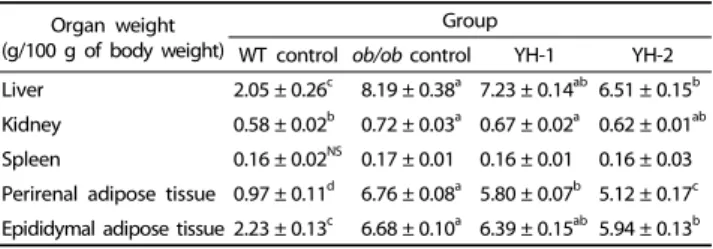
WT control ob/ob control YH-1 YH-2 Liver 2.05 ± 0.26c 8.19 ± 0.38a 7.23 ± 0.14ab 6.51 ± 0.15b Kidney 0.58 ± 0.02b 0.72 ± 0.03a 0.67 ± 0.02a 0.62 ± 0.01ab Spleen 0.16 ± 0.02NS 0.17 ± 0.01 0.16 ± 0.01 0.16 ± 0.03 Perirenal adipose tissue 0.97 ± 0.11d 6.76 ± 0.08a 5.80 ± 0.07b 5.12 ± 0.17c Epididymal adipose tissue 2.23 ± 0.13c 6.68 ± 0.10a 6.39 ± 0.15ab 5.94 ± 0.13b WT control, lean mice given vehicle; ob/ob control, ob/ob mice given vehicle; YH-1, ob/ob mice given 0.5 g/kg of YH; YH-2, ob/ob mice given 1 g/kg of YH. All experimental data were Mean ± SEM. Values with different superscripts letters within the same row are significantly different at P< 0.05 by Duncan’s multiple range test; NS, not significant.
Table 2. Effects of yeast hydrolysate (YH) on organ weight and adipose tissue mass in ob/ob mice
Lipids (mg/dL) Group
WT control ob/ob control YH-1 YH-2
Triacylglycerol 86.80 ± 6.89b 173.60 ± 5.36a 168.00 ± 9.56a 156.00 ± 5.77a Total cholesterol 89.92 ± 5.08b 179.83 ± 5.45a 176.00 ± 2.00a 157.71 ± 7.80a HDL-cholesterol 44.04 ± 2.42b 26.54 ± 3.01c 54.05 ± 2.13b 67.71 ± 2.10a LDL-cholesterol 28.52 ± 1.29d 120.49 ± 2.63a 88.35 ± 2.92b 58.80 ± 4.51c Atherogenic index 1.04 ± 0.01c 6.11 ± 0.59a 2.29 ± 0.15b 1.32 ± 0.04bc WT control, lean mice given vehicle; ob/ob control, ob/ob mice given vehicle; YH-1, ob/ob mice given 0.5 g/kg of YH; YH-2, ob/ob mice given 1 g/kg of YH.
LDL-cholesterol = Total cholesterol-[HDL cholesterol + (Triacylglycerol/5)]. Atherogenic index = (Total cholesterol - HDL cholesterol)/ HDL cholesterol. All experimental data were Mean ± SEM. Values with different superscripts letters within the same row are significantly different at P< 0.05 by Duncan’s multiple range test.
Table 3. Effects of yeast hydrolysate (YH) on blood lipid content in ob/ob mice
Package for Social Sciences (SPSS) version 12.0 (SPSS Inc., IL, USA). The differences among groups were evaluated by one- way analysis of variance (ANOVA) and Duncan's multiple range tests. All data were reported as the mean and standard error of the mean (SEM). A level of P < 0.05 was used as the criterion for statistical significance.
RESULTS
Change in body weight and food consumption
We prepared YH with high-content CHP using various proteases (Neutrase, Alcalase, Ficin, Flavourzyme and Protamax).
These proteases produced YH containing CHP concentrations greater than 200 μg/g. Specially, Flavourzyme-treated hydrolysate contained the highest CHP content (674.0 μg/g) of the all tested proteases in our previous report [7]. The YH had a molecular weight of less than 10 kDa and was composed of water (5.4%), crude fat (0.8%), crude protein (64.9%, 14% glutamic acid), carbohydrates (26.9%), ash (0.9%), and CHP (680 μg/g). YH also contained a high content of Zn (154 μg/g, data was not shown) [7].
To determine whether YH administration over 3 weeks can influence obesity, body weights were measured regularly. Body weight was found to be significantly higher in ob/ob control animals compared to WT control at the end of study (P < 0.05);
however, YH treatments (0.5 and 1 g/kg) decreased body weight gain in a dose-dependent manner (Table 1). YH-1 and YH-2- treated mice displayed significantly reduced body weight gains, with 13% and 21% reductions, respectively, compared to ob/ob control (P < 0.05). Throughout the experiment, food intake was
greater in the ob/ob control mice compared to WT control.
However, there was showed no significant difference in food intake between ob/ob control and YH-treated animals. Further- more, the food efficiency ratio (FER) was dose-dependently decreased in YH-treated animals.
Weight of organs and adipose tissues
As seen in Table 2, spleen weights were not significantly different among groups. However, a significant, four-fold increase in liver weight was observed in the ob/ob control group compared to WT control (P < 0.05). YH administration dose- dependently reduced liver weights by 12% and 21% in the YH-1 and YH-2 groups, respectively, compared to the ob/ob control group. Adipose tissue acts as a major storage site for excess energy, in addition to its role as an endocrine organ; thus, it is important for the regulation of energy homeostasis [24, 25].
In order to examine the effect of YH administration on body fat accumulation, adipose tissue weight in ob/ob mice was measured. Compared to WT control, perirenal and epididymal adipose tissue weight was 3- to 7-fold greater in the ob/ob control group (P < 0.05). Perirenal adipose tissue weights in the YH-1 and YH-2 groups were 5.80 ± 0.07 g and 5.12 ± 0.17 g, respectively, and both treated groups weighed significantly less than the ob/ob control group (6.76 ± 0.08 g) (P < 0.05). Addi- tionally, animals treated with YH-2 displayed a significant reduction in epididymal adipose tissue weight compared to ob/ob control (P < 0.05). In the ob/ob control group, epididymal adipose tissue weight was 6.68 ± 0.10 g/100 g body weight, while YH-1 and YH-2 group weights were 6.39 ± 0.15 g and 5.94
± 0.13 g/100 g body weight, respectively.
In this study, perirenal and epididymal fat adipose tissue and body weights were dramatically increased in ob/ob controls compared to WT control (Tables 1, 2). However, after YH treatment (0.5 and 1 g/kg), body weight gain and adipose tissue weight significantly were decreased. These results indicate that CHP in YH suppressed fat accumulation in adipose tissue, resulting in reduced body weight gain.
Lipid levels in blood
An imbalance between triacylglycerol hydrolysis and synthesis is critical during the development of obesity [26]. Blood lipid levels were measured after 3 weeks of YH administration in mice. Compared to the WT control, blood triacylglycerol and total cholesterol levels were significantly increased by 2.0-fold
Time Group
WT control ob/ob control YH-1 YH-2
0 week 109.21 ± 4.41b 339.66 ± 18.69a 337.89 ± 11.09a 340.03 ± 15.22a 1st week 110.14 ± 4.72c 357.79 ± 20.22a 286.12 ± 17.35b251.56 ± 14.33b 2nd week 114.53 ± 3.36c 371.31 ± 21.11a 286.21 ± 15.33b246.31 ± 12.03b 3rd week 113.19 ± 4.01c 364.98 ± 15.12a 284.31 ± 16.11b246.12 ± 13.09b WT control, lean mice given vehicle; ob/ob control, ob/ob mice given vehicle; YH-1, ob/ob mice given 0.5 g/kg of yeast YH; YH-2, ob/ob mice given 1 g/kg of YH.
All experimental data were Mean ± SEM. Values with different superscripts letters within the same row are significantly different at P< 0.05 by Duncan’s multiple range test.
Table 4. Effects of yeast hydrolysate (YH) on blood glucose levels in ob/ob mice
(A)
(B)
Fig. 1. Effects of yeast hydrolysate (YH) on oral glucose tolerance test (A, OGTT) and blood insulin levels (B) in ob/ob mice. Values are the mean ± SEM for 8 mice.
Values with different superscript letters are significantly different at P< 0.05 by Duncan’s multiple range test. WT control, lean mice given vehicle; ob/ob control, ob/ob mice given vehicle;
YH-1, ob/ob mice given 0.5 g/kg of YH; YH-2, ob/ob mice given 1 g/kg of YH. Incremental areas from the baseline under the response curves (AUC) were calculated using the trapezoidal rule.
in ob/ob controls (P < 0.05, Table 3). Blood triacylglycerol and total cholesterol levels were not significantly reduced in the YH-1 and YH-2 groups compared to the ob/ob control group.
However, HDL-cholesterol levels were markedly higher in animals treated with YH-1 and YH-2 than ob/ob controls by 104% and 155%, respectively. Blood LDL-cholesterol and atherogenic index were significantly higher in the ob/ob control than WT control (P < 0.05), but YH administration reduced significantly these levels (P < 0.05). Particularly, after 3 weeks of YH-2 treat- ment, blood concentrations of LDL-cholesterol, and the athero- genic index were significantly reduced by 50% and 77%, respectively, compared to the ob/ob control (P < 0.05). These results indicate that YH administration reduced the levels of obesity-associated lipids released into the blood.
Fasting blood glucose levels
Table 4 shows fasting blood glucose levels of YH-treated groups and controls. In the ob/ob control group, the blood glucose level was increased by approximately 400 mg/dL. As reported previously by Lin et al. [27], ob/ob mice had signifi- cantly elevated glucose levels compared to WT control. The ob/ob mice treated with two different doses (0.5 and 1 g/kg) of YH displayed significantly reduced fasting blood glucose levels compared to ob/ob control (P < 0.05). After 3 weeks of treatment, the fasting blood glucose levels of the YH-2 group (246.12 ± 13.09 mg/dL) were significantly lower than the ob/ob control group (364.98 ± 15.12 mg/dL) (P < 0.05). As a result, in vivo treatment with YH caused a significant reduction in blood glucose levels.
OGTT and blood insulin level
To investigate whether the inhibition of hyperglycemia in YH-treated animals was affected by insulin, an OGTT assessment was performed (Fig. 1). WT control, ob/ob control, and YH- treated groups showed significant increases in blood glucose level changes (209.93 ± 1.69, 413.35 ± 4.20, 397.0 ± 1.22, and 396.95 ± 2.20 mg/dL, respectively) in glucose gavages after 20
min (Fig. 1A, P < 0.05). The ob/ob control group showed slowly recovery to its baseline glucose level, even after 100 min.
However, the YH groups (YH-1 and -2) showed significantly lowered blood glucose levels compared to the ob/ob control after 100 min (P < 0.05). The AUC for glucose decreased by 10.2%
and 11.9% in YH-1 and YH-2 groups, respectively, compared to ob/ob controls (P < 0.05). Insulin controls many different metabolic processes in energy homeostasis, including glucose levels [28]. Blood insulin concentrations in YH groups decreased by 33% and 38%, respectively, compared to the ob/ob control (Fig. 1B, P < 0.05). Taken together, these data indicate that ob/ob mice treated with YH have improved glucose tolerance and hyperinsulinemia compared to ob/ob controls.
Immunoreactivities for insulin and glucagon in pancreatic islets The quantitative analysis results for insulin and glucagon immunoreactivities in the pancreatic islets of the ob/ob mice are shown in Fig. 2. YH-treated ob/ob mice (YH-1 and YH-2) displayed pancreatic islets with significantly enhanced insulin staining compared to the staining intensity of the ob/ob control (P < 0.05). The IHC intensities of glucagon in YH-treated groups (YH-1and YH-2) were significantly reduced compared to the ob/ob controls (P < 0.05).
(A)
(B)
Fig. 2. Effects of yeast hydrolysate (YH) on the immunoreactivities of insulin (A) and glucagon (B) in pancreatic islets of ob/ob mice. Values are the mean ± SEM for 8 mice. Values with different superscript letters are significantly different at P< 0.05 by Duncan’s multiple range test. WT control, lean mice given vehicle; ob/ob control, ob/ob mice given vehicle; YH-1, ob/ob mice given 0.5 g/kg of YH; YH-2, ob/ob mice given 1 g/kg of YH.
DISCUSSION
Recently, there has been a growing interest in hypoglycemic agents from natural products [3, 4], because natural sources are usually considered to be less toxic with fewer side effects than synthetic sources. Many traditional remedies for diabetes mellitus use natural sources, and over 200 pure phytochemicals are currently known to have hypoglycemic properties [29]. CHP found in many protein-rich processed foods or peptide sources [8], suggested to relate glycemic control in diabetes, demon- strated that mimicking the action of leptin [12,13], the regulation of insulin and leptin sensitivity [11,14]. In this study, we investi- gated whether administrating with CHP enriched YH could control and reduce the blood glucose level and lipid metabolism observed in obese C57BL/6J-ob/ob mice.
The reduction of body weight gain can be correlated with reduction of fat mass, indicating that reduced fat mass may lead to reduced body weight [30]. In this study, perirenal, epididymal fat adipose tissue, and body weights were drama- tically increased in the ob/ob control group when compared to the WT control mice, respectively (Table 1, 2). However, after administration with YH (0.5 and 1 g/kg of body weight), the body weight gain and adipose tissue weights were significantly decreased. These results indicate that CHP in YH suppressed fat accumulation in adipose tissue resulting in reduced body weight gain.
Blood triacylglycerol and total cholesterol levels were significantly higher in the ob/ob control group compared to the WT control group, whereas blood triacylglycerol and total cholesterol levels were decreased pattern in the YH admini- stration groups. According to den Boer et al. [31], triacylglycerol are synthesized in the liver, secreted into the bloodstream as very low-density lipoproteins (VLDL), and transported to adipose tissues. Consequently, the quantification of triacylglycerol levels showed the amount of lipids in the liver. Furthermore, the blood HDL-cholesterol level was higher in YH administration groups than in the ob/ob control group (Table 3). HDL-cholesterol plays an important role in reverse cholesterol transport pathway, carrying cholesterol esters and triacylglycerol from perirenal adipose tissues to liver for removal [32,33]. In this study, we
demonstrate that CHP in YH promote the efflux of cholesterol accumulation by increasing blood HDL-cholesterol level. Taken together, these results suggest that CHP in YH suppresses lipid accumulation, as well as levels of triacylglycerol and total cholesterol, and results in reduction of body weight gain and adipose tissue weight.
One of the most important effects of insulin is its ability to stimulate glucose transport into muscle and fat. Prospective studies of populations at high risk for type 2 diabetes have suggested that in most patients, the initial inherited lesion is insulin resistance. Insulin-stimulated glucose disposal is markedly reduced in patients with type 2 diabetes [34]. In ob/ob mice, by 6 weeks of age, insulin resistance and hyperinsulinemia are well developed [35]. Our experimental animals were profoundly hyperinsulinemic, since the average value for WT control group is under 6 ng/mL (Fig. 1). After YH administration, blood insulin levels were significantly reduced under fasting condition, suggesting that YH improved insulin resistance in the ob/ob mice.
The insulin resistance exhibited by type 2 diabetic patients is complicated by obesity. Past studies have shown that insulin sensitivity in type 2 diabetes patients improves with weight loss [28], possibly due to an improvement in insulin-stimulated glucose transport into muscle [36]. Our results showed that the CHP in YH possessed both anti-diabetic and anti-obese activity in ob/ob mice. The mechanisms of actions of CHP for the improvement of insulin resistance remain to be elucidated. Data from epidemiological studies [37, 38] and clinical trials [39, 40]
showed that hyperglycemia was the principal cause of the complications associated with diabetes. Thus, effective control of blood glucose level is a key step in preventing or reversing diabetic complications and improving the quality of life in both type 1 and type 2 diabetic patients [28]. In this study, we measured fasting blood glucose every week after YH administration; we found that these compounds progressively reduced blood glucose levels in ob/ob mice (Table 4). And then, data from the present study demonstrated that administration of YH significantly reduced fasting blood glucose level and improved glucose tolerance in ob/ob mice (Fig. 1). It is possible that glucose tolerance improvement was achieved by restoring
insulin sensitivity, and in turn, normalizing insulin-mediated glucose utilization.
Similar to our results, in which prostate extract containing zinc and CHP significantly decreased blood glucose and improved glucose tolerance and insulin sensitivity in genetically type 2 diabetic Goto-Kakizaki (GK) rats and ob/ob mice [9,41]. It is indicating that CHP has a strong ability to stimulate intestinal zinc absorption and cellular zinc uptake, and glucose utilization [41,42]. Zinc deficiency critically affects diabetes because zinc activates insulin receptor β-subunits, thereby exerting an influence in glucose metabolism [41]. Although the exact mechanism of anti-diabetes activity of CHP is not clearly established, it is highly possible that CHP is involved in the regulation of insulin sensitivity by stimulating zinc metabolism because of the following arguments: oral intake of CHP plus zinc significantly improves glucose tolerance in diabetic and CHP stimulates zinc transport mechanisms across the small intestine and cell membrane of muscle cells to increase zinc use [42]. Accordingly, it is assumed that the YH containing CHP might affect zinc metabolism, which plays an important role in the synthesis and secretion of insulin sensitivity that increase glucose uptake.
In this study, insulin staining was enhanced in pancreatic tissue from the YH-treated ob/ob mice, and plasma insulin levels were higher in the YH groups as compared to those in the ob/ob control group. We observed that a concentration of plasma insulin and insulin immunoreactivity in the pancreatic islets were significantly higher in the YH groups than in the ob/ob control group.
CHP-enriched YH ameliorated fasting blood glucose levels and glucose tolerance, and reduced hyperlipidemia and body weight in leptin-deficient C57BL/6J-ob/ob mice. While the molecular mediators responsible for the hypoglycemic and anti-hyperli- pidemic activity of CHP-enriched YH were not identified in this study, we found that CHP-enriched YH treatment could be useful for treating individuals with diabetes and hyperlipidemia.
YH may be a new strategy in the development of hypoglycemic peptide nutraceuticals. Further studies may lead to new thera- peutic approaches for treatment and/or prevention of diabetes.
REFERENCES
1. Almdal T, Scharling H, Jensen JS, Vestergaard H. The independent effect of type 2 diabetes mellitus on ischemic heart disease, stroke, and death: a population-based study of 13,000 men and women with 20 years of follow-up. Arch Intern Med 2004;164:1422-6.
2. Wild S, Roglic G, Green A, Sicree R, King H. Global prevalence of diabetes: estimates for the year 2000 and projections for 2030.
Diabetes Care 2004;27:2568-9.
3. Goldfrank L, Lewin N, Flomenbaum N, Howland MA. The pernicious panacea: herbal medicine. Hosp Physician 1982;18:64-9.
4. Sabu MC, Smitha K, Kuttan R. Anti-diabetic activity of green tea polyphenols and their role in reducing oxidative stress in experimental diabetes. J Ethnopharmacol 2002;83:109-16.
5. Pari L, Umamaheswari J. Antihyperglycaemic activity of Musa sapientum flowers: effect on lipid peroxidation in alloxan diabetic rats. Phytother Res 2000;14:136-8.
6. Tiwari AK, Rao JM. Diabetes mellitus and multiple therapeutic app- roaches of phytochemicals: present status and future prospects.
Curr Sci 2002;83:30-8.
7. Jung EY, Lee HS, Choi JW, Ra KS, Kim MR, Suh HJ. Glucose tolerance and antioxidant activity of spent brewer’s yeast hydrolysate with a high content of Cyclo-His-Pro (CHP). J Food Sci 2011;76:C272-8.
8. Hilton CW, Prasad C, Vo P, Mouton C. Food contains the bioactive peptide, cyclo(His-Pro). J Clin Endocrinol Metab 1992;75:375-8.
9. Hwang IK, Go VL, Harris DM, Yip I, Kang KW, Song MK. Effects of cyclo (his-pro) plus zinc on glucose metabolism in genetically diabetic obese mice. Diabetes Obes Metab 2003;5:317-24.
10. Song MK, Hwang IK, Rosenthal MJ, Harris DM, Yamaguchi DT, Yip I, Go VL. Anti-hyperglycemic activity of zinc plus cyclo (his-pro) in genetically diabetic Goto-Kakizaki and aged rats. Exp Biol Med (Maywood) 2003;228:1338-45.
11. Song MK, Rosenthal MJ, Song AM, Yang H, Ao Y, Yamaguchi DT.
Raw vegetable food containing high cyclo (his-pro) improved insulin sensitivity and body weight control. Metabolism 2005;54:1480-9.
12. Morley JE, Levine AS, Prasad C. Histidyl-proline diketopiperazine decreases food intake in rats. Brain Res 1981;210:475-8.
13. Steiner H, Wilber JF, Prasad C, Rogers D, Rosenkranz RT. Histidyl proline diketopiperazine (Cyclo [His-Pro]) in eating disorders. Neuro- peptides 1989;14:185-9.
14. Song MK, Rosenthal MJ, Song AM, Uyemura K, Yang H, Ament ME, Yamaguchi DT, Cornford EM. Body weight reduction in rats by oral treatment with zinc plus cyclo-(His-Pro). Br J Pharmacol 2009;158:
442-50.
15. Jung EY, Suh HJ, Kim SY, Hong YS, Kim MJ, Chang UJ. Appetite suppressive effects of yeast hydrolysate on nitric oxide synthase (NOS) expression and vasoactive intestinal peptide (VIP) immunor- eactivity in hypothalamus. Phytother Res 2008;22:1417-22.
16. Jung EY, Lee HS, Chang UJ, Bae SH, Kwon KH, Suh HJ. Acute and subacute toxicity of yeast hydrolysate from Saccharomyces cerevisiae.
Food Chem Toxicol 2010;48:1677-81.
17. Kim KM, Chang UJ, Kang DH, Kim JM, Choi YM, Suh HJ. Yeast hydrolysate reduces body fat of dietary obese rats. Phytother Res 2004;18:950-3.
18. Michael B, Yano B, Sellers RS, Perry R, Morton D, Roome N, Johnson JK, Schafer K, Pitsch S. Evaluation of organ weights for rodent and non-rodent toxicity studies: a review of regulatory guidelines and a survey of current practices. Toxicol Pathol 2007;35:742-50.
19. Peters JM, Boyd EM. Organ weights and water levels of the rat following reduced food intake. J Nutr 1966;90:354-60.
20. Friedewald WT, Levy RI, Fredrickson DS. Estimation of the concen- tration of low-density lipoprotein cholesterol in plasma, without use of the preparative ultracentrifuge. Clin Chem 1972;18:499-502.
21. Barham D, Trinder P. An improved colour reagent for the determi- nation of blood glucose by the oxidase system. Analyst 1972;97:
142-5.
22. Han GC, Ko SK, Sung JH, Chung SH. Compound K enhances insulin secretion with beneficial metabolic effects in db/db mice. J Agric Food Chem 2007;55:10641-8.
23. Kim MJ, Chang UJ, Chung JH, Kim HK, Lim BO, Yamada K, Lim Y, Kang SA. Dissimilarity in Fos and Jun immunoreactivity in hypotha- lamic regions between obese and lean Zucker rats. Biosci Biotechnol Biochem 2005;69:1982-4.
24. Arner P. Human fat cell lipolysis: biochemistry, regulation and clinical role. Best Pract Res Clin Endocrinol Metab 2005;19:471-82.
25. Galic S, Oakhill JS, Steinberg GR. Adipose tissue as an endocrine organ. Mol Cell Endocrinol 2010;316:129-39.
26. Lafontan M, Langin D. Lipolysis and lipid mobilization in human adipose tissue. Prog Lipid Res 2009;48:275-97.
27. Lin HZ, Yang SQ, Chuckaree C, Kuhajda F, Ronnet G, Diehl AM.
Metformin reverses fatty liver disease in obese, leptin-deficient mice. Nat Med 2000;6:998-1003.
28. DeFronzo RA. Pharmacologic therapy for type 2 diabetes mellitus.
Ann Intern Med 1999;131:281-303.
29. Marles RJ, Farnsworth NR. Plants as sources of antidiabetic agents.
In: Wagner H, Farnsworth NR, editors. Economic and Medicinal Plant Research. Vol. 6. London: Academic Press; 1994. 149-88.
30. Lee J, Chae K, Ha J, Park BY, Lee HS, Jeong S, Kim MY, Yoon M.
Regulation of obesity and lipid disorders by herbal extracts from Morus alba, Melissa officinalis, and Artemisia capillaris in high-fat diet-induced obese mice. J Ethnopharmacol 2008;115:263-70.
31. den Boer M, Voshol PJ, Kuipers F, Havekes LM, Romijn JA. Hepatic steatosis: a mediator of the metabolic syndrome. Lessons from animal models. Arterioscler Thromb Vasc Biol 2004;24:644-9.
32. Arsenault BJ, Boekholdt SM, Kastelein JJ. Lipid parameters for measuring risk of cardiovascular disease. Nat Rev Cardiol 2011;8:
197-206.
33. Nofer JR, Kehrel B, Fobker M, Levkau B, Assmann G, von Eckardstein A. HDL and arteriosclerosis: beyond reverse cholesterol transport.
Atherosclerosis 2002;161:1-16.
34. Reaven GM. Insulin resistance in noninsulin-dependent diabetes mellitus. Does it exist and can it be measured? Am J Med 1983;74:
3-17.
35. Genuth SM, Przybylski RJ, Rosenberg DM. Insulin resistance in genetically obese, hyperglycemic mice. Endocrinology 1971;88:
1230-8.
36. Friedman JE, Dohm GL, Leggett-Frazier N, Elton CW, Tapscott EB, Pories WP, Caro JF. Restoration of insulin responsiveness in skeletal muscle of morbidly obese patients after weight loss. Effect on muscle glucose transport and glucose transporter GLUT4. J Clin Invest 1992;89:701-5.
37. Klein R, Klein BE, Moss SE, Cruickshanks KJ. Relationship of hyperglycemia to the long-term incidence and progression of diabetic retinopathy. Arch Intern Med 1994;154:2169-78.
38. Liu QZ, Pettitt DJ, Hanson RL, Charles MA, Klein R, Bennett PH, Knowler WC. Glycated haemoglobin, plasma glucose and diabetic retinopathy: cross-sectional and prospective analyses. Diabetologia 1993;36:428-32.
39. Abraira C, Colwell JA, Nuttall FQ, Sawin CT, Nagel NJ, Comstock JP, Emanuele NV, Levin SR, Henderson W, Lee HS. Veterans Affairs Cooperative Study on glycemic control and complications in type II diabetes (VA CSDM). Results of the feasibility trial. Veterans Affairs Cooperative Study in Type II Diabetes. Diabetes Care 1995;18:
1113-23.
40. Ohkubo Y, Kishikawa H, Araki E, Miyata T, Isami S, Motoyoshi S, Kojima Y, Furuyoshi N, Shichiri M. Intensive insulin therapy prevents the progression of diabetic microvascular complications in Japanese patients with non-insulin-dependent diabetes mellitus: a randomized prospective 6-year study. Diabetes Res Clin Pract 1995;28:103-17.
41. Song MK, Rosenthal MJ, Hong S, Harris DM, Hwang I, Yip I, Golub MS, Ament ME, Go VL. Synergistic antidiabetic activities of zinc, cyclo (his-pro), and arachidonic acid. Metabolism 2001;50:53-9.
42. Rosenthal MJ, Hwang IK, Song MK. Effects of arachidonic acid and cyclo (his-pro) on zinc transport across small intestine and muscle tissues. Life Sci 2001;70:337-48.