• 검색 결과가 없습니다.

Diode Equivalent Parameters of Solar Cell

N/A
N/A
Protected

Academic year: 2021

Share "Diode Equivalent Parameters of Solar Cell"

Copied!
5
0
0

로드 중.... (전체 텍스트 보기)

전체 글

(1)

Diode Equivalent Parameters of Solar Cell

Sk Md Iftiquar 1) * ․ Vinh Ai Dao 1) ․ Junsin Yi 1,2) *

1)

College of Information and Communication Engineering, Sungkyunkwan University, Suwon, 16419, Republic of Korea,

2)

Department of Energy Science, Sungkyunkwan University, Suwon, 16419, Republic of Korea

ABSTRACT: Current characteristic curve of an illuminated solar cell was used to determine its reverse saturation current density (J

0

), ideality factor (n) and resistances, by using numerical diode simulation. High efficiency amorphous silicon, heterojunction crystalline Si (HIT), plastic and organic-inorganic halide perovskite solar cell shows n=3.27 for a-Si and n=2.14 for improved HIT cell as high and low n respectively, while the perovskite and plastic cells show n=2.56 and 2.57 respectively. The J

0

of these cells remain within 7.1×10

-7

and 1.79×10

-8

A/cm

2

for poorer HIT and improved perovskite solar cell respectively.

Key words: Amorphous silicon solar cell, Diode equivalent model, Numerical method, Active layer defect density

*Corresponding author: [email protected], [email protected] Received October 21, 2015; Revised November 23, 2015;

Accepted December 4, 2015

ⓒ 2015 by Korea Photovoltaic Society

This is an Open Access article distributed under the terms of the Creative Commons Attribution Non-Commercial License (http://creativecommons.org/licenses/by-nc/3.0)

which permits unrestricted non-commercial use, distribution, and reproduction in any medium, provided the original work is properly cited.

Nomenclature

J 0 : reverse saturation current density, A/cm 2 n : ideality factor

R s : series resistance, Ω.cm 2 R p : shunt resistance, Ω.cm 2 N d : defect density, cm -3 V oc : open circuit voltage, Volts

J sc : short circuit current density, mA/cm 2 FF : fill factor

Eff : efficiency, %

P maxV : voltage at maximum power point, mV

P maxJ : current density at maximum power point, mA/cm 2

Subscript

AFORS HET : Automat for simulation of heterostructure HIT : heterojunction with intrinsic thin layer SKE : stacked emitter

SE : single emitter a-Si : amorphous silicon J-V : current density voltage

p-a-SiO:H : p-type hydrogenated amorphous silicon oxide i-a-SiO:H : intrinsic hydrogenated amorphous silicon n-a-SiO:H : n-type hydrogenated amorphous silicon

q : charge of electron

k : Boltzmann constant

T : temperature

1. Introduction

Solar cell can be modeled as a combination of diode and resistor in absence of light, while in presence of incident light a certain constant current source should be added in the equivalent circuit 1-4) . Energy of the current source comes from incident light, because the solar cell can convert light into electrical energy. The diode current changes non-linearly with applied electrical bias, that makes the solar cell a bit complicated to analyze or evaluate its diode ideality factor (n), reverse saturation current density (J 0 ), series (R s ) and shunt (R p ) resistances.

Attempts to find these characteristic solar cell parameters can be found as early as 1981 5) to until recently in 2015 6,7) . Different authors propose different techniques like analytical 1,8-14) , numerical 15-17) , experimental 6,18,19) methods etc. However, most of these techniques are either difficult to adapt or time consuming to implement.

The quickest and one of the most popular approaches is to evaluate dynamic series and shunt resistances from a slope of the illuminated current density vs voltage characteristic (J-V) curve near open circuit and short-circuit conditions respectively, however, it was suggested that this method of estimating the resistances may not be good 20) . Here we propose a simple numerical simulation technique to determine these diode parameters.

107

(2)

Fig. 1. The single diode equivalent circuit of a solar cell

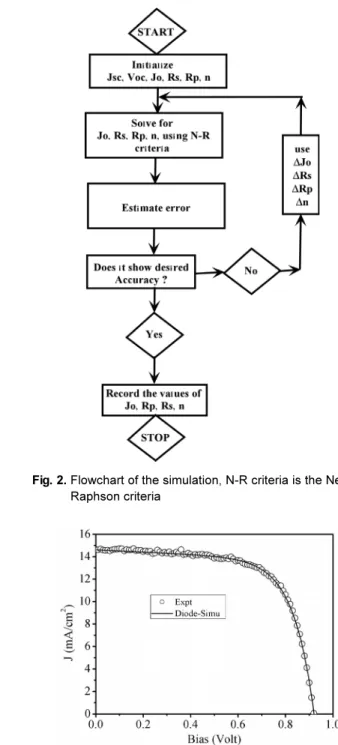
Fig. 2. Flowchart of the simulation, N-R criteria is the Newton- Raphson criteria

Fig. 3. Current density, J(mA/cm

2

) vs bias voltage plot of the reference cell denoted by symbols, and continuous line as diode simulation

2. Theoretical

When light is incident on a solar cell it generates electricity at the expense of photon. This generation of electricity can be denoted as a current source (J scm ), where the maximum current density, which is short circuit current density (J sc ), available from the solar cell can be J scm . We use a conventionally used equivalent circuit model in our analysis 21) , as shown in Fig. 1.

The output current density can be written with the help of Shockley diode equation, as is given in equation (1). We solve this equation numerically for the constant parameters.

     

 

  



   

 

(1)

3. Computational Details

Initial values of the constants can be obtained from the following equations:

     

 

(2)

    ∆ ∆  → (3)

  ∆ ∆  → (4)

       → (5)

≈  (6)

Fig. 2 shows the flowchart of the numerical simulation steps.

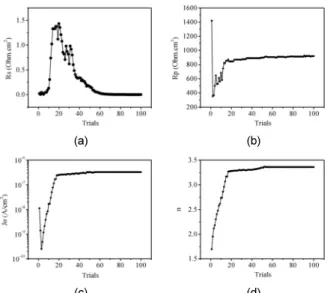
After a testing phase we observed that a 100 cycle of iterations can result in a reasonably acceptable solution. A step by step evolution of the solutions is shown below. We have noticed that

the final acceptable solution does not depend on the initial guesses, obtained from equations (2)-(6).

In the following we describe outcome the simulation and its

evolution with iteration cycle, with the help of a J-V charac-

teristic curve, published in reference 22) , as shown in Fig. 3. In

this figure a good match of the simulation to the experimental

results can be observed. This final solution appears after 100

iteration cycles. Graphical evolution of the solutions are shown

in Fig. 4.

(3)

(a) (b)

(c) (d)

Fig. 4. Evolution of parameters with number of trials during diode simulation of (a) series resistance, R

s

, (b) shunt resistance, R

p

, (c) reverse saturation current density, J

0

, (d) diode ideality factor, n

Table 1. Extracted solar cell parameters from some of the published results, as indicated in “Ref” column of the table. R

s

of these cells lie within a small range of 0.001 to 0.0015 Ω.cm

2

. HIT indicates silicon hetero- junction solar cell with intrinsic thin amorphous silicon passivation layer, SKE is stacked emitter, SE is single emitter, Perovskite implies Perovskite with 180 μ grain R

p

(Ω. cm

2

) n J

0

(A/cm

2

) Cell type Ref

918 3.27 3.4×10

-7

a-Si

22)

, Fig. 5B

3000 2.14 1.16×10

-7

HIT, SKE

23)

, Fig 3(b) 312 2.49 7.1×10

-7

HIT, SE

23)

, Fig 3(b) 700 2.56 1.79×10

-8

Perovskite

24)

, Fig. 2B 206 2.57 3.64×10

-8

Plastic

25,26)

, Fig. 2 of

25)

Fig. 5. J-V characteristics of the cells with varying i-layer defect density, the data points are the results of AFORS-HET simulation, adopted from reference

27)

, while the continuous lines are the numerical diode simulation based on the equation (1), as described above

4. Results and Discussions

We used a-Si, Si heterojunction (HIT), plastic and organic inorganic halide perovskite solar cells, and evaluated their characteristic parameters. The results are given in Table 1.

Shunt resistance, as shown in Fig. 1, can also be understood as the leakage resistance. In the device fabrication process, if the cathode and anode are not insulated well then a part of the device output leaks without contributing to the load current. Therefore higher R p is preferable. Here we obtained 3 kΩ.cm 2 as the highest and 206 Ω.cm 2 as the lowest R p for a HIT cell and plastic cell respectively. Thus, as it appears from the above results, a significant ohmic leakage exists in most of the above cells. The n > 2 indicates, that the equivalent diode of the solar cells are not an ideal one, as n = 1 for an ideal diode. The J 0 may indicate the

recombination loss of charge carriers 19) , so higher J 0 may imply that total defects in the active layer is relatively high because of which more photo carriers are lost by recombination. Table-I shows that, for a-Si solar cell the J 0 is smaller than that of the HIT cell (with single emitter, HIT SE), but higher than that of a perovskite solar cell. From this point of view, the organic- inorganic halide perovskite solar cell may have a lower recom- bination loss, but here the ohmic leakage is higher than that in a-Si or HIT solar cell (SKE).

The parameters given in Table I are for different types of solar cells. In order to have a better understanding of these parameters, we use the J-V characteristics of the cell from reference 27) (Fig. 7(a), trace “Simu1” of Ref 27) ). This cell structure was p-a-SiO:H (20nm)/i-a-Si:H(225 nm)/n-a-Si:H(25 nm) and defect density as 8×10 17 cm -3 27) , without surface texture and back reflector. Additional J-V characteristic curves, used for the investigation here, were obtained by AFORS HET simulation and for various lower defect densities (details of the simulation can be found in reference 27) ). Some of the results are given below.

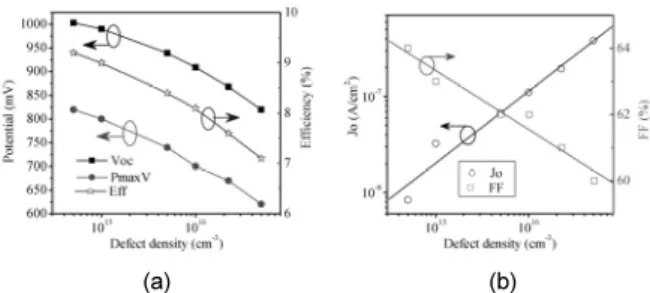
It is to be noted that the short circuit current density (J sc ) of these cells in Fig. 5, remains constant while the open circuit voltage (V oc ) increases with reduced defect density. Some of the cell parameters are shown in Fig. 6.

These are for solar cells that have 400 nm thick active layer, but with a varying defect density. J sc of all the cells remain 14.4 (±0.05) mA/cm 2 , with P maxJ = 11.4(±0.1) mA/cm 2 , R p = 311(±9) Ω.cm 2 . The n remained 3.0 for all the cells except the last one with 2.8 (N d = 5×10 14 cm -3 ).

The Fig. 6 shows the variation in cell characteristic parameters

(4)

(a) (b)

Fig. 6. Variation of characteristic parameters of solar cells that differ in defect density in the active layer. (a) Variation of V

oc

, P

maxV

and efficiency, (b) reverse saturation current density and FF

when defect density of the active layer was varied. The interesting thing to note here is that with the change in defect density in the range of N d = 5×10 16 to 5×10 14 cm -3 , the reverse saturation current density J 0 reduces, keeping other diode equivalent parameters as mostly unchanged. It is significant and a clear indication that J 0 strongly depends upon defect density 19) . Furthermore, Fig. 6(a) shows that the P maxV , V oc and efficiency (Eff) increases almost logarithmically with the reduction in defect density. Similarly the Fig. 6(b) shows that the FF reduces logarithmically while the J 0 increases linearly with the increase in defect density. In respect to other parameters, it is to be noticed here that the R p remains nearly constant while the FF decreases as a result of increased N d of the active layer.

Therefore a common perception 28) that the FF changes due to change resistance or energy band structure at the device interfaces, may not always be true. Furthermore, the resistance obtained from local slope of J-V curve is a dynamic resistance (changes from one measurement point to another), which is different from the resistances obtained by the diode simulation and reported here.

It seems that the cells with higher J 0 or n may degrade faster, because they are most likely to have higher defect density. It can be noticed from the results of this work as well as reference 19) , these cells are expected to have higher defect density in the active layer. As a result of this, the degradation of these cells is expected to be higher. Therefore, some information regarding stability of a cell can be obtained from these J 0 and n, where improved cells may need to have lower J 0 and n.

5. Conclusions

Numerical diode simulation can give a reliable solution of the modified Shockley diode equation of a solar cell. A good test of reliability of the solution is that the simulated J-V characteristic

curve will be very much similar to the reference data, and numerical values of unknown parameters will not change much for subsequent iterations. The value of the resistances obtained in this method corresponds to static resistances. Increased J 0 and n indicates that diodic nature of the cell is poorer, yet it may be possible that some of these cells exhibit higher initial efficiency but poorer stability.

Acknowledgments

This work was supported by the New & Renewable Energy Core Technology Program of the Korea Institute of Energy Technology Evaluation and Planning (KETEP) granted financial resource from the Ministry of Trade, Industry & Energy, and Republic of Korea (No. 20133030010930).

This work was supported by the Human Resources Development program (No. 20144030200580) of the Korea Institute of Energy Technology Evaluation and Planning (KETEP) grant funded by the Korea government Ministry of Trade, Industry and Energy.

References

1. J.C.H. Phang, D.S.H. Chan, J.R. Phillips, “Accurate analytical method for the extraction of solar cell model parameters”, Electron. Lett., 20 (1984) 406-408.

2. D.S.H. Chan, J.R. Phillips, J.C.H. Phang, “A comparative study of extraction methods for solar cell model parameters”, Solid State Electronics, 29 (1986) 329-337.

3. X. Yuan, Y. He, L. Liu, “Parameter extraction of solar cell models using chaotic asexual reproduction optimization”, Neural Comput. Appl., (2014).

4. J. Cabestany, L. Castaner, “Evaluation of solar cell parameters by nonlinear algorithms”, Journal of Physics D: Applied Physics, 16 (1983) 2547-2558.

5. J.P. Charles, M. Abdelkrim, Y.H. Muoy, P. Mialhe, “A prac- tical method of analysis of the current-voltage characteristics of solar cells”, Solar Cells, 4 (1981) 169-178.

6. T. Sogabe, A. Ogura, M. Ohba, Y. Okada, “Self-consistent electrical parameter extraction from bias dependent spectral re- sponse measurements of III-V multi-junction solar cells”, Prog Photovoltaics Res Appl, 23 (2015) 37-48.

7. K. Tada, “Parameter extraction from S-shaped current-voltage characteristics in organic photocell with opposed two-diode model: Effects of ideality factors and series resistance”, Phys.

Status Solidi A Appl. Mater. Sci., (2015).

8. D.S.H. Chan, J.C.H. Phang, “Analytical methods for the ex-

traction of solar-cell single- and double-diode model parame-

ters from i-v characteristics”, IEEE Trans. Electron Devices,

(5)

ED-34 (1987) 286-293.

9. J. Merten, J.M. Asensi, C. Voz, A.V. Shah, R. Platz, J. Andreu J Merten, J.M. Asensi, C. Voz, J. Andreu, “Improved equiv- alent circuit and analytical model for amorphous silicon solar cells and modules”, IEEE Trans. Electron Devices, 45 (1998) 423-429.

10. H. Saleem, S. Karmalkar, “An analytical method to extract the physical parameters of a solar cell from four points on the illu- minated J-V curve”, IEEE Electron Device Letters, 30 (2009) 349-352.

11. A.K. Das, S. Karmalkar, “Analytical derivation of the closed-form power law J-V model of an illuminated solar cell from the phys- ics based implicit model”, IEEE Trans. Electron Devices, 58 (2011) 1176-1181.

12. H. Fathabadi, “Novel neural-analytical method for determin- ing silicon/plastic solar cells and modules characteristics”, Energy Convers. Manage., 76 (2013) 253-259.

13. V. Lo Brano, G. Ciulla, “An efficient analytical approach for obtaining a five parameters model of photovoltaic modules us- ing only reference data”, Appl. Energy, 111 (2013) 894-903.

14. J. Cubas, S. Pindado, M. Victoria, “On the analytical approach for modeling photovoltaic systems behavior”, J Power Sources, 247 (2014) 467-474.

15. T.K.P. Wong, P.C.H. Chan, An equivalent circuit model ap- proach to the numerical modelling of a p-n solar cell and photo- detector, Int J Optoelectron, 11 (1997) 29-38.

16. J. Villanueva, J.A. Anta, E. Guillén, G. Oskam, “Numerical simulation of the current-voltage curve in dye-sensitized solar cells”, J. Phys. Chem. C, 113 (2009) 19722-19731.

17. W. Ding, R. Jia, D. Wu, C. Chen, H. Li, X. Liu, T. Ye,

“Numerical simulation and modeling of spectral conversion by silicon nanocrystals with multiple exciton generation”, J Appl Phys, 109 (2011).

18. E. Cuce, P.M. Cuce, T. Bali, “An experimental analysis of illu- mination intensity and temperature dependency of photo- voltaic cell parameters”, Appl. Energy, 111 (2013) 374-382.

19. H. Sakai, T. Yoshida, S. Fujikake, T. Hama, Y. Ichikawa,

“Effect of p/i interface layer on dark J-V characteristics and Voc in p-i-n a-Si solar cells”, J Appl Phys, 67 (1990) 3494-3499.

20. S. Voswinckel, V. Wesselak, B. Lustermann, “Behaviour of amorphous silicon solar modules: A parameter study”, Sol.

Energy, 92 (2013) 206-213.

21. L. Peng, Y. Sun, Z. Meng, “An improved model and parame- ters extraction for photovoltaic cells using only three state points at standard test condition”, J Power Sources, 248 (2014) 621-631.

22. K. Yoon, Y. Kim, J. Park, C.H. Shin, S. Baek, J. Jang, S.M.

Iftiquar, J. Yi, “Preparation and characterization of p-type hy- drogenated amorphous silicon oxide film and its application to solar cell”, J Non Cryst Solids, 357 (2011) 2826-2832.

23. Y. Lee, H. Kim, S.M. Iftiquar, S. Kim, S. Kim, S. Ahn, Y.J.

Lee, V.A. Dao, J. Yi, “Study of stacked-emitter layer for high efficiency amorphous/crystalline silicon heterojunction solar cells”, J Appl Phys, 116 (2014).

24. W. Nie, H. Tsai, R. Asadpour, J.C. Blancon, A.J. Neukirch, G.

Gupta, J.J. Crochet, M. Chhowalla, S. Tretiak, M.A. Alam, H.L. Wang, A.D. Mohite, “High-efficiency solution-processed perovskite solar cells with millimeter-scale grains”, Science, 347 (2015) 522-525.

25. A. Ortiz-Conde, F.J. García Sánchez, J. Muci, “New method to extract the model parameters of solar cells from the explicit analytic solutions of their illuminated I-V characteristics”, Sol Energ Mater Sol Cells, 90 (2006) 352-361.

26. T. Jeranko, H. Tributsch, N.S. Sariciftci, J.C. Hummelen,

“Patterns of efficiency and degradation of composite polymer solar cells”, Sol Energ Mater Sol Cells, 83 (2004) 247-262.

27. S.M. Iftiquar, J. Jung, C. Shin, H. Park, J. Park, J. Jung, J. Yi,

“Light management for enhanced efficiency of textured n-i-p type amorphous silicon solar cell”, Sol Energ Mater Sol Cells, 132 (2014) 348-355.

28. K.W. Mitchell, A.L. Fahrenbruch, R.H. Bube, “Analysis of the

fill factor for n-CdS/p-CdTe solar cells”, Solid-State Electron.,

20 (1977) 559-561.

수치

Fig. 2. Flowchart of the simulation, N-R criteria is the Newton-  Raphson criteria
Fig. 4. Evolution of parameters with number of trials during  diode simulation of (a) series resistance, R s , (b) shunt  resistance, R p , (c) reverse saturation current density,  J 0 , (d) diode ideality factor, n
Fig. 6. Variation of characteristic parameters of solar cells that  differ in defect density in the active layer

참조

관련 문서