
In vitro Regeneration and Genetic Stability Analysis of the Regenerated Green Plants in Japanese Blood Grass (Imperata cylindrica ‘Rubra’)
10
0
0
전체 글
(2) 홍띠 기내 재생과 재생 녹색식물체의 유전적 안정성. 2015), 미숙 화서 부위(Akashi and Ikeda, 1989), 생장점(Umami. 트에서 재배시킨 재분화 녹색 식물체 10개체, 1년간 노지에서. et al., 2012) 등이 이용되고 있다. 또한, 띠(cogongrass)에서는. 재배시킨 재분화 녹색 식물체 10개체로 총 28개체를 공시하였. 기내배양에 대한 연구(Akashi and Ikeda, 1989; Umami et al.,. 다(Fig. 1-G, H, I).. 2012; Shigeki et al., 2009)가 보고되고 있으나 홍띠에서는 거 의 찾아보기 힘든 실정이다. 안정적인 기내 식물체 대량증식을. 기내 배양 및 식물체 재분화. 위해서는 치상할 식물체의 적정 부위, 생장조절물질 종류 및 농. 홍띠의 기부생장점 부위를 포함한 식물체를 70% 에탄올에서. 도 등 다경 줄기(multiple shoot) 유도 조건 구명과 재분화 식물. 30초간, 2% sodium hypochlorite에서 15분, 멸균증류수에서 1. 체의 순화체계 구축 외에도 재분화 식물체의 유전적 변이성에. 분간 침지한 다음 3회 수세 후 멸균된 여과지로 수분을 제거하여. 대한 검토가 중요한 요소이다.. 표면 살균하였다. 기본배지로 MS 배지(Murashige and Skoog,. 기내 재생 재분화 식물체의 유전적 변이(somaclonal variation). 1962)를 사용하였고, pH는 멸균 전 5.80±0.05로 적정하여 12. 에 대한 분석에는 RAPD, SSR, AFLP, ISSR 등 다양한 분자 마커. 1℃, 1.2기압 하에서 15분간 멸균하였다. 재분화 녹색 식물체 재. 들이 이용되고 있다(Amin et al., 2018; Coronel et al., 2018;. 생은 Umami et al. (2012)의 띠(congongrass)의 기내 배양사례. Fatiha et al., 2019; Jin et al., 2008; Mo et al., 2009; Rama-. 를 일부 수정하여 MS 배지 + 0.1 ㎎/L 2,4-D + 2.0 ㎎/L BA 첨. krishnan et al., 2014; Ryu et al., 2011; Ryu et al., 2013).. 가 배지에 생장점을 포함한 부위를 치상하여 캘러스를 유도하. ISSR 마커는 4~10회 반복된 염기서열을 바탕으로 특정 프라이. 고, 캘러스 증식, 신초 재분화를 유도하였다. 재분화된 신초는. 머에 의해 식물체 genome 상의 반복된 염기서열로, 이러한 반. MS에 이식하여 뿌리를 유도하고 재생된 유식물체를 순화, 활착. 복서열은 genome 내에 풍부하게 존재하기 때문에 5’이나 3’ 끝. 시켰다. 배양은 26±2℃, 25 μ㏖/s/㎡, 14h/10h (day/night)의. 에 2~4개의 임의의 염기를 가지는 16~18 bp의 반복서열로 구성. 조건에서 실시하였다.. 된 단일 프라이머를 이용하여 genome 상의 여러 지역에서 증폭 가능하여 서로 다른 개체들 사이에서 증폭산물들이 다형성을. DNA 추출 및 ISSR 분석. 나타낸다(Godwin et al., 1997; Zietkiewicz et al., 1994). 화본. DNA는 식물체의 잎 부위를 CTAB 방법(Fang and Roose,. 과 식물의 기내배양에 의한 재분화 식물체의 유전적 변이와 다. 1997)에 따라 추출하여 0.8%의 agarose gel에서 전기영동하여 밴. 양성 연구는 ISSR 분석 등 다양한 방법(Carlos et al., 2018; Goh. 드를 확인하고, Nanodrop Spectrophotometer (Thermo Fisher. et al., 2011; Ramakrishnan et al., 2014)으로 진행되었다. 지. Scientific, Netherlands)로 농도를 측정하여 최종농도는 50. 금까지 화본과 식물에서 ISSR 분석 연구(Ramakrishnan et al.,. ng/μL로 희석하였다.. 2014)가 보고되고 있으나 띠(I. cylindrica var. koenigii (Ritz). ISSR 분석은 총 26개의 ISSR 프라이머(UBC primer Set No.. Benth. ex Pilg.)와 홍띠에서는 본 연구팀의 연구(Kang et al.,. 9, University of British Columbia, Canada)로 예비 실험 후 밴. 2019; Kang et al., 2020) 외에 찾기 힘든 실정이다.. 드가 명확한 22개의 프라이머를 선발하여 ISSR 분석에 이용하. 따라서 본 연구는 홍띠(Imperata cylindrica ‘Rubra’) 식물의. 였다(Table 1). PCR 반응액은 주형 DNA 50 ng/μL, 2X PCR. 기내 식물체 재생과 재생 식물체의 유전적 안정성에 대한 자료. Premix (LugenTM), 10 pmol 프라이머로 총 20 μL로 혼합하여. 를 제공할 목적으로 생장점 부위를 포함한 식물조직을 기내배. 사용하였다. PCR 반응은 Gene Amp 2700 (Applied Biosystem). 양하여 식물체를 재생시키고, ISSR 표지를 사용하여 기내에서. 을 사용하여 94℃에서 5분간 초기 변성시킨 후 94℃에서 45초. 재생된 녹색 식물체의 유전적 안정성을 조사하였다.. 간 denaturation, 52℃에서 45초간 annealing, 72℃에서 90초 간 extension 과정을 40회 수행한 후 최종적으로 72℃에서 7분. 재료 및 방법. 간 반응시킨 후 종료하였다. PCR이 완료된 후의 증폭산물 15 μL 를 RedSafe Nucleic Acid Staining Solution 20,000X (Intron. 식물재료. Biotechnology, Inc.)를 첨가한 1.2% agarose gel에 loading하. 공시재료는 재배식물로 개발된 홍띠(Imperata cylindrica ‘Rubra’)로 ‘하늘정원 야생화(대표 이동국)’에서 분양받았으며,. 여 전기영동(50V, 60분)한 다음 GelDoc (GDS200D, Korea)을 사용하여 주요 밴드를 확인하였다.. 영양체 번식된 대조구 식물체(mother plant) 8개체, 실내의 포. - 157 -.
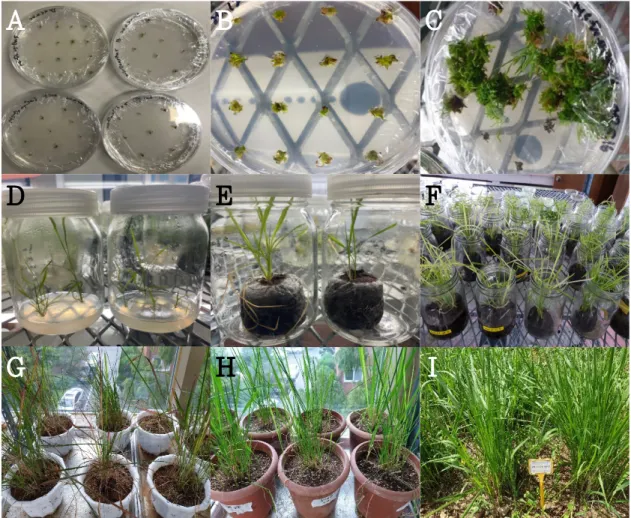
(3) Korean J. Plant Res. 34(2) : 156~165(2021). and Skoog, 1962) 배지에 치상하여 4주 동안 캘러스를 유도하. Data 분석 ISSR로 분석된 DNA 밴드 양상은 이진수를 이용하여 밴드. 고(Fig. 1-A), 0.1 ㎎/L 2,4-D와 0.05 ㎎/L BA 첨가 배지에서. 유·무에 따라 1과 0으로 data를 표시하여 Jaccard 계수 (Jaccard. 3~4주 동안 캘러스를 증식하였다(Fig. 1-B). 캘러스로부터 신. coefficient)로 유전적 유사도지수를 산출하고 평균연결법(Average. 초를 유도하기 위하여 0.01 ㎎/L NAA와 2 ㎎/L BA를 첨가한 배. linkage method)으로 군집분석을 하였다. 모든 통계처리는. 지에서 증식된 캘러스를 이식하여 4~5주 동안 신초를 재분화시. SPSS V.12 (SPSS Inc., USA)를 이용하여 실시하였다.. 켰다(Fig. 1-C). 4~6주 동안 MS 배지에서 발근을 유도하여 재 분화 식물체를 양성하고(Fig. 1-D), 멸균한 버미큘라이트 상토. 결과 및 고찰. 를 포함한 배양병에서 3주간 배양병의 뚜껑을 점진적으로 개방 하여 직경 6 ㎝의 포트에 이식하여 100% 활착시켰다(Fig. 1-E,. 기내배양에 의한 식물체 재생. F, H). 재분화 식물체는 모체가 가지고 있는 붉은 색과 달리 녹색. 기내 식물체의 재분화를 위하여 홍띠의 기부에서 적출한 생장. 을 나타내었고, 이 재분화 식물체를 분석용 시료로 사용하였다.. 점 부위를 0.1 ㎎/L 2,4-D와 2 ㎎/L BA를 첨가한 MS (Murashige. Akashi and Ikeda (1989), Umami et al. (2012)은 띠의 생장. A. B. C. D. E. F. G. H. I. Fig. 1. In vitro regeneration process (A to F), and 28 individual accessions (G, H and I) used in ISSR analysis of Imperata cylindrica ‘Rubra’. A: Callus induction from in vitro cultured tissues including growing point, B: Shoot induction from calli, C: Multiple shooting, D: Regenerated plantlet growth with rooting, E: Hardening on sterilized vermiculite, F: Hardening under cap-open condition, G: Mother plants (Control), H: Green-regenerants cultivated at culture room, I: Green-regenerants cultivated at field condition. - 158 -.
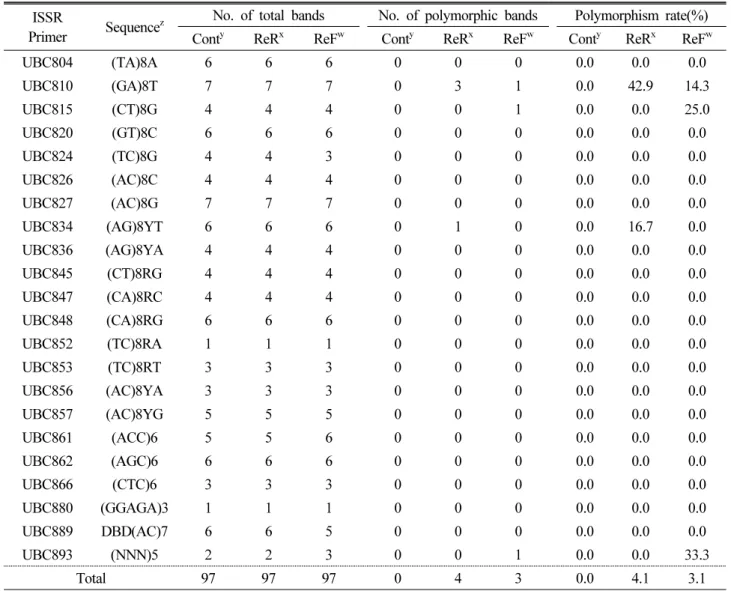
(4) 홍띠 기내 재생과 재생 녹색식물체의 유전적 안정성. 점 부위를 이용하여 캘러스 유도시 주로 2,4-D를 단독처리하거. 재분화 녹색 식물체의 DNA 밴드 양상. 나 옥신 대비 낮은 농도의 사이토키닌을 병행처리에서 효과적. 녹색을 띠는 재분화 식물체를 실내에서 포트 재배한 10개체. 이고, 캘러스 증식에는 캘러스 유도 보다 낮은 농도의 2,4-D를. 와 이 녹색 재분화 식물체를 노지 포장에서 재배한 10개체, 그리. 처리하였는데, 이는 본 연구의 홍띠에서도 비슷한 경향이었다.. 고 대조구로 모식물체 8개체, 총 28개체를 시료로 하여 재현성. 또한, 신초의 재분화는 BA와 상대적으로 낮은 농도의 NAA 처리. 이 높은 22개의 ISSR 프라이머를 선발하여 분석하였다(Table. 에서 양호했는데(Akashi and Ikeda, 1989; Goh et al., 2011;. 1). ISSR 분석결과, 대조구 8개체에서 밴드 수는 최저 1개(UBC. Kusano et al., 2003; Shigeki et al., 2009; Yu et al., 2015),. 852, UBC 880)에서 최고 7개(UBC 810, UBC 827)로 한 프라이. 본 실험에서도 유사한 재분화 양상을 나타내었다.. 머 조합당 평균 밴드 수는 4.4개였다. 공시한 22개 프라이머 모두 동일한 밴드패턴을 나타내어 다형성 밴드는 검출되지 않았다. 실내재배 재분화 식물체에서 밴드 수는 최저 1개(UBC 852,. Table 1. Sequence of the 23 ISSR primers, numbers of total bands and polymorphic bands amplified by each primers across all 28 individuals of Imperata cylindrica ‘Rubra’ ISSR Primer. Sequencez. UBC804. No. of total bands x. No. of polymorphic bands w. y. ReR. ReF. Cont. ReR. ReF. Conty. ReRx. ReFw. (TA)8A. 6. 6. 6. 0. 0. 0. 0.0. 0.0. 0.0. UBC810. (GA)8T. 7. 7. 7. 0. 3. 1. 0.0. 42.9. 14.3. UBC815. (CT)8G. 4. 4. 4. 0. 0. 1. 0.0. 0.0. 25.0. UBC820. (GT)8C. 6. 6. 6. 0. 0. 0. 0.0. 0.0. 0.0. UBC824. (TC)8G. 4. 4. 3. 0. 0. 0. 0.0. 0.0. 0.0. UBC826. (AC)8C. 4. 4. 4. 0. 0. 0. 0.0. 0.0. 0.0. UBC827. (AC)8G. 7. 7. 7. 0. 0. 0. 0.0. 0.0. 0.0. UBC834. (AG)8YT. 6. 6. 6. 0. 1. 0. 0.0. 16.7. 0.0. UBC836. (AG)8YA. 4. 4. 4. 0. 0. 0. 0.0. 0.0. 0.0. UBC845. (CT)8RG. 4. 4. 4. 0. 0. 0. 0.0. 0.0. 0.0. UBC847. (CA)8RC. 4. 4. 4. 0. 0. 0. 0.0. 0.0. 0.0. UBC848. (CA)8RG. 6. 6. 6. 0. 0. 0. 0.0. 0.0. 0.0. UBC852. (TC)8RA. 1. 1. 1. 0. 0. 0. 0.0. 0.0. 0.0. UBC853. (TC)8RT. 3. 3. 3. 0. 0. 0. 0.0. 0.0. 0.0. UBC856. (AC)8YA. 3. 3. 3. 0. 0. 0. 0.0. 0.0. 0.0. UBC857. (AC)8YG. 5. 5. 5. 0. 0. 0. 0.0. 0.0. 0.0. UBC861. (ACC)6. 5. 5. 6. 0. 0. 0. 0.0. 0.0. 0.0. UBC862. (AGC)6. 6. 6. 6. 0. 0. 0. 0.0. 0.0. 0.0. UBC866. (CTC)6. 3. 3. 3. 0. 0. 0. 0.0. 0.0. 0.0. UBC880. (GGAGA)3. 1. 1. 1. 0. 0. 0. 0.0. 0.0. 0.0. UBC889. DBD(AC)7. 6. 6. 5. 0. 0. 0. 0.0. 0.0. 0.0. UBC893. (NNN)5. 2. 2. 3. 0. 0. 1. 0.0. 0.0. 33.3. 97. 97. 97. 0. 4. 3. 0.0. 4.1. 3.1. z. x. y. w. Polymorphism rate(%). Cont. Total. y. x. IUB base code: Y(C,G), R(A,G), D(A,G,T), B(C,G,T), N(A, G, C, T), Mother plants, Regenerants cultivated at culture room, wRegenerants cultivated at field condition. - 159 -.
(5) Korean J. Plant Res. 34(2) : 156~165(2021). UBC 880)에서 최고 7개(UBC 810, UBC 827)로 평균 밴드 수는. UBC 847, UBC 848, UBC 852, UBC853, UBC 856, UBC 857,. 4.4개였으며, 다형성 밴드의 수는 최저 0개(UBC 804, UBC 815,. UBC 861, UBC 862, UBC 866, UBC 880, UBC 889, UBC 893)에. UBC 820, UBC 824, UBC 826, UBC 827, UBC 836, UBC 845,. 서 최고 3개(UBC 810)였다. 20개 프라이머(UBC 804, UBC 815,. Fig. 2. Examples of ISSR electrophoresis profiles for 28 individual accessions of Imperata cylindrica ‘Rubra’. Amplification products were separated on 1.2% agarose gels in 1×TAE buffer and photographed using gel documentation system (Bio-rad, USA). Lane M: 1kb ladder marker. Lanes 1~8: mother plants, 9~18: Regenerants cultivated at culture room (ReR), 19~28: Regenerants cultivated at field condition (ReF). All the primer names were included in Table 1. - 160 -.
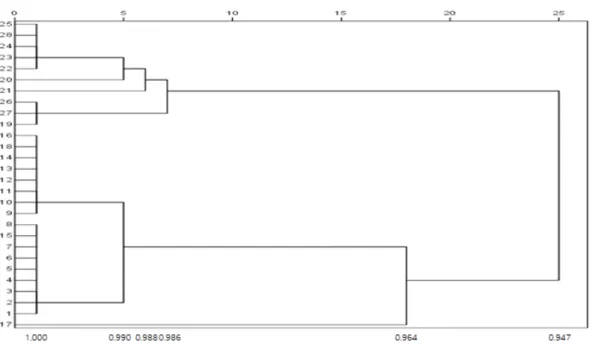
(6) 홍띠 기내 재생과 재생 녹색식물체의 유전적 안정성. UBC 820, UBC 824, UBC 826, UBC 827, UBC 836, UBC 845,. 최고 1.00(13, 14번과 9, 10, 11, 12, 13번 외) 사이로 28개 개체간. UBC 847, UBC 848, UBC 852, UBC 853, UBC 856, UBC 857,. 전체 유전적 유사도 지수 평균은 0.972였다.. UBC 861, UBC 862, UBC 866, UBC 880, UBC 889, UBC 893)에. 대조구 8개체의 유전적 유사도 지수 평균은 1.0이었으며, 실. 서 모두 동일한 밴드패턴을 나타내었고, 나머지 2개 프라이머. 내재배 재분화 식물체 간의 유전적 유사도 지수 평균은 0.993,. (UBC 810, UBC 834)에서 4개의 다형성 밴드로 프라이머 당. 노지재배 재분화체간의 유전적 유사도 지수 평균은 0.993로 기. 0.18개가 검출되었다(Table 1, Fig. 2).. 내 재생 식물체간의 유사도는 동일한 값을 나타냈다. 처리구 두. 노지재배 재분화체에서 밴드 수는 최저 1개(UBC 852, UBC. 그룹이 대조구 보다 낮지만 매우 높은 유전적 유사도를 나타내. 880)에서 최고 7개(UBC 810, UBC 827)로 평균 밴드 수는 4.4개. 어 재분화 식물체들의 유전적 구조가 매우 안정한 것으로 나타. 였으며, 다형성 밴드의 수는 최저 0개(UBC 804, UBC 820, UBC. 났다. 이 결과는 홍띠의 경우 국내외에서 ISSR 연구 보고의 사. 824, UBC 826, UBC 827, UBC 834, UBC 836, UBC 845, UBC. 례를 거의 유래를 찾기 힘들며(Kang et al., 2020), 초본 식물의. 847, UBC 848, UBC 852, UBC 853, UBC 856, UBC 857, UBC. ISSR 분석 시 재분화 식물체간 평균 유사도 0.982 (Liu et al.,. 861, UBC 862, UBC 866, UBC 880, UBC 889)에서 최고 1개. 2011), 목본식물의 재분화체를 ISSR 분석한 결과인 0.96~0.99. (UBC 810, UBC 815, UBC 893)였다. 19개 프라이머(UBC 804,. (Vijayan et al., 2015)에 비해 다소 낮거나 비슷하였고, 가지과. UBC 820, UBC 824, UBC 826, UBC 827, UBC 834, UBC 836,. 여러 품종 유래의 재분화체의 유전적 유사도 0.72~0.99보다는. UBC 845, UBC 847, UBC 848, UBC 852, UBC 853, UBC 856,. 높았다(Aversano et al., 2009).. UBC 857, UBC 861, UBC 862, UBC 866, UBC 880, UBC 889)에 서 모두 동일한 밴드패턴을 나타내었고, 나머지 3개 프라이머. 군집분석. (UBC 810, UBC 815, UBC 893)에서 3개의 다형성 밴드로 프라 이머 당 0.14개가 검출되었다(Table 1, Fig. 2).. ISSR 분석결과를 토대로 ISSR 마커의 밴드 양상을 평균연결 법(Average linkage method)으로 군집 분석한 결과는 Fig. 3과. 이상과 같이 유전적 다형성 비율은 재분화체(실내포트 재배. 같다. 모든 개체는 유사도지수 0.947~1.00 내에 분포하였다.. 식물체 4.1%, 노지 재배식물체 3.1%)에서 대조구인 모식물체. 유전적 유사도지수 0.950에서 2개 그룹으로 유집되었으며, 대. (0%) 보다 높게 나타났다. 이는 2,4-D 및 kinetin을 비롯한 기. 조구(1~8번)와 노지재배 재분화 식물체(19~28번)는 모두 분리. 내배양에 사용한 생장조절제가 형태적, 유전학적 각종 변이. 되어 독립적인 그룹으로 유집되었다. 또한, 17번을 제외한 실내. (somaclonal variation)를 유발하는 것에 기인한 것으로 보인다. 재배 재분화 식물체(9~18번)는 대조구와 같은 중그룹으로 유집. (Bednarek and Renata, 2020; Coronel et al., 2018; Dewir et. 되었다. 유전적 유사도지수 0.988에서 유집되는 2개의 하부 그. al., 2018; Garcia et al., 2019; Jin et al., 2008). 그러나 옥수수. 룹에서 실내환경에서 재배한 재분화 식물체중 15번과 17번을 제. 재분화체(Ramakrishnan et al., 2014), 바나나 재분화체(Ray. 외한 8개체(9~14번, 16, 18번)는 동일그룹으로 유집되었고, 대. et al., 2006) 보다 낮거나 비슷한 수준(Liu et al., 2011)으로 재. 조구도 또다른 동일 그룹으로 밀접하게 유집되었다. 이러한 결. 분화체들은 유전적으로 안정된 편이었다. 또한, 종자유래 갈대. 과는 생장조절제 처리 등 배양시 유전적 변이를 유발하는 배지. 의 재분화 기내재생 식물체에서 프라이머 당 1.3개의 다형성 밴. 내 여러 가지 환경(Garcia et al., 2019)에 기인한 것이 주요 원인. 드 검출로 17%의 다형성 비율을 보인 보고(Ryu et al., 2013)와. 이지만 Bednarek and Renata (2020)은 외부환경에 의한 변이의. 가지과 다양한 품종의 잎절편 유래 재생식물체의 18.5%. 가능성을 언급하고 있어 향후 장기적 관점에서 이에 대한 검토. (Aversano et al., 2009) 보다 본 연구에서 다형성 비율은 낮게. 가 필요할 것으로 보인다. 한편 다년생 약용식물인 Inula 잎절편. 나타났다.. (Amin et al., 2018), 가지과 잎절편 유래 재분화체(Aversano et al., 2009) 및 옥수수 shoot apex 유래 재분화체를 대상으로 ISSR primer 분석(Ramakrishnan et al., 2014)한 결과 모식물체와 동. 유전적 유사도 지수 ISSR 마커를 이용하여 상기 총 28개체 재분화 식물체들의 유. 일한 그룹으로 유집된 반면, 다른 품종별에서 유래한 재분화체. 전적 유사도를 평가하였다(Table 2). 총 28개체 간의 유전적 유. 는 다른 그룹으로 유집되어(Ray et al., 2006) 품종 또는 재분화. 사도 지수는 최저 0.919(19, 21, 26, 27번과 17번)에서 최고에서. 식물체의 단일 개체 유래 여부에 따라 다른 결과를 보였다.. - 161 -.
(7) . . . 4. . . . . 5. . . . . . 6. . . . . . . 7. . . . . . . . 8. . . . . . . . . 9. . . . . . . . . . 10. . . . . . . . . . . 11. . . . . . . . . . . . 12. . . . . . . . . . . . . 13. . . . . . . . . . . . . . 14. . . . . . . . . . . . . . . 15. - 162 . . . . . . . . . . . . . . . 16. . . . . . . . . . . . . . . . . 17. . . . . . . . . . . . . . . . . . 18. . . . . . . . . . . . . . . . . . . 19. . . . . . . . . . . . . . . . . . . . 20. . . . . . . . . . . . . . . . . . . . . 21. . . . . . . . . . . . . . . . . . . . . . 22. . . . . . . . . . . . . . . . . . . . . . . 23. . . . . . . . . . . . . . . . . . . . . . . . 24. . . . . . . . . . . . . . . . . . . . . . . . . 25. . . . . . . . . . . . . . . . . . . . . . . . . . 26. . . . . . . . . . . . . . . . . . . . . . . . . . . 27. . . . . . . . . . . . . . . . . . . . . . . . . . . . 28. Genetic similarity was calculated on the basis of Jaccard coefficients. 1~28: accessions numbers. 28 0.949 0.949 0.949 0.949 0.949 0.949 0.949 0.949 0.959 0.959 0.959 0.959 0.959 0.959 0.949 0.959 0.929 0.959 0.989 0.990 0.989 1.000 1.000 1.000 1.000 0.989 0.989 1.000. 27 0.939 0.939 0.939 0.939 0.939 0.939 0.939 0.939 0.949 0.949 0.949 0.949 0.949 0.949 0.939 0.949 0.919 0.949 1.000 0.979 0.979 0.989 0.989 0.989 0.989 1.000 1.000. 26 0.939 0.939 0.939 0.939 0.939 0.939 0.939 0.939 0.949 0.949 0.949 0.949 0.949 0.949 0.939 0.949 0.919 0.949 1.000 0.979 0.979 0.989 0.989 0.989 0.989 1.000. 25 0.949 0.949 0.949 0.949 0.949 0.949 0.949 0.949 0.959 0.959 0.959 0.959 0.959 0.959 0.949 0.959 0.929 0.959 0.989 0.990 0.989 1.000 1.000 1.000 1.000. 24 0.949 0.949 0.949 0.949 0.949 0.949 0.949 0.949 0.959 0.959 0.959 0.959 0.959 0.959 0.949 0.959 0.929 0.959 0.989 0.990 0.989 1.000 1.000 1.000. 23 0.949 0.949 0.949 0.949 0.949 0.949 0.949 0.949 0.959 0.959 0.959 0.959 0.959 0.959 0.949 0.959 0.929 0.959 0.989 0.990 0.989 1.000 1.000. 22 0.949 0.949 0.949 0.949 0.949 0.949 0.949 0.949 0.959 0.959 0.959 0.959 0.959 0.959 0.949 0.959 0.929 0.959 0.989 0.990 0.989 1.000. 21 0.939 0.939 0.939 0.939 0.939 0.939 0.939 0.939 0.949 0.949 0.949 0.949 0.949 0.949 0.939 0.949 0.919 0.949 0.979 0.979 1.000. 20 0.939 0.939 0.939 0.939 0.939 0.939 0.939 0.939 0.949 0.949 0.949 0.949 0.949 0.949 0.939 0.949 0.920 0.949 0.979 1.000. 19 0.939 0.939 0.939 0.939 0.939 0.939 0.939 0.939 0.949 0.949 0.949 0.949 0.949 0.949 0.939 0.949 0.919 0.949 1.000. 18 0.990 0.990 0.990 0.990 0.990 0.990 0.990 0.990 1.000 1.000 1.000 1.000 1.000 1.000 0.990 1.000 0.969 1.000. 17 0.959 0.959 0.959 0.959 0.959 0.959 0.959 0.959 0.969 0.969 0.969 0.969 0.969 0.969 0.959 0.969 1.000. 16 0.990 0.990 0.990 0.990 0.990 0.990 0.990 0.990 1.000 1.000 1.000 1.000 1.000 1.000 0.990 1.000. 15 1.000 1.000 1.000 1.000 1.000 1.000 1.000 1.000 0.990 0.990 0.990 0.990 0.990 0.990 1.000. 14 0.990 0.990 0.990 0.990 0.990 0.990 0.990 0.990 1.000 1.000 1.000 1.000 1.000 1.000. 13 0.990 0.990 0.990 0.990 0.990 0.990 0.990 0.990 1.000 1.000 1.000 1.000 1.000. 12 0.990 0.990 0.990 0.990 0.990 0.990 0.990 0.990 1.000 1.000 1.000 1.000. 11 0.990 0.990 0.990 0.990 0.990 0.990 0.990 0.990 1.000 1.000 1.000. 10 0.990 0.990 0.990 0.990 0.990 0.990 0.990 0.990 1.000 1.000. 9 0.990 0.990 0.990 0.990 0.990 0.990 0.990 0.990 1.000. 8 1.000 1.000 1.000 1.000 1.000 1.000 1.000 1.000. 7 1.000 1.000 1.000 1.000 1.000 1.000 1.000. 6 1.000 1.000 1.000 1.000 1.000 1.000. 5 1.000 1.000 1.000 1.000 1.000. 4 1.000 1.000 1.000 1.000. 3 1.000 1.000 1.000. . . 3. 워터마크. z. . 2. 2 1.000 1.000. 1 1.000. 1. Table 2. Genetic similarity matrix of Imperata cylindrica ‘Rubra’ 28 accessions revealed by ISSR analysisz Korean J. Plant Res. 34(2) : 156~165(2021).
(8) 홍띠 기내 재생과 재생 녹색식물체의 유전적 안정성. Fig. 3. Dendrogram illustrating genetic relationships among 28 accessions of Imperata cylindrica ‘Rubra’ generated by cluster analysis with average linkage method. Lanes 1~8: mother plants, 9~18: Regenerants cultivated at culture room (ReR), 19~28: Regenerants cultivated at field condition (ReF).. 적 요. 사 사. 바이오에너지작물의 중요한 소재를 제공하는 화본과 식물인. 이 결과는 「2020년도 교육부의 재원으로 한국연구재단의 지. 홍띠(Imperata cylindrica ‘Rubra’)의 기내재생 식물체의 유전. 원을 받아 수행된 지자체-대학 협력기반 지역혁신 사업」 지원. 적 안정성을 조사하고자 생장점 부위를 기내배양하여 재분화시. 과제(과제고유번호: 1345329679, 세부과제번호: 2020 대학혁. 킨 녹색 재생식물체의 변이성을 ISSR 마커로 조사하였다. MS. 신-146)로 수행되었습니다. 식물재료를 제공해 주신 ‘하늘정원. (Murashige and Skoog, 1962) 배지에 식물체 기부의 생장점 부. 야생화’ 이동국 대표님께 감사드립니다.. 위를 적출하여 캘러스를 유도하고(0.1 ㎎/L 2,4-D와 2 ㎎/L. Conflicts of Interest. BA), 캘러스 증식(0.1 ㎎/L 2,4-D와 0.05 ㎎/L BA), 신초 재분 화(0.01 ㎎/L NAA와 2 ㎎/L BA) 후 MS 배지에서 발근시켜 재분. The authors declare that they have no conflict of interest.. 화 식물체를 유도하고 100% 활착시켰다. 대조구인 모식물체 홍 띠 8개체, 1년간 노지 포장에서 재배중인 재분화 녹색 식물체. References. 10개체와 실험실 내 화분에서 재배중인 재분화 녹색 식물체 10 개체, 총 28개체에 대하여 ISSR 분석한 결과 유전적 다형성은 재분화 식물체가 실내포트 재배식물체 4.1% 및 노지 재배식물. Akashi, R. and H. Ikeda. 1989. Callus formation anfd plant. 체 3.1%로 0%인 대조구보다 높게 나타났다. 또한, 총 28개체들. regeneration from immature inflorescences and apical meristems of cogongrass (Imperata cylindrica L.). Grassl. Sci.. 간의 유전적 유사도를 평가한 결과, 유전적 유사도 지수는 0.919~1.0 사이에 분포하며, 평균 0.972로 유전적 충실도가 높 게 나타났다. 군집분석 결과 노지에서 재배한 재분화 식물체와 모식물체(대조군)가 독립적으로 유집되었다.. 34:333-335. Amin, S., T.A. Wani, Z.A. Kaloo, S. Singh, R. John, U. Majeed and G.A. Shapoo. 2018. Genetic stability using RAPD and ISSR markers in efficiently in vitro regenerated plants of Inula royleana DC. Meta Gene 18:100-106.. - 163 -.
(9) Korean J. Plant Res. 34(2) : 156~165(2021). Aversano, R., S. Savarese, J.M.De Nova, L. Frusciante, M.. Kang, I.-J., V. Kantayos, J.Y. Choi, Y.J. Lee and C.-H. Bae.. Punzo and D. Carputo. 2009. Genetic stability at nuclear and. 2019. In vitro multiple propagation of woolly grass (Imperata. plastid DNA level in regenerated plants of Solanum species. cylindrica ‘Rubra’). Proceedings of the Spring Conference. and hybrids. Euphytica 165:353-361.. of the Plant Resources Society of Korea. April 25-26, 2019. Yeosu, Korea. p. 79 (in Korean).. Bednarek, P.T. and O. Renata. 2020. Plant tissue culture environment as a switch-key of (epi) genetic changes. Plant Cell. Kang, I.-J., Y.J. Lee and C.-H. Bae. 2020. In vitro plant regeneration and genetic stability of the regenerants in woolly. Tiss. Organ Cult. 140:245-257. Cho, J.-H. and J.-H. Byeon. 2011. Establishment of callus. grass (Imperata cylindrica ‘Rubra’). Proceedings of the Spring. induction and plant regeneration system from mature seeds. Conference of the Plant Resources Society of Korea. Autumn. of Miscanthus sinensis. Korean J. Plant Res. 24(5):628-635.. 14-15, 2020. Jecheon, Korea. p. 37 (in Korean).. Coronel, C.J., A.I. Gonzălez, M.L. Ruiz and C. Polanco. 2018.. Kim, M.D., H. Jin, E.-J. Park, S.-Y. Kwon, H.-S. Lee and S.-S.. Analysis of somaclonal variation in transgenic and regenerated. Kwak. 2005. Plant regeneration through somatic embryo-. plants of Arabidopsis thaliana using methylation related metAFLP and TMD markers. Plant Cell Rep. 37:137-152.. genesis of Leymus chinensis Trin. Korean J. Plant Biotechnol. 32(1):51-55.. Dewir, Y.H., Nurmansyah, Y. Naidoo and J.A.T. da Silva. 2018.. Kusano, M., K. Tohyama, C.-H. Bae, K.-Z, Riu and H.-Y. Lee.. Thidiazuron-induced abnormalities in plant tissue cultures. Plant Cell Rep. 37:1451-1470.. 2003. Plant regeneration and transformation of kentucky bluegrass (Poa pratensis L.) via the plant tissue culture. Korean J. Plant Biotech. 30(2):115-121.. Fang, D.Q. and M.L. Roose. 1997. Identification of closely related citrus cultivars with inter-simple sequence markers. Theor. Appl. Genet. 95:408-417.. Lee, T.B. Illustrated Flora of Korea. 2003. Hyangmoonsa Publishing Com., Seoul, Korea (in Korean).. Fatiha, B., S.-R. Carolina and M. Carmen. 2019. Somaclonal. Liu, F., L.-L. Huang, Y.-L. Li, P. Reinhoud, M.A. Jongsma and. variation in olive (Olea europaea L.) plants regenerated via somatic embryogenesis: Influence of genotype and culture. C.-Y. Wang. 2011. Shoot organogenesis in leaf explants of Hydrangea macrophylla ‘Hyd1’ and assessing genetic stability. age on genetic stability. Sci. Hortic. 251:260-266.. of regenerants using ISSR markers. Plant Cell Tiss. Organ. Garcia, C., A.-A.F. de Almeida, M. Costa, D. Britto, R. Valle, S. Royaert and J.-P. Marelli. 2019. Abnormalities in somatic. Cult. 104:111-117. Mo, X.Y., T. Long, Z. Liu, H. Lin, X.Z. Liu, Y.M. Yang and. embryogenesis caused by 2,4-D: an overview. Plant Cell. H.Y. Zhang. 2009. AFLP analysis of somaclonal variations. Tiss. Organ Cult. 137:193-212. Godwin, I.D., E.A.B. Aiken and L.W. Smith. 1997. Application. in Eucalyptus globulus. Biol. Plant. 53(4):741-744. Moon, Y.-H., J.-E. Lee, G.-D. Yu, Y.-L. Cha, Y.-S. Song and. of inter simple sequence repeat (ISSR) markers to plant genetics.. K.-B. Lee. 2016. Quality and combustion characteristics of. Electrophoresis 18:1524-1528. Goh, E.J., E.S. Seong, J.H. Yoo, H.Y. Kil, J.G. Lee, I.S. Hwang,. miscanthus pellet for bioenergy. Clean Technol. 22(4):286291.. N.-j. Kim, B.K. Ghimire, M.J. Kim, J.K. Lee, J.D. Lim, N.Y.. Moon, Y.-H., K.-S. Kim, J.-E. Lee, D.-E. Kwon, Y.-K. Kang. Kim and C.Y. Yu. 2011. Effect of plant growth regulators and media on regeneration of Sorghum bicolor (L.) Moench.. and Y.-L. Cha. 2019. Single crossing conditions of Miscanthus sacchariflorus and Miscanthus sinensis to breed Miscanthus. Korean J. Plant Res. 24(2):168-173.. x giganteus cultivar. Korean J. Plant Res. 32(5):509-518.. http://www.missouribotanicalgarden.org/PlantFinder/PlantFin derDetails.aspx?kempercode=d520. Murashige, T. and F. Skoog. 1962. A revised medium for rapid growth and bioassays with tobacco tissue cultures. Physiol.. Hwang, K.S., S.T. Joo, S.S. Ha, K.D. Kim and Y.K. Joo. 2018.. Plant. 15:473-497.. Seedling plug and cutting method for multipropagation of ornamental Miscanthus Spp. Weed. Turf. Dci. 7(3):275-282.. Ramakrishnan, M., S.A. Ceasar, V. Duraipandiyan and S. Ignacimuthu. 2014. Efficient plant regeneration from shoot apex. Jin, S., R. Mushke, H. Zhu, L. Tu, Z. Lin, Y. Zhang and X.. explants of maize (Zea mays) and analysis of genetic fidelity. Zhang. 2008. Detection of somaclonal variation of cotton (Gossypium hirsutum) using cytogenetics, flow cytometry. of regenerated plants by ISSR markers. Plant Cell Tiss. Organ Cult. 119:183-196.. and molecular markers. Plant Cell Rep. 27:1303-1316.. Ray, T., I. Dutta, P. Saha, S. Das and S.C. Roy. 2006. Genetic - 164 -.
(10) 홍띠 기내 재생과 재생 녹색식물체의 유전적 안정성. banana (Musa spp.) cultivars of lower Indo-Gangetic plains,. 2012. Efficient nursery plant production of dwarf cogongrass (Imperata cylindrica L.) through mass propagation in liquid. as assessed by RAPD and ISSR markers. Plant Cell Tiss.. culture. Grassl. Sci. 58:201-207.. stability of three economically important micropropagated. Ryu, J.H., E.H. Kim, H.S. So, M.Y. Chung, W.S. Song and. Vijayan, A., P.P. Pillai, A.S. Hemanthakumar and P.N. Krishnan. 2015. Improve in vitro propagation, genetic stability and analysis. C.H. Bae. 2013. Plant regeneration and genetic diversity of. of corosolic acid synthesis in regenerants of Lagerstroemia. regenerants from seed-derived callus of reed (Phragmites. speciosa (L.) Pers. by HPLC and gene expression profiles. Plant Cell Tiss. Organ Cult. 120:1209-1214.. Organ Cult. 85:11-21.. communis Trinius). Korean J. Plant Res. 26(2):320-327 (in. Yoo, J.H., E.S. Seong, J.G. Lee, N.J. Kim, I.S. Hwang, H.Y.. Korean). long-term in vitro cultured Cymbidium goeringii Lindley and. Kim, B.K. Ghimire, J.D. Lim, K. Heo and C.Y. Yu. 2012. Morphological characteristics of collected Miscanthus spp.. Cymbidium kanran Makino. Korean J. Plant Res. 24:139-149. for bio-energy crop. Kor. J. Breed. Sci. 44(2):121-126.. Ryu, J.H., H.Y. Lee and C.H. Bae. 2011. Variation analysis of. (in Korean). Shigeki, Y., Y. Kutsuna, K. Yamamoto, H. Isobe, T. Abe, M.. Yu, G.-D., Y.-H. Jang, J.-I. Kim, J.-E. Lee, G.H. An, Y.-H. Moon, Y.-L. Cha, I.-H. Choi, J.W. Ahn, B.-C. Koo and K.-B.. Hashiguchi and R. Akash. 2009. Establishment of multiple-. Lee. 2015. Plant regeneration of M. sacchariflorus cv. Woo-. shoot formation from apical meristems and dwarf strain induced by heavy ion beam irradiation in cogongrass (Im-. ram using immature inflorescence. Korean J. Breed. Sci. 47(4):376-383.. perata cylindrica L.). Jpn. J. Grassl. Sci. 34:333-335 (in. Zietkiewicz, E., A. Rafalski and D. Labuda. 1994. Genome. Japanese). Umami, N., T. Gondo, H. Tanaka, M.M. Rahman and R. Akashi.. fingerprinting by SSR anchored PCR amplification. Genomics 20:176-183.. (Received 15 January 2021 ; Revised 3 March 2021 ; Accepted 4 March 2021). - 165 -.
(11)
수치


+2
관련 문서