• 검색 결과가 없습니다.

Prediction of pregnancy complication occurrence using fetal cardiac output assessments made by ultrasonography at 20 to 24 weeks of gestation

N/A
N/A
Protected

Academic year: 2022

Share "Prediction of pregnancy complication occurrence using fetal cardiac output assessments made by ultrasonography at 20 to 24 weeks of gestation"

Copied!
7
0
0

로드 중.... (전체 텍스트 보기)

전체 글

(1)

https://doi.org/10.5468/ogs.2017.60.4.336 pISSN 2287-8572 · eISSN 2287-8580

Introduction

Pregnancy complications including preterm birth (PTB), gesta­

tional hypertensive disorders, and fetal growth restriction (FGR) constitute substantial public health problems that are increas­

ing in prevalence worldwide [1]. Many studies have sought to predict pregnancy complications. However, prenatal predic­

tion of such complications remains difficult; no consensus has yet emerged on the most accurate and useful predictive parameters.

Several reports have indicated that fetal cardiac function yields important information on the hemodynamic status of,

Prediction of pregnancy complication occurrence using fetal cardiac output assessments made by ultrasonography at 20 to 24 weeks of gestation

Ji Yeon Lee 1 , Young Li Kim 1 , Ji Eun Jeong 1 , Jun Woo Ahn 2

Department of Obstetrics and Gynecology,

1

CHA Bundang Medical Center, CHA University School of Medicine, Seongnam,

2

University of Ulsan College of Medicine, Ulsan University Hospital, Ulsan, Korea

Objective

To evaluate the importance of assessment of fetal cardiac output (CO) for the prediction of complications of pregnancy.

Methods

We evaluated 65 fetuses and all of them had a fetal cardiac scan at 20 to 24 weeks of pregnancy. To measure CO, diameters (d) of the left right ventricle outflow tract were measured just above the valves. Each left CO (LCO) and right CO (RCO) was derived using the following equation: CO = velocity time integral × π × d

2

/4 × heart rate. Pregnancy complications included gestational hypertensive disorders, fetal growth restriction (FGR) and preterm birth (PTB) caused from preterm labor or preterm premature rupture of membrane (PPROM).

Results

There were 23 cases with one more pregnancy complication (FGR, 9; gestational hypertensive disorders, 8; PTB caused from PTB or PPROM, 12). The LCO was lower in complication group than in normal group (88±53 vs. 117±48 mL/min, P=0.028). The RCO to the LCO ratio (RCO/LCO) was higher in complication group (2.43±1.69 vs. 1.48±0.81, P=0.001).

Regression analysis demonstrated that RCO/LCO was a significant predictor of pregnancy complication; Odds ratio was 7.76 (95% CI, 1.15 to 52.21; P=0.029). The area under the receiver-operating characteristic curve for prediction of pregnancy complications from LCO was 0.71. The diagnostic cut-off value of LCO was 80 mL/min. The area under the receiver- operating characteristic curve from RCO/LCO was 0.68 and cut-off value was 1.41.

Conclusion

This study demonstrated that pregnancy complications can be suspected based on fetal CO assessments at a GA of 20 to 24 weeks.

Keywords: Cardiac output; Echocardiography; Fetal growth retardation; Pre-eclampsia; Premature birth

Articles published in Obstet Gynecol Sci are open-access, distributed under the terms of the Creative Commons Attribution Non-Commercial License (http://creativecommons.

org/licenses/by-nc/3.0/) which permits unrestricted non-commercial use, distribution, and reproduction in any medium, provided the original work is properly cited.

Copyright © 2017 Korean Society of Obstetrics and Gynecology Received: 2016.11.1. Revised: 2017.3.6. Accepted: 2017.3.9.

Corresponding author: Ji Yeon Lee

Department of Obstetrics and Gynecology, CHA Bundang Medical Center, CHA University School of Medicine, 59 Yatap-ro, Bundang-gu, Seongnam 13496, Korea

Tel: +82-31-881-7595 Fax: +82-31-780-5069 E-mail: [email protected]

http://orcid.org/0000-0002-6610-0245

(2)

and cardiovascular adaptations in, women whose fetuses have perinatal complications [2]. Fetal echocardiograms are now commonly obtained at 20 to 24 weeks’ gestational age (GA) to identify structural congenital heart disease. However, no study has yet investigated the utility of fetal cardiac func­

tion tests as predictors of pregnancy complications.

Therefore, we evaluated the ability of antenatal fetal car­

diac output (CO), measured ultrasonographically at 20 to 24 weeks’ GA to predict pregnancy complications (FGR, ges­

tational hypertensive disorders, and PTB caused by preterm labor [PTL], or preterm premature rupture of membranes [PPROM]).

Materials and methods

1. Study population

We evaluated 133 fetuses at 20 to 24 weeks’ GA. Women with medical conditions or multiple pregnancies, and preg­

nancies exhibiting fetal anomalies or abnormal estimated fetal weights (EFWs) (small for GA or large for GA) at the time of examination were excluded. In addition, 48 women who were transferred to local clinics for delivery were excluded from analysis. Ultimately, we enrolled 65 healthy mothers who gave birth at Ulsan University Hospital from November 2013 to Au­

gust 2014. All women were informed about the aims of the study, and all gave written informed consent. The institutional review board of the Ulsan University Hospital approved this

Fig. 1. Ultrasonographic measurement of cardiac output using pulsed-wave Doppler. (A) The pulmonary root diameter (arrow) is used to calculate pulmonary valve area. (B) Pulsed-wave flow profile in the pulmonary root. The angle of insonation for Doppler assessment is minimized so that the flow velocity time integral can be measured directly from the spectral display. (C) The aortic root diameter (arrow) is used to calculate aortic valve area. (D) Pulsed-wave flow profile in the aortic root.

A B

C D

(3)

study (UUH 2015­01­001). Pregnancy complications included gestational hypertensive disorders (gestational hypertension, pre­eclampsia, and eclampsia), FGR, and PTB secondary to PTL and PPROM.

2. Echocardiography

A Voluson E8 ultrasound machine (GE Healthcare, Little Chalfont, Buckinghamshire, UK) was used in this study. Echo­

cardiography was performed by an obstetrician specifically trained in the technique. CO was assessed by measuring the diameters (d values) of the left ventricle (LV) and right ven­

tricle (RV) outflow tracts immediately above the aorta or pul­

monary valve twice on frozen real­time images taken during systole using the leading­edge­to­edge method. Mean values were used in analysis. Aortic and pulmonary artery systolic time­velocity integrals and left and right heart rates were cal­

culated from the same view by subjecting the areas beneath the Doppler spectra to planimetric evaluation (Fig. 1). Each left CO (LCO) and right CO (RCO) was derived using the fol­

lowing equation: CO (mL/min) = velocity time integral (cm) × π × d(cm)

2

/4 × heart rate (beats/min). Conventional atrioven­

tricular flow velocity waveforms were obtained using apical four­chamber views. The Doppler sample volume was placed slightly distal to the mitral and tricuspid annuli, between the tips of the leaflets. Peak E and A wave velocities were record­

ed for atrioventricular flows, and the ratios of peak early vs.

late transmitral flow velocity (E/A ratios) calculated. Fetal myo­

cardial performance (Tei index) scores were also recorded. The end­diastolic dimension and end­systolic dimension of the LV and RV were measured in the ultrasonographic M­mode. The shortening fractions (SFs) of the LV and RV were calculated.

3. Other sonographic parameters

We also evaluated fetal growth and amniotic fluid volume.

Fetal biometric measurements included the biparietal diame­

ter, head circumference, abdominal circumference, and femo­

ral length. Doppler measurements of the umbilical artery and middle cerebral artery (MCA) were also obtained. The umbili­

cal artery systolic/diastolic ratio was measured in the umbilical cord in the region adjacent to the bladder. The peak systolic velocity of the MCA was measured distal to the junction of the internal carotid artery evident in the transverse view of the fetal skull. The measurement was made at the level of the circle of Willis.

4. Statistical analysis

Statistical analysis was performed using IBM SPSS ver. 19.0 (IBM Corp., Armonk, NY, USA). We analyzed discrete data using the Fisher’s exact and continuous variables using Stu­

dent’s t­test or the Mann­Whitney U­test, as appropriate. We also performed a multivariate logistic regression analysis. A receiver­operating characteristic curve was constructed for the

Table 1. Characteristics between normal group and pregnancy complication group Normal

(n=42) Pregnancy complication

(n=23) P-value

Maternal age (yr) 32.9±3.4 33.1±3.8 NS

BMI before pregnancy 20.9±2.2 23.5±3.6 0.001

Nulliparity 24 (57.1) 14 (60.9) NS

Preterm birth history 3 (7.1) 1 (4.3) NS

GA at measuring CO (wk) 21.6±0.9 21.6±1.2 NS

EFW at measuring CO (g) 461±82 409±81 0.016

MCA PSV at measuring CO (cm/s) 26.2±4.5 27.8±5.8 NS

GA at delivery (wk) 38.4±1.0 33.2±4.0 0.001

Birthweight (g) 3114±304 1947±857 0.001

Gender (male) 23 (54.8) 9 (39.1) NS

Cesarean section 25 (59.5) 13 (56.5) NS

Apgar score at 5 minutes <7 0 3 (13.0) 0.041

Value are presented as mean±standard deviation or number (%); P<0.05 was considered significant.

NS, not significant; BMI, body mass index; GA, gestational age; CO, cardiac output; EFW, estimated fetal weight; MCA, middle cerebral artery;

PSV, peak systolic velocity.

(4)

prediction of pregnancy complications by the LCO and RCO to the LCO ratio. Best cut­offs (points with the highest sensi­

tivity and lowest rate of false positivity) were then established.

A P­value <0.05 was considered statistically significant.

Results

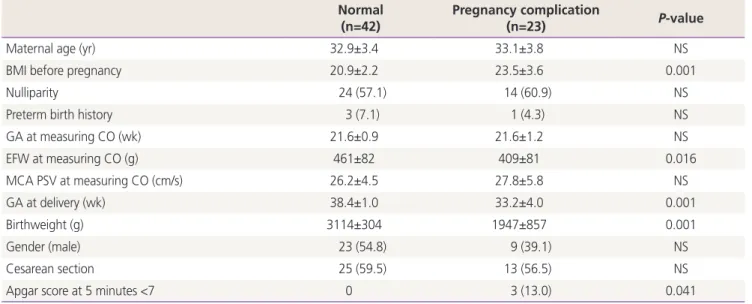
Sixty­five babies were delivered in our hospital. Table 1 lists the perinatal characteristics of mothers with and without pregnancy complications. In total, 23 had one or more preg­

nancy complications. There were nine cases of FGR (13.8%), eight of gestational hypertensive disorders (12.3%), and twelve of PTB caused by PTL or PPROM (18.5%). Several mothers experienced more than one complication.

We found no difference in maternal age, parity, mode of delivery, PTB history, or neonatal gender between mothers

with and without pregnancy complications (Table 1). Further­

more, we found no between­group difference in GA or in MCA peak systolic velocity at the time of fetal cardiac function examination. However, significant between­group differences were apparent in maternal body mass index prior to pregnancy, EFW during measurement of fetal cardiac function, GA at the time of delivery, birth weight, and the incidence of a low Ap­

gar score 5 minutes after delivery. The EFW was in the normal range because we excluded all cases with abnormal EFWs (e.g., small for GA or large for GA) from analysis.

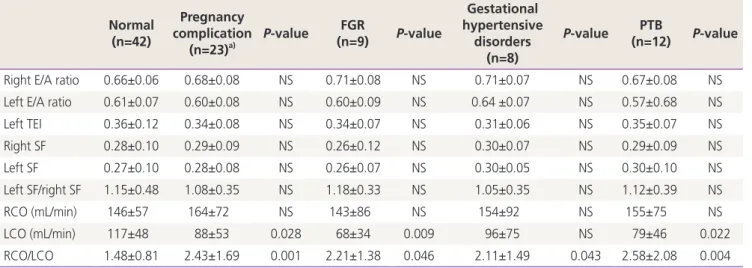
There were no significant differences in the E/A ratio, Tei score, SF, or RCO (Table 2). However, LCO was lower in the patients with than without pregnancy complications (88±53 vs. 117±48 mL/min, P=0.028). The RCO/LCO ratio was higher (2.43±1.69 vs. 1.48±0.81, P=0.001). The RCO/LCO was high­

er in the FGR (2.21±1.38 vs. 1.48±0.81, P=0.046), gestational hypertensive disorders (2.11±1.49 vs. 1.48±0.81, P=0.043),

Table 2. A comparison of fetal cardiac function in normal and pregnancy complication group

Normal (n=42)

Pregnancy complication

(n=23)

a)

P-value FGR

(n=9) P-value

Gestational hypertensive

disorders (n=8)

P-value PTB

(n=12) P-value

Right E/A ratio 0.66±0.06 0.68±0.08 NS 0.71±0.08 NS 0.71±0.07 NS 0.67±0.08 NS

Left E/A ratio 0.61±0.07 0.60±0.08 NS 0.60±0.09 NS 0.64 ±0.07 NS 0.57±0.68 NS

Left TEI 0.36±0.12 0.34±0.08 NS 0.34±0.07 NS 0.31±0.06 NS 0.35±0.07 NS

Right SF 0.28±0.10 0.29±0.09 NS 0.26±0.12 NS 0.30±0.07 NS 0.29±0.09 NS

Left SF 0.27±0.10 0.28±0.08 NS 0.26±0.07 NS 0.30±0.05 NS 0.30±0.10 NS

Left SF/right SF 1.15±0.48 1.08±0.35 NS 1.18±0.33 NS 1.05±0.35 NS 1.12±0.39 NS

RCO (mL/min) 146±57 164±72 NS 143±86 NS 154±92 NS 155±75 NS

LCO (mL/min) 117±48 88±53 0.028 68±34 0.009 96±75 NS 79±46 0.022

RCO/LCO 1.48±0.81 2.43±1.69 0.001 2.21±1.38 0.046 2.11±1.49 0.043 2.58±2.08 0.004

Value are presented as mean±standard deviation; P<0.05 was considered significant.

FGR, fetal growth restriction; PTB, preterm birth; E, peak velocity of the early diastolic transmitral flow; A, peak velocity of the late diastolic transmitral flow; E/A ratio, ratio of peak early vs. late transmitral flow velocity; NS, not significant; TEI, isovolumic contraction time plus isovolu­

mic relaxation time divided by ejection time; SF, shortening fraction; RCO, right cardiac output; LCO, left cardiac output.

a)

Several patients experienced more than two complications.

Table 3. Multivariate logistic regression analysis for the prediction of pregnancy complications

Variable Adjusted odds ratio (95% CI) P-value

Body mass index before pregnancy 2.14 (1.39–3.27) 0.001

Estimated fetal weight at examination 0.98 (0.94–1.03) NS

Right cardiac output/left cardiac output 7.76 (1.15–52.21) 0.029

All outcomes were adjusted for maternal age, body mass index, parity, preterm birth history, gestational age at measuring cardiac output, and estimated fetal weight; P<0.05 was considered significant.

CI, confidence interval; NS, not significant.

(5)

and PTB subgroups (2.58±2.08 vs. 1.48±0.81, P=0.004) than in the normal group (Table 2).

Multivariate analysis of adjusted maternal age, body mass index, parity, PTB history, GA at measuring CO, and EFW demonstrated that the RCO/LCO ratio was a significant pre­

dictor of pregnancy complications (adjusted odds ratio, 7.76;

95% confidence interval [CI], 1.15 to 52.21; P=0.029) (Table 3). In each case, the RCO/LCO ratio was a significant predictor of gestational hypertension (adjusted odds ratio, 6.59; 95%

CI, 1.17 to 37.14; P=0.032) and PTB (adjusted odds ratio, 2.36;

95% CI, 1.08 to 5.14; P=0.031) (Table 4).

The area under the receiver­operating characteristic curve used to predict pregnancy complications from LCO was 0.71 (P=0.011) (Fig. 2). The diagnostic cut­off value used for LCO was 80 mL/min. The area under the receiver­operating char­

acteristic curve derived from the RCO/LCO ratio was 0.68 (P=0.02) (Fig. 3), and the diagnostic cut­off value was 1.41 (68.2% sensitivity, 50.0% specificity).

Discussion

In this study, we demonstrated that ultrasonographic fetal CO measurement at a GA of 20 to 24 weeks is useful for the prediction of pregnancy complications. The complication rate was 35.4% (23/65), which appears high because 48 patients were transferred to local clinics after normal results of fetal heart function evaluation were obtained at our hospital.

Several studies that analyzed fetal cardiac function have in­

dicated that such analysis provides important information on the hemodynamic status and cardiovascular adaptations dur­

ing perinatal complications. Deterioration in clinical measures of cardiac function may frequently represent the first sign of fetal pathology [3].

Over the years, a number of different ultrasound methods have been proposed in an attempt to quantitatively evaluate fetal cardiac function, such as the E/A ratio, myocardial per­

formance index (MPI), SF, and CO [3,4].

Table 4. Multivariate logistic regression analysis of RCO/LCO for the prediction of each pregnancy complication

Variable Adjusted odds ratio (95% CI) P-value

RCO/LCO for fetal growth restriction 1.94 (0.95–3.96) 0.069

RCO/LCO for gestational hypertensive disorders 6.59 (1.17–37.14) 0.032

RCO/LCO for preterm birth (PTL or PPROM) 2.36 (1.08–5.14) 0.031

All outcomes were adjusted for maternal age, body mass index, parity, preterm birth history, gestational age at measuring cardiac output, and estimated fetal weight; P<0.05 was considered significant.

RCO, right cardiac output; LCO, left cardiac output; CI, confidence interval; PTL, preterm labor; PPROM, preterm premature rupture of mem­

branes.

1­specificity

0.0 0.2 0.4 0.6 0.8 1.0 1.0

0.8

0.6

0.4

0.1

0.0

1­ sensitivity

Fig. 2. Receiver-operating characteristics curve for the prediction of pregnancy complication according to cut-off values of left car- diac output.

1­specificity

0.0 0.2 0.4 0.6 0.8 1.0 1.0

0.8

0.6

0.4

0.1

0.0

1­ sensitivity

Fig. 3. Receiver-operating characteristics curve for the prediction

of pregnancy complication according to cut-off values of right car-

diac output to the left cardiac output.

(6)

In a healthy fetus, the E/A ratio is typically <1 because the majority of the blood passing to the ventricle is propelled by atrial contraction due to reduced compliance of the ventricu­

lar myocardium [3­5]. In patients with a reduced E/A ratio, the process of ventricular filling depends more on atrial contrac­

tion than on negative pressure during relaxation. This occurs mainly during two conditions: chronic hypoxia and cardiac overload [5,6]. However, there are limitations associated with its use. For example, both the E and A waves are fused in cas­

es of fetal tachycardia. In our study, there was no difference in the E/A ratio between patients with and without pregnancy complications.

The MPI has been shown to be relatively stable, varying only slightly throughout gestation (mean MPI, 0.36; range, 0.28 to 0.44) [7]. In our study, the mean MPI was 0.36±0.12. The MPI increases in hypervolemia and high cardiac afterload [8].

Benavides­Serralde et al. [9] reported that in cases of FGR, the MPI was a reliable early marker of fetal cardiac dysfunction.

In the present study, however, there was no difference in the MPI between patients with and without pregnancy compli­

cations. MPI measurements have several limitations. Most importantly, this measurement method is non­reproducible and it is not easy to obtain a clear­cut waveform. Further­

more, because the MPI is easily affected by the heart rate, it is markedly more difficult to apply MPI measurement to fetuses, which typically have variable heart rates. Finally, there is varia­

tion in reference ranges previously reported among different research groups; universal agreement on machine settings and the valve click measurement phase is required [10,11].

The SF represents the systolic decrease in ventricular diam­

eter expressed as a ratio of the end­diastolic diameter using M­mode. The SF can reflect CO. However, standardization of the measurement is difficult due to problems with M­mode alignment [4]. In our study, SF did not differ significantly be­

tween patients with and without pregnancy complications.

Several reports have described the assessment of fetal conditions using CO, which is determined by stroke volume and heart rate. Under normal conditions, there is a continu­

ous increase in all cardiac volumes throughout gestation, predominantly the RV volume, which accounts for 55% to 60% of the continuous CO [8]. Under hypoxic conditions, CO might respond differently due to a brain­sparing effect or cardiac overload. Much amount of blood ejected by the LV is forwarded to brain. And increased placental resistance is predominantly expressed in the RV because the blood flow

which it ejects is mainly forwarded to the lower part of the fetal body and placenta. Therefore, the RCO/LCO ratio might be decreased [5]. However, there are several reports in which the increased afterload induced by placental insufficiency may have reduced the LCO because changes in tissue resistance in this region are reflected principally in the LV. Rizzo et al. [12]

reported that the ejection force of the LV was significantly lower than that of the RV, while Kiserud et al. [13] found that the ejection force of both the LV and RV were decreased dur­

ing FGR.

According to our data, CO (especially LCO) may be in a pathological state before clinical signs appear. This suggests that an obstetrician should monitor the occurrence of preg­

nancy complications if the fetal LCO is <80 mL/min or the RCO/LCO ratio is 1.41 on fetal echocardiograms performed at a GA of 20 to 24 weeks. Why the RCO was greater than the LCO in our study remains unclear. The RV may work harder than the LV to overcome placental resistance during early­

stage pathology. As the disease progresses, the role of LV, which passes blood to the fetal brain, might increase. Finally, the RCO and LCO may be in balance, or the LCO could in­

crease more than the RCO.

The novel findings of this study are as follows. First, this is the first prospective study to reveal that ultrasonographic fetal CO measurement at a GA of 20 to 24 weeks is effective for the prediction of pregnancy complications. Our study also provides evidence that in complicated fetal cases with normal umbilical artery and MCA Doppler values, the E/A ratio and MPI may represent signs of subclinical cardiac dysfunction.

Second, this study proves that fetuses are already affected by pathologic conditions in the mid­trimester, although clinical signs later during later pregnancy. From a pathophysiological viewpoint, this fact is consistent with previous evidence that a proportion of fetuses exhibiting FGR and those under condi­

tions of maternal preeclampsia are exposed to placental insuf­

ficiency and chronic restriction of nutrients and oxygen due to abnormal placentation during early pregnancy [11]. Third, our study provides important information on the changes in placental vascular resistance associated with PTB, resulting from PTL or PPROM. These findings may serve as a basis for future studies pertaining to pathologic conditions during PTB.

For example, our data support other studies relating PTB to chronic placental inflammation [14].

However, there are also several limitations to our study. First,

although we attempted to overcome the lack of reproduc­

(7)

ibility by employing a single trained obstetrician to perform all fetal echocardiographs, obtaining a standard method and objective reference values for fetal CO should be a target for future research. Second, measuring fetal CO requires exten­

sive training and laborious data post­processing. Nevertheless, we believe that measurement of fetal CO has applicability for the assessment of specific pathologies or for use in research settings.

In conclusion, this study demonstrated for the first time that pregnancy complications such as FGR, preeclampsia, and PTB resulting from PTL or PPROM can be predicted based on fetal CO assessments made by ultrasonography at a GA of 20 to 24 weeks. In our opinion, measurement of fetal CO repre­

sents an additional informative parameter for the manage­

ment of high­risk pregnancies because it effectively predicts prenatal complications during relatively early­stage pregnancy.

Conflict of interest

No potential conflict of interest relevant to this article was reported.

Acknowledgments

This research was supported by the Basic Science Research Program through the National Research Foundation of Korea (NRF) funded by the Ministry of Education, Science and Tech­

nology (2016R1D1A1B03931905).

References

1. Law A, McCoy M, Lynen R, Curkendall SM, Gatwood J, Juneau PL, et al. The prevalence of complications and healthcare costs during pregnancy. J Med Econ 2015;18:533­41.

2. Tutschek B, Schmidt KG. Techniques for assessing car­

diac output and fetal cardiac function. Semin Fetal Neo­

natal Med 2011;16:13­21.

3. Godfrey ME, Messing B, Cohen SM, Valsky DV, Yagel S.

Functional assessment of the fetal heart: a review. Ultra­

sound Obstet Gynecol 2012;39:131­44.

4. Van Mieghem T, DeKoninck P, Steenhaut P, Deprest J.

Methods for prenatal assessment of fetal cardiac func­

tion. Prenat Diagn 2009;29:1193­203.

5. Hernandez­Andrade E, Benavides­Serralde JA, Cruz­

Martinez R, Welsh A, Mancilla­Ramirez J. Evaluation of conventional Doppler fetal cardiac function parameters:

E/A ratios, outflow tracts, and myocardial performance index. Fetal Diagn Ther 2012;32:22­9.

6. Bahtiyar MO, Copel JA. Cardiac changes in the in­

trauterine growth­restricted fetus. Semin Perinatol 2008;32:190­3.

7. Hernandez­Andrade E, Figueroa­Diesel H, Kottman C, Illanes S, Arraztoa J, Acosta­Rojas R, et al. Gestational­

age­adjusted reference values for the modified myocar­

dial performance index for evaluation of fetal left cardiac function. Ultrasound Obstet Gynecol 2007;29:321­5.

8. Balli S, Kibar AE, Ece I, Oflaz MB, Yilmaz O. Assessment of fetal cardiac function in mild preeclampsia. Pediatr Cardiol 2013;34:1674­9.

9. Benavides­Serralde A, Scheier M, Cruz­Martinez R, Crispi F, Figueras F, Gratacos E, et al. Changes in central and peripheral circulation in intrauterine growth­restricted fetuses at different stages of umbilical artery flow dete­

rioration: new fetal cardiac and brain parameters. Gyne­

col Obstet Invest 2011;71:274­80.

10. Meriki N, Welsh AW. Technical considerations for mea­

surement of the fetal left modified myocardial perfor­

mance index. Fetal Diagn Ther 2012;31:76­80.

11. Comas M, Crispi F, Cruz­Martinez R, Figueras F, Gratacos E. Tissue Doppler echocardiographic markers of cardiac dysfunction in small­for­gestational age fetuses. Am J Obstet Gynecol 2011;205:57.

12. Rizzo G, Capponi A, Rinaldo D, Arduini D, Romanini C.

Ventricular ejection force in growth­retarded fetuses.

Ultrasound Obstet Gynecol 1995;5:247­55.

13. Kiserud T, Ebbing C, Kessler J, Rasmussen S. Fetal car­

diac output, distribution to the placenta and impact of placental compromise. Ultrasound Obstet Gynecol 2006;28:126­36.

14. Lee J, Kim JS, Park JW, Park CW, Park JS, Jun JK, et al.

Chronic chorioamnionitis is the most common placental

lesion in late preterm birth. Placenta 2013;34:681­9.

수치

Fig. 1.  Ultrasonographic measurement of cardiac output using pulsed-wave Doppler. (A) The pulmonary root diameter (arrow) is used  to calculate pulmonary valve area
Table 1. Characteristics between normal group and pregnancy complication group Normal
Table 2. A comparison of fetal cardiac function in normal and pregnancy complication group
Table 4. Multivariate logistic regression analysis of RCO/LCO for the prediction of each pregnancy complication

참조

관련 문서