ORIGINAL ARTICLE
암석 순환의 구성요소와 과정에 대한 예비 지구과학 교사들의 이해
김윤지* (*대구대학교)
The Rock Cycle Composition Elements and Process of the Pre-service Earth Science Teachers' Understanding
Yun-Ji Kim
* (*Daegu University)ABSTRACT
The purpose of this study is to identify the composition elements and processes of the rock cycle that pre-service teachers in earth science field understand. Second-year students majoring in earth science were selected as research objects, all of whom attended teacher’s university located in the southern region. The methods of arranging the composition elements of the rock cycle in a structured way and displaying the cycle direction through the arrow and describing the cycle processes in detail were applied. Pre-service teachers recognized 5 composition elements: magma, igneous rocks, sediments, sedimentary rocks, metamorphic rocks of the rock cycle and cycle processes was represented into 20 branches. The cycle type was analyzed by four criteria: linear, triangular, circular, complex, some pre-teachers did not complete the loop of the cycle or some showed incomplete understanding of the cycle structure simply displayed in one direction. The rock cycle is an important theme of the earth system education characterized by dynamism and complexity.
Key words : rock cycle, earth system education, system thinking
Received 2 July, 2016; Revised 3 August, 2016; Accepted 4 August, 2016
*Corresponding author : Yunji Kim, Daegu University, 201 Daegudaero, Jillyang, Gyeongsan, Gyeongbuk, 38453, Korea
Phone: +82-10-4412-5595 E-mail: [email protected]
ⓒ The Korean Society of Earth Sciences Education . All rights reserved.
This is an Open-Access article distributed under the terms of the Creative Commons Attribution Non-Commercial License
(http://creativecommons.org/licenses/by-nc/3.0) which permits unrestricted non-commercial use, distribution, and reproduction in any medium, provided the original work is properly cited.
Ⅰ. INTRODUCTION
Mayer, Armstrong(1990)’s paper introduces the perspectives on the 21st century Earth. The paper states that subsystems of Earth, which is one of the essential concepts of Earth Systems Education, continuously evolve, change, and interact. Ben‐zvi‐
Assarf, Orion(2005b), who studied systems thinking,
emphasized the geochemical and biochemical cycles among subsystems and argued that in order to understand Earth systems, it is necessary to understand the cyclical characteristics of the systems.However, in the previous studies of the rock cycle(Kali et al., 2003; Kali, 2003), the water cycle(Ben‐Zvi‐
Assaraf, Orion, 2005a, 2005b), the rock, water, and carbon cycle(Sibley et al., 2007), and the nitrogen
cycle(Townsend et al., 2007) only focused on each cycle, rather than looking at the Earth systems as a whole. In order to understand Earth systems as a single system, three elements are necessary. These elements are the understanding of the parts of the system, the relationships among the parts, and the system as a whole(Kali et al., 2003; Kali, 2003).
Hence, the theme of cycle should be considered as an essential component for the understanding of interactions of subsystems in Earth Systems Education.
Looking at the domestic research trends, researchers have studied understanding of the preliminary earth science teacher for the carbon cycle (Moon et al., 2004), and the systematic recognition of earth water cycle by the high school, pre- earth science and elementary teachers were analyzed (Lee et al., 2008;
Jeong et al., 2007; Jeong & Kim, 2008), and they also studied various cycle and environment concept of the university and high school students in the entire earth system(Kim et al., 2009; Kim, 2014; Kim, 2015).
Jeong et al.(1994) analyzed theme of rock and studied the concept change of the sixth grade primary students regarding the cause of creation and changes in the rock. Coe et al.(2003) also found a difference in conceptual understanding of the rock by middle school students in different residential area. Wee et al.(2007) explored the features of understanding about mineral and rock among high school students. But the theme of rock cycle study was only conducted by Kim &
Jeong(2010), who targeted colleges students not majoring in science courses.
In our 7-9th grade middle school science curriculum, students learn that rock and mineral elements are presented as constituting the Geosphere of the earth system, and they have charateristrics of cycle. In the earth science Ⅱ of the high school curriculum, students learn the creation processes and features of igneous rocks, metamorphic rocks, sedimentary rocks in-depth. As a subject in the geological field of earth science to which the concept
of cycle is applied, rock cycle includes the scientific concept how rock is formed in accordance with various generation causes in the earth system and how it changes due to the environmental changes afterwards (Lee et al., 2015) . By understanding the scientific concept of the rock cycle and providing an opportunity to study the process of interaction in the earth system, the study of the rock cycle is very meaningful in that they could be the subject of earth system education (Kim & Jeong, 2010).
The purpose of this study is to illuminate the understanding of preliminary earth science teachers regarding the subject of rock cycle. ; How pre-teachers understand the composition elements of the rock cycle, and how they understand the processes of the cycle process respectively. Through this process, we can find a subjective model of the rock cycle among the pre-service teachers that include the scientific and non-scientific concept. By also exploring the systemic characteristics in the understanding of interaction when rock cycles in the earth system, we can find implication for pre-teacher’s education in the earth system field.
Ⅱ. METHODOLOGY
1. Participants
Students majoring in science of the Education College who want to become a teacher were selected for research objects. The study was conducted in a private university located in the southern region. 25 pre-service teachers who registered at earth science course opened for major elective in grade-2 first semester were selected for study objects. The study objects were 11 boys and 14 girls, who attended various high schools located from Jeju to Seoul. The objects were encoded from T1 to T25, and the number was assigned sequentially depending on the order of
merits, for example, by according TI to a student receiving a A+ in the evaluation and T25 to one receiving C. Some students learned earth scienceⅡ in their high schools, however, all students selected the earth scienceⅠ in college entrance exam. Therefore, some pre-service teachers lack in-depth understanding of earth science, and some have little confidence in earth science curriculum.
2. Data collection
The contents of the earth science was mainly organized around the geology, in March three classes focused on theory were carried out with the theme of rocks (igneous rocks, metamorphic rocks, sedimentary rocks). They dealt with the content that the rock cycle, however give a limited explanation to cycle elements and processes according to the researcher’s intention. Using class hours in June when the classes end, data was collected for analysis of the understanding of the rock cycle of pre-service teachers. We also refer to Si’s prior research that studied the concept of the rock cycle, and empty boxes were placed for the study object to write the composition elements of the cycle, and examination papers were put in between to draw an arrow in one direction and show the cycle process in advance.
However, we did not limit the number of the cycle composition elements and direction of the process cycle in order to help the pre-service teachers express their subjective understanding in an open way possible. Pre-teachers arranged composition elements of the rock cycle in a structured manner in the examination paper. They utilized the arrow(→) to display the process and direction of the rock cycle, and they recorded a description of the process cycle inside pictures together. Writing activity was carried out in about 20 minutes to describe their inner understanding of the rock cycle in a more detailed and schematic way.
3. Data analysis
Criteria were needed to analyze the composition elements and processes of the rock cycle from pre-teachers’ schematic representation. By interpreting Kali et al.(2003)’s prior research which studied the earth system cycle, we extracted composition elements of the rock cycle, and primary analysis was made based on this. Composition elements of the rock cycle extracted from previous studies of the Kali et al.(2003) were 6 including magma, igneous rocks, exposed rock, sediments, sedimentary rocks, metamorphic rocks, and these elements worked as analysis criteria. However, using 5 composition elements of the rock cycle such as magma, igneous rocks, sediments, sedimentary rocks, metamorphic rocks, final analysis was made on this research. The rock cycle processes derived from previous studies of the Kali et al.(2003) were 13, however, these could not be used as a analysis criteria because they included exposed rocks as a composition elements which is different from this research. Therefore, the final analysis was made based on 20 which include all rock cycle processes pre-teachers understand and was repeatedly elicited through a comparative analysis from the data collected in this research. Moreover, we classified rock cycle types pre-service teachers expressed, and we made an analysis by exploiting Kim et al.(2009)’s linear, circular, branched, complex type as main criteria. Kim et al.(2009) analyzed earth system cycle of University students in the past.
However, no case was found that rock cycle pre-service teachers understand in this study was analyzed as a branched type and in some cases triangular characteristics appears, therefore we classified it into four types of linear, triangular, circular, complex. Such examination and analysis methods refer to previous research of Kim et al.(2009) and Kim & Jeong(2010) who investigate the understanding of the university students’ earth system cycle majoring in non-science. Analysis criteria of
rock cycle’s composition elements was the same as the Kim & Jeong(2010) used, however, analysis criteria of rock cycle processes were very different from our research and comparisons on the findings were made.
Ⅲ. RESULTS and DISCUSSION
1. Composition elements of rock cycle
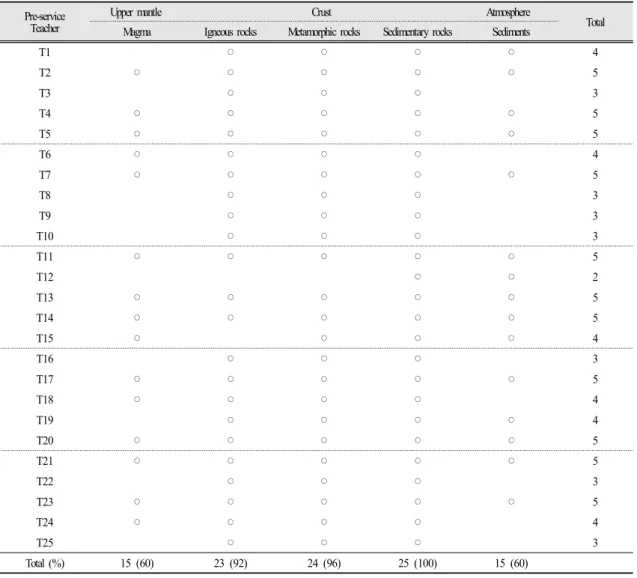
After analyzing composition elements of rock cycle pre-teachers expressed through schematic presentation, we found out that these pre-teachers understood 5 composition elements including magma, igneous rocks, metamorphic rocks, sedimentary rocks, sediments (Table 1). All 25 objects expressed the sedimentary rocks as composition elements of the rock cycle and it applied to all pre-service teachers. 24 objects represented composition elements of rock cycle as metamorphic rocks, and 23 as igneous rocks. T12, who did not represent metamorphic rocks and igneous rocks as a composition elements of rock cycle, understood the repeated processes of sediments from surfaces and sedimentary rocks acted from diagenesis.T15, displaying unscientific understanding that magma hardens into sediments without passing the steps of igneous rocks, shows the lacking of scientific concept of rock cycle. 15 pre-teachers representing more than half of the study included magma or lava in the last stage before igneous rocks as the composition elements of the rock cycle. In addition, 15 pre-teachers matching some of them above expressed sediments before the creation of sedimentary rocks as composition elements of the rock.
The reason pre-teachers’ understanding of composition element of rock cycle appears variously is that the rock cycle model presented by our science curriculum is not fully unified as one. Rock cycle model is presented differently depending on the textbook in different grade and different publisher.
Thus, students learn the concept of a rock cycle from a differently and variously expressed perspectives, and they may be viewed as presenting different understanding as in this study. In previous studies of the Sibley et al.(2007) which analyzed US college students’ systemic thinking on rock cycle, students recognized composition elements of rock cycle as rocks (igneous rocks, metamorphic rocks, sedimentary rocks) and even units containing minerals and ions and it is quite different from ours. In addition, composition elements of the rock cycle that pre-teachers represent are quite different from the result of this study in that composition elements contains exposed rocks(state of various rocks exposed before the phase of sediments) suggested by Kali et al.(2003)’s research to which these were applied as main criteria. The result of Kim & Jeong(2010) research which studied the non-science majors of our Universities reported same 5 cycles of composition elements as this study. Differences of understanding between American college students and Korea pre-service teachers are configured that the contents of rock cycles compose the rock units in our science curriculum, and even some textbooks additionally suggested elements of magma and sediments, thus Korean students learn through these textbooks. We have found out that our country’s textbooks and earth science and geology books simply illustrates the composition elements of rock cycle by displaying it in a diagram form, therefore learner’s understanding of the rock cycle will not go beyond the solid wall of books.
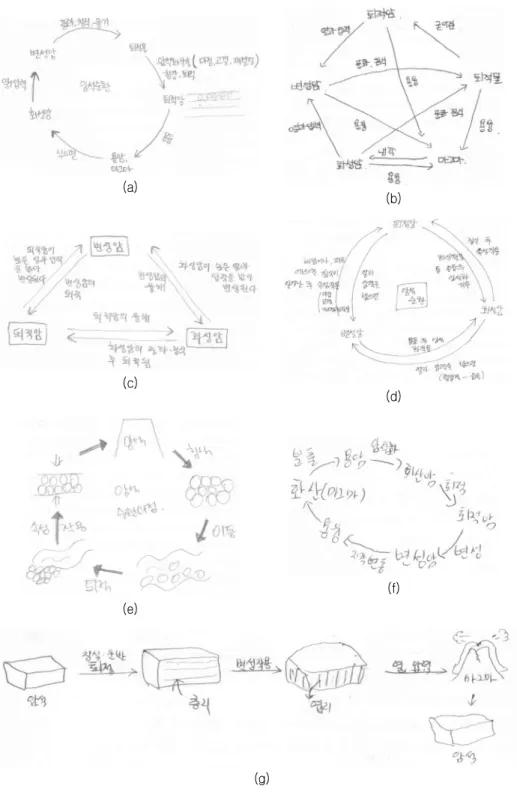
11 pre-teachers suggested that composition elements of rock cycle are 5 including magma, igneous rocks, metamorphic rocks, sedimentary rocks, sediments, representing around half of the sample studied (Table 2). Diagram of rock cycle between T7 and T14 makes a big difference, however, composition elements were equally analyzed as 5. This happens due to difference of understanding of rock cycle(Fig. 1(a),(b)). There
Pre-service Teacher
Upper mantle Crust Atmosphere
Total Magma Igneous rocks Metamorphic rocks Sedimentary rocks Sediments
T1 ○ ○ ○ ○ 4
T2 ○ ○ ○ ○ ○ 5
T3 ○ ○ ○ 3
T4 ○ ○ ○ ○ ○ 5
T5 ○ ○ ○ ○ ○ 5
T6 ○ ○ ○ ○ 4
T7 ○ ○ ○ ○ ○ 5
T8 ○ ○ ○ 3
T9 ○ ○ ○ 3
T10 ○ ○ ○ 3
T11 ○ ○ ○ ○ ○ 5
T12 ○ ○ 2
T13 ○ ○ ○ ○ ○ 5
T14 ○ ○ ○ ○ ○ 5
T15 ○ ○ ○ ○ 4
T16 ○ ○ ○ 3
T17 ○ ○ ○ ○ ○ 5
T18 ○ ○ ○ ○ 4
T19 ○ ○ ○ ○ 4
T20 ○ ○ ○ ○ ○ 5
T21 ○ ○ ○ ○ ○ 5
T22 ○ ○ ○ 3
T23 ○ ○ ○ ○ ○ 5
T24 ○ ○ ○ ○ 4
T25 ○ ○ ○ 3
Total (%) 15 (60) 23 (92) 24 (96) 25 (100) 15 (60)
Table 1. Pre-service teachers' composition elements understanding
Table 2. Composition elements of the rock cycle
Upper mantle Crust Atmosphere
Responses Total
Magma Igneous rocks Metamorphic rocks Sedimentary rocks Sediments (%)
T2.T4.T5.T7.T11.T13.
T14.T17.T20.T21.T23 11
(44) T3.T8.T9.T10.T16.T22.T25 7
(28)
T6.T18.T24 3
(12)
T15 1
(4)
T1 1
(4)
T19 1
(4)
T12 1
(4)
were seven cases that pre-teachers understood composition elements as 3 including igneous rocks, metamorphic rocks, sedimentary rocks, and they understand the rock cycle as rock unit. This simple results that rock cycle with only 3 kinds of rock, as stated in Lee et al.(2015)’s comparative study of international training courses around the concept of the rock cycle, suggested that in our country the rock is classified into 3 kinds depending on the causes of creation and this information is covered in conjunction with, step-by-step , from elementary to high school levels. The T3 and T10’s diagram of a rock cycle were considered as a general case(Fig. 1(c),(d)), however, there was some limitations that if we only recognize the small number of composition elements, we could not express the cycle process variously. Of course, as shown in Figure 1, it could not be interpreted that even if we recognize more composition elements of the cycle, we could represent the cycle processes in a more diverse way. However, it is not until we recognize the composition elements of the rock cycle and processes not an independent concept but various elements, we can have a more comprehensive understanding of the nature’s complex processes.
We found out that 3 persons recognize the composition elements of the rock cycle with four components of magma, igneous rocks, metamorphic rocks, sedimentary rocks. There were cases 4 elements were expressed including igneous rocks, metamorphic rocks, sedimentary rocks, sediments, 3 elements such as metamorphic rocks, sedimentary rocks, sediments, 2 elements of sedimentary rocks, sediments. T12 expressed that composition elements include sedimentary rocks and erosion product, and he(she) mainly understand the rock cycle focusing on sedimentary rocks. (Fig. 1(e)). However, T12’s diagram represented rock cycle as several processes that sediments is developed into sedimentary rocks and sedimentary rocks changed into sediments. These
results coincide with the one suggested by Kim &
Jeong(2010) research that some of the students majoring in non-science understand the rock cycle as partial process occurring at the surface. T24 analyze the composition elements as 4 including magma, igneous rocks, metamorphic rocks, sedimentary rocks and understand rock cycle with the focus on igneous rocks. (Fig. 1(f)). However, the diagram of T24 exhibited an extreme understanding biased toward igneous rocks, recognizing magma and lava as an independent composition elements of each rock cycle, equating the magma with volcano, with melting process corresponding to the process cycle included as composition elements. In addition, T24 together with T20, T22, described volcanic rocks instead of the term igneous rocks, T20, T22, T11, T16, T23 used a term granite. On these issues, Wee et al.(2009) researched on the concepts of high school students for the rocks and reached a conclusion that this confusion about term magmatic and granite was caused by the recognition that igneous rocks were created by the volcano explosion. And also prior research of the Kim
& Jeong(2010) showed that non-science majors confused igneous rocks with granite or volcanic rocks , therefore we warned that the term confusion of these students could soon lead to that of science concepts.
Another problem is that T12 collectively describe sedimentary rocks as the rock, T18 designate the igneous rocks as the rock (Fig. 1(g)) Kusnick(2002) conducted an essay writing targeted at elementary pre-teachers with the subject of the rock generation, argues that since pre-service teachers collectively used sedimentary rocks as the rock, and pointed out that these needs to be classified into kind of rocks and used exactly. Considering the impact that pre-service teachers who will become a teacher in the future have on the lots of students, a lot of attention needs to be taken in pre-service teacher training courses for the pre-teachers to use exact science terms.
(a) (b)
(c)
(d)
(e)
(f)
(g)
Fig. 1. Diagrams of rock cycle: (a)T7 (b)T14 (c)T3 (d)T10 (e)T12 (f)T24 (g)T18
2. Process of rock cycle
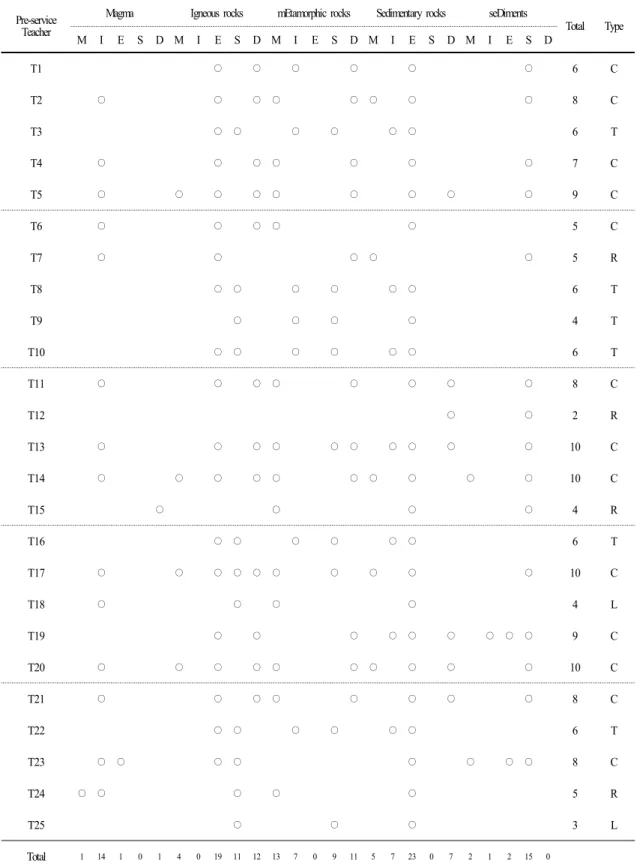
We analyzed the cycle process what happens among each composition elements of magma, igneous rocks, metamorphic rocks, sedimentary rocks, sediments from the diagram of pre-teachers, we have constituted 25 analysis framework, however, actually rock cycle process pre-service teacher understand was shown to be 20 (Table 3). 14 pre-service teachers, more than half of study objects, expressed the process
‘magma→igneous rocks’ regarding the cycle process that starts from magma, and the result showed that they understand the magma as the previous step of igneous rocks being formed. T24 who understand the rock cycle around the igneous rocks, explained that volcanic magma circulate into erupting lava by independently dividing magma and lava. (Fig. 1(f)).
T15 showed an unscientific understanding that magma could be hardened into sediments, with T23 understanding that magma could be changed into metamorphic rocks with metamorphism. Regarding the cycle process starting from igneous rocks, 12 people expressed the relationship ‘igneous rocks→sediments’, 11 people ‘igneous rocks→sedimentary rocks’, and majority of pre-teachers showed their understanding of rock change that the magmatic rock transform into sedimentary rocks in the igneous rocks. In addition, 19 people represented the rocks cycle with ‘igneous rocks→metamorphic rocks, 4 expressed igneous rocks
→magma. Regarding the process of igneous rocks cycling into magma, T14 and T17, T20 explained with the scientific term of melting, T5 explained the process that igneous rocks dissolve and turn into magma. Considering the impact which teachers have on their students through their class, it is recommended that pre-service teachers use the exact scientific terminology.
Regarding the cycle process that starts from metamorphic rocks, 13 persons expressed the process with metamorphic rocks→magma, 7 with metamorphic rocks→igneous rocks, so it was found out that
majority of the pre-teachers understand the rock change process that metamorphic rocks could be transformed into igneous rocks. Also 11 people expressed the process of ‘metamorphic rocks→
sediments’, 9 people ‘metamorphic rocks→
sedimentary rocks’, it was concluded that considerable numbers showed their common understanding that metamorphic rocks transform into sedimentary rocks.
Some pre-service teachers who included magma into composition element of the rock cycle recognized that magma is the prior phase before metamorphic rocks being transformed into igneous rocks, others who did not included magma into composition elements explained that metamorphic rocks directly change into igneous rocks. Likewise, some pre-teachers who included erosion rocks as composition elements of rock cycle, recognized sediments as a prior phase of metamorphic rocks being changed into sedimentary rocks, gave a more detailed description of the process how sedimentary rocks was created. However, some pre-teachers who did not include sediments into composition elements showed limitation in their understanding that the rock cycle is the process where metamorphic rocks directly change into sedimentary rocks. This analysis result confirmed that, as discussed in the previous study of the Kim et al.(2009), a variety of recognitions comprising rock cycle could lead to a various understanding and expression of rock cycle that actually happens in the natural world.
Regarding the cycle process that start from sediments, 15 pre-teachers (more than half of the study objects) expressed the relationship ‘sediments→
sedimentary rocks’, so they understood the sediments as prior phase before sedimentary rocks was created.
Among these persons 11 expressed that magma is the prior phase of igneous rocks. K’s study dealing with the rock cycle did not include magma and sediments into cycle process and analysis was not possible. Kim
& Jeong(2010)’s study shows difference with our research, however, we could get a more specific
Table 3. Pre-service teachers' process understanding (Type: Complex, Triangular, circulaR, Linear)
Pre-service Teacher
Magma Igneous rocks mEtamorphic rocks Sedimentary rocks seDiments
Total Type
M I E S D M I E S D M I E S D M I E S D M I E S D
T1 ○ ○ ○ ○ ○ ○ 6 C
T2 ○ ○ ○ ○ ○ ○ ○ ○ 8 C
T3 ○ ○ ○ ○ ○ ○ 6 T
T4 ○ ○ ○ ○ ○ ○ ○ 7 C
T5 ○ ○ ○ ○ ○ ○ ○ ○ ○ 9 C
T6 ○ ○ ○ ○ ○ 5 C
T7 ○ ○ ○ ○ ○ 5 R
T8 ○ ○ ○ ○ ○ ○ 6 T
T9 ○ ○ ○ ○ 4 T
T10 ○ ○ ○ ○ ○ ○ 6 T
T11 ○ ○ ○ ○ ○ ○ ○ ○ 8 C
T12 ○ ○ 2 R
T13 ○ ○ ○ ○ ○ ○ ○ ○ ○ ○ 10 C
T14 ○ ○ ○ ○ ○ ○ ○ ○ ○ ○ 10 C
T15 ○ ○ ○ ○ 4 R
T16 ○ ○ ○ ○ ○ ○ 6 T
T17 ○ ○ ○ ○ ○ ○ ○ ○ ○ ○ 10 C
T18 ○ ○ ○ ○ 4 L
T19 ○ ○ ○ ○ ○ ○ ○ ○ ○ 9 C
T20 ○ ○ ○ ○ ○ ○ ○ ○ ○ ○ 10 C
T21 ○ ○ ○ ○ ○ ○ ○ ○ 8 C
T22 ○ ○ ○ ○ ○ ○ 6 T
T23 ○ ○ ○ ○ ○ ○ ○ ○ 8 C
T24 ○ ○ ○ ○ ○ 5 R
T25 ○ ○ ○ 3 L
Total 1 14 1 0 1 4 0 19 11 12 13 7 0 9 11 5 7 23 0 7 2 1 2 15 0
derivation of result and interpretation based on study of the Kim & Jeong(2010). Two persons expressed cycle process with ‘sediments-→magma’, T14 shows the understanding that sediments and sedimentary rocks, when each melt, transform into magma, and T23’s expression was considered as unscientific because he could not express the transforming process that sedimentary rocks change into magma or igneous rocks. T19 who expressed ‘sediments→igneous rocks’
did not recognize the magma as the composition of the cycle, and explained that each sediments and sedimentary rocks mix with magma and transform into igneous rocks. In addition, T19 and T23 also revealed the recognition that the rock in the course of the cycle convert to ‘sediments→metamorphic rocks’ and considered the sediments as an independent composition elements.
Regarding the cycle process that start from sedimentary rocks, 23 pre-teachers expressed
‘sedimentary rocks→metamorphic rocks’, and it seems that most of them have a good understanding. In addition, five persons expressed ‘sedimentary rocks→
the magma’, 7 people ‘sedimentary rocks→igneous rocks’, and it seems that around half of the pre-teachers showed their understanding of the rock change from sedimentary rocks into igneous rocks. 7 persons expressed the cases of weathering and erosion processes in the course of ‘sedimentary rocks→
sediments’ while rock cycles, and all of them showed the transforming process of ‘sedimentary rocks→
sediments’. All 4 pre-teachers who have expressed the melting process of ‘igneous rocks→magma’ described the transforming process of magma→igneous rocks.
After all, this could be interpreted into saying that sedimentary rocks cycles into sedimentary rocks and igneous rocks into igneous rocks, and there was no case of understanding that metamorphic rocks could cycle into itself. These results shows clear difference to the Kim & Jeong(2010)’s preceding studies that around half of the students expressed the self cycle,
which is thought to be due to the difference of what they’ve learned in their class. From the results of this study that pre-service teachers do not understand the self cycle process of rocks, we find it necessary to give adequate training so that they can understand complex phenomena and various cycle processes occurring in nature. Analysis of cycle process type by which pre-teachers expressed through the diagram, it was classified into 13 complex, 6 triangular, 2 linear.
(Table 3). The complex type to which majority of pre-teachers belong, as shown in T14’s Fig. 1(b), are intertwined in a complex net shape. In triangular type, as shown T3 and T10’s in Fig. 1(c),(d), pre-teachers expressed composition elements of cycle as 3 kinds of rocks such as igneous rocks, metamorphic rocks, sedimentary rocks and understand the cycle process as interaction process among 3 rocks. In the circular type, as shown in Fig. 1(a),(e),(f) of T24, cycle process progresses in one direction and shows the forms of connecting the composition elements of the starting and ending points. In the linear type, as shown in Fig. 1(g) of T18, composition elements of cycle is lined up and cycle process progressed in one direction, therefore the cycling characteristics was not represented.
The conclusion that the rock cycle of the pre-teachers is usually analyzed as complex type and in some cases it is difficult to present cycle process and complete cycle loop due to modification of rocks, is consistent with previous study of the Kim et al.(2009). As proclaimed by Kim & Jeong(2010), it can be concluded that they do not recognize the cycle’s nature as they did not connect the starting and ending points while expressing rock cycles, and cycle endlessly spins without completing the cycle loop.
Magntorn & Hellden(2007) has argued that in order to better understand the ecology and make a effective deduction, we do not need to recognize the relationship of composition elements as simple linear, instead we need to have a more clear understanding of
the diverse and complex cycle relationship. If some pre-teachers have a mere understanding that rock cycle process is just linear and circular in one direction and triangular in 3 rock types, we have a limitation in understanding about what is actually going on in the complex earth system. Also, considering the impact that thousands of students will learn earth science from them, it is necessary to implement earth system education through the introduction of systematic thinking about the topic of the rock cycle in the curriculum of pre-service teachers.
Ⅳ. CONCLUSION
So I came to a conclusion in this research which analyzed pre-teachers’ understanding of the rock cycle based on cycle’s composition elements and processes, and suggestions to the education field is as follows.
First of all, composition elements of the rock cycle that pre-service teachers understand are limited. Some recognized sediments or magma as pre-phase of the rock or as quasi-rock, no cases were found that rocks generated from underground emerge into the surface and the human action affecting on rock cycle was recognized. Considering the impact that earth science curriculum and lessons and textbook have on subjective concept, it is needed to provide rock cycle model from a variety of perspectives that can actually occur in nature and do need to have a research in parallel with the impact.
Second, the rock cycle process that pre-service teachers understand was simply displayed. In some cases, cycle loop was not connected, cycle progress just in one direction and some have understanding that rock cycle is merely interaction among 3 rock type.
Understanding of the various processes of the rock cycle does not just help to get a scientific concept and it can also contribute to the systematic thinking.
Therefore, educators is advised not to make students simply memorize, moreover they need to go beyond the standardized rock cycle model to make the pre-teachers’ thinking extended divergently.
Third, the subject of rock cycle is meaningful material in education that covers the interaction between sub-systems. Rock is an essential material in education process from elementary to high schools and rock cycle is a good theme that can teach characteristics of dynamic earth system. Pre-teachers eventually will be teachers in future and their understanding could lead to the student’s understanding. Therefore, we need to have an earth education system in that pre-teachers recognize the composition elements from the diverse perspective, and they can develop their capacity to have a systematic thinking about the complex rock cycle.
국문요약
연구의 목적은 예비 지구과학 교사들이 이해하 고 있는 암석 순환의 구성요소와 과정에 대해 밝히 는 것이다. 남부 지역에 소재한 사범대학교 2학년 에 재학하면서 지구과학 수업을 수강하는 25명의 예비교사들이 연구대상으로 선정되었다. 암석 순환 의 구성요소들을 구조적으로 배열하고, 순환 방향 을 화살표로 표시하고, 순환 과정에 대해 서술하는 방법을 적용하였다. 예비교사들이 이해하는 암석 순환의 구성요소는 마그마, 화성암, 변성암, 퇴적물, 퇴적암의 5가지로, 순환의 과정은 20가지로 표현되 었다. 순환의 유형은 선형, 삼각형, 원형, 복합형의 4가지 기준으로 분석되었으며, 일부 예비교사들은 순환의 고리를 완성하지 못하거나 한 방향의 단순 한 순환 구조로 시스템적이지 못한 이해를 표출하 였다. 암석 순환은 역동성과 복잡성으로 특징되는 지구계 교육의 주제로서 중요한 의미가 있다.
References
Ben-Zvi Assaraf, O., & Orion, N. (2005a). A study of junior high students' perception of the water cycle. Journal of Geoscience Education. 53(4), 366-373.
Ben-Zvi Assaraf, O., & Orion, N. (2005b).
Development of system thinking skills in the context of earth system education. Journal of Research in Science Teaching. 42(5), 518-560.
Cho Kyu-Seong, Hwang Ji-Hyeon, & Kim Cheong-Bin(2003). Cognition of middle school students about 'The material and change of the earth's crust'. Journal of the Korean Earth Science Society. 24(3), 128-134.
Jeong Jin-Woo, Lim Cheong-Hwan, & Lee Yoon-Bok(1994). Elementary school children's conceptions on rock. Journal of Korean Elementary Science Education. 13(1), 1-17.
Jeong Jin-Woo, Kim Yun-Ji, & Jeong Ku-Song(2007).
Pre-service earth science teachers' perceptions about water cycle. Journal of the Korean Earth Science Society. 28(6), 699-706.
Jeong Jin-Woo, & Kim Yun-Ji(2008). The earth systems perceptions about water cycle of the elementary pre-service teachers. Journal of Korean Elementary Science Education. 27(4), 319-327.
Kali, Y. (2003). A virtual journey within the rock-cycle: A software kit for the development of systems-thinking in the context of the earth's crust. Journal of Geoscience Education. 51(2), 165-170.
Kali, Y., Orion, N., & Eylon, S. B. (2003). Effect of knowledge integration activities on students' perception of the earth's crust as a cyclic system.
Journal of Research in Science Teaching. 40(6), 545-565.
Kim Yun-Ji(2014). High school students' perceptions of environmental change. The Korean Society of Earth Science Education. 7(2), 151-158.
Kim Yun-Ji(2015). High school students' mental model about the global environment. The Korean Society of Earth Science Education. 8(1), 25-34.
Kim Yun-Ji, Jeong Jin-Woo, & Wee Soo-Meen(2009).
Analysis of conceptions of earth system cycles as perceived by college students. Journal of the Korean Association for Science Education. 29(8), 963-977.
Kim Yun-Ji, & Jeong Jin-Woo(2010). Understanding the rock cycle composition elements and process of the unscientific major college students. Korean Journal of Teacher Education. 26(6), 21-35.
Kusnick, J. (2002). Growing pebbles and conceptual prisms - understanding the source of student misconceptions about rock formation. Journal of Geoscience Education. 50(1), 31-39.
Lee Dong-Eun, Jeong Jin-Woo, & Kim Yun-Ji(2008).
Understanding the water cycle process and composition elements of high school students.
Journal of the Korean Association for Science Education. 28(1), 24-31.
Lee Hyonyong, Kim Jin-Sook, Park Byung-Yeol, &
Jeon Jaedon(2015). International comparative study on the science curriculum concepts continuity -focus on the concepts of moon and rock cycle-. Journal of the Korean Association for Science Education. 35(4), 677-689.
Mayer, V. J., & Armstrong, R. E. (1990). What every 17‐year old should know about planet earth: The report of a conference of educators, geoscientists.
Science Education. 74(2), 155-165.
Moon Byoung-Chan, Jeong Jin-Woo, Kyung Jai-Bok, Koh Yeong-Koo, Youn Seok-Tai, Kim Hai-Gyoung, & Oh Kang-Ho(2004). Related conception s to earth system and applying of systems thinking about carbon cycle of the preservice teachers. Journal of the Korean Earth Science Society. 25(8), 684-696.
Magntorn, O., & Hellden, G. (2007). Reading new environments: Students' ability to generalise their understanding between different ecosystems.
International Journal of Science Education. 29(1), 67-100.
Sibley, D. F., Anderson, C. W., Heidemann, M., Merrill, J. E., Parker, J. M., & Szymanski, D. W.
(2007). Box diagrams to assess students' systems thinking about the rock, water, carbon cycles.
Journal of Geoscience Education. 55(2), 138-146.
Townsend, M., Rule, A. C., Meyer, M. A., &
Dockstader, C. J. (2007). Teaching the nitrogen
cycle and human health interactions. Journal of Geoscience Education. 55(2), 158-168.
Wee Soo-Meen, Cho Hyun-Jun, Kim Jun-Suk, & Kim Yun-Ji(2007). Characteristics of high school students 'conceptual understanding about minerals and rocks. Journal of the Korean Earth Science Society. 28(4), 415-430.