16-3 / A.K. Sharma
IMID 2009 DIGEST • Abstract
According to the recent demand for materials for use in various displays and solid state lightings, new phosphors with improved performance have been pursued consistently. Multi objective genetic algorithm assisted combinatorial material search (MOGACMS) strategies have been applied to various multi-compositional inorganic systems to search for new phosphors and to optimize the properties of phosphors.
1. Introduction
There have been tremendous changes in display and lighting technologies during the past few years. Due to these changes, we have been faced with new specific requirements for luminescent materials especially for phosphors (1). In this regard, combinatorial chemistry has advantages to synthesize and screen hundred to thousand samples in one experimental attempt. The combinatorial chemistry has well developed and applied in pharmaceutical industry (2). Xing is pioneer to introduce the combinatorial chemistry for luminescent materials (3). Wolf et. al. (4) introduced the heuristic approach in combinatorial chemistry for catalyst system and switched the direction of conventional combinatorial chemistry to heuristics-based combinatorial chemistry. After that a lot of material scientists have employed heuristic based combinatorial chemistry to search for new materials in their respective field (5-10). We have been using the genetic algorithm assisted combinatorial materials science (GACMS) to develop new phosphor through solution based syntheses (11-18).
However, it is unfortunate that the commercialization of phosphors through combinatorial chemistry was limited. The causes are many, but one troublesome problem, which may give rise to scale up complications in industry, is experimental inconsistency. The cause of inconsistency was not only due to the experimental error but something from intrinsic property which is not understood fully. Our interest was not the controllable extrinsic error, but the intrinsic error that cannot be easily controlled because its origin is unknown. In contrast to the readily identifiable causes of extrinsic error, the most problematic and troublesome intrinsic error originates from uncontrollable solution behaviors. Because the precursor solutions used in our experiments contained at least six or more cations, it was nearly impossible to discern either the behavior of each cation or the more complicated interactions among cations in the mixture during the GACMS process. The ensuing solid-state syntheses should also have intrinsic inconsistency (19). Thus, it is reasonable to hypothesize that experimental inconsistency is strongly dependent on the composition of the precursor solution, and to therefore treat experimental inconsistency as a function of composition. Therefore, the experimental inconsistency was considered as an unknown objective function that should be minimized during the GACMS process. Therefore, a new strategy is required to handle the materials property of concern and the experimental inconsistency simultaneously in the GACMS process. Multi-objective genetic algorithm (MOGA) enables us sort out this issue in a systematic way (18-19). In this regard, we used an MOGA-assisted combinatorial materials search
Search for Phosphors for Use in Displays and Lightings
using Heuristics-based Combinatorial Materials Science
Asish Kumar Sharma and Kee-Sun Sohn
Department of Printed Electronics in World Class University Program, Sunchon National University, Chonnam, 540-742, Korea
Tel.:82-61-750-3557, E-mail: [email protected]
Keywords: Combinatorial Material Science, Multi-objective Genetic Algorithm, PDP, Red Phosphor
16-3 / A.K. Sharma
• IMID 2009 DIGEST
(MOGACMS) to simultaneously minimize experimental inconsistency and optimize luminescent property and thereby to identify promising phosphors. Specifically, we set both the luminance and the inconsistency index, which is the relative difference in luminance between two compounds with identical compositions from separately prepared libraries, as objective functions in our MOGACMS process. As expected, MOGACMS allowed for simultaneous maximization of, luminance and minimization of the inconsistency index. MOGA has been described in detail in many previous studies (20-23).
The present investigation aims at developing new phosphors which are comparable to commercially available ones. Also, final phosphors to be pin-pointed should have no problem in scale-up to a mass production level. The MOGACMS strategy is met with such requirements and eventually guides us to the practical development of promising phosphors. To confirm the usability of our MOGACMS process and more importantly to develop practical phosphors for use in actual applications such as displays and lightings, we screened the MnO – Na2O – Li2O – MgO – ZnO – CaO – GeO2 seven-dimensional library by using MOGACMS and thereby achieved a promising green phosphor for use in a cold cathode fluorescent lamp (CCFL) that serves as an LCD BLU.
2. Experimental
The Na2O – Li2O – MgO – ZnO – CaO - GeO2 – MnO seven-dimensional library compositions were prepared and screened using the solution-dependent combinatorial library method based on a high-throughput screening technique. All chemicals such as Sodium carbonate Na2CO3, lithium carbonate Li2CO3, manganese nitrate hydrous (Mn(NO3)2.xH2O), calcium nitrate hydrous (Ca(NO3)2.xH2O), zinc nitrate (Zn(NO3)2), magnesium nitrate hydrous (Mg(NO3)2.6H2O)) and 3,3’-(1,3- dioxo- 1,3- digermoxanediyl)bispropionic acid (C6H10Ge2O7), were prepared in deionized water. Organic precursors, such as 3,3’-(1,3- dioxo- 1,3- digermoxanediyl)bispropionic acid, commonly known as Ge-132 underwent special treatment. Ge-132, which is insoluble in water at high concentrations, was prepared in warm water at 30°C. Therefore, the concentrations of Ge-132 were less than the concentrations of the other solutions. Na2CO3, Li2CO3 solution was prepared by using 5% HNO3 with deionized water. The total volume of one library was
increased to 14 ml to obtain an adequate amount of compound. The calculated volume of each solution for every generation was then pipette into a 16×150 mm test tube, according to the composition table. For each generation, 54 solutions were prepared. The solutions were then dried at 85-150 0C for 96 hr in an oven. The samples were heated in a box furnace in a stepwise manner, i.e., 300 °C/3hr, to prevent rapid evaporation. Dried samples were gently pulverized and heated again at 600 0C/3 hr. The dried samples were pulverized and transferred to a specially designed alumina “combichem” container, in which they were heated at 850 0C for 8 hr under 5% H
2/N2 gas atmosphere so as to keep manganese in the Mn2+ state. This process was repeated once for each generation to produce a replicate that was used to estimate the inconsistency index. The Crystal structure and phase of the synthesized samples were analyzed by X-ray powder diffraction patterns were measured using Cu Kα radiation at 40 kV and 30 mA (Panalytical X’ pert Pro Pw 3060 MRD). The structure was refined with a program GSAS. The peak shape was modeled with pseudo-Voigt function. The fwhm (full width at half – maximum) and asymmetry was refined as a function of 2θ, taking account both Gaussian and Lorentzian broadening. Cell parameters, scale factor and background polynomial function were free variables during refinements. The emission spectrum was measured at an excitation wavelength of 254 nm in continuous wave (CW) mode at wavelengths ranging from 450 to 660 nm at room temperature using a spectrophotometer (Professional Scientific Instrument Ldt. Co., PS-PLU-X1420) equipped with a deuterium lamp.
3. Result and Discussion
A divalent manganese-doped alkali alkaline germanium oxide system (MnO – Na2O – Li2O – MgO – ZnO – CaO – GeO2 seven-dimensional compositions), which emits a variety of colors in the range from green to red, was screened by MOGACMS. The luminance, which was maximized, was the first objective function. The inconsistency index, which was minimized, was our second objective function. The compositions of library members were treated as decision parameters. Figure 1 show five libraries (generations) photographed under 254nm excitation and graphs exhibiting Pareto sorting for each generation respectively. As MOGA was reiterated to the fifth generation, both the
16-3 / A.K. Sharma
IMID 2009 DIGEST •
luminance and experimental inconsistency improved, resulting in identification of a phosphor with improved luminance and high reproducibility.
Figure 1: The first row a), b), c), d), e), shows the
photographs of generations 1-5 with the replicates under
excitation at 254 nm respectively. Second row shows the
Pareto surface a), b), c), d), e), was obtained for each generation 1-5 by plotting average Luminescence vs. the inconsistency index. From the origin the first surface-front is called first Pareto fronts and so on, and data points are also shown to illustrate niche sharing.
The first row in Figure 1 clearly shows that the number of promising members (bright-green-light-emitting members) increased in the later generations. The presence of non-green-light emission increased the experimental inconsistency. Relative to the first generation, which was randomly defined, later generations that underwent evolutionary improvement exhibited significant improvements in the inconsistency index. While the photographs in Figure 1a allow only rough estimation of luminance and the inconsistency index, the second row in Figure 1 shows a Pareto front for each generation, consisting of average luminance and inconsistency index. As MOGA was reiterated to the fifth generation, there was a gradual improvement in terms of both luminance and experimental consistency. Specifically, when considering the first Pareto front of each generation indicated by first surface, a conspicuous improvement can be detected in both luminance and experimental consistency. The luminance was at the maximum and the inconsistency index was almost zero in the first Pareto front of the last generation. Such a low inconsistency index implies that the method gave the same result on two separate occasions, thereby suggesting highly reliable reproducibility of sample preparation
After demonstrating the efficacy of our MOGACMS strategy, we next investigated the effects of material composition. According to the composition and XRD patterns we concluded that the
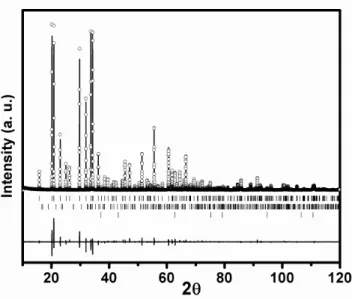
most appropriate stoichiometry that can be made up of only using simple integer numbers was Na2MgGeO4:Mn2+, referred to as NMG hereafter. We determined the exact structure of NMG from structural data of Na2ZnGeO4 by using Rietvelt refinement method shown in figure 2. (18, 24).
Figure 2: Rietveld refinement fits to powder XRD for
Na2MgGeO4: Mn+2,experimental (circle), theoretical (solid
line), reflectance positions (vertical bars), and difference between observed and calculated intensity (solid line) at bottom.
It is noteworthy that the (Mg+Zn+Ca)/Ge ratio was lower than the NMG stoichiometry in first two generations and it got increased in later generations, but still deviated slightly from the NMG stoichiometry. This means that an excessive amount of Ge was inevitable to achieve the NMG structure. It is customary to use such an excessive or deficient amount of elements in liquid solution-based syntheses (15-18). The determination of relevant processing compositions is based on trial-error strategies in general solution-based syntheses. Thus, this cumbersome process is time-consuming and expensive. However, it should be noted that the MOGACMS process guided us to do this automatically without any high-cost endeavors or in-depth consideration. More importantly, the MOGACMS enabled us to complete these procedures with high precision and reliable reproducibility in a very short time frame.
After demonstrating the effects of material composition and structure, we next investigated the significance of the material obtained from
16-3 / A.K. Sharma
• IMID 2009 DIGEST
MOGACMS, which we will denote as NMG. It should be noted that NMG has never been considered as a phosphor. The structure of NMG was identified as an isomorphous structure to well known Na2ZnGeO4 structure (24). The present MOGACMS process enabled us to pinpoint NMG, certainly a new phosphor, which has never been investigated before. For the sake of inquiring into the significance of NMG, we compared NMG to two reprehensive commercially available green phosphors in terms of luminance, color chromaticity and powder morphology. We employed BaMgAl10O17:Eu2+, Mn2+ (BAM) and Zn2SiO4:Mn2+ (ZSM) as reference phosphors, provide by Samsung SDI Co. Ltd. Figures 4a show excitation spectra and emission spectra of NMG along with BAM and ZSM.
4. Summary
MOGACMS tackled the most problematic obstacles, so that we could reduce the experimental inconsistency and enabled us to develop a readily practical green phosphor for use in CCFL for LCD BLU.
MnO – Na2O – Li2O – MgO – ZnO – CaO – GeO2 seven-dimensional library systems has been screened using MOGACMS to identify green phosphors with reproducibility and minimum experimental inconsistency in a systematic manner. We suggest that experimental inconsistency should be treated as a function of composition during the development of solution-synthesis-based combinatorial libraries by employing MOGACMS.
We found NMG in fifth generation after evolution of five generations and their replicate through MOGACMS. NMG showed promising luminescence and was reliably reproduced. Phase identification of NMG revealed that the structure of NMG was isomorphous to Na2ZnGeO4 structure and that Zn and Ca-doping took no effect. NMG was also synthesized by solid sate reaction and found higher intensity than BAM.
Acknowledgement
This research was supported by the IT R&D program of MKE/IITA [2009-F-020-01] and partly supported by WCU(World Class University) program through the Korea Science and Engineering Foundation funded by the Ministry of Education, Science and Technology
5. References
1. Luminescence from theory to application (Edited by Cees Ronda), Wiley –VCH, (2008).
2. M. Chaiken, K. D. Janda, “Molecular Diversity and Combinatorial Chemistry” Washington, DC, (1996). 3. X. -D. Xiang, X. Sun, G. Briceno, Y. Lou , K. -A.
Wang, H. Chang, W. G. Wallace-Freedman , S.-W. Chen, P. G. Schultz, Science, 268, 1738, (1995). 4. D. Wolf, O. V. Buyevskaya, M. Baerns, Appl. Catal.
A, 200, 63,( 2000).
5. W. F. Maier, K. Stowe, S. Sieg, Angew. Chem. Int. Ed., 46, 6016, 2007.
6. C. Klanner, D. Farrusseng, L. Baumes, M. Lengliz, C. Mirodatos, and F. Schuth, Angew. Chem. Int. Ed., 43, 5347, (2004).
7. R. A. Potyrailo, V. M. Mirsky, Chem. Rev., 108, 770, (2008).
8. A. Hagemeyer, B. Jandeleit, Y. Liu, D. M. Poojary, H. W. Turner, A. F. Volpe Jr., W. H. Weinberg, Applied Catalysis A: General, 221, 23, (2001).
9. A. Lin, J. Phillips, Solar Energy Materials &
Solar Cells, 92, 1698, (2008).
10. J. M. Serraa, A. Cormab, S. Valerob, E. Argenteb, V. Bottib, QSAR Comb. Sci., 26, 11, (2007).
11. K.-S Sohn, I. W. Zeon, H. Change, S. K. Lee, H. D. Park, Chem. Mater.,14, 2140, (2002).
12. K. -S. Sohn, J. M. Lee, N. Shin, Adv. Mat. , 15, 2081, (2003).
13. K.-S. Sohn , D. H. Park, S. H. Cho, J. S. Kwak, J. S. Kim Chem. Mater., 18, 1768, (2006). 14. K.-S. Sohn , D. H. Park, S. H. Cho, B. I.
Kim, S. I. Woo, J. S. Kim, J. Comb. Chem.8, 44, (2006).
15. Y. S. Jung, C. Kulshreshtha, J. S. Kim, N. Shin, K. -S. Sohn, Chem. Mater. , 19, 5309, (2007).
16. C. Kulshreshtha, A. K. Sharma, K.-S Sohn, J.
Comb. Chem. ,10, 421, (2008).
17. A. K. Sharma, C. Kulshreshtha, K.-M Sohn, K.-S. Sohn, J. Comb. Chem., 11, 131, (2009). 18. A. K. Sharma, C. Kulshreshtha, K.-S Sohn,
Adv. Funct. Mater. , 19, 1, (2009).
19. M. Jansen, Angew. Chem. Int. Ed.,41, 3746, (2002).