저작자표시-비영리-변경금지 2.0 대한민국 이용자는 아래의 조건을 따르는 경우에 한하여 자유롭게 l 이 저작물을 복제, 배포, 전송, 전시, 공연 및 방송할 수 있습니다. 다음과 같은 조건을 따라야 합니다: l 귀하는, 이 저작물의 재이용이나 배포의 경우, 이 저작물에 적용된 이용허락조건 을 명확하게 나타내어야 합니다. l 저작권자로부터 별도의 허가를 받으면 이러한 조건들은 적용되지 않습니다. 저작권법에 따른 이용자의 권리는 위의 내용에 의하여 영향을 받지 않습니다. 이것은 이용허락규약(Legal Code)을 이해하기 쉽게 요약한 것입니다. Disclaimer 저작자표시. 귀하는 원저작자를 표시하여야 합니다. 비영리. 귀하는 이 저작물을 영리 목적으로 이용할 수 없습니다. 변경금지. 귀하는 이 저작물을 개작, 변형 또는 가공할 수 없습니다.
A Thesis for the Degree of Master of Science
Genome-Wide Association between Histone H3
Lysine Methylation and DNA Methylation in an
Intergeneric Hybrid, xBrassicoraphanus
속간교잡종 배무채에서 히스톤 H3 라이신 9 와
DNA 메틸레이션의 전장유전체연관
FEBRUARY, 2016
HYE YEON SOH
MAJOR IN INTERDISCIPLINARY PROGRAM IN
AGRICULTURAL GENOMICS
THE GRADUATE SCHOOL OF
SEOUL NATIONAL UNIVERSITY
Genome-Wide Association between Histone H3 Lysine
Methylation and DNA Methylation in an Intergeneric Hybrid,
xBrassicoraphanus
UNDER THE DIRECTION OF DR. JIN HOE HUH
SUBMITTED TO THE FACULTY OF THE GRADUATE SCHOOL SEOUL NATIONAL UNIVERSITY
BY
HYE YEON SOH
MAJOR IN
INTERDISCIPLINARY PROGRAM IN AGRICULTURAL GENOMICS THE GRADUATE SCHOOL OF SEOUL NATIONAL UNIVERSITY
FEBRUARY, 2016
APPROVED AS A QUALIFIED THESIS OF HYE YEON SOH FOR THE DEGREE OF MASTER OF SCIENCE
BY THE COMMITTEE MEMBERS
CHAIRMAN
Yong-Hwan Lee, Ph.D.
VICE-CHAIRMAN
Jin Hoe Huh, Ph.D.
MEMBER
Doil Choi, Ph.D.
Genome-Wide Association between Histone H3
Lysine Methylation and DNA Methylation in an
Intergeneric Hybrid, xBrassicoraphanus
HYE YEON SOH
INTERDISCIPLINARY PROGRAM IN
AGRICULTURAL GENOMICS
THE GRADUATE SCHOOL OF SEOUL NATIONAL UNIVERSITY
ABSTRACT
Epigenetic changes in allopolyploids play a pivotal role in reprogramming
homeologous gene expression and genomic stability. Dimethylation of H3K9
(H3K9me2) marks heterochromatin and is crucial in controlling DNA methylation
and silencing transposable elements in Arabidopsis. In this study, chromatin
immunoprecipitation accompanied with sequencing method (ChIP-seq) was
employed to profile the distribution of H3K9me2 in intergeneric hybrid,
xBrassicoraphanus. Compared with methylome data, a high rate of association of
H3K9me2 with DNA methylation was observed throughout the genome. In
addition, occurrence and disappearance of H3K9me2 in xBrassicoraphanus after
polyploidization is intensely correlated with that CHG methylation. Extinction of
ii
subgenomic location. However, the newly generated epigenetic states showed
biased subgenomic proportion. These results confirm that epigenetic mechanisms
are mutually correlated and suggest that effects of hybridization between two
genera of genetic distance would trigger differential epigenetic modulation in
xBrassicoraphanus.
Key Words: Epigenetic change, H3K9me2, xBrassicoraphanus, ChIP-seq, DNA
methylation, allopolyploid
CONTENTS
ABSTRACT ··· i
CONTENTS ···
···· iii
LIST OF TABLES ··· v
LIST OF FIGURES ··· vi
LIST OF ABBREVIATIONS ··· vii
INTRODUCTION ··· 1
LITERATURE REVIEWS ··· 4
1. Polyploidy
2. Histone modification
3. Sequencing technologies and ChIP-seq
MATERIAL AND METHODS ··· 12
Plant materials and growth conditions
Isolation and immunoprecipitation of chromatin
Computational analysis of sequencing data
iv
RESULTS ··· 16
Genome-wide detection of H3K9me2-enriched regions
Characterizing the distribution of H3K9me2 level
The correlation between H3K9me2 and DNA methylation
Coincidence of DHMs and differentially methylated
regions (DMRs)
DHM and DMR coordinate gene expression changes
Expression patterns of the enzymes modulating epigenetic
modification
DISCUSSION··· 39
REFERENCES ··· 42
LIST OF TABLES
Table 1. ChIP-seq counts and mapping results
Table 2. General information of H3K9me2 detection
Table 3. Summary of differential histone modification binding
sites and common sites
Table 4. Summary of H3K9me peaks of xBrassicoraphanus and
those of B. rapa and R. sativus
Table 5. Subgenomic proportions of xB DHMs, BR DHMs, and
common peaks in xBrassicoraphanus
Table 6. Summary of the association of DMRs with DHMs in
xBrassicoraphanus
Table 7. Summary of the association of DEGs with DHMs and
DMRs
Table 8. Expression patterns of the genes related to epigenetic
modifications
vi
LIST OF FIGURES
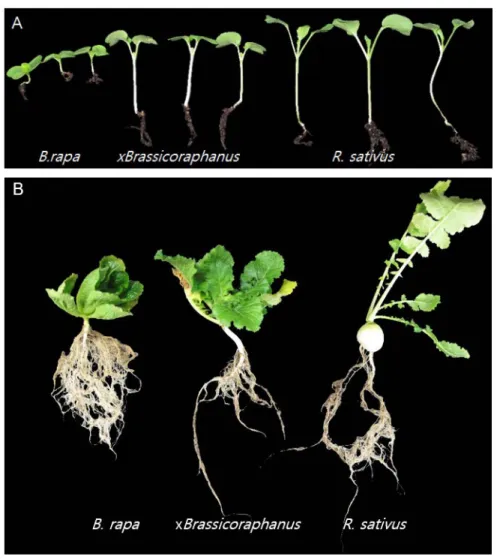
Figure 1. Phenotypes of Brassica rapa, xBrassicoraphanus, and
Raphanus sativus.
Figure 2. Genome-wide distribution of H3K9me2 and DNA
methylation in xBrassicoraphanus.
Figure 3. The distribution of H3K9me2 within different sites of
the xBrassicoraphanus genome.
Figure 4. Distribution of H3K9me2 within subgenomic
chromosomes of xBrassicoraphanus and in its parents.
Figure 5. Correlation of H3K9 dimethylation with DNA
methylation in xBrassicoraphanus.
Figure 6. The synchronicity of DHM (Differential
H3K9me2-marked region) and DMR (Differentially methylated
region) in xBrassicoraphanus.
Figure 7. Expression changes of differentially expressed genes
(DEGs) associated with DHM and DMR in
xBrassicoraphanus compared to the parents.
LIST OF ABBREVIATIONS
H3K9me2 Histone H3 lysine 9 dimethylation
ChIP
Chromatin immunoprecipitation
H3K4me
Histone H3 lysine 4 methylation
H3K27me Histone H3 lysine 27 methylation
FLC
Flowering Locus C
CCA1
CIRCADIAN CLOCK ASSOCIATED 1
LHY
LATE ELONGATED HYPOCOTYL
TOC1
TIMING OF CAB EXPRESSION1
GI
GIGANTEA
WGD
Whole Genome Duplication
PRMT
Protein Arginine Methyltransferase
HKMT
Histone Lysine Methyltransferase
Su(var)3-9 Suppressor of variegation 3-9
E(z)
Enhancer of zeste
TrxG
Trithorax group protein
ASH1
Absent, small, or homeotic discs 1
LSD1
Lysine-specific demethylase 1
viii
SUVH
Su(var)3-9 homolog
KYP
KRYPTONITE
rDNA
ribosomal DNA
NGS
Next-Generation sequencing
TE
Transposable element
sRNA
Small RNA
DHM
Differential histone-marked region
DMR
Differentially methylated region
DEG
Differentially expressed gene
CMT
CHROMOMETHYLASE
DDM
DECREASE IN DNA METHYLATION
DRM
DOMAINS REARRANGED METHYLASE
TTS
Translation termination site
INTRODUCTION
Polyploidization is one of the most important cues for eukaryotic
evolution. Most of angiosperms and the majority of pteridophytes (~95 %) have
experienced series of polyploidization (Soltis, 2014; Grant, 1981). Scrutinizing the
grounds and outcomes of polyploidy is essential to understand the diversity of
flowering plants and pteridophytes as well as other eukaryotic pedigrees.
Numerous major crops such as oats, soybean, wheat, cotton, canola, and banana
were generated through natural polyploidization, which allowed crop
domestications and the advent of valuable traits (Chen and Yu, 2013).
Genome-level investigations on these crops have recently been published and several
genetic and epigenetic mechanisms related to genome hybridization have been
gradually uncovered.
xBrassicoraphanus (2n=38) is a newly synthesized species from a cross
between Brassica rapa and Raphanus sativus (Lee et al., 2002). Intergeneric
hybridizations between these two species have been recurrently attempted since
early 1800’s and a genetically stable allopolyploid was developed through induced
mutation with the microspore culture method (Lee et al., 2011). xBrassicoraphanus
shows intermediate phenotypes between B. rapa and R. sativus in hypocotyl length,
the leaf shape, and the structure of silique. One of its novel phenotypes is the white
petal color while the flowers of B. rapa and R. sativus have yellow and purple color,
respectively. xBrassicoraphanus is genetically stabilized within a short period of
time as a rare case of intergeneric hybrid. The genome and epigenome of
2
between the two parents would be beneficial to distinguish the parental origin of
duplicate genes. Studying the unique allopolyploid, xBrassicoraphanus could
provide comprehensive understanding of genome rearrangement occurring within
an intergeneric hybrid and the developmental mechanism of neomorphism.
Furthermore, speciation and evolutionary process derived from intergeneric
crossing also could be explored.
Previous studies showed that histone modifications mediate gene
transcription during growth and development of plants and animals by remodeling
the chromatin structure (Berger, 2007; Zhang, 2008). In Arabidopsis thaliana
active promoters contain several modifications, such as histone H3 and H4
acetylations and methylation of H3 lysine 4 (H3K4me 1/2/3) that are also known as
euchromatic marks. By contrast, repressed gene expressions are associated with
methylations of H3 lysine 9 (H3K9) and H3 lysine 27 (H3K27) that are known to
mark heterochromatin (Jenuwein and Allis, 2001; Li et al., 2007). Out of these
several modifications, di-methylation of H3K9 (H3K9me2) is dispersed across
pericentromeric heterochromatin and the genome-wide location of H3K9me2 is
known to be highly correlated with transposable elements and repeat regions
(Lippman et al., 2004; Turck et al., 2007; Bernatavichute et al., 2008).
Epigenetic changes in newly hybridized interspecific allopolyploids are
supposed to play a crucial role in genomic reorganization and reprogramming
chromatin structures that give rise to gene expression changes (Osborn et al., 2003;
Chen, 2007). In Arabidopsis, a synthetic allotetraploid shows different phenotypes
including flowering time and morphological vigor compared to its parents A.
genome-level studies revealed that changes of histone modifications in the
promoters of FLC gene and the circadian clock genes (CCA1, LHY, TOC1, and GI)
are associated with the altered expression in allopolyploids and hybrids (Wang et
al., 2006; Ni et al., 2009).
In this study, chromatin immunoprecipitation followed by next-generation
sequencing (ChIP-seq) analysis was employed to profile H3K9me2 across the
entire xBrassicoraphanus genome. With DNA methylation data,
nucleotide-resolution histone modification (H3K9me2) profiling data were analyzed to
understand general states of epigenome in xBrassicoraphanus and the epigenetic
correlation between DNA methylation and H3K9me2 was revealed. Also by
comparing genome-wide distributions of H3K9me2 between xBrassicoraphanus
and its parents, B. rapa and R. sativus, epigenetic changes including DNA
methylation and subsequent transcriptomic changes after polyploidization were
explored. Generation of DNA methylation and H3K9me2 showed differences in
terms of their subgenomic sites. Hybridization effects and genomic incompatibility
between two progenitors are considered to be putative causes for this phenomenon.
This research would provide insights into comprehensive epigenetic states occurred
after genome hybridization and set up the basis for further studies of epigenetic
4
LITERATURE REVIEWS
1. Polyploidy
Polyploidy depicts an organism or a cell that possesses multiple sets of
chromosomes. In the majority of cases, even numbered sets of chromosomes are
included in polyploids. The research of eukaryotic genome sequence suggests that
genomes of many species show marks of polyploidal ancestor (Paterson, 2005;
Becak and Kobashi, 2004; Van de Peer and Meyer, 2005).
Polyploidization typically gives rise to biodiversity and instantaneous
speciation, acting as a major driving force of macro-evolution (Levin, 1983; Levin,
2002; Mayrose et al., 2011). This process is a common phenomenon that can be
easily found in plants and also among fish and amphibians (Leitch et al., 2008;
Comai, 2005; Wendel, 2000; Song and Chen, 2015; Hegarty and Hiscock, 2008;
Doyle et al., 2008; Soltis et al., 2014) Most of the flowering plants are believed to
have experienced whole-genome duplications (WGDs) (Soltis et al., 2014). Two
rounds of WGDs before the divergence of flowering plants are estimated to have
occurred and consequently diversify genes that are crucial for the development of
seeds and flowers, which gives clues for Charles Darwin’s abominable mystery
(Jiao et al., 2011; Van de Peer et al., 2009).
There are two types of polyploidy: autopolyploidy and allopolyploidy that
are grouped by its origin and the arrangement of chromosomes (Stebbins, 1950;
Song and Chen, 2015). Autopolyploids (AAAA in an autotetraploid) are derived
from a single genome duplication of one individual or different plants within a
of chromosomes between two different species. Therefore, two parental genomes
exist in a nucleus and allotetraploids (AABB) have two of each pair of equivalent
chromosomes from the parent species, or homeologous chromosomes that are also
known as homeologs. Some polyploid plants such as sugarcane are hard to
distinguish between them (Premachandran et al., 2011). Since intraspecific pairing
is more frequent than interspecific mating, allopolyploidy was estimated to be less
widespread than autopolyploidy (Stebbins, 1971). However, allopolyploids are
more universal than autopolyploids in nature (Schatlowski and Kohler, 2012;
Hegarty and Hiscock, 2008).
When a nucleus of allopolyploid contains two parental genomes, the
expression levels of homeologous genes could display divergence from the
arithmetic average, also known as additivity, of parental gene expression patterns.
The putative causes of those nonadditive gene expression patterns are
maternal-paternal influences, gene dosage balance, cis- and trans- regulations, and
dysregulation of transposons (Yoo et al., 2014). As maternal organellar genomes
are generally inherited in plants, the expression dominance toward the maternal
parent was observed in many polyploids; cotton, coffee, Spartina anglica, and
Tragopogon (Yoo et al., 2014). Secondly, the gene-balance hypothesis explains that
the function of the whole complex is regulated by the stoichiometry among parts of
macromolecular complexes (Birchler and Veitia, 2012). According this concept,
unequally fractionated subgenomes can describe the expression dominance toward
one homeologous gene. On the other hand, combined cis- and trans- regulatory
systems from two divergent parents can modulate the expression of homeologs.
6
crosstalk over homeologous cis-elements in allopolyploids. Lastly, epigenetic
changes during interspecific hybridization may alter the expressions of
transposable elements, which leads to the modulation of homeologs in
allopolyploids (McClintock, 1984; Parisod et al., 2009).
2. Histone modification
Histone proteins comprise the nucleosome, a fundamental unit of
chromatin, and several modifications on histone proteins modulate chromatin
structure through epigenetic mechanisms. Histone modification mainly occurs on
amino (N) terminal tails that protrude from core histone proteins. Various
posttranslational modifications can take place on histone residues by forming
covalent bonds with different chemical groups, which include acetylation,
methylation, phosphorylation, ubiquitination, sumoylation, glycosylation, and
ADP-ribosylation (Liu et al., 2010). The histone code hypothesis proposes that the
orchestration of histone modifications determines chromatin structures, which
leads to the activation or repression of gene transcription. (Jenuwein et al., 2001)
Histone methylation, one of the most commonly studied forms, plays a
crucial role in regulating diverse biological processes ranging from
heterochromatin formation to transcriptional regulation. It can be mono- and di-
methylated on arginine or mono-, di-, and tri- methylated on lysine residues by
protein arginine methyltransferases (PRMTs) and histone lysine methyltransferases
(HKMTs), respectively.
Lysine methylation of histone is found in both transcriptionally silenced
to methyl groups and the degree of methylation. Conjugating a methyl group to
lysine residues does not alter the net charge of the modified products, but the
hydrophobicity increases. Also, specific proteins that recognize the methylated
residues may be recruited to newly-made binding surfaces or intra- and
intermolecular interactions may change their patterns.
First discovered in Drosophila melanogaster are SET domain proteins
conserved in three proteins and named after them; Suppressor of variegation 3-9
(Su(var)3-9), Enhancer of zeste (E(z)), and trithorax group proteins (TrxG) (Dillon
et al., 2005). SET domain proteins are known to catalyze the lysine methylation
and there are 41 and 37 genes that encode SET domain proteins respectively in
Arabidopsis and rice genomes (Gendler et al., 2008). SET domain proteins in
plants are homologous to those in animals and yeast and grouped into four
categories; SU(VAR)3–9 groups, E(Z) homologs, TrxG groups, and ASH1 (absent,
small, or homeotic discs 1) groups (Baumbusch et al., 2001; Springer et al., 2003;
Zhao et al., 2004). Even though the specificity and characteristics of these SET
proteins in plants have not been deeply studied in every detail, several genetic
researches showed that they may affect the same lysine residues or related
pathways as in animals or yeast (Liu et al., 2010). On the other hand, the methyl
groups on lysine can be removed by histone demethylases that perform vital roles
in regulating homeostasis of histone methylation. The two types of demethylases
work in distinct ways; lysine-specific demethylase1 (LSD1) that oxidizes amine
group and Jumonji C (JmjC) domain-containing proteins that hydroxylate the
methylated substrate both result in withdrawing methyl groups from methylated
8
In Arabidopsis, Lys 4 (K4), Lys 9 (K9), Lys 27 (K27), and Lys 36 (K36) of
histone H3 are main targets for histone lysine methylation. In general, methylation
of histone H3K9 and H3K27 is related to silenced regions, whereas methylation of
H3K4 and H3K36 is related to active gene expression (Berger et al., 2007). Mono-
and di- methylation of H3K9 is especially more abundant in chromocenters than in
euchromatin regions and highly associated with transposons and related repeat
regions(Lippman et al., 2004; Turck et al., 2007; Bernatavichute et al., 2008). In
Arabidopsis genome, ten SU(VAR)3-9 homologues are expected to function
(SUVH1-10; Baumbusch et al., 2001). Among them, KRYPTONITE/SUVH4
(KYP), SUVH5 and SUVH6 have been reported to be in charge of the propagation
of H3K9me1 and H3K9me2 (Jackson et al., 2002; Ebbs et al., 2005; Ebbs et al.,
2006; Jasencakova et al., 2003). kyp suvh5 suvh6 triple mutants not only eliminate
H3K9me2 levels, but also show the reduced level of DNA methylation and release
the silent state of heterochromatin as transposons are reactivated (Ebbs et al., 2006).
kyp mutants discharge the silencing state insignificantly and do not show any
defects in morphology despite its role in repressing genes and transposable
elements (Tariq and Paszkowski, 2004).
In met1 plants that lack the function of maintenance of CG methylation, the
distribution of H3K9me2 was found to be massively relocated across the genome
(Mathieu et al., 2005; Soppe et al., 2002; Tariq et al., 2003), and the possibility that
CG methylation manipulates the level of H3K9me2 was proposed (Mathieu et al.,
2005; Soppe et al., 2002; Tariq et al., 2003; Tariq and Paszkowski, 2004).
Moreover, KYP/SUVH4-mediated H3K9 methylation was reported to manage
immunoprecipitation (ChIP) analysis accompanied with high-resolution genome
wide microarray (ChIP-chip) also showed the high correlation between H3K9me2
and CHG DNA methylation (Bernatavichute et al., 2008). Histone H3K9
methylation is essential to maintain non-CG methylation levels and they play a
pivotal role in repressing transposons, ribosomal RNA genes (rDNA), and repeat
sequences (Liu et al., 2010).
3. Sequencing technologies and ChIP-seq
After the DNA structure as double helix was discovered by Watson and
Crick in 1953 (Watson and Crick, 1953), Frederick Sanger proposed a modern
DNA sequencing method with chain-terminating inhibitors (Sanger et al. 1977). In
this method, DNA polymerase synthesizes complementary DNA sequences using
normal 2’-deoxynucleotides (dNTPs) and 2’, 3’-dideoxynucleotides (ddNTPs) that
terminate the reaction. Then DNA fragments with various sizes are separated using
gel electrophoresis method and examined to uncover its sequence. After several
modifications has been made, the automated Sanger sequencing has been spread
out for two decades but limitations of this first-generation technology made it to be
replaced by next-generation sequencing (NGS). These new technologies include
steps of template preparation, sequencing and imaging, and data analysis (Metzker,
2010). Compared to the former method, NGS platforms have drastically lowered
the cost and enabled higher throughput.
Since the genome of Arabidopsis was completed in 2000 (Initiative AG,
2000), a number of plant genomes have been sequenced with NGS technology and
10
genome assembly, plant genome still remains to have many barriers that block
complete analysis because of its tremendous genome size, repeat content, paralogy,
and heterozygosity. Less than 200 bp-long reads from NGS technologies are too
short to resolve complexity of plant genomes. While most mammalian genomes
have been assigned into chromosome scale regions (Gnerre et al., 2011), most draft
plant genomes comprise numerous contigs and scaffolds that shatter with
embedded gaps. Among plant genomes, the Arabidopsis genome is unquestionably
known to be the best organized one, but still scattered in 102 contigs and its total
gap length is 185,644 bp (TAIR 10; Lamesch et al., 2012).
A third generation sequencing technology has emerged to cover the
limitations of the former technologies and focuses on single molecule DNA. This
new generation platform can be grouped into three categories;
sequencing-by-synthesis technology that utilizes DNA polymerase to synthesize a single molecule
of DNA, nanopore-sequencing technology that detects individual bases as DNA
strand goes through the nanopore, and microscopy technology that directly makes
image of DNA molecules. These single-molecule-based sequencing technologies
have provided many advantages. First, they can process more throughput for much
shorter time at the lower price. Also from a diminutive amount of starting material,
they can produce longer reads that are helpful in assembling the de novo genome
(Schadt et al., 2010).
To study the interactions between DNA and protein, Varshavsky and his
colleagues first proposed the chromatin immunoprecipitation (ChIP) method in
1988 (Solomon et al., 1988). This experiment is basically composed of three steps;
the protein-DNA complex with specific antibody, and to reverse the cross-links and
analyze recovered DNA. Since DNA and proteins are randomly cross-linked and
non-specific interactions can occur during the immunoprecipitation step,
ChIP-derived DNA is compared to a mock sample that is collected after the
immunoprecipitation process done without antibody. For genome-wide analysis of
ChIP-selected DNA in yeast, Ren and colleagues primarily compared those two
samples by hybridizing to a genomic microarray (ChIP-chip) (Ren et al., 2000).
With the advent of next-generation sequencing technologies, ChIP-chip have been
substituted by ChIP followed by sequencing m (ChIP-seq). ChIP-seq provides
many advantages including higher resolution, lower price per the same amount of
data, less complicated process, and requirement for less input quantity and fewer
12
MATERIALS AND METHODS
Plant materials and growth conditions
xBrassicoraphanus, Brassica rapa cv. Chiifu-401-42, and Raphanus
sativus cv. WK10039 plants were grown on 1 X Murashige and Skoog medium
(Duchefa, Haarlem, The Netherlands) in a growth chamber under 16 h of
illumination for 14 days. The whole seedlings including shoots and roots were
harvested together for the analysis of chromatin modifications. Plants grown for 14
days and for 3 months are shown in Figure 1.
Isolation and immunoprecipitation of chromatin
Chromatin Immunoprecipitation (ChIP) was performed using the
seedlings (~ 3 g) of xBrassicoraphanus, B. rapa, and R. sativus respectively.
Whole plant tissues were combined and cross-linked in 1% formaldehyde for 15
min using vacuum infiltration method and the cross-linking reaction was quenched
with 0.125 M of glycine. Plants were washed three times with deionized water and
blotted to remove water. Frozen tissues in liquid nitrogen were ground to fine
powder and resuspended in 30 ml of extraction buffer 1 (0.4 M sucrose, 10 mM
Tris-HCl pH 8.0, 5 mM beta-mercaptoethanol, 1 mM phenylmethylsulfonyl
[PMSF], and complete protease inhibitor; Roche Diagnostics, Basel, Switzerland),
then filtered through two layers of Miracloth (Merk Miilipore, Guyancourt, France)
twice. The filtrate was centrifugated at 2,800 g at 4 oC for 25 min. The pellet was resuspended in 1 ml of extraction buffer 2 (0.25 M sucrose, 10 mM Tris-HCl p
M PMSF, and complete protease inhibitor; Roche Diagnostics, Basel, Switzerland)
and centrifugated at 12,000 g at 4 oC for 10 min. This procedure was performed twice for better nuclei isolation. The pellet was resuspended in 300 μl of extraction buffer 3 (1.7 M sucrose, 10 mM Tris-HCl pH 8.0, 2 mM MgCl2, 0.15% Triton
X-100, 5 mM beta-mercaptoethanol, 1 mM PMSF, and complete protease inhibitor;
Roche Diagnostics, Basel, Switzerland) and layered on top of 1.2 ml of clean
extraction buffer 3, then centrifugated at 16,000 g at 4 oC for 1 hr. The chromatin pellet was resuspended in 300 μl of nuclei lysis buffer (50 mM Tris-HCl pH 8.0, 10 mM EDTA, 1% SDS, and complete protease inhibitor; Roche Diagnostics, Basel,
Switzerland) and sonicated with a Sonifier (Branson Sonifier, Danbury, USA) to
shear DNA into 0.3 ~ 1 kb. The sonicated chromatin was centrifugated and the
supernatant was diluted 10-fold with ChIP dilution buffer (1.1% Triton X-100, 1.2
mM EDTA, 16.7 mM Tris-HCl pH 8.0, 167 mM NaCl). Seven ug of the antibody
against histone H3 dimethyl Lys 9 (AB1220, Abcam, Cambridge, UK) was reacted
respectively with 1.5 mg of protein G Dynabeads (Invitrogen, CA, USA) for 2 hr at
4 oC, then chromatin extract was incubated with antibody/magnetic bead mix at 4 oC overnight. After several washes, immunocomplex was eluted twice from the beads with 30ul of elution buffer (1% SDS, 0.1 M sodium bicarbonate) and reverse
cross-linked in the presence of 200 mM NaCl at 65 oC overnight. To remove all proteins proteinase K was treated, and then DNA was purified by
phenol/chloroform/isoamylalcohol extraction and precipitated with ethanol. The pellet was resuspended with 30 μl of tridistilled water. A small aliquot of untreated sonicated chromatin was reverse cross-linked and used as total input DNA control.
14
errors derived from experimental variations.
Computational analysis of sequencing data
ChIP-seq libraries were constructed as described in the Illumina ChIP
sequencing kit (Illumina, CA, USA). DNA fragments with a range of ~500 bp were
excised and amplified for cluster generation and sequencing. All DNA libraries
were sequenced on a HiSeq2500 (50 single end reads) (Illumina, CA, USA). The
sequencing reads were quality controlled with FastQC and aligned to the reference
genome of xBrassicoraphanus by Bowtie software using default settings
(Langmead et al., 2009). Reads that could be assigned to only one region of the
genome were used for downstream analyses. To find significant peaks compared to
control, MACS software (Zhang et al., 2008) was employed and common regions
from two biological replicates were extracted with mergePeaks command from
Homer software (Heinz et al., 2010). For comparative analysis between
xBrassicoraphanus and its parent, B. rapa and R. sativus, all peaks were classified
into three groups; common peaks found in both allopolyploid and its progenitors,
xB-specific peaks and BrRs-specific peaks that only exist in xBrassicoraphanus or
Figure 1. Phenotypes of Brassica rapa, xBrassicoraphanus, and Raphanus
sativus. (A) Whole seedlings grown for 14 days that were used in this study and (B)
16
RESULTS
Genome-wide detection of H3K9me2-enriched regions
Cross-linking chromatin immunoprecipitation sequencing (X-ChIP-seq)
methods employing formaldehyde fixation and sonication were utilized to get the
genome-wide histone modification pattern data for xBrassicoraphanus, B. rapa cv.
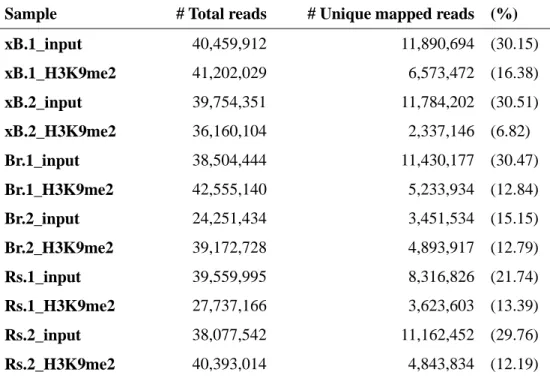
Chiifu, and R. sativus cv. WK10039. About 30 million reads were obtained from
the ChIP-seq process for each sample. All reads obtained from three genera were
mapped to the genome of xBrassicoraphanus and uniquely aligned reads (6~30%)
were only used for the peak calling process (Table 1). By comparing with control,
significantly H3K9me2-enriched regions (peaks) were detected for each replicate.
The common peaks were merged from two replicates and regarded as
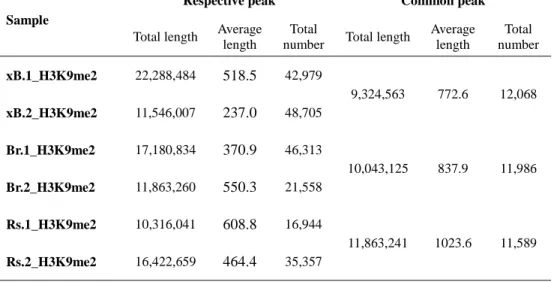
representative H3K9me2-related regions for each plant. For xBrassicoraphanus,
12,068 peaks were detected with the length of 9,324,563 bp of sequenced genome
(1.35%) (Table 2). And 11,986 and 11,589 peaks were allocated to B. rapa and R.
sativus spanning 10,043,125 bp and 11,863,241 bp, respectively.
To investigate the epigenomic changes occurred after polyploidization,
differential binding sites of histone modification (DHM; differential histone
modification-marked region) between xBrassicoraphanus and its progenitors were
identified. The peak file of xBrassicoraphanus and that of the parents were
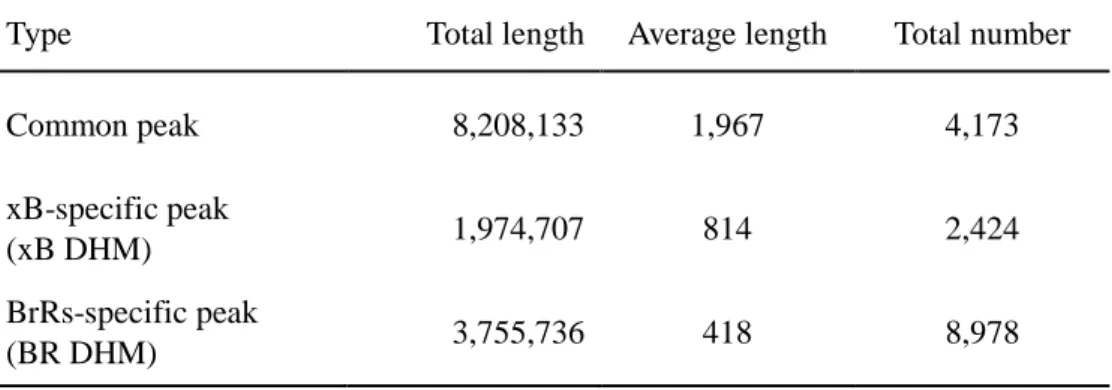
compared and the whole regions were classified into three types; the common
peaks that exist in both xBrassicoraphanus and its parents,
xBrassicoraphanus-specific peaks (xB DHMs) and B. rapa or R. sativus-xBrassicoraphanus-specific peaks (BR DHMs)
4,173 peaks covering 8,208,133 bp are sorted into common peaks (Table 3). Table
3 shows that xB DHMs contain 2,424 regions spanning 1,974,707 bp and 8,978
18
Table 1. ChIP-seq counts and mapping results
Sample # Total reads # Unique mapped reads (%)
xB.1_input 40,459,912 11,890,694 (30.15) xB.1_H3K9me2 41,202,029 6,573,472 (16.38) xB.2_input 39,754,351 11,784,202 (30.51) xB.2_H3K9me2 36,160,104 2,337,146 (6.82) Br.1_input 38,504,444 11,430,177 (30.47) Br.1_H3K9me2 42,555,140 5,233,934 (12.84) Br.2_input 24,251,434 3,451,534 (15.15) Br.2_H3K9me2 39,172,728 4,893,917 (12.79) Rs.1_input 39,559,995 8,316,826 (21.74) Rs.1_H3K9me2 27,737,166 3,623,603 (13.39) Rs.2_input 38,077,542 11,162,452 (29.76) Rs.2_H3K9me2 40,393,014 4,843,834 (12.19)
Table 2. General information of H3K9me2 detection
Sample
Respective peak Common peak
Total length Average length
Total
number Total length
Average length Total number xB.1_H3K9me2 22,288,484 518.5 42,979 9,324,563 772.6 12,068 xB.2_H3K9me2 11,546,007 237.0 48,705 Br.1_H3K9me2 17,180,834 370.9 46,313 10,043,125 837.9 11,986 Br.2_H3K9me2 11,863,260 550.3 21,558 Rs.1_H3K9me2 10,316,041 608.8 16,944 11,863,241 1023.6 11,589 Rs.2_H3K9me2 16,422,659 464.4 35,357
20
Table 3. Summary of differential histone modification binding sites and common sites
Type Total length Average length Total number
Common peak 8,208,133 1,967 4,173
xB-specific peak
(xB DHM) 1,974,707 814 2,424
BrRs-specific peak
Characterizing the distribution of H3K9me2 level
For the downstream analyses related to H3K9me2 distributions in
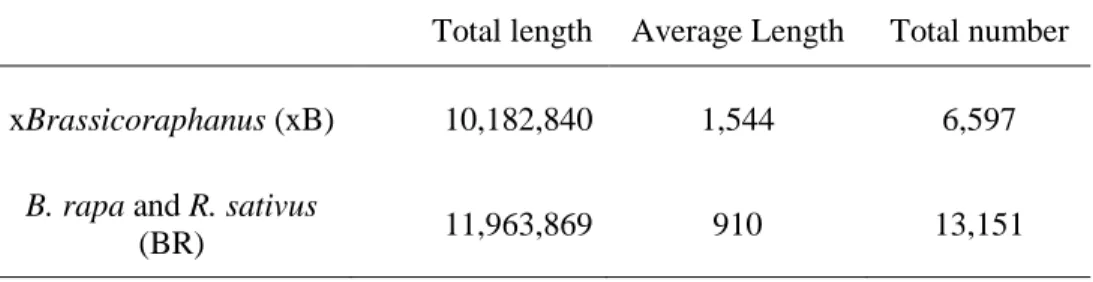
xBrassicoraphanus, both xB DHMs and the common peaks were utilized (Table 4).
In the same way BR DHMs and the common peaks were included in H3K9me2
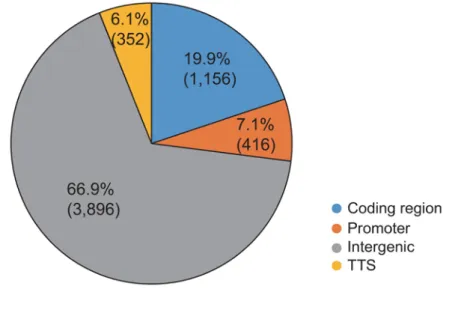
associated regions in the parents. Figure 2 describes the distribution of H3K9me2
level and fractional DNA methylation levels of xBrassicoraphanus and the parents
along 19 pseudochromosomes (10 Ax chromosomes from A genome and 9 Rx
chromosomes from R genome) of xBrassicoraphanus in 100 kb windows.
H3K9me2 is highly enriched in gene-poor regions and tightly associated with DNA
methylation (Figure 2). The locations of xB DHMs and BR DHMs are not
restricted to the specific regions but are dispersed across the genome. Also, the
distribution of histone modification was calculated relative to inter and intragenic
regions in xBrassicoraphanus (Figure 3). It was found that H3K9me2 is
predominantly wide-spread within intergenic regions (66.9%) followed by the
coding regions (19.9%). The percentages of H3K9me2 in translation termination
sites (TTS) and in the promoter regions are similar to each other (6.1% and 7.1%).
To understand detailed distributions of H3K9me2 in xBrassicoraphanus, 6,597
peaks were divided according to their subgenomic locations and the lengths of
allocated peaks were merged. Figure 4A shows that less than half of the total length
of H3K9me2-enriched regions (43.5%) are positioned in the B. rapa subgenome
(AxAx) while the rest in the R. sativus subgenome (RxRx). When the whole
lengths of identified H3K9me2 regions of B. rapa and R. sativus are compared to
each other, the higher coverage of the peaks in R. sativus than that in B. rapa is
22
histone modification, the subgenomic locations of xB DHMs and BR DHMs were
examined (Table 5). One third of xB DHMs occur in the Ax subgenome and the
rest two-thirds are positioned in the Rx subgenome. BR DHMs, however, are
divided equally to each subgenome. In the case of Common peaks, subgenomic
distribution is similar to that of H3K9me2 peaks in xBrassicoraphanus. Disparity
of xB DHMs in each subgenome would explain Rx-weighted H3K9me2
Figure 2. Genome-wide distribution of H3K9me2 and DNA methylation in xBrassicoraphanus. The xBrassicoraphanus genome is composed of two
subgenomes from B. rapa and R. sativus including 10 Ax chromosomes and 9 Rx
chromosomes. Tracks shown are (A, B) H3K9me2 densities of xBrassicoraphanus
(A) and of its parents, B. rapa and R. sativus (B). (C, D) DNA methylation levels
of xBrassicoraphanus (C) and of its parents (D). CG, CHG, CHH methylation
levels are indicated as red, green, and blue lines, respectively. (E) Differential
H3K9me2 binding sites. xBrassicoraphanus-specific site (red) and the
24
Figure 3. The distribution of H3K9me2 within different sites of the xBrassicoraphanus genome.
According to its location the whole peaks (6,597) were grouped into four regions;
Coding region, promoter (-2 kb from the translation start site), intergenic, and
translation termination site (TTS). When located in the region from -1 kb to 100 bp,
Figure 4. Distributions of H3K9me2 within subgenomic chromosomes of xBrassicoraphanus and in its parents. (A) The proportion of H3K9me2 levels in
xBrassicoraphanus according to its subgenome. All peaks of H3K9me2 were
divided based on their subgenomic locations and the total lengths were presented.
Dark grey represents Ax subgenome and light grey represents Rx genome. (B) The
proportion of H3K9me2 levels between B. rapa (dark grey) and R. sativus (light
26
Table 4. Summary of H3K9me peaks of xBrassicoraphanus and those of B.
rapa and R. sativus
Total length Average Length Total number
xBrassicoraphanus (xB) 10,182,840 1,544 6,597
B. rapa and R. sativus
Table 5. Subgenomic proportions of xB DHMs, BR DHMs, and common peaks in xBrassicoraphanus xB DHM BR DHM Common peak Total length % Total length % Total length % Ax 669,483 33.90 1,913,253 50.94 3,713,349 45.24 Rx 1,252,848 63.44 1,825,688 48.61 4,428,761 53.96 Not assigned 52,376 2.65 16,795 0.45 66,023 0.80 Total 1,974,707 100 3,755,736 100 8,208,133 100
28
The correlation between H3K9me2 and DNA methylation
One of the well-known factors that induce H3K9me2 is DNA methylation.
To investigate the correlation between H3K9me2 and DNA methylation, DNA
methylome data from bisulfite sequencing (BS-seq) that display
nucleotide-resolution data of quantitative methylation levels (analyzed and kindly provided by
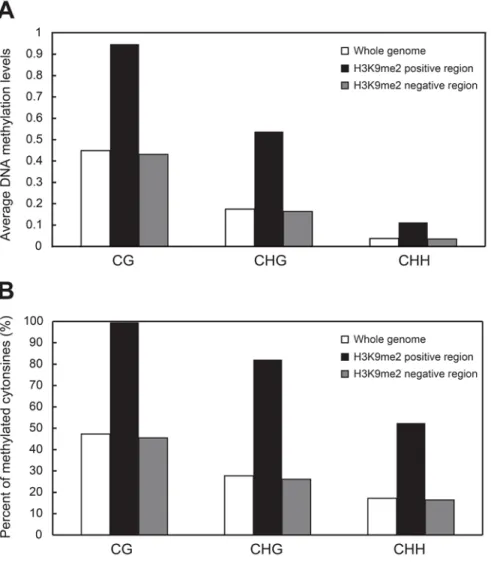
Hosub Shin) were compared with the ChIP-seq data in two different ways. First,
the average levels of DNA methylation in different contexts, CG, CHG, and CHH,
were calculated within H3K9me2 positive and negative regions in
xBrassicoraphanus (Figure 5A). The DNA methylation levels of all three types
within H3K9me2 positive regions are much higher than those within genome and
the regions devoid of H3K9me2. Compared to a two-fold increase in average CG
methylation level, non-CG methylation was three times more enriched within
H3K9me2-related regions.
There are negligible differences of the average DNA methylation levels
between genomic area and H3K9me2 negative zones. The general aspect of Figure
5A is connected to that in Arabidopsis (Bernatavichute et al., 2008), which verifies
the quality of ChIP-seq results. Second, the ratio of methylated cytosines (>50%
for CG, >20% for CHG, and >0% for CHH; Bernatavichute et al., 2008) relative to
the whole number of cytosines was figured out according to the degree of
H3K9me2 enrichment (Figure 5B). In the CG context, almost all cytosines
(99.56%) are methylated in H3K9me2 positive areas while the half are methylated
across the genome (47.29%) and H3K9me2-deficient regions (45.46%). A quarter
of cytosines in the CHG context are methylated in xBrassicoraphanus but a
regions with DNA methylation (Figure 5B). Similarly, the percentage of CHH
methylated cytosines increases from 17% to 52% in accordance with dimethylation
of H3K9. In short, H3K9me2 and DNA methylation are mutually correlated within
xBrassicoraphanus genome, where non-CG methylation is significantly correlated
30
Figure 5. Correlation of H3K9 dimethylation with DNA methylation in xBrassicoraphanus.
(A) Average DNA methylation levels throughout the genome (white), in
H3K9me2-related region (black), and in H3K9me2 negative region (grey). All
methylated cytosines within each region were used to compute average methylation
levels in CG, CHG, and CHH contexts. (B) The number of qualified
methylcytosines (>50% for CG, >20% for CHG, and >0% for CHH;
Bernatavichute et al., 2008) was presented in a ratio to total cytosines within each
Coincidence of DHMs and differentially methylated regions (DMRs)
Since the maintenance mechanism of DNA methylation patterns with
histone H3K9me2 has been discovered in previous studies (Stroud et al., 2014;
Bernatavichute et al., 2008), the regions of xB DHMs and BR DHMs were
associated with hyper DMRs and hypo DMRs that exhibit the areas where
relatively higher levels of DNA methylation are found in xBrassicoraphanus than
in the parents and vice versa. Out of 1,974,707 bps of xB DHMs, nearly 9% falls
within hyper DMRs whereas a small fraction (1.47%) is overlapped with hypo
DMRs (Figure 6). On the other hand, one fifth of BR DHMs that span 772,585 bps
overlap with hypo DMRs, while only 6.1% of BR DHMs are found in the regions
of hyper DMRs. To summarize, xB DHMs are more correlated with hyper DMRs
and BR DHMs are more connected to hypo DMRs.
To test whether the occurrence and disappearance of H3K9me2 after
polyploidization correlate with the different contexts of DNA methylation, the total
length of DMR-associated DHMs was calculated according to the contexts; CG,
CHG, and CHH. Table 6 displays that almost all (97.7%) of the xB DHMs that
overlap with hyper-DMRs are highly correlated with CHG-methylated hyper
DMRs. Interestingly, BR DHMs also have a high level of interrelation with hypo
DMRs in the CHG context. These results indicate that the differentially
CHG-methylated regions are correlated with the high proportion of both xB DHMs and
32
Figure 6. The synchronicity of DHM (Differential H3K9me2-marked region) and DMR (Differentially methylated region) in xBrassicoraphanus. The
percentage of DHM that is associated with DMR. Each DHM was compared with
hypo DMR and hyper DMR and DMR-associated DHMs were merged to calculate
Table 6. Summary of the association of DMRs with DHMs in xBrassicoraphanus Context xB DHM BR DHM Total number Total length % Total number Total length % Hyper DMR CG 90 107,774 61.0 21 13,655 6.0 CHG 156 172,598 97.7 686 220,700 96.3 CHH 67 114,926 65.1 20 12,229 5.3 Hypo DMR CG 1 2,443 8.4 276 235,125 30.4 CHG 18 20,194 69.8 862 731,787 94.7 CHH 11 13,339 46.1 329 274,100 35.5
34
DHM and DMR coordinate gene expression changes
To test if generation and disappearance of H3K9me2 and DNA
methylation affects gene expression patterns in xBrassicoraphanus, the regions
including hyper-DMRs and xB DHMs were compared with differentially expressed
genes (DEGs) between xBrassicoraphanus and the parents. The expression levels
of associated DEGs in xBrassicoraphanus were generally found to decrease than in
the parents (Figure 7A). For the regions associated with hypo DMRs and BR
DHMs, the expression changes of associated DEGs in xBrassicoraphanus increase
(Figure 7B).
To investigate the patterns of gene expression changes, DEGs found in the
regions associated with DMRs and DHMs were classified into up-regulated DEGs
(up DEGs), down-regulated DEGs (down DEGs). In Table 7, down DEGs (31.4%)
are highly enriched in the regions of hyper DMRs and xB DHMs (Fisher's exact
test, P = 9.82E-08). For the regions associated with hypo DMRs and BR DHMs,
the proportion of up DEGs is much higher than observed in xBrassicoraphanus
(Fisher's exact test, P = 0.0017). Taken together, hyper DMR and xB DHMs are
often associated with the lower expression of genes in xBrassicoraphanus than its
parents and hypo-DMR and BR DHMs with the higher expression in
Figure 7. Expression changes of differentially expressed genes (DEGs) associated with DHM and DMR in xBrassicoraphanus compared to the parents. Fold changes (log2) of DEG expression are displayed. Fold change (FC) =
(expression in xBrassicoraphanus) / (expression in the parents) (A) DEGs
associated with the regions including hyper DMR and xB DHM. (B) DEGs related
36
Table 7. Summary of the association of DEGs with DHMs and DMRs
hyper DMR & xB DHM hypo DMR & BR DHM xBrassicoraphanus Up DEG 4 (7.8%) 46 (11.6%) 5,115 (7.2%) Down DEG 16 (31.4%) 25 (6.3%) 4,676 (6.6%) Non DEG 31 (60.8%) 325 (82.1%) 61,231 (86.2%) Total 51 (100%) 396 (100%) 71,022 (100%)
Expression patterns of the enzymes modulating epigenetic modification
To investigate whether some factors that are known to modify epigenetic
states of chromatin are engaged in epigenetic changes in xBrassicoraphanus, the
genes encoding such enzymes were identified in xBrassicoraphanus and their
expression patterns were comparatively analyzed with the RNA-seq data (analyzed
and kindly provided by Hosub Shin). CHROMOMETHYLASE (CMT),
DOMAINS REARRANGED METHYLASE (DRM), and DECREASE IN DNA
METHYLATION (DDM) are supposed to mediate non-CG DNA methylation and
five, eight, and two of their homologues were found respectively in
xBrassicoraphanus for each family (Table 8). Also, 23 genes were found to be
homologous to SUVH that transfers methyl groups to lysine of histones. Most of
genes were expressed similarly between xBrassicoraphanus and its parents and
four of them were confirmed as DEGs (Table 8). In the case of DRM homologs,
even though they are classified as DEGs, the disparity of FPKM is not huge and
their expression levels are very low. The expression levels of xB01275r and
xB11965r that are homologs of SUVH slightly increase in xBrassicoraphanus
(Table 8). However, the homologs of DRM2, CMT2, CMT3, DDM1, SUVH4, and
SUVH5 that are supposed to play crucial roles in maintaining and initially
establishing DNA methylation and H3K9me2 in Arabidopsis show no expression
difference between xBrassicoraphanus and the parents (Table 8). Other cues but
epigenetic modification enzymes are expected to trigger epigenetic changes in
38
Table 8. Expression patterns of the genes related to epigenetic modifications
At ID xB ID xB FPKM BR FPKM DEG CMT1 xB23077r 24.68 23.16 None CMT1 xB66307b 16.00 23.26 None CMT2 xB12574r 14.35 9.14 None CMT2 xB25616b 12.79 16.60 None CMT3 xB57468b 0.58 0.75 None DDM1 xB47302b 9.10 15.70 None DDM1 xB64642b 31.56 33.84 None DRM1 xB03359b 0 0.69 Down DRM1 xB71947b 771.06 1155.73 None DRM2 xB10199b 17.71 22.81 None DRM2 xB12043r 0.53 0.05 UP DRM2 xB19415r 14.35 19.97 None DRM2 xB58631b 0.49 1.63 None DRM3 xB40032b 5.37 8.65 None DRM3 xB41361r 7.28 7.18 None SUVH1 xB01275r 13.11 5.68 UP SUVH1 xB11666r 0 0.19 None SUVH1 xB20043r 7.03 13.24 None SUVH1 xB20044r 8.61 8.28 None SUVH1 xB43996b 9.76 11.93 None SUVH1 xB56005b 0.16 0.51 None SUVH1 xB73419b 20.32 21.43 None SUVH1 xB73420b 11.69 11.08 None SUVH2 xB54470b 3.15 5.44 None SUVH2 xB78524b 0.00 0.00 None SUVH3 xB20911r 16.17 13.35 None SUVH3 xB24889r 7.18 9.73 None SUVH3 xB57856b 6.43 10.02 None KYP/SUVH4 xB00911r 32.61 37.96 None KYP/SUVH4 xB44396b 50.55 66.39 None SUVH5 xB29881b 4.21 5.39 None SUVH5 xB78679b 3.40 2.90 None SUVH7 xB03235b 0 0 None SUVH7 xB62149b 0 0 None SUVH7 xB62150b 0 0 None SUVH9 xB11965r 22.69 10.62 UP SUVH9 xB22032r 0.98 2.27 None SUVH9 xB35894b 24.13 27.27 None
DISCUSSION
During polyploidization epigenetic changes are known to be crucial for
stabilizing the hybrid genome. To assess whether histone modifications are
involved in mediating epigenomic changes in xBrassicoraphanus, the distribution
of H3K9me2 across the genome was profiled by the ChIP-seq method in this study.
Furthermore, the BS-seq data were combined to figure out the correlation between
H3K9me2 and DNA methylation. Also, epigenomic differences between
xBrassicoraphanus, an allotetraploid, and its parents, B. rapa and R. sativus, were
investigated to comprehend the hybridization effects on gene expression changes.
Due to the complexity of ChIP procedures, the mapping results of sequenced reads
are not uniform. However, this weakness was complemented by using two
biological repeats and utilizing overlapped regions for downstream analyses. Since
the length of identified regions that are associated with H3K9me2 varies and is
generally long, most results are based on the total length of peaks.
Consistent with previous studies in Arabidopsis, H3K9me2 and DNA
methylation are mutually colocalized in the xBrassicoraphanus genome and their
distributions are inversely proportional to the gene density. This tendency is
derived from their high concentration at heterochromatin and repeat regions. The
exceedingly enriched DNA methylation within H3K9me2 regions implies that
general mechanisms modulating those epigenetic states and interdependency
between them are universal. Furthermore, genome-wide dispersion of xB DHM
and BR DHM suggests that genesis and vanishment of H3 Lys 9 methylation after
40
associated with that of CHG methylation. This correlation is coherent with the
proposed self-reinforcing state of CHG methyltransferase and H3K9me2-related
histone methyltransferase in Arabidopsis (Johnson et al., 2007). The association
with DEGs indicates that when H3K9me2 and DNA methylation are generated in
an allotetraploid, the expression of genes within that area declines in general. On
the contrary, if they are dissipated, genes are expressed relatively in high level.
Thus, polyploidization between B. rapa and R. sativus triggered epigenetic changes
in genome level, which leads to transcriptional reprogramming.
When epigenetic changes in xBrassicoraphanus compared to the
progenitors are examined, the occurrence rate of H3K9me2 in Rx subgenome was
much higher than that in Ax subgenome (63.4% and 33.9%). Since B. rapa was
used as a maternal progenitor, the genome of R. sativus in an allopolyploid would
have experienced a different maternal environment. Responding to cytoplasm of B.
rapa, chromatin from R. sativus would adjust by itself through genome-wide
modification of H3K9me2 levels. However, the locations of newly or more
established DNA methylation in xBrassicoraphanus specifically scatter over Ax
subgenome (74.6%, length-based). In contrast to subgenomic differences in
forming the new patterns of histone modification and DNA methylation,
perishments of the epigenetic patterns equally happened regardless of subgenomic.
These results suggest that after hybridization, epigenetic changes have occurred in
subgenome-specific ways; more H3K9me2 was preferentially generated towards
Rx subgenome but DNA methylation was generated towards Ax subgenome. These
biased alterations may have been derived from the expression changes of
polyploidization (Chen and Yu, 2013). As to assumed factors concerned in
epigenomic changes in xBrassicoraphanus, there was no striking discrepancy of
gene expressions between homeologs. Therefore, associations of sRNAs and
transposable elements with DHM or DMR could be further explored to trace
mechanisms having induced epigenome changes after intergeneric hybridization.
This study conducted a genome-level investigation of H3K9me2 in an
intergeneric hybrid, xBrassicoraphanus, and its correlation with DNA methylation
was explored. Furthermore, general epigenetic changes in xBrassicoraphanus
relative to its parents were identified. To my best knowledge, this is the first report
on epigenomic variations in a polyploid compared with the progenitors with
ChIP-seq method. And this may help to understand the hybridization effects orchestrating
chromatin structures more clearly. Furthermore, the study under the subject of
intergeneric hybrid, which is rarely found in nature, could provide clues to how two
genetically distinct genomes were combined in a nucleus and to the mechanisms
permitting genome hybridization, which leads to explanation for evolutionary
42
REFERENCES
Baumbusch, L.O., Thorstensen, T., Krauss, V., Fischer, A., Naumann, K., Assalkhou, R., Schulz, I., Reuter, G., and Aalen, R.B. (2001) The
Arabidopsis thaliana genome contains at least 29 active genes encoding
SET domain proteins that can be assigned to four evolutionarily conserved classes. Nucleic Acids Research 29, 4319-4333.
Becak, M.L. and Kobashi, L.S. (2004) Evolution by polyploidy and gene regulation in Anura. Genetics and Molecular Research 3, 195-212.
Berger, S.L. (2007) The complex language of chromatin regulation during transcription. Nature 447, 407-412.
Bernatavichute, Y.V., Zhang, X., Cokus, S., Pellegrini, M., and Jacobsen, S.E. (2008) Genome-wide association of histone H3 lysine nine methylation with CHG DNA methylation in Arabidopsis thaliana. PLoS ONE 3, e3156.
Birchler, J.A. and Veitia, R.A. (2012) Gene balance hypothesis: connecting issues of dosage sensitivity across biological disciplines. Proceedings of the National Academy of Sciences of the United States of America 109, 14746-14753.
Chen, Z.J. (2007) Genetic and Epigenetic Mechanisms for Gene Expression and Phenotypic Variation in Plant Polyploids. Annual Review of Plant Biology 58, 377-406.
Chen, Z. J. and Yu, H. H. (2013) Genetic and epigenetic mechanisms for polyploidy and hybridity. In Chen, Z. J. and Birchler, J. A. (eds.) Polyploid
and Hybrid Genomics. 335-354. Wiley-Blackwell, New York.
Comai, L. (2005) The advantages and disadvantages of being polyploid. Nature Reviews Genetics 6, 836-846.
Conesa, A., Götz, S, García-Gómez, J.M., Terol, J., Talón, M. and Robles, M. (2005) Blast2GO: a universal tool for annotation, visualization and analysis in functional genomics research. Bioinformatics 21, 3674-3676.
Dillon, S.C., Zhang, X., Trievel, R.C., and Cheng, X. (2005) The SET-domain protein superfamily: protein lysine methyltransferases. Genome Biology 6, 227.
Doyle, J.J., Flagel, L.E., Paterson, A.H., Rapp, R.A., Soltis, D.E., Soltis, P.S., and Wendel, J.F. (2008) Evolutionary genetics of genome merger and doubling in plants. Annual Review of Genetics 42, 443-461.
Ebbs, M.L., Bartee, L., and Bender, J. (2005) H3 lysine 9 methylation is maintained on a transcribed inverted repeat by combined action of SUVH6 and SUVH4 methyltransferases. Molecular and Cellular Biology 25, 10507-10515.
Ebbs, M.L. and Bender, J. (2006) Locus-specific control of DNA methylation by the Arabidopsis SUVH5 histone methyltransferase. Plant Cell 18, 1166-1176.
Gendler, K., Paulsen, T., Napoli, C. (2008) ChromDB: the chromatin database. Nucleic Acids Research 36, 298-302.
Gnerre, S., MacCallum, I., Przybylski, D., Ribeiro, F.J., Burton, J.N., Walker, B.J., Sharpe, T., Hall, G., Shea, T.P., and Sykes, S. (2011) High-quality draft
44
assemblies of mammalian genomes from massively parallel sequence data. Proceedings of the National Academy of Sciences of the United States of America 108, 1513-1518.
Grant, V. (1981) Plant Speciation, Columbia University Press, New York.
Hegarty, M.J. and Hiscock, S.J. (2008) Genomic clues to the evolutionary success of polyploid plants. Current Biology 18, R435-R444.
Heinz, S., Benner, C., Spann, N., Bertolino, E., Lin, Y.C., Laslo, P., Cheng, J.X., Murre, C., Singh, H., and Glass, C.K. (2010) Simple Combinations of Lineage-Determining Transcription Factors Prime cis-Regulatory Elements Required for Macrophage and B Cell Identities. Molecular Cell 38, 576-589.
Initiative A.G. (2000) Analysis of the genome sequence of the flowering plant
Arabidopsis thaliana. Nature 408, 796-815.
Jackson, J.P., Lindroth, A.M., Cao, X., and Jacobsen, S.E. (2002) Control of CpNpG DNA methylation by the KRYPTONITE histone H3 methyltransferase. Nature 416, 556-560.
Jasencakova, Z., Soppe, W.J.J., Meister, A., Gernand, D., and Turner, B.M. (2003) Histone modifications in Arabidopsis - high methylation of H3 lysine 9 is dispensable for constitutive heterochromatin. Plant Journal 33, 471-480.
Jenuwein, T. and Allis, C.D. (2001) Translating the Histone Code. Science 293, 1074-1080.
Jiao, Y., Wickett, N.J., Ayyampalayam, S., Chanderbali, A.S., Landherr, L., Ralph, P.E., Tomsho, L.P., Hu, Y., Liang, H., Soltis, P.S. et al. (2011) Ancestral
polyploidy in seed plants and angiosperms. Nature 473, 97-100.
Johnson, L.M., Bostick, M., Zhang, X., Kraft, E., Henderson, I.R., Callis, J., and Jacobsen, S.E. (2007) The SRA methyl-cytosine-binding domain links DNA and histone methylation. Current Biology 17, 379-384.
Lamesch, P., Berardini, T.Z., Li, D., Swarbreck, D., Wilks, C., Sasidharan, R., Muller, R., Dreher, K., Alexander, D.L., and Garcia-Hernandez, M. (2012) The Arabidopsis Information Resource (TAIR): improved gene annotation and new tools. Nucleic Acids Research 40, 1202-1210.
Langmead B., Trapnell C., Pop M., and Salzberg S.L. (2009) Ultrafast and memory-efficient alignment of short DNA sequences to the human genome. Genome Biology 10, R25.
Lee, S.S., Choi, W.J., and Woo, J.G. (2002) Development of a new vegetable crop in Brassicoraphanus by hybridization of Brassica campestris and
Raphanus sativus.Journal of Korean Society for Horticultural Science 43, 693-698.
Lee, S.S., Lee, S.A., Yang, J., and Kim, J. (2011) Developing stable progenies of xBrassicoraphanus, an intergeneric allopolyploid between Brassica rapa and Raphanus sativus, through induced mutation using microspore culture. Theoretical and Applied Genetics 122, 885-891.
Leitch, A.R. and Leitch, I.J. (2008) Genomic plasticity and the diversity of polyploid plants. Science 320, 481-483.
Levin, D.A. (1983) Polyploidy and novelty in flowering plants. The American Naturalist 122, 1-25
46
Levin, D.A. (2002) The Role of Chromosomal Change in Plant Evolution. Oxford University Press, New York.
Li, B., Carey, M., and Workman, J.L. (2007) The Role of Chromatin during Transcription. Cell 128, 707-719.
Lippman, Z., Gendrel, A.V., Black, M., Vaughn, M.W., Dedhia, N., McCombie, W.R., Lavine, K., Mittal, V., May, B., Kasschau, K.D., et al. (2004) Role of transposable elements in heterochromatin and epigenetic control. Nature 430, 471-476.
Liu, C., Lu, F., Cui, X., and Cao, X. (2010) Histone Methylation in Higher Plants. Annual Review of Plant Biology 61, 395-420.
Malagnac, F., Bartee, L., and Bender, J. (2002) An Arabidopsis SET domain protein required for maintenance but not establishment of DNA methylation. The EMBO Journal 21, 6842-6852.
Mardis, E.R. (2007) ChIP-seq: welcome to the new frontier. Nature 4, 613-614.
Mathieu, O., Probst, A.V., and Paszkowski, J. (2005) Distinct regulation of histone H3 methylation at lysines 27 and 9 by CpG methylation in Arabidopsis. The EMBO Journal 24, 2783-2791.
Mayrose, I., Zhan, S.H., Rothfels, C.J., Magnuson-Ford, K., Barker, M.S., Rieseberg, L.H., and Otto, S.P. (2011) Recently formed polyploid plants diversify at lower rates. Science 333, 1257.
McClintock, B. (1984) The significance of responses of the genome to challenge. Science 226, 792-801.
Metzker, M.L. (2010) Sequencing technologies — the next generation. Nature Reviews Genetics 11, 31-46.
Michael, T.P. and Jackson, S. (2013) The first 50 plant genomes. Plant Genome 6.
Ni, Z., Kim, E.D., Ha, M., Lackey, E., Liu, J., Zhang, Y., Sun, Q., and Chen, Z.J. (2009) Altered circadian rhythms regulate growth vigour in hybrids and allopolyploids. Nature 457, 327-331.
Osborn, T.C., Pires, J.C., Birchler, J.A., Auger, D.L., Chen, Z.J., Lee, H.S., Comai, L., Madlung, A., Doerge, R.W., Colot, V., and Martienssen, R.A. (2003) Understanding mechanisms of novel gene expression in polyploids. Trends in Genetics 19, 141-147.
Parisod, C., Salmon, A., Zerjal, T., Tenaillon, M., Grandbastien, M.A., and Ainouche, M. (2009) Rapid structural and epigenetic reorganization near transposable elements in hybrid and allopolyploid genomes in Spartina. New Phytologist 184, 1003-1015.
Paterson, A.H. (2005) Polyploidy, evolutionary opportunity, and crop adaptation. Genetica 123, 191-196.
Premachandran, M.N., Prathima, P.T., and Lekshmi, M. (2011) Sugarcane and polyploidy: a review. Journal of Sugarcane Research 1, 1-15.
Ren, B., Robert, F., Wyrick, J.J., Aparicio, O., Jennings, E.G., Simon, I., Zeitlinger, J., Schreiber, J., Hannett, N., Kanin, E., Volkert, T.L., Wilson, C.J., Bell, S.P., and Young, R.A. (2000) Genome-wide location and function of DNA binding proteins. Science 22, 2306-2309.
chain-48
terminating inhibitors. Proceedings of the National Academy of Sciences of the United States of America 74, 5463-5467.
Schadt, E.E., Turner S., and Kasarskis, A. (2010) A window into third-generation sequencing. Human Molecular Genetics 19, 227-240.
Schatlowski, N. and Kohler, C. (2012) Tearing down barriers: understanding the molecular mechanisms of interploidy hybridizations. Journal of Experimental Botany 63, 6059-6067.
Shi, Y., Lan, F., Matson, C., Mulligan, P., Whetstine, J.R., Cole, P.A., Casero, R.A., and Shi, Y. (2004) Histone demethylation mediated by the nuclear amine oxidase homolog LSD1. Cell 119, 941-953.
Solomon, M.J., Larsen, P.L., and Varshavsky, A. (1988) Mapping protein-DNA interactions in vivo with formaldehyde: Evidence that histone H4 is retained on a highly transcribed gene. Cell 53, 937-947.
Soltis, D.E., Visger, C.J., and Soltis, P.S. (2014) The polyploidy revolution then. . . and now: stebbins revisited. American Journal of Botany 101, 1057-1078.
Song, Q. and Chen, Z.J. (2015) Epigenetic and developmental regulation in plant polyploids. Current Opinion in Plant Biology 24, 101-109.
Soppe, W.J., Jasencakova, Z., Houben, A., Kakutani, T., Meister, A., Huang, M.S., Jacobsen, S.E., Schubert, I., and Fransz, P.F. (2002) DNA methylation controls histone H3 lysine 9 methylation and heterochromatin assembly in
Arabidopsis. The EMBO Journal 21, 6549-6559.
Springer, N.M., Napoli, C.A., Selinger, D.A., Pandey, R., Cone, K.C., Chandler, V.L., Kaeppler, H.F., and Kaeppler, S.M. (2003) Comparative analysis of
SET domain proteins in maize and Arabidopsis reveals multiple duplications preceding the divergence of monocots and dicots. Plant Physiology 132, 907-925.
Stebbins, G.L. (1950) Variation and Evolution in Plants. Columbia University Press, New York.
Stebbins, G.L. (1971) Chromosomal Evolution in Higher Plants. Edward Arnold, London.
Stroud, H., Do, T., Du, J., Zhong, X., Feng, S., Johnson, L., Patel, D.J., and Jacobsen, S.E. (2014) Non-CG methylation patterns shape the epigenetic landscape in Arabidopsis. Nature structural & molecular biology 21, 64-72.
Tariq, M. and Paszkowski, J. (2004) DNA and histone methylation in plants. Trends in Genetics 20, 244-251.
Tariq, M., Saze, H., Probst, A.V., Lichota, J., Habu, Y., and Paszkowski, J. (2003) Erasure of CpG methylation in Arabidopsis alters patterns of histone H3 methylation in heterochromatin. Proceedings of the National Academy of Sciences of the United States of America 100, 8823-8827.
Tsukada, Y., Fang, J., Erdjument-Bromage, H., Warren, M.E., Borchers, C.H., Tempst, P., and Zhang, Y. (2006) Histone demethylation by a family of JmjC domain-containing proteins. Nature 439, 811-816.
Turck, F., Roudier, F., Farrona, S., Martin-Magniette, M.L., Guillaume, E., Buisine, N., Gagnot, S., Martienssen, R.A., Coupland, G., and Colot, V. (2007)
Arabidopsis TFL2/LHP1 specifically associates with genes marked by
50
Van de Peer, Y. and Meyer, A (2005) Large-scale gene and ancient genome duplications. In Gregory, T. R. (eds.) The Evolution of the Genome. 330-363. Elsevier, San Diego.
Van de Peer, Y., Maere, S., and Meyer, A. (2009) The evolutionary significance of ancient genome duplications. Nature Reviews Genetics 10, 725-732.
Wang, J., Tian, L., Lee, H.S., Wei, N.E., Jiang, H., Watson, B., Madlung, A., Osborn, T.C., Doerge, R.W., Comai, L. et al. (2006) Genomewide nonadditive gene regulation in Arabidopsis allotetraploids. Genetics 172, 507-517.
Watson, J.D. and Crick, F.H.C. (1953) Molecular structure of nucleic acids. Nature 171, 737-738.
Wendel, J.F. (2000) Genome evolution in polyploids. Plant Molecular Biology 42, 225-249.
Ye, J. , Fang, L. , Zheng, H., Zhang, Y., Chen, J., Zhang, Z., Wang, J., Li, S., Li, Y., Bolund, L., and Wang, J. (2006) WEGO: a web tool for plotting GO annotations. Nucleic Acids Research 34, 293-297.
Yoo, M.J., Liu, X., Pires, J.C., Soltis, P.S., and Soltis, D.E. (2014) Nonadditive gene expression in polyploids. Annual Review of Genetics 48, 485-517.
Zhang, X. (2008) The Epigenetic Landscape of Plants. Science 320, 489-492.
Zhang, Y., Liu, T., Meyer, C.A., Eeckhoute, J., Johnson, D.S., Bernstein, B.E., Nusbaum, C., Myers, R.M., Brown, M., Li, W. et al. (2008) Model-based analysis of ChIP-Seq (MACS). Genome Biology 9, R137.
Zhao, Z. and Shen, W.H. (2004) Plants contain a high number of proteins showing sequence similarity to the animal SUV39H family of histone methyltransferases. Annals of the New York Academy of Sciences 1030, 661-669.