버진 올리브 oil의 천연색소와 다른 기능성 성분에 대한 공정 기술의 효과
김 현 정 (주)두비엘
Ⅰ. 서론
올리브 공정기술의 최적화는 버진 올리브 oil의 질적향상과 농작물인 oil의 과도한 생산비용의 절 감에서 오는 oil의 생산성 향상에 많은 기여할 수 있다(Catalano & Caponio, 1996; Ranalli, pollastri, Contento, Lucera, & Del Re, 2003b). 최근의 공정 체계는 올리브 과육에 함유된 oil 량의 20%정도 밖에 회수 되지 못하고 추출된 oil 또한 빈번히 중 급이나 저급으로 평가되거나 심지어 결점이 있는 것으로 평가된다. 이것은 효율적이지 못한 생산 공정에 의한 것으로 보인다(Caponio, Alloggio, &
Gomes, 1999; Lercker, Frega, Bocci, & Mozzon, 1999; Morales, Angerosa, & Aparicio, 1999). Oil내 에 천연 색소(dye)의 농도는 oil의 감각적인 부분 이나, 노화방지제적 역할, 건강기능성적 측면 뿐 아니라 그것의 전반적인 품질과 특징에 영향을 주 는 주요한 인자이다(Escolar, Haro, & Ayuso, 2002;
Galeano Diaz, Duran Meras, Correra, Roldan, &
Rodriguez caceres, 2003; Gallardo-Guerrero, Roca,
& Minguez-Mosquera, 2002; Minguez-Mosquera, Gallardo-Guerrero, & Roca, 2002).
본 연구는 이러한 기능성복합물의 kinetic과 이 에 관련된 chromatic parameter들 뿐만 아니라 oil 페이스트의 연화공정 중 사용되는 온도 변화와 관 련하는 주요 분석항목의 kinetics를 연구하고자 하 였다. 이러한 핵심 기술공정은 올리브 과육의 파 쇄로 기인한 몇 몇 효소의 활동으로 발생되는 oil 의 조성과 등급의 뚜렷한 개선을 위하여 사실 크 게 요구되어져 왔다(Amirante, Cini, Montel, &
Pasqualone, 2001; Koutsaftakis, Kotsifaki, &
Stefanoudaki, 1999; Ranalli, Contento, Schiavone,
& Simone, 2001). 이들 가운데 전구체가 cis-cis-1,4 -pentadiene system(리놀레익과 리놀레닉산)으로 밝혀진 녹색 휘발물질(C6와 C5이 대부분을 이룸)의 생합성(biogeneration)을 주로 이끄는 lipoxygenase 경로는 가장 주요한 것이다(Angerosa, Mostallino, Basti, & Vito, 2001; Morales, & Aparicio, 1999;
Ranalli, Lucera, COntento, Simone, & Del Re, 2004). 연화 공정 중에 활성화 되는 또 다른 중요
한 효소(대부분 유전학적으로 밝혀진)는 항산화 성질과 버진 올리브 oil의 향미에 영향을 주는 것 으로 주장되어온 새로운 페놀 성분의 생합성에 관 여하고 있다. 이 가운데 oleurpein을 분해하는 β -glucosidase는 중요한 것 중의 하나라고 할 수 있다(Morales & Aparicio, 1999; Ranalli, Pollastri, Contento, Iannucci, & Lucera, 2003c; Servilli, Selvaggini, Taticchi, Esposto, & Montedoro, 2003).
본고에서는 연화 공정 중에 두 가지 효소 (Rapidase adex D와 Bioliva)의 첨가적 사용에 관 하여 연구 하였다. 그 목적은 lipochrom분획의 조 성개선과 버진 올리브 oil내에 존재하는 non-glyceric 기능성 물질의 개선을 위한 것이다. 본 연구의 결 과는 버진 올리브 oil의 질적 기준에 긍정적인 영 향을 줄 수 있었다.
Ⅱ. 실험방법
올리브 페이스트의 연화 공정은 4가지 온도에서 실시하였다(20, 25, 30, 35℃). 또한 개별적으로 3 0℃로 고정된 연화 온도 조건에서 앞서 언급했던 두 가지 효소를 사용하여 연화시키고 이를 분석하 였다. 연구계획에 따라 모든 실험을 실시하기 위 해 two-way centrifuging 추출 시스템을 사용하 였다. 추출 전 재료(올리브)는 세척 후 잎을 제거 시켰다. 올리브의 파쇄는 체의 size가 6 ㎜되는 mobile hammer crusher를 사용하였다. 올리브 페 이스트의 연화 공정은 60분간 실시하였다. 페이스 트는 400 rpm의 속도로 실시되는 원심분리 공정 에서 30℃의 수돗물을 시간당 100 L이상 사용하였 다. 유층과 수층의 분리를 위하여 원심분리를 실시 하였다. Pectolytic, cellulolytic, hemicellulolytic 효 소 종류가 다른 두 가지 효소 복합물은 연화 공정 의 시작인 분리과정에서 첨가하되 올리브 kg당 600 unit을 사용하였다. 갓 수확된, 양질의 신선한
Coratina, Leccino, Dritta 올리브 품종은 이탈리아 중부에서 재배된 것으로 이를 가공하였다. 사용된 올리브는 산업적으로 사용할 수 있을 정도의 숙성 도를 지닌 것으로 손으로 수확 것이며 검사결과 양질의 oil을 함유한 것(각각 oil 함유량은 18.1%, 18.9%, 22.6%)으로 나타났다. Dynamometer로 측 정한 결과 올리브 나무에서 올리브를 수확하는데 인장강도는 465-470 g정도였다. 3회 반복 실험을 적용하기 위해 각 테스트당 300 kg의 올리브가 소비되었다. 효소 복합물에 대한 분석을 위해서 대조군으로는 아무것도 첨가하지 않은 것을 사용 하였다.
Oil의 물리화학적 관능적 평가는 거의 대부분 지난연구와 동일한 방법, 시약 및 장비를 사용하 였다(Ranalli et al., 2001; Ranalli, Gomes, Delcuratolo, Contento, & Lucera, 2003a).
Glyceridic 이나 non-glyceridic 조성물을 정량하 였다. 특별히, β-carotine과 다른 주요 노란색 lipochrome (lutein, violaxanthin, neoxanthin)은 N,N-dimethylformamide를 사용하여 추출하고 65 - 95℃의 petroleum ether: aceton:diethylamine을 10:4:1의 비율로 섞은 용매를 전개하여 TLC (thin layer chromatography)로 분리 후 색도계로 분석 하였다(Gandul-Rojas & Minguez-Mosquera, 1996).
Chlorophylls a와 b (마그네슘이 없는 클로로필 유 도체로서 phenophytin a와 b를 포함한 것)는 색도 계로 분석하였다(Ranalli et al., 2001). 색도(σ%), 명 도(h%)와 색상(λd)와 integral 색지수는 투과도 (transmittance) 분석법을 이용하였다(Ranalli et al., 2003b). 주요한 secoiridoid 화합물은 (hydroxytyrosol, tyrosol과 이들의 aglycon들)은 methanol로 추출하 고 capillary gas chromatography (HRGC)로 분석 하였다. 사용한 coulmn은 길이가 25m, 내경이 0.32 mm이었고 충전제는 0.2um두께의 dimethylpolysiloxane
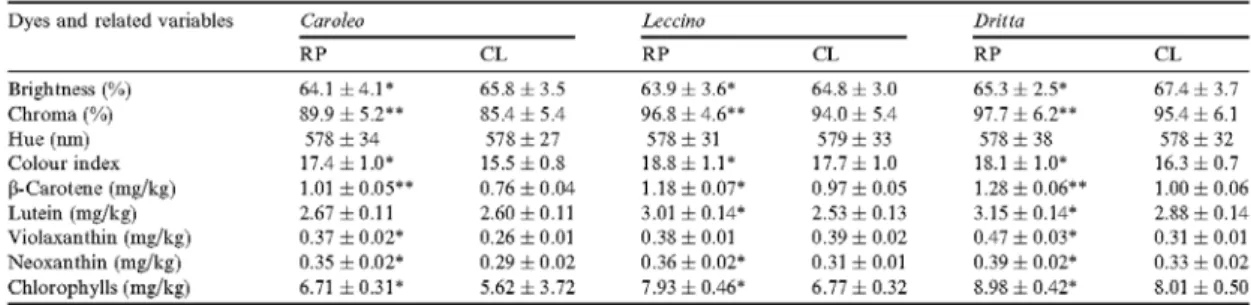
Table 1. Values of chloroplast pigments and related chromatic parameters in three extra-virgin olive oil varieties obtained with the new enzyme processing aid, Rapidase adex D (RP), as compared to the control (CL)A
으로 만들어 진 것을 사용하였다. 그리고 resorcinol 은 표준물질로 사용하였다(Ranalli et al., 2003c).
Tocopherol은 HPLC (high pressure chromatography) 를 이용하여 분석하였고 column은 길이 300 mm 의 순상 column으로 내경 3.9 mm에 10 ㎛두께의 M-porasil이 충전된 제품을 사용하였다. 분리액의 조성은 hexan: prophan -2-ol을 98.5:1.5비율로 사 용하였고 UV 검출은 292 nm에서 확인하였다 (Ranalli et al., 2001). 휘발성 물질은 dynamic head-space(DHS)-HRGC로 분석하되 25m길이, 내경이 0.32mm인 0.2um의 ethylene glycol의 column을 사용하였다(Ranalli et al., 2004).
Triacylglycerol은 13C NMR(nuclear magnetic resornance를 이용하여 분석하였고 이때 Varian 500 spectrophotometer를 이용하였다. Oil의 spectra 는 oil: deuterochloroform의 비율을 500:1로 섞은 후 분석하였다. Chemical shift는 Me4Si (tetramethylsilane) 의 시그날과 상대적으로 비교하여 분석하였다 (Ranalli et al., 2003c). Individual triglycerol은 전 체 triglycerol 중 얼마를 차지하는지 %로 나타냈 는데 이때 Shodex RF Se-61 differental refractometer 과 chromoject integrator가 갖춰진 LDC4 100Ms
모델 장비를 사용하는 HPLC로 분석하였다. 분리 는 Ranalli (2001)등의 방법에 따라 실시하였다.
도출된 결과는 이원배치분산 분석법(ANOVA) 을 적용하여 Scheffe's test법으로 사후비교검정 (the post hoc pairwise comparison)으로 분석하였다.
다변량분석법인 주성분 분석principal component analysis (PCA), 계층적 군집분석 hierarchical cluster analysis (HCA), the non-parametric neighbour classification (KNN)을 사용하였고 SPASS, Stastica, Stagraphics,등은 소프트 웨어를 활용하였다(Ranalli et al., 2003a).
Ⅲ. 실험결과
사용된 효소의 효과의 정도는 다르다 할지라도 두 효소의 조성은 oil의 천연 색소물질(chlorophylls, xanthophylls, carotenes)을 더 풍부하게 하도록 만 들었다. Rapidase adex D의 경우 표 1에서 보여 준 것처럼 분석결과 더 많은 영향을 준 것으로 나 타났다. 색도 parameter관련된 값들이 증가하였고 반면 명도관련 수치들이 감소하는 것으로 나타났 다. 대조적으로 색상 대해서는 아무런 변화가 없 었는데 좁은 구간인 578 -579nm에서 값이 감소되
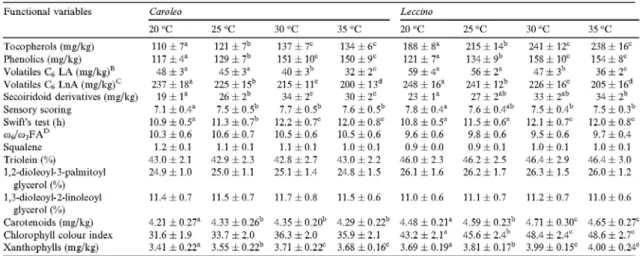
Table 2. Values of functional biomarkers and colour-related compounds in three extra-virgin olive oil varieties obtained at four different malaxing temperaturesA
는 것으로 나타나는데 oil을 분석할 때 보이는 전 형적인 패턴으로 대조군과 동일하게 로 노란색을 나타내었다. Integral 색지수의 값을 보면 처리군 에서 색소의 농도가 증가되었음을 알 수 있다(표 1).
명백하게 효소 복합물은 천연 염료 물질이 상당량 존재하는 과육의 피하층 조직에 생화학적 작용을 하고 이는 oil층으로 이러한 물질의 유입시킨다고 할 수 있다(Ranalli et al., 2004).
다른 생리 활성 물질인 secoiridoid 유도체, tocopherol, 향기로운 방향성 물질 또한 처리군에 서 증가하였고 이는 과육의 선세포 조직에서 이러 한 물질들을 방출을 높였다고 할 수 있다 (Minguez-Mosquera et al., 2002; Ranalli et al., 2003a). 다른 연구에 따르면 (Vierhuis et al., 2001), 위의 phenol 복합물의 증가는 부분적으로 다당체와 같은 물질과의 complexation의 감소로 설명될 수 있다. Non-glyceridic 미량성분은 oil 분획에 광범위하게 함유되어 있기 때문에 최종 처
리된 생산품은 개선된 향미와 향기를 갖고 관능평 가 시 높은 점수를 획득하며 저장기간을 길게 하 였다. 다시 말해서, 분석학적, 영양학적, 감각수용 성적 측면에서 질적으로 향상되었다고 할 수 있다.
효소처리방법으로 oil의 생산량은 과육부분의 조 직을 oil쪽으로 이동시킴으로서 2% 정도 향상되었 다. 이러한 현상은 이멀젼 콜로이드에서 지방구를 떨어지게 함으로서 액체상-고체상 이멀젼(pectins, hemicellulose, proteins, 등)을 제거할 뿐만 아니라 액체상-액체상 이멀젼을 제거시키는 효소 복합체 의 활약에 의해서 일어난 것이다. 또 후자의 경우 효소복합체가 지닌 소량의 endopolygalacturonase 효소의 효과로 보인다(Ranalli et al., 2004; Vierhis et al., 2001). 이러한 융합현상과 다른 효과들이 연화과정에서 일어난다는 것은 효소처리의 첨가가 주목할만한 향상을 준다는 것을 의미한다(Ranalli et al., 2001).
올리브 패이스트의 온도인자에 관한한 우리는
생산된 oil 내의 자연색소의 양적인 증가로 다양한 개별성분의 증가를 관찰 할 수 있었다. 온도가 높 아짐에 따라 사실, 과육조직으로부터 녹색과 노란 색 색소성분의 방출이 촉진되었다.; 결론적으로 oil 패이스트에 많은량의 색소성분이 녹게 된 것이다 (Moyano et al., 2001; Puspitasari-Nienaber, Ferruzzi,
& Schwartz, et al., 2001; Viljanen, Sundberg, Ohshima, & Heinonen, 2002). 그러나 온도가 30에 서 35℃의 구간에서는 색소성분의 양적변화는 보 이지 않았고 이는 동시에 열적파괴가 일어났기 때 문이다(Ranalli et al., 2001; Roca, Gandul-Rojas, Gallardo-Guerrero, & Minguez-Mosquera, 2003).
Chromatic parameter(색도와 명도)와 integral 색 지수의 변화는 lipochrome의 변화와 일치 하였다 (표 2).
기타 분석항목(tocopherols, phenolics, secoiridoid derivatives, sensory scoring, oxydative stability) 은 비슷한 경향을 보였다. 방향성 혼합물만 상반 된 결과를 보였는데 이는 연화 공정의 온도가 증 가함에 따라 감소되었기 때문이다. 이러한 성질은 몇몇 좋은 향기를 생성시키는데 중추적 역할을 하 는 LOX 경로에 포함된 endogenous한 효소의 점 진적인 열적 불활성화 때문일 수 도 있다(Salas &
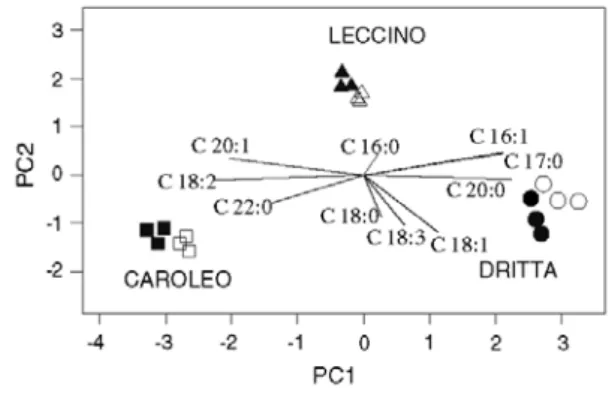
Sanchez, 1999). 비누화가 가능한 물질 뿐 아니라 스쿠알렌도 본 기술적 처리에 대한 영향은 없는 것으로 나타났다. 많은 분석 결과는 Caroleo와 Leccino 품종으로 분석 후 도출된 것으로 이를 표 2에 정리하였고 유사한 결과를 Dritta 품종으로 얻긴 하였으나 발표하지 않았다. 그림 1은 다변수 의 주성분 분석기술을 이용하여 지방산 조성결과 를 적용한 Bi-plot (score 와 loading plot)으로서 이는 품종에 의한 oil의 그룹화가 가능하였다. 솔 직히, dimension 1(전체 품종의 75.1% 정도)에 따 라 Dritta종(positive half)와 Caroleo종(negative
half)의 구분이 가능하였고 dimension 2 (품종의 16.4%정도)에 따라 분석시 Leccino종을 분리 할 수 있었다. 각각의 효소로 처리된 oil 군은 비처리 군과 구분되었다. 유사한 결과를 HCA와 KNN분 석법으로 얻을 수 있었다.
Fig. 1. Score and loading plot (based on the fatty acid composition data set) by dimension 1 and 2 from PCA, showing groupings (varieties) and subgroupings, such as enzyme-treated (solid symbols) and untreated (open symbols) virgin olive oils.
Ⅳ. 결론
사용된 효소는 유전자적인 변형없는 유기물로부 터 얻어진 자연물질이고 추출과정의 마지막에 사 용될 뿐 아니라 적절한 역할을 수행하고 (과육내 수분층에 녹기 때문에) 액상층으로 완전하게 빠져 나올 수 있어 oil층에 잔존하지 않게 된다. 본고는 lipochrom의 조성과 다른 non-glyceridic한 기능성 분획에 대한 효소들의 순기능에 대해서 명료하게 기술하였다. 이러한 혁신적인 가공기술은 올리브 oil 생산자들에 의해서 적용할 수 있도록 고려되어 야만 하는데 이는 소비자들의 기호에 가장 중요한 chromatic한 성질과 버진 올리브 oil의 질적 향상 을 위한 것이다. 올리브 패이스트 연화공정 온도
는 natural coloring과 생리활성을 가진비누화가 되지 않는 물질(기능성 bio-marker)의 정도를 효 과적으로 개선하는 또 하나의 인자이다. 이러한 기술의 핵심은 연화 온도가 30℃ 이상으로 올리지 않아야하는데 이는 포함물질의 유지를 위해서다.
더 높은 온도는 특히, hydroperoxide lyase(FAHL) 효소 (Salas & Sanchez, 1999)를 강하게 불활성화 시켜 그린과 플로랄향의 생합성(biogeneration)을 감소시킬 뿐만 아니라 지방분해, 산화, 발효과정 (지방산, 아미노산, 당을 포함)을 증가시킨다. 실제 적으로 올리브 패이스트 처리시 차가운 온도(15℃
이하)에서 사용하는 것을 나을 수 도 있으나, 올리 브 oil 압착기는 상온인 20 - 25℃에서 사용되므로 이온도 조건에서의 사용은 이점을 더 많이 줄 것 으로 보이며 만족스런 수율을 이끌 수 있다고 생 각된다.
Ⅴ. 참고문헌
1. Amirante, R., Cini, E., Montel, G. L., &
Pasqualone, A. (2001). Influence of mixing and extraction parameters on virgin olive oil quality. Grasas y Aceites, 52, 198–01.
2. Angerosa, F., Mostallino, R., Basti, C., & Vito, R. (2001). Influence of malaxation temperature and time on the quality of virgin olive oils.
Food Chemistry, 72, 19–8.
3. Caponio, F., Alloggio, V., & Gomes, T. (1999).
Phenolic compounds of virgin olive oil.
Influence of paste preparation techniques.
Food Chemistry, 64, 203–09.
4. Catalano, D., & Caponio, F. (1996). Machines for olive oil paste preparation producing quality virgin olive oil. Fett/Lipid, 98, 408–12.
5. Escolar, D., Haro, M. R., & Ayuso, J. (2002).
An efficient method for a numerical
description of virgin olive oil color with only two absorbance measurements. Journal of the American Oil Chemists Society, 79, 769–74.
6. Galeano Dı´az, T., Dura´n Mera´s, I., Correra, C. A., Rolda´n, B., & Rodrı´guez Ca´ceres, M.
I. (2003). Simultaneous fluorometric determination of chlorophylls a and b and pheophytins a and b in olive oil by partial least-squares calibration. Journal of Agricultural and Food Chemistry, 51, 6934–940.
7. Gallardo-Guerrero, L., Roca, M., & Mı´nguez- Mosquera, I. (2002). Distribution of chlorophylls and carotenoids in ripening olives and between oil and alperujo when processed using a two-phase extraction system. Journal of the American Oil Chemists Society, 79, 105-09.
8. Gandul-Rojas, B., & Minguez-Mosquera, M.
L. (1996). Chlorophyll and carotenoid composition in virgin olive oils from various Spanish olive varieties. Journal of Science and Agriculture, 72, 31–9.
9. Koutsaftakis, A., Kotsifaki, F., & Stefanoudaki, E. (1999). Effect of extraction system, stage of ripeness, and kneading temperature on the sterol composition of virgin olive oil. Journal of the American Oil Chemists Society, 76, 1477–481.
10. Lercker, G., Frega, N., Bocci, F., & Mozzon, M. (1999). Volatile constituents and oxidative stability of virgin olive oils: influence of the kneading of olive paste. Grasas y Aceites, 50, 26–9.
11. Mı´nguez-Mosquera, I., Gallardo-Guerrero, L.,
& Roca, M. (2002). Pectinesterase and
polygalacturonase in changes of pectic matter in olives (cv. Hojiblanca) intended for milling. Journal of the American Oil Chemists Society, 79, 93–9.
12. Moyano, M. J., Ayala, F., Echa´varri, J. F., Alba, J., Negueruela, A. I., & Heredia, F. J.
(2001). Simplified measurement of virgin olive oil color by application of the characteristics vector method. Journal of the American Oil Chemists Society, 78, 1221–
226.
13. Morales, M. T., Angerosa, F., & Aparicio, R.
(1999). Effect of the extraction conditions of virgin olive oil on the lipoxygenase cascade:
chemical and sensory implications. Grasas y Aceites, 150, 114–21.
14. Morales, M. T., & Aparicio, R. (1999). Effect of extraction conditions on sensory quality of virgin olive oil. Journal of the American Oil Chemists Society, 76, 295–00.
15. Puspitasari-Nienaber, N. L., Ferruzzi, M., &
Schwartz, S. J. (2002). Simultaneous detenction of tocopherols, carotenoids, and chlorophylls in vegetable oils by direct injection C30 RP-HPLC with coulorimetric electrochemical array detection. Journal of the American Oil Chemists Society, 79, 633-40.
16. Ranalli, A., Contento, S., Schiavone, C., &
Simone, N. (2001). Malaxing temperature affects volatile and phenol composition as well as other analytical features of virgin olive oil. European Journal of Lipid Science and Technology, 103, 228–38.
17. Ranalli, A., Gomes, T., Delcuratolo, D., Contento, S., & Lucera, L. (2003a). Improving
virgin olive oil quality by means of innovative extracting biotechnologies. Journal of Agricultural and Food Chemistry, 51, 2597 –602.
18. Ranalli, A., Lucera, L., Contento, S., Simone, N., & Del Re, P. (2004). Bioactive constituents, flavors and aromas of virgin oils obtained by processing olives with a natural enzyme extract. European Journal of Lipid Science and Technology, 106, 187–97.
19. Ranalli, A., Pollastri, L., Contento, S., Lucera, L., & Del Re, P. (2003b). Enhancing the quality of virgin olive oil by use of a new vegetable enzyme extract during processing.
European Food Research and Technology, 216, 109–15.
20. Ranalli, A., Pollastri, L., Contento, S., Iannucci, E., & Lucera, L. (2003c). Effect of olive paste kneading process time on the overall quality of virgin olive oil. European Journal of Lipid Science and Technology, 105, 57–7.
21. Roca, M., Gandul-Rojas, B., Gallardo-Guerrero, L., & Mı´nguez-Mosquera, I. (2003). Pigment parameter determining Spanish virgin olive oil authenticity: stability during storage.
Journal of the American Oil Chemists Society, 80, 1237–240.
22. Salas, J. J., & Sa´nchez, J. (1999). The decrease of virgin olive oil flavour produced by high malaxation temperature is due to inactivation of hydroperoxide lyase. Journal of Agricultural and Food Chemistry, 47, 809-12.
23. Servili, M., Selvaggini, R., Taticchi, A.,
Esposto, S., & Montedoro, G. F. (2003).
Volatile compounds and phenolic composition of virgin olive oil: optimization of temperature and time of exposure of olive paste to air contact during the mechanical extraction process. Journal of Agricultural and Food Chemistry, 51, 7980–988.
24. Vierhuis, E., Servili, M., Baldioli, M., Schols, H. A., Voragen, A. G. J., & Montedoro, G.
F. (2001). Effect of enzyme treatment during
mechanical extraction of olive oil on phenolic compounds and polysaccharides. Journal of Agricultural and Food Chemistry, 49, 1218–
223.
25. Viljanen, K., Sundberg, S., Ohshima, T., &
Heinonen, M. (2002). Carotenoids as antioxidants to prevent photoxidation. European Journal of Lipid Science and Technology, 104, 356–59.
〈출처 : Food research International 38, 873-878, 2005〉