https://doi.org/10.4094/chnr.2019.25.3.262
CHNR
Factors Influencing Physical Activity in Adolescents with Complex Congenital Heart Disease
Su Jin Kwon
1, Eun Kyoung Choi
2, Kyung Hee Lee
2, Yu-Mi Im
31Advanced Practice Nurse, Congenital Heart Disease Center, Asan Medical Center, Seoul; 2Assistant Professor, College of Nursing ․ Mo-Im Kim Nursing Research Institute, Yonsei University, Seoul; 3Assistant Professor, Seoul Women’s College of Nursing, Seoul, Korea
Purpose: We aimed to identify factors influencing physical activity in adolescents with complex congenital heart disease. Methods:
We recruited 92 adolescents with complex congenital heart disease from a tertiary medical center in Seoul, measured their levels of physical activity, and identified factors that influenced their physical activity levels using the Global Physical Activity Questionnaire, the New York Heart Association classification, congenital heart disease complexity, the Self-Efficacy Scale, and the Parental Bonding Instrument scale. Stepwise multiple linear regression was used to determine factors influencing physical activity. Results: Total physical activity was higher in males than in females (t=4.46, p<.001). Adolescents who participated in school physical education classes engaged in more physical activity than those who did not (t=6.77, p<.001). Higher self-efficacy (β=.41, p<.001), male gender (β=.37, p<.001) and participation in school physical education classes (β=.19, p=.042) were associated with a higher likelihood of engagement in physical activity. Conclusion: It is necessary to develop nursing interventions that enhance self-efficacy in order to promote physical activity in adolescents with complex congenital heart disease. Physical activity should also be promoted in an individualized manner, taking into account gender, disease severity, and parental attitude.
Key words: Congenital heart defects; Physical activity; Parenting; Self-efficacy; Adolescents
INTRODUCTION 1. Need for Study
Although Korea’s birthrate is rapidly falling, the percent- age of infants born with congenital anomalies is gradually increasing. The number of congenital heart disease operation performed annually has increased from 4546 in 2006 to 5398 in 2016, an increase of 1000 within a decade [1,2]. According to a 2017 report by the American Heart Association (AHA), mor- tality rates from complex congenital heart diseases have de- creased by 22% since 1979. Advanced techniques to detect car- diac lesions, improved diagnosis and management strategies, and surgical interventions have contributed to higher survival rates of infants with congenital heart disease through adult- hood [3,4]. Although infant survival rates have increased, the incidence of long-term arrhythmia and cardiac insufficiency has increased among survivors previously diagnosed with congenital heart disease. Therefore, regular monitoring of pa- tients with congenital heart disease from infancy, through ado- lescence and extending into adulthood is necessary [5].
During growth, illnesses in adolescents might not be meas- urable in the same way as in adults although poor health in adolescence can affect health in adulthood. Therefore, appro- Corresponding author Eun Kyoung Choi
https://orcid.org/0000-0003-4622-2437 College of Nursing, Yonsei University,
50-1 Yonsei-ro, Sedaemun-gu, Seoul 03722, Korea TEL +82-2-2228-3340 FAX +82-2-392-5440 E-MAIL [email protected]
*This article was adapted from a thesis by Su Jin Kwon in partial fulfillment of the requirements for the master's degree at Yonsei University of Korea.
*This study was supported by Chijung Sim scholarship of the College of Nursing of Yonsei University in 2018.
Received Feb 12, 2019 Revised Mar 20, 2019 Accepted Mar 23, 2019
This is an Open Access article distributed under the terms of the Creative Commons Attribution Non- Commercial License (http://creativecommons.org/licenses/by-nc/4.0/) which permits unrestricted non- commercial use, distribution, and reproduction in any medium, provided the original work is properly cited.
priate interventions for health management are necessary starting in adolescence, and positive health behaviors must be promoted to ensure a healthy adult life [6]. Congenital heart disease management in Korea currently focuses on promoting physical health, as there is a lack of awareness regarding mul- timodal approaches to health management, such as physical activity, career counseling, pregnancy choices, social activ- ities, and quality of life [7].
Physical activity impacts adolescent health positively; how- ever, almost half of patients with congenital heart disease rarely follow physical activity recommendations [8]. The AHA emphasized the importance of a physically active life and pos- itive habits related to health and welfare in children and adults with congenital heart disease, noting that physical activity should be limited only when there is arrhythmia [9]. In addi- tion, it has been reported that regular physical activity im- proves motor ability, the musculoskeletal system, blood ves- sels, and immune functions, and also benefits a person’s men- tal and social welfare well-being, quality of life, and self-effi- cacy; additionally, the risk of acquired heart diseases can be reduced by regular physical activity [9,10].
Although it is theoretically evident that regular physical ac- tivities have improved one’s quality of life, a lot of adolescents with congenital heart disease have been found lack of physical activity [8,11]. Previous studies have reported several factors that promote or limit physical activity among adolescents with congenital heart disease, and self-efficacy was found to positively promote physical activity in adolescents with con- genital heart disease [12]. Sable et al. [13] pointed out that the type of cardiac disorder and disease severity are important factors influencing decisions regarding the type of physical activity. However, some additional factors are more im- portant, such as parental attitudes, recommendations from medical staff, the effect of exercise, and other adolescent inter- ests [13]. Adolescents habits also affect physical activity [9].
Habits that encourage a low level of physical activity may be due to overprotection by parents or others, and such factors were found to be common among patients with complex con- genital heart disease [11,14]. Additionally, it was observed that adolescents with complex congenital heart disease gen- erally failed to practice a proper amount of physical activity as recommended by the World Health Organization (WHO), and that their quality of life was also relatively low [11].
Lack of physical activity is a risk factor for noninfectious diseases such as cardiovascular disease, ischemic stroke, type II diabetes mellitus, obesity, colon cancer, and breast cancer. The WHO developed the Global Physical Activity Questionnaire (GPAQ) to investigate analyze factors causing such noninfectious diseases and to compare the amount of physical activity across countries [15]. Several studies have
used the GPAQ to investigate physical activity levels, but most have focused on adults. There have been few studies, at home and abroad, that examined factors influencing physical activity in adolescents with congenital heart disease, partic- ularly complex congenital heart disease. Hence, it is necessary to analyze the extent to which the factors suggested in pre- vious studies affect physical activity in this population.
The present study aimed to examine the characteristics of adolescents with complex congenital heart disease and their amount of physical activity depending on disease severity, utilizing the GPAQ developed by the WHO, and to derive fac- tors influencing the physical activity of adolescents with com- plex congenital heart disease. It is expected that the findings of this study will be utilized as a basis for developing of nurs- ing interventions and educational programs aimed at promot- ing physical activity among adolescents with complex con- genital heart disease, and that this study will help enable a healthy transition from adolescence to adulthood.
2. Objectives
The objective of this study was to examine the characteris- tics of adolescents with complex congenital heart disease and their amount of physical activity depending on disease sever- ity, and to analyze factors influencing their physical activity.
Disease severity in adolescents with complex heart dis- ease was examined.
The impact of differences in various characteristics of ado- lescents with complex heart disease on their physical ac- tivity was examined.
The impact of differences in disease severity of adoles- cents with complex heart disease on their physical activ- ity was examined.
The correlations between physical activity, self-efficacy, and parental attitude in adolescents with complex heart disease were examined.
Factors influencing the physical activity of adolescents with complex congenital heart disease were derived.
METHODS 1. Study Design
This is a descriptive study conducted to examine factors that influence physical activity in adolescents with complex congenital heart disease.
2. Study Subjects and Data Collection
This study involved patients aged 12 to 18 years who had
been diagnosed with complex congenital heart disease at a tertiary care hospital located in Seoul, and were under ambu- latory tracking and monitoring at the pediatric cardiology or pediatric cardiac surgery department.
To determine the number of subjects necessary for multi- ple regression analysis, the G-power 3.1.9.2 program was used. The significance level was set to .05. The power of the test was set to .95 and six predictors were analyzed (gender, participation in physical education classes at school, New York Heart Association (NYHA) classification, self-efficacy, paternal care as a sub-item of parental attitude, and sedentary behaviour). When the effect size was set to .30 similar to a pre- vious study [16], the appropriate sample size was calculated to be 77. The final sample size was 93 as a high drop-out rate (15%) was expected. Ninety-two copies (99%) of the ques- tionnaire were collected and utilized for the final analysis, out of 93 distributed.
3. Research Tools
1) Characteristics of adolescents with complex congenital heart disease
Nine questions collected general information about the participants, including age, gender, current residential area, school/grade, type of school, school performance, participa- tion in physical education classes at school, financial con- dition, and body mass index (height and weight). Six ques- tions were on disease characteristics, including a confirmed diagnosis of congenital heart disease, number of operations to date, age at first surgery, number of medications currently taken, and whether advice was given by medical staff regard- ing physical activity. As a biological index, oxygen saturation at rest was also recorded.
2) Disease severity
Disease severity was determined by two measures: con- genital heart disease (CHD) complexity and the NYHA clas- sification.
The first method (CHD complexity) classified complex congenital heart diseases as being of moderate or great com- plexity based on the structure of congenital heart disease, as proposed in the ACC/AHA 2018 Guideline published by the American College of Cardiology (ACC) and the AHA [17]. The classification of moderate or great complexity was made based on echocardiography, and great complexity was considered to indicate a higher level of disease severity.
The second method was the NYHA classification, which divides cardiac functional states into stages I to IV. Questions from the translated version were used, as it was designed to include questions for better patient understanding. The high-
er the class, the higher the level of disease severity [18].
3) Physical activity
Physical activity was measured using the GPAQ developed by the WHO. The GPAQ consists of 15 questions ─ six ques- tions about physical activity at school (work-related activity), six questions about after-school activity of sports (leisure ac- tivity), and three questions about travel to and from places ─ as well as one question about sedentary behaviour [15]. For our analysis, the amount of physical activity was classified as mod- erate to vigorous intensity, and the total amount of physical ac- tivity was converted into metabolic equivalents of task (METs) (minutes/week): Vigorous-intensity physical activity was giv- en a rating of 8 METs, and moderate-intensity physical activity and relocation was rated as 4 METs. Higher values of the METs corresponded to greater, amounts of physical activity.
4) Self-efficacy
To measure the level of self-efficacy specifically relevant to physical activity as recognized by the participants, the Self- Efficacy Scale developed by Motl et al. [19] was translated into Korean and used after consent was obtained from the author.
Each question was measured on a 5-point Likert scale, with 1 point indicating “not at all”, 2 points “not in general”, 3 points
“normal”, 4 points “yes in general”, and 5 points “always”.
Higher scores indicated higher levels of self-efficacy asso- ciated with physical activity. The tool was translated into Korean, and its content was validated by one professor at a pe- diatric cardiac surgery department, one professor at a pedia- tric cardiology department, two professors at a nursing col- lege, and one professional nurse at a pediatric cardiac surgery department. Among the eight questions of the original tool, the item “I can practice physical activity during my free time even if I have a lot of homework to do”. was excluded because its contents validity index was .40; however, the remaining 7 questions were used. At the time of development, the Cron- bach’s ⍺ was .84, and in this study, it was .90 [19].
5) Parental attitude
To measure parents’ attitude towards adolescents with complex congenital heart disease, the Korean version of the Parental Bonding Instrument developed by Parker et al. and translated by Song [20] was used after obtaining consent from the developer and translator. It is a self-reporting tool that measures memories up to respondents’ 16th year life. Each parent's caring attitude is measured with 25 questions, includ- ing 12 questions about care (positive caring attitude items in- clude interest, sensitivity, love, etc.) and 13 questions about overprotection (negative caring attitude items include regu- lation, requirement, and punishment). Each question is an-
swered on a 4-point Likert scale, with 0 points for ‘very un- like’, 1 point for ‘moderately unlike,’ 2 points for ‘moderately like’, and 3 points for ‘very like’. Some of these questions in this tool are reverse-scored. High scores for a caring attitude and low scores for overprotection correspond to an appro- priate parental attitude. Regarding the Cronbach’s ⍺ values for this tool in the study of Song [20], the scores were .87 for maternal care, .87 for maternal overprotection, .90 for paternal care, and .87 for paternal overprotection. The Cronbach’s ⍺ values in this study were .87 for maternal care, .77 for mater- nal overprotection, .88 for paternal care, and .75 for paternal overprotection.
4. Method of Data Collection
The researcher obtained approval for this study from the hospital’s Institutional Review Board (IRB) (No. 2018-0444).
Hospital permission and cooperation for the survey also were obtained from the nursing department, pediatric cardiac sur- gery department, pediatric cardiology department, and am- bulatory care team. The structured questionnaire was filled out by the participants, and the survey took about 10 minutes to complete. Survey respondents were given a token gift and data collection lasted for 7 months, from April 16 to Novem- ber 30, 2018.
5. Data Analysis
The collected data were analyzed using SPSS version 25.0 (IBM Corp., Armonk, NY, USA). The extent of physical activ- ity depending on participants’ characteristics and disease se- verity was analyzed in terms of frequency, percentage, aver- age, and standard deviation. Differences in physical activity depending on participants’ characteristics and disease se- verity were analyzed using the independent t-test and analy- sis of variance (for post-hoc analysis, the Scheffé test was used). The correlations among the research variables were an- alyzed by Pearson correlation analysis. Finally, stepwise mul- tiple linear regression was conducted to derive factors on in- fluencing physical activity in adolescents with complex con- genital heart disease.
RESULTS
1. General and Disease-related Characteristics of Adoles- cents with Complex Congenital Heart Disease
Ninety-two adolescents with complex congenital heart dis- ease participated in the study, and their general character- istics are presented in Table 1. The average age of the partic-ipants was 15.03±1.92 years, and more participants were male than female (54, 58.7%). Seventy-nine participants (85.9%) at- tended physical education classes at school. Regarding dis- ease characteristics, participants who had undergone three or more operations accounted for the largest portion of the study population (41, 44.6%). Oxygen saturation levels ranged be- tween 77% and 100%, with an average of 94.90%±3.75%. The maximum number of cardioactive medications taken was five.
Fifty participants (54.4%) were no longer taking medications.
The most common medication taken was warfarin. Among the 92 individuals, the majority (72, 78.3%) had never received any advice from medical staff (doctors and nurses) regarding the importance of physical activity.
2. Disease Severity
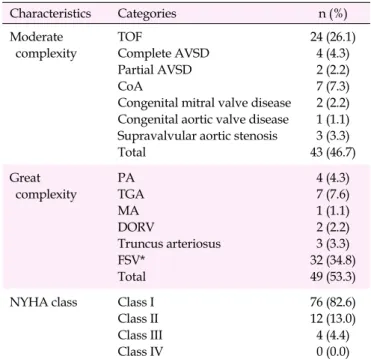
Disease severity was categorized as shown in Table 2. Com- plex congenital heart disease types were classified based on the ACC/AHA 2018 Guideline. Forty-three participants (46.7
%) were classified as having moderate-complexity disease, while 49 (53.3%) had disease of great-complexity. Participants were classified based on NYHA class as an indicator of their current cardiac functional status (i.e., the extent of cardiac in- sufficiency), as follows: 76 (82.6%) belonged to NYHA class I, 12 (13.0%) to Class II, 4 (4.4%) to class III, and 0 (0.0%) to class IV.
3. The Amount of Physical Activity among Adolescents with Complex Congenital Heart Disease and Differ- ences in Physical Activity Based on Their Character- istics
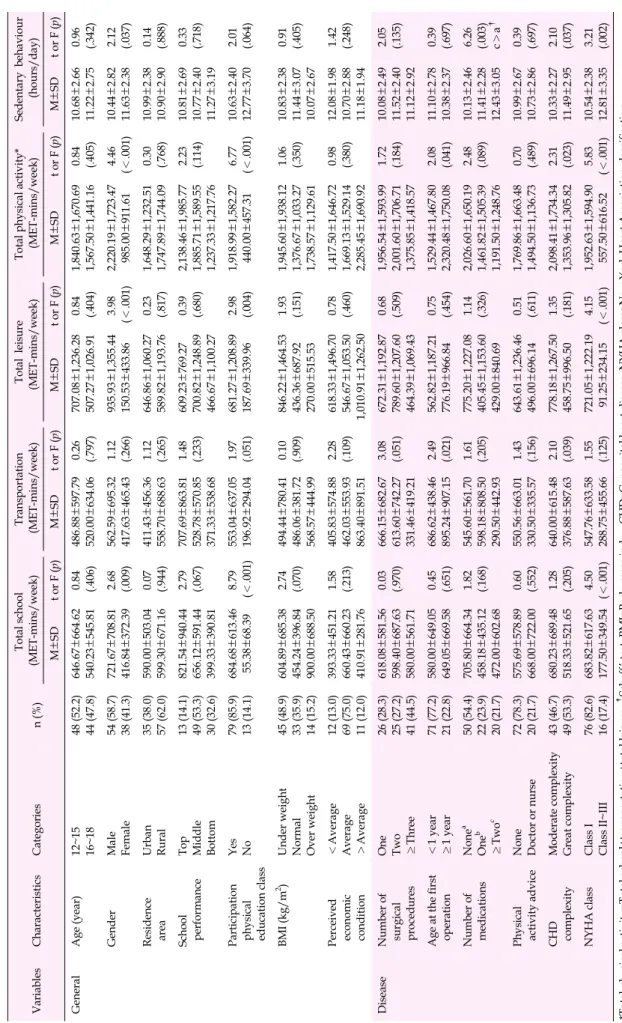
The total amount of physical activity among adolescents with complex congenital heart disease was presented as METs (minutes/week). The average amount of physical ac- tivity was 1710.00±1562.64 METs, and the average time spent sitting was 10.94±2.70 hours/day. The amount of phy- sical activity was significantly higher among: 1) male students as compared to female students (t=4.46, p<.001); 2) students who attended physical education classes at school compared to those who did not (t=6.77, p<.001); and 3) participants who underwent their first surgery at the age of 1 or older as com- pared to those who underwent their first surgery before 1 year of age (t=2.08, p=.041) (Table 3).
4. Differences in Physical Activity Depending on Disease Severity
Differences in physical activity depending on disease se- verity were noted (Table 3). The amount of total physical ac-
Table 1. Characteristics of Adolescents with Complex Congenital Heart Disease (N=92)
Variables Characteristics Categories n (%) M±SD
General Age (year) 12~15
16~18
48 (52.2) 44 (47.8)
15.03±1.92
Gender Male
Female
54 (58.7) 38 (41.3)
Residence area Urban
Rural
35 (38.0) 57 (62.0)
School type Middle school
High school Others*
45 (48.9) 42 (45.7) 5 (5.4)
School performance Top
Middle Bottom
13 (14.1) 49 (53.3) 30 (32.6) Participation in
physical education class
Yes No
79 (85.9) 13 (14.1)
BMI (kg/m2) Underweight (<20)
Normal (20~24.9)
Overweight & obese (>25)
45 (48.9) 33 (35.9) 14 (15.2)
21.07±3.72
Perceived economic condition Above average Average Below average
11 (12.0) 69 (75.0) 12 (13.0)
Disease Number of surgical procedures One
Two
≥Three
26 (28.2) 25 (27.2) 41 (44.6) Age at the first surgical procedure <1 year
≥1 year
71 (77.2) 21 (21.8)
SpO2 94.90±3.75
Number of medications None
One Two or more
50 (54.4) 22 (23.9) 20 (21.7) Health professional who
gave advice on physical activity
None Doctor Nurse
Doctor & nurse
72 (78.3) 15 (16.3) 3 (3.2) 2 (2.2)
*Including taking the qualification examination, while studying abroad; BMI=Body mass index; SpO2=Saturation of percutaneous oxygen.
tivity was significantly higher among participants with mod- erate-complexity disease as compared to those with disease of great- complexity (t=2.31, p=.023), and higher levels of physical activity were also observed among participants be- longing to NYHA class I than among those in classes II to III (t=5.83, p< .001).
5. Factors Influencing Physical Activity in Adolescents with Complex Congenital Heart Disease
Stepwise multiple linear regression was conducted based
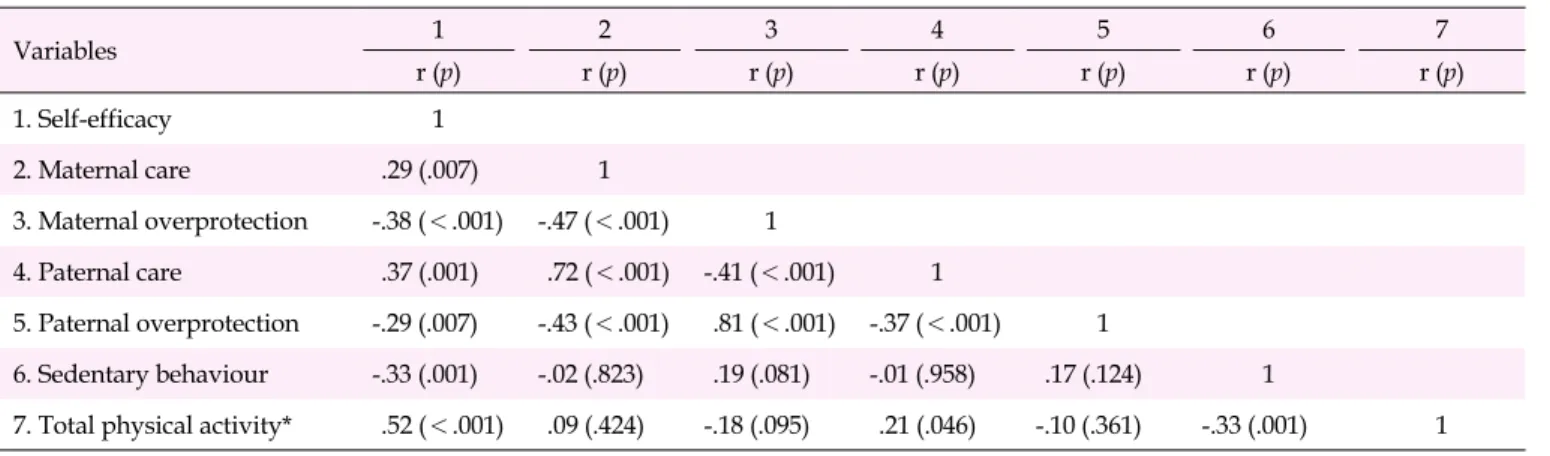
on six variables including self-efficacy (r=.52, p<.001), pater- nal care (r=.21, p=.046), sedentary behaviour (r=-.33, p=.001) (Table 4), classifications identified as significant factors as such as gender, attendance of school physical education class- es, and the NYHA classification. The age at which participants underwent their first surgery showed a significant relation- ship with CHD complexity (x2=6.08, p=.014). Additionally, CHD complexity was significantly correlated with the NYHA classification as a variable indicating disease severity in the present study (x2=6.56, p=.013). Therefore, the stepwise re- gression analysis was conducted solely based on the NYHA
Table 2. Classification of Participants by Complexity of Conge- nital Heart Disease Diagnosis and New York Heart Associa-
tion Class (N=92)
Characteristics Categories n (%)
Moderate complexity
TOF
Complete AVSD Partial AVSD CoA
Congenital mitral valve disease Congenital aortic valve disease Supravalvular aortic stenosis Total
24 (26.1) 4 (4.3) 2 (2.2) 7 (7.3) 2 (2.2) 1 (1.1) 3 (3.3) 43 (46.7) Great
complexity
PA TGA MA DORV
Truncus arteriosus FSV*
Total
4 (4.3) 7 (7.6) 1 (1.1) 2 (2.2) 3 (3.3) 32 (34.8) 49 (53.3) NYHA class Class I
Class II Class III Class IV
76 (82.6) 12 (13.0) 4 (4.4) 0 (0.0)
*Including double inlet left ventricle, tricuspid atresia, hypoplastic left heart syndrome, and any other anatomic abnormality with a functionally single ventricle; TOF=Tetralogy of Fallot; AVSD=Atrioventricular septal defect; CoA=Coarctation of the aorta; PA=Pulmonary atresia; TGA=
Transposition of the great arteries; MA=Mitral atresia; DORV=Double outlet right ventricle; FSV=Functionally single ventricle; NYHA class=
New York Heart Association classification.
classification, which was found to have a more significant rela- tionship with participants’ physical activity as a disease se- verity factors. The factors that significantly influenced phys- ical activity in adolescents with complex congenital heart dis- ease included self-efficacy (β=.41, p<.001), gender (β=.37, p<
.001), and participation in school physical education classes (β=.19, p=.042). The tolerance of these independent variables was 0.85 to 0.99, and the variation inflation factor was between 1.01 and 1.18, indicating multicollinearity. The explanatory power of the model was high, at 42.2%(F=20.21, p<.001) (Table 5).
DISCUSSION
This study applied the GPAQ developed by the WHO to ex- amine the amount of physical activity of adolescents with complex congenital heart disease. Factors influencing phys- ical activity were derived based on disease severity, self-effi- cacy, and parental attitude.
First, the average amount of physical activity of adolescents with complex congenital heart disease was 1710.00±1562.64 METs (minutes/week), which was less than the WHO physical
activity recommendation of at least 60 minutes per day (intense physical activity at a moderate to vigorous level) for children and adolescents aged 5 to 17 years. This is similar to findings in a previous study in which 34.1% of adolescents with complex congenital heart disease matched the recommended level of physical activity, which was a lower proportion than observed for both normal adolescents (64.1%) and for adolescents with simple congenital heart disease (54.5%) [11].
The following factors influenced physical activity in ado- lescents with complex congenital heart disease. Self-efficacy had a significant positive correlation with physical activity in adolescents with complex congenital heart disease, and it af- fected physical activity, similar to the findings of Ray and Henry et al. [12]. Individuals with high self-efficacy maintain positive energy and obtain vitality while exercising, feeling less fatigued during physical activity [21]. Hence, self-effi- cacy can have a positive influence on physical activity. In ad- dition, self-efficacy is related to the parental caring attitude.
In this study, self-efficacy was found to be positively corre- lated with parental care and negatively correlated with paren- tal overprotection. This is similar to the results of Park and Cheon [22], who found that as stable attachment to parents de- veloped, children developed self-confidence to overcome their fears of potential negative results and to manage their feelings successfully. Hence, it is thought that interventions to enhance self-efficacy might begin with attempts to change parents’ car- ing attitude. As parents provide their children with oppor- tunities to feel a sense of achievement and to experience regu- lar successes, maintaining a reasonable caring attitude helps them to develop self-efficacy, which can affect physical activ- ity directly or indirectly [23,24]. However, interventions are necessary since parents of adolescents with congenital heart disease tend to practice overprotection [14]. To improve self-efficacy, therefore, parents of adolescents with congenital heart disease need help to develop not overprotection, but a desirable caring attitude that would help their children expe- rience successes through physical activity with regular verbal encouragement.
Paternal care was positively correlated with physical activ- ity but was not found to be a factor influencing physical activity. In contrast, Määttä, Ray, and Roos [25] noted that pa- rents had a positive influence on their children's physical ac- tivity in a variety of ways: Parental encouragement and in- volvement influenced children’s perceptions and cognitions about physical activity positively, and these factors increased the levels of children’s physical activity and self-efficacy. In particular, having their fathers as a role model ─specifically as children watched their fathers participate in sports or learn- ed that their fathers also enjoyed sports had a direct impact on children’s physical activity. Brouwer et al. [26] reported that
Table 3. Physical Activity by Characteristics of Adolescents with Complex Congenital Heart Disease(N=92) VariablesCharacteristicsCategoriesn(%)Total school (MET-mins/week)Transportation (MET-mins/week)Total leisure (MET-mins/week)Total physical activity* (MET-mins/week)Sedentary behaviour (hours/day) M±SDt or F(p)M±SDt or F(p)M±SDt or F(p)M±SDt or F(p)M±SDt or F(p) GeneralAge(year)12~15 16~1848(52.2) 44(47.8)646.67±664.62 540.23±545.810.84 (.406)486.88±597.79 520.00±634.060.26 (.797)707.08±1,236.28 507.27±1,026.910.84 (.404)1,840.63±1,670.69 1,567.50±1,441.160.84 (.405)10.68±2.66 11.22±2.750.96 (.342) GenderMale Female54(58.7) 38(41.3)721.67±708.81 416.84±372.392.68 (.009)562.59±695.32 417.63±465.431.12 (.266)935.93±1,355.44 150.53±433.863.98 (<.001)2,220.19±1,723.47 985.00±911.614.46 (<.001)10.44±2.82 11.63±2.382.12 (.037) Residence areaUrban Rural35(38.0) 57(62.0)590.00±503.04 599.30±671.160.07 (.944)411.43±456.36 558.70±688.631.12 (.265)646.86±1,060.27 589.82±1,193.760.23 (.817)1,648.29±1,232.51 1,747.89±1,744.090.30 (.768)10.99±2.38 10.90±2.900.14 (.888) School performanceTop Middle Bottom 13(14.1) 49(53.3) 30(32.6) 821.54±940.44 656.12±591.44 399.33±390.81 2.79 (.067)707.69±863.81 528.78±570.85 371.33±538.68 1.48 (.233)609.23±769.27 700.82±1,248.89 466.67±1,100.27 0.39 (.680)2,138.46±1,985.77 1,885.71±1,589.55 1,237.33±1,217.76 2.23 (.114)10.81±2.69 10.77±2.40 11.27±3.19 0.33 (.718) Participation physical education class
Yes No79(85.9) 13(14.1)684.68±613.46 55.38±68.398.79 (<.001)553.04±637.05 196.92±294.041.97 (.051)681.27±1,208.89 187.69±339.962.98 (.004)1,918.99±1,582.27 440.00±457.316.77 (<.001)10.63±2.40 12.77±3.702.01 (.064) BMI(kg/m2 )Under weight Normal Over weight 45(48.9) 33(35.9) 14(15.2) 604.89±685.38 454.24±396.84 900.00±688.50 2.74 (.070)494.44±780.41 486.06±381.72 568.57±444.99 0.10 (.909)846.22±1,464.53 436.36±687.92 270.00±515.53 1.93 (.151)1,945.60±1,938.12 1,376.67±1,033.27 1,738.57±1,129.61 1.06 (.350)10.83±2.38 11.44±3.07 10.07±2.67
0.91 (.405) Perceived economic condition
<Average Average >Average 12(13.0) 69(75.0) 11(12.0) 393.33±451.21 660.43±660.23 410.91±281.76 1.58 (.213)405.83±574.88 462.03±553.93 863.40±891.51 2.28 (.109)618.33±1,496.70 546.67±1,053.50 1,010.91±1,262.50 0.78 (.460)1,417.50±1,646.72 1,669.13±1,529.14 2,285.45±1,690.92 0.98 (.380)12.08±1.98 10.70±2.88 11.18±1.94
1.42 (.248) DiseaseNumber of surgical procedures
One Two ≥Three
26(28.3) 25(27.2) 41(44.5) 618.08±581.56 598.40±687.63 580.00±561.71 0.03 (.970)666.15±682.67 613.60±742.27 331.46±419.21 3.08 (.051)672.31±1,192.87 789.60±1,207.60 464.39±1,069.43 0.68 (.509)1,956.54±1,593.99 2,001.60±1,706.71 1,375.85±1,418.57 1.72 (.184)10.08±2.49 11.52±2.40 11.12±2.92
2.05 (.135) Age at the first operation<1 year ≥1 year71(77.2) 21(22.8)580.00±649.05 649.05±669.580.45 (.651)686.62±438.46 895.24±907.152.49 (.021)562.82±1,187.21 776.19±966.840.75 (.454)1,529.44±1,467.80 2,320.48±1,750.082.08 (.041)11.10±2.78 10.38±2.370.39 (.697) Number of medicationsNonea Oneb ≥Twoc
50(54.4) 22(23.9) 20(21.7) 705.80±664.34 458.18±435.12 472.00±602.68 1.82 (.168)545.60±561.70 598.18±808.50 290.50±442.93 1.61 (.205)775.20±1,227.08 405.45±1,153.60 429.00±840.69 1.14 (.326)2,026.60±1,650.19 1,461.82±1,505.39 1,191.50±1,248.76 2.48 (.089)10.13±2.46 11.41±2.28 12.43±3.05
6.26 (.003) c>a† Physical activity adviceNone Doctor or nurse72(78.3) 20(21.7)575.69±578.89 668.00±722.000.60 (.552)550.56±663.01 330.50±335.571.43 (.156)643.61±1,236.46 496.00±696.140.51 (.611)1,769.86±1,663.48 1,494.50±1,136.730.70 (.489)10.99±2.67 10.73±2.860.39 (.697) CHD complexityModerate complexity Great complexity43(46.7) 49(53.3)680.23±689.48 518.33±521.651.28 (.205)640.00±615.48 376.88±587.632.10 (.039)778.18±1,267.50 458.75±996.501.35 (.181)2,098.41±1,734.34 1,353.96±1,305.822.31 (.023)10.33±2.27 11.49±2.952.10 (.037) NYHA classClass I Class II~III76(82.6) 16(17.4)683.82±617.63 177.50±349.544.50 (<.001)547.76±633.58 288.75±455.661.55 (.125)721.05±1,222.19 91.25±234.154.15 (<.001)1,952.63±1,594.90 557.50±616.525.83 (<.001)10.54±2.38 12.81±3.353.21 (.002) *Total physical activity=Total school+transportation+total leisure;†Scheffé́́ test; BMI=Body mass index; CHD=Congenital heart disease; NYHA class=New York Heart Association classification.
Table 4. Correlations between Physical Activity, Self-efficacy, and Parental Attitude (N=92)
Variables 1 2 3 4 5 6 7
r (p) r (p) r (p) r (p) r (p) r (p) r (p)
1. Self-efficacy 1
2. Maternal care .29 (.007) 1
3. Maternal overprotection -.38 (<.001) -.47 (<.001) 1
4. Paternal care .37 (.001) .72 (<.001) -.41 (<.001) 1
5. Paternal overprotection -.29 (.007) -.43 (<.001) .81 (<.001) -.37 (<.001) 1
6. Sedentary behaviour -.33 (.001) -.02 (.823) .19 (.081) -.01 (.958) .17 (.124) 1
7. Total physical activity* .52 (<.001) .09 (.424) -.18 (.095) .21 (.046) -.10 (.361) -.33 (.001) 1
*Total physical activity=Total school+transportation+total leisure.
Table 5. Factors Affecting Physical Activity in Adolescents with Complex Congenital Heart Disease (N=92)
Variables (Reference) B SE β t p
(Constant) -2,017.02 535.40 3.77 <.001
Self-efficacy 99.68 22.08 .41 4.51 <.001
Gender (Female) 1,167.28 267.72 .37 4.36 <.001
Participation in
physical education class
(No participation) 850.21 411.28 .19 2.07 .042
R2=.422, Adj. R2=.401, F=20.21, p<.001
children tended to imitate the physical activity of the parent of the same gender, and that the father’s type of work, time spent with the father, and knowledge regarding health be- haviors affected the son’s physical activity. The finding of this study that paternal care was positively correlated with physical activity in adolescents with complex congenital heart disease is thought to be related to the fact that in this study, there were more male participants (58.7%) than female participants (41.3%), and that paternal influence was there- fore regarded as significant. Parents of the same gender need to be role models for their children in terms of physical activity. In this regard, follow-up studies should examine the effects of social environments, such as parental disposition and occupation, on children’s physical activity. In addition, it is necessary to inform parents that the father’s role is as im- portant as the mother’s in childcaring because parental caring attitude, and particularly paternal care, has positive effects on physical activity. Meanwhile, excessive protection by parents needs to be avoided.
This study verified gender to be a factor influencing phys- ical activity in adolescents with complex congenital heart dis- ease. The amount of time spent on physical activity was sig- nificantly larger among male participants than female partici- pants, which corresponds to the findings of a previous study
[27]. However, the difference in the amount of time spent on physical activity depending on gender is not limited to ado- lescents with congenital heart disease. In general, male ado- lescents tend to be more motivated to perform physical activ- ity than females. While male adolescents participate in phy- sical activity mainly for reasons related to personal identity, female adolescents tend to participate in physical activity to maintain their figure and weight or as a way to spend time together with their friends [28]. For this reason, male adoles- cents spend more time engaging in physical activity than fe- male adolescents, and they may become interested in differ- ent sports depending on gender. In other words, since gender differences are an important factor when it comes to physical activity, it is necessary to consider gender, in addition to pa- tients’ diagnoses and physical condition, when emphasizing the importance of physical activity to adolescents with com- plex congenital heart disease in order to motivate them as ef- fectively as possible to engage in physical activity and when giving them guidance on the most suitable types of physical activity.
Finally, it was found that attending in school physical edu- cation classes influenced physical activity in adolescents with complex congenital heart disease. Participation in physical education classes at school was related to the NYHA classi-
fication which indicated the extent of cardiac insufficiency.
Specifically, of the participants who did not attend physical education classes at school, 8 (62%) were categorized as NYHA class II or III. This indicates that among adolescents with com- plex congenital heart disease, a greater severity of disease was related to a lower rate of participation in physical education classes at school.
Statistically significant differences in the amount of time spent engaging in physical activity were also observed ac- cording to CHD complexity and the NYHA classification, as indices of disease severity. However, these were not found to be factors that influenced physical activity in the stepwise re- gression analysis, for the following reasons. First, this study only examined the amount of physical activity only among adolescents with complex congenital heart disease, and did not include adolescents with simple congenital heart disease.
Hence, there was a statistically significant difference between the participants with moderate-complexity disease and those with disease of great-complexity, but it was not found to be a factor influencing physical activity. Second, the percentage of participants in NYHA classes II to III was smaller than that of participants in NYHA class I, and most survey respondents were outpatients whose physical symptoms were controlled.
For this reason, the NYHA classification was not an influenc- ing factor.
Nonetheless, the NYHA classification is an important clin- ical tool for the assessment of patients with congenital heart disease. It has significant correlations with brain natriuretic peptide levels and peak oxygen uptake, making it a useful in- dex to assess the prognosis of patients with congenital heart disease. It is recommended that the NYHA classification of patients should be checked each visit to the hospital [29]. The NYHA classification needs to be checked on a regular basis for adolescent outpatients with congenital heart disease in order to facilitate continuous monitoring of high-risk patients who spend a small amount of time engaging in physical activity. In addition, it is necessary to examine individuals’ diagnoses and cardiac functional status to determine the scope and pos- sibility of physical activity and to offer appropriate education on the recommended range of physical activity. Furthermore, physical activity needs to be encouraged with due consid- eration of individuals’ attitudes toward physical activity, in- terests, gender, extent of cardiac insufficiency, NYHA classi- fication, and CHD complexity in relation to the diagnosis.
When adolescents with congenital heart disease have to make decisions about physical activity, advice from medical staff regarding physical activity is of great importance in terms of self-efficacy, in addition to the direct importance of such advice for facilitating physical activity. Therefore, en- couragement and advice on physical activity from medical
staff are essential for adolescents with complex congenital heart disease [30]. Among the survey respondents in this study, however, 72 individuals (78.3%) answered that they never received any advice on physical activity from medical staff. This might indicate that while congenital heart disease management in Korea focuses on physical disease conditions, little attention is paid to patient’s quality of life or health be- haviors [7].
Despite these limitations, it is still possible to enhance pa- tients’ self-efficacy and to increase their amount of physical activity, as nurses are both aware of the specific diagnoses of adolescents with complex congenital heart disease and are fa- miliar with suitable forms of physical activity depending on patients’ physical characteristics. The combination enables nurses to offer guidance on physical activity tailored to each patient. In addition, early interventions ─ both for adoles- cents and for their parents ─ will contribute to the proper growth and development of children with congenital heart disease. For this purpose, first of all, it is necessary to provide specific information and guidelines on the possible scope of patients’ physical activity to nurses caring for patients with congenital heart disease.
This study is significant in that it provides a basis for fol- low-up through its classification of patients by severity levels and via the reported measurements of the amount of physical activity specifically in adolescents with complex congenital heart disease, as distinct from measurements in patients with congenital heart disease more broadly. In addition, it will be possible to promote enhanced levels of physical activity based on self-efficacy by developing nursing interventions that en- courage physical activity in adolescents with complex con- genital heart disease and their parents with due consideration of gender and disease severity.
However, since this study applied convenience sampling to patients aged 12~18 years at one hospital, it is unlikely to be representative of all adolescents with complex congenital heart disease in Korea. Therefore, attention needs to be paid to the generalizability of its findings. Since patients with cardiac insufficiency and arrhythmia were excluded from this study, it was not possible to examine the amount of physical activity of NYHA class IV patients with severe cardiac insufficiency, which is a limitation of the sampling of this study. Finally, cross-sectional research involves certain inherent limitations as it samples participants at a single point in time. Future re- search needs to examine changes in physical activity over time from infancy to adolescence, rather than focusing solely on adolescence in patients with complex congenital heart disease. Doing so would help obtain longitudinal finding rele- vant for understanding the growth and development of pe- diatric patients affected by complex congenital heart disease.
CONCLUSION
This descriptive study was conducted to examine the fac- tors influencing physical activity in adolescents with complex congenital heart disease, and identified gender, attendance of physical education classes at school, and self-efficacy as fac- tors affecting their physical activity. Hence, to motivate these adolescents effectively, it is necessary to take gender into con- sideration, as well as their diagnoses and physical conditions when emphasizing the necessity of physical activity and rec- ommending proper types of physical activity. In addition, nursing interventions focusing on self-efficacy by supporting the family and advice from medical staff regarding physical activity are expected to contribute significantly to promoting physical activity in adolescents with complex congenital heart disease, thereby improving their health.
In addition, it is necessary to inform parents that the fa- ther’s roles, although it was not found to be a factor influenc- ing physical activity, is as important as the mother’s role in childcare because parental caring attitude, particularly pater- nal care, has positive effects on physical activity. Meanwhile, overprotection by parents needs to be avoided. Nurses can play a helpful role as health managers by providing education to adolescents with complex congenital heart disease on the possible range and types of physical activity based on their di- agnoses and physical conditions.
The results of this study recommend as follows. First, only 21.7% of the respondents in this study were given recom- mendations on physical activity from medical staff. It is neces- sary to examine the perceptions of health management ex- perts who personally treat adolescents with congenital heart disease, such as doctors, nurses, and school nurses, regarding physical activity in adolescents with congenital heart disease.
Second, it is necessary to conduct replication studies on pa- rental attitudes ─ not only for adolescents, but also for in- fants, preschool, and school age children─ when developing nursing interventions aiming at improving the self-efficacy of children with congenital heart disease. It is also necessary to examine adolescents’ peer relationships and social support.
Conflict of interest
No existing or potential conflict of interest relevant to this article was reported.
REFERENCES
1. Oh IS. 10% of babies born during the year are congenital anom- alies. Joongang SUNDAY [Internet]. 2016 Jan 17 [cited 2018 Jan 25]. Available from:
https://news.joins.com/article/19423963.
2. The Korea heart Foundation. Yearly heart surgery [Internet]. Seoul:
The Korea Heart Foundation; 2018 [cited 2018 Jan 25]. Available from:
http://www.heart.or.kr/korean/board/board_renew.php?sa=list
&bid=2.
3. Benjamin EJ, Blaha MJ, Chiuve SE, Cushman M, Das SR, Deo R, et al.
Heart disease and stroke statistics-2017 update: A report from the American Heart Association. Circulation. 2017;135(10):e146-e603.
https://doi.org/10.1161/CIR.0000000000000485
4. Ottaviani G, Buja LM. Update on congenital heart disease and sud- den infant/perinatal death: From history to future trends. Journal of Clinical Pathology. 2017;70(7):555-562.
https://doi.org/10.1136/jclinpath-2017-204326
5. Markus S, Fabienne S, Corina T, Alexander K, Jean-Pierre P, Kers- tin W. Challenges of congenital heart disease in grown-up pati- ents. Swiss Medical Weekly. 2017;147:w14495.
https://doi.org/10.4414/smw.2017.14495
6. Choi YJ, Kim HY. Analyzing changes and determinants of self- rated health during adolescence: A latent growth analysis. Child Health Nursing Research. 2018;24(4):496-505.
https://doi.org/10.4094/chnr.2018.24.4.496
7. Lee S, Kim SS. The life of adolescent patients with complex con- genital heart disease. Journal of Korean Academy of Nursing. 2010;
40(3):411-422. https://doi.org/10.4040/jkan.2010.40.3.411 8. Swan L, Hillis WS. Exercise prescription in adults with congenital
heart disease: A long way to go. Heart. 2000;83(6):685-687.
https://doi.org/10.1136/heart.83.6.685
9. Longmuir PE, Brothers JA, de Ferranti SD, Hayman LL, Van Hare GF, Matherne GP, et al. Promotion of physical activity for children and adults with congenital heart disease: A scientific statement from the American Heart Association. Circulation. 2013;127(21):
2147-2159. https://doi.org/10.1161/CIR.0b013e318293688f 10. Duppen N, Takken T, Hopman MTE, ten Harkel ADJ, Dulfer K,
Utens EMWJ, et al. Systematic review of the effects of physical exercise training programmes in children and young adults with congenital heart disease. International Journal of Cardiology. 2013;
168(3):1779-1787. https://doi.org/10.1016/j.ijcard.2013.05.086 11. Kim HJ, Yoon ES, Lee SJ, Choo J, Kim SH, Jae SY. Comparison of
physical activity and health-related quality of life in adolescents with and without congenital heart disease: A propensity matched comparison. The Korean Journal of Sports Medicine. 2017;35(1):
40-47. https://doi.org/10.5763/kjsm.2017.35.1.40
12. Ray TD, Henry K. Self-efficacy and physical activity in children with congenital heart disease: Is there a relationship? Journal for Specialists in Pediatric Nursing. 2011;16(2):105-112.
https://doi.org/10.1111/j.1744-6155.2011.00282.x
13. Sable C, Foster E, Uzark K, Bjornsen K, Canobbio MM, Connolly HM, et al. Best practices in managing transition to adulthood for adoles- cents with congenital heart disease: The transition process and