125
Management of Diabetes from HbA1c Test
Cheolin Park1, Cheol-Hoe Kim1, and Jae-Sik Lee2
Wellness banaba Co. Ltd. 864-1, Goyang-si 410-380, Korea1
Department of Clinical Laboratory Science, Hyejeon College, Chungcheongnam-do 350-702, Korea2
HbA1c test measures the amount of glycated hemoglobin in blood. HbA1c shows the average of blood glucose levels for the past three months, this is a better indicator of how overall diabetes is doing. HbA1c gives a much better idea of how the body is breaking down the glucose. Therefore, this HbA1c is very important tool for maintaining normal glucose levels for pre-and diabetic patients. Total 408 participants were tested HbA1c voluntarily from Chosunilbo Health Expo (8th~11th, July 2010). Through this small-scaled direct HbA1c, about 54.7% (207 out of 408) was shown glucose tolerance and diabetes.
However, 61 from 157 participants who were shown under 6.9% HbA1c (normal and pre-diabetic stage) are taking only antidiabetic drugs to maintain a normal blood glucose. Regular HbA1c test can bring an important management and awareness about controlling blood sugar level and prevention of diabetic complications.
Received 4, OCT 2010 / Returned for modification 25, NOV 2010 / Accepted 23, DEC 2010 Key Words : HbA1c, diabetes, blood glucose, glucose tolerance, diabetic complications
I. INTRODUCTION
Diabetes is a metabolic disorder which does not pro- duce or properly uses insulin. Diabetes mellitus is characterized by constant high levels of blood glucose (sugar). Hemoglobin is the substance in the blood that carries oxygen within red blood cells. Over time, glucose binds very slowly to hemoglobin and results in glycated hemoglobin. This glycated hemoglobin (Hemoglobin A1c, HbA1c) can be measured and provides an estimate of
Corresponding author : Lee, Jae-Sik. Department of Clinical La- boratory Science, Hyejeon College, Chungcheongnam-do 350-702, Korea.
TEL : 041-630-5340 E-Mail : [email protected]
average blood sugar levels. HbA1c was first separated from other forms of hemoglobin by Huisman and Meyering in 1958 using a chromatographic column (Bookchin와 Gallop, 1968). The use of HbA1c for monitoring the degree of control of glucose metabolism in diabetic patients was proposed in 1976 by Anthony Cerami, Ronald Koenig and coworkers (Koenig et al., 1976).
The natural lifeline of a red blood cell is 120 days and its behavior during this period is of great importance to the medical practitioners; how much glucose it is carrying is crucial; thus the test is specific–monitoring how much it has locked itself with for quite a long period 2 to 3 months or more. The higher the glucose content, the higher the level of HbA1c. In addition to random fasting blood glucose levels, HbA1c levels are routinely measured
대한임상검사학회지 : 42권 제3호, 125-128, 2010 ISSN 1738-3544
Park C, et al. Management of Diabetes from HbA1c Test
126
Subjects No. of participants
Total 408
Sex
Male 241
Female 167
Age (years olds)
Over 80 18
70~79 144
60~69 155
50~59 67
40~49 16
30~39 7
Under 30 1
HbA1c (%)
Over 10 7 (7)*
9.0~9.9 7 (7)*
8.0~8.9 16 (15)*
7.0~7.9 60 (45)*
6.0~6.9 157 (61)*
5.0~5.9 157
Under 5.0 4
* Numbers in parenthesis means persons who are taking prescribed antidiabetic drugs currently.
Table 1. General characteristics of participants in the Chosunilbo Health Expo 2010 (July 8-11 2010, Seoul), and their HbA1c results
in the monitoring of people with diabetes. HbA1c levels depend on the blood glucose concentration. That is, the higher the glucose concentration in blood, the higher the level of HbA1c. Levels of HbA1c are not influenced by daily fluctuations in the blood glucose concentration but reflect the average glucose levels over the prior six to eight weeks. Therefore, HbA1c is a useful indicator of how well the blood glucose level has been controlled in the recent past (over two to three months) and may be used to monitor the effects of diet, exercise, and drug therapy on blood glucose in people with diabetes and also may be awaken non-diabetic peoples to the dangers of diabetes.
II. METHODS
The Chosunilbo Health Expo 2010 was held from July 8-11, 2010 in COEX, Korea. Total 408 volunteers including non-diabetic peoples were participated and tested voluntarily. HbA1c test was performed with NycoCard Reader II (Axis-Shield PcC AS, Norway). The NycoCard HbA1c test requires only 3-minute for the measurement of glycated hemoglobin, which provides an accurate and reliable method to monitor HbA1c levels with capillary blood samples in people with diabetes or non-diabetes for only confirmation. This HbA1c test was followed by guidelines sheet provided by the manufacture.
III. RESULTS
Total 408 persons consist of 241 men and 167 women were willingly tested. An age group primarily was seniors over 60 (Table 1). About 38.5% of tested persons, HbA1c was shown <6.0% (normal and good control), and another 38.5% shown 6.0~6.9% HbA1c (prediabetic stage), and
remained 22% shown over 7.0% HbA1c (diabetic stage).
However, 135 persons out of 247 persons who were over 6.0% HbA1c were taking prescribed antidiabetic drugs or insulin.
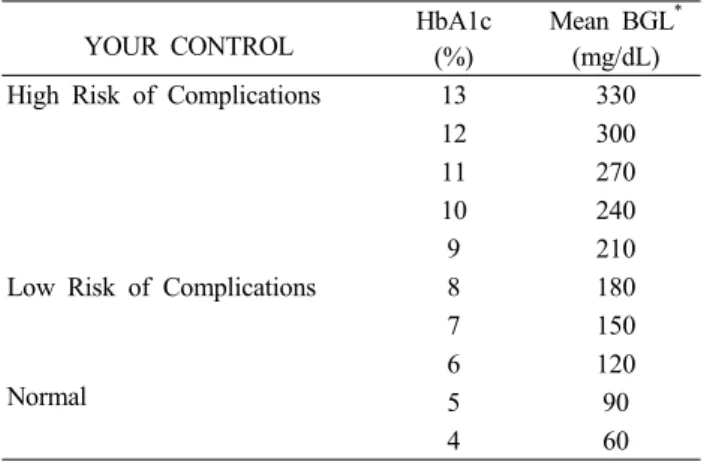
YOUR CONTROL HbA1c
(%)
Mean BGL* (mg/dL) High Risk of Complications 13 330
12 300
11 270
10 240
9 210
Low Risk of Complications 8 180
7 150
Normal
6 120
5 90
4 60
*BGL: blood glucose level
Table 2. Guidelines of "YOUR CONTROL" with HbAlc levels using in the Chosunilbo Health Expo 2010
Korean J. Clin. Lab. Sci. 42(3):125-128, 2010
127
IV. DISCUSSIONS
HbA1c with diabetes is an important long-term control of blood glucose monitoring indicators, and chronic complications of diabetes and development are closely linked, is by far the evaluation of patients with diabetes glucose control for normal range. Therefore, HbA1c control the level of direct impact on the long-term prognosis of patients with diabetes and on check-up standard with pre-and non-diabetes as well as diabetes.
As shown in Table 1 using data from 408 participants they found that HbA1c level% are 161 persons, while over > 6.0% (prediabetic and diabetic stage) are 247 persons. Over 60.5% are pre-and diabetes.
However, we can not conclude that all 157 persons who are shown 6.0~6.9% HbA1c are controlled well.
Among 157 persons, 61 persons are currently taking antidiabetic medicines. This means that this figure is not
"good control" naturally but "good control" by most of antidiabetic medicines. This level also means that they have an enough possibility to develop from prediabetic to diabetic stage. We also guess that 96 persons who are prediabetic stage but not taking antidiabetic medicines can not realize the development of diabetes seriously. From this HbA1c test, about 54.7% (247 out of 408 persons) is shown prediabetic or diabetic stage. This is very serious matter in Korea because few middle-aged subjects and seniors realize the importance of HbA1c test. Most of seniors are taking antidiabetic medicines to control only or lower their blood glucose levels. Additionally and seriously, they do not know nor take this HbA1c test regularly. HbA1c levels of 6.1~6.4% were more likely to have diabetes or prediabetes, while diabetes was highly probable in people with HbA1c 6.5~6.9% (Lu et al., 2010). Thus individuals with HbA1c 6.0~6.9% may
require an OGTT (oral glucose tolerance test) to confirm their current or past two or three month-glycemic status and regular monitoring such HbA1c as for people with pre-diabetes.
For the vast majority of patients with diabetes, HbA1c provides an excellent measure of glycemic control.
However, there are situations and conditions where HbA1c may be unreliable because HbA1c may be increased falsely in certain medical conditions. These conditions include kidney failure, chronic excessive alcohol intake, and hypertriglyceridemia. Medical conditions that may falsely decrease HbA1c include acute or chronic blood loss, sickle cell disease or thalassemia. Factors such as race or age are also reported to influence HbA1c (Little and Sacks, 2009).
However, through this regular HbA1c test for diabetic patients, they can check the progression of blood glucose level to stop serious complications development even though HbA1c may be increased falsely in some cases.
Therefore, regular check-up will be a key cornerstone in the management of type II diabetes and in retardation of serious complications.
Regular exercise and proper nutrition are very important for maintaining of normal glucose level, prevention of diabetes and stop of diabetes complications. To maintain the normal blood sugar levels, it is essential to maintain a healthy and constantly monitored with HbA1c test. When very high levels or not to be maintained normally of blood glucose are present for years, it leads to damage of the small blood vessels. This in turn increases your risk of developing late-stage diabetes complications including retinopathy, nephropathy, neuropathy and cardiovascular diseases.
Let’s not forget this HbA1c test helps determine management plans for diabetics and non-diabetics be it in
Park C, et al. Management of Diabetes from HbA1c Test
128 dieting, medication etc in children or adults. Regular check-up of HbA1c test will do bring how to maintain, what to eat and why we take an exercise regularly (Table 2, The American Diabetic Association, 1998). With this kind of "YOUR CONTROL" guidelines for diabetic control, pre- and diabetic patients should check and confirm to maintain their normal blood glucose level.
Maintaining of normal blood glucose level is very important matter. The overall efficiency of using HbA1c as first line for diabetes screening may facilitate early diagnosis and reduce the health burden associated with diabetes complications. We strongly recommend that prior to use antidiabetic drugs to maintain a normal blood glucose, it is better to find natural ingredients such as banaba (Judy et al., 2003 Benalla et al., 2010), bitter melon (Leung et al., 2009) and cinnamon (Qin et al., 2010). The primary reasons are various side-effects of antidiabetic drugs have been reported for past several years.
REFERENCES
1. Benalla W, Bellahcen S, Bnouham M. Antidiabetic medicinal plants as a source of alpha glucosidase inhibitors. Curr Diabetes Rev 6:247-254, 2010.
2. Bookchin RM, Gallop PM. Structure of hemoglobin AIc: nature of the N-terminal beta chain blocking group. Biochem Biophys Res Commun 32:86–93, 1968.
3. Koenig RJ, Peterson CM, Jones RL, Saudek C, Lehrman M, Cerami A. Correlation of glucose regulation and hemoglobin AIc in diabetes mellitus. N Engl J Med 295:417–420, 1976.
4. Judy WV, Hari SP, Stogsdill WW, Judy JS, Naguib YM, Passwater R. Antidiabetic activity of a standardized extract (Glucosol) from Lagerstroemia speciosa leaves in Type II diabetics. A dose- dependence study. J Ethnopharmacol 87:115-117, 2003.
5. Leung L, Birtwhistle R, Kotecha J, Hannah S, Cuthbertson S. Anti-diabetic and hypoglycaemic effects of Momordica charantia (bitter melon): a mini review. Br J Nutr 102:1703-1708, 2009.
6. Little RR, Sacks DB. HbA1c: how do we measure it and what does it mean? Curr Opin Endocrinol Diabetes Obes 16(2):113-118, 2009.
7. Lu ZX, Walker KZ, O'Dea K, Sikaris KA, Shaw JE.
A1C for screening and diagnosis of type 2 diabetes in routine clinical practice. Diabetes Care 33(4):817-819.
2010.
8. Qin B, Panickar KS, Anderson RA. Cinnamon:
potential role in the prevention of insulin resistance, metabolic syndrome, and type 2 diabetes. J Diabetes Sci Technol 4:685-693, 2010.
9. The American Diabetes Association. Clinical Practice Recommendations 1998: Standards of medical care for patients with diabetes mellitus. Diabetes Care 21:S23-S31, 1998.