Brief Report
Vol. 31, No. 2, 2019 247
Received January 19, 2018, Revised April 6, 2018, Accepted for publication April 9, 2018
Corresponding author: Hyo Hyun Ahn, Department of Dermatology, Korea University College of Medicine, 73 Inchon-ro, Seongbuk-gu, Seoul 02841, Korea. Tel: 82-2-920-5479, Fax: 82-2-928-7540, E-mail: [email protected] ORCID: https://orcid.org/0000-0002-1129-5305
This is an Open Access article distributed under the terms of the Creative Commons Attribution Non-Commercial License (http://creativecommons.
org/licenses/by-nc/4.0) which permits unrestricted non-commercial use, distribution, and reproduction in any medium, provided the original work is properly cited.
Copyright © The Korean Dermatological Association and The Korean Society for Investigative Dermatology
Table 1. Pre- and post-treatment CIELAB values of each facial region
Sites Before treatment After treatment Forehead
L* 72.5 73.4
a* 6.6 6.4
b* 26.8 25.1
Left cheek
L* 67.9 73.3
a* 8.5 8.7
b* 27.9 25.0
Right cheek
L* 68.0 68.7
a* 8.8 7.8
b* 25.0 24.0
Chin
L* 62.6 59.3
a* 9.7 8.4
b* 21.0 21.2
Average
L* 67.8 68.7
a* 8.4 7.8
b* 24.9 23.9
CIELAB: Commission International d’Eclairage L*a*b*.
https://doi.org/10.5021/ad.2019.31.2.247
Lightening Effect of a Light-Emitting Diode Mask on Facial Skin: A Colorimetric Assessment
Ji Hyuck Hong, Dae Yeon Kim, Young Chul Kye, Soo Hong Seo, Dai Hyun Kim
1, Hyo Hyun Ahn
Departments of Dermatology and 1Anatomy, Korea University College of Medicine, Seoul, Korea
Dear Editor:
Low-level light therapy is applied to a diverse range of therapeutic fields, including therapy for pain relief, in- flammation, and skin rejuvenation. Many reports have ex- plained the beneficial effects of light-emitting diode (LED) therapy in skin rejuvenation, wrinkle reduction, and skin tightening1. There are, however, few reports on the skin- lightening effects of LED2. Herein, we present a report on the skin-lightening effects of an LED device, confirmed by colorimetric assessment.
For 3 weeks, a 44-year-old Korean woman was irradiated for 20 minutes, once daily with an LED mask device containing 72 LEDs emitting red and near-infrared light (650∼840 nm).
To objectively compare skin brightness before and after treatment, a mirrorless digital camera (EOM-M; Canon Inc., Tokyo, Japan) with a macro lens (EF-M 28 mm F/3.5 Macro IS STM; Canon Inc.) and built-in light source was used. Three representative parts of the face (forehead, cheek, and chin) were photographed under identical settings in the manual mode. We received the patient’s consent form about publishing all photographic materials. Commission International d’Eclairage L*a*b* (CIELAB) values of each facial region were calculated to quantitatively measure skin brightness.
Regression analysis using a simple linear regression model was performed for calibration3. Image software (ImageJ,
version 1.46r; Softonic International SA, Barcelona, Spain) was used to acquire RGB values.
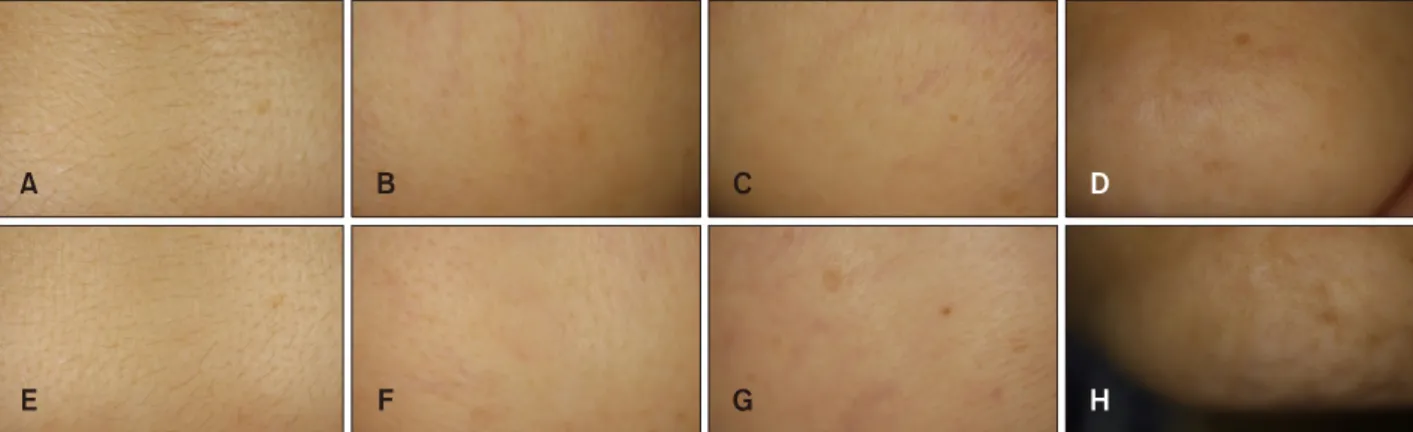
The pre-treatment forehead L* of 72.5 increased to 73.4 after treatment. In the left cheek, the L* value increased considerably, from 67.9 to 73.3. In right cheek, it increased slightly from 68.0 to 68.7. On average, pre-treatment cal- culated L* values increased from 67.8 to 68.7 after LED mask irradiation (Table 1). No remarkable changes in col- or hue were visible after LED mask use (Fig. 1).
Before and after photographs of the facial skin were ana- lyzed using CIELAB coordinates to confirm changes in brightness. CIELAB values have been applied to evaluate skin brightness quantitatively in other studies4. According to the results, LED irradiation improved overall skin bright-
Brief Report
248 Ann Dermatol
Fig. 1. (A∼D) Photographs of skin before light-emitting diode (LED) treatment. (A) Forehead, (B) left cheek, (C) right cheek, (D) chin.
(E∼H) Photographs of skin after LED treatment. (E) Forehead, (F) left cheek, (G) right cheek, (H) chin. Change of color was not identified in any of the facial regions shown above.
ness, indicated by an increased calculated L* value. These results were consistent with some of the findings of Lee and colleagues5, showing skin-lightening effects of LED ir- radiation, and confirming these results by measuring mela- nin levels.
Most of the observed areas, including the forehead, and both cheeks showed improvements in brightness. On the chin, however, the calculated L* value decreased despite having been irradiated with the LED device. This may be due to post-inflammatory hyperpigmentation caused by the improvement of folliculitis on the chin, which was confirmed by the photographs. This could be explained by the calculated a* value decreasing from 9.7 to 8.4.
Regarding methodological aspects, it is important to ob- tain photographs under constant conditions free from the influence of external factors. As such, we used a non- transparent funnel-shaped spacer that provided the same distance from the subject to the camera sensor and dark space inside the spacer. This device can be used for other studies evaluating skin color.
Herein, we quantitatively report the effects of LED irradi- ation on skin brightness in a middle-aged Asian woman.
ACKNOWLEDGMENT
This research was supported by the Basic Science Re- search Program through the National Research Foundation of Korea (NRF), funded by the Ministry of Science, ICT &
Future Planning (NRF-2017R1A2B4011001).
CONFLICTS OF INTEREST
The authors have nothing to disclose.
ORCID
Ji Hyuck Hong, https://orcid.org/0000-0003-1301-6995 Dae Yeon Kim, https://orcid.org/0000-0002-2264-7337 Young Chul Kye, https://orcid.org/0000-0002-5695-6154 Soo Hong Seo, https://orcid.org/0000-0002-3836-0445 Dai Hyun Kim, https://orcid.org/0000-0002-3546-2366 Hyo Hyun Ahn, https://orcid.org/0000-0002-1129-5305
REFERENCES
1. Avci P, Gupta A, Sadasivam M, Vecchio D, Pam Z, Pam N, et al. Low-level laser (light) therapy (LLLT) in skin: stimu- lating, healing, restoring. Semin Cutan Med Surg 2013;32:
41-52.
2. Greaves AJ. The effects of narrowbands of visible light upon some skin disorders: a review. Int J Cosmet Sci 2016;38:
325-345.
3. Kim JW, Seo SH, Kye YC, Ahn HH. Colorimetric meas- urements of iris colour and their significance in East Asian patients with skin cancer. Clin Exp Dermatol 2010;35:711- 716.
4. Kye H, Choi JE, Seo SH, Kye YC, Ahn HH. Application of analytic technique using green light parallel-polarized light images in various skin diseases. Ann Dermatol 2016;28:
242-245.
5. Lee SY, You CE, Park MY. Blue and red light combination LED phototherapy for acne vulgaris in patients with skin phototype IV. Lasers Surg Med 2007;39:180-188.