Agric. Chem. Biotechnol.49(3), 110-113 (2006) Note
Prolyl Endopeptidase Inhibitory Activity of 6- O -Palmitoyl L-Ascorbic Acid
Yoon-Seok Park and Young-Sook Paik*
College of Environment and Applied Chemistry and Plant Metabolism Research Center, Kyung Hee University, Yongin 446-701, Korea
Received August 11, 2006; Accepted September 19, 2006
Prolyl endopeptidase (PEP, EC 3.4.21.26, also referred to as prolyl oligopeptidase) degrades proline- containing, biologically active neuropeptides such as vasopressin, substance P and thyrotropin-releasing hormone by cleaving peptide bonds on carboxyl side of prolyl residue within neuropeptides of less than 30 amino acids. Evaluation of PEP levels in postmortem brains of Alzheimer’s disease patients revealed significant increases in PEP activity. Therefore, a specific PEP inhibitor can be a good candidate of drug against memory loss. Upon our examination for PEP inhibitory activity from micronutrients, ascorbic acid (vitamin C) showed small but significant PEP inhibition (13% PEP inhibition at 8µg · ml−1).
Palmitic acid showed almost no PEP inhibition. However, 6-O-palmitoyl ascorbic acid (1) showed 70%
PEP inhibition at 8µg · ml−1 indicating that hydrophobic portion of the compound 1 may facilitate the inhibitory effect. IC50 value of compound 1 was 12.6 ± 0.2µM. The primary and secondary Lineweaver- Burk and Dixon plots for compound 1 indicated that it is a non-competitive inhibitor with inhibition constant (Ki) value of 23.7µM.
Key worlds: prolyl endopeptidase inhibitor, memory loss, 6-O-palmitoyl L-ascorbic acid, ascorbic acid, palmitic acid
Prolyl endopeptidase (PEP, EC 3.4.21.26) widely distributed in various organs, particularly in the human brain, cleaves peptide bond on the carboxylic side of prolyl residue within polypeptides of less than 30 amino acids and, therefore, is also referred to as prolyl oligopeptidase.1-4) PEP has been suggested to participate in learning and memory processes.1) Evaluation of the PEP levels in postmortem brains obtained from Alzheimer’s disease patients revealed significant increases in the enzyme activity, suggesting that PEP plays a functional role in the brain.5) Thus, a specific PEP inhibitor can be a good candidate for anti-amnestic drugs for curing memory loss and neuropathological disorders by blocking the catabolism of endogenous neuropeptides.
At present, drug treatments for Alzheimer’s disease are primarily focused on treating the symptoms rather than preventing mental deterioration. Mental illness in elderly people has been found to be associated with poor diet. In particular, deficiency of micronutrients is associated with cognitive impairment. Studies showed that a diet rich in antioxidants, such as vitamins C (ascorbic acid) and E (tocopherol) and polyphenols, can help reduce the risk of dementia by eliminating harmful free radicals and decreasing the level of oxidative stress.6,7) Vitamin C, as an antioxidant, plays an important role in protecting against the heart disease, high cholesterol, high blood pressure, common cold, cancer,
Alzheimer’s disease and other types of dementia.8-13) Human body does not produce vitamin C on its own, nor does it store it. Eating adequate amounts of vitamin C in the daily diet may help reduce the risk of developing some of these conditions.
The objective of our work was to search vitamin C for the potential health benefits associated with age-related memory loss in terms of PEP inhibition.
Materials and Methods
Materials. PEP (from Flavobacterium meningosepticum) and benzyloxycarbonyl-glycyl-L-prolyl-p-nitroanilide (Z- Gly-Pro-pNA) were purchased from Seikagaku Co. (Tokyo, Japan). Benzyloxycarbonyl-L-prolyl-prolinal (Z-Pro-prolinal) as a positive control was purchased from Biomol Research Laboratories Inc. (Philadelphia, PA, USA). All chemicals including vitamins C and E, 6-O-palmitoyl L-ascorbic acid, palmitic acid, and solvents, either reagent or HPLC grade, were obtained from Sigma-Aldrich Co. (St. Louis, MO, USA)
PEP inhibition assay. UV-VIS spectra were recorded on Varian Cary 300 and Jasco V-530 spectrophotometers. PEP activity was assayed using the method of Yoshimoto et al. with minor modifications.14,15) A mixture of 800µL of 0.1 M phosphate buffer (pH 7.0), 80µL of 2 mM Z-Gly-Pro-pNA in 40% 1,4-dioxane, and 40µL sample solution (1 mg · ml−1 MeOH stock solution diluted with 0.1 M phosphate buffer, pH 7.0) was preincubated at 37oC for 10 min. The reaction was started by adding 80µL of 0.1 unit · ml−1 PEP in 0.1 M phosphate buffer (pH 7.0) at 37oC. After incubation for 30 min, the amount of released p-nitroaniline of the solution (A)
*Corresponding author
Phone: 82-31-201-2422; Fax: 82-31-202-7337 E-mail: [email protected]
Abbreviations: PEP, prolyl endopeptidase
6-O-Palmitoyl L-ascorbic Acid as PEP Inhibitor 111
was determined colorimetrically based on the absorbance at 380 nm. The A380 value of the mixture containing 960µL of 0.1 M phosphate buffer (pH 7.0) and 40µL sample solution was separately measured as mentioned above (B). A control was made by adding 40µL of 0.1 M phosphate buffer instead of 40µL of the sample solution used in A. The percentage of inhibition was calculated using the following equation:
percentage of inhibition = [{A380 of control−(A−B)}/ A380 of control] × 100. Triplicate samples were analyzed, and IC50
value was determined graphically based on the curves of the enzyme activity versus inhibitor concentrations.
Statistics. Intergroup comparisons of data were made using Enzyme Kinetics Module (Add-on software for SigmaPlot 2000) from SPSS Science (San Francisco, CA, USA).
Results and Discussion
The role of micronutrients in age-related cognitive decline is of great interest. For example, a diet rich in antioxidants such as vitamins C and E can help reduce the risk of elderly cognitive impairment by eliminating harmful free radicals and
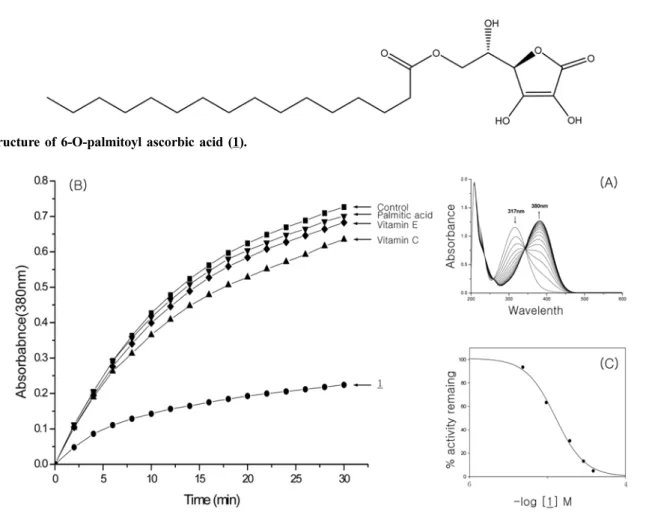
decreasing the level of oxidative stress.6,7) Age-related cognitive decline (ARCD) refers to mild deterioration in memory performance, executive functions, and speed of cognitive processing.16) Avoidance of cardiovascular and other chronic diseases, a flexible personality during middle age, and maintenance of vision and hearing have been identified as protective factors to the progressive cognitive decline.16) Eating adequate amounts of vitamin C in the daily diet may help reduce the risk of developing some of these conditions since studies showed that vitamin C can play a role in protecting against the heart disease, high cholesterol, high blood pressure, osteoarthritis, cataracts, diabetes, common cold, cancer, Alzheimer’s disease and other types of dementia.8-13) Vitamins C and E, 6-O-palmitoyl L-ascorbic acid (1; Fig.
1), and palmitic acid were chosen to examine the relationship between these compounds and the inhibitory activity of PEP, which has been suggested to participate in the learning and memory processes. PEP inhibitory activity was measured using Z-Gly-Pro-pNA as a substrate. Fig. 2A shows the UV- vis spectra for the production of p-nitroaniline by the enzymatic reaction of PEP on Z-Gly-Pro-pNA at 10-min Fig. 1. Structure of 6-O-palmitoyl ascorbic acid (1).
Fig. 2. (A) UV-vis spectra for the production of p-nitroaniline. p-Nitroaniline was produced by reacting Z-Gly-Pro-pNA with PEP in 0.1 M phosphate buffer (pH 7.0; 37; scanning interval, 10 min). (B) Typical inhibition pattern of p-nitroaniline pro- duced from the reaction of Z-Gly-Pro-pNA with PEP in 0.1 M phosphate buffer (pH 7.0, 37oC, 2-min scanning interval) at 380 nm in the absence and presence of vitamins C and E, palmitic acid, and 6-O-palmitoyl ascorbic acid (8µg · ml−1). (C) Plots of % activity remaining from the reaction of Z-Gly-Pro-pNA with PEP versus -log [6-O-palmitoyl ascorbic acid]. Each data point represents the average of triplicate measurements.
112 Yoon-Seok Park and Young-Sook Paik
scanning intervals. The λmax of Z-Gly-Pro-pNA at 317 nm decreased, whereas that of p-nitroaniline at 380 nm increased.
Z-Pro-prolinal (IC50= 2.19 nM), a synthetic PEP inhibitor, was used as a reference compound of the positive control.17)
Upon preliminary examination of vitamins C and E, 6-O- palmitoyl L-ascorbic acid (1), and palmitic acid at 8µg · ml−1
for the inhibition of PEP, vitamin C showed small but
significant inhibitory activity with the value of 13% PEP inhibition, whereas vitamin E and palmitic acid showed almost no inhibitory activity (Fig. 2B). However, 6-O- palmitoyl L-ascorbic acid (1) showed 70% inhibition of PEP activity at 8µg · ml−1 (Fig. 2B), indicating that hydrophobic portion of compound 1 may facilitate the inhibitory effect.
Compound 1 was further investigated at various concentrations Fig. 3. Kinetic analysis of PEP inhibition. (A) Lineweaver-Burk plots of PEP inhibition by 6-O-palmitoyl ascorbic acid (1) in the absence (●) and presence of 4.82 (○), 9.65 (▼), and 19.30 (▽) µM 6-O-palmitoyl ascorbic acid. (B) Secondary plot of intercepts (i) taken from Lineweaver-Burk plots versus 6-O-palmitoyl ascorbic acid concentration. (C) Secondary plot of slopes (s) taken from Lineweaver-Burk plots versus 6-O-palmitoyl ascorbic acid concentration. (D) Dixon plots of PEP inhibition by 6-O-palmitoyl ascorbic acid. [S] = 0.1 mM (●), 0.12 mM (○), 0.14 mM (▼), 0.16 mM (∇). (E) Secondary plot of intercepts (i) taken from Dixon plots versus reciprocal of the Z-Gly-Pro-pNA concentration. (F) Secondary plots of slopes (s) taken from Dixon plots versus reciprocal of the Z-Gly-Pro-pNA concentration.
6-O-Palmitoyl L-ascorbic Acid as PEP Inhibitor 113 to evaluate IC50 value and showed a dose-dependent PEP
inhibitory effect with IC50 value of 12.6 ± 0.2µM (Fig. 2C).
Lineweaver-Burk plots of the PEP inhibition by compound
1 indicate that it is a noncompetitive inhibitor (Fig. 3A). The secondary Lineweaver-Burk plots show linear relationship for both intercepts (i) versus compound 1 concentration (Fig. 3B) and slope (s) versus compound 1 concentration (Fig. 3C).
Dixon plots of the PEP inhibition by compound 1 also indicate that it is a noncompetitive inhibitor with an inhibition constant (Ki) value of 23.7µM (Fig. 3D). The secondary Dixon plots show linear relationships between intercepts (i) versus reciprocal of the Z-Gly-Pro-pNA concentration, and slope (s) versus reciprocal of the Z-Gly-Pro-pNA concentration as shown in Figs. 3E and 3F, respectively.
Although IC50 value of compound 1, 12.6µM, was higher than those reported for strong natural inhibitors, such as ginkgolic acid (IC50, 0.62µM),17) staurosporine (IC50, 0.77
µM),18) and kynapsin 24 (IC50, 1.14µM),19) compound 1 was similar or more effective PEP inhibitor than triterpenic acids possessing a variety of physiological effects, such as ursolic and oleanolic acids (IC50, 17.2 and 22.5µM, respectively).20) Compound 1 was also more effective PEP inhibitor than unsaturated fatty acids such as oleic and linoleic acids, DHA, arachidonic acid, and EPA (IC50, 23.6, 43.8, 46.2, 53.4, 99.4
µM, respectively),15) whose deficiency is associated with retarded visual acuity, cognitive impairment, cerebellar dysfunction, and various other neurological disorders.21)
In summary, 6-O-palmitoyl L-ascorbic acid (1) inhibited PEP activity and its IC50 was 12.6 ± 0.2µM and Ki was 23.7
µM, while ascorbic and palmitic acids showed small or little PEP inhibition. Therefore, both components, ascorbyl and palmitoyl group, may function synergically on the PEP inhibition. These results suggest compound 1 has potential use in the prevention of memory loss and could be used as memory-enhancing principles.
Acknowledgments
This research was supported by the Kyung Hee University Research Fund in 2006.
References
1. Cunningham, D. F. and O’Connor, B. (1997) Proline spe- cific peptidase. Biochem. Biophys. Acta1343, 160-186.
2. Walter, R., Shlank, H., Glass, J. D., Schwartz, I. L. and Kerenyi, T. D. (1971), Leucylglycinamide released from oxytocin by human uterine enzyme. Science173, 827-829.
3. Kalwant, S. and Porter, A. G.. (1991) Purification and char- acterization of human brain prolyl endopeptidase. Biochem.
J. 276, 237-244.
4. Odaka, C., Mizuochi, T., Shirasawa, T., Morain, P. and Che- cler, F. (2002) Murine T cells expressing high activity of prolyl endopeptidase are susceptible to activation-induced cell death. FEBS Lett.512, 163-167.
5. Aoyagi, T., Wada, T., Nagai, M., Kojima, F., Harada, S., Takeuchi, T., Takahashi, H., Hirokawa, K. and Tsumita, T.
(1990) Deficiency of kallikrein-like enzyme activities in cerebral tissue of patients with Alzheimer’s disease. Experi- entia46, 94-97.
6. Engelhart, M. J., Geerlings, M. I., Ruitenberg, A., van Swi- eten J. C., Hofman, A., Witteman, J. C. and Breteler, M.
M. (2002) Dietary intake of antioxidants and risk of Alzhe- imer disease. J. Amer. Med. Assoc.287, 3223-3229.
7. Markesbery, W. R. (1997) Oxidative stress hypothesis in Alzheimer’s disease. Free Radical Bio. Med. 23, 134-147.
8. Parle, M. and Dhingra, D. (2003) Ascorbic acid: a promis- ing memory-enhancer in mice. J. Pharmacol. 93, 129-135.
9. Frank, B. and Gupta, S. (2005) A review of antioxidants and Alzheimer’s disease. Ann Clin. Psychiatr.17, 269-286.
10. Morris, M. C., Beckett, L. A. and Scherr, P. A. (1998) Vita- min E and vitamin C supplement use and risk of incident Alzheimer disease. Alz. Dis. Assoc. Disord. 12, 121-126.
11. Masaki, K. H., Losonczy, K. G., Izmirlian, G., Foley, D. J., Ross, G. W., Petrovitch, H., Havlik, R. and White, L. R.
(2000) Association of vitamin E and C supplement use with cognitive function and dementia in elderly men. Neurology
54, 1265-1272.
12. Duffy, S. J., Gokce, N., Holbrook, M., Huang, A., Frei, B., Keaney Jr, J. F. and Vita, J. A. (1999) Treatment of hyper- tension with ascorbic acid. The Lancet354, 2048-2049.
13. Padayatty, S. J. and Levine, M. (2000) Reevaluation of ascorbate in cancer treatment: emerging evidence, open minds and serendipity. J. Am. Coll. Nutr. 19, 423-425.
14. Yoshimoto, T., Walter, R. and Tsuru, D. (1980) Proline-spe- cific endopeptidase from Flavobacterium. Purification and properties. J. Biol. Chem. 255, 4786-4792.
15. Park, Y.-S., Jang, H.-J., Lee, K.-H., Hahn, T.-R. and Paik, Y.-S. (2006) Prolyl endopeptidase inhibitory activity of unsaturated fatty acids. J. Agric. Food Chem. 54, 1238- 1242.
16. Solfrizzi, V., Panza, F., Torres, F., Mastroianni, F., Del Parigi, A., Venezia, A. and Capurso, A. (1999) High monounsaturated fatty acids intake protects against age- related cognitive decline. Neurology 52, 1563-1569.
17. Lee, J.-H., Lee, S.-Y., Lee, K.-S., Jang, H.-J., Lee, K.-H., Hahn, T.-R. and Paik, Y.-S. (2004) Prolyl endopeptidase inhibitors from the leaves of Ginkgo biloba. Planta Med.
70, 1228-1230.
18. Kimura, K., Kawaguchi, N., Yoshihama, M. and Kawan- ishi, G.. (1990) Staurosporine, a prolyl endopeptidse inhibi- tor. Agric. Biol. Chem.54, 3021-3022.
19. Song, K.-S. and Raskin, I. (2002) A prolyl endopeptidase- inhibiting benzofuran dimer from Polyozellus multiflex. J.
Nat. Prod. 65, 76-78.
20. Park, Y.-S., Jang, H.-J. and Paik, Y.-S. (2005) Prolyl endopeptidase inhibitory activity of ursolic and oleanolic acids from corni fructus. Agric. Chem. Biotechnol. 48, 207- 21. Haag, M. (2003) Essential fatty acids and the brain. 212. Can. J.
Psychiatr.48, 195-203.