서 론
파킨슨병(Parkinson's Disease, PD)은 도파민을 생
성하는 중뇌 흑질의 신경세포가 변성, 탈락되어 생기 는 신경퇴행성 질환으로 점진적 퇴행을 초래하는 유 전적 요인과 환경적 요인 사이의 상호 작용으로 발
한방병원에 내원한 파킨슨병 환자의 통증의 임상적 특성에 관한 후향적 의무기록 분석 연구
정혜선1,2, 김하리2, 김서영2, 임태빈2, 진철2, 권승원2,3, 조승연1,2,3, 정우상2,3, 문상관2,3, 박정미1,2,3 고창남1,2,3, 박성욱1,2,3*
1강동경희대학교한방병원 뇌신경센터 한방내과, 2경희대학교 대학원 한방순환신경내과학교실
3경희대학교 한의과대학 순환·신경내과
Original Article
⋅Received:7 April 2020 ⋅Revised:19 May 2020 ⋅Accepted:21 May 2020
⋅Correspondence to:박성욱
서울시 강동구 동남로 892 강동경희대학교병원 뇌신경센터 한방내과
Tel:+82-2-440-6217, Fax:+8—-440-7171, E-mail:[email protected]
Clinical Characteristics of Pain in Patients with Parkinson’s Disease Who Have Visited a Korean Medical Hospital : A Retrospective Chart Review
Hye-Seon Jeong1,2, Ha-Ri Kim2, Seo-Young Kim2, Tae-Bin Yim2, Chul Jin2, Seung-Won Kwon2,3, Seung-Yeon Cho1,2,3, Woo-Sang Jung2,3, Sang-Kwan Moon2,3, Jung-Mi Park1,2,3, Chang-Nam Ko1,2,3, Seong-Uk Park1,2,3*
1Stroke and Neurological Disorders Center, Kyung Hee University Korean Medicine Hospital at Gangdong, Seoul, Korea
2Department of Cardiology and Neurology of Clinical Korean Medicine, Graduate School, Kyung Hee University, Seoul, Korea,
3Department of Cardiology and Neurology of College of Korean Medicine, Kyung Hee University, Seoul, Korea Objectives: To investigate the prevalence of pain, clinical characteristics of pain, association between clinical features and pain of patients with Parkinson’s Disease(PD).
Methods: We undertook a retrospective review of the medical records of patients diagnosed with PD between 2012 and 2019 at Kyung Hee University Korean Medicine Hospital at Gangdong in South Korea.
Results: A total of 172 PD patients met entry criteria and 147 out of 172 patients(85.5%) reported pain. In comparison with general population, PD patients has high prevalence of pain. Female PD patients more frequently reported pain than male (P=0.03). 102 out of 147patients(69.3) complained of musculoskeletal pain, and musculoskeletal pain show significant difference depending on the PD motor subtypes (P=0.039). Pain was mainly locatedin the leg (57.8%) in all PD motor subtypes. Tremor-dominant PD more frequently felt pain in upper limb than postural instability-gait difficulty dominant(PIGD) PD, but it was not statistically significant.
Conclusions: These findings showed high prevalence of pain in PD patients, the correlation between female and pain, and the relationship between PD motor subtype and pain type. Our study can contribute to the clinical approach based on a more in-depth understanding of PD patients with pain.
Key Words : Pain, Parkinson's disease, Pain prevalence, Pain characteristics
생한다
1). 파킨슨병의 증상은 서동증, 자세 불안정, 안정 시 진전 및 경직 등의 운동 증상과 통증, 변비, 수면장애, 소변장애, 발한장애, 피로, 우울, 불안 등의 비운동 증상이 있다
2).
통증은 파킨슨병 환자들이 호소하는 주요 비운동 증상으로, 적절히 조절되지 않는 통증은 삶의 질 저 하 및 우울증과 밀접한 상관관계를 가진다
3). Broen 등
4)은 체계적 문헌고찰 연구에서 파킨슨 환자의 통 증 유병율을 40%~85%, 평균 67%으로 보고하였다.
파킨슨병 환자의 통증 양상은 근골격계 통증, 신경병 증성 통증, 근긴장이상증으로 인한 통증, 중추성 통 증 등으로 분류되며 발생부위 허리, 다리, 턱 등 다 양한 편이다
3,4). 최근 파킨슨병 환자의 통증과 유전적 요인 사이의 연관성에 관한 연구들이 보고되고 있으 며, 당뇨병, 골다공증, 류마티스 질환과 같은 전신 질 환은 파킨슨병 환자의 높은 통증 유병률과 밀접한 연관이 있다
5,6).
현재까지 알려진 파킨슨병 환자의 통증 치료법은 적절한 도파민요법이 우선적으로 고려된다
7). 그러나 레보도파를 장기간 투여할 경우 이상운동증, wearing off, delay on과 같은 부작용이 발생할 수 있고, 통증 조절에 효과적으로 알려진 아편유사진통제(opiate agonist)는 인체 내 의존적인 반응을 야기할 수 있다
8).
또한 통증 자체가 매우 주관적인 증상이며, 보행장 애와 떨림 같은 운동 증상에 초점을 맞추어 치료방 향을 설계하는 경우가 대부분이기에 통증은 파킨슨 병의 치료에서 간과되기 쉽다. 예로 Buhmann 등
3)의 연구에서 통증을 호소하는 파킨슨병 환자의 오직 절 반 정도가 병원에서 진통제를 처방받은 것으로 나타 났다.
이에 파킨슨병 환자의 통증을 심도있게 고찰하고, 한의학적 통증 관리 가능성을 모색할 수 있는 기초 연구가 필요하다고 사료되었다. 본 연구에서는 단일 한방병원에서 후향적으로 파킨슨병 환자의 통증 양 상, 임상적 특성과 통증의 상관관계에 대한 분석을 시행하여 통증을 호소하는 파킨슨병 환자에 대하여
종합적으로 고찰해보고, 통증치료에서 한의치료를 고 려해볼 수 있는 기초 자료를 마련하고자 본 연구를 수행하였다.
방 법
1.
연구 대상연구대상자의 선정, 제외기준은 다음과 같다.
1) 선정 기준
(1) 2012년 01월 01일부터 2019년 09월 30일까지 강동경희대학교병원 뇌신경센터 한방내과 외 래를 방문한 환자 중에서 영국 파킨슨병학회 뇌은행 진단기준(United Kingdom Parkinson’s Disease Society Brain Bank Criteria)의 특발 성 파킨슨병 진단기준을 만족시키는 자 (2) 파킨슨병 임상척도(Unified Parkinson's Disease
Rating Scale; UPDRS) 점수가 존재하는 자 (3) 진료시 받은 진단이 국제질병분류 10차 개정
판개정판(International Classification of Diseases 10th edition; ICD-10) G20, G20.002, G20.003, G20.005를 포함하는 자
2) 제외 기준
(1) 비전형적 파킨슨증후군이 의심되는 환자 (2) 속발성 혹은 증후성 파킨슨증(Parkinsonism)으
로 진단받은 자
(3) 기타 연구자가 부적합하다고 판단되는 자
2.
연구 방법연구 선정/제외 기준을 만족하는 대상자의 전자의 무기록(Electronic Medical Record; EMR)을 조회하 여 대상자의 하기 항목에 대한 데이터를 수집하여 후향적 분석을 실시하였다.
본 연구는 강동경희대학교한방병원 기관생명윤리
위원회(IRB, Institutional Review Board)의 승인을
받아 시행되었다. (KHNMC-OH-IRB-2019-09-006).
1) 관찰 항목
통증의 유무, 통증 양상, 통증 부위, 연령, 성별, 파 킨슨병 진단 유무, 발병 시기, 진단 시기, 유병기간, UPDRS 점수, 혼-야 지수(Hoen and Yahr stage;
HY stage)
2) 평가 방법 (1) 통증 양상 분류
Valkovic등
9)의 Ford의 통증 분류법을 사용하여 근 골격계 통증, 신경병증성 통증, 근긴장이상으로 인한 통증, 중추성 통증, 4개의 통증 유형에 해당되지 않 는 기타 통증으로 분류하여 총 5가지 양상으로 분석 하였다(Appendix 1). 해당 양상의 통증은 유/무로만 평가하였고, 각각의 통증양상은 독립된 변수로 고려 하며 중복을 허용하였다.
(2) 통증 부위 분석
통증을 호소하는 부위는 머리(Head), 턱(Jaw), 목 (Neck), 가슴(Chest), 배(Abdomen), 어깨(Shoulder), 상지(Arm), 손(Hand), 허리(Back), 둔부(Hip), 하지 (Leg), 발(Foot)로 항목화하여 분석하였다. 통증을 호 소하는 부위는 각각 독립된 변수로 고려하였으며, 중 복을 허용하였다. 해당 부위의 통증은 유/무로만 판 단되었다.
(3) 파킨슨 환자의 임상적 특성
환자의 임상적 특성을 분석하고, 이를 바탕으로 증 상 발병부터 진단까지 걸린 기간을 구하였다. 기간은
‘년(year)’을 기준으로 하였으며, 년 단위 미만의 기 간은 절사하였다. UPDRS와 HY stage는 환자가 처 음 내원시 평가된 것을 기준으로 하였으며, UPDRS 를 구성하는 4개의 Part 중 일상생활 수행능력을 평 가하는 Part2와 운동능력을 평가하는 Part3을 분석하 였다.
(4) 파킨슨병 아형(PD motor subtype) 분류 초진시 작성된 UPDRS 점수를 이용하여 Jankovic 등
10)의 파킨슨병 아형분류에 따라 환자들을 떨림 (Tremor) 우세형 파킨슨병, 보행장애-자세불안(postural instability and gait disturbance; PIGD) 우세형 파킨 슨병, 혼합된 파킨슨병(Indeterminate; ID)으로 구분 하였다. 떨림과 연관된 UPDRS 문항 2.16, 3.20, 3.21 문항을 합산하여 평균 떨림 점수를, 보행장애 및 자세불안과 관련된 항목인 2.13 2.14 2.15 3.29 3.30문항을 합산하여 평균 보행장애-자세불안 점수 를 계산하였다. 이를 통하여 평균 떨림 점수/평균 보 행장애-자세불안 점수가 1.5 이상인 경우를 떨림 우 세형 파킨슨병, 1.0 이하인 경우를 보행장애-자세불 안 우세형 파킨슨병, 점수가 1.0초과 1.5미만의 경우 혼합형 파킨슨병으로 판단하였다.
3) 통계 분석
수집된 자료는 SPSS 18.0 (Chicago, IL, USA)을 이용하여 분석하였다. 대상자의 일반적 특성, 파킨슨 아형별 통증 양상은 기술통계, 빈도분석을 사용하였 다. 성별과 통증의 유무, 통증양상과 파킨슨 아형간 의 상관관계 분석은 chi-square test를, 기대값이 5 이하일 경우에는 fisher's exact-test를 진행하였다. 발 병시기, 유병기간과 통증 유무의 상관관계, 파킨슨 아형에 따른 발병시기와 증상 발현부터 진단까지 걸 린 시간은 정규성을 만족할 경우 Independent t-test, 만족하지 않을 경우 Mann-Whitney Test로 분석하였 다 P-value 0.05 미만을 통계적 유의성이 있다고 판 정하였다.
결 과
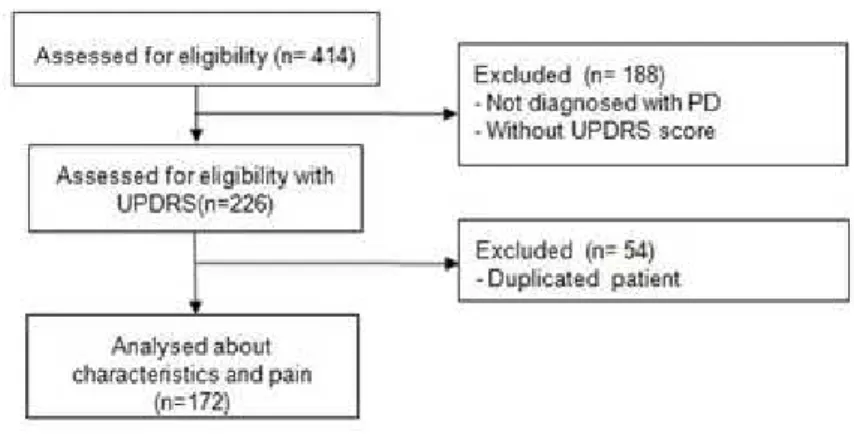
2012년 01월 01일부터 2019년 9월 30일까지 강동
경희대병원 뇌신경센터 한방내과 외래에서 파킨슨병
으로 1회 이상 치료를 받은 자는 총 414명이었다. 이
중 선정/제외기준에 부합하는 172명을 대상으로 후
향적 분석을 진행하였다(Figure 1).
1.
인구학적 및 임상적 특성172명의 환자를 대상으로 분석한 결과, 남성의 비 율이 55.2%(95명), 파킨슨병 임상아형은 자세불안- 보행장애(PIGD) 우세형 98명(56.9%), 떨림(Tremor) 우세형 67명(39.0%), 혼합형(ID) 7명(4.1%) 순이었다.
평균 발병시기는 60.9±10.4세, 평균 유병기간은 6.3±3.8년, 증상 발현으로부터 진단까지 걸린 평균 기간은 0.5±1.1년 이었다(Table 2). 아형별 발병시기 는 떨림 우세형이 자세불안-보행장애 우세형에 비하 여 발병시기가 유의하게 이른 것으로 나타났다 (P=0.048). 증상발현으로부터 진단까지 걸린 시간 또 한 두 파킨슨 아형간에 유의한 차이가 존재하였다 (P=0.002)(Table 2).
2.
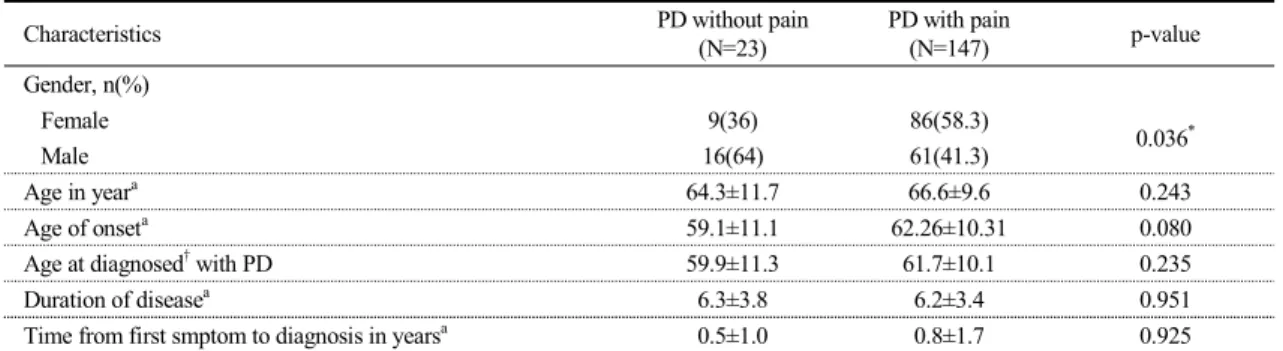
통증 관련 특성통증을 호소한 환자는 총 147명으로, 통증 유병율 은 85.5%였다(Table 1). 여성이 남성보다 통증을 호 소하는 비율이 유의하게 높았다(P=0.036). 그 외 항 목은 통증의 유무와 유의한 상관관계를 보이지 않았 다(Table 3).
통증을 호소하는 환자들을 파킨슨병 아형별로 분 류하였을 때 각 군간 유의한 차이는 보이지 않았다
Table 1. General and Clinical Characteristics of PatientsCharacteristics Total
Number 172
Gender, n(%) 77(44.8)
Male 95(55.2)
Female 77(44.8)
PD subtype†, n(%)
PIGD type 98(56.9)
TD type 67(39.0)
ID type 7(4.1)
Hoehn and Yahr stage, n(%)
HY stage 1 89(51.7)
HY stage 2 46(26.7)
HY stage 3 26(15.1)
HY stage 4 8(4.7)
HY stage 5 3(1.7)
Median Hoehn and Yahr stagea 1.8±1.0
UPDRSa 9.3±6.6
Part 2 9.3±6.6
Part 3 14.3±10.6
Pain prevalence, n(%) 147(85.3)
Independent t-test was used to compare age of onset between PD subtypes. Mann–Whitney U test was used to compare time from first symptom to diagnosis in years between PD subtypes.
P*<0.05wasconsideredtobesignificant.
*Shown as mean±SD, †PD motor subtype.
PD : Parkinson's Disease; HY : Hoehn and Yahr; UPDRS : The unified Parkinson's disease rating scale; PIGD = Postural instability-gait difficulty dorminan;, TD = Tremor dorminant
Fig. 1. A Flow Chart of our study
PD : Parkinson's Disease, HY : Hoehn and Yahr, UPDRS : The unified Parkinson's disease rating scale
(P=0.253)(Table 4). Ford 분류법에 근거하여 환자들 의 통증 양상을 분석한 결과 근골격계 통증 102명 (69.3%), 방사통/신경병증성 통증 58명(39.4%), 근긴 장이상으로 인한 통증 47명(32.0%), 기타 통증 45명 (30.6%), 중추성 통증 41명(27.9%) 순이었으며, 근 골격계 통증에서만 파킨슨병 아형별로 유의한 차이 가 존재했다(P=0.039) (Table 4). 통증 부위 분석 결 과 하지(84명)에서 가장 많은 통증을 호소하였고, 허 리(51명), 발(40명), 어깨(36명), 둔부(30명), 상지(22 명), 머리(22명), 목(18명), 가슴(14명), 손(13명), 턱 (6명) 순이었다(Table 4). 떨림 우세형이 자세불안-보 행장에 우세형에 비하여 어깨, 상지의 통증을 호소하
는 비율이 높은 경향성을 보였으나, 통계적으로 유의 한 상관관계를 보이지는 않았다(Table 4).
복수의 통증을 호소하는 양상을 조사하였을 때 147명의 환자들 중 2가지 양상의 통증을 호소한 자 가 가장 많았다(Figure 2).
고 찰
파킨슨병 환자에서 나타나는 비운동 증상은 운동 증상에 비해 진단에 끼치는 영향력은 적으나, 대개 운동 증상 발병 이전부터 흔하게 나타나는 증상이 다.
11)통증은 높은 유병율을 가진 비운동 증상이며,
Table 2. Correlation between Parkinson’s Disease Subtype and Age
Characteristics Total P-value
Agea ― yr
Age in years 66.3±9.9
Age of onset 60.9±10.4
PIGD type 62.0±11.0
0.048*
TD type 58.7±9.1
Age at diagnosed with PD 61.5±10.3
Duration of diseasea 6.3±3.8
Time from first symptom to diagnosis in yearsa 0.5±1.1
PIGD type 1.1±1.5
0.002*
TD type 0.6±1.2
Independent t-test was used to compare age of onset between PD subtypes. Mann–Whitney U test was used to compare time from first symptom to diagnosis between PD subtypes. P*<0.05was considered to be significant. †Shown as mean±SD
PD : Parkinson's Disease; HY : Hoehn and Yahr; PIGD = Postural instability-gait difficulty dorminant; TD = Tremor dorminant
Table 3. Correlation between Pain and General Characteristics in Parkinson’s Disease
Characteristics PD without pain
(N=23)
PD with pain
(N=147) p-value
Gender, n(%)
Female 9(36) 86(58.3)
0.036*
Male 16(64) 61(41.3)
Age in yeara 64.3±11.7 66.6±9.6 0.243
Age of onseta 59.1±11.1 62.26±10.31 0.080
Age at diagnosed† with PD 59.9±11.3 61.7±10.1 0.235
Duration of diseasea 6.3±3.8 6.2±3.4 0.951
Time from first smptom to diagnosis in yearsa 0.5±1.0 0.8±1.7 0.925
Data analysed by descriptive statistics. Correlation between data analysed by chi square test. PD = Parkinson's disease, P*<0.05was considered to be significant. †Shown as mean±SD ‡Time when the patient diagnosed at the time of initial stage
장기간 관리하지 않고 방치할 경우 삶의 질 저하, 우 울, 피로 등과 연관되기 쉬우므로
12)반드시 적절한 관리가 필요하다. 그럼에도 불구하고 파킨슨병 운동
증상에 비해 적극적으로 통증을 관리하려는 시도는 부족한 실정으로, 이는 파킨슨병 환자의 치료가 운동 증상의 조절에 집중되어 있는 의료적 현실과, 환자의 통증치료 중요성에 대한 낮은 인식에서 비롯된 것으 로 판단된다. 국내에서 이뤄진 파킨슨병 환자의 통증 에 관한 연구도 매우 제한적이다. 따라서 파킨슨병 환자의 통증의 특성 및 치료에 관한 연구가 더욱 활 발히 진행될 필요가 있다. 이에 본 연구에서는 후향 적 의무기록 연구를 통해 한방병원에 내원한 파킨슨 병 환자의 통증의 임상적 특성을 분석, 고찰하였다.
본 연구에서는 총 147명의 파킨슨병 환자 중 127 명(85.5%)이 통증을 호소하였다. Broen등
4)은 체계적 문헌고찰 연구에서 파킨슨병 환자 중 통증을 호소하 는 비율을 40~85%, 평균 67%으로 보고하였는데, 본 연구의 결과는 기존 연구와 유사한 경향성을 보였다.
Fig. 2. Number of pain types in Parkinson’s Disease Patients.
Different pain types often coexist in the one patient. According to Ford’s pain type, there are five types- musculoskeletal, radicular/
neuropathic, dystonic, central, other- of pain. When analyzing the types of pain in one person, 38.1% of PD patient have 2 types of pain. More than two-thirds of patient have two or more types of pain.
Table 4. Clinical Characteristics of Pain and Subtype in Parkinson’s Disease
PD with pain (N=147)
PD stubtype(N=147)
p-value PIGD
(N=83)
TD (N=57)
ID (N=3)
N 147 85 57 5 0.253
Type of Pain, n(%)†
Musculoskeletal Pain 102(69.3) 66(77.6) 33(57.8) 3(60.0) 0.039*
Radicular/Neuropathic Pain 58(39.4) 30(35.3) 26(45.6) 2(40.0) 0.531
Dystonic Pain 47(32.0) 27(31.8) 18(31.6) 2(40.0) 0.992
Central Pain 41(27.9) 25(29.4) 14(24.6) 2(40.0) 0.774
Other pain 45(30.6) 31(36.3) 13(22.8) 1(20.0) 0.184
Region, n(%)
Head 22(15.0) 16 5 1 0.238
Jaw 6(4.1) 3 2 1 0.287
Neck 18(12.2) 12 6 0 0.555
Shoulder 36(24.3) 16 18 2 0.184
Arm 22(15.0) 9 12 1 0.186
Hand 13(9.3) 7 6 0 0.868
Abdomen 17(11.6) 13 5 0 0.377
Back 51(34.7) 33 17 1 0.435
Hip 30(20.4) 17 12 1 0.961
Leg 84(57.8) 50 31 4 0.829
Foot 40(27.2) 25 14 1 0.708
Chest 14(9.3) 7 7 0 0.502
Data analsyed by chi square test. If the expected count less than 5, fisher's exact test was done. Chi square test; P*<0.05was considered to be significant. N(%)† shown as Number and proportion of PD subtype who have pain.
PIGD = Postural instability-gait difficulty dorminant type, TD = Tremor dorminant type, ID = Indetermined type
2012년 국내에서 시행된 고령화연구패널조사에서 60세 이상 일반 노인의 통증 유병율이 평균 66.7%
였던 것을 감안하면 파킨슨병 환자들이 정상인에 비 해 더 많이 통증을 호소하고 있음을 알 수 있다
13).
파킨슨병 환자들의 높은 통증 유병율은 근육의 강 직과 자세부정렬, 통증에 대한 과민성, 변화된 통각 수용 과정(Altered nociceptive processing)
7)과 밀접 하게 연관된다. 강직은 파킨슨병의 대표적인 운동증 상으로, 병세가 진행될수록 관절 가동성 저하, 자세 부정렬 등을 유발하여 통증을 발생시킨다
14). 파킨슨 병 환자는 기존 연구에서 급성 유해성 자극
15), 전기 자극
16)에 대해 정상인보다 낮은 통증 역치를 가지는 것으로 보고되었다. 이는 파킨슨병 환자가 정상인에 비해 동일한 자극에 더 큰 통증 과민성을 가진다는 것을 시사한다. 마지막으로 도파민 경로, 비도파민성 신경전달물질체계의 이상, 유전자 돌연변이 등의 병 리 기전 또한 통증 인식에 영향을 미친다
17). 선조체 의 도파민이 결핍되면 통각 수용과정이 변형되고, 이 것으로 인해 통증에 대한 과민성이 증가하고 만성 통증을 호소하는 비율이 늘어나게 된다
18).
성별과 통증유무의 상관관계에 대한 분석 결과 여 성이 남성보다 통증을 빈번히 호소하는 것으로 나타 났다(P=0.036). 그동안 통증의 유무와 성별의 연관성 에 관해 상반된 연구결과가 존재하나
12,19), 성별과 연 관이 있다는 보고의 경우 대체적으로 여성에서 통증 유병율이 높았다
20,21). Scott 등
22)은 여성에서 통증이 더 많이 나타났을 뿐만 아니라 우울, 불안 역시 여성 에서 높게 나타난 것으로 보고하였다. 통증과 우울은 생리학적으로 깊은 연관이 있다
23). 통증을 포함한 파 킨슨 증상으로 심리적인 고통을 받을수록 우울, 불안 이 증가하고, 이는 통증의 악화로 이어질 수 있다.
통증양상에 관한 분석결과 5가지 통증 양상 중 근 골격계통증을 호소하는 환자가 69.3%로 가장 많았 다. 기존 연구에서도 근골격계통증의 빈도가 가장 높 았는데 대략 파킨슨병 환자의 41~70%가 근골격계 통증을 호소하였다
12,24). 파킨슨병 환자의 경우 통증
에 대한 낮은 역치, 근육의 강직으로 인해 신체 불균 형이 발생하고, 이러한 상황이 근골격계의 통증에 매 우 취약한 상태로 변화시키기 때문으로 사료된다. 중 추성 통증은 가장 적은 빈도였음에도 파킨슨병 환자 의 약 1/3이 호소하는 것으로 나타나 기존 연구들 보 다 높은 빈도를 보였다. 중추성 통증의 양상은 레보 도파(levodopa)의 농도에 따라 변동되는 경우가 많았 다.
기존 연구들에서 PIGD 우세형의 분포는 50~64%, Tremor 우세형은 24~26%, 혼합형은 12~24% 순의 분포를 보였으며
25,26,27), 본 연구 또한 기존 연구와 유사한 분포를 보였다. Eisinger 등
28)은 파킨슨병 아 형이 질병 유병기간에 따라 Tremor 우세형에서 PIGD 우세형, 혼합형으로 이동하는 전반적인 경향 성을 보고하였는데, 본 연구에도 PIGD 우세형 중 Tremor 우세형에서 변화된 인원이 포함되어 높은 PIGD우세형 비율이 나타난 것으로 사료된다.
PIGD우세형은 Tremor 우세형에 비하여 발병시기 가 약 3.24년 높았고(P=0.048) 두 아형간에 발병으 로부터 파킨슨병 진단까지 걸린 시간은 PIGD 우세 형이 Tremor 우세형에 비해 약 2배 정도 길었다 (P=0.002). Jankovic 등
10)은 PIGD 우세형이 Tremor 우세형에 비해 평균적으로 늦은 발병시기를 가지는 것으로 보고했는데 본 연구 또한 유사한 결과를 보 였다. 보행장애 및 자세불안의 경우 증상이 서서히 진행되어 증상을 무시하고 가료하거나, 근골격계 질 환으로 오인하여 최종적으로 파킨슨병 진단을 받기 까지 기간이 지연되는 경우가 많다. 이에 PIGD 우세 형과 Tremor 우세형 간에 진단시기 및 발병부터 진 단까지 걸린 기간의 유의한 차이가 발생하였다고 사 료된다.
특정 통증 양상에서 파킨슨병 아형간에 유의한 차
이가 존재하는지 분석한 결과 오직 근골격계 통증만
이 파킨슨병 아형간에 유의미한 유병율의 차이를 보
였다(P=0.039). 자세불안-보행장애(PIGD) 우세형의
경우 근육의 강직과 운동완서를 주 증상으로 하여
29)근골격계 통증과 밀접한 연관성을 지니기 때문으로 사료된다.
기존 연구에서는 허리 통증을 호소하는 파킨슨병 환자의 비율이 가장 높았다.
3,30)그러나 본 연구에서 파킨슨병 환자들이 통증을 가장 빈번히 호소한 부위 는 ‘하지’였다. 하지의 통증은 모든 통증 양상으로 인해 발생 가능하다. 그리고 자세불안정, 보행장애, 하지불안증후군 등과 직접적으로 연관된 부위이므로 높은 비율을 보인 것으로 판단된다. 그 다음으로 높 은 비율을 보인 허리의 경우 보행, 자세와 가장 밀접 하게 연관된 부분이며, 자세불안-보행장애(PIGD) 우 세형 환자가 떨림(Tremor) 환자보다 높은 비율로 분포하고 있기에 이러한 결과가 나타난 것으로 판단 된다.
상지, 어깨 통증의 경우 떨림 우세형 환자가 자세 불안-보행장애 우세형 환자에 비해 더 많이 호소하는 경향성을 보였으나, 통계적으로 유의한 수준은 아니 었다. 떨림 우세형 환자의 경우 상지의 떨림과 동반 하여 저린 감각의 신경병증성 통증이나 뒤틀리거나 꼬이는 듯한 근긴장이상으로 인한 통증을 호소하는 경우가 강직으로 운동제한 양상을 빈번히 보이는 자 세불안-보행장애 우세형 환자에 비해 많았다. 이로 인해 떨림 우세형에서 상지 통증이 빈번하게 나타난 것이라 추론해볼 수 있다. 그러나 좀 더 명확한 통계 적 유의성을 확인하기 위해서는 향후 대규모 집단을 대상으로 한 추가적 연구가 시행되어야 할 것으로 사료된다.
본 연구는 국내 단일기관에서 시행된 연구이며, 통 증을 호소하는 환자들을 대상으로 통증의 유병률 및 임상적 특성을 후향적 의무기록 분석을 통해 고찰하 였다. 따라서 대조군 설정 및 엄격한 통제가 불가능 한 점은 본 연구의 한계점이나 향후 파킨슨병 환자 의 통증에 대한 한의학적 연구의 기초자료를 마련하 였다는 점에 의의가 있다고 사료된다. 또한 국내 파 킨슨병 환자의 임상아형과 통증 양상간의 상관관계 를 고찰함으로써, 향후 파킨슨병 환자에 대한 더욱
깊이 있는 이해를 바탕으로 한 임상적 접근에 기여 할 수 있을 것으로 판단된다. 추후 통증을 호소하는 파킨슨병 환자를 대상으로 한 대규모의 후향적 연구, 파킨슨병 환자에 대한 한의치료의 진통효과에 관한 RCT 연구, 한의치료의 병태생리학적인 진통 기전 연구 등이 필요하다고 사료된다.
결 론
본 연구는 한방병원에 내원한 파킨슨병 환자에 대 한 후향적 의무기록 분석을 통해 다음과 같은 결과 를 얻었다.
파킨슨병 환자의 통증 유병률은 85.5%으로 높은 유병률을 보였다.
여성이 남성보다 통증을 더 많이 호소하였다.
가장 통증을 많이 호소한 부위는 ‘하지’였으며, 그 다음으로 ‘허리’ 순으로 나타났다. 상지 통증의 경우 떨림 우세군이 보행장에-자세불안 우세군에 비하여 빈번히 발생하는 경향성을 보였지만 파킨슨병 아형 간에 통계적 유의성은 보이지 않았다.
‘Musculoskeletal Pain’이 가장 빈번한 통증 양상 으로 나타났으며, 그 다음으로 radicular pain, dystonic pain, other pain, central pain 순으로 분포하였다.
‘Musculoskeletal pain’은 파킨슨병 아형에 따라 유의한 차이를 보였다.
참고문헌
1. Association of Korean Medicine Professors for Cardiovascular and Neurologic Medicine.
Cardiovascular and Neurological Medicine in Korean Medicine 3.Seoul: WOORI Medical Books. 2016:113-114.
2. Gelb DJ, Oliver E, Gilman S. Diagnostic Criteria for Parkinson Disease. JAMA Neurol.
1999;56(1):33-39.
3. Buhmann C, Wrobel N, Grashorn W, et al.
Pain in Parkinson disease: a cross-sectional survey of its prevalence, specifics, and therapy. J Neurol. 2017;264(4):758-769.
4. Broen MPG, Braaksma MM, Patijn J, Weber WEJ. Prevalence of pain in Parkinson’s disease:
a systematic review using the modified QUADAS tool. Mov Disord. 2012;27(4):480 -484.
5. Zhang LM, Chen YQ, Li WJ, Sun W, Huang Y, Zou HQ. Association between mutations of SCN9A gene and pain related to Parkinsonism.
Chinese J Med Genet. 2013;30(1):17-20.
6. Greenbaum L, Tegeder I, Barhum Y, Melamed E, Roditi Y, Djaldetti R. Contribution of genetic variants to pain susceptibility in Parkinson disease. Eur J Pain. 2012;16(9):1243-1250.
7. Rukavina K, Leta V, Sportelli C, et al. Pain in Parkinson’s disease: New concepts in pathogenesis and treatment. Curr Opin Neurol.
2019;32(4):579-588.
8. Trenkwalder C, Chaudhuri KR, Martinez MP, et al. Prolonged-release oxycodone-naloxone for treatment of severe pain in patients with Parkinson’s disease (PANDA): A double-blind, randomised, placebo-controlled trial. Lancet Neurol. 2015;14(12):1161-1170.
9. Valkovic P, Minar M, Singliarova H, et al.
Pain in Parkinson’s disease: A cross-sectional study of its prevalence, types, and relationship to depression and quality of life. PLoS One.
2015;10(8).
10. Jankovic J, McDermott M, Carter J, et al.
Variable expression of Parkinson’s disease: A base-line analysis of the DAT ATOP cohort.
Neurology. 1990;40(10):1529-1529.
11. Pont-Sunyer C, Hotter A, Gaig C, et al. The onset of nonmotor symptoms in parkinson’s disease (the onset pd study). Mov Disord.
2015;30(2):229-237.
12. Chaudhuri KR, Rizos A, Trenkwalder C, et al.
King’s Parkinson’s disease pain scale, the first scale for pain in PD: An international validation.
Mov Disord. 2015;30(12):1623-1631.
13. Ministry of Employment and Labor. 2012 Korean Longitudinal Study of Ageing(KLoSA).
Korea Employment Information Service. 2013.
14. Duvoisin RC, Marsden CD. Note on the scoliosis of Parkinsonism. J Neurol Neurosurg Psychiatry. 1975;38(8):787-793.
15. Djaldetti R, Shifrin A, Rogowski Z, Sprecher E, Melamed E, Yarnitsky D. Quantitative measurement of pain sensation in patients with Parkinson disease. Neurology. 2004;62(12):2171 -2175.
16. Gerdelat-Mas A, Simonetta-Moreau M, Thalamas C, et al. Levodopa raises objective pain threshold in Parkinson’s disease: A RIII reflex study. J Neurol Neurosurg Psychiatry. 2007;
78(10):1140-1142.
17. Gandolfi M, Geroin C, Antonini A, Smania N, Tinazzi M. Understanding and Treating Pain Syndromes in Parkinson’s Disease. In:
International Review of Neurobiology. Vol 134. Academic Press Inc.; 2017:827-858.
18. Jarcho JM, Mayer EA, Jiang ZK, Feier NA, London ED. Pain, affective symptoms, and cognitive deficits in patients with cerebral dopamine dysfunction. Pain. 2012;153(4):744 -754.
19. Hanagasi HA, Akat S, Gurvit H, Yazici J,
Emre M. Pain is common in Parkinson’s
disease. Clin Neurol Neurosurg. 2011;113(1):
11-13.
20. Tinazzi M, Del Vesco C, Fincati E, et al. Pain and motor complications in Parkinson’s disease.
J Neurol Neurosurg Psychiatry. 2006;77(7):
822-825.
21. Müller T, Muhlack S, Woitalla D. Pain perception, pain drug therapy and health status in patients with Parkinson’s disease.
Neuroepidemiology. 2011;37(3-4):183-187.
22. Scott B, Borgman A, Engler H, Johnels B, Aquilonius SM. Gender differences in Parkinson’s disease symptom profile. Acta Neurol Scand. 2000;102(1):37-43.
23. Han CS, Pae CU. Pain and Depression: A Neurobiological Perspective of Their Relationship. Psychiatry Investig. 2015;12(1):
1–8.
24. Beiske AG, Loge JH, Rønningen A, Svensson E. Pain in Parkinson’s disease: Prevalence and characteristics. Pain. 2009;141(1-2):173-177.
25. Jankovic J, McDermott M, Carter J, et al.
Variable expression of Parkinson’s disease: A base-line analysis of the DAT ATOP cohort.
Neurology. 1990;40(10):1529-1529.
26. Jankovic J, Kapadia AS. Functional decline in Parkinson disease. Arch Neurol. 2001;58(10):
1611-1615.
27. Stebbins GT, Goetz CG, Burn DJ, Jankovic J, Khoo TK, Tilley BC. How to identify tremor dominant and postural instability/gait difficulty groups with the movement disorder society
unified Parkinson’s disease rating scale:
comparison with the unified Parkinson’s disease rating scale. Mov Disord. 2013;28(5):
668-670.
28. Eisinger RS, Hess CW, Martinez-Ramirez D, et al. Motor subtype changes in early Parkinson’s disease. Park Relat Disord. 2017;43:67-72.
29. Kotagal V. Is PIGD a legitimate motor subtype in Parkinson disease? Ann Clin Transl Neurol. 2016;3(6):473-477.
30. Zella MAS, May C, Müller T, et al. Landscape of pain in Parkinson’s disease: impact of gender differences. Neurol Res. 2019;41(1):
87-97.
ORCID
정혜선 https://orcid.org/0000-0002-1930-1626
김하리 https://orcid.org/0000-0001-5383-7726
김서영 https://orcid.org/0000-0001-7970-194X
임태빈 https://orcid.org/0000-0003-4396-1955
진 철 https://orcid.org/0000-0002-4646-3495
권승원 https://orcid.org/0000-0002-1857-3515
조승연 https://orcid.org/0000-0003-3149-9759
정우상 https://orcid.org/0000-0001-7355-7684
문상관 https://orcid.org/0000-0003-0497-3080
박정미 https://orcid.org/0000-0002-0851-4431
고창남 https://orcid.org/0000-0002-4749-7961
박성욱 https://orcid.org/0000-0002-4617-2719
Appendix 1. Ford's pain classification
Pain type Pain features
Musculoskeletal pain Aching, cramping, arthralgic, myalgic sensations in joints, and muscles Associated findings may include muscle tenderness, arthritic changes, skeletal deformity, limited joint mobility, postural abnormalities, and antalgic gait May be exacerbated by parkinsonian rigidity, stiffness, and immobility, and relieved by mobility
May fluctuate with dose of medication and improves with levodopa Radicular/neuropathic
pain
Pain in a root or nerve territory, associated with motor or sensory signs of nerve or root entrapment
Dystonic pain Associated with sustained twisting movements and postures; muscular contractions often very forceful and painful
May fluctuate closely with medication dosing: early morning dystonia, off dystonia, beginning-of-dose and end-of-dose dystonia, peak dose dystonia Central or primary pain Burning, tingling, formication, “"neuropathic”" sensations, often relentless and
bizarre in quality, not confined to root or nerve territory
Pain may have an autonomic character, with visceral sensations or dyspnea, and vary in parallel with the medication cycle as a non-motor fluctuation Not explained by rigidity, dystonia, musculoskeletal or internal lesion Other pain Primary headache, visceral, arthritic, non-radicular low back pain, oral and
genital pain
Note: in an original paper Ford proposed a 5th type of pain: “"akathitic
discomfort”"51);Valkovicetal,.substitutedthistypeintheirstudybycategory“"other pain”"13). doi:10.1371/journal.pone.0136541.t002