Corresponding author: An, Gyeong-Ju https://orcid.org/0000-0001-7634-8327
Department of Nursing, Cheongju University, 298 Daesung-ro, Cheongwon-gu, Cheongju 28503, Korea.
Tel: +82-43-229-8992, Fax: +82-43-229-7998, E-mail: [email protected] Received: Jul 16, 2018 / Revised: Sep 1, 2018 / Accepted: Sep 20, 2018
This is an open access article distributed under the terms of the Creative Commons Attribution Non-Commercial License (http://creativecommons.org/licenses/
by-nc/3.0), which permits unrestricted non-commercial use, distribution, and reproduction in any medium, provided the original work is properly cited.
ORIGINAL ARTICLE Open Access
Effects of a Group Reminiscence Program on Self-forgiveness, Life Satisfaction, and Death Anxiety among Institutionalized Older Adults
Jo, Kae-Hwa
1· An, Gyeong-Ju
21Professor, College of Nursing, Catholic University of Daegu, Daegu, Korea
2Professor, Department of Nursing, Cheongju University, Cheongju, Korea
Purpose: This study was conducted to examine the effects of a group reminiscence program on self-forgiveness, life satisfaction, and death anxiety among Korean older adults in nursing homes. Methods: This study was under- taken in two nursing homes in Korea using a nonequivalent control group with a pretest-posttest design. The sub- jects were 47 older adults aged 69 to 91 years. The experimental group underwent the group reminiscence program for eight weeks. All participants’ self-forgiveness, life satisfaction, and death anxiety levels were measured using the State Self-Forgiveness Scale-Korea (SSFS-K), the Satisfaction with Life Scale (SWLS), and the Death Anxiety Scale (DAS), respectively, before and after the eight-week intervention. Results: After the group reminiscence pro- gram, life satisfaction (t=3.23, p=.003) and death anxiety (t=2.49, p=.018) levels of the experimental group im- proved significantly compared to those of the control group. There was no statistically significant difference in self-forgiveness between the experimental and control groups. Conclusion: The results of this study suggest that use of the group reminiscence program can be considered an effective intervention, with a positive impact on life satisfaction and death anxiety of Korean older adults in nursing homes.
Key Words: Aged, Anxiety, Forgiveness, Life, Personal satisfaction
INTRODUCTION
In Korea, the population over 65 years of age accounted for 12.8% of the population in 2015 and are reported to in- crease to 20.0% of the population by 2026 [1]. Traditionally in Korea, family members have taken care of their elderly parents at home due to the influence of Confucianism. If elderly parents became too old to take care of themselves, the extended family would function as a substitute wel- fare institution [2].
However, Korean modernization and urbanization caused the breakdown of traditional family structures, and Confucian cultural norms were compromised and reconstituted. According to the 2016 census in Korea, in- stitutionalized elderly people increased by 7.1% from 157,000 in 2015 to 168,000 in 2016 [3]. Therefore, when care-giving at home is no longer possible due to the ab- sence of a co-resident family, family members consider
sending their sick parents to a nursing home. Accordingly, the number of nursing homes has grown drastically be- cause the need for long-term care service in nursing homes has increased sharply [2]. Indeed, Korean society is aging, and many Koreans are getting increasingly used to send- ing their elderly parents to nursing homes.
In previous studies, levels of depression and loneliness among Korean older adults in nursing homes were noted to be higher than those of Korean older adults residing in communities [4]. In addition, levels of depression and lone- liness among Korean older adults in nursing homes were higher than those of Japanese older adults in long-term care facilities [2]. The reason levels of depression and lone- liness of Korean institutionalized older adults were higher than those of Japanese institutionalized older adults is that many Koreans had unfavorable opinions of nursing homes. Most Korean older adults still think that living with their son’s family as extended family is the greatest joy in
old age. In some studies, institutionalized aged people re- ported greater depression [5], lower life satisfaction [6], and more death anxiety [7] compared to non-institutionalized older adults. Therefore, Korean healthcare providers need to develop a nursing intervention aimed at addressing psy- chological problems among institutionalized older adults so that they can be more satisfied with their lives.
According to Erikson’s psychosocial theory, ego integ- rity should be attained in the last stage of life for older adults to be satisfied with their lives [8]. Ego integrity re- fers to the capacity to accept one’s past and to face death without fear. When older adults review their lives and find meaning in it, ego integrity is attained; hence, acceptance of death is facilitated [9].
According to a previous study, an important factor in helping the elderly achieve ego integrity in the final stage of their lives is self-forgiveness [10]. Self-forgiveness involves a change in negative thoughts and feelings toward the self to positive emotions such as compassion, generosity, and love [11]. Older adults who struggled with self-forgiveness had difficulty in the cognitive reframing of negative events from the past and struggled to incorporate negative feel- ings toward the self for past actions into their present self- schemas [12]. On the other hand, people who show a high score in self-forgiveness exhibit greater quality of life [10].
Ego integrity shows a significant negative correlation with death anxiety [13]. In other words, for ego integrity to be at- tained at an elderly age, death anxiety should be decreased.
The most common method of achieving ego integrity during old age is reminiscence therapy, whereby the per- son reflects on their past and organizes their life by evalu- ating past experiences that are personally meaningful [13].
Reminiscence therapy helps older adults gain awareness of aging and death; and organize their lives with accept- ance of life and death [9].
According to previous studies, a reminiscence program increases life satisfaction [14,15] and ego integration [16].
Life satisfaction among older adults is influenced by the individual’s evaluation of their past and is the best pre- dictor of death anxiety [17]. Reminiscence may also help in death preparation as a positive function [18]. However, other research that found that higher levels of death anxi- ety were associated with greater reminiscence frequency noted negative psychological functioning [19]. These in- consistent results suggest that a change in death anxiety following the reminiscence program should be explored.
However, there is no empirical study to date that has ex- amined whether the group reminiscence program can de- crease death anxiety and increase self-forgiveness and life satisfaction among institutionalized older adults in Korea.
In particular, the group reminiscence program is appro- priate for application in nursing homes because it is low- cost and time-efficient compared to an individual reminis- cence program. It also allows the sharing of experiences in a supportive atmosphere [20].
Accordingly, the purpose of the present study was to identify the effect of the group reminiscence program on self-forgiveness, life satisfaction, and death anxiety among Korean older adults in nursing homes.
METHODS
1. Study DesignThis study was conducted using a non-equivalent con- trol group with a pretest-posttest design to investigate the impact of an eight-week group reminiscence program on institutionalized older adults.
2. Setting and Samples
For this study, individuals aged 65 years and above, were selected from two nursing homes in Daegu with a similar number of beds (80~100 beds). The number of par- ticipants was calculated using the G*Power 3.1.9 program with a significance level of ⍺ at .05, a power 1-β at .80, and an effect size of 0.74 for independent t-test. The effect size was verified by the study on the reminiscence program for the elderly [20]. The calculated size of the sample per one group was 24 people. Therefore, 24 participants were re- cruited from nursing homes into a control group and an experimental group, respectively. For this study, the in- clusion criteria were (a) older adults who showed eight points or higher in the Short Mental Status Questionnaire (SPMSQ), (b) older adults who could understand the con- tent of the questionnaire and communicate verbally, and (c) older adults with no hearing or visual impairment.
However, one participant from the control group was ex- cluded following admission to hospital due to pneumonia.
At the end of the research, the control group totaled 23 peo- ple, while the experimental group had 24 people.
3. Measurements
The authors obtained permission to use the State Self- Forgiveness Scale-Korea (SSFS-K), the Satisfaction with Life Scale (SWLS), and the Death Anxiety Scale (DAS) from the original developers and Korean version author via e-mail.
4. Self-forgiveness
This study used the SSFS-Korean version, in which Bae [21] modified the SSFS of 17 items developed by Wohl et al. [11] to 16 items, according to the Korean situation. This scale was divided into two sub factors: self-disciplinary state and self-acceptance state; and consists of 16 items, measured by a 4-point Likert scale. The participants could gain 16 to 64 points: the higher the score, the higher the self-forgiveness.
The reliability was measured as Cronbach’s ⍺=.87 in the study conducted by Bae [21] and as Cronbach’s ⍺=.83 in this study.
5. Life Satisfaction
Life satisfaction was assessed using the Satisfaction with Life Scale (SWLS) established by Diener et al. [22]. It consists of five items with a seven-point Likert scale. Total scores ranged from five to 35, with five indicating low satisfaction and 35 indicating high satisfaction. The reli- ability was measured as Cronbach’s ⍺=.87 in the study conducted by Diener et al. [22] and as Cronbach’s ⍺=.91 in this study.
6. Death Anxiety
Death anxiety was assessed using the Death Anxiety Scale (DAS) that contained 15 items established by Temp- ler [23]. The 15 items were divided into five categories:
absolute death anxiety, fear of pain, thoughts related to death, life shortened over time, and fear of the future. Each item was measured by a five-point scale, and the higher the score, the higher the death anxiety. The reliability was measured as Cronbach’s ⍺=.76 in the study conducted by Templer [23] and as Cronbach’s ⍺=.81 in this study.
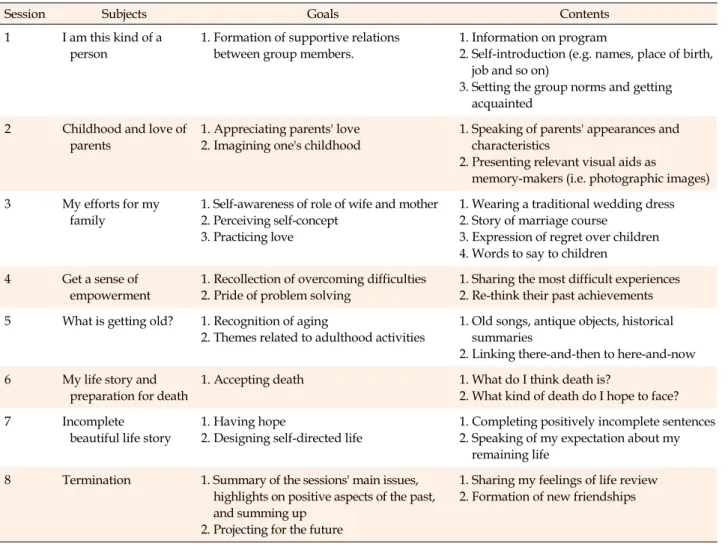
7. Intervention: The Group Reminiscence Program The group reminiscence program can be construed as a program that shapes the present life by recalling past pleas- ant and sad memories, feelings, and thoughts between two or more individuals [9]. The experimental group was div- ided into three groups each composed of eight participants, because the ideal group size was seven to 10 people. The program was carried out by the researcher once a week for eight weeks. Since the effective period for group meetings was reported as 40~50 minutes [14], this study carried out each session for 50 minutes.
This program was designed based on the life review theory, which points out that the self-concept of older
adults can be enhanced through psychological reconstruc- tion of past experiences and past conflicts, in particular.
Based on the research findings of Fry [24] that the struc- tured reminiscence method reduces depression and streng- thens the self-concept of the elderly, the topics of different reminiscences were selected according to the life cycle from childhood to old age (Table 1). Implementation of the group reminiscence program was performed by two gerontologi- cal nurse practitioners who had prior experience of partic- ipating in the group reminiscence program.
Based on the theme “my profile,” the first session was the orientation meeting, in which participants and nurse practitioners gave self-introductions and formed friend- ships with one another. Participants were also provided with an explanation of the period and method of the pro- gram. The second session was based on the theme “love of parents and grandparents.” The purpose of this session was to talk about the type of person participants were to their parents and grandparents, to realize that they were valuable beings raised with love and care. Based on the theme “my efforts focused on marriage and children,” the third session was carried out to help older adults feel proud of the results of their sacrifice and love. In the fourth session, which was based on the theme “overcoming suf- fering and hardship,” participants shared experiences of success and difficulties by looking at household items and pictures from 40 to 50 years ago. Based on the theme
“What is aging?” the fifth session provided the older adults with a chance to share past experiences of spending time with their grandparents, to realize that aging is a nat- ural part of the human development process. The sixth session, which was based on the theme “my life story and preparing for death,” helped reduce the participants’ fear of death and accept death as a part of life, by expressing their thoughts about death and describing their most de- sirable way of dying. Based on the theme “incomplete yet beautiful life story,” the seventh session was carried out to help the older adults share their expectations of their re- maining lives and design their present and future. Finally, the program concluded with the eighth session, which was a tea party that involved summarizing the thoughts of the older adults gathered from the program. Due to the 50-minute time limitation, the program provided the older adults with a chance to try on wedding clothes for three sessions. Other sessions focused on helping the older adults share personal stories with others.
8. Ethical Considerations
This study was approved by the Institutional Review
Table 1. Contents of Group Reminiscence Program
Session Subjects Goals Contents
1 I am this kind of a person
1. Formation of supportive relations between group members.
1. Information on program
2. Self-introduction (e.g. names, place of birth, job and so on)
3. Setting the group norms and getting acquainted
2 Childhood and love of parents
1. Appreciating parents' love 2. Imagining one's childhood
1. Speaking of parents' appearances and characteristics
2. Presenting relevant visual aids as
memory-makers (i.e. photographic images) 3 My efforts for my
family
1. Self-awareness of role of wife and mother 2. Perceiving self-concept
3. Practicing love
1. Wearing a traditional wedding dress 2. Story of marriage course
3. Expression of regret over children 4. Words to say to children
4 Get a sense of empowerment
1. Recollection of overcoming difficulties 2. Pride of problem solving
1. Sharing the most difficult experiences 2. Re-think their past achievements 5 What is getting old? 1. Recognition of aging
2. Themes related to adulthood activities
1. Old songs, antique objects, historical summaries
2. Linking there-and-then to here-and-now 6 My life story and
preparation for death
1. Accepting death 1. What do I think death is?
2. What kind of death do I hope to face?
7 Incomplete
beautiful life story
1. Having hope
2. Designing self-directed life
1. Completing positively incomplete sentences 2. Speaking of my expectation about my
remaining life 8 Termination 1. Summary of the sessions' main issues,
highlights on positive aspects of the past, and summing up
2. Projecting for the future
1. Sharing my feelings of life review 2. Formation of new friendships
Board (IRB) of the Daegu Catholic University Hospital (CR-11-150-RES-001-R). In this study, participation was voluntary, and no participation fee was paid to partici- pants. Individual participants obtained a copy of an agree- ment form and a statement that the data provided would be used for the purpose of this study only. Participants were also informed that confidentiality would be main- tained and that they could withdraw at any time. All par- ticipants in this study submitted written consent, and pres- ent research was performed in compliance with the princi- ples of the Declaration of Helsinki.
9. Data Collection
The data were gathered from December 2011 to March 2012, after gaining the consent of the directors of the nurs- ing homes, participants, and their families. After receiving the written consent of participants, the survey was con- ducted by a trained research assistant. The program was
carried out in a quiet, comfortable room in one nursing home. At the end of each session, participants were notified of the topic that would be discussed in the next session. The research assistant measured age, gender, religion, number of children, length of nursing home stay, perceived health condition, self-forgiveness, life satisfaction, and death anxi- ety of the two groups using questionnaires before and after the group reminiscence program. Questionnaires were sub- mitted anonymously. The control group kept participating in daily activities at their nursing home.
10. Data Analysis
Data were analyzed using the SPSS/WIN 21.0 software program. First, the normal distribution of each variable was tested by the Kolmogorov-Smirnov test. Second, ho- mogeneity of general characteristics and dependent varia- bles between the two groups were tested using the chi- squared test and independent t-test at pretest. Third, the
Table 2. Homogeneity of General Characteristics of Participants (N=47)
Characteristics Categories Exp. (n=24) Con. (n=23)
x2 or t p
n (%) or M±SD n (%) or M±SD Gender Men
Women
11 (45.8) 13 (54.2)
12 (52.2) 11 (47.8)
0.21 .802
Age (year) 77.79±7.47 80.16±7.52 0.97 .337
Education Uneducated
Elementary school Above middle school
9 (37.5) 11 (45.8) 4 (16.7)
7 (30.4) 13 (56.5) 3 (13.1)
1.09 .608
Religion Yes
No
19 (79.1) 5 (20.9)
17 (73.9) 6 (26.1)
0.27 .799
Length of nursing home stay (month) 20.28±13.59 22.05±15.13 0.62 .403
Number of children 5.79±1.13 5.47±1.31 0.31 .768
Perceived health status Good
Bad
4 (16.6) 20 (83.4)
3 (13.0) 20 (87.0)
0.13 .935
Exp.=experimental group; Cont.=control group.
effects of the group reminiscence program on dependent variables (self-forgiveness, life satisfaction, and death an- xiety) were identified, using differences between the two groups at posttest by independent t-test. The significance level was set at p<.05.
RESULTS
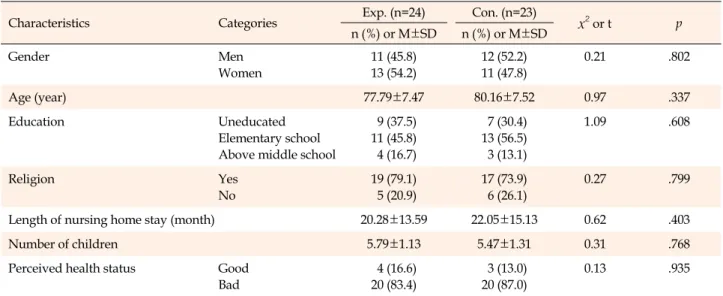
1. Homogeneity of the Two GroupsThe homogeneity test showed no significant differences between the experimental and control groups regarding the general characteristics (i.e., gender, religion, number of children, length of nursing home stay, and perceived health condition). We also ran a homogeneity test on self-forgive- ness, life satisfaction, and death anxiety at pretest, which similarly yielded no significant differences (Table 2).
2. Self-forgiveness
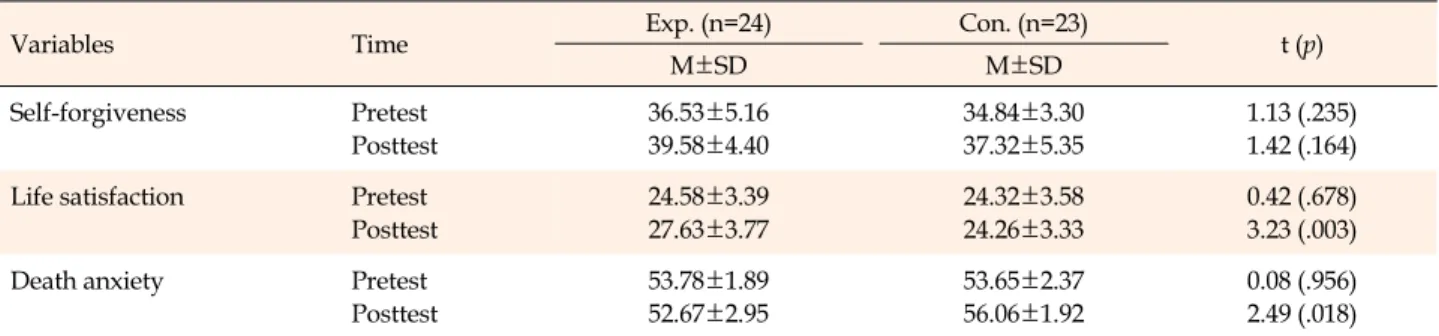
The mean score for self-forgiveness was presented as 36.53±5.16 for the experimental group and 34.84±3.30 for the control group before application of the group reminis- cence program, thus verifying statistically that there was no significant difference between the two groups (t=1.13, p=.235).
In the posttest, the self-forgiveness score of the experi- mental group was 39.58±4.40 and that of the control group was 37.32±5.35 after the group reminiscence program.
There was no statistically significant difference in self-for- giveness between the experimental and control groups (t=1.42, p=.164) (Table 3).
3. Life Satisfaction
The mean score for life satisfaction was presented as 24.58±3.39 for the experimental group and 24.32±3.58 for the control group before implementation of the group rem- iniscence program, thus identifying that there was no stat- istically significant difference between the experimental and control groups (t=0.42, p=.678).
In the posttest, the life satisfaction score was 27.63±3.77 in the experimental group and 24.26±3.33 in the control group after the group reminiscence program. There was significant difference in life satisfaction between the two groups (t=3.23, p=.003) (Table 3).
4. Death Anxiety
The mean score for death anxiety was presented as 53.78
±1.89 for the experimental group and 53.65±2.37 for the control group before implementation of the group reminis- cence program, thus verifying that there was no statisti- cally significant difference between the experimental and control groups (t=0.08, p=.956).
In the posttest, the death anxiety score was 52.67±2.95 in the experimental group and 56.06±1.92 in the control group after the group reminiscence program. There was significant difference in death anxiety between the two groups (t=2.49, p=.018) (Table 3).
DISCUSSION
The present study aimed at identifying the effect of the group reminiscence program on self-forgiveness, life satis-
Table 3. Effects of Group Reminiscence Program on Self-forgiveness, Life Satisfaction, and Death Anxiety of Older Adults (N=47)
Variables Time Exp. (n=24) Con. (n=23)
t (p)
M±SD M±SD
Self-forgiveness Pretest
Posttest
36.53±5.16 39.58±4.40
34.84±3.30 37.32±5.35
1.13 (.235) 1.42 (.164) Life satisfaction Pretest
Posttest
24.58±3.39 27.63±3.77
24.32±3.58 24.26±3.33
0.42 (.678) 3.23 (.003)
Death anxiety Pretest
Posttest
53.78±1.89 52.67±2.95
53.65±2.37 56.06±1.92
0.08 (.956) 2.49 (.018) Exp.=experimental group; Cont.=control group.
faction, and death anxiety among institutionalized Korean older adults. The results of the present study indicated that after the eight-week group reminiscence program, the older adults in nursing homes improved in life satisfaction and death anxiety but did not increase their self-forgive- ness. Based on 30 years of research, 50% of the patients showed measurable improvement in eight sessions of re- miniscence [13]. Therefore, the eight-session, once-a-week group reminiscence program used in this study also pro- ved to be an appropriate intervention for high life satisfac- tion and low death anxiety compared to the control group.
For older people, it was reported that self-forgiveness could play an essential role in reducing guilt and improv- ing ego integrity [10]. Especially, self-forgiveness can bring about a more integrative view of the self in the process of reminiscence [25]. However, in the present study, self-for- giveness was shown to have no significant change in the experimental group after the group reminiscence program.
This finding is not in agreement with previous research in which group reminiscence improved forgiveness [25,26].
Self-forgiveness is a process that requires time and effort to think about one’s mistakes and responsibility, in order to restore one’s moral self [26]. According to Maltby et al.
[27], those who were unable to forgive themselves for past negative life events were less optimistic and less outgoing.
Further, the inability to self-forgive is characterized by de- pressed, maladaptive emotions associated with low self- esteem and causes avoidance behavior [25]. Therefore, it is suggested that self-forgiveness based on personality type among institutionalized elderly people be examined in further studies.
In addition, since accepting the past is a core component of the development of ego integrity, self-forgiveness is an essential factor in reviewing negative memories through reflection and reconciling the resulting image [26]. Since self-forgiveness can be inspired by recovering moral iden- tity, the effect of the group reminiscence program on rees- tablishing moral identity should be explored.
However, we discovered that the elderly people in the experimental group were reluctant to discuss negative memories such as the death of a child, unlike positive life events such as success stories, during group reminiscence.
Generally, people tend to distance themselves from neg- ative memories, whereas they tend to hold on to positive memories. However, to establish ego integration, coping with important negative life events is essential, and one of the functions of reminiscence is to offer a coping mecha- nism [28]. According to a previous study, self-forgiveness should be examined within the context of religion [12].
Some studies reported that feeling forgiven by God tends to promote self-forgiveness [29]. Therefore, the finding that there is no significant increase in self-forgiveness among the institutionalized older adults after the group reminiscence program may be because religiosity is not in- cluded in the structure of the reminiscence program. In further study, religiosity should be considered as a com- ponent of the group reminiscence program for institution- alized older adults.
The life satisfaction and death anxiety levels in the ex- perimental group improved compared to those of the con- trol group in this study. These results indicate that the group reminiscence program was effective with institu- tionalized older adults, who are known to have low levels of life satisfaction [6] and high levels of death anxiety [7]
compared to non-institutionalized older adults in several studies. Using the SWLS instrument, the score of life sat- isfaction ranged from 24.26 to 27.63 among institution- alized older adults in this study; it was higher than 20.2 among Malaysian institutional older adults [15] and 25.2 among Indian institutionalized older adults [17].
This finding was in line with previous studies. Melen- dez-Moral et al. [30] and Cook [14] investigated the effect of an eight-session group reminiscence program in im- proving life satisfaction of older adults in nursing homes.
Internal factors such as individual cognitive and emo- tional processes influence life satisfaction, and life events
are experienced in positive or negative ways. Hence, the group reminiscence program based on cognitive and emo- tional processes facilitated the life satisfaction of the in- stitutionalized older adults. In other words, as proposed by Cook [14], group work during a reminiscence program that entails the recollection of meaningful events, pleasant experiences, and past achievements in their lives, may en- courage increased life satisfaction of the participants.
Group reminiscence fosters socialization, and encourages intimacy and connection with others [18]. Therefore, in- creased life satisfaction after the group reminiscence pro- gram in this study may be influenced by the intimacy formed within the group.
Death anxiety among older adults can be defined as the fear and anxiety generated not only during the dying proc- ess but also in relation to the deaths of other people wit- nessed during the aging process [31]. The death anxiety score of the experimental group measured after the remi- niscence program was significantly lower than that of the control group. Death anxiety among older adults in nurs- ing homes is generally high based on the limited autono- my and isolation from social relationships that elderly people experience because of community life and regu- lations in nursing homes [32]. Low levels of death anxiety among older adults in the experimental group compared to those in the control group in this study can be attributed to the socially supportive effect gained through the for- mation of new social relationships with elderly colleagues residing in the nursing home during the group reminis- cence program [33]. Although we could not measure the level of social support, since the group reminiscence pro- gram enhanced elderly people’s social interaction, the rea- son for decreased death anxiety in the experimental group can be attributed to the sharing of thoughts about the meaning of life and death. In several research studies, re- searchers accentuated the use of small group approaches for older adults [34,35], rather than individual interven- tions, because small group approaches promote interper- sonal communication, sharing experiences, emotional sup- port, and interaction among participants.
Therefore, the group reminiscence program in this study may encourage recalling and sharing positive experiences, which contributes to improving emotional mood, promot- ing bonding, and stimulating social interaction.
The present study has some limitations to consider when interpreting the results. First, since the sample size is small and there is no randomization, the possibility of gen- eralizing the results may be limited. Second, the present study was performed at two nursing homes in Daegu, Korea. As a result, the findings of this research may be spe-
cific to this sample. Third, owing to limited access to insti- tutions where older adults reside, we could not identify the long-term effects of the group reminiscence program.
Lastly, although the data collection period was long, the present study has been helpful in nursing practice since no studies have been conducted to verify the effects of the group reminiscence program among older adults in nurs- ing homes on self-forgiveness and death anxiety.
CONCLUSION
This study found that the group reminiscence program had a positive impact on life satisfaction and death anxiety among institutionalized older adults. The group reminis- cence program can support institutionalized older adults in rebuilding individual life experiences and attaining long-term life satisfaction, by recollecting past achieve- ments, meaningful moments, and positive memories. Fu- ture researchers may consider religiosity as a component of the group reminiscence program with different sam- ples, according to personality type and residence type among Korean older adults.
CONFLICTS OF INTEREST
The authors declared no conflict of interest.
REFERENCES
1. Statistics Korea. Increasing trend of elderly population [Inter- net]. Seoul: Statistics Korea; 2016 [cited 2018 July 10]. Avail- able from:
http://kostat.go.kr/portal/korea/kor_nw/2/2/6/index.boa rd?bmode=read&bSeq=&aSeq=357935&pageNo=1&rowNu m=10&navCount=10&currPg=&sTarget=title&sTxt=
2. Kim O, Byeon YS, Kim JH, Endo E, Akahoshi M, Ogasawara H.
Loneliness, depression and health status of the institutionalized elderly in Korea and Japan. Asian Nursing Research. 2009;3(2):
63-70. https://doi.org/10.1016/S1976-1317(09)60017-7 3. Statistics Korea. Population and housing census [Internet]. Seoul:
Statistics Korea; 2017 [cited 2018 July 10]. Available from:
http://kostat.go.kr/portal/korea/kor_nw/2/2/2/index.board
?bmode=read&bSeq=&aSeq=362609&pageNo=1&rowNum=
10&navCount=10&currPg=&sTarget=title&sTxt=
4. Oh MN, Choi WS. A study on self-esteem, death anxiety and depression of the elderly in home and facilities. Journal of the Korean Home Economics Association. 2005;43(3):105-18.
5. Venkatesan S, Ravindranath A. Depression in institutionalized and non-institutionalised elderly. Journal of the Indian Acad- emy of Applied Psychology. 2011;37(1):53-9.
6. Gueldner SH, Loeb S, Morris D, Penrod J, Bramlett M, John-
ston L, et al. A comparison of life satisfaction and mood in nursing home residents and community-dwelling elders.
Archives of Psychiatric Nursing. 2001;15(5):232-40.
https://doi.org/10.1053/apnu.2001.27020
7. Bektaş H, Körükcü Ö, Kabukcuoğlu K. Undercover fear of eld- erly people in nursing homes: death anxiety and depression.
Journal of Human Sciences. 2017;14(1):587-97.
https://doi.org/10.14687/jhs.v14i1.4268
8. Erickson EH. Childhood and society. 2nd ed. New York: Nor- ton; 1964. p. 168.
9. Elias SMS, Neville C, Scott T. The effectiveness of group remi- niscence therapy for loneliness, anxiety and depression in old- er adults in long-term care: a systematic review. Geriatric Nursing. 2015;36(5):372-80.
https://doi.org/10.1016/j.gerinurse.2015.05.004
10. Hansen MJ, Enright RD, Baskin TW, Klatt J. A palliative care intervention in forgiveness therapy for elderly terminally ill cancer patients. Journal of Palliative Care. 2009;25(1):51-60.
11. Wohl MJA, DeShea L, Wahkinney RL. Looking within: meas- uring state self-forgiveness and its relationship to psychologi- cal well-being. Canadian Journal of Behavioral Science. 2008;
40(1):1-10. https://doi.org/10.1037/0008-400x.40.1.1.1 12. Ingersoll-Dayton B, Campbell R, Ha J. Enhancing forgiveness:
a group intervention for the elderly. Journal of Gerontological Social Work. 2009;52(1):2-16.
https://doi.org/10.1080/01634370802561901
13. Lin YC, Dai YT, Hwang SL. The effect of reminiscence on the elderly population: a systematic review. Public Health Nursing. 2003;20(4):297-306.
https://doi.org/10.1046/j.1525-1446.2003.20407.x
14. Cook EA. Effects of reminiscence on life satisfaction of elderly female nursing home residents. Health Care for Women In- ternational. 1998;19(2):109-18.
https://doi.org/10.1080/073993398246449
15. Dahlan A, Nicol M, Maciver D. Elements of life satisfaction amongst elderly people living in institutions in Malaysia: a mixed methodology approach. Hong Kong Journal of Occu- pational Therapy. 2010;20(2):71-9.
https://doi.org/10.1016/S1569-18611170006-7
16. Kim SY, Kim MA. Effects of group reminiscence with Mugwort fragrance inhalation on pain, depression and ego integrity of the elderly with chronic pain. Journal of Korean Academy of Adult Nursing. 2005;17(3):358-67.
17. Roshani K. Relationship between religious beliefs and life sat- isfaction with death anxiety in the elderly. Annals of Biological Research. 2012;3(9):4400-5.
18. Cappeliez P, O’Rourke N, Chaudhury H. Functions of reminis- cence and mental health in later life. Aging & Mental Health.
2005;9(4):295-301.
https://doi.org/10.1080/13607860500131427
19. Cully JA, LaVoie D, Gfeller JD. Reminiscence, personality, and psychological functioning in older adults. The Gerontologist.
2001;41(1):89-95. https://doi.org/10.1093/geront/41.1.89 20. Zhou W, He G, Gao J, Yuan Q, Feng H, Zhang CK. The effects of
group reminiscence therapy on depression, self-esteem, and af- fect balance of Chinese community-dwelling elderly. Archives of Gerontology and Geriatrics. 2012;54(3):e440-7.
https://doi.org/10.1016/j.archger.2011.12.003
21. Bae S. Validation of the Korean version of state self-forgiveness scale [master's thesis]. Seoul: Ewha Womans University; 2010.
22. Diener E, Emmons RA, Larsen RJ, Griffin S. The satisfaction with life scale. Journal of Personality Assessment. 1985;49(1):71-5.
https://doi.org/10.1207/s15327752jpa4901_13
23. Templer DI. The construction and validation of a death anxiety scale. The Journal of General Psychology. 1970;82(2):165-77.
https://doi.org/10.1080/00221309.1970.9920634
24. Fry PS. Individual differences in reminiscence among older adults: predictors of frequency and pleasantness ratings of reminiscence activity. The International Journal of Aging and Human Development. 1991;33(4):311-26.
https://doi.org/10.2190/LFH1-CNDQ-GJ7Y-LTJF
25. Hall JH, Fincham FD. Relationship dissolution following in- fidelity: the role of attributions and forgiveness. Journal of Social and Clinical Psychology. 2006;25(5):508-22.
https://doi.org/10.1521/jscp.2006.25.5.508
26. Woodyatt L, Wenzel M. A needs-based perspectives on self-for- giveness: addressing threat to moral identity as a means of en- couraging interpersonal and intrapersonal restoration. Journal of Experimental Social Psychology. 2014;50:125-35.
https://doi.org/10.1016/j.jesp.2013.09.012
27. Maltby J, Macaskill A, Day L. Failure to forgive self and others:
a replication and extension of the relationship between for- giveness, personality, social desirability, and general health.
Personality and Individual Differences. 2001;30(5):881-5.
https://doi.org/10.1016/S0191-8869(00)00080-5
28. Westerhof GJ, Bohlmeijer ET. Celebrating fifty years of re- search and applications in reminiscence and life review: state of the art and new directions. Journal of Aging Studies. 2014;
29:107-14. https://doi.org/10.1016/j.jaging.2014.02.003 29. Escher D. How does religion promote forgiveness? linking be-
liefs, orientations, and practices. Journal for the Scientific Study of Religion. 2013;52(1):100-19.
30. Melendez-Moral JC, Charco-Ruiz L, Mayordomo-Rodriguez T, Sales-Galan A. Effects of a reminiscence program among in- stitutionalized elderly adults. Psicothema. 2013;25(3):319-23.
https://doi.org/10.7334/psicothema2012.253
31. Azaiza F, Ron P, Shoham M, Gigini I. Death and dying anxiety among elderly Arab Muslims in Israel. Death Studies. 2010;34:
351-64. https://doi.org/10.1080/07481181003613941 32. Lee HJ, Jo KH. A path model for death anxiety to suicidal idea-
tion of the elderly. Journal of the Korean Gerontological Soci- ety. 2006;26:717-31.
33. Ertel KA, Glymour MM, Berkman LF. Effects of social in- tegration on preserving memory function in a nationally rep- resentative US elderly population. American Journal of Public Health. 2008;98:1215-20.
https://doi.org/10.2105/AJPH.2007.113654
34. Bonhote K, Romano-Egan J, Cornwell C. Altruism and creative
expression in a long-term older adult psychotherapy group.
Issues in Mental Health Nursing. 1999;20(6):603-17.
https://doi.org/10.1080/016128499248394
35. Thomas MC, Martin V. Training counselors to facilitate the transitions of aging through group work. Counselor Education and Supervision. 1992;32(1):51-66.
https://doi.org/10.1002/j.1556-6978.1992.tb00174.x