Journal of the Korean Chemical Society 2004, Vol. 48, No. 3
Printed in the Republic of Korea
-331-
단 신
다이아조 메탄에 의한 γ-Alkoxy-α,β-unsaturated Acid 의 고리첨가반응
유 병 찬*
목원대학교 화학 및 응용화학부 (2004. 1. 26 접수)
Cycloaddition of γ -Alkoxy- α , β -unsaturated Acids with Diazomethane
Byung-Chan Yu*
Division of Chemistry and Applied Chemistry, Mokwon University, Daejeon 302-729, Korea (Received January 26, 2004)
주제어: 다이아조메탄, 고리첨가반응, 피라졸린 Keywords: Diazomethane, Cycloaddition, Pyrazoline
Diazomethane is known to undergo [3+2] addi- tion reaction with alkenes and alkynes to give pyra- zolines and pyrazole respectively.1 The reaction proceeds rapidly with electron-deficient alkenes and strained alkenes.The recent applications of the [3+2] cycloaddition to natural products bearing cyclic α,β-unsaturated ester were reported2 The reaction is controlled by FMO consideration; the HOMO of the diazomethane and the LUMO of the alkenes serving as a predominant interaction.3 The corresponding pyrazolines are most often used as precursors to cyclopropanes by either thermal or photochemical exclusion of N2.4 To our knowledge the cycloaddition of γ-alkoxy-α,β-unsaturated acids with diazomethane to alkoxy pyrazoline such as B has been prepared before in a limited scope.5 There- fore it is our intention to report the examples of the preparation in this paper.
This reaction was observed when we investi- gated [2,3] Wittig rearrangement6 of dianion of pro- pargyloxy-α,β-unsaturated caboxylic acid to provide
allenol ester such as 2 to prepare 2,3-substituted furano compounds which could be applied to the synthesis of furano natural products.7
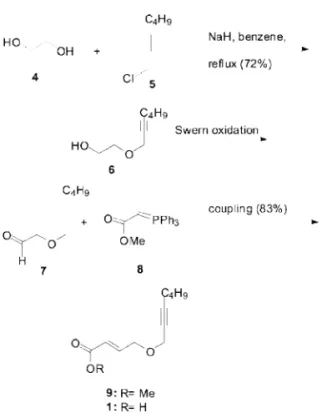
The γ-propargyloxy-α,β-unsaturated acid was prepared as followings; the substitution of sodium hydroxyethylalkoxide with the propargylic chlo- ride generated from the corresponding propargylic alcohol by Collington-Meyer chlorination8 gave β- alkoxy alcohol 6. The alcohol was oxidized by Swern condition. The following coupling of the aldehyde with the ylide 8 gave γ-alkoxy-α,β-unsat- urated acid after the treatment with LiOH in the mixture of methanol and water.
Journal of the Korean Chemical Society
332 유 병 찬
The planned Wittig reaction of 1 gave us an unknown substance which was identified as allene pyrzoline 10 by a three fold reaction pathway; Wit- tig reaction, methylation and [3+2] dipolar cycload- dition with generated diazomethane. Therefore the pyrazoline 10 was obtained in 44% yield.
The direct addition of excess diazomethane in ether to γ-propargyloxy-α,β-unsaturated acid and allyloxy-α,β-unsaturated acid gave rise to the corre- sponding pyrazolines in 64% yields respectively.
The compound 12 possessing an allyloxy system could be prepared in the silmilar steps starting from 2-heptenyl chloride in excellent yields.9
The pyrazoline 11 was fully identified by the fol- lowing spectroscopic method: a decoupling experi- ment was carried. The irradiation of methine H caused simplification of ABX system of propar- gylic methylene and pyrazoline methylene peaks to AB system (Fig. 1). Mass spectrum shows 2 nitro- gens and also CH2N2 fragmentation was observed.
In conclusion, we have demonstrated the cycloaddi- tion of γ-alkoxy-α,β-unsaturated acids with diaz- omethane to afford the alkoxypyrazoline system.
The synthetic application of the prazolines will be reported in due course.
Fig. 1. 1H NMR spectrum (500 MHz) and the decoupling experiment (300 MHz) of the pyrazoline 11.
다이아조 메탄에 의한 γ-Alkoxy-α,β-unsaturated Acid의 고리첨가반응 333
2004, Vol. 48, No. 3
EXPERIMENTALS
2-Hept-2-ynyloxy-ethanol (6)
To a suspension of 779 mg (32.1 mmol) of NaH in 20 mL of benzene was added 22.3 mL (306 mmol) of ethylene glycohol dropwise at 0oC. The solution was refluxed for 2 hrs and cooled to room temperature. To the solution was added 4.0 g (30.6 mmol) of the chloride 5 in 5 mL of benzene. The solution was refluxed for 4 hrs and cooled to room temperature. Water was added and the aqueous layer was separated and extracted with ether three times. The extracts were washed with brine, dried over MgSO4 and concentrated under reduced pres- sure. The residue was chromatographed on silica gel.
Elution with 50% ethylacetate in hexanes gave 3.43 g(72%) of the alcohol 6: IR (film) υ 3417, 2934, 2864, 1638, 1354 cm−1; 1H NMR (300 MHz, CDCl3) δ 4.15 (2H, t, J=2.0 Hz, propargylic Hs), 3.73 (2H, brt, HOCH2-), 3.59 (2H, brt, HOCH2CH2-), 2.20 (1H, tt, J=4.9, 2.0 Hz, propargylic Hs), 2.09 (1H, brt, -OH), 1.52-1.32 (4H, m, CH3(CH2)2-), 0.88 (3H, t, J=7.2 Hz, -CH3) ppm.
4-Hept-2-ynyloxy-2-methyl-but-2-enoic acid methyl ester (9) and 4-Hept-2-ynyloxy-2-methyl-but-2-enoic acid (1)
To a solution of 1.58 mL (18.2 mL) of oxalyl chloride in 20 mL of CH2Cl2 was added 2.58 mL (3.63 mmol) of DMSO at -78 oC. The solution was stirred for 10 min and then added 1.89 g (12.1 mmol) of the alcohol 6 in 5 mL of CH2Cl2. The resultant white emulsion was stirred for 40 min and 7.43 g (21.3 mmol) of 2-(triphenylphosphanylidene)- propionic acid methyl ester11 was added. The solu- tion was warmed to room temperature and stirred overnight. Water was added and the organic layer was extracted with ether three times. The extracts were washed with brine, dried over MgSO4 and concentrated under reduced pressure. The residue was chromatographed on silica gel. Elution with 10% ethyl acetate in hexanes gave 2.24 g (83%) of the ester 9: IR (film) υ 2956, 2862, 2360, 1720, 1656, 14536, 1253, 1136, 1036 cm−1; 1H NMR (300 MHz, CDCl3) δ 6.80 (1H, t, J=6.1 Hz, vinyl H), 4.21 (2H, d, J=6.1 Hz, allylic Hs), 4.13 (2H, t, J=2.2 Hz, pro-
pargylic Hs), 3.73 (3H, s, -OCH3), 2.21 (2H, tt, J= 6.9, 2.2 Hz, propargylic Hs) 1.84 (3H, s, vinyl CH3), 1.50-1.35 (4H, CH3(CH2)2-), 0.89 (3H, t, J=7.1 Hz, -CH3) ppm. The resultant ester was dissolved in the mixture of methanol-water and treated with LiOH- H2O. The solution was stirred overnight and quenched with 3% HCl. The aqueous layer was separated and extracted with CH2Cl2 three times and the extracts were washed with saturated NaHCO3 and then with brine. The residue was concentrated under reduced pressure to afford the acid 1 quantitatively.
The IR shows the broad carboxylic OH at 3443 cm−1; 1H NMR (300 MHz, CDCl3) δ 6.80 (1H, t, J=
6.1 Hz, vinyl H), 4.21 (2H, d, J=6.1 Hz, allylic Hs), 4.13 (2H, t, J=2.2 Hz, propargylic Hs), 2.21 (2H, tt, J=6.9, 2.2 Hz, propargylic Hs) 1.84 (3H, s, vinyl CH3), 1.50-1.35 (4H, m, CH3(CH2)2-), 0.89 (3H, t, J=7.1 Hz, -CH3) ppm.
4-(2-Butyl-1-hydroxy-buta-2,3-dienyl)-3-methyl-4,5- dihydro-3H-pyrazole-3-carboxylic acid methyl ester (10)
To a solution of 0.096 mL (0.95 mmol) of diiso- propylamine in 1 mL of THF was added 0.380 mL of 2.5 M n-BuLi in hexanes at 0 oC. The solution was stirred for 10 mins and cooled to -78oC and then added 80 mg (0.38 mmol) of the acid 1 in 1 mL of THF dropwise. The solution was gradually warmed to room temperature over 12 hrs and then quenched with 1 N HCl. The aqueous solution was separated and extracted with ether three times. The extracts were washed with brine, dried over MgSO4 and concentrated under reduced pressure to afford 71 mg of a mixture. The residue was diluted in ether and the solution was treated with an ethereal solution of diazomethane. The excess diazomethane was quenched with acetic acid and the resultant solution was concentrated under reduced pressure.
The residue was chromatograped on silica gel. Elu- tion with 10% ethyl acetate in hexanes gave 44 mg (44%) of the pyrazoline 10: IR (film) υ 3422, 2956, 1955, 1738, 1560, 1435, 1247 cm−1; 1H NMR (300 MHz, CDCl3) δ 4.95 and 4.93 (2H, d, J=2.0 Hz, allenic Hs), 4.62 and 4.52 (2H, ABX, JAB=18.0, JAX
=8.4, JBX=5.8 Hz, -N2CH2-), 3.99 (1H, brs, -CHOH), 3.71 (3H, s, -OCH3), 2.60 (1H, m, methine H), 2.20
Journal of the Korean Chemical Society
334 유 병 찬
(1H, brs, -OH), 1.92 (2H, m, allylic CH2), 1.66(3H, s, -CH3), 1.50-1.20 (4H, m, -(CH2)2-), 0.87 (3H, t, J=6.0 Hz, -CH3) ppm.
4-Hept-2-ynyloxymethyl-3-methyl-4,5-dihydro-3H- pyrazole-3-carboxylic acid methyl ester (11)
To a solution of 60 mg (0.27 mmol) of the acid 1 in THF was treated with an ethereal solution of dia- zomethane. The excess diazomethane was quenched with acetic acid and the resultant solution was con- centrated under reduced pressure. The residue was chromatograped on silica gel. Elution with 10% ethyl acetate in hexanes gave 46 mg (64%) of the pyrazo- line 11: IR spectrum shows the characteristic N=N stratching band at 1556 cm−1; 1H NMR (500 MHz, CDCl3) δ 4.72 and 4.38 (2H, ABX, JAB= 17.8, JAX=8.7, JBX=6.3 Hz, -N2CH2-), 4.06 (2H, s, propargylic CH2), 3.74 (3H, s, -OMe), 3.45 and 3.34 (2H, ABX, JAB=9.2, JAX=6.9 and JBX=6.4, -OCH2), 2.60 (1H, m, methine H), 2.18 (2H, t, J=7.0 Hz, propargylic CH2), 1.52 (3H, s, -CH3), 1.47-1.35 (4H, m, -(CH2)2-), 0.88 (3H, t, J=7.3 Hz, -CH3) ppm: 13C NMR (75 MHz, CDCl3) δ 196.5, 87.6, 76.0, 67.3, 58.9, 58.8, 52.9, 38.2, 30.6, 21.9, 18.3, 15.3, 13.5; Mass (m/z) 267 (M+H), 223, 207, 193, 179, 166, 149, 126, 113 (base peak).
REFERENCES
1. For a review, see: Regitz, M.; Heydt, H. In 1,3-Dipolar Cycloaddition Chemistry; Padwa, A.; Ed.; Weily: New York, 1984; p 393.
2. Recent application to natural products, see; 1) Kalsi, P.
S.; Sharma, S.; Kaur, G.; Phytochemistry 1983, 22, 1993. 2) Maldonado, E.; Mayorga, L.; Ortega, A.; Phy- tochemistry 1987, 26, 205.
3. For a discussion of the orbital interactions that control dipolar additions of diazomethane, see: Fleming, I Frontier Molecular Orbitals and Organic Chemistry Reactions;
Weily: New York, 1976: pp 148-161.
4. For the examples of [1,3] dipolar cycloaddition with dia- zomethane, see (1) Martelli, J.; Gree, R. J. Chem. Soc.
Chem. Commun 1980, 8355. (2) Collum, D. B.; Still, W.
C.; Mohamadi, F. J. Am. Chem. Soc. 1986, 108, 2094.
5. Cativiela, C.; Diaz-de-Villegas, Maria D.; Garcia, J. I.;
Jimenez, A. I Tetrahedron 1997, 53, 4479.
6. (1) Marshall, J. A.; in Comprehensive Organic Synthesis, Vol. 3, Trost, B. M.; Fleming, I., Eds, Pergaman, London,
1991. (2) Mikami, K.; Nakai, T. Synthesis 1991, 594.
7. One of many examples of furano natural products;
Bandurraga, M-M; Fenical, W. J. Am. Chem. Soc 1982, 104, 6463.
8. Collington, E. W.; Meyers, A. I. J. Org. Chem. 1971, 36, 3044.
9. The acid 12 was prepared as the following sequence starting from trans-2-heptenyl chloride:
10. The spectroscopic data for the compounds 15, 17, 12 and 13. The compound 15: IR(film) υ 3422, 2925, 1670, 1459, 1116 cm−1; 1H NMR (300 MHz, CDCl3) δ 5.69 (2H, dt, J=15.4 and 6.5 Hz, vinyl Hs), 5.53 (1H, dt, J=15.4 and 6.2 Hz, vinyl H), 3.95 (2H, d, J=6.0 Hz, allylic Hs), 3.72 (2H, brt, HOCH2-), 3.52 (2H, brt, HOCH2CH2-), 2.25-2.20 (3H, brs and brt, -OH and allylic Hs), 1.40-1.29 (4H, m, CH3(CH2)2-), 0.87 (3H, t, J=6.9 Hz, -CH3) ppm. The compound 17: IR (film) υ 2957, 1722, 1437, 1260, 1136 cm−1; 1H NMR (300 MHz, CDCl3) δ 6.81 (1H, t, J=6.0 Hz, vinyl H), 5.70 (1H, dt, J=15.4 and 6.6 Hz, vinyl H), 5.53 (1H, dt, J=
15.4 and 6.2 Hz, vinyl H), 4.12 (2H, d, J=6.0 Hz, allylic Hs), 3.92 (2H, d, J=6.2 Hz, allylic Hs), 3.72 (3H, s, -OCH3), 2.03 (2H, brt, allylic Hs) 1.82 (3H, s, vinyl CH3), 1.40-1.22 (4H, CH3(CH2)2-), 0.87 (3H, t, J=7.0 Hz, -CH3) ppm. The compound 12: IR (film) υ 3443, 1649 cm−1; 1H NMR (300 MHz, CDCl3) δ 6.96 (1H, t, J=4.5 Hz, vinyl H), 5.70 (1H, dt, J=15.4 and 6.7 Hz, vinyl H), 5.53 (1H, dt, J=15.4 and 6.2 Hz, vinyl H), 4.15 (2H, d, J=5.9 Hz, allylic Hs), 3.93 (2H, d, J=6.3 Hz, allylic Hs), 2.03 (2H, t, J=7.4 Hz, allylic Hs) 1.82 (3H, s, vinyl CH3), 1.40-1.22 (4H, CH3(CH2)2-), 0.87 (3H, t, J=7.0 Hz, -CH3) ppm. The compound 13: IR spectrum shows the characteristic N=N stratching band at 1550 cm−1; 1H NMR (300 MHz, CDCl3) δ 5.52 (1H, dt, J=15.4 and 7.1 Hz, vinyl H), 5.43 (1H, dt, J=15.4 and 5.2 Hz, vinyl H) 4.70 and 4.34 (2H, ABX, JAB= 17.8, JAX=8.7, JBX=6.5 Hz, -N2CH2-), 3.82 (2H, d, J=6.2 Hz, allylic CH2), 3.72 (3H, s, -OMe), 3.33 and 3.21 (2H, ABX, JAB=9.4, JAX=6.9 and JBX=6.3 Hz, -OCH2), 2.58 (1H, m, methine H), 2.33 (2H, m, allylic CH2), 1.47 (3H, s, -CH3), 1.40-1.20 (4H, m, -(CH2)2-), 0.85 (3H, t, J=7.3 Hz, -CH3) ppm.
11. Stotter, P. L.; Hill, K. A. Tetrahedron Lett. 1975, 1679.