1. Introduction
1) Research Aim
The concept of the tourism destination life cycle model (Butler, 1980) has some problems for the application to a case study. First, it is mainly decided by the number of tourists overlooking lots of factors that have influenced on the change of the tourists
area life cycle. In addition the statistic data of the number of tourists has discontinuous, unreliable and unscientific. Second, it is not fit for a tourist area, which has a small scale and long history because it was made for a large-scale tourist destination devel- oped in the 20th century.
In order to resolve these problems, Lee (2000) built the spa town life cycle model for the small scale
* The work was supported by the Korean Research Foundation Grant (KRF-2001-037-CB0045)
** Part-time Lecturer, Department of Tourism, Hanyang University, [email protected]
Application and Evaluation of Spa Town Life Cycle Model through a Case Study of Bath Spa, United Kingdom
*
Younghee Lee**
관광지 라이프사이클 모형의 검증 - 영국의 바스 온천을 사례로*
이 영 희**
Abstract : This article aims to validate empirically and verify theoretically, the applicability of the spa town life cycle model to Bath Spa located in United Kingdom. In order to test the model, the indicators of the model that associated with the rate of transportation infrastructure, the length of stay, tourist facilities, competitive resorts, advertising, tourism policy, environmental problem and the attitude of residents were examined through a comparative analysis. According to the result of this research, the indicators of 7 items excepting competitive resorts applied to Bath Spa. The competitive resorts of Bath Spa emerge at the maturity stage differing from the model that appeared at the stagnation stage. In conclusion if the new hypothesis of competitive resorts is added to the model, the model will be applied to western spa town, which has a small scale and a long history.
Key Words : spa town life cycle, Recreation Business Districts (RBD), initial stage, development stage, maturity stage, stagnation stage, decline stage, rejuvenation stage
요약: 본 연구의 목적은 우리 나라 온천관광지를 대상으로 개발한 관광지 라이프사이클 모형을 영국의 바스 온
천에 검증하는 것이다. 연구의 방법으로는 관광지 라이프사이클 모형의 교통, 관광객의 체류기간, 편의시설, 경쟁 관광지, 광고활동, 관광행정, 환경문제 그리고 지역주민이 태도 등의 각 항목별 지표를 사례지역에 적용하는 비교
분석 방법을 택하였다. 이와 같은 비교분석법에 의한 연구 결과‘경쟁관광지’를 제외한 나머지 7개 항목의 각각
의 지표들이 영국 바스 온천에 적용되었다. 바스 온천에서‘경쟁관광지’는 관광지 라이프사이클 모형과는 달리
침체단계에 나타나지 않고 성숙단계에 등장하는 것이 특징이다. 결론적으로 우리 나라를 사례로 개발된 관광지 라이프사이클 모형은 경쟁관광지의 등장시기만 수정, 보완한다면 규모가 작고 역사가 오래된 서구 온천관광지에 적용이 가능하다.
주요어 : 관광지 라이프사이클, 레크레이션 업무지구, 초기단계, 개발단계, 성숙단계, 정체단계, 쇠퇴단계, 회복단계
of oriental tourist area, which has a long history. The model is based on not the number of tourist but another factors related to transportation, length of stay, tourist facilities, resorts, advertising, policy, environment and residents. This article aimed to val- idate empirically and verify theoretically, the applic- ability of the model to Bath Spa located in UK.
2) Case-Study Area: Bath Spa
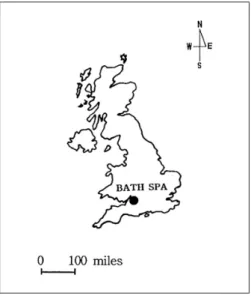
Bath Spa was chosen for this study on the basis that it is a small scale and has a long history related to hot mineral water like the case-study area of the model. Figure 1 shows the location of Bath Spa on the southwest side of the UK. The reason for the existence of Bath Spa is water. The whole place has been built because of, and literally on, the only hot mineral springs in Britain. A quarter of a million gal- lons of water at a constant temperature of 120°
Fahrenheit have gushed up from the springs every day since before the Roman conquest (Bath City Council Spa Committee, 1973)
In addition, the waters are the reason for the Romans (AD 43 - AD 367) building Bath their most important bathing establishment in Britain; the reason for the 18th century social life and architectural devel- opment; and the reason for the spa of today. The new
spa will use Bath’s natural thermal waters to provide bathing, treatments and relaxation from 2003.
3) Research Methods
For the applicability of the spa town life cycle model to Bath Spa, there are 3 methodological approaches judged to be best suited, to undertaking research in Bath Spa. First, the content analysis of historical records is based upon an internal interpre- tation. Second, the empirical analysis of the case- study area is broadly based upon the historical and contemporary reconstruction of the length of stay and trends around the framework provided by the spa town life cycle model. Third, the comparative studies were used in order to show the points of similarity or difference.
And in order to establish the type of data avail- able, its quality and quantity, an extensive review of all potential data sources was conducted. For exam- ples, first, reports and assessments produced by county councils also proved to be extremely infor- mative. A good example is, ‘Bath & Beyond’ pro- duced by Bath Conference Bureau. And the report provides major events, index of accommodation and Bath accommodation map on annual basis. Second, information on the early years of tourism develop- ment was taken from local records and histories. A full investigation into the evolution and develop- ment of Bath Spa through time, and changing nature and pattern of tourism within them, was conducted.
By tracing the historical evolution of Bath Spa and reconstructing its development, in terms of infra- structure and the length of stay, an attempt is made to empirically test and theoretically validate the model. Third, in order to chart the changing volume and nature of tourism within Bath Spa, a compre- hensive content analysis of local newspapers was conducted. Fourth, Bath Spa guides were also used to reconstruct the changing nature of tourism. Fifth, the analysis of planning applications provided a source through which the changing nature of tourism within Bath Spa could be reconstructed.
Figure 1. Case-study area: Bath Spa, UK
Last, in-depth interviews were conducted from the 12th Aug 2002 to the 24th Dec 2002 in order to obtain details relating to the role of the local authority in tourism development, the promoter of Bath Spa changed over time, environmental problems associ- ated with tourism, recreation business district, the conversion of accommodation to other uses, a change of ownership and slums.
However problems associated with data sources and construction of Bath Spa profile relate to data’s discontinuous nature and the omissions of statistical data. These data were supplemented by the data of interview with historian, spa project marketing director and residents.
2. Outline of the Spa Town Life Cycle Model
The spa town life cycle model was made by Lee (2000) through the case study of the spa town, which has a long history and small scale in South Korea.
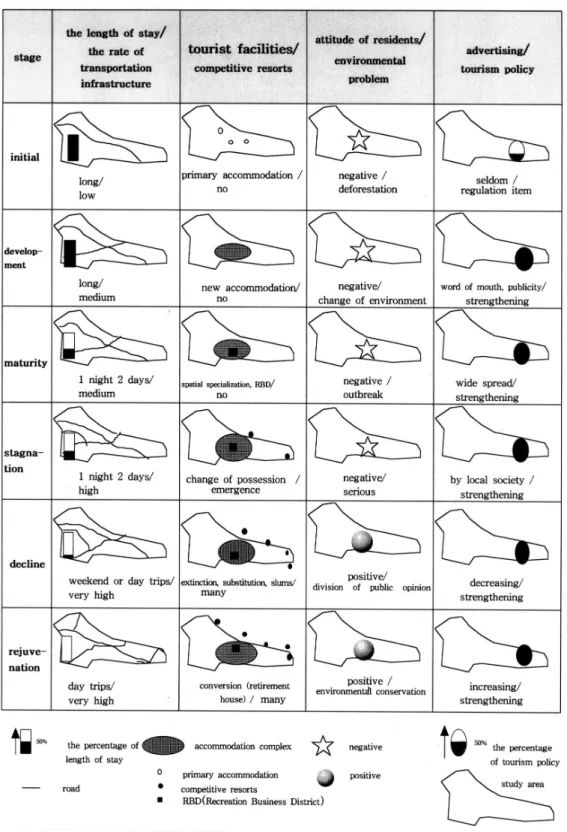
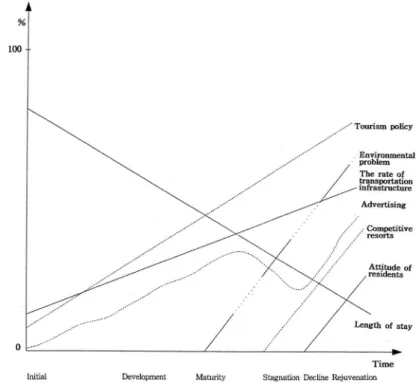
Lee hypothesized 8 items, which are the rate of transportation infrastructure, the length of stay, tourist facilities, competitive resorts, advertising, tourism policy, environmental problem and the atti- tude of residents in order to develop the spa town life cycle model (see Figure 2). Lee accepted indica- tors that are suitable for Suanbo to build spa town life cycle model, after testing the hypotheses are founded on Suanbo. And when the accepted indica- tors were displayed by the time series, 5 time axises appeared. Lee decided to apply 5 times axises to the stages of tourism destination area life cycle in Suanbo; first axis (initial stage), second axis (devel- opment stage), third axis (consolidation stage), fourth axis (stagnation stage), fifth axis (decline stage).
According to the model, the rate of transportation infrastructure has been increased as a tourism desti- nation develops. And the length of stay is shorter as spa town develops. Third, the characteristics of
tourist facilities as spa town develops are below: in the initial stage, a primary accommodation is intro- duced by residents for visitors and in the develop- ment stage more up-to-date facilities are provided by external organizations. In the consolidation stage, the spatial segregation of accommodation is appeared and the recreation business districts (RBD) is formed. In the stagnation stage, the existing prop- erties of tourist facilities are likely to have frequent changes in ownership. In the decline stage, slums districts appeared in part. Forth, the competitive resorts emerge at the stagnation stage. Fifth, the rate of the activity of advertisement peaks out in consoli- dation stage and is decreasing in stagnation and decline stages. Sixth, the regulation of government is getting strong from the initial stage to the rejuvena- tion stage because hot spring is in possession of gov- ernment. Seventh, the environment sensitively reflects the phenomena of tourism. Eighth, the atti- tude of residents changed in the decline stage from negative to positive.
This model is useful to analyze current situation of tourist destination, which is having a hard time for reasons of the economic slump of tourism in this area. In addition, a framework can be provided within which to analyze the pattern of tourism development on a tourist area, which has a long his- tory and small scale. However the limitation of this model is that the model was built through just Suanbo Spa located in South Korea. And the quality of water, the international and domestic situation, and economy were overlooked for the factors of the transformation of tourist destination.
3. The Model of Spa Town Life Cycle Applied to Bath Spa
1) The Rate of Transportation Infrastructure
The hypothesis of the rate of transportation infra-
Figure 2. The model of spa town life cycle Source: Lee, Y.H., 2000, 178.
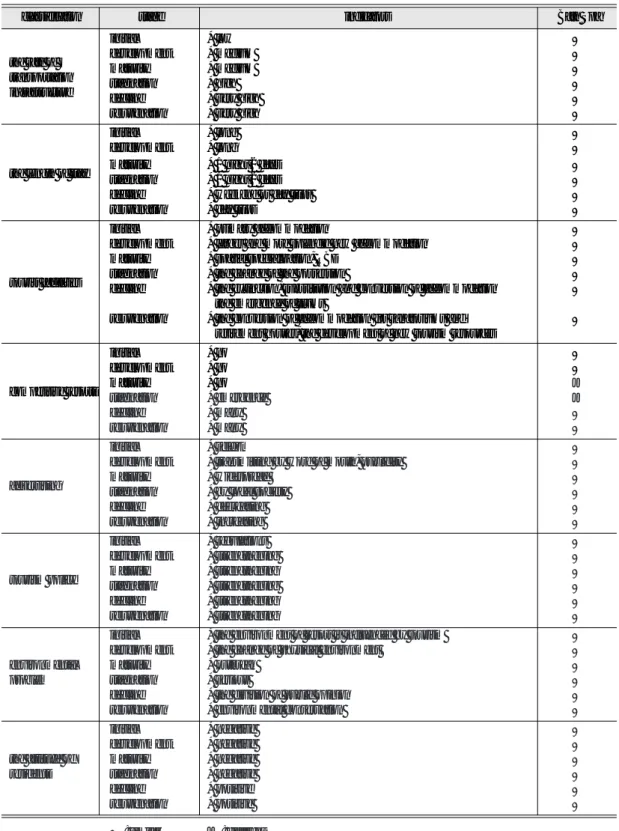
structure, which has been increased as tourism desti- nation develops, can be applied to Bath Spa (see Table 1). Figure 3 shows that the rate of transporta- tion has increased from Roman times to nowadays.
In the Roman period the first road system laid out, crossed the river near Pulteney Bridge and the sec- ond road system was reorganized on the Cleveland Bridge (Cunliffe, 1986). Then, in the 10th century the street grid was established (Cunliffe, 1986). Next in the medieval period the roads leading to the north, south, east and west gates were organized because of the development of suburbs of Bath Spa (Cunliffe,
1986). And in the 18th century Gay Street, Terrace Walk, Brock Street, Pulteney Bridge, Alfred Street, Wood Street, Great Pulteney Street, Bath Street, Kennet and Avon Canal (Robertson, 1975) were established so that Bath Spa had to be rebuilt because wealthy visitors were critical (Simons, 2002).
Next in the 19th century York Street, Wells Road, Cleveland Bridge, Broad Street, Great Western Railway, Charlotte Street, Manvers Street, Dorchester Street, Lansdown Road, Milsom Street, George Street, Green Park Station and Monmouth Street (Robertson, 1975) were developed. In the 20th century the widening of part of Walcot Street, a large bus station (1937), five new road bridges and a dozen new roundabouts (Haddon, 1973), the motor- way to the north of Bath (M4), a new road entering from the east, south of the London Road, a link road from the south into the Lower Bristol Road by a roundabout (Haddon, 1973; 194-211) were devel- oped.
2) The Length of Stay
The hypothesis of the length of stay, which is shorter as tourism destination develops, can be applied to Bath Spa (see Table 1). In the Roman era, the length of stay was long because the Romans developed Bath Spa as a sanctuary of leisure, not a military fortress like most Roman towns (www.bathspa.co.uk/history/roman.html, 29th Nov. 2001). And in the Medieval era it might be esti- mated at around 3 months because of the big church and headquarters of a big monastery that also man- aged the hot springs with the pilgrims cooperated with merchants that was not religious. Also in the Elizabethan, Georgian and Victorian eras the length of stay is estimated to have been long. The main rea- son is that Bath Spa became a city center for European aristocracy. And Bath Spa had not only spa facilities but also dance places, beautiful parks to take exercise and music concerts. In 1553 Queen Mary regularly shopped at Milsom street (Torner, 2001). In 1692, 1702, 1703 Queen Anne came to Bath Figure 3. The process of transportation infrastructure
development
Source: Cunliffe, 1986.
Table 1. Indicators of the model of spa town life cycle
initial * low √
the rate of development * medium √
transportation maturity * medium √
infrastructure stagnation * high √
decline * very high √
rejuvenation * very high √
initial * long √
development * long √
the length of stay maturity * 1 night 2 days √
stagnation * 1 night 2 days √
decline * weekend or day trips √
rejuvenation * day trips √
initial * primary accommodation √
development * larger and more splendid new accommodation √
maturity * spatial specialization, RBD √
tourist facilities stagnation * the change of the possession √
decline * the extinction, substitution and conversion of accommodation √ the emergence of slums
rejuvenation * the conversion of accommodation for sanatoriums and √ retirement houses, the development of new tourism resources
initial * no √
development * no √
competitive resorts maturity * no „
stagnation * emergence „
decline * many √
rejuvenation * many √
initial * seldom √
development * transmitting by word of mouth, publicity √
advertising maturity * widespread √
stagnation * by local society √
decline * decreasing √
rejuvenation * increasing √
initial * regulations √
development * strengthening √
tourism policy maturity * strengthening √
stagnation * strengthening √
decline * strengthening √
rejuvenation * strengthening √
initial * the environment of resort is influenced by tourism √
development * the change of physical environment √
environmental maturity * outbreak √
problem stagnation * serious √
decline * the division of public opinion √
rejuvenation * environmental conservation √
initial * negative √
development * negative √
the attitude of maturity * negative √
residents stagnation * negative √
decline * positive √
rejuvenation * positive √
√ : similar „ : different Source: Lee, Y.H., 2000, 172.
classification stage indicators Bath Spa
Spa for health and also for pleasure (www.
bathspa.co.uk/history/elizabethan.html, 29th Nov.
2001). And in the 18th century, wealthy tourists who came from Germany, Italy, Switzerland and London (in summer) came Bath Spa (Simons, 2002). After the end of the 19th century Bath Spa declined from a place of pleasure to be just a functional hospital again. Visitors, who were not wealthy, came to stay at the hospital for long periods or many people retired after their working life to live in Bath to hop- ing for a longer life because of the good benefit of the water. So the market changed to a very different market for the long stay, for travellers from different areas. In 1948 at the end of the Second World War many injured men came to Bath. Injured soldiers who came from the U.K., Canada, Australia and India maybe stayed for the 6 months until rehabilita- tion and then they would be sent back to the home- towns or back to work (Simons, 2002). In 1976 the hospital was closed because of a myth. The myth was that the bacteria, which lived in old pipes, killed an 8 year old. These bacteria made many tourists anxious, so the National Health Service stopped using the natural mineral water, and the hospital was closed for this reason. Nobody wanted go to Bath (Simons, 2002). Therefore, from 1948 to 1976 the leisure business of Bath Spa had declined. After Bath Spa changed to a world heritage city in the 1980s, the length of stay was shorter than before. In 1985 it was 4.5 hours (Bath City Council, 1987). Simons (2002) indicates that the length of stay is 4.0 hours in 2002.
3) Tourist Facilities
The hypothesis of tourist facilities can be applied to Bath Spa excepting the rejuvenation stage (see Table 1). In the initial stage (Roman times) Bath had a primary accommodation, which were a reservoir (AD 70) of hot water and a fine and extensive bathing establishment because the Romans devel- oped Bath Spa for a sanctuary of relaxation (www.bathspa.co.uk/history/roman.html). In the
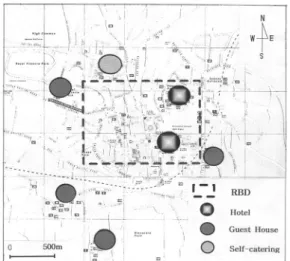
development stage, old accommodation had been changed by larger and more splendid new accom- modation. For example, Queen’s bath, King’s bath, Pump Room, hospitals, beautiful Georgian houses and apartments were built for wealthy tourists (Simons, 2002). Next in the maturity stage, RBD (Recreation Business District) and the spatial special- ization of accommodations were emerged in Bath Spa (see Figure 4). For instance, 63% of hotels are clustered in the city center where there exists the Riverside Avon, Henrietta Park and Pierrepont. And 37% of hotels are located outside of city center where are Corsham, Shaw, Bradford-on Avon, Holt, Trowle Common, Timsbury, Saltford, Keynsham, Midsomer Norton and Wells. Also 28% of self-cater- ing establishments are dispersed in the city center where there are the Henrietta, South PRD, Beau Street, Rivers Street, Circus Mews, Milton AV and Devonshire Bldges. 72% of all self-catering accom- modation is located outside of the city center. As for guest houses, Inns Caravans & Camping and farms are mainly dispersed outside of city center. Next, in the stagnation stage, the possession of the tourist facilities had been changed from 1973 to 1979 as table 2. And there are the emergence, substitution and conversion of accommodation in Bath Spa in the
Figure 4. RBD and the spatial specialization of accommodations
decline stage. For example the number of the close- down of hotel, guest house and self-catering is 61 from 1979 to 1997. And it is 66 from 1997 to 2002.
And 3 hotels have been changed to office and restau- rants and 1 very big hotel had been converted to apartment between 1987 and 1995. Since 1995, 4 new hotels have been established outside of city center in order to resolve the problem of car parking (Rollins 2002) and 3 big hotels were changed hospital, big college and car parking of new hotel (Simons, 2002).
Also slums has been emerged at the Now Hill, London Road, Lansdown Road and behind of the cannel, Holloway (see figure 5). Last in the rejuvena- tion stage, Thermae Development Company has developed new tourism resources since 1997.
However the conversion of accommodation for retirement houses is not appeared yet (Rollins, 2002).
4) Competitive Resorts
The hypothesis of competitive resorts that emerge at the stagnation stage might not be estimated to Bath Spa (see Table 1). The competitive resorts of Bath Spa could be appeared by the Great Western Railway (Robertson, 1975) to be in the maturity stage (19th century). According to Patmore (1970) there were 70 spas in England in 1841. These spas might be estimated as competitive resorts of Bath Spa because these spas can be accessed by railway sys- tem. And after the Second World War, Bath Spa had lost customers to Harrogate, Buxton, Woodhall Spa, Table 2. The change of the possession of tourist facilities (1973- 1979)
Classification The number of closedown The number of a newly
facilities established facilities
Hotel, Boarding Houses, Guest houses, Self-catering 21 51
Department Store 2 -
Shops 13 12
Restaurants 3 5
Attractions and Sport 4 9
Travel Agency 1 3
Estate Agency 2 1
Industries and Services 1 -
Source: Author own calculations
Classification The number of closedown The number of a newly
facilities established facilities
London Road (Dec. 24th2002) Lansdown Road (Dec. 24th2002) Figure 5. Slums
Llandrindod Wells, Droitwich, Leamington and Cheltenham (Patmore, 1970). In particular Woodhall Spa is almost the equal of Bath Spa in the number of treatments given at Spa establishments (Patmore, 1970). Since Bath Spa was transferred by world her- itage city in the 1980s, it has faced increasing compe- tition in the tourism industry from traditionally vis- ited town and cities, from secondary historic cities such as Winchester, Stratford-upon-Avon and Durham and also from newly developed tourist cen- ters such as Bradford, Glasgow and Wigan Pier (Bath City Council, 1987). And also competition to Bath Spa has come from cities with an industrial her- itage, such as Bristol and Cardiff since in the 1980s (Bath City Council, 1987).
5) Advertising
The hypothesis of advertising can be applied to Bath Spa (see Table 1). In the initial stage the adver- tising of Bath Spa was seldom to promote the hot spring. Next in the development stage the promo-
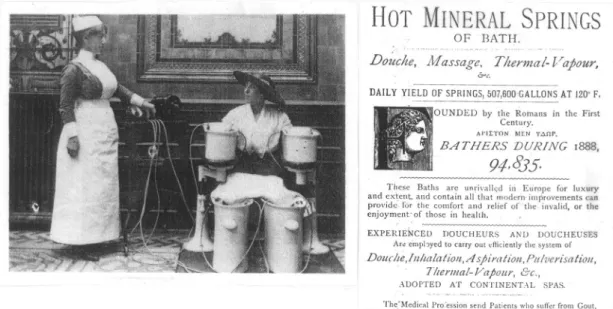
tion of Bath Spa had been transmitted by the word of mouth and publicity. The word of mouth might be shown by a legend. The legend (Bath City Council Spa Committee, 1973) says that Prince Bladud (later the father of King Lear) became a swineherd after he contracted leprosy and was ban- ished from his father’s court. One day he saw his pigs, also suffering from skin disease, completely cured by wallowing in a hot steamy swamp they found. Bladud followed suit and too was cured, and so again was acceptable at his father’s court. When king himself he set up a spa at the scene of his heal- ing and gave it his name Bladud, from which Bath derives. And the evidence of the publicity is shown in Figure 6. This was provided by the Douche and Massage Baths for the advertisement of a new range of facilities in 1889 (Cunliffe, 1986). In the maturity stage, the advertising of Bath Spa had been broad publicity. Hotel, retailers, restaurants and visitor ser- vices had been promoted through direct mail, per- sonal contacts, brochures, and tourism consortia
Figure 6. Advertising (1888) Source: Cunliffe, 1986, 161.
(Bath City Council, 1987). Next in the stagnation stage, the Bath City Council carried out the tourism marketing. In the decline stage, the advertising had been decreased from 1995 to 1999 because of the shortage of funds. Finally in the rejuvenation stage, the advertising has been increased by the local authority, local government, accommodation sec- tors, charity trust, transportation company and trav- el trade (Simons, 2002). The local government has promoted private sector and partnership projects through electronic promotion by web and email, tra- ditional print publication and traditional methods of distribution. And also the local authority has made a new brand (Royal Bath) for promotion.
6) Tourism Policy
The hypothesis of tourism policy, which had been regulation in the initial stage and strengthening from the development stage onwards, can be applied to Bath Spa (see Table 1). In the initial stage Bath Spa had been subject to regulations. For instance, in 1735 separate days were introduced for men and women and in 1737 it was ruled that men, except boys under ten, must wear drawers or a waistcoat and woman must wear a decent shift (see Figure 7) in Bath Spa for the regulations of sexual problems (The Bath Chronicle Special Publication, 2 July 2000). And also,
between 1738 and 1750 acts of Parliament outlawed the most notorious card games, dice and roulette and drove heavy betting underground (The Bath Chronicle Special Publication, 2 July, 2000). Next in the development stage the tourism policy might be estimated as strengthening because Bath was devel- oped by the town plan for a resort (Robertson, 1975).
For example, there was the limit on the height of buildings (Robertson, 1975). In the maturity stage tourism policy might be estimated strengthening because new accommodation had been increased by economic growth and water pollution was serious by overuse. In the decline stage the tourism market- ing strategy based on the policy document redrafted by the City Council aimed to diversify the city’s image, to spread visitors spatially and seasonally (Bath: City Center Management Scheme, 1996-1999).
Five various attempts in the 1980s and 1990s- were made by the local council and by business (www.bathspa. co.uk/project/background.html, 29th Nov. 2001). And also local government had managed traffic access, pedestrian priority, a balance between the local business and the local people and the local environment, noise, air quality, car thieves, drug pushers, and house burglars (Southgate Bath, 1998). In particular the Bath CCTV system was installed to crack down on crime in Bath (Ballinger, 1995), in the rejuvenation stage local authorities are fully integrating Bath Spa Project to attract new visi- tors (Simons, 2002).
7) Environmental Problem
The hypothesis of environmental problems can be applied to Bath Spa (see Table 1). The environ- ment of Bath Spa would be changed by patients who had stayed in Bath Spa tried an attempt to cure their disease before the Roman Conquest according to the Prince Baladud legend of Bath’s beginning.
And In the Roman times the physical fabric of Bath Spa had been changed because the Romans devel- oped Roman Baths, Lucus Bath, Roman Walls, Roman Road and Roman House (Haddon, 1973) for Figure 7. Bathing (1737)
Source: The Bath Chronicle Special Publication, Monday July 3 2000.
leisure. In the maturity stage Bath Spa generated the outbreak of environmental problems. For example, in 17th century Bath Spa had water pollution as Samuel Pepys (1668) claimed that: ‘It cannot be clean to go so many bodies together in the same water’. And also in 18th century Bath Spa had air pollution as Fanny Burney (The Bath Chronicle, 2 July 2000) described this phenomena in 1791: This city is so filled with workmen, dust and lime that you really want two pairs of eyes to walk about it one for being put out, and the other to see with afterwards. In the 1990s, the environmental prob- lem had been serious in Bath Spa. The Bath city cen- ter was under real threat of destruction in early 1990s (Reader’s Notes, p.2), had a smog (1997) like Los Angeles and the problem of litter (1989). And also Bath Spa has traffic congestion and air pollu- tion because Bath is located in a river valley, which is very steep, and also bus station and rail station are located in Bath city center. So Bath Spa local government has planned to move the bus station and railway station outside the city. In 1996 the BTB (Bath Tourism Bureau) recognized that the carrying capacity of Bath had almost been reached. In the decline stage there were differences amongst stake- holders about the extent and causes of environmen- tal problem. Because the economic benefit is short term and the environmental benefit is long term. In the rejuvenation stage, UNESCO carried out first conservation for world heritage. And recently Bath local government has managed the monitoring of water in the Pump Room for the prevention of water pollution.
8) The Attitude of Residents
The hypothesis of the attitude of residents, which changed in the decline stage from a negative attitude to positive, can be applied to Bath Spa (see Table 1).
From the initial stage to the stagnation stage, it might be estimated that the attitude of local resi- dents had been negative. For example, in the Roman time it could be estimated that the attitude of the
local residents had not been positive because Bath Spa was used by the Roman army who was a con- queror. And in the 18th Century the local residents had suffered because of the sexual problems as Wood (2000) points out: the Baths were like so many Bear Gardens and modesty was entirely shut out of them; people of bath sexes bathing by day and night naked.’ In addition the residents might have been adversely affected by risk of a wager because in the 18th century Bath’s attraction as a spa was matched by its growing reputation as a gaming center, the seasonal arrival of patients sent for the cure was accompanied by the gamesters seeking profit and thrills (The Bath Chronicle special publication, Monday 2 July 2000). But when Bath Spa was in the decline stage, the attitude of residents changed to a positive perspective. In relation to this, Coles (2002) indicates that over 90% of respondents regarded tourism as a good thing with the financial benefits for the economy and employment opportunities.
4. The Evaluation of The Spa Town Life Cycle Model
1) Discrepancies and Reformulation of the Spa Town Life Cycle Model
Bath Spa has a slight deviation from the overall pattern of the spa town life cycle model. The degree of uncertainty associated with the applicability of the spa town life cycle model occurs in relation to the hypothesis of competitive resorts. The results reveal the need for a theoretical reformulation of the model, in order to take account of competitive resorts.
According to the result, the hypothesis of competi- tive resorts emerge at the stagnation stage might be changed as follows; competitive resorts emerge at the maturity stage. The deterministic life-to-death concept outlined by the spa town life cycle model is problematic. But the growth and development of the Bath Spa can be characterized and related to the
overall pattern of the rise and fall proposed in the spa town life cycle model. According to the results of this study and also for the simplification of the model, the spa town life cycle model can be modi- fied as figure 8.
2) Implications
In its present form, the spa town life cycle model cannot be successfully applied to study the process of adaptation that is currently occurring within spa towns. Too many uncertainties associated with the theoretical and empirical validity of the hypothesis of the model, still remain unanswered. It is hard to predict the future when so little is known about the present; therefore, current processes of change must be researched further before the significance of the spa town life cycle model can be fully qualified.
The most controversial issue in applying historical data to the spa town life cycle model is the interpre-
tation of deflection points in the evolutionary curve.
Actually it is impossible to assign a definite date to the beginning and end of each phase as in reality, this as a gradual process occurring over a number of years.
As Foster and Murphy (1991) point out, the analy- sis and results of this study are both based on and restricted to such research design decisions, which have to be made when attempting to cross over from a conceptual framework to the realities of the pre- sent world and limitations of past record keeping.
Consequently, the interpretations of this case study are constrained by the type of questions raised and the quality of data available.
Even if the spa town life cycle model is problem- atic the significance of the model will lie in the impli- cations that it can be provided a framework to ana- lyze the pattern of tourism development on tourist area, which has a long history and small scale.
Figure 8. The reformulation of the spa town life cycle model
5. Conclusion
This article has examined the appropriateness of the spa town life cycle model (Lee, 2000) on Bath Spa. To summarize, what factors cause Bath Spa’s cycle to differ from the spa town life cycle model?
The factor is, or would appear to be, the competitive resorts. The competitive resorts of Bath Spa emerge at the maturity stage differ from the model of spa town life cycle. According to the model, the hypoth- esis of competitive resorts that emerge at the stagna- tion stage. In conclusion, the spa town life cycle model cannot be applied to Bath Spa without modi- fication. However if the new hypothesis of competi- tive resorts added to the spa town life cycle model, the model will be useful for the prediction of the future spa town and provide a framework for the study of tourism destination.
References
Agarwal, S.J., 1995, The Resort Cycle, and Restructuring: The Case of Coastal Tourism in the South of England, Ph.D Dissertation, University of Exeter, UK.
Ballinger, S., 4 May 1995, The Bath Chronicle.
Bath Chronicle, 23rd June, 1970.
Bath Chronicle special publication, 2 July, 2000, 4.
Bath City Center Management Scheme, Business Plan 1996-1999, A Partnership Scheme Between Bath & North East Somerset Council and The Bath Business Community.
Bath City Council, 1987, Economics of Tourism in Bath, Coopers & Lybrand Associates.
Bath City Council Spa Committee, 1973, Bath Official Guide Book.
Baum, T., 1998, Taking the exit route: extending the tourism area life cycle model, Current Issues in Tourism, 1(2), 167-175.
Coles, T. and Shaw, G., 2002, Tourism, tourist and local residents: management implications for
the world heritage city of Bath, Karl, W.
Wober (ed.), City Tourism 2002; Proceedings of European Cities Tourism’s International Conference in Vienna, Austria, 2002, Springer Wien, New York, 230-240.
Cunliffe, B., 1986, The City of Bath. Alan Sutton, Oxford.
Foster, Danny M. and Murphy, P., 1991, Resort cycle revisited, the retirement connection, Annals of Tourism Research, 18, 553-567.
Howells, S.B., 2002, How to reposition, change image & remarket a destination in maturity or decline case: Majorca, Presentation for the Seminar, Department of Geography, University of Exeter.
Johnston, C.S., 2001, Shoring the foundation of the destination life cycle model, part 2: a case study of Kona, Hawaii Island, Tourism Geographies, 3(2), 135-164.
Lee, Y.H., 2000, The Building of Tourism Destination Area Life Cycle Model: A Case Study of Suanbo Spa, South Korea, Ph.D. Dissertation, Dongguk University, South Korea.
Patmore, J.A., 1967, The spa towns of Britain, Gilbert, E.W. Beckinsal, R.P. and Houston, J.M.
(eds.), 1970, Urbanization and Its Problems, Basil Blackwell, Oxford, 47-69.
Robertson, C., 1975, Bath an Architectural Guide, Faber
& Faber, London.
Rollins, P., 2002, Sales and Marketing Manager, Thermae Bath Spa, Interview.
Simons, P., 2002, Chairman, The British Spas Federation, Interview.
Southgate Bath, Oct. 1998, Environmental Statement, Non Technical Summary, Sheaper Property Holdings.
Torner, N., 2001, Bath Spa University College Coursework Report.
Received May 12, 2003 Accepted June 12, 2003