https://www.jomes.org | 287
Circulating Monocyte Chemoattractant Protein-1 Levels and Lumbar Bone Mineral Density in Korean Women
Seong-Kyu Lee*
Department of Biochemistry-Molecular Biology, Eulji University School of Medicine, Daejeon; Department of Internal Medicine, Eulji University Hospital, Daejeon, Korea
Background: Monocyte chemoattractant protein-1 (MCP-1) is expressed in adipose tissue, macrophages, en- dothelial cells, and osteoblasts by parathyroid hormone administration. Circulating MCP-1 levels are positively correlated with the degree of obesity. However, whether circulating MCP-1 affects bone metabolism is unclear.
Therefore, in this study, the association between circulating MCP-1 levels and lumbar bone mineral density (BMD) based on menopausal status was assessed.
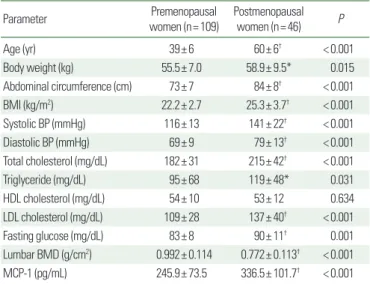
Methods: We recruited 109 premenopausal and 46 postmenopausal Korean women and examined the asso- ciation between circulating MCP-1 concentrations and various parameters including lumbar BMD based on menopausal status.
Results: A significant increase in body weight, abdominal circumference, body mass index, and MCP-1 levels (from 245.9±73.5 to 336.5±101.7 pg/mL) and significant decrease (from 0.992±0.114 to 0.772±0.113 g/cm
2) in lumbar BMD were observed after menopause. However, circulating MCP-1 levels were not correlated with any parameters including lumbar BMD in premenopausal or postmenopausal women.
Conclusion: Circulating MCP-1 levels were not correlated with lumbar BMD regardless of menopausal status.
Key words: Monocyte chemoattractant protein-1, Bone density, Women
Received November 11, 2017 Reviewed November 20, 2017 Accepted November 29, 2017
* Corresponding author Seong-Kyu Lee
https://orcid.org/0000-0002-5999-7656 Department of Biochemistry-Molecular Biology, Eulji University School of Medicine, 77 Gyeryong-ro 771beon-gil, Jung-gu, Daejeon 34824, Korea Tel: +82-42-259-1642 Fax: +82-42-259-1539 E-mail: [email protected]
INTRODUCTION
Chemotactic cytokine, monocyte chemoattractant protein-1 (MCP-1)/C–C motif chemokine ligand 2 is a major ligand for C–
C motif chemokine receptor 2.
1-3MCP-1 and its receptor, C–C motif chemokine receptor 2, are important for monocyte and mac- rophage recruitment in inflammation.
3-5MCP-1 is overexpressed in the adipose tissue of obese rodents.
4,6,7In various ethnic popula- tions
8-13, MCP-1 expression is higher in obese individuals and in visceral adipose tissue and positively associated with obesity or in- sulin resistance. MCP-1 is expressed in various types of cells such as vascular endothelium, fibroblasts, smooth muscle cells, and mo-
nocytic cells.
14In addition, osteoblast lineage cells in the bone mar- row were shown to express increased MCP-1 after parathyroid hor- mone (PTH) administration.
14Tamasi et al.
14showed that MCP-1 in bone is a core mediator for the anabolic effect of human PTH (1-34). Therefore, it is speculated that circulating MCP-1 levels (not MCP-1 secreted by bone cells) are possibly associated with bone metabolism. Sukumar et al.
15demonstrated serum MCP-1 levels were positively associated with bone turnover markers in lean women but not obese women, and were weakly associated with femoral neck and hip bone mineral density (BMD) in both types of women (P<0.09). However, the authors did not analyze the study results based on menopausal status or use lumbar BMD.
Copyright © 2017 Korean Society for the Study of Obesity
This is an Open Access article distributed under the terms of the Creative Commons Attribution Non-Commercial License (http://creativecommons.org/licenses/by-nc/4.0/) which per- mits unrestricted non-commercial use, distribution, and reproduction in any medium, provided the original work is properly cited.
Short Communication pISSN 2508-6235
eISSN 2508-7576 Journal of Obesity & Metabolic Syndrome 2017;26:287-290
https://doi.org/10.7570/jomes.2017.26.4.287
CROSSMARK_logo_3_Test 1 / 12017-03-16 https://crossmark-cdn.crossref.org/widget/v2.0/logos/CROSSMARK_Color_square.svg