*This thesis is amendment to the thesis of Lim chul-ho’s master’s degree at Chungbuk National University.
*Corresponding Author : Jong-Jin Park([email protected]) Received October 27, 2020
Accepted December 20, 2020 Revised November 23, 2020 Published December 28, 2020
배드민턴 동호인의 자아정체감 및 자아탄력성이 대인관계에 미치는 영향
임철호1, 박종진2*
1충북대학교 체육교육과 석사과정, 2충북대학교 체육교육과 교수
The Effects of Badminton Club Members’ Self-identity and Ego-resilience on Interpersonal Relationship
Cheol-Ho Lim1, Jong-Jin Park2*
1Master’s course, Dept. of Physical Education, Chungbuk National University
2Professor, Dept. of Physical Education, Chungbuk National University
요 약 이 연구는 배드민턴 동호인들의 자아정체감 및 자아탄력성이 대인관계에 미치는 영향을 규명하여 배드민턴의 저변확대 및 발전에 기여하기 위한 정보를 제공하는데 목적이 있다. 이를 위해 배드민턴 동호인 259명을 대상으로 상관 관계분석, 단계별 다중회귀분석을 통해 다음과 같은 결과를 도출하였다. 첫째, 자아정체감과 자아탄력성 그리고 대인관 계의 하위요인들 간에는 분노조절, 처음관계맺기, 자기노출, 대인갈등 다루기의 몇몇 요인을 제외하고 모두 통계적으로 관련성이 있는 것으로 나타났다. 둘째, 대인관계의 하위 요인 중 처음관계맺기에 영향을 미치는 요인은 대인관계 효율 성, 미래확신성, 친밀성, 타인에 대한 불쾌감 주장하기에 영향을 미치는 요인은 주체성과 친밀성, 자기노출에 영향을 미치는 요인은 대인관계 효율성과 주체성, 정서적지지 및 조언에 영향을 미치는 요인은 주체성과 낙관적 태도, 대인갈등 다루기에 영향을 미치는 요인은 분노조절과 자신감 순으로 나타났다. 따라서 배드민턴 동호인의 자아정체감 및 자아탄 력성의 하위요인들은 대인관계에 유의미한 영향을 미치는 중요한 요인임이 시사된다.
주제어 : 배드민턴, 동호인, 자아정체감, 자아탄력성, 대인관계
Abstract This purpose of this study was to provide information to contribute to the expansion and development of badminton clubs by identifying the effects of self-identity and self-resilience of badminton club members on interpersonal relationships. Thus, in order to achieve the objectives of this study, 259 badminton club members were verified throught correlation analysis and stepwise multiple regression analysis, which resulted in the following result: First, Among the sub-factors of self-identity, ego-resilience and interpersonal relationships, all of them were statistically relevant, except for a few factors in handling anger management, first-time relationships, self-exposure, and dealing with interpersonal conflicts. Second, Among the sub-factors of interpersonal relationships, the factors affecting the first relationship were interpersonal efficiency, future certainty, intimacy, anger management and subjecthood. The factors affecting the claiming displeasure with others were subjecthood and intimacy. The factors affecting the self-exposure were interpersonal efficiency and subjecthood. The factors affecting the emotional support and advice were subjecthood and optimistic attitude. The factors affecting the dealing with interpersonal conflicts were anger management and confidence. Therefore, the factors of self-identity and self-resilience of badminton club members suggest that they serve as important factors to facilitate interpersonal relationship.
Key Words : Badminton, Club members, Self-identity, Ego-resilience, Interpersonal relationship
1. 서론
현대인들은 과거와 다르게 의•식•주와 같은 기본적인 요소들에 대한 갈증이나 부족함보다 복잡한 4차 산업으 로 빠르게 성장한 사회 안에서 타인과의 관계를 맺는 것 에 대한 심리적인 어려움을 더 겪고 있다[1]. 대인관계 문 제는 내가 아닌 다른 사람들과의 사이에서 발생하는 심 리적 문제로 타인과 대인관계를 유지하지 못해 어려움을 겪어 부정적 정서를 경험하는 것이다[2]. 이와 같은 대인 관계 문제는 남녀노소 구분 없이 현대인들이 겪고 있는 문제점이며 Kang[3]은 대인관계를 올바르게 형성하지 못하면 불안, 분노, 초조함과 같은 심리적 고통을 겪게 된 다고 하였다. 따라서 대인관계 형성의 어려움과 문제점을 해결할 수 있는 방안이 절실하게 강구되어야 할 필요성 이 있다.
자아정체감이란 자신의 내재적 특징과 사회에서 맺고 있는 관계에 대하여 자기 스스로 가지고 있는 일관되고 안정적인 자아상이며 자기 스스로의 독자성에 대한 인식 이고 다른 사람과의 연대감, 안정감에 기반한 자존감이다 [4]. Baumesister[5]은 건강한 자아정체감을 형성하고 있는 사람이 그렇지 않은 사람보다 심리적으로 안정감이 있고 건강하기 때문에 다른 사람들과 올바른 대인관계를 맺을 수 있다고 하였고, 관련된 다른 선행연구에서도 자 아정체감이 건강한 사람이 그렇지 않은 사람보다 다른 사람과의 관계가 좋다는 것을 보여주고 있다[6,7].
자아탄력성이란 ‘외적•내적 스트레스에 대한 융통성 있고 풍부한 적응 능력’을 말한다[8]. Block과 Kremen[9]은 일반적으로 자아탄력성이 높은 사람들은 자신감과 긍정적인 정서를 보이며 심리적 적응을 잘 해 내는 반면, 자아탄력성이 낮은 사람들은 스트레스를 받을 때 경직되고 집요한 태도나 산만한 행동을 하는 경향이 있다고 보고하였다. 따라서 현대사회에서 건강한 자아정 체감과 높은 자아탄력성은 대인관계의 문제점을 해결할 수 있는 필수요소라고 할 수 있다.
자아정체감과 자아탄력성 변인과 관련된 연구들 [10-13]을 살펴보면 신체활동 및 체육활동이 이들 변인 을 증가시키는데 도움을 준다는 결과를 나타내고 있고, 이를 토대로 대인관계 문제해결의 방법으로 생활체육을 활성화시키는 방안이 제시되고 있다.
생활체육과 대인관계 문제와 관련된 연구를 살펴보면 생활체육 참여자는 참여하지 않는 사람보다 대인관계 성 향이 높다고 하였고, 참여 자체만으로도 대인관계 성향에 긍정적 영향을 줄 수 있다고 보고하고 있다[14,15]. 이에
정부는 국민의 생활체육 참여에 힘쓰고 있으며 실제 생 활체육에 참여하는 사람들도 증가하고 있다[16]. 문화체 육관광부[17]에 따르면 2019년도 현재 우리나라의 생활 체육 참여율은 66.6%, 생활체육 경험률은 92.7%에 육박 하며, 이 중에 12.9%는 단순한 생활체육 참여를 넘어 생 활체육 동호회에 가입하여 활동 중이다. 그중에서도 축구 는 동호인 607,300명, 생활체조 동호인은 396,260명, 배드민턴은 354,844명의 동호인이 활동하고 있는 인기 종목들이다[18].
이와 같이 현재 우리나라에서 많은 인기를 얻고 있는 생활체육 종목 중의 하나인 배드민턴은 남녀노소 누구나 쉽게 참여할 수 있을 뿐만 아니라 심폐지구력, 운동 협응 성, 신체적 건강, 근력, 그리고 골밀도 등 생리학적 요인 변화에 긍정적으로 작용하고[19-21], 회복탄력성, 자기 효능감 증가, 스트레스 감소, 그리고 대인관계 유지 등 사 회학적 요인 유지에도 긍정적인 영향을 준다고 보고되고 있는[22-24] 종목이다. 그러나 배드민턴과 관련된 선행 연구를 살펴보면 주로 배드민턴 엘리트 선수들의 기술력 향상, 스포츠 자신감, 기술 수준, 자기관리, 그리고 경기 분석 등에만 초점을 둔 연구가 대부분이고[25-28], 배드 민턴 동호인들을 대상으로 한 연구로도 운동중독, 참여 정도에 따른 운동몰입, 운동 만족, 재미 요인, 운동지속 의도와 같은 변인만을 다룬 연구[29-32] 정도만 이루어 진 상태이다. 물론 앞선 연구들을 통해 스포츠의 참가가 자아정체감 및 자아탄력성을 높게 해주고, 건강한 자아정 체감을 갖고 있는 사람은 그렇지 않은 사람에 비해 대인 관계가 원만하며, 자아탄력성의 하위요인들은 개인의 행 복감에 영향을 미쳐 다른 사람과의 갈등으로 겪을 수 있 는 대인관계문제를 유연하게 통제하고 극복할 수 있다는 점을 유추할 수 있다[33-36]. 그러나 기존의 연구들은 세 부종목별 참여자가 아닌 모든 스포츠 참여자를 대상으로 하였다는 한계가 있고, 자아정체감과 자아탄력성을 분리 하여 대인관계에 미치는 영향을 세부적으로 살펴본 연구 는 더욱 부족한 실정이다.
따라서 배드민턴 동호인의 자아정체감 및 자아탄력성 이 대인관계에 미치는 영향을 규명하는 것은 좀 더 체계 적인 연구로서의 그 의미가 매우 클 것이며 생활체육으 로서 배드민턴의 저변 확대에도 많은 기여를 할 수 있을 것이다. 더불어 대인관계 문제로 어려움을 겪는 사람이 증가하는 추세에서 이에 대한 해결책을 강구하고 모색할 수 있는 기초 자료를 제공하는데에도 이바지할 것이다.
2. 연구 방법 1.1 연구대상
이 연구는 C시, D시, K시, S시에서 배드민턴 동호회 에 참여하고 있는 20세 이상의 성인 남녀를 모집단으로 하여 편의표본추출법(convenience sampling method)을 이용하였다. 연구대상자는 259명을 선정 후 분석을 실시 하였고, 인구통계학적 특성은 Table 1과 같다.
Table 1. characteristics of the subjects
categories N %
gender male 148 57.1
female 111 42.9
age
30y under 65 25.1
30~40y under 114 44.0
40~50y under 53 20.5
50y over 27 10.4
exercise career
2y under 47 18.1
2~3y under 28 10.9
3~4y under 35 13.5
4~5y under 29 11.2
5y over 120 46.3
total 259 100%
1.2 조사도구
이 연구에서는 배드민턴 동호인의 자아정체감 및 자아 탄력성이 대인관계에 미치는 영향을 규명하기 위해 선행 연구를 참고하여 검사 도구의 설문 문항을 구성하였다.
설문지 문항은 최초 121문항에서 5인의 전문가와 협의 하여 연구목적에 맞는 문항을 내용타당도 측면에서 61문 항으로 최종 선정하였다. 구체적인 구성은 Table 2와 같다.
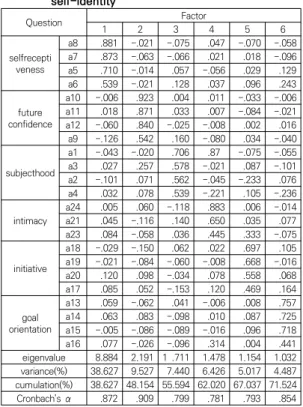
259부의 설문지로 탐색적 요인분석(EFA: Exploratory Factor Analysis)을 실시하였고 탐색적 요인분석에 사용 된 구체적인 요인추출방법은 주축요인추출(principal axis factoring)을 이용하였다. 요인회전은 오블리민 방 법을 사용하였으며 요인추출 과정에서 요인 부하량 (factor loading)이 .40이상, 공통성이 .40 이상을 나타 내는 문항을 선택하였다. 구체적인 조사도구의 내용과 타 당도 및 신뢰도 검증의 내용을 살펴보면 다음과 같다.
첫째, 자아정체감을 측정하기 위해 Park[37]이 개발 하고 Lee[38]가 일부 수정•보완한 ‘한국형 자아정체성검 사’를 토대로 이 연구에 맞게 수정•보완하여 사용하였다.
설명된 총분산은 71.52%의 설명력을 보였으며, KMO 검정값은 .904로 보통 이상의 강한 관계로 나타났다. 또 한 각 요인의 Cronbach's α 값은 .781∼.909로 나타나
자아정체감 설문지의 타당성과 신뢰성이 확인되었다. 자 아정체감의 탐색적 요인분석 및 신뢰도 분석 결과는 Table 3과 같다.
content composition Question demographic
characteristic gender(1), age(1), exercise career(1) 3 self-identity
selfreceptiveness(4),future confidence(4) 24 subjecthood(4), intimacy(4)
initiative(4), goal orientation (4) resilienceego-
confidence(4), interpersonal efficiency(4) optimistic attitude(4), anger management (2) 14
Interpersonal Relationship
first-time relationships(4) claiming displeasure with others(4)
20 self-exposure(4), emotional Support and
Advice(4)
dealing with interpersonal conflicts(4)
Total 61
Table 2. Questionnaire configuration
Table 3. The exploratory factor analysis results of self-identity
Question Factor
1 2 3 4 5 6
selfrecepti veness
a8 .881 -.021 -.075 .047 -.070 -.058 a7 .873 -.063 -.066 .021 .018 -.096 a5 .710 -.014 .057 -.056 .029 .129 a6 .539 -.021 .128 .037 .096 .243 future
confidence
a10 -.006 .923 .004 .011 -.033 -.006 a11 .018 .871 .033 .007 -.084 -.021 a12 -.060 .840 -.025 -.008 .002 .016 a9 -.126 .542 .160 -.080 .034 -.040 subjecthood
a1 -.043 -.020 .706 .87 -.075 -.055 a3 .027 .257 .578 -.021 .087 -.101 a2 -.101 .071 .562 -.045 -.233 .076 a4 .032 .078 .539 -.221 .105 -.236 intimacy a24 .005 .060 -.118 .883 .006 -.014 a21 .045 -.116 .140 .650 .035 .077 a23 .084 -.058 .036 .445 .333 -.075 initiative
a18 -.029 -.150 .062 .022 .697 .105 a19 -.021 -.084 -.060 -.008 .668 -.016 a20 .120 .098 -.034 .078 .558 .068 a17 .085 .052 -.153 .120 .469 .164 goal
orientation
a13 .059 -.062 .041 -.006 .008 .757 a14 .063 .083 -.098 .010 .087 .725 a15 -.005 -.086 -.089 -.016 .096 .718 a16 .077 -.026 -.096 .314 .004 .441 eigenvalue 8.884 2.191 1 .711 1.478 1.154 1.032 variance(%) 38.627 9.527 7.440 6.426 5.017 4.487 cumulation(%) 38.627 48.154 55.594 62.020 67.037 71.524 Cronbach’s α .872 .909 .799 .781 .793 .854 KMO=.904, Bartlett's test of Sphericity =3492.854, df=253, p<.001
둘째, 자아탄력성을 측정하기 위해 Block[39]과 Klohenn[40]이 개념화하고 Park[41]이 번안한 자아탄
력성 척도를 사용하였다. 설명된 총분산은 78.27%의 설 명력을 보였으며, KMO 검정값은 .825로 보통 이상의 강한 관계로 나타났다. 또한 각 요인의 Cronbach's α 값은 .732∼.834로 나타나 자아탄력성 설문지의 타당성 과 신뢰성이 확인되었다. 자아탄력성의 탐색적 요인분석 및 신뢰도 분석 결과는 Table 4와 같다.
Table 4. The exploratory factor analysis results of ego-resilience
Question Factor
1 2 3 4
confidence b2 .797 .044 .023 -.020 b1 .765 -.053 -.035 -.115 b3 .737 .008 -.035 .038 anger
management b14 -.095 .778 -.021 -.046 b13 .135 .746 .006 .025 optimistic
attitude
b10 -.060 -.046 .837 -.139 b11 .028 .064 .674 .121 b9 -.013 -.046 .652 .074 interpersonal
efficiency b8 .008 .025 .013 -.769 b7 .099 .017 -.089 -.726 eigenvalue 4.343 1.388 1.078 1.017 variance(%) 43.433 13.883 10.782 10.173 cumulation(%) 43.433 57.316 68.098 78.271 Cronbach’s α .834 .732 .778 .782 KMO=.825, =1031.247, df=45, p<.001
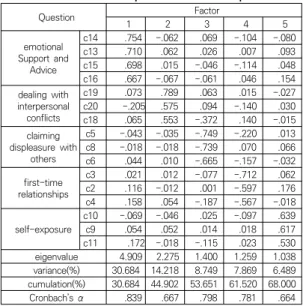
Table 5. The exploratory factor analysis results of interpersonal relationship
Question Factor
1 2 3 4 5
emotional Support and
Advice
c14 .754 -.062 .069 -.104 -.080 c13 .710 .062 .026 .007 .093 c15 .698 .015 -.046 -.114 .048 c16 .667 -.067 -.061 .046 .154 dealing with
interpersonal conflicts
c19 .073 .789 .063 .015 -.027 c20 -.205 .575 .094 -.140 .030 c18 .065 .553 -.372 .140 -.015 claiming
displeasure with others
c5 -.043 -.035 -.749 -.220 .013 c8 -.018 -.018 -.739 .070 .066 c6 .044 .010 -.665 -.157 -.032 first-time
relationships
c3 .021 .012 -.077 -.712 .062 c2 .116 -.012 .001 -.597 .176 c4 .158 .054 -.187 -.567 -.018 self-exposure c10 -.069 -.046 .025 -.097 .639 c9 .054 .052 .014 .018 .617 c11 .172 -.018 -.115 .023 .530 eigenvalue 4.909 2.275 1.400 1.259 1.038 variance(%) 30.684 14.218 8.749 7.869 6.489 cumulation(%) 30.684 44.902 53.651 61.520 68.000 Cronbach’s α .839 .667 .798 .781 .664 KMO=.836, =1463.814, df=120, p<.001
셋째, 대인관계 요인을 측정하기 위해 Buhrmester 등[42]이 제작하고 Kim과 Kim[43]이 번안한 것을 수정·
보완하여 사용하였다. 설명된 총분산은 68%의 설명력을
보였으며, KMO 검정값은 .836으로 보통 이상의 강한 관계로 나타났다. 또한 각 요인의 Cronbach's α 값은 .664∼.839로 나타나 대인관계 설문지의 타당성과 신뢰 성이 확인되었다. 대인관계의 탐색적 요인분석 및 신뢰도 분석 결과는 Table 5와 같다.
1.3 자료처리
이 연구의 목적을 달성하기 위해 수집된 설문지의 검 토 작업 후 SPSS 22.0 프로그램을 이용하여 통계처리를 실시하였다. 자아정체감과 자아탄력성 그리고 대인관계 변인 간 상관관계를 검증하기 위해 피어슨의 적률상관분 석을 실시하였으며, 자아정체감과 자아탄력성이 대인관 계에 미치는 영향력을 검증하기 위해 단계적 다중회귀분 석을 실시하였다. 이때 모든 통계적 유의수준은 .05로 설 정하였다.
3. 연구결과
3.1 자아정체감과 자아탄력성 및 대인관계 하위요인 들 간의 상관관계
자아정체감, 자아탄력성 그리고 대인관계의 하위요인 들 간의 상관관계는 Table 6과 같다.
Table 6. Relationship between self-identity, ego- resilience and interpersonal relationship sub-factors
① ② ③ ④ ⑤ ⑥ ⑦ ⑧ ⑨ ⑩ ⑪ ⑫ ⑬ ⑭
② -.346**
③ .544**-.469**
④ -.529**.549**-.420**
⑤ -.404**.502**-.410**.542**
⑥ -.341**.469**-.389**.471** .553**
⑦ -.499**.578**-.595**.591** .610** .593**
⑧ -.266**.394**-.399**.296** .363** .590** .525**
⑨ .374**-.565**.522**-.503**-.446**-.601**-.548**-.481**
⑩ -.119 .253** -.121 .254** .209** .212** .275** .207**-.246**
⑪ .373**-.344**.428**-.343**-.344**-.473**-.444**-.485**.397** -.008 ⑫ .362**-.236**.188**-.281**-.312**-.318**-.280**-.145* .282** -.056 .292**
⑬ .255** -.078 .274**-.206**-.173**-.286**-.218**-.327**.281** -.037 .429** .149*
⑭ .374**-.193**.265**-.310**-.281**-.319**-.293**-.209**.350** -.093 .454** .184** .487**
⑮ -.034 .057 -.064 .103 .008 .024 .019 .041 -.098 .535** .037 .133* -.034 -.141*
①subjecthood ②self receptiveness ③future confidence ④goal orientation ⑤initiative ⑥intimacy
⑦confidence ⑧interpersonal efficiency ⑨optimistic attitude ⑩anger management ⑪first-time relationships
⑫claiming displeasure with others ⑬self-exposure ⑭emotional Support and Advice ⑮dealing with interpersonal conflicts
각 요인들간의 관계를 알아본 결과는 Table 6과 같이 변인들 간 대부분 유의하였으나 ⑩, ⑪, ⑬, ⑮번 변인에 서 유의하지 않은 변인이 나타났다.
3.2 자아정체감과 자아탄력성이 대인관계에 미치는 영향
자아정체감과 자아탄력성이 대인관계에 미치는 영향 을 알아보기 위해 단계별 다중회귀분석을 실시하였다.
Table 7. First-time relationships
order of input B β t p
1 interpersonal efficiency -.221 -.274 -4.283 .001 2 future certainty .143 .167 2.642 .009
3 intimacy -.191 -.224 -3.470 .001
4 anger management .107 .134 2.603 .010
5 subjecthood .193 .149 2.450 .015
R Square .352, F=6.004, p=.001, Durbin-Watson 1.876 removed variable entry- β t p Tolerance VIF 1 selfreceptiveness -.053 -.862 .390 1.525 .567 2 goal orientation -.069 -1.065 .288 1.673 .550
3 initiative -.032 -.510 .611 1.609 .512
4 confidence -.069 -.906 .366 2.279 .439 5 optimistic attitude .039 .569 .570 1.915 .512
Table 7은 배드민턴 동호인의 자아정체감 및 자아탄 력성이 처음관계맺기에 미치는 영향을 알아보기 위해 단 계별 다중회귀분석을 실시한 결과이다. 회귀모형은 R2=.352로 F=6.004, p<001 수준에서 통계적으로 유의 하게 나타났다. 다중공선성을 판단하는 VIF(Variance Inflation Factor)지수가 4.0 이하로 나타나 다중공선성 에는 문제가 없는 것으로 나타났으며, Durbin-Watson 1.876으로 잔차들 간의 상관이 없어 회귀모형이 적합한 것으로 나타났다.
처음관계맺기에 영향을 미치는 하위요인은 대인관계 효율성(β=-.274, t=-4.283, p=.001), 미래확신성(β
=.157, t=2.642, p=.001), 친밀성(β=-.224, t=-3.470, p=.001), 분노조절(β=.134, t=2.603, p=.010), 주체성(β
=.149, t=2.450, p=.015) 순으로 나타났다.
Table 8은 배드민턴 동호인의 자아정체감 및 자아탄 력성이 타인에 대한 불쾌감 주장하기에 미치는 영향을 알아보기 위해 단계별 다중회귀분석을 실시한 결과이다.
회귀모형은 R2=.174로 F=13.216, p<001 수준에서 통계 적으로 유의하게 나타났다. 다중공선성을 판단하는 VIF 지수가 4.0 이하로 나타나 다중공선성에 문제가 없는 것 으로 나타났으며, Durbin-Watson=1.988로 잔차들 간 의 상관이 없어 회귀모형이 적합한 것으로 나타났다.
Table 8. Claiming displeasure with others
order of input B β t p
1 subjecthood .228 -.274 -4.283 .001
2 intimacy -.115 .167 2.642 .009
R Square .174, F=13.216, p=.001, Durbin-Watson 1.988 removed variable entry- β t p Tolerance VIF 1 selfreceptiveness -.045 -.680 .497 1.350 .741 2 future certainty -.082 -1.172 .242 1.521 .657 3 goal orientation -.042 -.579 .563 1.601 .625
4 initiative -.116 -1.644 .101 1.558 .642
5 confidence -.012 -.159 .874 1.823 .548 6 interpersonal efficiency .094 1.331 .184 1.545 .615 7 optimistic attitude .069 .950 .343 1.649 .607 8 anger management .026 .452 .652 1.050 .854
타인에 대한 불쾌감 주장하기에 영향을 미치는 하위요 인은 주체성(β=-.274, t=-4.283, p=.001), 친밀성(β
=.167, t=2.642, p=.009) 순으로 나타났다.
Table 9. Self-exposure
order of input B β t p
1 interpersonal efficiency -.208 -.279 -4.628 .001
2 subjecthood .218 .181 3.003 .003
R Squrare .137, F=9.015, p=.001, Durbin-Watson 1.952 removed variable entry- β t p Tolerance VIF 1 selfreceptiveness .120 1.841 .067 1.279 .782 2 future certainty .101 1.391 .165 1.576 .634 3 goal orientation -.040 -.573 .567 1.441 .694
4 initiative .002 .029 .977 1.304 .767
5 intimacy -.098 -1.325 .186 1.625 .615
6 confidence .032 .418 .677 1.707 .586 7 optimistic attitude .112 1.626 .105 1.422 .703 8 anger management .044 .740 .460 1.050 .898
Table 9는 배드민턴 동호인의 자아정체감 및 자아탄 력성이 자기노출에 미치는 영향을 알아보기 위해 단계별 다중회귀분석을 실시한 결과이다. 회귀모형은 R2=.137 로 F=9.015, p<001 수준에서 통계적으로 유의하게 나타 났다. 다중공선성을 판단하는 VIF지수가 4.0 이하로 나 타나 다중공선성에 문제가 없는 것으로 나타났으며, Durbin-Watson=1.952로 잔차들 간의 상관이 없어 회 귀모형이 적합한 것으로 나타났다.
자기노출에 영향을 미치는 하위요인은 대인관계효율 성(β=-.279, t=-4.628, p=.001), 주체성(β=.181, t=3.003, p=.003) 순으로 나타났다.
Table 10. Emotional support and advice
order of input B β t p
1 subjecthood .294 .283 4.664 .001
2 optimistic attitude .193 .244 4.019 .001 R Square .191, F=16.151, p=.001, Durbin-Watson 2.025 removed variable entry- β t p Tolerance VIF 1 selfreceptiveness .064 .923 .357 1.515 .645 2 future certainty -.028 -.375 .708 1.707 .586 3 goal orientation -.062 -.867 .387 1.634 .612
4 initiative -.078 -1.197 .233 1.359 .736
5 intimacy -.122 -1.713 .088 1.604 .607
6 confidence -.030 -.414 .679 1.669 .599 7 interpersonal efficiency -.023 -.349 .727 1.315 .703 8 anger management .001 .010 .992 1.065 .819
Table 10은 배드민턴 동호인의 자아정체감 및 자아 탄력성이 정서적지지 및 조언에 미치는 영향을 알아보기 위해 단계별 다중회귀분석을 실시한 결과이다. 회귀모형 은 R2=.191로 F=16.151, p<001 수준에서 통계적으로 유의하게 나타났다. 다중공선성을 판단하는 VIF지수가 4.0 이하로 나타나 다중공선성에 문제가 없는 것으로 나 타났으며, Durbin-Watson=2.025로 잔차들 간의 상관 이 없어 회귀모형이 적합한 것으로 나타났다.
정서적지지 및 조언에 영향을 미치는 하위요인은 주체 성(β=.283, t=4.664, p=.001), 낙관적태도(β=.244, t=4.019, p=.001) 순으로 나타났다.
Table 11. Dealing with interpersonal conflicts
order of input B β t p
1 anger management .435 .573 10.554 .001
2 confidence -.126 -.138 -2.548 .011
R Squrare .303, F=6.494, p=.001, Durbin-Watson 2.115 removed variable entry- β t p Tolerance VIF 1 subjecthood -.047 -.775 .439 1.332 .704 2 selfreceptiveness -.013 -.195 .846 1.525 .648 3 future certainty -.119 -1.837 .067 1.553 .604 4 goal orientation .061 .941 .347 1.558 .635 5 initiative -.043 -.655 .513 1.597 .605 6 intimacy -.024 -.374 .709 1.549 .625 7 interpersonal efficiency -.008 -.126 .900 1.388 .696 8 optimistic attitude -.047 -.755 .451 1.450 .679
Table 11은 배드민턴 동호인의 자아정체감 및 자아 탄력성이 대인갈등 다루기에 미치는 영향을 알아보기 위 해 단계별 다중회귀분석을 실시한 결과이다. 회귀모형은 R2=.303로 F=6.494, p<001 수준에서 통계적으로 유의
하게 나타났다. 다중공선성을 판단하는 VIF지수가 4.0 이하로 나타나 다중공선성에 문제가 없는 것으로 나타났 으며, Durbin-Watson=2.115로 잔차들 간의 상관이 없 어 회귀모형이 적합한 것으로 나타났다.
대인갈등 다루기에 미치는 영향을 미치는 하위요인은 분노조절(β=.573, t=10.554, p=.001), 자신감(β=-.138, t=-1.548, p=.011) 순으로 나타났다.
4. 논의
이 연구는 배드민턴 동호인들의 자아정체감과 자아탄 력성이 대인관계에 미치는 영향력을 규명하기 위해 이루 어졌으며, 연구 결과를 통해 도출한 내용은 다음과 같다.
첫째, 자아정체감과 자아탄력성 및 대인관계 하위요인 들 간에는 분노조절, 처음관계맺기, 자기노출, 대인갈등 다루기 변인에서 몇 개의 변인을 제외하고 모두 유의한 상관관계가 있는 것으로 나타났다. Hwang[44]이 자아정 체감과 대인관계 성향의 관계를 알아보기 위해 대학생을 대상으로 연구한 결과 대인관계성향이 통계적으로 유의 한 상관을 나타내고 있다는 보고와 일치하며, Oh[45]의 연구에서도 자아정체감과 대인관계의 상관관계를 남녀 중학생을 대상으로 분석한 결과 자아정체감이 높아지면 대인관계도 높아진다고 하여 이 연구 결과가 일부 지지 되었다. 위와 같은 결과를 통해 배드민턴 동호인들의 자 아정체감, 자아탄력성 그리고 대인관계가 서로 밀접한 관 련이 있다는 사실을 알 수 있으며, 배드민턴 동호인들의 대인관계 문제는 스스로 가지고 있는 자아정체감 뿐만 아니라 자아탄력성의 하위요인들도 함께 고려해야 한다 는 것을 말해준다.
또한 Kim[46]이 자아탄력성과 대인관계의 관계를 알 아보기 위해 성인을 대상으로 한 연구에서 대인관계가 높아지면 자아탄력성이 높아진다고 하여 위 연구 결과가 일부 지지되었다. 따라서 자아탄력성이 높은 사람일수록 다른 사람에 대한 이해도가 높으며, 어떤 상황 또는 문제 에서 긍정적인 생각을 하고, 미래에 대한 희망을 품고 있 는 낙관적 태도가 높고, 자신의 분노를 잘 관리할 수 있 는 능력이 높을수록 대인관계를 보다 원만하게 유지한다 고 생각된다. 하지만 생활체육 또는 신체활동을 주기적으 로 하는 사람을 대상으로 자아탄력성과 대인관계의 상관 관계를 본 연구는 미비한 실정이므로 앞으로 생활체육 종목별로 자아탄력성과 대인관계의 관계를 규명할 수 있 는 연구가 활발하게 진행될 필요성이 있다고 사료된다.
둘째, 대인관계에 영향을 미치는 자아정체감과 자아탄 력성의 하위요인들을 알아보기 위해 단계적 회귀분석을 실시하였다. 그 결과 대인관계의 하위요인 중 처음관계맺 기에 영향을 미치는 요인은 대인관계효율성, 미래확신성, 친밀성, 분노조절 그리고 주체성 순으로 나타났으며, 타 인에 대한 불쾌감 주장하기에 영향을 미치는 요인은 주 체성과 친밀성 순으로 나타났다. 자기노출에 영향을 미치 는 요인은 대인관계 효율성과 주체성 순으로 나타났고 정서적지지 및 조언에 영향을 미치는 요인은 주체성과 낙관적태도 순으로, 대인갈등 다루기에 영향을 미치는 요 인은 분노조절과 자신감의 순으로 나타났다.
이와 같은 결과는 주체성이 포함된 자아존중감이 높을 수록 자신의 주장 또는 분노감을 타인에게 표출하는 요 인에 정적 영향을 미친다고 보고한 Lee[47]의 연구가 이 연구의 결과를 일부 지지하고 있다. 자신에게 주어진 긍 정적 또는 부정적 환경이나 어려운 상황 속에서 자신을 스스로 긍정적으로 평가하고 스스로 주어진 환경과 상황 을 지배하고 유의미한 영향을 줄 수 있다고 판단하는 사 람일수록 대인관계가 원만할 것이라고 해석된다. 또한 주 체성이 높다는 의미는 자신에 대한 자신감, 환경을 적극 적으로 지배하는 능력이 높다고 판단하는 것으로 타인에 게 조언하는 능력과 타인에 대한 반응을 알아차려 지지 하는 능력에 더욱 적극적으로 대처하는 것으로 사료된다.
Kim[48]은 자아정체감이 증진되면 직무스트레스가 감 소한다고 했으며, Won[49]은 배드민턴 동호인들의 직무 스트레스가 감소되면 대인관계 정서에 유의한 영향을 미 친다고 하여 이 연구 결과를 부분적으로 지지하고 있다.
이러한 연구 결과는 자신에게 주어진 환경이나 역할을 지 배하고 영향을 줄 수 있다는 느낌이 강할수록 타인과의 관계인 대인관계가 원만하다고 볼 수 있다. Kim[50]은 처음에 관계를 맺을 때에는 내적인 모습보다 외적 모습이 더 중요하며 이로 인해서 외향적인 사람들이 타인과 처음 관계맺기가 쉽다고 하였으나, 그 요인뿐만이 아닌 스스로 분노를 조절할 수 있는 분노조절과 낙관적태도를 갖고 있 는 사람일수록 타인과 처음관계 맺기가 더 쉽다는 것도 알 수 있다. 같은 맥락으로 분노조절의 능력이 높은 배드 민턴 동호인 일수록 대인갈등을 다루는 능력이 높은 것은 타인을 배려하는 요인인 분노조절이 대인관계에 긍정적 인 역할을 한다고 볼 수 있다. 특히 개인 운동이 아닌 타 인과 함께 하는 종목인 배드민턴 동호인들은 서로의 화합 을 위해 자신의 분노를 조절하려는 성격이 더욱 강하며, 긍정적 사고를 갖고 사람과의 관계를 만들려는 성향이 강 하다고 판단된다. 그러나 후속 연구에서는 연구대상자의
심리적 사회적 특성을 고려하기 위해 보다 체계적이고 심 층적인 연구를 진행할 필요성이 있다.
5. 결론 및 제언
이 연구는 배드민턴 동호인들의 자아정체감 및 자아탄 력성이 대인관계에 미치는 영향을 규명하여 배드민턴 동 호회의 저변 확대 및 발전에 기여하기 위한 정보를 제공 하는데 목적이 있다. 결론은 다음과 같다.
첫째, 자아정체감과 자아탄력성 그리고 대인관계의 하 위요인들 간에는 분노조절, 처음관계맺기, 자기노출, 대 인갈등 다루기에서 몇몇 요인을 제외하고 모두 통계적으 로 관련성이 있는 것으로 나타났다.
둘째, 대인관계의 하위 요인 중 처음관계맺기에 영향 을 미치는 요인은 대인관계 효율성, 미래확신성, 친밀성, 분노조절, 주체성 순으로, 타인에 대한 불쾌감 주장하기 에 영향을 미치는 요인은 주체성과 친밀성 순으로, 자기 노출에 영향을 미치는 요인은 대인관계 효율성과 주체성 순으로, 정서적 지지 및 조언에 영향을 미치는 요인은 주 체성과 낙관적 태도 순으로, 대인갈등 다루기에 영향을 미치는 요인은 분노조절과 자신감 순으로 나타났다.
이상의 결과를 통해 배드민턴 동호인의 자아정체감 및 자아탄력성의 하위요인들이 대인관계에 유의미한 영향을 미친다는 것을 알 수 있었다. 따라서 배드민턴 동호인들 의 자아정체감과 자아탄력성을 향상시킬 수 있는 심리적 훈련 방법이 필요하며, 배드민턴 지도자는 동호인들에게 기술적인 측면뿐만 아니라 위와 같은 심리적 요소들도 향상될 수 있는 효율적인 지도 방법을 고안해야 할 것이 다. 또한 배드민턴 동호인들을 대상으로 자아정체감과 자 아탄력성 그리고 대인관계를 명확하게 측정할 수 있는 도구의 개발도 필요할 것이다.
REFERENCES
[1] Y. S. Kim. (2019). Analysis of the effect of self-identity and rejection sensitivity on interpersonal problem and of the Moderating effects of gender and level of social withdrawal on it. Doctoral dissertation. Daejin University, Po-cheon.
[2] L. M. Horowitz, L. E. Alden, J. S. Wiggins & A. L.
Pincus. (2000). Inventory of interpersonal problems manual. New York, NY: Psychological Corporation.
[3] E. J. Kang. (2016). An mediating effect of
ego-resilience on the relationship between college students' ambivalence over emotional expressiveness and interpersonal problem. Master’s dissertation.
Pyeongtaek University, Pyeong-taek.
[4] A. J. Park & S. K. Lee. (1999). A Structural Analysis of Ecological Variables Affecting Adolescent Ego - identity Development. Korean Educational Psychology Association, 13(4), 113-142.
[5] R. F. Baumeister. (1995). The Need to Belong: Desire for Interpersonal Attachments as a Fundamental Human Motivation. Psychological bulletin, 117(3), 497.
DOI: 10.1037/0033-2909.117.3.497
[6] B. S. Lee. (2004). Influence of father-attachment, mother attachment and ego-identity on adolescents' interpersonal relationship. Master’s dissertation.
Kei-Myung University, Dae-gu.
[7] K. O. Hwang. (2001). The Relationship Between Attachment Style, Identity and Interpersonal Relation Master’s dissertation. One-Kwang University, Kang-won.
[8] J. H. Block & J. Block. (1980). The role of ego-control and ego-resiliency in the organization of behavior. In W. A. Collins(Ed.), Development of cognition, affect, and social relations. Minnesota Symposia on Child Psychology, 13, 39-101.
[9] J. Block & A. M. Kremen. (1996). IQ and ego-resiliency:
Conceptual and empirical connections and separateness. American Psychological Association, 70(2), 349-378.
DOI: 10.1037/0022-3514.70.2.349
[10] H. G. Sun & J. S. Beak. (2015). The effects of particiating in sport club activity for depression, aggressiveness and self-resilience of middle school students depending on the extent of smartphone addiction. Journal of Korean Society for the Study of Physical Education, 20(1), 107-123.
DOI: 10.15831/JKSSPE.2015.20.1.107
[11] E. J. Shin. (2013). The Effects of Pre-Class Physical Education on Physical Fitness, Ego Resilience, and Classroom Concentration. Master’s dissertation.
Ewha-Womans University, Seoul.
[12] C. H. Lee. (2012). Influence of youth's participation conviction in sports club and self-efficacy on self-flexibility and anger expression mode. Doctoral dissertation. Dae-Gu University, Dae-gu.
[13] Y. K. Byeon. (2005). A Comparison of Ego-Resilience and Stress Coping Strategies according to Adolescents’
Participation in Sports Activities. Master’s dissertation.
Ewha-Womans University, Seoul.
[14] H. Yoon & J. Y. Lee. (1998). The Relationship between the Level of Taekwondo Training and Self-respect and Interpersonal Direction. National Sports Festival Memorial, 1998(12), 161-169.
[15] S. K. Kim. (1998). Relationship Between Youth's Sport Participation and Interpersonal Relations Disposition.
Master’s dissertation. Seoul National University, Seoul.
[16] KOREA INSTITUTE OF SPORT SCIENCE (2017). Sport Indicators in Korea.
[17] Ministry of Culture, Sports and Tourism (2018). 2018y A Survey on the Actual Condition of Participation in Sports for All
[18] KOREA INSTITUTE OF SPORT SCIENCE. (2019). Sport Indicators in Korea.
[19] S. C. Sung, Y. J. Choi & S. H. Kim. (2011). Comparison of Strength, Bone Mineral Density, Lean Body Mass, and Posture-related Variables by Exercise Career of Badminton Club Members. Korean journal of physical education, 50(2), 331-340.
[20] H. J. Song & C. J. Kim. (2015). The Effect of Badminton on the Play Voluntary and Exercise Co-operation of Children with Autistic Growth on the Principle of Central Axis Response Training. Journal of Special Education & Rehabilitation Science, 54(1), 331-340.
[21] D. J. Oh, H. E. Kim & Y. J. Hong. (2014). The Effects of Badminton Exercise on Percentage Body Fat and Physical Fitness in the Obese Children. Journal of Korean Physical Education Association for Girls and Women, 28(1), 1-11.
[22] K. S. Kim. (2007). The Effect of the Achievement Target of Badminton Participants on Leisure and Life Satisfaction. Master’s dissertation. Kyong-gi University, Kook-Min University, Seoul.
[23] M. H. Kim. (2011). Analysis of Participants' Satisfaction according to Leadership Style of Badminton Club's Leader and Facilities. Master’s dissertation. Kong-Ju National University, Gongju.
[24] S. K. Lee & Y. K. Kim. (2014). Analyzing the Body Composition and Resilience Quotient of Physically Challenged Women participating in the Sitting Badminton Program. Journal of Korea Sport Society, 12(2), 317-330.
[25] K. T. Kim. (2015). The Effect of Self-management based upon the Achievement-Goal Orientation on Performance of Badminton Athletes. Master’s dissertation. Kyonggi University, Kyong-gi.
[26] H. K. Kim. (2007). Providing Development Direction through Match Analysis on Superior Badminton Players. Master’s dissertation. Korea National Sport University, Seoul.
[27] T. H. Yoon. (2014). Kinetic Analysis of Backhand Smash, Clear and Drop Shots upon the Level of Skills for the Elite Badminton Players. Doctoral dissertation.
Soon Chun Hyang University, Asan.
[28] S. W. Han. (2016). A Structure Analysis for The Recognized Performance Improvement of Badminton Players. Doctoral dissertation. Myong-Ji University, Seoul.
[29] S. K. Min. (2014). Effects of Exercise Flow on Exercise Satisfaction and Quality of Life in Badminton Club Members. Master’s dissertation. Cho-Sun University.
Gwang-ju.
[30] J. H. Ryu. (2012). effects of badminton club members’participation level and motive on their leisure satisfaction and exercise adherence. Master’s dissertation. Chon-Nam University, Jeon-nam.
[31] N. Y. Lee. (2017). Badminton club members’ exercise flow and resilience difference according to level of participation. Master’s dissertation. Ewha-Womans University, Seoul.
[32] Y. E. Lee & D. S. Jang. (2020). The Effects of Amateur Badminton Player's Exercise Desire and Exercise Adherence Mediated by Competitiveness. Journal of Korea Sport Society, 18(1), 321-331
[33] D. Y. Eom, C, H, Kim & S, Y, Park. (2017). A Study on Relationship among Self-identity, Self-realization and Happiness Index of School Sports Club Participants.
The Korean Journal of Sport, 15(4), 301-312 [34] C. G. Kim. (2014). The Influence of Participating in
Saturday Sports Day on Adolescent Ego-resiliency, Self-identity and School life Adptation. Journal of Sport and Leisure Studies, 57(1), 207-219.
[35] G. H. Jeong & G. G. Choe. (2003). The Relationships among the Showing an Example Group Activity Participation of the Taekwondo Specialty University Students, the Self-fulfillment and Ego-Identity. Journal of Sport and Leisure Studies, 19(2), 1409-1420.
[36] H. J. Jin, D. D. Kim & J. Y. Park. (2013). The Effects of Basic Psychological Needs and Ego-Resiliency on the Subjective Happiness in Dance Sports Club Members. Korean Journal of Sports Science, 22(5), 537-548.
[37] A. C. Park. (1996). Preliminary Development of Korean Adolescent Ego-identity Scale. KoreanJournal of Psychology: General, 15(1), 140-162.
[38] S. G. Lee. (1999). structural analysis of ecological variables affecting adolescent ego-identity development.
Doctoral dissertation. Kei-Myung University, Dae-gu.
[39] J. Block, (1961). Ego identity, role variability, and adjustment. Journal of Consulting and Clinical Psychology, 25(5).
DOI: 10.1037/h0042979
[40] E. C. Kolhnen. (1996). Conceptual Analysis and measurement of the Construct of Ego-Resiliency.
Journal of Personality and Social psycholpathology, 70, 1067-1079.
DOI: 10.1037/0022-3514.70.5.1067
[41] H. J. Park. (1996). Perceptual stress, coping and depression due to self-elasticity. Master’s dissertation.
Korea University, Seoul.
[42] D. Buhrmester, W. Furman, M. T. Wittenberg & H. T.
Reis. (1988). Five domains of interpersonal competence in peer relationships : Psycscan Developmental Psychology, 1(10), 79.
DOI: 10.1037/0022-3514.55.6.991
[43] C. D. Kim, S. Y. Kim, M. C. Kang & Y. G. Kim. (2012).
Validation of the Impact Message Inventory- Circumplex(IMI-C). Korea Journal of Counseling.
DOI: 10.15703/kjc.13.4.201208.1881
[44] K. O. Hwang. (2001). The Relationship Between Attachment Style, Identity and Interpersonal Relation Tendency of University Students. Master’s dissertation.
Won-kwang University, Jeong-buk.
[45] M. A. Oh & S. B. Kim. (2020). Influence of family support on the establishment of ego identity for middle school students: the mediating effect of interpersonal relations. Journal of The Korean Society of School Social Work,0(49), 131-153.
DOI: 10.20993/jSSW.49.6
[46] J. H. Kim. (2020). Influence of Rejection Sensitivity on Interpersonal Competence through Self-Exposure and Ego-Resilience. Master’s dissertation. Dae-Gu University, Dae-gu.
[47] J. Y. Lee. (2019). Effect of Aggression on Self-expression and Interpersonal Relationship in Male College Student : With the Mediating. Master’s dissertation. Ga-Chon University, Gyeog-gi.
[48] S. H. Kim. (2011). The effect of self-identity enhancement on job stress and response. Master’s degree of Seoul Theological University, Seoul.
[49] H. J. Won. (2018). The Effect of Exercise Flow of Badminton Club Members on Job Stress and Interpersonal Harmony. Master’s dissertation. Kyung-Hee University, Seoul.
[50] N. Y. Kim. (2017). Effects of College Student’s Self-Esteem and Ego-Resilience on their Interpersonal Relationships. Master’s dissertation. Bae-Je University, Dae-Jeon.
임 철 호(Cheol-Ho Lim) [정회원]
․ 2020년 8월 : 충북대학교 대학원 졸업 (석사)
․ 관심분야 : 스포츠 사회학
․ E-Mail : [email protected]
박 종 진(Jong-Jin Park) [정회원]
․ 1990년 8월 : 충북대학교 대학원 졸 업(체육학 석사)
․ 1999년 2월 : 한양대학교 대학원(체 육학 박사)
․ 1999년 9월 ∼ 현재 : 충북대학교 체 육교육과 교수
․ 관심분야 : 스포츠 사회학
․ E-Mail : [email protected]