http://dx.doi.org/10.12925/jkocs.2018.35.4.1276
Antioxidant properties of Angelica dahurica extracts fermented by probiotics strains isolated from gimchi
Joong Gu Ji
1*․Sun Kyun Yoo
2,✝1
Department of Oriental Care, Joongbu University
2
Department of Food and Biotechnology, Joongbu University
(Received November 13, 2018; Revised December 18, 2018; Accepted December 23, 2018)
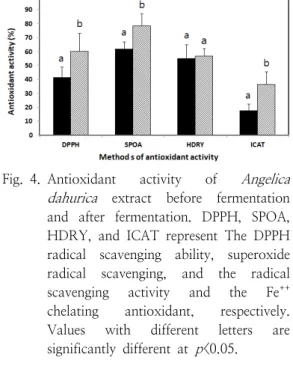
Abstract : probiotics strains promoting the health are a collection of microorganisms that improve or restore microbial populations in the intestines. In this study, Leuconostoc probiotics was isolated from fermented gimchi and identified. Angelica dahurica , containing abundantly antioxidant activity, imperator, is a wildly grown species of angelica native. Before fermentation, total phenolics compound were 48.83 ± 4.9 GAE mg /g in the Angelica dahurica extract. After fermentation total phenolic compounds were 97.7 ± 12.6 GAE mg/g. The total amount of phenol in the fermented product was 30.2% higher than that before fermentation. The total flavonoid content before fermentation was 9.86 ± 4.3 mg / g and the total flavonoid content was 37.17 ± 7.4 mg/g after fermentation, which was 82.3% higher than before fermentation. The DPPH radical scavenging activity, superoxide radical scavenging activity, hydroxy radical scavenging activity and Fe
++chelating antioxidative activity of the Angelica dahurica extract were 41.6 ± 7.1%, 65.7 ± 8.4%, 55.26 ± 9.4% and 17.5 ± 4.6%, respectively. After fermentation, they were 60.3 ± 12.6%, 78.8 ± 8.3%, 56.9 ± 4.9% and 36.6 ± 8.9%, respectively. Therefore, the present study suggests that the fermentation using the probiotics strain of the Angelica dahurica extract can be used as a functional health food and cosmetic material with increased antioxidant capacity.
Keywords : Probiotics, Angelica dahurica, Leuconostoc, Antioxidant activity, Fermentation
1. Introduction
The probiotics strains promoting the health are a collection of microorganisms that improve or restore microbial populations in the intestines[1-2]. The World Health Organization (WHO) defines probiotics as live microorganisms that, "when administered in
✝
Corresponding author
(E-mail: [email protected])
adequate amounts, confer a health benefit on the host[2]." Fermented gimchi is a traditional fermented food in Korea. gimchi has been reported to contain a variety of probiotics lactic acid bacteria[3-4]. Recently, among the lactic acid bacteria, Leuconostoc strains have been reported to exhibit various physiological activities as probiotcs[5-7].
The active oxygen produced in the body is
cleared by antioxidant present in vivo .
However, the excessive stress caused by
environmental pollutants, environmental
hormones, smoking and alcohols, destroys the balance of the oxidation-antioxidant system.
Therefore, the accumulated oxygen in the body is known to be cause of various diseases such as brain diseases, heart diseases, arteriosclerosis, skin diseases, digestive diseases, inflammation, rheumatism, and immune diseases including cancer[8]. Antioxidants are substances that react with active oxygen to minimize or inhibit vital injury, but synthetic antioxidants have been reported to cause side effects such as carcinogenesis[9]. Recently, studies on the development of natural antioxidants from animals and plants, which have been highly safe for a long time, have been actively perfumed [10-12].
Angelica dahurica , is a wildly grown species of angelica native to Siberia, Russia Far East, Mongolia, Northeastern China, Japan, Korea, and Taiwan. Imperatorin is a furocoumarin and a phytochemical that has been isolated from Angelica dahurica [13]. Imperatorin (9-(3-methylbut-2-enoxy)-7-furo [3, 2-g]
chromeone) is an active furocoumarin in the traditional Chinese medicine Angelica dahurica . It has been used in Korea or Chinese traditional medicine for anti-inflammatory, anticancer, anticonvulsant, vasodilator, antihypertensive, anti-biotic effect [14-16].
Imperatorin is known to prevent the production of inducible nitric oxide synthase and myeloperoxidase while significantly inhibited the phosphorylation and show a significant antioxidant capabilities[17-18].
Recently, fermentation of plant extracts containing natural physiologically active substances has been actively studied. The fermentation process has been known to increase the bioavailability by freeing bound physiologically active substances. Therefore, in this study, The probiotics strain was isolated from gimchi which is a traditional fermented food. Subsequently, the fermentation was performed by using the strain and the extract of Angelica dahurica . The antioxidant capacity of the fermented extract was investigated.
2. Materials and Method 2.1. Reagents and Materials
The reagents used in the assay antioxidant activity assay were 2,2-diphenyl-1-picrylhydrazyl, ascorbic acid, 1,10-phenantholine, FeSO
4, hydrogen peroxide, HCl, pyrogallol, FeCl
2, ferrozine, ethylene diamine tetra acetic acid and purchased from Sigma Aldrich Company (St. Louis, Mo., USA) The other reagents used were the grade 1. The Angelica dahurica used in the experiment were purchased at the local herb medicinal shop. Fermentation strains were isolated from traditional fermented gimchi (Home plus, Daejeon, Korea).
2.2. Strain isolation and identification The strains used in this study were isolated from fermented gimchi. The broth was poured into small sterilized container and one loopful of the broth was streaked on MRSA plate culture medium (Difco, NJ, USA). The plates were incubated at 30°C for 48 h. Colonies of milky white were selected and again cultured on a TSA (Difco, NJ, USA) plate medium containing 3% of sucrose for 24 h in incubator at 30°C. Finally, strains producing the dextran were selected. Finally, the selected strains were cultured on TSA plate medium and transferred to a slide glass and observed at 400 magnifications on a microscope (BX51, Olympus, Japan). The isolated and purified strains were identified by ABI PRISM BigDye Terminator Cycle Sequencing Ready Reaction Kit (Applied Biosystems, Carsbad, CA) with isolation of 16S rRNA sample, The base sequence of 16S rRNA (500-580 bp) was determined using an ABI PRISM 310 Genetic Analyzer (Applied Biosystems, Carsbad, CA).
Homology was used in BLAST program of
DDBJ / NCBI / GenBank database. The
generation of the systematic diagram was
determined based on the neighborhood binding
method.
2.3. Preparation and enrichment of Angelica dahurica extract
The water extract of Angelica dahurica was performed by immersing 300 g of dried Angelica dahurica dry in a 5 L extractor containing 2 L of distilled water and fully immersing the extractor in an 8°C reflux condenser at 95°C for 4 h. After the extraction, the residue was removed using a cheese cloth. The recovered pure extracts were refrigerated at 4°C or less. Concentration of the Angelica dahurica extract was carried out by placing 200 mL of the extract in a 500 mL concentration flask and connecting it to a vacuum condenser until the concentrate was 15
obrix at 60°C. The final concentrate was refrigerated at 4°C or lower until used in the experiment.
2.4. Fermentation of Angelica dahurica extract
For seed culture, the MM(mineral medium) was prepared by adding 3 g of K
2HPO
4, 0.01 g of FeSO
4· H
2O, 0.01 g of MnSO
4· 7H
2O, 0.01 g of NaCl, 0.05 g of CaCO
3, 1 g of ethylene diamine tetra acetic acid to 1 L distilled water. After dissolving MM, 0.5%
(w/v) yeast extract was added and the medium was adjusted to 6.5 using a pH meter. The fermentation medium was prepared by adding Angelica dahurica extract (15
oBrix) and 0.5%(w/v) yeast extract. The medium of pH was adjusted to 6.5. The fermentation was performed with 5 L batch fermenter (Semitic, Daejeon, Korea) and cultured at 30℃
and 100 rpm for 48 h.
2.5. Analysis of Angelica dahurica extract
The HPLC for analysis was as follows:
Shimadzu LC-20AD pump, CTO-20AC oven, Sil-20AC auto-sampler, PDA-20A UV detector, CBM-20A system controller and LC Workstation software (Shimadzu Corporation, Kyoto). A guide column and column Agilent C18 were used for sample separation. The
mobile phase consisted of (A) acetonitrile and (B) acetic acid, maintaining the 90-60% B solvent composition for 0-15 min, 60-20% B solvent for 15-25 min, 25-26 min, 0% B for 26-34 min, 0-90% B for 34-35 min, and 90% B for 10 min. For the next sample analysis, the elution time of the solvent was 10 min and the elution rate of the solvent was 1.0 mL / min. The temperature of the column oven was maintained at 40℃. The total UV detector wavelength was performed at 275 nm.
The amount of sample for analysis was 10 μ L.
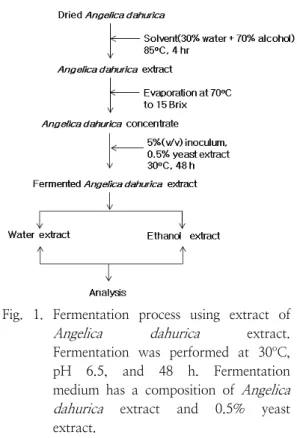
Fig. 1. Fermentation process using extract of Angelica dahurica extract.
Fermentation was performed at 30
oC, pH 6.5, and 48 h. Fermentation medium has a composition of Angelica dahurica extract and 0.5% yeast extract.
2.6. Antioxidant activity analysis
2.6.1. DPPH antioxidant measurement
The electron donating ability of DPPH-
radical was measured according to the method
of Huang et al[19]. The extracted samples
were dissolved in distilled water at a constant
concentration (0.1%), and then 2 mL of the
sample solution and 0.5 mL of DPPH-radical (0.2 mM) solution were mixed. The mixture was stored at room temperature for 30 min in darkness and the absorbance was measured at 517 nm. As a control, ascorbic acid was used.
DPPH radical scavenging activity was calculated by the following equation.
DPPH-radical scavenging activity(%)=
[(B−A)/B]×100 A: absorbance of sample, B: absorbance of blank
2.6.2. Hydroxy radical scavenging ability The scavenging activity for hydroxyl radicals was measured by modifying Avellar's method [20]. 10 mg of ascorbic acid was mixed with 10 mL DIW (deionized water). For the control, 0.1 M sodium phosphate buffer (pH 7.4) is used and samples are prepared at 10,000 ppm and 20,000 ppm. For the radical reaction, 300 μL of the sample solution, 300 μL of 3 mM 1,10-phenantholine, 300 μL of 3 mM FeSO
4, and 300 μL of 0.01%
hydrogen peroxide were mixed and incubated at 37°C for 1 h with shaking. The absorbance was measured at 536 nm using a spectrophotometer Respectively. Hydroxyl radical scavenging activity was calculated by comparing the absorbance of the sample with the control.
Hydroxyl radical scavenging activity(%)=
{[(ΔA/min)b-(ΔA/min)s]/(ΔA/min)b}×100.
b: control, s: sample
ΔA/min : absorbance after reaction – absorbance before reaction
2.6.3. Superoxide radical scavenging ability The digestive activity of superoxide was determined by modifying Xie's method[21]. For the control, 50 mM Tris-HCl buffer (pH 8.3) solution was used. The reaction was carried out by mixing 500 μL of the peptide in 500 μL of 50 mM Tris-HCl buffer (pH 8.3) prepared by using a micro tube, mixing 400
μL of 1.5 mM pyrogallol solution, reacting at room temperature for 4 min, Was used to measure the absorbance at 420 nm. The digestive activity against superoxide was calculated by the following equation by comparing the absorbance of the sample to the control.
Superoxide scavenging activity(%)=
{[(ΔA/min)b-(ΔA/min)s]/(ΔA/min)b}×100.
b: control, s: sample
ΔA/min : absorbance after reaction – absorbance before reaction
2.6.4. Fe2 + chelation ability
Iron chelation ability was measured according to the method of Le et al [22]. The extracted samples were dissolved in distilled water at a constant concentration (0-1%). 500 μL of the extracted sample, 100 μL FeCl
2(0.6 mM) and 900 μL of methanol were added to the test tube and mixed. After incubation for 5 min at room temperature, 100 μL ferrozine (5 mM) was added to the mixture and reacted at room temperature for 10 min. Absorbance was measured at 562 nm and ethylene diamine tetra acetic acid (EDTA) was used as a control.
Iron chelation activity(%)=(1−A/B)×100 A: absorbance of sample,
B: absorbance of blank
2.7. Statistical processing
All statistical analysis software SAS (Statistical Analysis System, 9.2) was used. The multiful comparison of means was performed by Tukey's multiple range test at ∂ = 0.05 level.
3. Result and Discussion
3.1. Isolation of probiotics strains from fermented gimchi
In order to isolate the probiotics strains
Fig. 1. Phylogenetic tree showing the phylogenetic relationships of strain of the isolated strain showed similarly Leuconostoc citreum . Therefore, the isolate strain was named Leuconostoc sp. YJJ18. Morphology and colonies of finally selected bacteria. Colonies were grown at TSA medium for 24 h. Bacterial figure was taken by a microscope of 400× magnification without stain.
from the fermented gimchi, gimchi broth was aseptically plated on the MRS medium.
Typical lactic acid bacteria colonies were selected and observed under a microscope. To obtain the pure bacteria, colonies were separated and plated on MMY2S solid medium. Subsequently, pure strains were screened by selecting colonies that produced a viscous substance, which appeared to be dextran.
Molecular phylogenetic analysis based on the 16S rRNA gene sequence showed that the selected strain was a strain belonging to the phylogenetic group including Leuconostoc sp.
The isolated strain showed a 100% affinity with Leuconostoc citreum (Fig. 2). Therefore, the isolate syrain was named Leuconostoc sp.
YJJ18.
3.2. Imperatorin analysis of Angelica dahurica extract
In this study, the imperatorin contained in extract was quantitatively analyzed using the internal standard trolox. Fig. 2A and B are HPLC chromatogram and represent the standard and the extract of Angelica dahurica . Numbers(A) indicate chlorogenic acid(1),
hesperidine(2), naringin(3), luteolin(4), internal standard trolox(5), and imperatorin(6).
Numbers(B) indicate internal standard trolox(5) and imperatorin(6), respectively. The amount of imperatorin was found to be 5.55 g/100 g as a result of comparison with known concentrations of standard. Another similar study reported that about 6.63 g/100 g was isolated from Angelica dahurica [23].
3.3. Total phenols and flavonoids of Angelica dahurica in fermented extract
The contents of total phenolic compounds in
white fly extract and fermented extract were
measured Table 1. Total phenolic compounds
and flavonoid contents were analyzed by
qualitative and quantitative analysis using gallic
acid and hesperidine as representative
indicators. Before fermentation, 48.825 ± 4.9
GAE mg / g was found in the white fly
extract, and 97.7 ± 12.6 GAE mg / g total
phenolic compound was measured in the white
fermented extract after fermentation. The total
amount of phenol in the fermented product
was 30.2% higher than that before
fermentation. The total flavonoid content
Fig. 3. A and B are HPLC chromatogram and represent the standard and the extract of Angelica dahurica . Numbers(A) indicate chlorogenic acid(1), hesperidine(2), naringin(3), luteolin(4), internal standard trolox(5), and imperatorin(6). Numbers(B) indicate internal standard trolox(5) and imperatorin(6), respectively.
Table 1. Total phenolic flavonoid compounds of Angelica dahurica extract
Total phenolic Total Flavonoid GAE (mg/g)
aHesperidine(mg/g)
bExtract before fermentation 48.8±14.31 9.87±4.30
Extract after fermentation 97.7±12.60 37.17±7.47
a
Total phenolic contents were expressed as gallic acid equivalents(GAE) mg/g dried hot water extract. Values are means ±SD (n=5).
b