Introduction
Since the fish farming of hybrid striped bass in the US started in the late 1980, it has greatly expanded to the industrial scale of approximately 30 million dollars in farm-gate value (Dasgupta and Thompson, 2013). The majority of hybrid striped bass are cultured in earthen ponds (Daniels, 2005). This is the most economical means of producing these fish, especially in rural areas of eastern North Carolina where the flat topography, high clay content of the soils and abundance of groundwater are ideally suited for this type of aquaculture production. However, cage culture is also practiced filling a small niche in southern Appalachian states with deep and watershed ponds that are not suitable for seining (Dasgupta and Thompson, 2013).
Feeds for hybrid striped bass are formulated to contain optimum nutrient levels, and fish are highly efficient at converting feed into nutrients while generating little waste product (Lochmann, 2015). However, some un-eaten feed or metabolites from the fish
inevitably pass into the pond water. These waste products primarily contribute to the organic load, increasing biological and chemical oxygen demand, blooming algae, and turning the pond water green (Jayaram and Beamish, 1992). Occasionally, effluent is released from the ponds into drainage ditches and eventually enters public waterways. The most significant release of effluent occurs when ponds are drained between crops (Schwartz and Boyd, 1994).
Since effluents from fish ponds are regulated under the National Pollutant Discharge Elimination System (NPDES) from 1973 in the US, all fish farms that discharge effluent into public waterways must be permitted (Schwartz and Boyd, 1994). Under the NPDES, the pond effluent with over 40 μg/l of chlorophyll-a, and measu- rable biochemical oxygen demand (BOD >5 mg/l) cannot be dis- charged. Based on past research, however, most pond effluent will not meet these standards, so that the appropriate effluent treatment methods are required.
Many chemicals are frequently used as the pond water treat- ment agents to improve soil and water quality and to control
JMLS
http://jmls.or.krChanges in BOD, COD, Chlorophyll-a and Solids in Aquaculture Effluent with Various Chemical Treatments
Jeonghwan Park1*, Harry V. Daniels2
1Department of Marine Bio-materials and Aquaculture, Pukyong National University, Busan 48513, Korea
2Department of Applied Ecology, North Carolina State University, Raleigh, North Carolina 27695, USA
Corresponding Author Jeonghwan Park
Department of Marine Bio-materials and Aquaculture, Pukyong National University, Busan 48513, Korea
E-mail : [email protected]
Received : October 18, 2017 Revised : October 22, 2017 Accepted : October 24, 2017
Four chemical treatments with hydrogen peroxide (H2O2), copper sulfate (CuSO4), potassium permanganate (KMnO4) and chlorine (Cl2) were applied to the effluent pond water of a hybrid striped bass saltwater recirculating aquaculture system to compare their oxidation power. Four chemicals were applied at concentrations of 0 (control), 1, 5, 10 and 20 mg/l.
An additional concentration of 40 mg/l was included in the chlorine treatment. Water samples from four hybrid striped bass ponds were tested with KMnO4 and Cl2. H2O2 did not reduce any of BOD, COD and chlorophyll-a, and copper sulfate was only effective on chlorophyll-a for the effluent pond. Removal efficiencies for chlorophyll-a by copper sulfate were 19.2%, 37.5%, 54.2% and 74.1% dose-dependently. Potassium permanganate effectively removed the BOD, COD and chlorophyll-a. The COD removal rates in four fish ponds varied from 15.9% to 31.6% at the concentration of 10 mg/l. Interestingly, Cl2 did not reduce the BOD and COD at all, but the BOD and COD instead increased drastically with increasing the Cl2 concentration. The pond water with the highest initial BOD and COD values among the fish ponds tested increased by 350% in the BOD and 150% in the COD at 20 mg/l. Furthermore, Cl2 did not significantly reduce any types of solid matter in this study, while KMnO4 seemed to reduce some extent volatile dissolved solid in the fish pond.
Keywords: Chemical treatment, Hybrid striped bass, Pond water, BOD, COD, Chl-a, Solids
50 Park J, Daniels HV
phytoplankton blooms and disease vectors (Boyd, 1995; Boyd and Tucker, 1998). Although the use of chemicals for pond water treat- ment often draws public concerns due to its potential impact on the culture animals, it would be still recognized as an effective method for water treatment between crops when no fish are present. Nevertheless, it is rare to find out the studies about the chemical oxidation efficiency on organics and phytoplankton removal. Therefore, the purpose of this study was to evaluate the oxidation efficiency of some chemicals which are known to reduce the organics or phytoplankton. The response of BOD, COD, chlorophyll-a and solids fraction with chemical treatment for the pond water were observed as indicators for oxidation efficiency of the chemicals.
Materials and Methods 1. Pond water and chemical treatment 1) Oxidation efficiency of chemicals
Water samples were collected from the effluent pond of a hybrid striped bass saltwater recalculating system at the Lake Wheeler Fish Barn of North Carolina State University to evaluate the oxidation efficiency of the different commonly used chemicals.
The four chemicals used were hydrogen peroxide (H2O2), copper sulfate (CuSO4), potassium permanganate (KMnO4) and chlorine (sodium hypochlorite; Cl2). Each chemical was applied at 0 (control), 1, 5, 10 and 20 mg/l, and the concentration of 40 mg/l was added to chlorine treatment. The water samples for each chemical treat- ment were collected separately over a short period so that the water quality variable remained within similar ranges.
2) Saltwater fish pond water treatment with KMnO4 and Cl2
Water samples from four hybrid striped bass ponds were treated with KMnO4 and Cl2. The treatment concentrations were 0 (control), 1, 5, 10 and 20 mg/l. Four water samples used in this study were taken from a fish pond at the Tidewater Research Station of North Carolina Department of Agriculture (P1), two commercial fish ponds (P2, P3) at Pinetown, North Carolina and a commercial fish pond (P4) at Aurora, North Carolina, from February to March.
3) Chemical preparation and treatment procedure
All chemicals were reagent grade purchased from a commercial supplier (Fisher Scientific). Hydrogen peroxide was added at the required amount from a 50% H2O2 extra pure stabilized solution.
Stock solutions of 5,000 mg/l were used for CuSO4 and KMnO4. A 10,000 mg/l stock solution of hypochlorite was used as the chlorine source. The hydrogen peroxide and chlorine concen- tration were quantified with permanganate titrimetric methods and DPD ferrous titrimetric method, respectively just before the experiment. Water temperature and pH of the sample waters were first adjusted at 20℃ and 8.5. The sample waters were divided into one-liter bottles, and the chemicals were added into the bottles at each concentration. The experiment was performed in triplicate for each treatment, and the contact times after adding the chemicals were 6 hours for KMnO4, H2O2 and Cl2, but 18 hours for CuSO4. All the sample waters were vigorously shaken to vent out any residual gaseous chemicals before water quality analysis.
2. Water quality and statistical analyses
The BOD, COD and chlorophyll-a were measured for all water samples (APHA 1995), and the solid matters were measured for samples from three commercial fish ponds (P2, P3 and P4).
The 5 day BOD test was measured with 300 ml BOD bottles according to the APHA (1995). The water samples were agitated until the oxygen concentration increased up to 8.5 mg/l. At the end of contact time, the water samples including the control were seeded with the sample waters not treated, and the contribution of the seed was deducted in BOD calculation. The water sample were also diluted by 0~75% to with the distilled water, depending on the enrichment of the sample waters.
The COD was determined by the heat of dilution method with sulfuric acid and potassium dichromate. (Boyd, 1979). All glassware was washed with H2SO4-Na2Cr2O7 combined cleaning solution, and rinsed with distilled water immediately prior to use.
The Acetone-Methanol extraction method was used to deter- mine the chlorophyll-a concentration (Picharr, 1987). Chlorophyll- a was extracted in a hot mixture of acetone and methanol after filtering with glass fiber filters (Gelman Sciences AE, 47 mm). The extraction was acidified with 0.1 N HCl, and the difference between readings before and after acidification in absorbance at 665 nm were measured to calculate the concentration.
Total solids, total volatile solids, total suspended solids, total dissolved solids, volatile suspended solids and volatile dissolved
52 Park J, Daniels HV
solids were determined according to the APHA (1995).
One-way ANOVA tests were performed to evaluate the effects of KMnO4 and Cl2 treatments on solids fractions in the commercial fish pond waters using SPSS 12.0 for Windows (SPSS Inc., Chicago, IL, USA). Duncan's multiple range test was used for detecting significant differences among the averages (p < 0.05).
Results and Discussion
Hydrogen peroxide has been used to reduce the BOD, COD and offensive odor in domestic or industrial wastewater for many years (Ksibi, 2006). There has been also some interest on H2O2 as an oxidizing agent in aquaculture to reduce the BOD and COD in the pond water. However, H2O2 removed neither the BOD, COD, nor chlorophyll-a within the treatment concentration used in this study (Fig. 1). Although the BOD concentration greatly decreased with H2O2 treatment, apparently the residual oxygen atom released from the H2O2 and captured in BOD bottles increased the oxygen concentration. This was supported by the fact that the BOD con- centration in the highest treatment concentration greatly exceeded the initial value, and the COD concentration did not change with the treatment. The bottles with H2O2 treatment were vigorously shaken after 6 hours and left open to the air for an hour before the BOD setup. Nevertheless, increases in DO concentration in the BOD bottles with the treatment were still observed in an additional experiment for validation. Ksibi (2006) reported reduced COD in domestic wastewater with H2O2 treatment. However, the treat- ment concentrations showing more than 30~80% reduction were 150~450 mg H2O2/l, which were much higher concentrations compared to those in the present study. The concentration of 75 mg H2O2/l that was the lowest in the previous study, but was much higher than the highest value in this study, showed only 5%
COD reduction. Furthermore, Brik et al. (2004) also reported that the maximum reduction in color material of textile wastewater was only less than 10% at 250 mg H2O2/l. Vänninen and Koskula (1998) demonstrated that a single application of 125 mg H2O2/l to one week old cucumber seedling or daily applications over three weeks of 100 mg H2O2/l reduced algal growth by 40~60%. After algae were already grown up intensively, however, a concentration of 1,500 mg H2O2/l could not eliminate the algae or reduce its further growth in the study. Based on the previous study and this study, the effective concentration to reduce the organic matter or control the algae with H2O2 treatment would be much higher than the concentration used in this study, which is unlikely to be acceptable for fish pond or effluent water treatment.
Copper sulfate did not reduce either the BOD or COD, but reduced chlorophyll-a. Copper sulfate has been recognized as a strong algaecide, and many authors have demonstrated its toxicity to algae (Bartlett et al., 1974; Levy et al., 2009; Mischke et al., 2009). The removal efficiencies of CuSO4 were 19.2%, 37.5%, 54.2%
and 74.1% at the treatment concentrations of 1, 5, 10 and 20 mg CuSO4/l. The values were relatively much lower than the values 13%, 37% and 53% at 0.5, 1 and 2 mg CuSO4/l, reported by Palmer (1956). Many studies have addressed different effects of CuSO4 on algae as a function of pH, alkalinity, temperature, and
exposure opportunity (Bartsch, 1954; Fitzgerald and Faust, 1963;
Takamura et al., 1990; Mischke et al., 2009). In addition, the toxicity of CuSO4 may vary even at the same treatment concentration within same genus or species, as copper absorption into the algae is governed by competitive binding at the cell surface (Webster and Gadd, 1996; Wilde et al., 2006; Mischke et al., 2009).
Potassium permanganate was most effective in reducing the BOD, COD and chlorophyll-a of the effluent pond and fish pond waters in this study (Fig. 2). Potassium permanganate is known as a strong oxidizer that reacts with organic matter, and even reduces inorganic substances in water (Boyd, 1979), consequently reducing the rate of oxygen consumption by biological and chemical pro- cesses (Lay, 1971). Tucker and Boyd (1977) reported slight reduction of BOD and COD levels with KMnO4 treatment. The dissolved oxygen levels after four days in pond water with the COD level
under 100 mg/l remained high after treatment with KMnO4 con- centrations of 4 and 8 mg/l. In addition, the COD level was re- duced by 15% at a KMnO4 concentration of 8 mg/l. The removal efficiency with KMnO4 for the effluent pond in this study was 33.2% at 10 mg/l, which is higher than the value reported by Tucker and Boyd (1977). In the meantime, the COD removal rates in four fish ponds greatly varied from 15.9% to 31.6% at the treatment concentration of 10 mg/l. The effectiveness of chemicals can vary with the other water qualities such as pH, water tempera- ture and dissolved oxygen, and the amount of consumption of the organic matter in water. Furthermore, the sample water used in the experiment was previously treated with the geo-textile bag and ozone treatment before being released to the pond, and the bio-chemical degradability would be enhanced to show the better removal efficiency for the BOD and COD. As many authors have
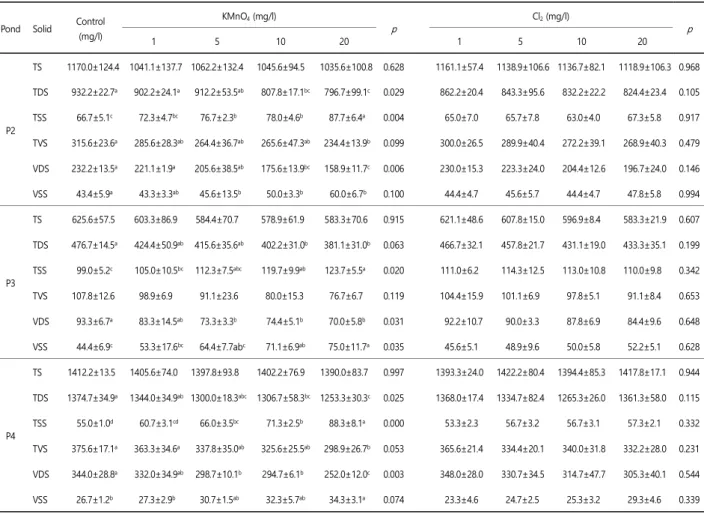
Table 1. Solids fractions in the commercial fish pond waters treated with KMnO4 and Cl2
Pond Solid Control (mg/l)
KMnO4 (mg/l)
p Cl2 (mg/l) p
1 5 10 20 1 5 10 20
P2
TS 1170.0±124.4 1041.1±137.7 1062.2±132.4 1045.6±94.5 1035.6±100.8 0.628 1161.1±57.4 1138.9±106.6 1136.7±82.1 1118.9±106.3 0.968 TDS 932.2±22.7a 902.2±24.1a 912.2±53.5ab 807.8±17.1bc 796.7±99.1c 0.029 862.2±20.4 843.3±95.6 832.2±22.2 824.4±23.4 0.105 TSS 66.7±5.1c 72.3±4.7bc 76.7±2.3b 78.0±4.6b 87.7±6.4a 0.004 65.0±7.0 65.7±7.8 63.0±4.0 67.3±5.8 0.917 TVS 315.6±23.6a 285.6±28.3ab 264.4±36.7ab 265.6±47.3ab 234.4±13.9b 0.099 300.0±26.5 289.9±40.4 272.2±39.1 268.9±40.3 0.479 VDS 232.2±13.5a 221.1±1.9a 205.6±38.5ab 175.6±13.9bc 158.9±11.7c 0.006 230.0±15.3 223.3±24.0 204.4±12.6 196.7±24.0 0.146 VSS 43.4±5.9a 43.3±3.3ab 45.6±13.5b 50.0±3.3b 60.0±6.7b 0.100 44.4±4.7 45.6±5.7 44.4±4.7 47.8±5.8 0.994
P3
TS 625.6±57.5 603.3±86.9 584.4±70.7 578.9±61.9 583.3±70.6 0.915 621.1±48.6 607.8±15.0 596.9±8.4 583.3±21.9 0.607 TDS 476.7±14.5a 424.4±50.9ab 415.6±35.6ab 402.2±31.0b 381.1±31.0b 0.063 466.7±32.1 457.8±21.7 431.1±19.0 433.3±35.1 0.199 TSS 99.0±5.2c 105.0±10.5bc 112.3±7.5abc 119.7±9.9ab 123.7±5.5a 0.020 111.0±6.2 114.3±12.5 113.0±10.8 110.0±9.8 0.342 TVS 107.8±12.6 98.9±6.9 91.1±23.6 80.0±15.3 76.7±6.7 0.119 104.4±15.9 101.1±6.9 97.8±5.1 91.1±8.4 0.653 VDS 93.3±6.7a 83.3±14.5ab 73.3±3.3b 74.4±5.1b 70.0±5.8b 0.031 92.2±10.7 90.0±3.3 87.8±6.9 84.4±9.6 0.648 VSS 44.4±6.9c 53.3±17.6bc 64.4±7.7abc 71.1±6.9ab 75.0±11.7a 0.035 45.6±5.1 48.9±9.6 50.0±5.8 52.2±5.1 0.628
P4
TS 1412.2±13.5 1405.6±74.0 1397.8±93.8 1402.2±76.9 1390.0±83.7 0.997 1393.3±24.0 1422.2±80.4 1394.4±85.3 1417.8±17.1 0.944 TDS 1374.7±34.9a 1344.0±34.9ab 1300.0±18.3abc 1306.7±58.3bc 1253.3±30.3c 0.025 1368.0±17.4 1334.7±82.4 1265.3±26.0 1361.3±58.0 0.115 TSS 55.0±1.0d 60.7±3.1cd 66.0±3.5bc 71.3±2.5b 88.3±8.1a 0.000 53.3±2.3 56.7±3.2 56.7±3.1 57.3±2.1 0.332 TVS 375.6±17.1a 363.3±34.6a 337.8±35.0ab 325.6±25.5ab 298.9±26.7b 0.053 365.6±21.4 334.4±20.1 340.0±31.8 332.2±28.0 0.231 VDS 344.0±28.8a 332.0±34.9ab 298.7±10.1b 294.7±6.1b 252.0±12.0c 0.003 348.0±28.0 330.7±34.5 314.7±47.7 305.3±40.1 0.544 VSS 26.7±1.2b 27.3±2.9b 30.7±1.5ab 32.3±5.7ab 34.3±3.1a 0.074 23.3±4.6 24.7±2.5 25.3±3.2 29.3±4.6 0.339 Values are means ± SD (cm, g) of triplicate groups. Means ± SD within the same columns for each of potassium permanganate or chlorine treatment with the same superscript are not significantly different at p<0.1, based on Duncan's multiple range test
54 Park J, Daniels HV
reported the effectiveness of KMnO4 to remove algae from water (Fitzgerald, 1964; Kemp et al., 1966; Ma et al., 1997; Drikas et al., 2001; Knappe et al., 2004), the chlorophyll-a levels greatly de- creased with KMnO4 treatment for both of effluent and fish ponds in this study.
The chlorination effects on the organic matter in wastewater have been assessed by measuring the BOD and COD in last decades. It was generally accepted that chlorination slightly re- duced the parameters presenting some benefits for removal of organic matters (El-Rehaili, 1995). In this study, Cl2 reduced the chlorophyll-a above the treatment concentration of 20 mg Cl2/l.
However, interestingly, Cl2 could not reduce the BOD and COD at all, but the BOD and COD instead increased drastically with increasing treatment concentration. The increases in the BOD and COD after Cl2 treatment were also observed in all of the hybrid striped bass pond waters. Although the BOD levels at P1 and P3 did not greatly increase with increasing Cl2 concentration, the levels after treatment were still higher than the values in the control.
Specifically, the P4, with the highest initial BOD and COD values among the fish ponds tested, presented increases of 350% in BOD and 150% in COD at 20 mg Cl2/l. El-Rehalili (1995) has reported that chlorination increased the BOD and COD together on sec- ondary effluent wastewater with increasing Cl2 concentration. The BOD and COD values in the raw wastewater were 29 mg/l of BOD and 74 mg/l of COD which were similar with this study, and those values increased to 35 mg/l and 85 mg/l after 10 mg/l of chlorine treatment. At the higher chlorine concentration of 20 mg/l, the values increased to 40 mg/l and 118 mg/l respectively, so that the tendency was coincident with this study (Fig. 3). Chlorine which is one of the strongest oxidizing agents and commonly used for water disinfection seemed to change the biological and chemical properties of the water, specifically its organic characteristics.
Basically, the BOD and COD used for measuring the organic con- tent in water is an indirect measure which does not represent any chemical identity or status of organic matter by themselves (Jolley, 1975; Michael et al., 1991; El-Rehalili, 1995). For these increases in the BOD and COD, El-Rehalili (1995) has presumed that Cl2 treatment might result in modifying the organic matrix to render it more biodegradable and amenable to oxidation in the BOD and COD tests.
The changes of the solid fraction in the commercial fish pond waters treated with KMnO4 and Cl2 would help understanding the changes of the BOD and COD. In this study, although the total solids (TS) were not significantly changed with either chemical treatment (p>0.1, Table 1), Potassium permanganate seemed to
reduce to some extent volatile dissolved solids (VDS). Furthermore, KMnO4 treatment was likely to increase the suspended solids, so that VDS could be reduced with KMnO4 treatment by both oxi- dation and coagulation. Thus, the reduction in BOD and COD with KMnO4 treatment could be attributed to the oxidation of VDS, which is a major component of the organic part of solid matters.
Unlike KMnO4, although the solids measuring method would be somewhat rough to precisely identify the differences derived from the chemical treatment and there was decreasing tendency in VDS at high treatment concentration, Cl2 could not significantly reduce any types of solid matters in this study, which had not been considered (p>0.1). El-Rehalili (1995) also mentioned that total organic carbon (TOC) concentration in the secondary waste- water did not change after chlorination even in the high dose of 30 mg/l, which has a thread of connection with the solids fraction result in this study. Therefore, it is quite acceptable that Cl2 may not reduce the organic part of the solid, but change the property of the organic matters more to a bio-chemically degradable form to increase the apparent BOD and COD levels.
During this study, CuSO4 and Cl2 could reduce only chlorophyll- a, while KMnO4 reduced both organic matters and chlorophyll-a.
However, the removal ratios of the BOD, COD and chlorophyll-a to 1 mg of KMnO4 (quantitative removal ratio) greatly decreased with increasing treatment concentration. Thus, the KMnO4 was more required to remove further BOD, COD and chlorophyll-a.
These changes in the quantitative removal ratio may be caused by a relative increase of non-degradable organic matter resulting in more KMnO4 demands.
References
APHA. 1995. Standard Methods for the Examination of Water and Wasterwater, 19th ed. Am. Public Health Association Inc., New York.
Bartlett LF, Rabe W, Funk WH. 1974. Effects of copper, zinc and cadmium on Selenastrum capricornutum. Water Res 8: 179 -185.
Bartsch AF. 1954. Pratical Methods for Control of Algae and Water Weeds. U.S. Public Health Rep 69: 749-757.
Boyd CE. 1979. Water quality in warmwater fish ponds. Alabama Agricultural Experiment Station, Auburn University, Auburn, Alabama, pp 1-354.
Boyd CE. 1995. Bottom Soils, Sediment, and Pond Aquaculture.
Chapman and Hall, New York, New York, pp 1-348.
Boyd CE, Tucker CS. 1998. Water Quality and Pond Soil Analyses
for Aquaculture. Alabama Agricultural Experiment Station, Auburn University, Alabama, pp 1-183.
Brik MB, Chamam B, Schöberl P, Braun RB, Fuchs W. 2004. Effect of ozone, chlorine and hydrogen peroxide on the elimination of colour in treated textile wastewater by MBR. Water Sci and Tech 49: 299-303.
Daniels VH. 2005. Effluents From Hybrid Striped Bass Ponds (blueprint). North Carolina SeaGrant. North Carolina State University, Raleigh, Publication No. NA16RG2251.
Dasgupta S, Thompson KR. 2013 Comparision of Costs of Dif- ferent Hybrid Striped Bass Production Systems in Ponds.
Southren Regional Aquaculture Center, Stonville, Mississippi, SRAC Publication No. 3000.
Drikas M, Chow CW, House J, Burth MD. 2001. Using coagulation, flocculation, and settling to remove toxic cyanobacteria. J Am Water Works Assoc 93: 100-111.
El-Rehaili AM. 1995. Response of BOD, COD and TOC of secondary effluents to chlorination. Water Res 29: 1571-1577.
Fitzgerald BG. 1964. Laboratory evaluation of potassium perman- ganate as an algaecide for water reservoirs. Southwest Water Works J 45: 16-17.
Fitzgerald BG, Faust SL. 1963. Factors affecting the algicidal and algistatic properties of copper. J Appl Microbiol 11: 345-351.
Jayaram MG, Beamish FW. 1992. Influence of dietary protein and lipid on nitrogen and energy losses in lakes trout, Salvelinus namaycush. Can J of Fish Aquat Sci 49: 2267-2272.
Jolley RL. 1975. Chlorine-containing organic constituents in chlor- inated effluents. J Water Pol Cont Fed 47: 601-618.
Kemp HT, Fuller RG, Davidson RS. 1966. Potassium permanganate as an algaecide. J Am Water Works Assoc 58: 255-263.
Knappe R, Detlef RU, Belk C, Driley DS, Grandy SR, Rastogi N, Rike AH. 2004. Algae detection and removal strategies for drinking water treatment plants. AWWA Research Foundation, Denver, pp 1-251.
Ksibi M. 2006. Chemical oxidation with hydrogen peroxide for domestic wastewater treatment. Chem Eng J 119: 161-165.
Lay BA. 1971. Applications for potassium permanganate in fish culture. Transactions. Am Fish Soc 100: 813-815.
Levy JL, Stauber JL, Wakelin SA, Jolley DF. 2009. The effect of bac-
teria on the sensitivity of microalgae to copper in laboratory bioassays. Chemosphere 74: 1266-1274.
Lochmann R. 2015. Feeds and feeding of hybrid striped bass.
Southern Regional Aquaculture Center, Mississippi, SRAC Publication No. 3001.
Ma J, Graham N, Li G. 1997. Effect of permanganate peroxidation in enhancing the coagulation of surface water laboratory case studies. J Water Supply Res T-Aqua 46: 1-10.
Michael LC, Pellizzari ED, Norwood DL. 1991. Application of the master analytical scheme to the determination of volatile organics in wastewater influents and effluents. Environl Sci Tech 25: 150-155.
Mischke CC, Wise DJ, Zimba PV. 2009. Impact of copper sulfate on plankton in channel catfish nursery ponds. JWAS 40: 122 -128.
Palmer CM. 1956 Control of algae in swimming pools. The Journal of the American Medical Association 162: 938.
Picharr L. 1987. Use of an Aceton: Methanol Mixture for the Ex- tration and Spectrophotometric Determination of Chlorophyll a in Phytoplankton, Archiv für Hydrobiologie - Supplement 78: 99-117.
Schwartz MF, Boyd CE. 1994. Channel catfish pond effluents. Prog Fish-Cult 56: 273-281.
Takamura N, Kasai F, Watanabe MM. 1990. Unique response of Cyanophyceae to copper. J Appl Phyco 2: 293-296.
Tucker CS, Boyd CE. 1977. Relationships between potassium per- manganate treatment and water quality. Trans Am Fish Soc 106: 481-488.
Vänninen I, Koskula H. 1998. Effect of hydrogen peroxide on algal growth cucumber seedling and the reproduction of shore flies (Scatella Stagnalis) in rockwool. Crop Prot 17: 547-553.
Webster EA, Gadd GM. 1996. Perturbation of monovalent cation composition in Ulva lactuca by cadmium, copper and zinc.
Biometals 9: 51-56.
Wilde KL, Stauber JL, Markich SJ, Franklin NM, Brown PL. 2006.
The effect of pH on the uptake and toxicity of copper and zinc in a tropical freshwater alga (Chlorella sp.). Arch of Environ Contam and Toxicol 51: 174-185.