1)1. Introduction
With the fast development in ad-hoc wireless com-
※ 본 논문은 산업통상자원부 ‘산업전문인력역량강화사업’의 재원으로 한국산업 기술진흥원(KIAT)의 지원을 받아 수행된 연구임(2020년 임베디드SW 전문 인력 양성사업, 과제번호: N0001884).
※ 본 논문은 2018년 과학기술정보통신부 재원으로 한국연구재단 지역대학연구 사업의 지원을 받아 수행된 연구임(NRF-2018R1D1A3B07042838).
† 비 회 원 : 충북대학교 전파통신공학 석사과정
†† 종신회원 : 충북대학교 정보통신공학부 부교수 Manuscript Received : October 10, 2019 Accepted : November 9, 2019
* Corresponding Author : Euisin Lee([email protected])
munications and vehicular technologies, vehicular ad hoc networks (VANETs) have enabled to deliver data between vehicles through self-organizing vehicle-to- vehicle communication networks [1]. Many projects (e.g., VIC’S [2], CarTALK 2000 [3], NOW (Network- on-Wheels)) and industry groups (e.g., the Car2Car Communication Consortium [4]) have conducted va- rious researches to provide applications for the intelligent transport system by using VANETs. In the intelligent transport system, VANETs enable to
A RSU-Aided Resource Search and Cloud Construction Mechanism in VANETs
Yoonhyeong Lee†⋅Euisin Lee††
ABSTRACT
With the fast development in wireless communications and vehicular technologies, vehicular ad hoc networks (VANETs) have enabled to deliver data between vehicles. Recently, VANETs introduce a Vehicular Cloud (VC) model for collaborating to share and use resources of vehicles to create value-added services. To construct a VC, a vehicle should search vehicles that intend to provide their own resource.
The single-hop search cannot search enough provider vehicles due to a small coverage and non-line-of-sights of communications. On the other hand, the multi-hop search causes very high traffics for large coverage searching and frequent connection breakages. Recently, many Roadside Units (RSUs) have been deployed on roads to collect the information of vehicles in their own coverages and to connect them to Internet. Thus, we propose a RSU-aided vehicular resource search and cloud construction mechanism in VANETS. In the proposed mechanism, a RSU collects the information of location and mobility of vehicles and selects provider vehicles enabled to provide resources needed for constructing a VC of a requester vehicle based on the collected information. In the proposed mechanism, the criteria for determining provider vehicles to provide resources are the connection duration between each candidate vehicle and the requester vehicle, the resource size of each candidate vehicle, and its connection starting time to the requester vehicle. Simulation results verify that the proposed mechanism achieves better performance than the existing mechanism.
Keywords : VANETs, Vehicular Cloud, RSU, Cloud Construction, Resource Search
차량 네트워크에서 RSU를 이용한 리소스 검색 및 클라우드 구축 방안
이 윤 형†⋅이 의 신††
요 약
무선 통신 및 차량 기술의 발전으로 차량 간 네트워크(VANETs)는 차량간에 데이터를 전달할 수있게 되었다. 최근 VANETs은 차량의 자원을 공유하고 사용하여 부가가치 서비스를 창출하기 위해 차량 클라우드(VC)모델이 등장했다. VC를 구성하기위해서 차량은 자원을 제공하는 차량을 검색해야한다. 하지만 단일 홉 검색은 범위가 작고 통신 범위 밖에 공급차량을 검색할 수 없다. 반면 멀티 홉 검색은 넓은 통신범위를 검색 하지만 차량의 이동성으로 인해 연결 끊김이 잦고 검색에 사용되는 트래픽이 크다. 최근 많은 도로변 장치(RSU)가 도로에 배치되어 차량 정보를 수집하고 인터넷에 연결하는 역할을 한다. 따라서 VANETs에서 RSU를 이용한 차량 자원 검색 및 클러스터 구성 메커니즘을 제안한다. 본 논문에서 RSU는 차량의 위치 및 이동성 정보를 수집하고 수집된 정보를 통해 요청 차량의 VC를 구성하는데 필요한 자원을 제공 할 수 있는 공급차량을 선정한다.
제안 방안에서, 자원을 공급하는 차량을 결정하기 위한 기준으로 각 후보 차량과 요청 차량 사이의 연결 지속시간, 각 후보 차량의 가용 자원 및 요청 차량에 대한 연결 시작 시간을 고려한다. 시뮬레이션을 통해 기존 방안들과 비교하고 성능의 향상을 확인 하였다.
키워드 : VANETs, 차량 클라우드, RSU, 클라우드 형성, 리소스 검색
※ This is an Open Access article distributed under the terms of the Creative Commons Attribution Non-Commercial License (http://creativecommons.org/ licenses/by-nc/3.0/) which permits unrestricted non-commercial use, distribution, and reproduction in any medium, provided the original work is properly cited.
provide drivers and passengers with safety and convenience, and furthermore introduce new applications for entertainment and environment monitoring [5].
Many literatures on VANETs have been addressed various applications such as car accident warning for active safety, emergency vehicle access for public service, road congestion notice for improved driving, and commercial advertisement for business [6, 7].
VANETs is recently about to evolve with the following emerging paradigms [8]. Frist, vehicles produce and consume a great amount of contents having the property of local relevance. Next, vehicles collaborate by sharing and using their resources to create value-added services. These paradigms enable VANETs to support next-generation vehicular applications such as traffic signal optimization, traffic flow control, and autonomous driving. To enable these paradigms, the technique of cloud computing is necessary to VANETs [9]. To do this, a Vehicular Cloud (VC) model is defined as a set of vehicles that enable to share their own resources [10]. In VANETs, a vehicle is able to construct a VC by using the collection of vehicles’ resources. The VC leverages the increasing processing and storage capacity of vehicles. Thus, to construct a VC, a vehicle should search vehicles that intend to provide their own resource.
Many mechanisms have been proposed for sear- ching resource provider vehicles to construct a VC on vehicular environments in the literature [11-15].
They can be categorized two approaches: single-hop search and multi-hop search. In the single-hop search approach, the range of resource searching is limited within only the communication range of requester vehicles [11, 12]. If a requester vehicle does not have many neighbor vehicles in its com- munication range, it cannot search enough resource provider vehicles to construct a VC due to the small coverage of single-hop communications, and thus causes to high resource search failures. Furthermore, since a requester vehicle might have much less neighbor vehicles due to the problem of non-line- of-sight in urban environments, the problem of res- ource search failures is even worse. On the other hand, the multi-hop search approach performs multi-hop communications search to find more vehicles by extending the resource searching range
[13-15]. However, it generates very high traffics in the network for multi-hop searching. Moreover, since multi-hop communications incurs frequent connection breakages between the resource requester and provider vehicles, it causes more traffics to reconstruct multi-hop communication connections.
To connect vehicles to Internet recently, many Roadside Units (RSUs) have been deployed along roads in vehicular environments [16, 17]. RSUs cover relatively wide areas in communications, collect the information such as locations of vehicles in their own coverages, and maintain connections with the vehicles. Thus, we propose a RSU-aided vehicular resource search and cloud construction mechanism in VANETs. In the proposed mechanism, RSUs collect the information of mobility and resource in addition to the location information of every vehicle within their own coverage. On the collected information, RSUs select provider vehicles enabled to provide resources needed for constructing a VC of a request vehicle. In the proposed mechanism, the criteria for determining provider vehicles to provide resources are the connection duration between each candidate vehicle and the request vehicle, the resource size of each candidate vehicle, and its connection starting time to the request vehicle. Simulation results verify that the proposed mechanism achieves better performance than the single-hop search, the multi- hop search, and the simple RSU search mechanisms in terms of the cloud success ratio and the number of V2V packets.
The remainder of the paper is organized as follows. Section 2 describes the proposed protocol in detail and section 3 evaluates the performance of the proposed protocol through simulation results.
Section 4 concludes the paper.
2. Problem Statement and Network model
2.1 Problem Statement
In existing researches, when the requester vehicle requests insufficient resources and service time, it sends a request message to other vehicles within its communication range. However, if required re- sources and service time is insufficient within sin- gle-hop, the cloud cannot be constructed. In this case, to construct cloud, the requester vehicle
searches vehicles located in multi-hop communica- tion range to receive insufficient resources and service time. But, the single/multi-hop search for constructing a cloud using only V2V communication increases the delay time until the cloud is con- structed and decreases the cloud success ratio due to the mobility problem of the vehicle. As a result, this causes several problems. Although the requester
vehicle and other vehicles are located in communi- cation range, the search cannot be performed be- cause of the multi-hop communication character- istics, packet collision or loss. Also, even if the cloud is constructed, as the number of hops increas- ing, the reliability of service is decreased. There is another problem. In the intersection scenario, the requester vehicle cannot search other vehicles lo- cated in the communication range of the requester vehicle because of obstacles such as buildings.
2.2 Network Model of Proposed Mechanism
In this paper, requester vehicle requires resources and service time to construct a VC. The vehicular cloud is constructed by utilizing resources and service time of the requester vehicle and provider vehicles. However, available resources and service time of the requester vehicle are insufficient to construct a VC in single hop. Therefore, the re- quester vehicle must utilize the resources and service time of vehicles entering the intersection in out- of-sight-zone.
1
2
3
4
5 R
6 RSU Mreq
7
1
2
3
4
5 R
6
RSU 7
Mrep
Mres Mres Mres
(a) Requester Vehicle Requests to RSU (b) RSU Selects Provider Vehicle for Requester and Reserve
RSU
1
3 4
R
6
7
5
2 Mres Mrel
Mrea
RSU
1
3 4
R
6 5
2
Vehicle Cloud
(c) RSU Reallocates cloud When Sensing cloud is going to Broke (d) Cloud Construction Fig. 1. Network Scenario Model Example
Notation Description
CST Connection Start Time
CET Connection End Time
Rr Amount of request resource Tr Request resource time Rn Available resource of provider vehicle n Tsn CST of provider vehicle n and requester vehicle Ten CET of provider vehicle n and requester vehicle Tn Connection time of provider n and requester
Vreq Requester Vehicle
VCn Available Candidate Vehicle
VPn Provider Vehicle
Table 1. Notaion Table
There are RSUs in an intersection, and the RSUs can obtain information using V2I communication with all vehicles entering the intersection in four different trajectories. The out-of-sight-zone is to the location of vehicles moving to intersection from other routes that are not visible in the sight of the requester vehicle. For the requester vehicle to obtain information on the vehicles in the out-of-sight-zone, V2I communication via a RSU is utilized. In the intersection, the requester vehicle utilizes V2V com- munication to construct a VC and calculates reliable connection time using trajectory, location, and velocity information.
In the network model of proposed mechanism, V2I communication and V2V communication adopt different communication method respectively. In general, the communication speed and distance are a trade-off relationship [18]. In the V2V communication providing direct resources, the IEEE802.11g is adopted to provide resources rapidly in an intermittent network and the communication range is 120m for reliable transmission speed for providing VC services.
On the other hand, in the V2I communication between the vehicle and the RSU, IEEE 802.11p communication is adopted, which has a reliable communication range (about 1000m) by exchanging information for matching the V2V communication.
3. Proposed mechanism
In this paper, to solve problems mentioned in problem statement, we propose RSU-aided vehicular resource search and cloud construction mechanism.
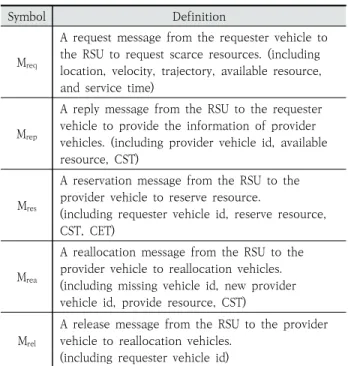
The messages use in the mechanism are summarized in Table 2.
The requester vehicle Vreq requires resources and service time to provide insufficient resources for cloud services. Since the resources of Vreq is insufficient, Vreq cannot utilize the cloud service. Vreq
must search provider vehicles having the required Rr
and Tr in its communication range. The Vreq sends a request message to the RSU, including its location, velocity and trajectory information.
The RSU receiving the Mreq from the Vreq selects VPns satisfying the requirement of the Vreq because the RSU maintains information (location, velocity and trajectory) of all vehicles within its communication range using periodical beacon signaling. Also, the
RSU can calculates reliable connection time between the Vreq and all VCns through the spatio-temporal similarity algorithm. The reliable connection time is the time duration between the CST and CET. Finally, the requester vehicle can receive resources and service time from VPns selected by RSU in the intersection the proposed mechanism is represented sequentially (a) to (d) in Fig. 1.
In the following subsections, we describe the role of the requester vehicle, RSU and provider in details.
3.1 The Role of Requester Vehicle
The role of Vreq is represented as algorithm 1. For example, let the Vreq requests Rr and Tr in Fig. 1.
The Vreq unicast Mreq including its location, velocity, trajectory, Rr and Tr to RSU. Upon receiving Mrep
about the information (resources, CST) of VPns(Vp2, Vp3, Vp5) from the RSU, Vreq updates the infor- mation in its cloud table as Fig. 2(a). After that, Vreq
requests resources of VPns based on CST of each vehicle. And Vreq receives resources from VPns.
As shown in Fig. 2(a), the Vreq requests resources on Ts2 to VP2, on Ts3 to VP3 and on Ts5 to VP5.
VPns receiving request provider own resources to the requester vehicle sequentially.
From the RSU, Vreq receives the Mrep including the id of VPns (VP2, VP3, VP5) and the allocated resource and CST information, respectively. As shown in Fig. 2(a),
Symbol Definition
Mreq
A request message from the requester vehicle to the RSU to request scarce resources. (including location, velocity, trajectory, available resource, and service time)
Mrep
A reply message from the RSU to the requester vehicle to provide the information of provider vehicles. (including provider vehicle id, available resource, CST)
Mres
A reservation message from the RSU to the provider vehicle to reserve resource.
(including requester vehicle id, reserve resource, CST, CET)
Mrea
A reallocation message from the RSU to the provider vehicle to reallocation vehicles.
(including missing vehicle id, new provider vehicle id, provide resource, CST)
Mrel
A release message from the RSU to the provider vehicle to reallocation vehicles.
(including requester vehicle id)
Table 2. Message Table for Proposed Mechanism
ID CST Res
2 Ts2 R2
3 Ts3 R3
5 Ts5 Rr-R2-R3
ID CST Res
2 Ts2 R2
3 Ts3 R3
5 Ts5 Rr-R2-R3 7 Ts7 Rr-R2-R3
(a) (b)
Fig. 2. Replace ID 5 to ID 7 on Cloud Table
Algorithm 1: Message Procedure of Requester Vehicle 1:
2:
3:
4:
5:
6:
7:
8:
9:
10:
11:
12:
13:
14:
15:
16:
17:
18:
if ( requires to resources ) then Vreq sends Mreq to RSU end if
if (receives Mrep) then if(resource is satisfied) then Vreq update Cloud Table;
Vreq requests resource to VPn to VPn at TSn;
else
Vreq sends Mreq to RSU;
end if end if
if(doesn’t receive resource from VPn at TSn) delete VPn on Cloud Table;
send Mreq to RSU about miss resource;
end if
if(receive Mrea from RSU) Vreq update Cloud Table;
end if
Vreq updates the information of VP2, VP3, and VP5 in its own cloud table. Based on the CST of the provider vehicles through the cloud table, Vreq requests resources for VP2, VP3 and VP5, and provides the resources through V2V communication. Vreq requests to VP2 in Ts2 time, requests VP3 to VP3 in Ts3 time, and requests resources to VP5 in Ts5 time.
However, due to the characteristic of the vehicular cloud such as mobility and communication delays, the requester vehicle cannot receive the requested re- sources. If the trajectory of VP5 is changed suddenly, Vreq cannot receive the requested resources. If the re- quested resource in VP5 is not provided, Vreq requests the RSU again for the missing resource (Rr-R2-R3) in the error of VP5 and deletes the information of VP5 from the cloud table. As shown in Fig. 1 (c), If Vreq receives information of new provider vehicle such as VP7 to re- place VP5 from the RSU, Vreq updates the new vehicle in the cloud table. At time Ts7, Vreq requests resources to VP7 and receives resources through V2V communication.
In this paper, in general, if a provider vehicle failure occurs before cloud formation, the requester vehicle can receive the Mrea to replace VP5 with VP7
from the RSU that recognized the provider vehicle departure. The Vreq removes VP5 information from the cloud table and adds VP7. At Ts7, Vreq requests a resource to VP7 and receives resources. This reduces the costs of cloud reconstruction and enables efficient cloud construction. Finally, Vreq constructs cloud as shown in Fig. 1 (d).
3.2 The Role of RSU
Algorithm 2: Message Procedure of RSU 1:
2:
3:
4:
5:
6:
7:
8:
9:
10:
11:
12:
13:
14:
if(receives Mreq from Vreq)
calculate each VCns’s CST, CET with requester;
update Information Table;
select VPn; if(resource satisfy) send Mrep to Vreq
send Mres to VPn
end if end if
if(detect VPn’s issue)
send Mrel to provider vehicle;
select new VPn for release_resource;
send Mrea to Vreq
end if
Id Res Next Position (Pn)
Velocity
(Vn) CST CET
2 R2 L Px2, Py2 Vx2, Vy2 Ts2 Te2
3 R3 S Px3, Py3 Vx3, Vy3 Ts3 Te3
… … … … … … …
5 R5 R Px5, Py5 Vx5, Vy5 Ts5 Te5
… … … … … … …
Table 3. Information Table
This section describes the role of RSU. The RSU op- erates as in Algorithm 2. The RSU requests location information (Pxn, Pyn), velocity (Vxn, Vyn), and expected trajectory information to VCn in its coverage periodi- cally and maintains each vehicle information at t0. The RSU can predict the position of the vehicle at t before the next update time through Eq. (1).
The RSU updates the position (Pxr, Pyr), the velocity (Vxr, Vyr) and the expected trajectory information of the Vreq via the Mreq at t. Using Equation (2), the RSU can determine whether the vehicle is communicating using the vehicle position information. Equation (2) is the Euclidean distance formula and can be expressed as Equation (3). Then, The RSU calculates the CST and the CET between the Vreq and VCn using
equation (3). This allows the RSU to calculate each Tn of different VCn. Then, the RSU can update Rn, CST and CET in the information table as shown in Table 3.
(1)
(2)
(3)
Through Tsn and Ten, the RSU calculates the Tn be- tween Vreq and VCn. If CST is less than the current time, the current time is used as CST. Then, based on the resource Rn of the VCs and the connection time (Tsn-Ten), The VCn selected by RSU becomes VPn
to provide resource to the Vreq. This allows the RSU to immediately calculate and respond to the request message without waiting for all the response mes- sages of the vehicle, thereby reducing the overhead for Vreq to search for VPn. After the selection, the RSU transmits the Id, CST, and resources of the se- lected provider vehicles to the requester vehicle through a Mrep. At the same time, the RSU reserves resources of the provider vehicles via a Mres.
One of the VCns satisfying the connection time and having the largest available resources by the RSU.
This is because it is the simplest way to construct a cloud of vehicles with a minimum number of ve- hicles. This minimizes the instability of the vehicular cloud.
Because each VC has a different location, velocity, and trajectory, it has a different CST. Some services may be generous about time and concurrency, but there are other services that are not. Therefore, we prefer to select vehicles with the smallest CST so that all resources can be provided at the same time and the service can be used as soon as possible.
As shown in Fig. 1 (a), VC1 and VC6 are within the communication range of Vreq. In case of VC1 and VC6, they have fast CST has the past time because it is already in the communication range of the Vreq. Therefore, when calculating the connection time, the connection time is measured by using the CST as the current time. VC1 has a small CET value because it changes its direction with the requester vehicle at
intersection. This leads to a reduction of connection time. So, VC1 that does not satisfy the request time is excluded from the provider vehicle candidates.
The RSU that calculates CST and CET can select a candidate vehicle that satisfies the request time. The RSU maintains a table as shown in Table 3. The RSU selects the candidate vehicle as the provider vehicle in the sequence of resources in Table 3. Assume that the resources of VC2, VC3, and VC5 are R5 = R2 <R3 and CST is Ts5 <Ts3 <Ts2, respectively. The RSU first selects the VC3 having a large resource until satisfying the cloud request resource Rr. Since VC2 and VC5 have the same resources, RSU first select VC2 with a larger CST value, and then select VC5. After the selection, the RSU transmits the Id, CST, and resources of the selected provider vehicles to the Vreq through Mrep. At the same time, the RSU reserves the resources of the provider vehicles via Mres.
Vehicular clouds have instability due to vehicle mobility. The proposed mechanism helps to construct a more reliable cloud using trajectory information.
However, unexpected errors can cause cloud fail- ures. As mentioned in 3.1, the unexpected situation occurs, the vehicular cloud construction fails. At this time, the RSU can recognize that the VC5 is out of the expected trajectory through the periodic signal. As shown in Fig. 1. (c), The RSU recognizing the change of the VC5 releases the reserved resource of the VC5
through the Mrel. Then, the VC5 selects the VC7 to pro- vide the promised resource (Rr-R2-R3) and sends a re- allocation message to the Vreq. This prevents waste of resources reserved by the VC5. And it minimizes the cost of re-search VPn.
3.3 The Role of Provider Vehicle
This section describes the role of provider vehicle.
The resource provider vehicle operates as in Algorithm 3. Basically, all vehicles periodically report their location information (Pxn, Pyn), velocity (Vxn, Vyn), and expected trajectory information when they re- ceive an information request message from the RSU.
When the provider vehicle receives a Mres including the CST, CET, Rn and the requester vehicle ID(Vreq) information from the RSU, provider vehicle reserves the resources Rn to provide for Vreq. Upon receiving the resource request message from the Vreq, the pro- vider vehicle provides the resource to the requester vehicle. If the request message from the requester
vehicle is not received until CST, the resource allocated for reservation is released.
Algorithm 3: Message Procedure of Provider Vehicle 1:
2:
3:
4:
5:
6:
7:
8:
9:
10:
11:
12:
if (receives beacon signal from RSU) sends own information to the RSU;
end if
if(receives Mres from RSU) hold reserve resource until CST;
end if
if(receives resource request from Vreq) provide own resource to Vreq; end if
if(receives Mrel from RSU) release reserve resource;
end if
As shown in Fig 1. (b), When the VP2 receives Mres
including the Ts2, Te2 information, the resource information (R2) and the requester vehicle ID information (Vreq) from the RSU, VP2 reserve the resources R2 to provide for Vreq. Upon receiving the resource request message from the Vreq, the provider vehicle VP2 provides the resource R2 to the Vreq. If the request message from the Vreq to the CST is not received, the resource allocated for reservation is released.
VC5 sends its location (Px5, Py5), velocity (Vx5, Vy5), R5, and trajectory information to the RSU periodically.
As shown Fig. 1 (b), when the VC5 receives the re- quester vehicle information and the resources (Rr- R2-R3), Ts5, and Te5 information from the RSU via Mres, VC5 becomes VP5. VP5 restricts the use of resources by setting as many reservation resources as the re- quested resources (Rr-R2-R3) among the resources R5. However, an unexpected mobility may cause an error in connection time. At this time, if communi- cation with the Vreq fails in CST or a release message is received from the RSU, the VP5 releases the resource restriction of the reserved resource (Rr-R2-R3) and returns to the original state (VC5).
4. Performance evaluation
4.1 Simulation Environment
This section presents the performance evaluation of the proposed mechanism using NS-3 network simulator that a discrete event simulation models a
system [19]. We use the Constant Speed Propagation Delay Model and Range Propagation Loss Model provided by ns3 to consider the communication characteristics such as packet loss and delay. To evaluate the proposed mechanism, we compare it with three existing mechanism only RSU mechanism that has no expected trajectory[13], single-hop V2V, multi-hop V2V[14]. The network topology size is 580x580m2 with one intersection. The velocity of each vehicle has an arbitrary speed of 40 to 80km/h, and the size of available resources have a random value of 30 to 60Mbytes. Vehicle number, cloud request resource, and request time start with default values, and other parameters are shown in Table 4.
Parameter Values
Simulator NS-3
Transmission Range(V2V) 120m
Transmission Range(V2I) 1000m
Base Protocol IEEE 802.11a
IEEE 802.11p
Topology Size 580x580(m2)
Simulation Time 10s
Vehicle Speed 40~80(km/h) [Random]
Provide Vehicle Resource 30~60(Mbytes) [Random]
Vehicle Number(default) 30
Cloud Request Resource
(default) 150(Mbyte)
Request Time (default) 2s
Trajectory Error Rate 10(%) Table 4. Simulation Parameter
To evaluate the performance of the proposed mechanism, we compare the performance of each mechanism for cloud request time, cloud request resource and the number of vehicles according to the following two performance factors. Cloud request time is the time duration while the requester vehicle requests to the RSU and receives resources to construct the cloud. Cloud request resource is that the amount of resources to construct the vehicular cloud by the requester vehicle. The number of vehicles is the density of vehicles in the network topology. Cloud Success Ratio (CSR) is the rate that the requester vehicle successfully receives and service time from provider vehicles and completes the vehicular cloud construction. The number of
V2V Packet is the amount of vehicle communication control messages that are consumed in the network topology until the vehicular cloud of the requester vehicle is completely constructed.
4.2 Simulation results for Cloud Request Time
Fig. 3 shows the CSR for cloud request time. As the cloud request time increases, the mobility of the vehicle causes change of vehicles located in the communication range of the requester vehicle and decreasing CSR. In single/multi-hop V2V cases, these mechanisms cannot consider vehicles located in the out-of-sight-zone due to the limited communication range of the requester vehicle. Thus, the CSR is decreased. Since only RSU mechanism has no infor- mation about the expected trajectory, the CSR is decreased. On the other hand, in the proposed me- chanism, the requester vehicle can get the infor- mation of vehicles located in the out-of-sight- zone through RSU and construct the vehicular cloud at intersection. As a result, the proposed mechanism improved cloud success ratio by 30-50% over the existing mechanism.
Fig. 4. shows the number of V2V packet for cloud request time. The correlation between the increasing of cloud request time and the number of V2V packet is less in single-hop communication range. However, in multi-hop communication range, the packet ex- change of multi-hop V2V occurs frequently because of V2V characteristic such as intermittent con- nection, frequent cloud destruction. Therefore, mul- ti-hop V2V, the number of V2V packet of multi-hop V2V is highly increased. On the other hand, the number of V2V packet of the proposed mechanism and only RSU mechanism are smaller than sin- gle/multi-hop V2V because the RSU periodically up- dates information of provider vehicles and provides it to requester vehicle. As a result, the proposed mechanism decreased the number of V2V packet by up to 90% over the existing mechanism.
4.3. Simulation Results for Cloud Request Resource Fig. 5 shows CSR for the cloud request resource.
As cloud request resources is increased, the number of provider vehicles is increased. The increasing of the number of provider vehicle causes the proba- bility that some vehicles leaving the cloud is in- creased. Thus, the probability of cloud destruction is
increased. In other words, CSR is decreased. Since single/multi-hop V2V have limited communication range, as cloud requested resource is increased, the number of provider vehicles is increased, and it causes the decreasing of CSR. In Only RSU mechanism, al- though the RSU has large communication range that can cover the intersection, the expected trajectory is not considered, so CSR is decreased. Unlike only RSU mechanism, the proposed mechanism is more effi- cient because it considers the expected trajectory.
Therefore, the proposed mechanism improved cloud success ratio by up to 60% over the existing me- chanism.
Fig. 6 shows the number of V2V packets for cloud request resource. As cloud request resource is increased, the number of provider vehicles is increased, it causes increasing of the number of exchanged packets. Typically, the proposed mechanism and existing mechanisms are similar. But, in multi-hop V2V, as the hop count is increased, the number of V2V packets is highly increased. However, the number of V2V packets of the proposed mechanism is smaller than existing mechanism because the requester vehicle uses information from the RSU. As a result, the proposed mechanism decreased the number of V2V packet by up to 60% over the existing mechanism.
4.4 Simulation Results for Vehicle Number
Fig. 7 shows CSR for the number of vehicles in network. As the number of vehicles is increased in network, CSR is increased. This is because an in- crease in the number of vehicles means an increase in the number of vehicles that can be considered for cloud construction. Only RSU mechanism shows an increase in the success rate as the number of vehicles increases, but there is a large instability of the cloud success rate because only the current speed in- formation is used instead of the expected trajectory information. In the case of single-hop V2V, as the number of vehicles increases, CSR increases due to the increase of vehicles in single-hop. Multi-hop V2V has better performance than single-hop V2V because its communication range is larger. The proposed mechanism improve cloud success ratio by 10-50%
over the existing mechanism because it uses the wide communication range of RSU and the expected tra- jectory information of provider vehicles.
Fig. 8 shows the number of V2V packets for the number of vehicles in network. In the case of using RSU, since the information of RSU is utilized, the change of V2V packet due to the increase of the number of vehicles is insignificant. In the case of 1-hop V2V, as the number of vehicles increases, the number of vehicles considered in the search process increases, so the number of V2V packets increases.
In case of multi-hop V2V, when the vehicle number is 20, 30, high V2V packet amounts are represented.
This is because when a vehicular cloud cannot be constructed within single-hop, many control packets are generated because the communication range needs to be extended to construct the vehicular cloud. As the number of vehicles increases to 40, the construction ratio of single-hop vehicular cloud increases, and a packet amount similar to single-hop V2V. However, as the number of vehicles increases, the number of packets increases at the point of starting the multi-hop procedure. As a result, it has more control packet than single-hop V2V. As a result, the proposed mechanism decreased the number of V2V packet by up to 65% over the existing mechanism.
5. Conclusion
In this paper, we propose RSU-aided vehicular re- source search and cloud construction mechanism.
Since the RSU has advantages in terms of computing capacity and communication range to construct a vehicular cloud, RSU can selects provider vehicles satisfying the requirements of the requester vehicle based on CST and CET. In the proposed mechanism, the requester vehicle constructs vehicular cloud using RSU more efficient than V2V cloud construction for cloud services. Simulation results show the proposed mechanism is more efficient on cloud success ratio and minimize control packets than existing mecha- nisms.
References
[1] F. Li and Y. Wang, “Routing in Vehicular Ad Hoc Networks:
Survey,” IEEE Vehicular Technology Magazine, Vol.2, No.2, pp.12-22, Jun. 2007.
[2] S. Yamada, “The strategy and deployment plan for VICS,”
IEEE Communication, Vol.34, No.10, pp.94–97, 1996.
[3] D. Reichardt, M. Miglietta, L. Moretti, P. Morsink, and W.
1 2 3 4 5 6 7
0 20 40 60 80 100
Cloud Success Ratio(%)
Cloud Request Time(s) Proposed Mechanism Only RSU Single-hop V2V Multi-hop V2V
1 2 3 4 5 6 7
25 50 75 100 125 150
The Number of V2V Packets
Cloud Request Time(s) Proposed Mechanism Only RSU Single-hop V2V Multi-hop V2V
50 100 150 200 250
0 20 40 60 80 100
Cloud Success Ratio(%)
Cloud Request Resource(Mbytes) Proposed Mechanism
Only RSU Single-hop V2V Multi-hop V2V
Fig. 3. The Cloud Success Ratio for the Request Time of Requester
Fig. 4. The V2V Packet Number for the Request Time of Requester
Fig. 5. The Cloud Success Ratio for the Cloud Request Resource of Requester
50 100 150 200 250
0 20 40 60 80 100
The Number of V2V Packets
Cloud Request Resource(Mbytes) Proposed Mechanism
Only RSU Single-hop V2V Multi-hop V2V
20 30 40 50 60 70 80
0 20 40 60 80 100
Cloud Success Ratio(%)
The Number of Vehicles Proposed Mechanism Only RSU Single-hop V2V Multi-hop V2V
20 30 40 50 60 70 80
0 20 40 60 80 100
The Number of V2V Packets
The Number of Vehicles Proposed Mechanism Only RSU Single-hop V2V Multi-hop V2V
Fig. 6. The V2V Packet Number for the Cloud Request Resource of Requester
Fig. 7. The Cloud Success Ratio for the Vehicle Number
Fig. 8. The V2V Packet Number for the Vehicle Number
Schulz, “CarTAKL 2000: safe and comfortable driving based upon inter-vehicle-communication,” in Proc. IEEE Intelligent Vehicle Symposium, Jun. 2002.
[4] C. Consortium, www.car-2-car.org.
[5] F. Bai and B. Krishnamachari, “Exploiting the Wisdom of the Crowd: Localized, Distributed Information-Centric VANETs,” IEEE Commun. Mag., Vol.48, No.5, May 2010, pp.138–46.
[6] E. Schoch, F. Kargl, M. Weber, and T. Leinmuller, “Com- munication Patterns in VANETs,” IEEE Communications Magazine, pp.119-125, Nov. 2008.
[7] V. Kumar, S. Mishra, and N. Chand, “Applications of VANETs: Present and Future,” Communications and Network, 5, pp.12-15, 2013.
[8] E. Lee et al., “Vehicular Cloud Networking: Architecture and Design Principles,” IEEE Communications Magazine, pp.148-155, Feb. 2014.
[9] M. Whaiduzzaman et al., “A survey on vehicular cloud computing,” Journal of Network and Computer Applications, Vol.40, pp.325-344, 2013.
[10] M. Gerla, “Vehicular cloud computing,” in Proc. 11th IEEE Annual Mediterranean Ad Hoc Networking Workshop (Med-Hoc-Net), 2012.
[11] P. Fonseca, R. Rodrigues, A. Gupta, and B. Liskov, “Full information lookups for peer-to-peer overlays,” IEEE Transactions on Parallel and Distributed Systems, Vol.20, No.9, Sep. 2009.
[12] L. Monnerat and C. L. Amorim, “An effective single-hop distributed hash table with high lookup performance and low traffic overhead,” Concurrency and Computation:
Practice & Experience, Vol.27. No.7, May 2015.
[13] R. E. Siba, T. Atchian, J. B. Abdo, R. Tawil, and J.
Demerjian, “Connectivity-aware service provision in vehicular cloud,” in Proc. Of the International Conference on Cloud Technologies and Applications (CloudTech), Jun.
2015.
[14] R. Meneguette, A. Boukerche, and R. De Grande, “SMART:
an efficient resource search and management scheme for vehicular cloud-connected system,” in 2016 IEEE Global Communications Conference: Mobile and Wireless Networks (Globecom2016 MWN), Washington, USA, Dec.
[15] R. Meneguette and A. Boukerche, “Peer-to-peer Protocol for Allocated Resources in Vehicular Cloud Based on V2V
Communication,” in 2017 IEEE Wireless Communications and Networking Conference (WCNC), San Francisco, CA, USA, Mar.
[16] D. Kim, Y. Velasco, W. Wang, R. Uma, R. Hussain, and S. Lee, “A New Comprehensive RSU Installation Strategy for Cost-Efficient VANET Deployment,” IEEE Transactions on Vehicular Technology, Vol.66, No.5, May 2017.
[17] P. Li, T. Zhang, C. Huang, X. Chen, and B. Fu, “RSU- Assisted Geocast in Vehicular Ad Hoc Networks,” IEEE Wireless Communications, Vol.24. No.1, Feb. 2017.
[18] Alessandro Bazzi, Barbara M. Masini, Alberto Zanella, and Ilaria Thibault, “On the Performance of IEEE 802.11p and LTE-V2V for the Cooperative Awareness of Connected Vehicles,” IEEE Transactions of Vehicular Technology, Vol.66, No.11, Nov. 2017.
[19] NS-3, [online] Available: http://www.nsnam.org/
Yoonhyeong Lee
https://orcid.org/0000-0003-3429-5380 e-mail : [email protected]
He received a Bachelor's. degree in Information and Communication En- gineering from Chungbuk National University. He is now a Student of mas- ter's course in Radio Communications Engineering in Chungbuk National University.
Euisin Lee
https://orcid.org/0000-0002-0422-0647 e-mail : [email protected]
He received a Ph. D. degree in Computer Science and Engineering from Chungnam National University in 2012. He was a Post-Doctoral Researcher, Department of Computer Science in University of California at Los Angeles from 2012 to 2014 (hosted by Prof. Mario Gerla).
He had been an Assistant professor from 2014 to 2018, and now he has been an Associate professor at Chungbuk National University in School of Information & Communica- tion Engineering since 2018.