JDCS Vol. 18, No. 8, pp. 1543-1550, Dec. 2017
관광객 대상 스마트폰 사용의 정보이용 분석
지 근 성
1
· 김 민 철2
· 하 태 현3*
1
(주)한국통신 제주고객본부
2
제주대학교 경영정보학과 교수
3
우석대학교 소방안전학과 교수
Analysis on Information Use of Smartphone in the context of Tourists
Geun-Sung Jee 1 · Min-cheol Kim 2 · Tai-Hyun Ha 3*
1
Dept. Jeju Customer Center, Korea Telecom Co. Ltd.,
2
Dept. of MIS, Jeju National University
3*
Dept. of Fire Protection & Safety, Woosuk University
[요 약]
스마트폰에 대한 선행연구들은 지금까지는 정보시스템 품질에 대한 개인성과, 접근성 및 정보격차 등에 대한 논의가 있어 왔 다. 본 연구는 스마트폰 정보사용과 개인특성간의 관계를 분석하기 위해 제주공항에서 관광을 경험하고 돌아가는 관광객 300명을 대상으로 설문조사를 하였으며, 가설 검증을 위해 3가지 요인을 가지고 분석을 하였는데, 첫 번째는 자기효능감, 두 번째는 충동성 의 변수, 세 번째는 개인적 특성을 가지는 스마트폰의 인구 통계적 변수(연령, 성별, 교육수준 등)를 통해 분석을 하였다. 연구결과 자기효능감과 충동성이 스마트폰 사용에 긍정적으로 나타나는 것은 원하는 시간에 원하는 정보를 취득할 수 있는 생활환경이 만 들어져 있기 때문으로 나타났다. 또한 온라인과 오프라인의 경계가 없어지고 항상 온라인으로 연결되어 있는 모바일 네이티브 (Mobile native)의 환경과 40~50대의 디지털리터러시(Digital literacy)의 환경은 차이가 있다고 보인다. 이러한 점은 기존 연구와 다 른 추가적 분석 결과라고 볼 수 있다.
[Abstract]
Previous research on smartphone has been focused on personal performance, accessibility, and information gaps in information system quality. In order to analyze the relationship between the use of smartphone information and personal characteristics, this study conducted a survey of 300 tourists at Jeju Airport, by using three variables of self-efficacy, 'impulsiveness and demographic variables (age, sex, education level, etc.) of smartphone use with personal characteristics. In conclusion, self-efficacy and impulsiveness seem to be positively related to the use of smartphone because it seems to be a living environment in which the desired information can be acquired within a desired time. In addition, there seems to be a difference between a mobile native environment in which online and offline boundaries are always connected and an environment in which 40 to 50 digital literacies are connected. This can be interpreted as a result of additional analysis.
색인어 :
스마트폰, 정보이용, 개인적 특성, 자기 효능감, 충동성
Key word : Smartphone, Information use, Personal characteristics, Self-efficacy, Impulsive tendency
http://dx.doi.org/10.9728/dcs.2017.18.8.1543
This is an Open Access article distributed under the terms of the Creative Commons Attribution Non-CommercialLicense(http://creativecommons .org/licenses/by-nc/3.0/) which permits unrestricted non-commercial use, distribution, and reproduction in any medium, provided the original work is properly cited.
Received 08 November 2017; Revised 23 November 2017 Accepted 25 December 2017
*Corresponding Author; Min-cheol Kim Tel: +82—64-754-3182
E-mail: [email protected]
1. Introduction
With the recent development of Information and Communication Technology (ICT), smartphone use has become popular, and the area is expanding. As a result, necessary information can be easily found on smartphone without regard to location [1].
The proliferation of such smartphone not only solves many issues around the world, but also promotes mobile business, increases in wireless network services, services based on big data, and artificial intelligence (AI) based services Service, and so on.
In particular, the penetration rate of smartphone has surpassed 50% for the first time in the world in 2016, 85% for Korea, and 2017 for the world mobile telecommunication carriers[2].
The smartphone is an open operating system (OS) in the function of the existing mobile phone. Users can install various applications in the Android Open Store (Play Store) or Apple's App Store, It is a digital convergence device that can use digital contents such as Internet search, music and video viewing, SNS through Wi-Fi network[3].
In this study, the use of information through smartphones is becoming common, through the rapid changes in the working environment for smartphone and the change of communication method through SNS. By analyzing the correlation of certain characteristics, it is possible to analyze the correlation between ICT and mobile devices, Big data, Wearables, Internet of thing (IoT), 3D printing, Services can be provided as basic data that can be applied or utilised.
In this study, we conducted a questionnaire survey on the users of smartphone information, that is, smartphone users who finished their tour of Jeju island, according to the psychological characteristics of the individual and the characteristics of the demographic individual.
First, we reviewed the concept and usage of smartphone and major cases related to smartphone by referring to various related books, papers and reports on smartphone information utilization.
Second, we analyzed the questionnaires of demographic variables and psychological characteristics of individuals, and questionnaire data for travelers who actually use smartphone information.
2. Theoretical background
2.1 Definitions of Smartphone
Although there is no standardized definition for smartphone, Laudon and Laudon[4] suggested that smartphone is hybrid
devices that combine the functions of a mobile phone and a personal digital assistant (PDA). Smartphone is an intelligent terminal that adds computer support functions such as internet communication and information retrieval to mobile phone. It is a mobile phone that allows users to install and remove applications and freely use internet[5].
The smartphone combines the advantages of a mobile phone and a PDA, and it has a data communication function such as a mobile phone function and a wireless Internet access, and is capable of e-mail, web browsing, internet shopping, and Internet banking among other things. It can be equipped with broadcasting service and camera, digital multimedia broadcasting (DMB), MP3 function, camcorder, and radio function, and it is possible to create documents using programs such as Excel and Word. Using Wi-Fi function or data network, voice data can be converted into internet protocol and telephone conversation can be done. It has a standardized or dedicated operating system (OS) for the acceptance of various functions. Also, it can be called a multifunctional hybrid terminal because it can perform various functions of a terminal in a complex manner[6]. The appearance of such a smartphone can use the Internet anywhere a phone is available, without any time and space constraints. Through this, a document can be created with a document editing app (App), a calendar, e-mail, Games, social network services (SNS), music, shopping, and phone banking, all of which can be done using smartphone [7].
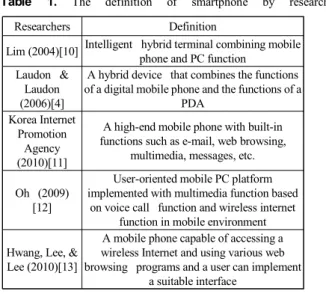
The results of research on the definition of smartphone are as follows.
Table 1. The definition of smartphone by researchers
Researchers Definition
Lim (2004)[10] Intelligent hybrid terminal combining mobile phone and PC function
Laudon &
Laudon (2006)[4]
A hybrid device that combines the functions of a digital mobile phone and the functions of a
PDA Korea Internet
Promotion Agency (2010)[11]
A high-end mobile phone with built-in functions such as e-mail, web browsing,
multimedia, messages, etc.
Oh (2009) [12]
User-oriented mobile PC platform implemented with multimedia function based
on voice call function and wireless internet function in mobile environment Hwang, Lee, &
Lee (2010)[13]
A mobile phone capable of accessing a wireless Internet and using various web browsing programs and a user can implement
a suitable interface (Source: Son, 2012[8]; Seong, 2015[9])
The first smartphone was 'Simon', developed in 1992, and was
released to the general public in 1993.In 1996, Nokia launched a
smartphone that combined Hewlett-Packard's PDA with a mobile phone, but it was difficult to popularize it because of its high price. Since then, various mobile operating systems (OS) have been developed for smartphone. In the mid-2000s, smartphone began popularization with RIM's BlackBerry phones. Together with touch screen technology, PDAs have been replaced by smartphone. In Korea, as Korea Telecom launched Apple's iPhone in late 2009, interest in smartphone and users increased sharply. As smartphone such as LG Optimus, Samsung Galaxy, Google Nexus One, and SKY Vega launched, competition has become fierce[6].
2.2 Preliminary research on smartphone information
As Korea Telecom has been supplying iPhone since 2009, the research on smartphone information has been made with previous research on information system quality, user satisfaction, usage motive and personal performance. Previous studies on smartphone information are as follows.
In the study of Seo [14], the research on the situation of motivation and satisfaction as the target of the worker was carried out with the news application of the smartphone being able to easily acquire the latest information or utilize it as a new learning tool. As a suggestion for improvement of quality and future development of news application of smartphone, it suggested 5 factors such as information acquisition motivation, social relationship maintenance motivation, information seeking motivation, and period consumption motivation., While those who prefer to listen to news by smartphone show high satisfaction with smartphone application.
According to Kim [15], factors affecting user satisfaction and users' personal performance can be analyzed through smartphone.
The results showed that mobility, convenience, timeliness, suitability, real - time performance, user satisfaction and personal performance were surveyed, and mobility, convenience, and accuracy were found to satisfy user 's satisfaction and personal performance.
Shin [16] investigated the effects of the quality (service, function, emotion) characteristics of customers using smartphone on customer satisfaction and loyalty. Through the comparative analysis of product I and product G, we presented the management aspect, direction of customer - oriented product design, intangible service quality and functional quality characteristic of existing type.
Lee [17] analyzed smartphone usage motivational factors based on prior studies of smartphone such as internet research, mobile internet research, and mobile research in study that classified customer types according to usage motives of
smartphone users. The results of this study found five factors which jncluded various functional factors, mobile search factors, business social relations factors, rates and convenience factors, and fashion and show factors.
According to Lee [18], university students under 23 years of age were studying the use of smartphone and smartphone addiction, and analyzed the correlation between self-efficacy and problem solving ability, and revealed factors related to smartphone addiction. The higher the mobility of the smartphone, the higher the social anxiety, the higher the levels of depression and the lower the self-efficacy. The convenience of being able to use anytime and anywhere with portability makes it difficult for self control. Because it uses the social network service constantly, overuse of the smartphone becomes a problem and it is recognized as a social problem. Male students who emphasize interpersonal relationships show high self-efficacy, life satisfaction, and low possibility of smartphone addiction.
According to Lee [19], the study has studied the changes in the work environment of companies where the spread of smartphone becomes commonplace and the use of smartphone becomes everyday. Information system quality is classified into three factors such as service quality, system quality, and information quality. Smartphone accessibility is classified into convenience and speed of use, and the existing Internet was used as a tool. And that it is a competitive advantage.
3. Research model and hypotheses
3.1 Research model
The research model applied in Okazaki & Mendez [1] focuses
on the personal trait of smartphone service, self-efficacy which is
the personal trait of smartphone, impulse Purchasing factors and
demographic variables (age, gender, education level, etc.) were
included. Therefore, this study looks into the relationship between
smartphone information use and personal characteristics, and the
research model is derived as shown in Fig. 1. .
Fig. 1. Research model
3.2 Defining variables and hypotheses
Bandura [20] defined self-efficacy as "confidence in ones own ability" or "confidence in the ability to perform actions to produce the desired outcome". Bandura [20] suggested that the relationship between self-efficacy and behavioral change can be hypothesized. Based on this preliminary study, we set the following hypothesis. Regression analysis was used for this purpose.
H1 : Smartphone users' self-efficacy will have a positive (+) impact on smartphone usage.
Impulsive buying usually occurs when a consumer experiences an impulse without thoughtful consideration of when and why a product is needed. These impulses may seem temporarily out of control, and decisions are generally short and spontaneous [21].
This is in contrast to the positive usage aspect of the smartphone in the first hypothesis, which can negatively affect the use of the smartphone for tourists' deliberate information search. Therefore, the following hypothesis is set up based on the above rationale.
Regression analysis was used for this purpose.
H2 : The impulsive tendency of smartphone users will have a negative impact on smartphone usage.
In this study, we focus on the demographic variables of personal traits and analyze their relationship [22]-[23]. In this study, we tried to find out whether smartphone usage might be different according to the gender, age, and education presented in the questionnaire of this study. Based on these findings, the following hypothesis was set.
H3: Smartphone usage differs depending on demographic variables of smartphone users.
4. Empirical analysis
4.1 General characteristics of the sample
The questionnaires were distributed to 300 smartphone users who were tourists in Jeju International Airport, Korea. The questionnaires were distributed to 289 participants excluding the inadequate respondents. SPSS 18.0 was used for statistical analysis, reliability analysis to check the internal consistency of the variables, and factor analysis to check the validity analysis.
Then, regression analysis and ANOVA analysis were conducted to identify the relationship between each factor.
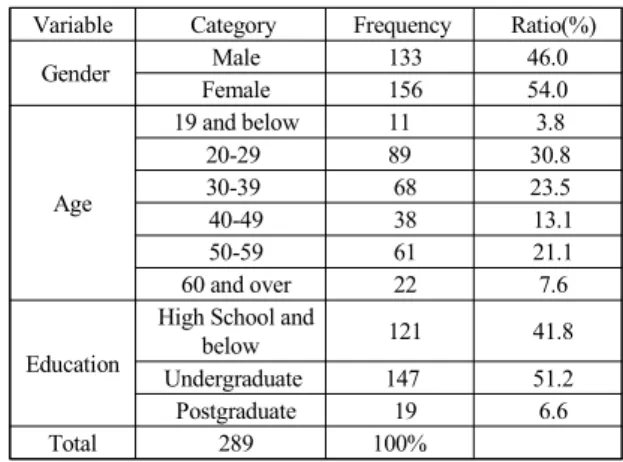
Among the 289 respondents, 133 (44.1%) were female, and 155 (55.9%) were female. The number of female respondents was higher than that of female respondents.(33.3%), 30 ~ 40 students (35.9%), 50 ~ 60 students and 83 students (30.9%).(See Table 2), and occupations by occupation were ranked in the order of sales, sales, professional, and administrative office workers.
Table 2. Demographic characteristics of respondents Variable Category Frequency Ratio(%)
Gender Male 133 46.0
Female 156 54.0
Age
19 and below 11 3.8
20-29 89 30.8
30-39 68 23.5
40-49 38 13.1
50-59 61 21.1
60 and over 22 7.6
Education
High School and
below 121 41.8
Undergraduate 147 51.2 Postgraduate 19 6.6
Total 289 100%
4.2 Factor analysis: reliability and validation
Reliability indicates consistency, accuracy, dependability, and predictability, indicating that the measured values are the same in repetitive measurements. This reliability measurement indicates the degree of the measurement result, the existence of the error in the measurement result, and the range of the error. In this analysis, the criterion of Cronbach's alpha coefficient, which is a measure of reliability measure, is set at 0.7 or more.
The aim of validity analysis is to see how faithfully the
measured variables are measured and whether they are measured
accurately for the inherent characteristics of the separated
variables. And how well the items related to the measurement
variables are related.
Table 3. shows the results of the validity analysis and the reliability analysis of the self-efficacy factor. Here, the communality value is over 0.5 as a whole. The Cronbach alpha coefficient was 0.875 and the reliability of the questionnaire was confirmed.
Table 3. Factor analysis on self-efficacy
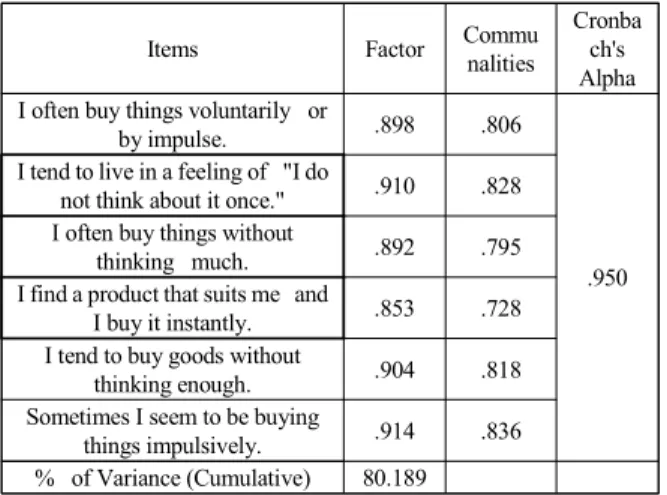
Table 4. shows the validity and reliability analysis of impulsive tendency factors. Here, the commonality measure was 0.7 or more in total. Also, the Cronbach alpha coefficient was calculated to be 0.950, which shows that the reliability of the questionnaire is secured.
Table 4. Factor analysis on impulsive tendency
The overall explanatory power of the factor is as high as 88.3%. This means that factor loadings, which are the criterion of validity between each variable in the factor, are higher than 0.88, which is significant. The Cronbach's Alpha coefficient for the reliability evaluation was 0.883, which was consistent with internal consistency (See Table 5).
Table 5. Factor analysis on use of smartphone
4.3 Hypotheses test
Hypothesis 1 indicates that self-efficacy and impulse factors are related to the use of smartphone in Table 6. . This means that each factor has a positive (+) relationship with the attitude, and finally, the fitness value of the regression model is statistically meaningful with 1% significance. The coefficient of determination (R2), which is a statistically significant factor for the significance of the regression line, was 0.134 and the total explanatory power was 13.4%.In addition, the degree of multicolinearity (VIF value) showing the correlation between independent variables is close to 1, indicating that there is no correlation between two independent variables.
Table 6. Result on hypothesis 1 & 2
In conclusion, the higher the self-efficacy of tourists, the higher the level of smartphone usage. However, in contrast to the second hypothesis, impulsive people were more likely to use smartphone.
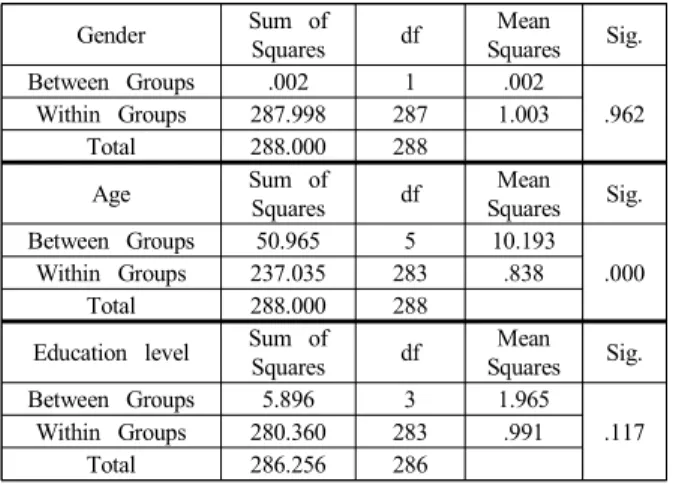
The results of the hypothesis test shown in Table 7. show that the level of smartphone use by tourists is the only difference among demographic variables (sex, age and education). These results show that there is no meaningful difference in the level of smartphone usage according to gender and education level, and it Items Factor Commonalities Cronbach's
Alpha I think I can achieve most of
the goals I set. .740 .548
.875 When confronted with difficult
things, I am confident that I will accomplish them.
.826 .682
In general, I think I can get results that I think are important
to me.
.877 .769
I believe that I can succeed
through my utmost effort. .820 .672 I can successfully overcome
many challenges. .820 .673 % of Variance (Cumulative) 66.874
Total Eigen 3.344
Items Factor Commu
nalities
Cronba ch's Alpha I often buy things voluntarily or
by impulse. .898 .806
.950 I tend to live in a feeling of "I do
not think about it once." .910 .828 I often buy things without
thinking much. .892 .795 I find a product that suits me and
I buy it instantly. .853 .728 I tend to buy goods without
thinking enough. .904 .818 Sometimes I seem to be buying
things impulsively. .914 .836
% of Variance (Cumulative) 80.189
Items Factor Commu
nalities Cronb
ach's Alpha Smartphone is practical
because smartphone has been able to be used
without difficulty wherever they are located.
.916 .783
.883 The smartphone was
convenient to use regardless of a specific
sightseeing spot.
.900 .810
I was able to obtain tourist information at any time
using a smartphone.
.885 .839
% of Variance
(Cumulative) 81.086 Total Eigen 2.433
Model
Unstandardized Coefficients
Standardized
Coefficients t Sig. VIF B Std. Error Beta
Self-
efficacy .322 .055 .322 5.85 .000 1.00
Impulsive
tendency .177 .055 .177 3.21 .001 1.00
F- value = 22.093 R2=.134 Adjusted R2=.128
can be confirmed that the lower the age, the higher the frequency of use of smartphone.
Table 7. Result on hypothesis 3
5. Conclusions
Recently, the use of smartphone is being more popular [24].
Specifically, in the contex of tourism, smartphone is essential device for traveller’s optimal decision within limited time and cost [25]. Under this background, this study focused on tourists who use information through smartphone and how these factors (self-efficacy, impulsive tendency, and personal characteristics) affect the use of smartphone. In other words, demographic variables considering the personal trait of the smartphone service, psychological characteristics of the individual, self-efficacy and impulsive tendency were analyzed.
The factors affecting the use of smartphone are classified into self-efficacy and impulsiveness, and the influence factors are set as follows. First, whether the information is freely used in the smartphone web application. The hypotheses about the effect of phone information usage on each other were set up.
In order to verify the hypothesis, we surveyed 300 smartphone users among the tourists at Jeju airport and analyzed the reliability and validity of the factor items by performing factor analysis, regression analysis and ANOVA analysis using SPSS 18.0.
The results of the research hypotheses are summarized as follows.
First, self-efficacy, which indicates the ability to perform to produce the desired outcome, has a positive (+) impact on smartphone use. Second, the impulsive purchasing occurs when consumers feel impulsive without thoughtful consideration of the information they need is positive rather than negative. This seems to be due to the rapid development of wireless networks such as
WiFi and the environment in which information can be easily accessed anytime and anywhere through high-performance smartphone developed to replace PCs. Third, the hypothesis that smartphone usage differs according to demographic variables of users shows that smartphone usage level is different according to age.
As a result, the mobile communication market has rapidly shifted from G (Generation) to 5G, and the spread of various smartphone applications has become common, so that careful information search and immediate information acquisition have positively influenced smartphone usage. Demographically, the difference between smartphone usage by age means that there are no boundaries between online and offline, and the environment of mobile native, which is always connected online, and the environment of 40 ~ 50 digital literacy. The results show that the impulsive factor, which is a psychological variable, can be interpreted differently in the smartphone environment. The results of this analysis are statistically significant in this study.
In future studies, it is necessary to segment and analyze by additional psychological factors, demographic variables and various other factors. In this sense, this study is meaningful as basic data to analyze the hypothesis verification factor. As well, more literature review needs to be more detailed as the future work.
References