EPG를 이용한 담배가루이( Bemisia tabaci )의 섭식행동과 Cyantraniliprole에 대한 섭식변화
권혜리ㆍ윤영남*
충남대학교 농업생명과학대학 응용생물학과
Feeding Behaviors of Bemisia tabaci (Gennadius) (Hemiptera: Aleyrodidae) and Changing of Feeding Behaviors to Cyantraniliprole
Hye-Ri Kwon, Young-Nam Youn*
Dept. Applied Biology, Chungnam National University, Daejeon, 305-764, Korea Received on 29 May 2014, revised on 24 June 2014, accepted on 24 June 2014
Abstract : Feeding behaviors of the sweet potato whitefly, Bemisia tabaci, and changing of their feeding behaviors were recorded and analyzed with an Electrical Penetration Graph (EPG) analysis against cyantraniliprole. The characteristic patterns of feeding behaviors investigated were as follows; NP (non probing), pathway phase waveform, waveform of feeding xylem. In results, B. tabaci did not almost feeding the phloem. And It was not appeared potential drop during recording time. It was predominantly indicated pathway activity waveform and waveform of xylem feeding. After treatment of cyantraniliprole with recommended concentrations to tomato plants, EPG waveforms were recorded during 3 hours.
Cyantraniliprole treatment showed longer time to first feeding xylem than untreated (P=0.043). It was showed shorter duration of first feeding xylem than untreated (P=0.017). And it was showed longer NP (non-probing) time than untreated.
Consequently, It was supposed that cyantraniliprole was effect of anti-feeding or avoidance to B. tabaci.
Key words : Bemisia tabaci, Electrical Penetration Graph (EPG), Cyantraniliprole, Tomato
*Corresponding author: Tel: +82-42-821-5769 E-mail address: [email protected]
I. 서 론
담배가루이(Bemisia tabaci (Gennadius): Hemiptera:
Aleyrodidae)는 전 세계적으로 발생하며, 기주범위가 넓어 500여종의 기주를 가해하며, 직접적인 흡즙으로 인한 피 해, 다량의 감로를 분비하여 잎이나 과실표면에 그을음병 을 유발하는 것 뿐 만 아니라 바이러스 매개를 통하여 시설 재배 작물의 수량과 품질에 큰 영향을 미치는 주요한 해충 으로 알려져 있다(Bedford 등, 1994; Blua와 Toscano, 1994).
담배가루이는 기주식물의 범위, 피해양상, 바이러스 매개 율 차이 등으로 여러 생태형(biotype)으로 나뉘는데, 현재 까지 24개 이상의 생태형이 보고되어 있다(Bedford 등, 1994;
Perring, 2001). 이 중 B-biotype과 Q-biotype이 가장 문
제가 되고 있으며(van Lenteren와 Woets, 1988; Oliveira 등, 2001; Chu 등, 2004), 특히 Q-biotype은 TYLCV 등 40여종의 바이러스를 매개하여 경제적으로 중요한 작물에 심각한 피해를 주고 있다(Muñiz, 2000; Navas-Castillo 등, 2000; Zhang 등, 2005).
Cyantraniliprole은 second generation anthranilic diamide계 살충제로써 Dupont Co.에서 개발하였다.
Anthranlic diamide계통 약제는 특이한 작용기작을 가지 는데, Cyantraniliprole의 기작은 Ryanodin receptor(RyRs) 와 바인딩하여 저장되어 있는 칼슘을 다량 방출하여 근육세 포의 조절기능을 비활성화 시킴으로써 근육의 수축이나 체 내의 근육이 마비로 인해 활동이나 섭식이 중단되므로 해 충의 치사를 야기시킨다(Lahm 등, 2005; 2007; Cordova 등, 2006; Sattelle 등, 2008). 그리고 cyantraniliprole은 척추동물에 매우 저독성이고, 비선택성 살충제이므로 살충
제 피해를 최소한으로 감소시킬 수 있으며, 경엽처리, 토양 관주처리를 통하여 나비목, 노린재목 등 흡즙형, 저작형 해 충방제에 효과가 있다(Sattelle 등, 2008; Caballero 등, 2013).
EPG(Electrical Penetration Graph)는 담배가루이 뿐 만 아니라 진딧물, 총채벌레 등과 같은 흡즙형 곤충의 탐침 행동을 연구하기에 유용한 기술이다. EPG 기술은 McLean 과 Kinsey(1964)에 의해 교류시스템(AC system)이 발명 되었고, 그 이후 네덜란드의 Tjallingii(1978)에 의해 직류 시스템(DC system)으로 개조되었다. EPG 파형은 곤충의 섭식행동 및 식물의 정보를 반영하는 것으로, 식물의 조직 내에서의 구침의 탐침행동을 상세하게 나타낸다(Tjallingii, 1988). EPG는 첫째, 식물과 흡즙형 곤충간의 상호작용(Youn 과 Chang, 1993; Youn, 1998, Youn 등, 2011); 둘째, 곤충 에 의해 전파되는 식물병원균 및 바이러스 전이(Martín 등, 1997; Jiang 등, 2000; Johnson 등, 2002; Backus 등, 2005); 셋째, 섭식자극 또는 저해되는 곤충의 섭식 행동 및 위치 파악(Montllor & Tjallingii, 1989; Garzo 등, 2002; Xue 등, 2009; Boina 등, 2011)과 같은 연구에 이용 되고 있다.
본 연구에서는 담배가루이가 토마토 잎을 섭식할 때 나 타나는 섭식행동을 EPG 기술을 이용하여 관찰하고, 섭식 파형을 분석하였으며 더 나아가서 담배가루이의 효과적인 방제를 위하여 Diamide계통인 cyantraniliprole 약제를 사용하였을 경우에 나타나는 담배가루이의 섭식행동에 있 어서의 차이를 비교·분석하여 약제에 대한 영향을 알아보 는데 그 목적이 있다.
II. 재료 및 방법
1. 공시충과 기주
담배가루이를 포트에 파종한지 약 3주 된 토마토 유묘를 기주식물로 사용하여 아크릴 사육상(40×44×50 cm)에서 온도 25±2℃, 상대습도 50∼60%, 광주기 16L:8D의 사육 실 조건에서 유지하였다. 본 실험에는 현재 시판되고 있는 작물보호제 중 cyantraniliprole 단일성분으로 이루어진 약제를 선발하여 추천농도로 토마토 유묘에 경엽처리하여 음건시킨 후에 사용하였다.
2. EPG 기록
Electrical Penetration Graph(EPG)기록은 실험에 이 용한 담배가루이 성충은 채집하여 CO2를 이용하여 마취시 킨 후, 직경이 12.7 ㎛인 금선을 약 3 cm로 잘라 전도성 있는 silver conductive paint(P-100, CANS, Japan)을 이용하여 담배가루이의 날개에 부착하였다. 담배가루이 날 개에 금선을 부착한 후에 부착된 금선을 GIGA-4 DC EPG amplifier(Wageningen University, Netherland)에 연결 하였다. EPG를 기록하는 과정에서 생기는 전기적 잡음을 제거하기 위하여 Faraday cage 안에서 실시하였다. 이와 같이 연결된 EPG 시스템에서 담배가루이의 섭식행동을 총 3시간동안 기록하였다. EPG wavefome은 PROBE 3.4 DATAQ(Wageningen Agricultural University, Wageningen, The Netherlands)를 통하여 IBM personal computer에 저장하였으며, 저장된 자료는 PROBE 3.4 software(W.F.
Tjallingii, Wageningen University, The Netherlands) 로 분석하였다.
담배가루이의 섭식행동을 관찰한 EPG 기록은 담배가루 이가 시스템에서 이탈하거나 혹은 죽은 경우를 제외하고 정상적으로 토마토 잎에서 흡즙을 한다고 판단된 경우만 모아 10반복을 실시하여 섭식행동을 분석하였다.
3. 통계분석
Cyantraniliprole 약제의 처리 유무에 따른 토마토 유묘 에서의 담배가루이의 섭식행동비교는 SPSS statistics(ver.
21)를 이용하여 독립표본 T-test를 실시하였다.
III. 결과 및 고찰
EPG 기술은 식물과 곤충간의 조직적인 상관관계를 알아 보는데 유용한 기술로, 흡즙형 구기를 가진 곤충의 섭식행 동을 연구하기 위한 방법 중의 하나이다. 이 방법은 곤충과 기주식물을 하나의 전기적 회로로 연결하고 구침의 활동에 따른 전압의 변화에 기초하여 분석하게 되며 전기적인 시 스템에 기록된 각 파형은 곤충이 식물에 구침을 삽입하는 것과 그 구침의 위치에 의해 관찰된다(Table 1).
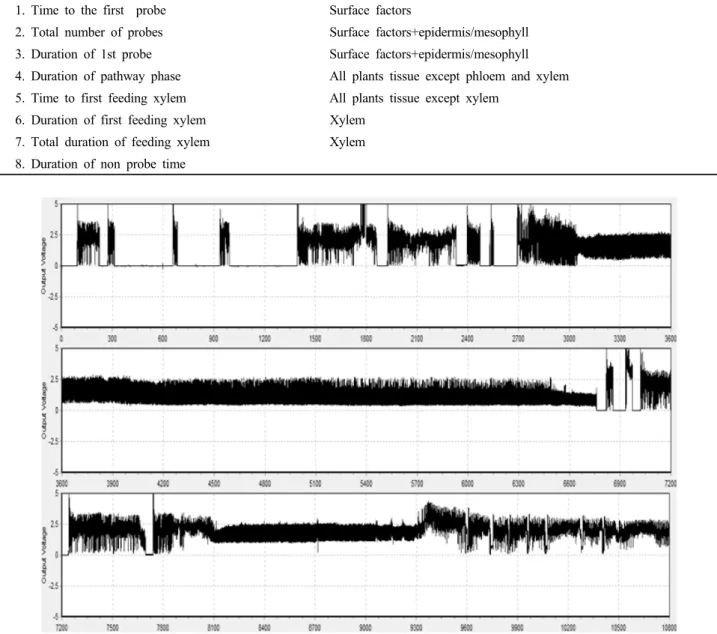
담배가루이의 섭식행동 중에 나타나는 파형에는 구침을 삽입하지 않은 NP(non probing)파형, 구침을 찔러 기주식
Table 1. EPG parameters and possible relations to resistance factors in specific plant tissue.
EPG parameters Tissue(s)/factors involved
1. Time to the first probe Surface factors
2. Total number of probes Surface factors+epidermis/mesophyll 3. Duration of 1st probe Surface factors+epidermis/mesophyll 4. Duration of pathway phase All plants tissue except phloem and xylem 5. Time to first feeding xylem All plants tissue except xylem
6. Duration of first feeding xylem Xylem 7. Total duration of feeding xylem Xylem 8. Duration of non probe time
Fig. 1. The typical feeding patterns of B. tabaci during 3 hours.
물의 섭식부위를 찾는 Pathway activity파형, 물관부를 섭 식하는 Xylem파형, 총 3가지 파형을 위주로 cyantraniliprole 약제가 담배가루이의 섭식행동에 미치는 영향에 대하여 분 석하였다(Fig. 1, 2).
담배가루이 EPG 기록을 보면, 담배가루이를 토마토 유 묘 위에 올린 후, 기록 초기에 불규칙한 형태의 높은 증폭정 도를 보이는 파형이 나타나면서 담배가루이 구기와 식물 조직 간의 전기적 연결시작을 보인다. 전기적 연결 신호 후 빈도와 증폭정도가 다소 불규칙적인 패턴들이 나타나기 시작하는데, 이는 pathway activity 파형이다. 이 파형은 구침의 끝부분이 세포간극에서의 탐침양상을 보여주는 것
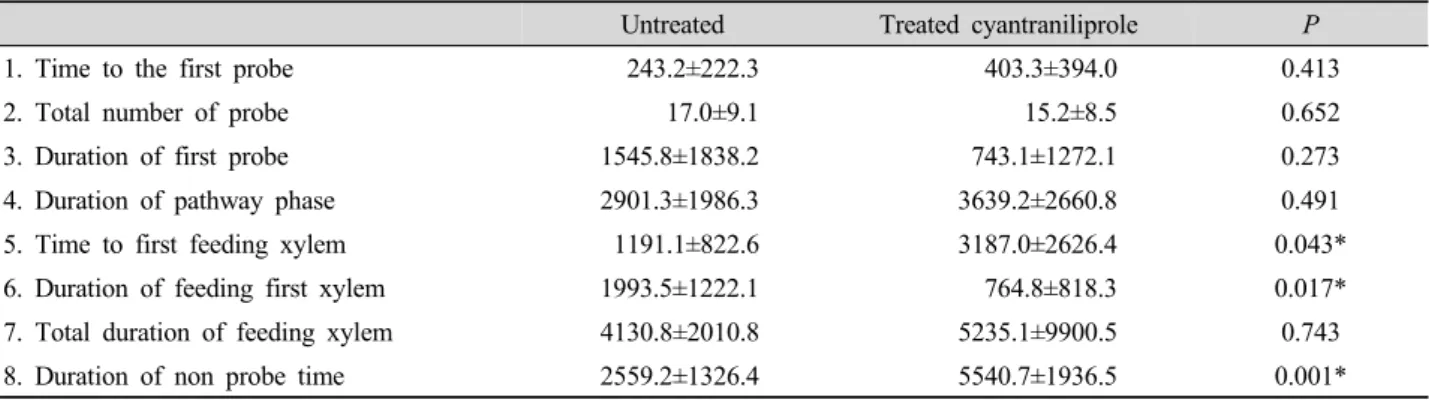
으로 표피, 엽육과 같은 식물체의 조직적인 요인과 밀접한 연관이 있다(Yin 등, 2010). 이러한 파형은 식물을 섭식하 기에 앞서 세포간극의 식물즙액을 얻기 위해 세포를 찌르 는 행동을 반복함으로써 먹이의 적합성을 판별해내는 주된 행동이라 볼 수 있다. 하지만 본 실험에서의 pathway activity에 대하여 무처리구 토마토와 cyantraniliprole 약 제 처리 토마토간의 통계적 유의성은 없었다(Table 2).
Pollard(1955)는, 담배가루이의 아랫입술이 식물체 표 면과 닿으면서 흡즙을 시작하는데, 구침은 주로 표피세포 내에 위치하며, 유조직을 통한 탐침은 주로 세포사이에서 이루어지고, 최종적으로 체관부의 체요소를 목표로 섭식을
Fig. 2. Characteristics of EPG waveforms recorded from B. tabaci. (a) Main features (45 min), (B) NP (non probing), Pathway activity ; Frame (30 seconds), Range (5.0) (C) Xylem feeding waveform ; Frame (10 seconds), Range (5.0).
Table 2. Mean (seconds) EPG feeding parameters recorded 3hr period for B. tabaci that fed on treated and untreated cyantraniliprole tomatoes.
Untreated Treated cyantraniliprole P
1. Time to the first probe 243.2±222.3 403.3±394.0 0.413
2. Total number of probe 17.0±9.1 15.2±8.5 0.652
3. Duration of first probe 1545.8±1838.2 743.1±1272.1 0.273
4. Duration of pathway phase 2901.3±1986.3 3639.2±2660.8 0.491
5. Time to first feeding xylem 1191.1±822.6 3187.0±2626.4 0.043*
6. Duration of feeding first xylem 1993.5±1222.1 764.8±818.3 0.017*
7. Total duration of feeding xylem 4130.8±2010.8 5235.1±9900.5 0.743
8. Duration of non probe time 2559.2±1326.4 5540.7±1936.5 0.001*
Value represent by mean±SD, *P<0.05; T-test in SPSS (ver. 21.0).
한다고 한다. 이와 같이 담배가루이는 체관부를 주로 흡즙 하는 곤충으로 알려져 있으며, 체관부를 섭식할 때 반영속 적바이러스와 영속적 바이러스를 감염시키는 것으로 알려 져 있다(Jiang 등, 2000; Johnson 등, 2002). 따라서 담배 가루이가 체관부를 흡즙하며 머무르는 시간이 많다는 것은 기주에 대한 적합성을 나타낸다고 볼 수 있다(Lei 등, 1998).
Pollard(1955)의 연구결과, 80%가 체관부까지 도달하였고 나머지는 유조직 내에서만 머물렀던 것으로 나타났으며, 물관부를 섭식한 경우는 단 한 개체에 대한 결과에서만 확 인되었다.
하지만 본 실험에서 EPG를 기록하는 3시간 동안 체관부 섭식파형과 potential drop이 몇 차례 나타나지 않아, 분석 대상에서 제외하였다. 오히려 구침의 탐침행동의 활성을 나타내는 pathway activity가 많이 나타났으며, 물관부에
주로 머무는 것으로 나타났다. EPG 기록을 시작하고 물관 부 섭식이 처음 나타나기까지의 시간을 측정하였을 때 cyantraniliprole 약제처리구(3187.0±2626.4)보다 무처 리구(1191.1±822.6)에서 더 빨리 나타났으며(P=0.043), 물관부에 처음 구침을 꽂아 섭식이 유지되는 시간 또한 cyantraniliprole 약제처리구(764.8±818.3)보다 무처리 구 토마토(1993.5±1222.1)에서 더 오래 유지되는 것으로 나타났다(P=0.017)(Table 2).
식물에 바이러스를 매개하는 곤충이 기주식물에 구침을 꽂고 있는 시간은 바이러스 발생에 있어서 중요한 변수가 될 수 있다. 본 실험에서 구침을 꽂지 않은 NP(non-probing) 시간은 무 처리구보다 cyantraniliprole 약제 처리구에서 더 길게 나타났다. 즉, 무처리구에 비하여 cyantraniliprole 을 처리한 토마토 유묘에서 훨씬 짧은 시간동안 구침을 꽂
고 있다는 것을 알 수 있다. 이는 cyantraniliprole 약제가 담배가루이 섭식에 있어서 기피 또는 섭식저해의 효과가 있는 것으로 볼 수 있다. 하지만, 바이러스 전이는 체관부 섭식과 더 밀접한 관계가 있으므로, EPG 기록시간을 늘려 확인할 필요성이 있다고 사료된다.
IV. 결 론
담배가루이의 섭식행동 및 cyantraniliprole이 섭식행 동에 미치는 영향을 알아보기 위하여 EPG기술을 사용하여 분석하였다. cyantraniliprole 단일약제를 추천농도로 처 리한 후 3시간 동안 EPG 파형을 기록하였다. 담배가루이의 섭식행동 중에 나타나는 파형인 구침을 삽입하지 않은 NP(non probing)파형, 구침을 찔러 기주식물의 섭식부위 를 찾는 Pathway activity 파형, 물관부를 섭식하는 Xylem 파형, 총 3가지 파형을 위주로 분석하였다. 실험결과 담배 가루이는 3시간동안 거의 체관부를 섭식하지 않으며, potential drop이 나타나지 않아 분석대상에서 제외하였다. 주로 pathway activity와 물관부섭식 파형이 나타났다. EPG기 록을 시작한 이후 무처리구에 비하여 cyantraniliprole 처 리구에서 물관부섭식이 처음 나타나기까지 걸린 시간이 더 오랜 시간이 걸렸고, 물관부에 처음 구침을 꽂아 섭식이 유지되는 시간은 무처리구에서 더 길게 나타났다. 따라서 cyantraniliprole 약제가 담배가루이 섭식에 있어서 저해 또는 기피의 효과가 있는 것으로 볼 수 있다.
감사의 글
본 연구는 농림축산식품부 농림수산식품기술기획평가 원에 의해 이루어진 것임(project no. 112018-3)
참 고 문 헌
Backus EA, Habibi J, Yan FM, Ellersieck M. 2005. Stylet penetration by adult Homalodisca coagulata on grape:
Electrical penetration graph waveform characterization, tissue correlation, and possible implications for transmission of Xylella fastidiosa. Annals of the Entomology Society of America. 98(6):787-813.
Bedford ID, Briddon RW, Brown JK, Rosell RC, Markham PG.
1994. Geminivirus transmission and biological characterisation of Bemisia tabaci (Gennadius) biotypes from different geo- graphic regions. Annals of Applied Biology. 125:311-325.
Blua MJ, Toscano N. 1994. Bemisia argentifolii (Homoptera:
Aleyrodidae) development and honeydew production as an function of cotton nitrogen status. Environmental Entomology.
23:317-321.
Boina DR, Youn YN, Folimonovac S, Stelinski LL. 2011.
Effects of pymetrozine, an antifeedant of Hemiptera, on Asian citrus psyllid, Diaphorina citri, feeding behavior, survival and transmission of Candidatus Liberibacter asiaticus.
Pest Manag. Sci. 67:146-155.
Caballero RS, Cyman DJ, Schuster HE, Portillo, Slater R. 2013.
Baseline susceptibility of Bemisia tabaci (Genn.) biotype B in southern Florida to cyantranilliprole. Crop Protection.
44:104-108.
Chu D, Zhang YJ, Cong B, Xu BY, Wu QJ. 2004. The invasive mechanism of a world important pest, Bemisia tabaci biotype B. Acta Entomologicia Sinica. 47:400-406.
Cordova D, Benner EA, Sacher MD, Raul JJ, Sopa JS, Lahm GP, Selby TP, Stevenson TM , Flexner L, Gutteridge S, Rhoades DF, Wu L, Smith RM, Tao Y. 2006. Anthranilic diamides: A new class of insecticides with a novel mode of action, ryanodine receptor activation. Pesticide Biochemistry and Physiology. 84(3):196-214.
Garzo E, Soria C, Gomez-Guillamon ML, Fereres A. 2002.
Feeding behavior of Aphis gossypii on resistant accessions of different melon genotypes (Cucumis melo). Phytoparasitica.
30:129-140.
Jiang YX, De Blas C, Barrios L, Fereres A. 2000. Correlation between whitefly (Homoptera: Aleyrodidae) feeding behavior and transmission of tomato yellow leaf curl virus. Ento- mologia Experimentalis et Applicata. 52:69-81.
Johnson DD, Walker GP, Creamer R. 2002. Stylet penetration behavior resulting in inoculation of a semipersistently transmitted closterovirus by the whitefly Bemisia argentifolii.
Entomologia Experimentalis et Applicata. 102:115-123.
Lahm GP, Selby TP, Freudenberger JH, Stevenson TM, Myers BJ, Seburyamo G, Smith BK, Lindsey F, Christopher EC, Daniel C. 2005. Insecticidal anthranilic diamides: A new class of potent ryanodine receptor activators. Bioorganic &
Medicinal Chemistry Letters. 15 (22):4898-4906.
Lahm GP, Stevenson TM, Selby TP, Freudenberger JH, Cordover D, Flexner L, Bellin ACA, Dubas CM, Smith BK, Hughes KA, Hollingshau JG, Clark CE, Benner EA.
2007. Rynaxypyr™ : A new insecticidal anthranilic diamide that acts as a potent and selective ryanodine receptor activator. Bioorganic & Medicinal Chemistry Letters. 17(22):
6274-6279.
Lei H, Tjallingii WF, van Lenteren JC. 1998. Probing and feeding characteristics of the greenhouse whitefly in association with host-plant acceptance and whitefly in association with host-plant acceptance and whitefly strains. Entomologia Experimentalis et Applicata. 79:77-84.
Martín B, Collar JL, Tjallingii WF, Fereres A. 1997. Intracellular ingestion and salivation by aphids may cause the acquisition and inoculation of non-persistently transmitted plant viruses.
Journal of General Virology. 78:2701-2705.
McLean DL, Kinsey MG. 1964 Technique for electrically recording aphid feeding + salivation. Nature. 202:1358-1359.
Montllor CB, Tjallingii WF. 1989. Stylet penetration by two aphid species on susceptible and resistant lettuce. Entomologia Experimentalis et Applicata. 52(2):103-111.
Muñiz M. 2000. Host suitability of two biotypes of Bemisia tabaci on some common weeds. Entomologia Experimentalis et Applicata. 95:63-70.
Navas-Castillo J, Camero R, Bueno M, Moriones E. 2000.
Severe yellowing outbreaks in tomato in Spain associated with infections of Tomato chlorosis virus. Plant Disease.
84:835-837.
Oliveira MRV, Henneberry TJ, Anderson P. 2001. History, current status and collaborative research project for Bemisia tabaci. Crop Protection. 20:709-723.
Perring TM. 2001. The Bemisia tabaci species complex. Crop protection. 20:725-737.
Pollard DG. 1955. Feeding habits of the cotton whitefly, Bemisia tabaci Genn. (Homoptera: Aleyrodidae). Annals of Applied Biology. 43(4):664-671.
Sattelle DB, Cordova D, Cheek TR. 2008. Insect ryanodine receptors: molecular targets for novel pest control chemicals.
Invertebrate Neuroscience. 8:107-119.
Tjallingii WF. 1978. Electronic recording of penetration behavior by aphids. Entomologia Experimentalis et Applicata. 24:
721-730.
Tjallingii WF. 1988. Electrical recording of stylet penetration
activities. Aphid, their biology, Nature Enemies and Control (eds. A. K. Minks & P. Harrewijn), pp. 95-108. Elsevier Science Publishers, Amsterdam.
van Lenteren JC, Woets J. 1988. Biological and integrated pest control in greenhouses. Annual Review of Entomology. 33:
239-269.
Xue K, Wang XY, Huang CH, Wang RJ, Liu B, Yan FM, Xu CR. 2009. Stylet penetration behaviors of the cotton aphid Aphis gossypii on transgenic Bt cotton. Insect Science. 16:
137-146.
Yin HD, Wang XY, Xue K, Huang CH, Wang RJ, Yan FM, Xu CR. 2010. Impacts of transgenic Bt cotton on the stylet penetration behaviors of Bemisia tabaci biotype B : Evidence from laboratory experiments. Insect science. 17:344-352.
Youn YN, Backus EA, Serikawa RH, Stelinski LL. 2011.
Correlation of an electrical penetration graph waveform with walking by Asian citrus psyllid, Diaphorina citri (Hemiptera: Psyllidae). Florida Entomologist 94(4):1084-1087.
Youn YN, Chang YD. 1993. Electrical feeding patterns and stylet movement of rice brown planthopper, Nilaparvata lugens (Homoptera), in the rice plant. Korean Journal of Applied Entomology. 32(2):208-217.
Youn YN. 1998. Electrically recorded feeding behavior of Nephotettix cincticeps. J. Asia-Pacific Entomol. 1(2):147-161.
Zhang LP, Zhang YJ, Zhang WJ, Wu QJ, Xu BY, Chu D. 2005.
Analysis of genetic diversity among different geographical populations and determination of biotypes of Bemisia tabaci in China. Journal of Entomology. 129: 121-128.