UWB-TH BPSK 시스템의 다중 사용자 간섭을 위한 개선된 가우시안 근사
Modified Gaussian Approximation for Multiple Access Interference of UWB-TH system with BPSK
박장우*, 조성언*, 조경룡*
Jang-Woo Park*, Sung-Eon Cho*, Kyung-Ryung Cho*
요 약
UWB 통신 시스템의 비트 오율을 계산하기 위해서는 다중 사용자 간섭의 정확한 표현식이 필수적이다. 지 금까지, 많은 연구에서 다중 사용자 간섭은 가우시안 근사에 의하여 모델링되었다. 그러나 이 방법은 매우 큰 오차를 수반하는 것으로 알려져 있다. MAI에 대한 정확한 모델링을 위한 여러 논문이 발표되었지만, 비트 오 율 계산 시 매우 많은 시간이 걸리는 문제점이 있다. 이 논문에서 BPSK를 이용하는 UWB-TH 시스템의 비트 오율을 계산하기 위한 간단한 표현식을 제시한다. 이때, 다중 사용자 간섭은 가우시안 근사에 바탕을 둔 특성함 수 방법으로 설명되었다. 이 방법을 이용하면 UWB-TH 시스템의 비트 오율을 쉽고 빠르게 그리고 보다 정확 히 계산할 수 있다.
Abstract
To calculate the probability of bit error of UWB communication systems, the exact expression of multiple access interference is essential. So far, in many researches, MAI has been modeled by the Gaussian Approximation, which leads to the huge errors. And there are some tries to obtain the exact model fot the MAI but they have some problems such as long calculation time. We introduce the simple expression to calculate the probability of error of an UWB-TH system with BPSK. The multiple access interference is explained by the characteristic function method combined with the Gaussian approximation. It allows us to easily and fast calculate the bit error rate of an UWB-TH system.
Key words : BPSK-TH UWB system, Multiple User Interference, Gaussian Approximation.
* 순천대학교 정보통신공학부 (Dept. of Intormation Communication Eng., SunChon National University)
․접수일자 : 2005년 5월 20일
I. Introduction
In UWB(Ultra-wideband) communication systems, Time Hopping(TH) has been popularly considered as one of the multiple access methods, where the users are distinguished by their own arrival time sequence. A number of researches have investigated the multiple access capacity of an UWB-TH
system, using a Gaussian approximation(GA) for the multiple access interference(MAI) which is based on the Central Limit Theorem. Because for a TH system with pulse-position modulation (PPM), the GA for the MAI can result in poor results[1], there have been some researches[2,3] to try to find the characteristic function for MAI to develop the exact expression for MAI. Reference [2]
gave the analytical expression for the probability of
error assuming the rectangular transmitted pulse and the expression of [3] included many multiple integrals. The authors of [2] assumed the rec- tangular pulse as the UWB pulse, because the Gaussian pulse which is mainly used in the UWB communication systems makes it difficult to obtain its simple correlation function. [3] gave the analy- tical expression of the bit error rate for UWB-TH PPM systems but their equation has a lot of multiple integrals, it leads to the too much time and computer resources to calculate the error rate.
In this paper, the method is introduced for calculating the BER(bit error rate) for an UWB TH system combined with BPSK(or known as pulse flipping modulation) in the presence of the MAI. The method presented in this paper is simpler and faster than other methods. For characterizing the MAI, we use the characteristic function method with the Gaussian approximation so that it will be possible to obtain the simple expression, by which the BER can be calculated very easily and fast.
Ⅱ. System Model
The general UWB-TH BPSK transmitted signal of the -th user, representing the -th information data symbol, is described by
( 1) 1
( ) ( ) ( )
( ) ( )
s
s
i N
k b k k
i f j c
s j iN
s t E d w t jT c T
N
+ -
=
=
å
- -(1) where is the bit energy, is time, and
is the signal pulse with support , normalized so that
∞
∞
. Each information bit,
is spread over frames, each duration , then the bit duration .
is the chip time with assuming the relation of
. That is, the frame time consists of
chips. The transmitted pulse is time-hopped over a frame duration by pseudo-random sequence ,
which is an integer in the range . By assuming , (1) can be reformulated by
( 1) 1 ( 1) 1
( )( ) ( ) ( ) ( )
s c
s c
i N j N
k b k k
i n c
j iN n jN
s
s t E d a w t nT
N
+ - + -
= =
=
å å
-(2) where is the sequence depending on
with the following relation,
( )
( ) 1
0 otherwise
k
k s j
n
n jN c
a ì = +
= í
î (3)
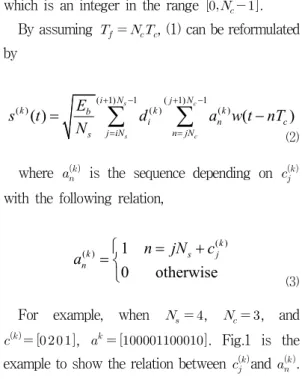
For example, when , , and
, . Fig.1 is the example to show the relation betweenand.
Fig. 1. This figure shows an example of TH-BPSK UWB signals and the relation between and .
(2) will be almost the same form as the signal equation of DS-CDMA system except being
"0" or "+1" instead of "-1" or "+1", which has already been pointed by Martret and Giannakis[4]
for the TH-PPM system. If we assume is an uniform discrete random variable in , the probability of is and the probability of is . That is,
Pr[a( )nk =1] 1/= Nc
Pr[a( )nk =0]=(1 1/- Nc)
Ⅲ. Multiple Access Interference
For asynchronous systems with active users, the received signal may be expressed by
( ) 1
( ) ( ) ( )
K k
k k
r t s t t n t
=
=å - +
(4) where the perfect power control is assumed and is the time delay corres- ponding to user k. is AWGN with zero mean and variance . With no loss of generality, ≤ is assumed and
will be considered as the reference signal so that all other signals are interference signals. We further assume , which results in
(1) 1 for , 0,1.. 1
0 otherwise
c s
n
n jN j N
a ì = = -
= íî (5)
The receiver employs the correlation demodu- lator with the template signal
( 1) 1 ( 1) 1
(1)( ) (1) ( )
s c
s c
i N j N
s
n c
j iN n jN
b
s t N a w t nT
E
+ - + -
= =
=
å å
-(6) It is assumed the receiver has a perfect synchronization with the first user's signal. At the output of the receiver, decision statistic will be
r=S+ +I h
(7) where is a Gaussian random variable with zero mean and variance of
2 2
0 / 2
n N Ns Eb
s = ,
and will be the value for first user's useful signal bit expressed as
(1)
i s
S=d N .
Also, in (7), is the total MAI resulted from all interference signals which is expressed by the sum of individual interferences.
2 K
k k
I I
=
=
å
where is the MAI from -th interference, which will be expressed by
( )
1 1
( ) ( ) ( )
/
0 0
( )
c k
c k
N N
k k k
k m mN N mN k
m m
I z d g a g Ra
- -
ê - ú -
ë û
= =
=å =å
(8)
In (8), , is the nearest integer to
, and is a random variable uniformly distributed in . is the auto- correlation function of given by
( ) ( ) ( )
R x ¥ w t w t x dt
=
ò
-¥ - .Because is the function of three random variables, , and α, it is very difficult to find the pdf(probability density function) of . Therefore, we assume to be a Gaussian random variable with zero mean and variance,
2 / 2 2
/ 2
1 c ( )
c
T
r T
c
R x dx s T
= ò- .
conditioned on ⌊ ⌋ and
, therefore, will be a Gaussian random variable with zero mean and variance of , where is used. Therefore, the characteristic function(CF) of conditioned on
will be
2 2 2 ( )|
r k
m
a
z a e w s
j = - .
Because is the sum of independent random variables, , the CF of is
2 2/ 2
1 1
1
s r k
N I
c c
N e N
w s
j = - +æç - ö÷
è ø (9)
(9) is obtained by averaging out the random variable a, recalling the probability distribution of
. Therefore the CF of I , which consists of
independent random variables, , can be
expressed by
( )
k 1 KI I
j = j -
2 2
1 1
0
1 1 1
1 1
s r
K k
K
kN
c k c
K e
k
N N
w s
- -
-
=
æ ö æ - öæ ö
=ç - ÷ ç ÷ç ÷
è ø -
è ø å è ø
(10) Inverse Fourier transforming (10) gives the pdf of the MAI. (10) finds that the MAI is the sum of
Gaussian random variables with zero mean and variance of
{kNssr2,k=1,...,K-1}.
Ⅳ. Results
As Eq. (10) consists of Characteristic functions of Gaussian random variables, the probability of error can be easily obtained.
Recalling the decision statistic, (7), the probability of error is given by
Pr[ ]
e s
P = I+h< -N
( )
1 1
2 2
0
1 1 1
1 1 2
K K k
s
c k c s r n
K N
k Q
N N kNs s
- -
=
æ ö
æ ö æ - öæ ö ç ÷
=çè - ÷ø çè ÷øçè - ÷ø çç + ÷÷
è ø
å
(11) Bit error rate of TH-BPSK, as seen in (11), can be calculated by as many as -functions.
-function, or complementary error function is easily estimated by the commercial numerical tools such as MATLAB® or Mathematica®.
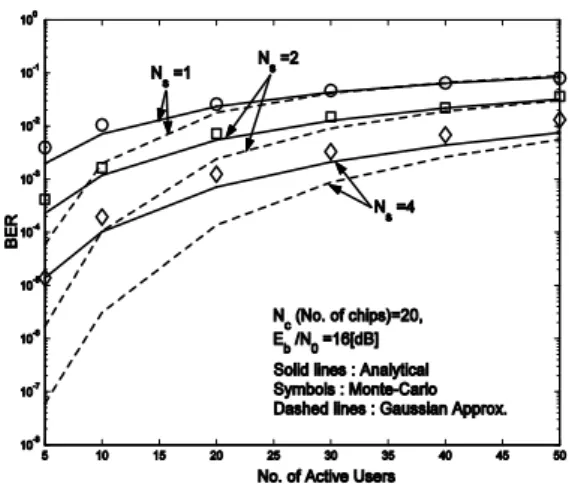
To show the accuracy of our model, the results from our model will be compared to the simulation results. Fig.1 shows the BER curves as a function of SNR(singla to noise power ratio). In this figure, there are three results such as our analytical results(solid lines,) Monte-Carlo simulation results (symbols) and the results obtained from Gaussian approximation(dotted lines) for the MAI. Fig.1 tells us our results has a good agreement with the simulation results. The GA, however, gives poor results for the great value of SNR. It means the
Gaussian Approximation for the MAI is not a good approximation. Fig.2 gives the BER curves as a function of the number of users. For the small number of users, the analytic model gives slightly underestimated BERs, but better results than GA does. And the proposed method in this paper spends less time to calculate the BER than other methods.
Fig. 1 BER performance as a function of SNR( solid lines : the analytic results, symbols : Monte-Carlo simulation, dashed lines : Gaussian Approximation) with the repetition codes of N =s 1, 2, and 4 and 20 active users.
Fig. 2 BER performance versus the number of active users( solid lines : the analytic results, symbols : Monte-Carlo simulation, dashed lines : Gaussian Approximation) with the repetition codes of N =s 1,
2, and 4.
참 고 문 헌
[1] Durisi, G. and Romano, G. : On the validity of Gaussian approximation to cha- racterize the multiuser capacity of UWB TH-PPM,Conf. on UWBST, pp.20-23, 2002.
[2] Hamdi, K. A. and Gu, X. :Bit error rate analysis for TH-CDMA/PPM impulse radio networks,Proc. WCNC, pp.167-172, 2003.
박 장 우(朴長雨)
1987년 2월 : 한양대학교 전자공학 과(공학사)
1989년 2월 : 한양대학교 대학원 전자공학과(공학석사) 1993년 7월 : 한양대학교 대학원
전자공학과(공학박사) 1995년 3월~현재 : 순천대학교 정
보통신공학부 부교수
관심분야 : UWB 통신 시스템, 통신용 집적회로 등
조 경 룡(趙慶龍)
1987년 2월 : 숭실대학교 전자공학 과(공학사)
1989년 2월 : 숭실대학교 전자공학 과(공학석사) 1995년 2월 : 숭실대학교 전자공학
과(공학박사) 1989년 12월~1990년 11월 : 한국
증권전산(주) 통신시스템부 사원 1990년 11월~1996년 2월 : SK 텔레컴 중앙연구원 선임연구원 1996년 3월~현재 : 순천대학교 정보통신공학부 부교수
관심분야 : 이동통신, 채널코딩, TCM 등
[3] Sabatini, M., Masry E., and Milstein L. B. :
A Non-Gaussian approach to the perfor- mance analysis of UWB TH-BPPM system
, Proc. UWBST, pp.52-55, 2003.
[4] Le Martret, C. J. and Giannakis, G. B. : All-digital impulse radio with multiuser detection for wireless cellular systems, IEEE trans. on Commu., 50(9), pp.1440- 1450, 2002.
조 성 언(趙誠彦)
1989년 2월 : 항공대학교 항공정보통 신공학과(공학사) 1991년 2월 : 항공대학교 항공정보통
신공학과(공학석사) 1997년 2월 : 항공대학교 항공전자공
학과(공학박사) 1997년 3월~현재: 순천대학교 공
과대학 정보통신공학과 부교수
관심분야 : 무선 통신 시스템, RFID, RTLS 등