A Study on the Noise Characteristics of noise occurred when medical examination in dental clinic
1)
Dong-Ha Ji*, Yong-Gyoo Lee**
Abstract
This study was conducted to investigate the effects of noise from dental clinics on workers and to establish a reduction plan. The noise generated by the treatment instrument(Ultrasonic scaler, Hand piece, 3-way syringe, Suction, Compressor) was measured in order to determine the characteristics(level, frequency) of the noise during medical treatment(Oral prophylaxis, Conservation treatment, Prosthesis treatment, Implant Scaling, Tooth eliminating). We also assessed the noise levels in dental clinic using evaluation indicators such as NR-curves and NRN. The results of the analysis showed that the noise generated during the treatment was 85dB(A) ~ 70dB(A) and that the high frequency component was dominant, which would affect the workers working at the dental clinic.
The NR-curve analysis showed NR-67 to NR-83 and the high frequency components of 4kHz to 8kHz were predominant and far exceeded noise levels in the workplace. To minimize the noise damage of workers and to provide high quality medical service, it is necessary to establish countermeasures such as wearing a soundproof and periodic hearing tests.
▸Keyword : Noise characteristics, Personal sampling method, NR-curves, NRN, Soundproof
Ι. Introduction
현대인은 쾌적한 환경에서 삶을 영위하고 싶은 욕망에 비하여 건설공사 소음, 도로교통 소음, 항공기 소음, 아파트에서 거주할 경우 경험하는 층간소음 등 다양한 소음원에 노출되고 있다.
지속적으로 소음에 노출 될 경우 스트레스를 증가시키고 심리 적으로 불안을 느끼게 되며 짜증을 증가시키는 등 정신적 건강에 악영향을 끼치게 된다.
일상생활에서 경험하게 되는 소음은 환경적 소음과 직업적 소음으로 특징지을 수 있는데 직업적으로 소음에 지속적으로 노출되는 작업환경에서 근무하는 근로자는 소음성 난청에 시 달리게 된다[1].
치과병원에서 진료 시 발생하는 기기의 소음은 반복적으로 되풀이되는 강한 소음으로 대부분의 치과병원 근무자들에게 높은 불쾌감과 지속적으로 노출시 소음성 난청의 위험을 부담 하고 있다[2].
소음성 난청이 발생할 경우 진료 협조를 주로 하는 치과위생 사는 진료를 하는 치과의사 및 치과병원을 방문하는 환자와 정확 한 의사소통에 곤란을 초래하게 되며 결국 치과서비스의 질 저하 를 초래하게 된다[3] [4][5].
기존의 연구는 치과병원에서 진료 시 소음수준을 평가하기 위하여 소음기(Sound Level Meter)를 주요 치료기기 주위에 설치하여 측정하는 지역시료 채취방법으로 측정을 실시하여 치 과병원 근무자가 실제 경험하게 되는 소음 특성의 반영에 한계가 있으며 대부분의 연구가 치과공포를 느끼는 치과방문환자에게 관심을 두고 시행되어왔다.
그러나 본 연구에서는 진료 시 발생하는 소음을 개인시료 채 취방식으로 실시하므로 치과병원에 근무하는 근무자가 치료 종 류별로 경험하게 되는 소음수준에 대한 분석이 가능한 방법으로 실시하였다.
∙First Author: Dong-Ha Ji, Corresponding Author: Dong-Ha Ji
*Dong-Ha Ji ([email protected]), Dept. of Environmental Health, Daejeon Health Institute of Technology
**Yong-Gyoo Lee ([email protected]), Division of Social Welfare, Woo song College
따라서 본 연구는 치과병원에서 진료 종류에 따라 사용하는 치료기기로부터 발생하는 소음특성을 파악하기 위하여 치과병 원에서 진료 시 발생하는 소음의 발생수준 및 주파수특성을 분석 하고, 이 결과를 통하여 치과병원 근무자의 진료 시 발생하는 소음에 대한 저감방안을 제공하고자 본 연구를 실시하였다.
Ⅱ. Research and analysis method
소음 측정방법은 작업환경측정 및 지정측정기관 평가 등에 관한 고시에 준하여 1일 작업시간 동안 개인시료 채취방법으 로 연속 측정을 실시하였다[6].
소음 측정은 누적소음 노출량측정기(Dosemeter)를 사용하여 치과병원 내에서 최고 노출이 예상되는 근무자를 선정하여 소음측 정기의 센서 부분을 작업 근로자의 귀 위치(귀를 중심으로 반경 30cm인 반구)에 장착하여 실시하였다<Table 1>, <Fig. 1>.
Fig. 1. Measuring Feature
Dosemeter
▪ Model : CESVA 320
▪ Criteria : 90dB
▪ Exchange Rate : 5dB
▪ Threshold :80dB
Applications
▪ Simultaneous evaluation of workers exposure to noise at work and testing of PPE(Personal Protective Equipment)
Characteristics
▪ Real time frequency analysis in octave bands for the evaluation PPE(Personal Protective Equipment)
▪ Saves the time history of the measurement in the memory(64MB)
▪ Protection of parameters: evaluation of exposure to noise measurement times shorter than exposure time
Table 1. Specification of measuring instrument
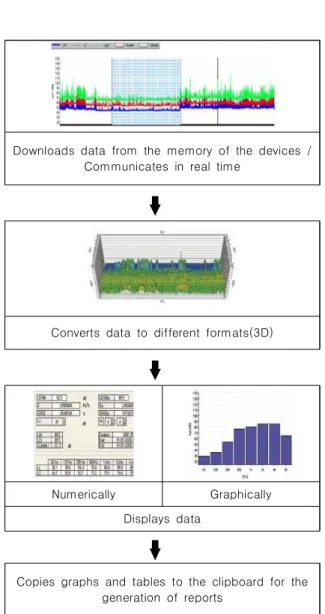
측정된 자료의 분석은 해당진료 시작부터 종료 시까지 누적 소음 노출량측정기를 통하여 현장에서 저장한 신호를 분석용 프로그램(CESVA V.8)을 이용하여 소음특성을 분석하였다
<Fig. 2>.
Downloads data from the memory of the devices / Communicates in real time
Converts data to different formats(3D)
Numerically Graphically
Displays data
Copies graphs and tables to the clipboard for the generation of reports
Fig. 2. Specification of analysis program(CESVA V.8)
본 연구에서 분석에 적용한 주파수 범위는 31.5Hz∼12kHz 까지이며 1/1옥타브밴드로 각 치료종류에 따라 구분하여 분석 하였으며 소음의 평가는 NR곡선을 이용하였다.
2.1 Noise measurement methods
치과병원에서 진료시 가동되는 각종 기기로부터 발생하는 소음특성에 대한 측정은 측정당시 이루어진 진료 행위를 기본 으로 치면세마, 보존치료, 보철치료, 임플란트 시술 등으로 구 분하여 실시하였다.
치료 종류에 따라 소음측정 시 사용된 기구의 종류는 치면세마
진료시에는 Ultrasonic scaler, Hand piece(low speed), 3-way
syringe, Suction, 보존치료(치아삭제) 시에는 3-way syringe,
Hand piece, Suction, 보철치료(치아연마, 크라운 작업, 틀니
치료) 및 임플란트 시술 시에는 Hand piece(high/low speed),
Suction 등의 장비 등을 사용하였으며 진료장비의 동력을 제공하
기 위하여 Compressor가 가동되었다<Table 2>.
(3)
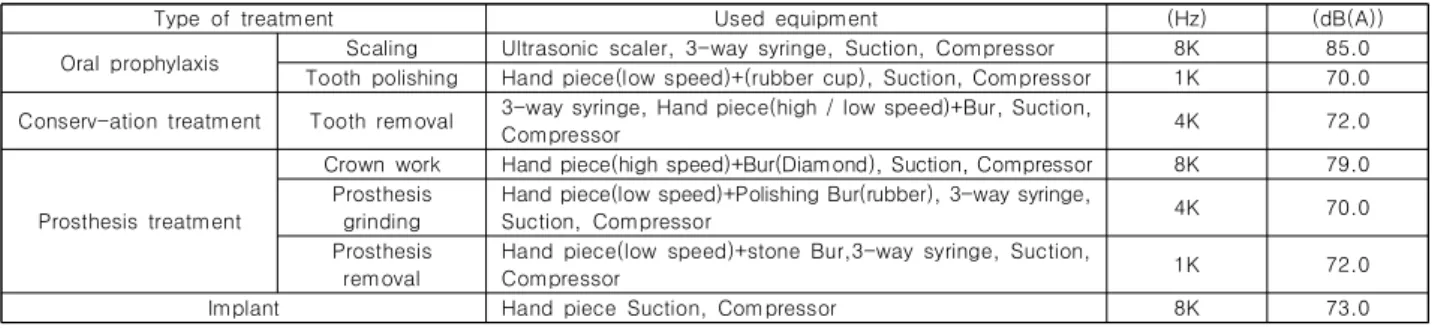
Type of treatment Used equipment Treatment Details
Crown work Hand piece(high speed)+Bur(Diamond), Suction, Compressor 8K 79.0 Prosthesis
grinding
Hand piece(low speed)+Polishing Bur(rubber), 3-way syringe,
Suction, Compressor 4K 70.0
Prosthesis removal
Hand piece(low speed)+stone Bur,3-way syringe, Suction,
Compressor 1K 72.0
Implant Hand piece Suction, Compressor 8K 73.0
Table 3. The characteristics of noise and used instrument according to the dental practice
Ⅲ. Analysis and discussion
3.1 Noise characteristics of equipment used in dental practice
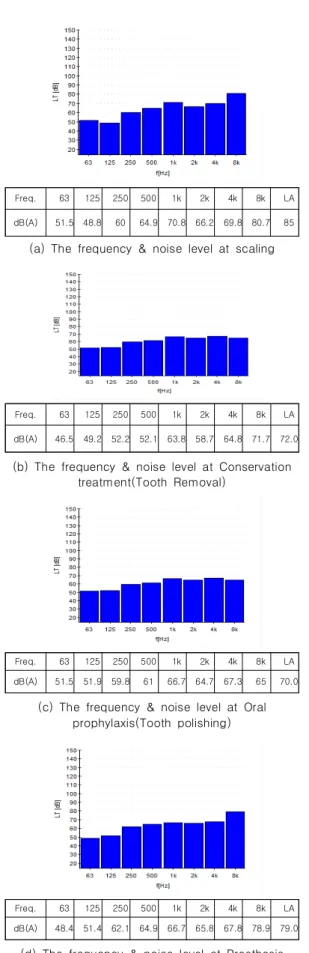
치과병원에서 진료 시 사용되는 기기는 Ultrasonic scaler, Hand piece, 3-way syringe, Suction, Compressor 등 이었 으며 Hand piece의 경우 Bur를 연결하여 사용하는 등 치료 종류에 따라 기기를 조합하여 사용하고 있었다.
기기에서 발생하는 소음특성을 분석한 결과 발생소음의 크기는 Ultrasonic scaler, Hand piece(high speed)+Bur(Diamond), Hand piece(low speed)+Stone Bur, Hand piece(low speed)+
Rubber Cup 순으로 분석되었으며 주파수 특성의 경우 Hand piece(low speed)+Bur(rubber) 및 Hand piece(low speed)+
Stone Bur 경우에서 1K(Hz)에서 우세하였으며 나머지의 경우 4K(Hz) 이상의 고주파 성분이 우세한 것으로 분석되었다<Fig.3>.
Fig. 3. Noise level of treatment device by frequency
3.2 Noise characteristics according to type of dental practice
치과병원에서 진료시 발생하는 소음특성을 파악하기 위하여 측정한 치료의 종류는 치면세마(스케일링, 치아연마) 보존치료(치 악삭제), 보철치료(크라운작업, 보철물 삭제 / 연마 등), 임플란트 시술 등이었으며 소음도 및 주파수 특성은 <Fig. 4>와 같다.
치과병원에서 치료 종류별로 사용되는 기기에 따른 소음 수준을 비교한 결과 Ultrasonic scaler, 3-way syringe, Suction, 등의 기기를 조합하여 사용하는 치면세마(스케일링) 치료 시 발생하는 소음도가 85.0dB(A)로 가장 높은 것으로 분석 되었다.
Hand piece(high speed), Suction 등의 기기를 조합하여 사용하 는 보철치료(크라운 작업) 시 79.0(A)), Hand piece, Suction 기기 를 조합하여 사용하는 임플란트 시술 시 73.0dB(A), Hand piece, 3-way syringe, Suction 기기를 조합하여 사용하는 보존치료(치 아삭제, 72.0dB(A)), Hand piece, Suction 기기를 조합하여 사용하 는 보철치료(보철물 삭제, 72.0dB(A)/ 보철물 연마, 70.0dB(A)) 순으로 높게 나타나는 것으로 분석 되었다<Table 3>.
주파수 특성의 경우 보철치료 중 보철물 연마 시 발생하는 소음의 경우를 제외하고는 탁월 주파수가 4KHz∼8KHz 로 고 주파 소음 특성을 보이고 있었으며 고주파로 갈수록 소음도가 높은 것으로 분석되었다<Fig. 3>.
3.3 Noise level and its effect on human body during dental practice
치과진료 시 발생하는 소음이 인체에 미치는 영향과 비교한 결과 치과 종류별로 발생하는 소음레벨의 범위는 70.0∼
Fig. 4. Characteristics of noise according to the treatment kind
이 정도의 소음에 지속적으로 노출 될 경우 말초혈관이 수
축하고 부신피질 호르몬이 감소하며 청력손실이 발생할 수 있
는 수준으로 분석되었다<Table. 4>.
(5)
(a) Implant
(b) Prosthesis treatment(Crown work) Noise
Level (dB(A))
Effect on the human body Pertinent to medical exam.
100 Bring audition-loss when long exposure
90 Increase urine, genegates hearing difficulty 80 Possible early rupture of
amnion
◾Oral prophylaxis - Scaling
75 Begins occurrence of stamina-loss
◾Prosthesis treatment - Crown work
◾ Implant
◾Conservation treatment
- Tooth removal
◾Prosthesis treatment
- Prosthesis removal
70
Contraction of peripheral blood vessel, decrease of adrenocortical hormones
◾Prosthesis treatment -Prosthesis grinding
◾Oral prophylaxis -Tooth polishing
65
Decline of spiritual concentration, various hearing-impediment 60 Limitation of health Preservation by noise
Table 4. Effect of noise on human body
3.4 Noise evaluation by NR curve (Noise Rating Curves)
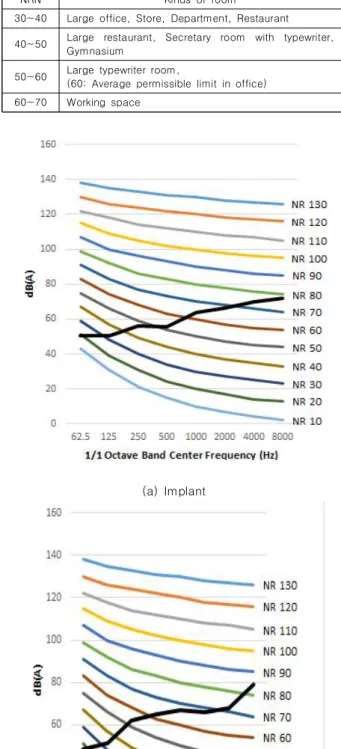
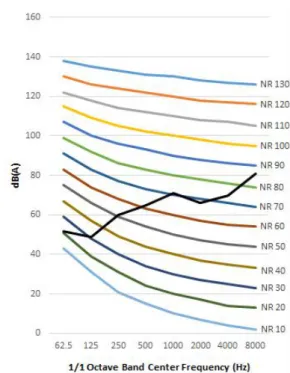
치과병원에서 진료 시 발생하는 소음에 대하여 청력장해, 회화방 해, 시끄러움의 3가지 관점에서 평가하기 위하여 NR곡선(Noise Rating Curves)에 1/1옥타브 대역별 중심주파수의 각 소음 수준을 기입하여 구한 NR값의 결과를<Fig. 5>에 제시하였다.
NR곡선에 적용한 결과 스케일링 치료를 할 경우 NR-83, 보존치료 시 NR-67, 보철치료(크라운 작업) 시 NR-72, 임플 란트 작업하는 경우 NR-75인 것으로 나타났다<Table. 5>.
NR곡선을 결정하는 결정주파수가 4k(Hz)∼8k(Hz)로 고주 파 성분인 것으로 분석되었으며 치과병원 근무자들은 4k(Hz) 이상 대역의 고주파수에서 가장 많은 영향을 받아 청력장해가 예상되는 것으로 나타났다[7].
Case of medical examination NR Determining frequency(Hz)
Oral prophylaxis(Scaling) NR-83 8k
Conservation treatment
(Tooth Removal) NR-67 8k
Prosthesis treatment
(Crown work) NR-72 4k
Implant NR-75 8k
Table 5. NR and Determining frequency in accordance with medical examination
<Fig. 5>에서 정리한 NR값을 NRN에 의한 각 실 소음 기준표인
<Table. 6>과 비교한 결과 NR-67∼NR-83의 범위를 나타내고 있어 작업장의 소음기준을 훨씬 초과하는 수준임을 알 수 있었다.
특히, 스케일링을 담당하는 근무자는 4k(Hz)이상의 고주파 소음 에 노출되는 것으로 분석되었는데 스케일링 치료를 담당하는 근무자 에게 미치는 소음에 대한 방음대책 수립이 필요할 것으로 판단된다.
NRN Kinds of room
30~40 Large office, Store, Department, Restaurant 40~50 Large restaurant, Secretary room with typewriter,
Gymnasium
50~60 Large typewriter room,
(60: Average permissible limit in office) 60~70 Working space
Table 6. Permissible value of indoor noise in accordance with
NRN
(6)
(b) Prosthesis treatment(Prosthesis grinding)
(b) Prosthesis treatment(Prosthesis removal)
(c) Conservation treatment(Tooth removal)
(d) Oral prophylaxis(Tooth polishing)
(7)
(d) Oral prophylaxis(Scaling)
Fig. 5. NR-curve at medical examination(Continue)
Ⅳ. Conclusion
본 연구는 치과병원에서 치료 시 치료기기 사용으로 인하여 발생하는 소음이 치과병원 근무자에게 미치는 영향 정도를 파악 하기 위하여 치료기기에서 발생하는 소음특성, 치료기기를 조합 하여 사용하는 치면세마, 보존치료, 보철치료, 임플란트 시술 등 진료시 발생소음 특성에 대하여 측정을 실시하였으며 이 측정 결과를 NR곡선에 비교하여 인체에 미치는 영향에 대한 정도를 비교하는 등의 방법을 통하여 치과병원 근무자의 소음피해 저감 방안를 제시하고자 실시하였으며 그 결과는 다음과 같다.
치과치료 시 사용하는 주요 기기에서 발생하는 소음의 특성 을 분석한 결과 Ultrasonic scaler, Hand piece(high speed)+Bur(Diamond), Hand piece(low speed)+Stone Bur, Hand piece(low speed)+Rubber Cup 순으로 소음수준 이 높은 것으로 분석되었으며 Hand piece를 low speed로 사 용하는 경우를 제외한 나머지의 경우에서 4K(Hz) 이상의 고 주파 성분이 우세한 것으로 분석되었다
치과치료 시 발생하는 소음의 특성을 분석한 결과 치면세마(스 케일링) 치료 시(Ultrasonic scaler, 3-way syringe, Suction, 등) 발생하는 소음도가 85.0dB(A), 보철치료 중 크라운 작업 시 (Hand piece(high speed), Suction 등) 79.0(A)), 임플란트 시술 시(Hand piece, Suction 등) 73.0dB(A), 보존치료 중 치아삭제
시(Hand piece, 3-way syringe, Suction 등) 72.0dB(A), 보철치 료(Hand piece, Suction 등) 중 보철물 삭제 시 72.0dB(A), 보철물 연마 시 70.0dB(A)) 순으로 높게 나타났다.
주파수 특성의 경우 Ultrasonic scaler, Hand piece(high speed)를 사용하여 치료하는 경우에서 4KHz∼8KHz의 고주 파 소음이 우세하게 나타나는 특성을 보이고 있었으며 고주파 로 갈수록 소음도가 높게 나타나 치과병원에 근무하는 근무자 는 고주파 성분에 의하여 영향을 받고 있음을 알 수 있다.
치과 진료시 기기에서 발생한 소음레벨의 범위가 70.0∼
85.0dB(A)로 말초혈관 수축, 부신피질 호르몬 감소하고 청력손 실의 발생 등을 보일 수 있는 수준으로 근무자의 피해 호소가 예상되며 집중력 저하로 인한 양질의 의료서비스 제공에 악영향 을 끼치게 될 것으로 예상되어 치과병원 근무자에게 미치는 영향 을 최소화하기 위한 대책이 마련되어야 한다고 판단된다[8].
치과병원에서 진료 시 발생하는 소음에 대하여 NR곡선 (Noise Rating Curves)을 이용하여 평가한 평가 결과 스케일 링 치료를 할 경우 NR-83, 보존치료 시 NR-67, 보철치료(크 라운 작업) 시 NR-72, 임플란트 작업하는 경우 NR-75인 것 으로 나타났으며 결정 주파수가 4k(Hz)∼8k(Hz)였으며 NR값 을 NRN에 의한 각 실 소음 기준과 비교한 결과 NR-67∼
NR-83의 범위를 나타내고 있어 치료가 진행되는 동안 작업 장의 소음기준을 훨씬 초과하는 수준임을 알 수 있었으며 4k(Hz)이상의 고주파대역에 대한 방음대책을 수립하여 근무 자에게 미치는 소음에 대한 영향을 최소화 시킬 필요가 있는 것으로 판단된다.
결국 치과병원에서 발생하는 소음의 특성을 분석하기 위하여 사용되는 기구의 발생소음 과 기구를 조합하여 사용하는 치료종류 별 발생소음의 소음도 및 주파수 특성 분석 분석결과 치과병원에서 발생하는 소음의 특성은 고주파성분이 우세한 소음으로 이는 치과 치료 시 사용되는 장비 중 Ultrasonic scaler, Hand piece(high speed)의 기구 사용으로 인하여 발생하는 소음성분에 의해 지배적 인 영향을 받고 있었음을 알 수 있었다[9].
또한 분석 결과를 NR 곡선 분석 및 NRN에 의한 각 실 소 음 기준과 비교한 결과 치과병원 근무자에게 지속적으로 노출 시 집중력 저하 및 소음성 난청의 피해가 예상되므로 치료시 적절한 방음대책(방음보호구 착용)[10] 및 주기적인 청력 검 사를 실시하는 등의 대책 수립이 필요할 것으로 판단된다.
REFERENCES
[1] JHoLee, “Occupational Diseases of Noise Exposed Workers,” HANYANG MEDICAL REVIEWS, Vol. 30, No.
4, pp 326-332, Oct. 2010.
[2] YSChoi, HKKwon, WGChung, “Dimensions and measures
in patients satisfaction with dental care,” J korean Acad
(8)
Dong-Ha Ji received the Ph,D. degree in Environmental Health from Soonchunhyang university, in 2010. He is currently a Professor in the Dept.
Environmental Health, Daejeon Health Institute of Technology. He is interested in indoor air quality, occupational stress and noise & vibration control.
Yong-Gyoo Lee studied at the Nihon University of Japan from 1986 to 1993.
He is currently a Professor in the Division of Social Welfare, Woosong College. He is interested in health science, hydrology and indoor environment.
Dent. Health, Vol. 29, No. 4, pp. 407-417, Dec. 2005.
[3] Ministry of Employment and Labor, “Notification on measurement and designation of work environment”, No. 2017-27.
[4] NJKim, JKKwon, JHLee, “The Impact of Noise Expose on the Hearing Threshold Extended High Frequency,”
Korean J Occup Environ Med, Vol. 20, No. 2, pp. 81-92, May 2008.
[5] BMKwon, JHLee, SKim, TSJeong, “The assessment of noise in the pediatric dental clinics,” J Korean Acad Pediatr Dent, Vol. 39, No. 3, pp. 267–272, Aug. 2012.
“ Related factors of high frequency hearing loss in the noise-exposed male workers,” Korean J Occup Environ Med, Vol. 12, No. 2, pp. 187-197, June 2000.
[7] KOSHA, “A Study on Prediction of Hearing Loss and Noise Hearing Impairment of Noise Exposed Workers,”
No. 2004-96-590, pp. 83-89, 2004
[8] MYKim, KWLee, HSMoon, MK Chung, “A study on the gratification of the patient in the Dental Hospital,” The Korean Academy of prosthodontics, Vol. 46, No. 1, pp.
65-82, Feb. 2008.
[9] JMKim, “ The health effects of industrial noise,” Korean society of environmental engineers, Vol. 29, No. 2, pp.131~137, June 2007.
[10] SCKim, KSPark, KWKim, “The Study on Affecting Subject Accomplishment by Noise,” Journal of the Ergonomics Society of Korea, Vol. 29, No. 1, pp.121-128, Feb. 2010.