1. Introduction
Sea Surface Temperature (SST) is the sea temperature close to the ocean’s surface and affects the Earth’s atmosphere as an important parameter for monitoring the climate circulation and change (Park et al., 2013).
The global determination of climate change through the SST is an important aim of satellite remote sensing (Park et al., 2013; Smith et al., 1996). In previous study, the SST estimation from satellite have been performed for the accuracy improvement. To evaluate the quality of SST production, Park et al., (2011) assessed the SST error from between the National Oceanic and
Atmospheric Administration (NOAA) satellite (NOAA-15, 17, 18 and 19) and the drifting data.
O’Carroll et al (2012) produced the SST from the Meteorological Operation (MetOp)/Infrared Atmospheric Sounding Interferometer (IASI) and Advanced Very High Resolution Radiometer (AVHRR) sensors.
Although the SST measurement need accurate data for climate model, the SST from satellite still has biases from the error in specifying retrieval coefficients from either forward modeling or instrumental biases (Merchant and Borgne, 2004; Merchant et al., 2009).
Furthermore, to produce high quality of the SST products, radiometric calibration was also conducted
Sensitivity analysis of satellite-retrieved SST using IR data from COMS/MI
Eun-bin Park, Kyung-soo Han
†Jae-hyun Ryu and Chang-suk Lee Department of Spatial Information Engineering, Pukyong National University
Abstract : Sea Surface Temperature (SST) is the temperature close to the ocean’s surface and affects the Earth’s atmosphere as an important parameter for the climate circulation and change. The SST from satellite still has biases from the error in specifying retrieval coefficients from either forward modeling or instrumental biases. So in this paper, we performed sensitivity analysis using input parameter of the SST to notice that the SST is most affected among the input parameter. We used Infrared (IR) data from the Communication, Ocean, and Meteorological Satellite (COMS)/Meteorological Imager (MI) from April 2011 to March 2012. We also used the Global Space-based Inter-Calibration System (GSICS) correction to quality of the IR data from COMS.
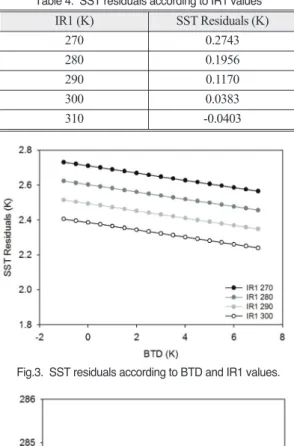
SST was calculated by substituting the input parameters; IR data with or without the GSICS correction. The results of this sensitivity analysis, the SST was sensitive from -0.0403 to 0.2743 K when the IR data were changed by the GSICS corrections.
Key Words : SST, COMS/MI, sensitivity analysis, GSICS correction http://dx.doi.org/10.7780/kjrs.2013.29.6.1
Received October 17, 2013; Revised November 5, 2013; Accepted November 7, 2013.
†