JKSCI
Development and application of Scenario-based Admission Management VR contents for nursing students
1)
Yu-Jeong Kim*
*Professor, Dept. of Nursing Science, Chosun Nursing College, Gwangju, Korea
[Abstract]
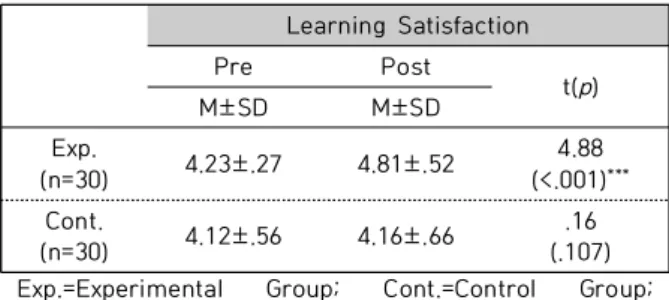
In this paper, I developed a scenario-based admission management virtual reality (SAM VR) content for practical training for nursing students and verified the effectiveness. The SAM VR contents used in the study was developed by the researcher using Gear VR and smartphone according to the standard practical procedure suggested by the Korea Acreditation Board of Nursing Education and Evaluation. In the 30 experimental groups who received practical training using SAM VR contents, learning flow, learning confidence, and learning satisfaction increased statistically significantly after the practical training (p<.001). In the control group, who received practical training in the traditional way, learning confidence increased after the practical training (p<.005), but there was no change in learning flow and learning satisfaction (p>.005). It was verified that the SAM VR contents are effective practical education contents for nursing students' learning flow, learning confidence and learning satisfaction.
▸Key words: Virtural Reality, Nursing Student, Practical Training, Learning Flow, Learning Confidence, Learning Satisfaction
[요 약]
본 연구는 간호학생 실습교육을 위해 시나리오 기반 입원관리 가상현실 (Scenario-based Admission Management Virtual Reality, 이하 SAM VR) 콘텐츠를 개발한 후 효과성을 검증하기 위해 수행되었다.
연구에 사용된 SAM VR 콘텐츠는 한국간호교육평가원에서 제시한 표준실무 절차에 따라 기어 VR 과 스마트폰을 활용하여 10분 분량으로 개발되었다. SAM VR 콘텐츠 활용한 실습교육을 받은 실험 군 30명은 실습교육 후에 학습몰입감, 학습자신감 및 학습만족도가 통계적으로 유의하게 상승했다 (p<.001). 전통적인 방식으로 실습교육을 받은 대조군은 실습교육 후에 학습자신감은 상승하였으나 (p<.005) 학습몰입감과 학습만족도에는 변화가 나타나지 않았다(p>.005). SAM VR 콘텐츠는 간호학 생의 학습몰임감, 학습자신감과 학습만족도에 효과적인 실습교육 콘텐츠임이 검증되었다.
▸주제어: 가상현실, 간호학생, 실습교육, 학습몰입감, 학습자신감, 학습만족도
∙First Author: Yu-Jeong Kim, Corresponding Author: Yu-Jeong Kim
*Yu-Jeong Kim ([email protected]), Dept. of Nursing Science, Chosun Nursing College
∙Received: 2020. 11. 30, Revised: 2020. 12. 18, Accepted: 2020. 12. 18.
Copyright ⓒ 2021 The Korea Society of Computer and Information http://www.ksci.re.kr pISSN:1598-849X | eISSN:2383-9945