JESK
http://jesk.or.kr eISSN:2093-8462Suggestion of a Method to Assess the Risk Level of Agricultural Works Considering Work Posture and Working Time
Hee-Sok Park1, Yun Keun Lee2, Hyocher Kim3, Kyungsuk Lee3
1Department of Industrial Engineering, Hongik University, Seoul, 04066
2Wonjin Institute for Occupational and Environmental Health, Seoul, 02221
3National Institute of Agricultural Science, Rural Development Administration, Jeonju, 55365
작업자세와 작업시간을 고려한 농작업의 인간공학적위험성 평가 방법의 제안
박희석1, 이윤근2, 김효철3, 이경숙3
1홍익대학교 신업공학과
2노동환경건강연구소
3농업과학원
Corresponding Author Hee-Sok Park
Department of Industrial Engineering, Hongik University, Seoul, 04066 Phone : +82-10-2389-1473 Email : [email protected]
Received : September 19, 2017 Accepted : September 27, 2017
Copyright@2017 by Ergonomics Society of Korea. All right reserved.
○
ccThis is an open-access article distributed under the terms of the Creative Commons Attribution Non-Commercial License (http://creativecommons.org/licenses/by-nc/3.0/), which permits unrestricted non-commercial use, distribution, and reproduction in any medium, provided the original work is properly cited.
Objective:A method to assess the risk level of agricultural works considering work posture and working time was suggested, and the method was applied to the major fruit crops.
Background: It is not complete to analyze only work postures when assessing risk level of agricultural works.
Method: 3×3 matrix was employed, in which the severity level was taken from the REBA method and exposure level was taken from the working time, using the criteria of caution zone/hazard zone.
Results: Among the 5 major fruit crops(apple, pear, grape, peach, persimmon), the highest level of ergonomic risk was found in the apple and pear, while medium level was found in other 3 crops, mainly because the working time was less in the 3 crops.
Conclusion: It was found that when assessing the overall ergonomic risk of agricultural works, work posture and working time should be considered at the same time.
Application: The suggested method could be applied to other non-cyclic tasks.
Keywords: Ergonomic risk assessment, Agricultural work, Work posture, Working time
1. Introduction
근골격계질환은 농업인들에게 흔한 질병 중 하나이다. 우리나라 농업인을 대상으로 한 공 식적인 통계가 없어서 근골격계질환의 발생규모를 정확히 알 수는 없으나, 근골격계질환
과 관련된 통증 호소율이 80% 이상인 것으로 보고된 바 있다(Ko, 2012; Kim, 2015). 농업인들에게 가장 흔한 근골격계질환은 요통과 무 릎 골관절염이며, 목과 상지의 근골격계질환은 일반인 인구집단에 비해 높은 유병률이 보고되었다(Ko, 2012). 또한 우리나라에서 의학적 검진을 통해 근골격계질환의 유병률을 조사한 결과, 농업인이 비농업인에 비해 8.96배 높은 것으로 나타났다(Sur et al., 2015). 외국의 경 우에도 농업인의 90.6%가 평생 한번 이상 근골격계질환을 경험하며, 유병률은 76.9%에 달하는 것으로 알려져 있다(Osborne et al., 2012).
인간공학적 위험성을 평가할 때 주로 사용되는 자세평가 기법들은 노출시간을 거의 평가하지 않는다. RULA (Rapid Upper Limb Assessment) 에서는 신체부위의 각도에 따른 자세 점수와 근육사용 점수, 힘 사용 정도 등을 종합하여 최종 위험 점수를 산정하며, 위험요인에 노출되 는 시간은 고려되지 않는다(McAtamney and Corlett, 1993). OWAS (Ovaco Working posture Analysing System) (Karhu et al., 1977)나 REBA (Rapid Entire Body Assessment) (Higneet and McAtamney, 2000)도 마찬가지이다. 한편, JSI (Job Strain Index) (Moore and Garg, 1995)나 미 국 워싱턴 주에서 사용하고 있는 기준(WDLI, 2000)은 위험요인의 1일 노출시간을 반영하고 있다. 그러나 이 두 가지 방법 모두 매일 반 복되는 작업이라는 것을 전제로 1일 노출시간만을 반영한다. 따라서 농작업과 같이 매일 또는 작업단계마다 위험요인에 노출되는 시간 이 다른 경우에는 기존의 자세평가 기법들을 그대로 적용하는 데는 한계가 있다.
농작업은 작업내용이 표준화되어 있지 않고, 작물의 생육단계에 따라 다른 작업이 불연속적으로 이루어진다는 특징이 있다. 따라서 작업 을 관찰하는 시점에 따라서 작업내용과 작업시간이 다르기 때문에 전체 농사기간에 걸쳐 근골격계질환의 위험성을 평가하는 데는 한계 가 있다. 특정 작업단계에서 발생하는 작업자세에 대한 연구들은 이루어진 바 있으나(Lee et al., 2008; Kim et al., 2009; Chae et al., 2012;
Lee and Kim, 2012; Kang et al., 2016), 작업자세와 작업시간을 동시에 고려하여 종합적인 위험성을 평가한 연구는 찾아보기 힘든 실정이 다. 이에 본 연구에서는 작업자세와 작업시간을 바탕으로 근골격계질환의 위험성을 평가하는 손쉬운 방법을 제시하였고, 주요 과수작목 들에 대하여 적용하여 보았다.
2. Method
2.1 Crops for analysis
평가대상 작목은 다른 작목군에 비해 특정 작업자세가 지속적으로 반복되는 비중이 상대적으로 많은 과수작목을 대상으로 하였다. 2015년 '농림어업총조사'결과(KOSIS, 2017)에 수록된 재배농가수를 기준으로 상위 5개 작목(사과, 배, 포도, 복숭아, 단감)을 선정하였다. 이 5개 작 목은 우리나라 과수 재배농가의 77.8%를 차지하는 주요 작목이다. 과수농가의 작목별 평균 재배면적은 사과가 8,411m2로 가장 많았으며, 다음으로 배(7,762m2), 복숭아(5,273m2), 포도(4,679m2)순이었고, 단감이 3,670m2로 가장 적었다.
2.2 Analysis method
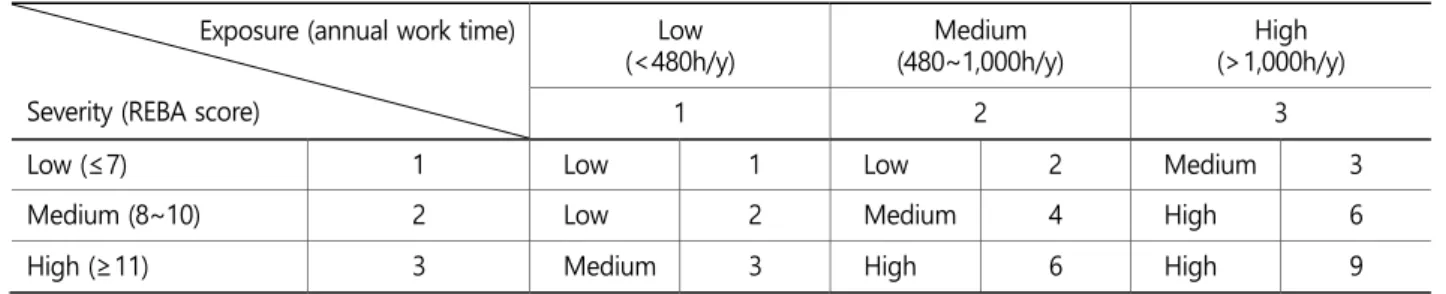
작업자세와 작업시간을 동시에 고려하는 평가방법으로 안전/보건 분야의 위험성 평가에서 사용되는 3×3 행렬을 이용하였다. 이는 위험 의 강도(severity, dose)와 위험의 노출수준(likelihood, exposure)을 각각 3단계로 나누고 두 변수의 조합을 계산하여 최종 위험도를 산정 하는 방법이다(Ristic, 2013).
본 연구에서는 위험의 강도를 나타내는 지표로 REBA를 응용하여, '상=3점(REBA 점수≥11)', '중=2점(REBA 점수 8~10)', '하=1점(REBA 점 수≤7)' 3단계로 분류하였다.
노출수준 즉, 작업시간은 caution zone/hazard zone에 관한 기준(WDLI, 2000)을 참고하여 1일 작업시간 8시간을 기준으로 특정 작업단계 가 4시간(50%) 이상 계속되면 '상=3점', 2~4시간(25~50%) 계속되면 '중=2점', 2시간(25%) 이하이면 '하=1점' 3단계로 간주하였다. 일반적 으로 연간 노동시간 2,000시간(250일)을 100%로 간주하므로 연간 노동시간 1,000시간은 전체 작업시간의 50%를 의미하며, 연간 노동시 간 480시간은 전체 작업시간의 25%를 의미한다(Table 1).
작업단계별 작업시간은 연구자가 연속적으로 관찰 또는 워크샘플링 등 간헐적으로 관찰하여 파악하거나, 농민대상 인터뷰를 통하여 파악 할 수 있다. 또는 국가통계인 '농축산물 소득자료집'(RDA, 2017)에 수록된 '작업단계별 노동시간'을 사용하여 간접적으로 파악할 수 있다.
최종적인 위험성은 작업자세와 작업시간 각각의 점수를 곱하여 나오는 값을 '상(6~9점)', '중(3~4점)', '하(1~2점)'로 차별하였다. 최종적인 위험성에 대한 기준은 선행 연구에서 사용하는 3×3 행렬에 의한 점수표를 그대로 적용하였다(Ristic, 2013). 예를 들어, 위험도 수준이 '상' 은 REBA에서 작업자세 점수가 '곧 조치가 필요한 단계' 또는 '즉시 조치가 필요한 단계'이면서 연간 작업시간 비중이 25% 이상에 해당되 는 경우이다.
3. Results 3.1 Working time
작목별 연간 작업시간은 '농축산물 소득자료집'을 참고하였다(RDA, 2017). 작목별로 보면 1,000m2 당 남성농업인의 자가 노동시간은 포 도가 89.5시간으로 가장 많았으며, 복숭아 74.5시간, 배 66.6시간, 사과는 62.0시간이었다. 단감의 노동시간이 49.0시간으로 가장 적게 나 타났다(Table 2).
'농축산물 소득자료집'의 작목별 노동력 투하시간과 '농림어업총조사'의 농가 당 평균 재배면적(KOSIS, 2017)을 기준으로 연간 노동시간을 환산하면 사과 작목이 521시간으로 가장 많았고, 배(517시간), 포도(419시간), 복숭아(393시간) 순이었다. 단감은 농가당 평균 재배면적과 자가 노동시간이 적어서 연간 노동시간도 180시간으로 5개 작목 중 가장 적었다.
3.2 Ergonomic risk
과수작목에서 가장 전형적인 위보기자세를 취하는 가지다듬기, 순지르기, 가지유인, 인공수정, 열매솎기, 봉지 씌우기/벗기기, 잎따기, 수 확작업 등은 작목별로 다소 차이는 있지만 전체 작업단계의 거의 대부분을 차지하는 주 작업들로서, 이들 작업을 중점적으로 분석하였 Table 1. Ergonomic risk assessment matrix for agricultural works
Exposure (annual work time) Severity (REBA score)
(<480h/y) Low Medium
(480~1,000h/y) High
(>1,000h/y)
1 2 3
Low (≤7) 1 Low 1 Low 2 Medium 3
Medium (8~10) 2 Low 2 Medium 4 High 6
High (≥11) 3 Medium 3 High 6 High 9
Table 2. Annual working time per household for each crop
Crop Area per household
(m2) Annual working time
(h/1,000m2) Annual working time per household (h)
Apple 8,411 62.0 521
Pear 7,762 66.6 517
Grape 4,679 89.5 419
Peach 5,273 74.5 393
Persimmon 3,670 49.0 180
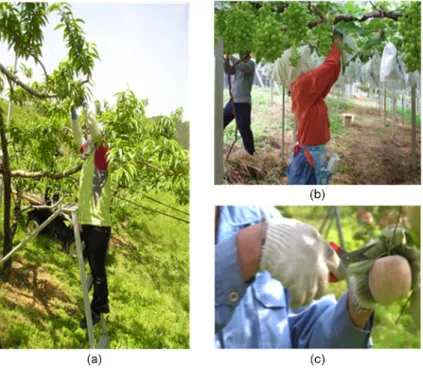
다. 위 작업들은 상완을 90° 이상 들어 올리고, 팔을 쭉 뻗은 상태에서 1분 이상 정적인 자세를 유지한다(Figure 1a). 또한 동시에 목이 뒤 로 20° 가까이 신전되거나 옆으로 기울어진 자세가 1분 이상 유지된다(Figure 1b). 다리 부위는 대부분이 사다리 위에서 작업이 이루어지 기 때문에 좁은 사다리 발판 폭(5cm)과 무게 중심을 잡는 과정에서 발목과 무릎에 힘이 많이 들어가게 된다(Figure 1a). 추가하여 전지가위 를 사용하기 때문에 손목이 30° 이상 굴곡되거나 편향된 자세가 발생되며(Figure 1c), 포도의 경우 전지가위 사용빈도가 다른 작목에 비 해 더 많은 것으로 나타났다. 또한 수확 시에는 중량물 작업이 추가되는 데, 복숭아와 포도는 수확물 상자의 무게가 10kg 이하이나 사과, 배, 단감은 수확물 상자의 무게가 20kg 내외로 무거운 편이다.
상기한 작업들에 대한 REBA 평가 결과(Table 3), 포도의 경우에는 하지 및 손목 부위의 위험성이 높아서 REBA 점수가 13점이 나왔다. 그 외 작목은 대부분의 작업단계에서 REBA 점수가 11점으로 나왔으며, 사과, 배, 단감의 경우는 수확 시 20kg 내외의 중량물 작업이 있어 12점으로 나타났다.
Table 3. Results from REBA
Task REBA sore
Apple Pear Grape Peach Persimmon
Trimming 11 11 13 11 11
Pinching 11 11 13 11 11
Attraction 11 11 13 11 11
Artificial fertilization 11 11 13 11 11
Fruit picking 11 11 13 11 11
Figure 1. Typical work postures
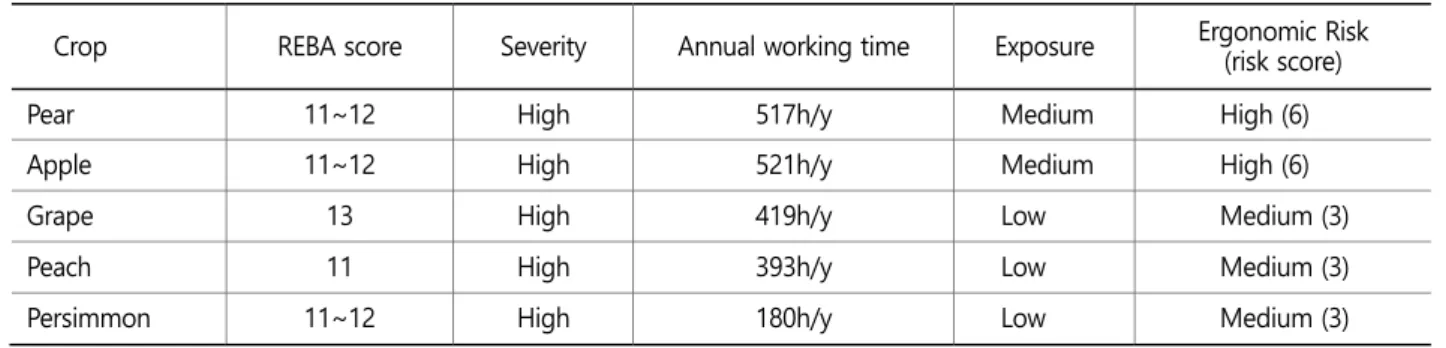
'농축산물 소득자료집'의 작목별 노동력 투하시간과 '농림어업총조사'의 농가 당 평균 재배면적(KOSIS, 2017)을 기준으로 환산된 연간 작 업시간과 REBA 점수를 이용하여 종합적인 위험성을 평가한 결과는 Table 4와 같다. 사과, 배 작목은 위험도가 높은 고위험 작업(위험성 6점)으로, 그리고 포도, 복숭아, 단감 작목은 중위험 작업(위험성 3점)으로 평가되었다.
4. Conclusion
본 연구에서는 작업자세와 작업시간을 바탕으로 근골격계질환의 위험성을 평가하는 손쉬운 방법을 제시하였고, 주요 과수작목들에 대하 여 적용하여 보았다.
작업자세와 작업시간을 이용하여 종합적인 인간공학적 위험성을 평가한 결과, 사과, 배 작목은 위험성이 높은 고위험 작업으로 포도, 복 숭아, 단감은 중위험 작업으로 평가되었다. 이와 같은 위험성의 차이에는 연간 작업시간이 영향을 미치는 것으로 해석된다. 평균 재배면 적을 기준으로 연간 노동시간을 환산해보면 포도와 복숭아, 단감은 각각 각각 419시간, 393시간, 182시간으로 노동시간이 가장 많은 사 과작목 노동시간의 80~35%에 불과하여 위험요인 노출 시간이 상대적으로 적은 것으로 나타났다.
위험성 평가에서 노출시간(위험 빈도)은 매우 중요한 변수이다(Ristic, 2013). 그러나 근골격계질환 위험요인 평가에서 작업시간 즉, 노출 시간을 고려한 평가방법은 많지 않다. 일반적인 산업현장처럼 일정한 작업주기와 통상적인 작업시간이 존재할 때는 위험요인 노출시간 이 중요한 평가요소가 아닐 수도 있다. 그러나 대부분의 농작업은 작목군 별로 비슷한 위험요인 특성을 가지고 있는 반면, 농사규모나 작 목에 따라 투여되는 노동시간에는 많은 차이가 있다. 따라서 농작업을 대상으로 인간공학적 위험성을 평가할 때는 작업자세와 함께 작 업시간이 중요한 영향을 미칠 수 있기 때문에 작업시간을 고려한 평가가 반드시 이루어져야 할 것이다.
이와 같이 작업자세와 작업시간을 함께 고려하는 위험성 평가방법은 농작업 이외의 비정형적인 작업의 위험성 평가에 활용될 수 있을 것 이다.
Table 3. Results from REBA (Continued)
Task REBA sore
Apple Pear Grape Peach Persimmon
Bagging 11 11 13 11 11
Leaf picking 11 11 13 11 11
Harvesting 12 12 13 11 12
Table 4. Result of ergonomic risk assessment for each crop
Crop REBA score Severity Annual working time Exposure Ergonomic Risk
(risk score)
Pear 11~12 High 517h/y Medium High (6)
Apple 11~12 High 521h/y Medium High (6)
Grape 13 High 419h/y Low Medium (3)
Peach 11 High 393h/y Low Medium (3)
Persimmon 11~12 High 180h/y Low Medium (3)
본 연구에서는 과수작목에서 가장 보편적인 작업자세(위보기자세)를 기준으로 평가하였다. 그러나 과수작목은 나무의 크기에 따라 작업 자세가 약간씩 차이가 있을 수 있는데(특히 포도작목은 지역별로 높이 차이가 있음), 이를 모두 분석하지 못하였다. 또한 처음 농사를 시 작할 때부터 끝날 때까지의 모든 작업단계를 평가하지 못하고 작업비중이 많은 8개 작업단계만을 평가했다는 한계가 있다. 거름주기, 제 초작업, 농약 방제작업, 선별 및 포장작업과 같이 위보기자세기 아닌 다른 작업에 대해서도 추가적인 연구가 필요하다.
Acknowledgements
This research was supported by Rural Development Administration.
References
Chae, H.S., Yoon, K.W., Min K.D., Lee, K.S. and Kim, H.C., "Exposure levels of risk factors related to musculoskeletal disorders for farmers",
Proceedings of the ESK Spring Conference 2012,
2012.Hignett, S. and McAtamney, L., Rapid entire body assessment (REBA),
Applied Ergonomics,
31, 201-205, 2000.Kang, M.Y., Lee, M.J., Chung, H., Shin, D.H., Youn, K.W., Im, S.H., Chae, H.S. and Lee, K.S., Musculoskeletal disorders and agricultural risk factors among Korean farmers,
Journal of Agromedicine
, 21(4), 353-363, 2016.Karhu, O., Knasi, P. and Kuorinka, I., Correcting working postures in industry, a practical method for analysis,
Applied Ergonomics
, 8, 199-201, 1977.Kim, K.R., Lee, K.S., Kim, H.C. and Song, E.Y., Health status and musculoskeletal workload of red pepper farmers,
Journal of the Ergonomics Society of Korea
, 28(8), 7-15, 2009.Kim, M.H., Work-related musculoskeletal symptoms among egricultural workers in the rural community,
Asia-pacific Journal of Multimedia Services Convergent with Art, Humanities, and Sociology,
5(2), 71-79, 2015.Ko, S.B., Work-related diseases and injury of Korean farmer: causes, epidemiology, and countermeasure,
Journal of the Korean Medical Association
, 55(11), 1044-1045, 2012.Korian Statistical Information Service (KOSIS) Home page
,http://kosis.kr/statisticsList/statisticsList_01List.jsp?vwcd=MT_ZTITLE&- parentId=F (retrieved september 6, 2017).Lee, I.S. and Kim, J.H., Survey of the characteristics of the symptoms of musculoskeletal disorders among farmers of fruits and vegetables,
Journal of the Korean Society of Safety,
27(6), 144-150, 2012.Lee, Y.H., Lee, J.H., Lee, K.S., Kim, K.R. and Lee, S.J., Ergonomic risk factors related to musculoskeletal symptoms in the vineyard workers,
Journal of Korean Society of Occupational and Environ Hygiene
, 18(2), 122-132, 2008.McAtamney, L. and Corlett, E.N., RULA: a survey method for the investigation of work-related upper limb disorders,
Applied Ergonomics
,24(2), 91-99, 1993.Moore, J.S. and Garg, A., The strain index: A proposed method to analyze jobs for risk of distal upper extremity disorders,
American Industrial Hygiene Association Journal
, 56(5), 443-458, 1995.Osborne, A., Blake, C., Fullen, B.M., Meredith, D., Phelan, J., McNamara, J. and Cunningham, C., Prevalence of musculoskeletal disorders among farmers: a systematic review.
American Journal of Industrial Medicine
,55,
143-158, 2012.Ristic, D., A tool for risk assessment,
Journal Safety Engineering
, 121-127, 2013. Doi: 10.7562/SE2013.3.03.03Rural Development Adminstration (RDA) Home page,
https://amis.rda.go.kr/portal/ap/mn/incomeAnalysisLst/lst# (retrieved september 6. 2017).Sur, Y.S., Cheon, Y.H., Kim, H.O., Kim, R.B., Park, K.S., Yang, H.S., Park, H.B., Na, J.B., Yoon, C.H. and Lee, S.I., Prevalence and risk factors of upper extremity musculoskeletal diseases among farmers in Gyeongnam,
Journal of Rheumatic Diseases
, 22(6), 366-373, 2015.Washington Department of Labor and Industries (WDLI), WAC 296-62-05174 appendix B: Criteria for analyzing and reducing WMSD hazards for employers who choose the specific performance approach, May 2000.
Author listings
Hee-Sok Park: [email protected] Highest degree: Ph.D, University of Michigan
Position title: Professor, Department of Industrial Engineering, Hongik University
Areas of interest: Work-related musculoskeletal disorders, human vibration, work analysis and design
Yun Keun Lee: [email protected]
Highest degree: PhD, Department of Public Health, Catholic University
Position title: Director, Wonjin Institute for Occupational and Environmental Health Areas of interest: Industrial health, ergonomics, agricultural health
Hyocher Kim: [email protected]
Highest degree: MPH from Seoul National University
Position title: Researcher, National Institute of Agricultural Science, Rural Development Administration Areas of interest: Occupational hygiene, agricultural health and safety
Kyungsuk Lee: [email protected]
Highest degree Ph.D., Seoul National University
Position title: Team leader, National Institute of Agricultural Science, Rural Development Administration Areas of interest: Agricultural health and safety