2015년 5월 http://dx.doi.org/10.5000/EESK.2015.19.3.085
기초체계의 운동학적 상호작용을 고려한 고층건물의 응 답스펙트럼에 미치는 고차모드의 영향
Effects of Higher Modes on the Response Spectra of High-rise Buildings considering the Kinematic Interaction of a Foundation System
김용석1)*
Kim, Yong-Seok1)*
1)국립목포대학교 건축공학과
1)Department of Architectural Engineering, Mokpo National University
/ A B S T R A C T /
Response spectra of a building are made with a SDOF system taking into account a first mode shape, even though higher modes may affect on the dynamic responses of a high-rise building. A soft soil layer under a building also affects on the responses of a building. In this study, seismic responses of a MDOF system were investigated to examine the effects of higher modes on the response of a tall building by comparing them with those of a SDOF system including the kinematic interaction effect. Study was performed using a pseudo 3D finite element program with seven bedrock earthquake records downloaded from the PEER database. Effects of higher modes on the seismic responses of a tall building were investigated for base shear force and base moment of a MDOF system including story shear forces and story moments. Study results show that higher modes of a MDOF system contribute to a reduction of base shear force up to 1/4-1/5 of KBC and base moment. The effect of higher modes is more significant on the base shear force than on the base moment. Maximum story shear force and moment occurred at the top part of a building rather than at a base in the cases of tall buildings differently from short buildings, and higher modes of a tall building affected on the base forces making them almost constant at the base. A soft soil layer also affects some on the base shear force of a high-rise building independently on the soft soil type, but a soft soil effect is prominent on the base moment.
Key words: Response spectrum, MDOF system, High-rise building, Kinematic interaction, Finite element program, Base shear force, Base moment, Story shear force
*
Corresponding author: Kim, Yong-Seok E-mail: [email protected]1. Introduction
A response spectrum is mostly made performing seismic analyses of a single degree of freedom(SDOF) system, which is convenient and efficient to predict dynamic effects on the various structural systems having a short fundamental period and governing the dynamic behavior of a system by a first mode. However, a response of a tall building which has a long fundamental period might be affected by higher modes of a system resulting a beneficial or detrimental effect on the system. Soil layers beneath the foundation of a building also could
affect on the response spectra due to structure-soil interactions including kinematic and inertia ones. Soft soil layer would be beneficial on the response of a building in the short period range, but it might be harmful in the long period range.
Studies on the high-rise building system were performed for various topics by many researchers during several decades. Some studies on the seismic responses of a high-rise building were related to dynamic analysis, vertical mass irregularity, higher mode uncertainty, story-drift, shear and overturning moment estimation, and soil type effect.
Seismic behavior of high-rise steel frames was investigated
considering vertical mass irregularity by Choi and Song[1] in 2004,
and Control of earthquake responses of buildings were studied taking
into account higher mode uncertainty by Koh et al.[2] in 2000. Story
shear forces considering high modes were studied through a pseudo
(a) SDOF Model (b) MDOF Model Fig. 1. Pseudo-3D Finite-Element Model
dynamic analysis by Lee et al.[3] in 2001, and seismic force distribution on multistory building structures was also examined by Jun et al.[4] in 1994. Shear force and overturning moment of a building were estimated from building seismic records constructing mode shapes by Mau and Aruna[5] in 1994. Seismic responses of tubular structures for different soil types were studied by Chon et al.[6] in 2007, and horizontal seismic responses of buildings built on a soft soil layer were also examined by Kim[7] in 2001.
However, a research on the effect of high modes to the seismic responses of a high-rise building having a foundation on a soft soil layer was not able to search in the data base of domestic and foreign journals.
In this study, seismic responses of a building was investigated by modelling a building as a multi-degree of freedom(MDOF) system and comparing response spectra of a SDOF system with those of a MDOF system. Response spectra were also compared considering 3 different underlying soil types of S
B, S
Cand S
D. Seismic response analyses of a structure-foundation-soil system were carried out utilizing a pseudo 3D finite element program of P3DASS with seven bedrock earthquakes downloaded from the PEER database.
2. Model of a Structure-Foundation-Soil System
A finite-element software for Pseudo 3-Dimensional Dynamic Analysis of Structure-Soil System (P3DASS) utilized in this study was developed to perform the horizontal seismic analysis of a structure built on a surface or embedded foundation in a linear or nonlinear soil by Kim[8-9] using the cylindrical coordination system. P3DASS can solve for multiple seismic responses of a SDOF building system built
on layered soil in a single run. The soil around a foundation is assumed to be layered on bedrock or relatively stiffer soil as shown in Fig. 1.
The soil layer can be divided into sub-layers for the finite-element analysis, and partitioned into a cylindrical core region under the equivalent circular foundation and the far field outside of the core. An arbitrary shaped foundation can be modeled as an equivalent circular foundation having the same area or moment of inertia (aspect ratio up to 4 is acceptable for a rectangular shaped foundation; Roesset[10]).
The validity of an equivalent circular foundation in the seismic analysis was verified in references of Kausel[11], Roesset[10], Gazetas and Tassoulas[12], and Kim[8]. A mat foundation and the soil under the foundation in the core region are subdivided into toroidal finite-elements considering the horizontal and vertical displacements around the circumference of a cylinder. The far field is represented by the consistent transmitting boundary matrix developed by Kausel[11]
reproducing an extension of the finite-element mesh from the foundation boundary to infinity. The consistent transmitting boundary can be placed at the edge of a circular foundation for the linear elastic analysis according to Kim and Roesset[9].
In this study, the 30m thick (H) soil layer lying on stiff bedrock was
considered assuming that it is horizontally layered, homogeneous,
elastic, viscous and isotropic. Five shear wave velocities of 100, 180,
360, 760 and 1500 m/s for the soil were considered to classify the site
for the seismic analyses. They are the boundary shear wave velocities
specified in IBC2009[13] to classify the site classes. Unit weights of
the soil were assumed to be 16, 16, 18, 20 and 26 kN/m
3depending on
the shear wave velocities respectively, and Poisson's ratio of 0.3 and
initial damping ratio of 0.05 were also assumed. Furthermore, the
foundation was taken as a rigid cylindrical mat foundation with an
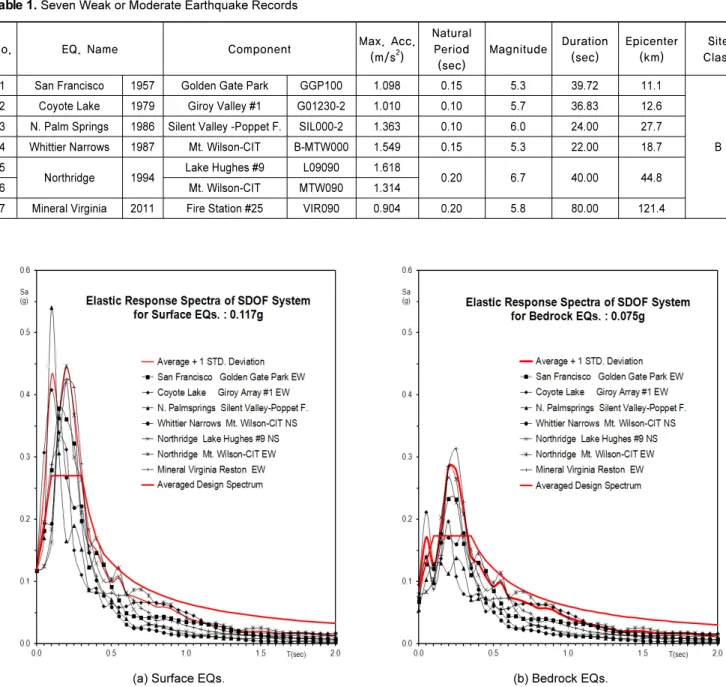
Table 1. Seven Weak or Moderate Earthquake Records
No. EQ. Name Component Max. Acc.
(m/s
2)
Natural Period
(sec) Magnitude Duration
(sec) Epicenter
(km) Site
Class
1 San Francisco 1957 Golden Gate Park GGP100 1.098 0.15 5.3 39.72 11.1
B
2 Coyote Lake 1979 Giroy Valley #1 G01230-2 1.010 0.10 5.7 36.83 12.6
3 N. Palm Springs 1986 Silent Valley -Poppet F. SIL000-2 1.363 0.10 6.0 24.00 27.7
4 Whittier Narrows 1987 Mt. Wilson-CIT B-MTW000 1.549 0.15 5.3 22.00 18.7
5 Northridge 1994 Lake Hughes #9 L09090 1.618
0.20 6.7 40.00 44.8
6 Mt. Wilson-CIT MTW090 1.314
7 Mineral Virginia 2011 Fire Station #25 VIR090 0.904 0.20 5.8 80.00 121.4