Effect of Exogenous Trehalose on the Solvent Tolerance of Pseudomonas sp.
BCNU 106
Hye Jung Choi
1, Bo Ra Lim
1, Sang-Chul Ha
2, Gi-Seok Kwon
3, Dong Wan Kim
4and Woo Hong Joo
1*
1Department of Biology and Chemistry, Changwon National University, Changwon 51140, Korea
2Department of Confectionery Decoration, Daegu Mirae College, Gyeongsan 38607, Korea
3Department of Medicinal Plant Resources, Andong National University, Andong 36729, Korea
4Department of BioHealth Sciences, Changwon National University, Changwon 51140, Korea Received December 28, 2016 /Revised February 13, 2017 /Accepted February 15, 2017
To some extent, the growth of solvent-tolerant Pseudomonas sp. BCNU 106 is limited by toxic solvents.
Therefore, various strategies to overcome this limitation need to be investigated. One such strategy is to use exogenous trehalose. The highest intracellular trehalose content of 181.88 mM was measured at 12 hr. The extracellular trehalose content decreased rapidly within 12 to 16 hr in the presence of cyclohexane. Moreover, the number of Pseudomonas sp. BCNU 106 cells grown in Luria-Bertani (LB) broth supplemented with 0.1 M trehalose in the presence of 1%(v/v) cyclohexane, hexane, pro- pylbenzene, and m-xylene increased 89.94-, 89.72-, 91.25-, and 118.9-fold, respectively, in comparison to the control level. High survival rates of 80% and 90% were observed in the presence of cyclohexane and hexane by the addition of 0.05 M trehalose for up to 4 hr, respectively. Exogenously-added treha- lose was transported into the cells, and it conferred protection against cyclohexane, hexane, pro- pylbenzene, and m-xylene. Adding exogenous trehalose to the growth medium improved the tolerance of Pseudomonas sp. BCNU 106; thus, it is a potential biocatalyst for biotransformation and biodegradation.
Key words : Exogenous trehalose, Pseudomonas sp., solvent tolerance, stress tolerance, trehalose
*Corresponding author
*Tel : +82-55-213-3453, Fax : +82-55-213-3459
*E-mail : [email protected]
This is an Open-Access article distributed under the terms of the Creative Commons Attribution Non-Commercial License (http://creativecommons.org/licenses/by-nc/3.0) which permits unrestricted non-commercial use, distribution, and reproduction in any medium, provided the original work is properly cited.
Journal of Life Science 2017 Vol. 27. No. 8. 945~950 DOI : https://doi.org/10.5352/JLS.2017.27.8.945
서 론
키랄 약물, 화장품, 바이오연료 및 정밀화학 등 생명공학 산업에서는 친환경적이면서 경제적인 공정이 요구되고 있다.
다양한 미생물 기원의 산업적 효소는 비수계 시스템에서 이러 한 요구에 부합하며 지속적으로 활용 가능한 기술로써 각종 산업제품 생산에 있어서 사용이 증대되고 있는 추세이다[6, 8].
미생물이 생산하는 효소는 활성, 안정성 및 선택성에 기초 하여 특정 전환반응에 사용될 수 있으며, 기질의 용해도가 반 응 속도를 결정하고 생합성 반응에서 생산 수율을 증가시킨다 [19]. 특히, 소수성인 유기용매에서 생체 촉매로 기능할 수 있 는 리파아제 및 에스테라아제는 합성에 유리한 열역학적 평형 의 이동, 소수성 기질의 사용, 용매에 의한 효소 선택성의 조 절, 수계에서의 부반응 억제, 효소의 열 안정성 향상 및 오염 가능성을 최소화 시키는 등의 새로운 기능성을 가지고 있는
것으로 알려져 있다[9]. Pseudomonas sp. S5, Bacillus sphaericus 205y 및 Arthrobacter nitroguajacolicus Ru61로부터 생산된 효소 는 소수성이 높은 hexadecane과 같은 용매의 첨가에 의해 불 활성화되는[15, 16] 반면에 이들 균주가 생산하는 리파아제의 경우는 유기용매의 첨가에도 효소 활성이 유지되는 것으로 보고되고 있다[11]. 그러나 이러한 장점은 비수계 시스템에서 유기용매에 의해 쉽게 변성되어 촉매 작용을 잃기 때문에 낮 은 안정성 및 활성으로 인해 제한되며, 따라서 비수계 시스템 에서 안정한 효소에 대한 연구가 필요하다.
유기 용매는 세포막에 결합하여 막을 파괴시키고 장벽의 투과성을 감소시켜 세포 대사 손상 및 성장 억제를 초래하며 나아가 세포 사멸을 초래할 수 있으나 유기 용매 내성 세균은 이러한 독성 용매의 존재하에서도 생존이 가능하다[7, 17]. 많 은 연구에 의해 유기용매 내성 세균이 생산하는 효소는 유기 용매 존재하에서 안정적이며, 비극성 기질의 용해도 증가 및 물에서의 부반응의 억제 등 많은 이점이 있음이 보고되어 있 다[9]. 그럼에도 불구하고 많은 요인들은 유기용매하에서 효소 의 촉매 기능에 불리하게 작용하므로 이러한 비수계에서 낮은 효소 활성을 극복하기 위한 기술의 개발이 절실히 요구된다.
유기용매 내성 Pseudomonas sp. BCNU 106 균주는 hexane, toluene 및 xylene 등 독성 유기용매에 내성을 보이는 세균으 로[2], 이 균주가 생산하는 리파아제는 고농도 xylene, hexane, octane, toluene, chloroform 및 dodecane에서 활성을 보이며 안정한 것으로 보고되어 있다[1]. 트레할로스는 두 개의 포도
- Note -
A B
C D
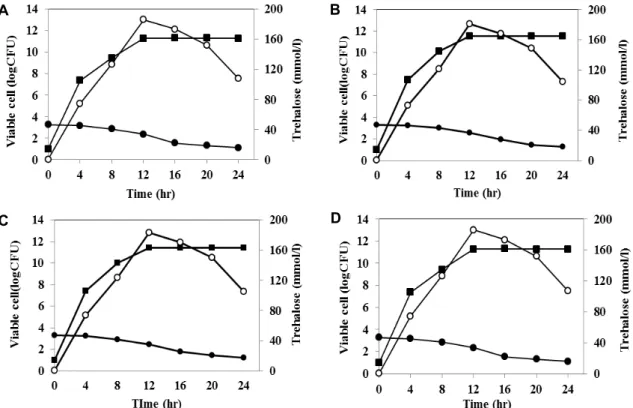
Fig 1. Time course of trehalose contents and growth curves of Pseudomonas sp. BCNU 106 on LB broth supplemented with 0.05 M trehalose in the presence of 1%(v/v) cyclohexane (A), hexane (B), propylbenzene (C) and m-xylene (D). Viable cells were estimated by plating cells on agar plates. Trehalose contents were measured by enzymatic glucose assay. (○) viable cell, (■) trehalose in cell and (●) trehalose in medium. Data are mean values of three independent experiments.
당이 α,α-1,1-글리코시드 결합으로 연결된 비환원당으로 세균, 효모, 균류 및 다수의 무척추 동물을 포함하여 다양한 종에 존재한다. 이것은 탄소원으로서의 역할, 스트레스 조건하에서 생체 분자를 보호하는 작용 및 세포벽 구성 성분으로써 중요 한 역할을 담당하고 있다[5, 18].
따라서 본 연구에서는 비수계 생물전환 반응, 생물정화 및 폐수 처리 시스템에 적용 가능성을 높이고자 트레할로스를 첨가함으로써 유기용매 내성 세균의 고밀도 배양을 실시하였 으며, cyclohexane, hexane, propylbenzene 및 m-xylene 존재 하에서 생존력이 증대됨을 확인함으로써 다양한 용매에서의 생물전환 공정에서 잠재적인 생물촉매로 적용될 수 있는 가능 성을 확인하여 보고하고자 한다.
재료 및 방법
균주 및 배양조건
유기용매 내성 Pseudomonas BCNU 106은 0.01 M MgCl
2가 첨가된 LB 배지(pH 7.0)에서 37°C, 16 hr 동안 전배양한 뒤 실험에 사용하였다. 전배양액 1%(v/v)를 0.05 M trehalose와 1% cyclohexane, hexane, propylbenzene 및 m-xylene이 각각 첨가된 새로운 LB 배지에 접종하였고 대조군으로는 1% 유기 용매만 첨가된 배지에 배양액을 접종하였다. 배양 후 1 ml을
채취하여 원심분리(10,000 g for 10 min)하여 saline buffer로 두 번 세척한 뒤, 1 ml의 phosphate-buffered saline (PBS, 0.1 M phosphate buffer, pH 7.4, 0.15 M NaCl)에 재현탁하였고 단계별 희석을 통해 생균수를 측정하였다.
Cell-free extracts 준비 및 트레할로스 함량 측정 배양액은 원심분리(10,000 g for 10 min)하여 균체와 상등액 을 분리하였으며, glucose assay kit (Sigma-Aldrich)를 사용하 여 540 nm에서 흡광도를 측정함으로써 세포내·외 트레할로스 함량을 정량하였다. 세포내 트레할로스 함량 측정을 위해 균 체(1 g wet wt)를 saline buffer로 두 번 세척한 뒤, 1 ml의 distilled water (DW)에 첨가하여 95°C에서 20분간 반응시킨 후 원심분리하여 상등액을 시료로 사용하였다. 세포외 트레할 로스 함량은 3 ml의 배양 상등액에 1 ml의 DW를 첨가하여 같은 방법으로 시료를 준비하였다. 그리고 다음 식을 사용하 여 트레할로스 함량을 계산하였다.
mg Glucose = (A
540of test)(mg glucose in standard)/(A
540of blank)
용매에 대한 내성 측정
0.05 M 및 0.1 M 트레할로스가 첨가된 LB 배지에 1% cyclo-
hexane, hexane, propylbenzene 및 m-xylene을 각각 첨가하고
A B
C D
Fig. 2. Effect of exogenous trehalose concentration on growth rate of Pseudomonas sp. BCNU 106 in 1%(v/v) cyclohexane (A), hexane (B), propylbenzene (C) and m-xylene (D). The cells grown in LB broths supplemented with 0.05, or 0.1 M trehalose were harvested at different growth phases. Cells were washed and suspended in 10 ml 0.1 M potassium phosphate buffer in the presence of 1% organic solvent at room temperature for 10 hr. (□ White bars) control, (■ grey bars) 0.05 M trehalose and (■ black bars) 0.1 M trehalose. Data are mean values of three independent experiments. Vertical segments represent SD. Letters above vertical bars indicate significant differences among experiments (p<0.05).
8 hr, 12 hr 및 24 hr 배양하였으며, 대조군으로 1% 용매만 첨가된 균 배양액을 사용하였다. 원심분리(10,000 g for 10 min) 후, 균체는 0.1 M PBS (pH 7.0)로 두 번 세척하고 10 ml의 0.1 M PBS에 재현탁한 뒤 1% 유기용매를 각각 첨가하고 실온에서 10 hr 정치 배양하였다. 단계별 희석을 통해 생균수 를 측정함으로써 용매에 대한 내성을 확인하였다.
결과 및 고찰
다양한 유기용매 존재하에서 생존율과 세포내·외 트레할로 스 함량
0.05 M 트레할로스가 든 배지에 1% cyclohexane, hexane, propylbenzene 및 m-xylene을 각각 첨가하여 배양한 후 생균 수 및 세포내·외 트레할로스 함량을 측정하였다(Fig. 1). 12시 간 배양했을 때 대수증식기에 도달했으며, 생존율은 cyclo- hexane, hexane, propylbenzene 및 m-xylene 순으로 2.85×
10
11, 3.45×10
11, 2.56×10
11및 1.9×10
11CFU/ml로 조사되었다.
Cyclohexane의 존재하에서 세포외 트레할로스는 서서히 감소 하다가 12시간에서 16시간 사이에 가장 급격하게 감소하는 것으로 나타났다. 세포내 트레할로스 함량은 12시간에 181.88 mM로 가장 높게 나타났고 이후 감소하는 것으로 조사되었으
며, hexane, propylbenzene 및 m-xylene에서도 cyclohexane과 유사한 경향을 보이는 것을 확인하였다. Pseudomonas BCNU 106은 이전 보고에서 1% toluene 조건하에서 트레할로스를 첨가했을 때의 세포 생존율이 용매만 첨가했을 때 보다 좋은 것으로 확인되었고, 세포외 트레할로스는 8시간에서 12시간 사이에 급격히 감소하였고, 세포내 함량은 12시간 배양했을 때 가장 높은 것으로 보고되어 유사한 경향이 확인되었다[10].
용매 스트레스에 대한 트레할로스의 영향
Pseudomonas sp. BCNU 106 균주로 도입된 트레할로스가
세포 생장에 미치는 영향을 알아보기 위해 1% cyclohexane,
hexane, propylbenzene 및 m-xylene 조건하에서 0.05 M 및
0.1 M 트레할로스를 첨가하여 8시간, 12시간 및 16시간 배양하
였다. 각 시간별로 생균수를 측정한 결과, 0.1 M 트레할로스
첨가군이 용매만 첨가한 대조군에 비해 생존율이 월등히 높았
으며 특히, 대수증식기 후기인 12시간 배양 후 수집된 세포의
생존율은 대조군에 비해 cyclohexane, hexane, propylbenzene
및 m-xylene 순으로 각각 89.94, 89.72, 91.25 및 118.9배 높은
것으로 확인되었고 이후 감소하는 경향을 보였다(Fig. 2). 또한
트레할로스는 농도 의존적으로 고농도를 첨가했을 때 용매
스트레스에 대한 내성이 강한 것으로 확인되었다. 미생물 생
A B
C D
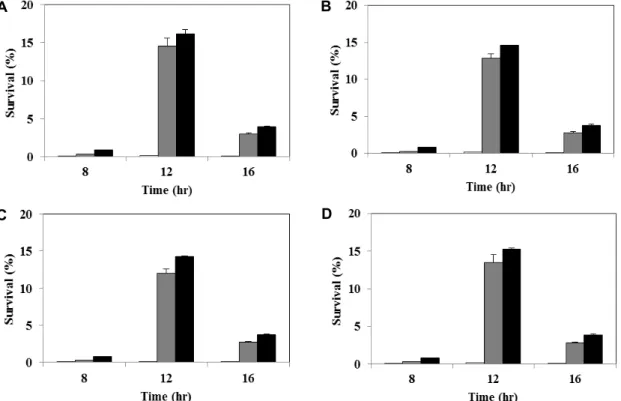
Fig. 3. The relative survival rate of Pseudomonas sp. BCNU 106 grown in LB broths supplemented with 0.05, or 0.1 M trehalose in the presence of 1%(v/v) cyclohexane (A), hexane (B), propylbenzene (C) and m-xylene (D). The cells were harvested at the late-exponential phase (12 hr) in LB broths supplemented with 0.05, or 0.1 M trehalose, and their survival (%) was determined in the presence of 1% organic solvent up to 10 hr. (●) control, (□) 0.05 M trehalose and (▲) 0.1 M trehalose.
Data are mean values of three independent experiments. Vertical segments represent SD
촉매는 고농도 탄수화물 기질 및 축적된 산물로부터 삼투압 및 화학적 스트레스를 견딜 수 있어야 하며, 동·식물 및 미생물 은 glutamate, betaine, proline 및 trehalose와 같은 세포내 호 환성 삼투물질을 사용하여 이러한 스트레스에 대응하는 것으 로 알려져 있다[3, 4, 14].
트레할로스 농도가 생존에 미치는 영향
0.05 M 및 0.1 M 트레할로스가 첨가된 LB 배지에 1% cyclo- hexane, hexane, propylbenzene 및 m-xylene을 각각 첨가하고 배양하면서 2시간 간격으로 생균수를 측정함으로써 트레할로 스가 생존에 미치는 영향을 확인하였다. 트레할로스 첨가없이 용매만 첨가한 대조군의 생존 세포수는 트레할로스를 첨가했 을 때와 비교했을 때 모든 용매에서 급격하게 감소하는 경향 을 보였으며, 트레할로스를 첨가했을 때는 농도 의존적으로 서서히 감소하는 것으로 확인되었다(Fig. 3). 특히, hexane에서 는 0.05 M 트레할로스 첨가시 4시간까지 90% 이상의 높은 생존율을 보였으며, cyclohexane에서는 0.05 M에서 80% 이상 의 생존율이 확인되었고, propylbenzene과 m-xylene 존재하 에서도 0.1 M 트레할로스 첨가시 80% 이상의 생존율을 가지 고 있는 것으로 조사되었다.
P. aeruginosa LST-03은 소수성이 높은 n-decane 및 n-octane
에서 높은 리파아제 활성을 보인 반면에 p-xylene, methanol, toluene 및 ethanol에서는 리파아제 활성이 감소되는 것으로 보고되고 있으며[12], Rhodococcus spp.는 benzene, n-alkanes 및 alcohol 존재하에서 리파아제 활성이 있음이 보고됨으로써 [13] 리파아제 및 이를 생산하는 미생물은 용매에 대한 감수성 이 다양한 것이 확인되고 있다.
본 연구에서 용매는 대체로 용매의 독성에 비례하여 세포
생장에 영향을 미치는 것으로 나타났으며, 트레할로스를 첨가
함에 따라 생존율이 월등히 향상되는 것을 확인하여 배양시
트레할로스를 첨가함으로써 다양한 용매에 대한 스트레스로
부터 균주를 보호할 수 있을 것으로 판단된다. 따라서 다양한
생명공학 산업, 특히 비수계 시스템에서 미생물 효소를 활용
하기 위해 트레할로스를 첨가하여 유기용매 내성 세균의 고밀
도 배양을 가능하게 함으로써 유기용매 조건하에서도 낮은
효소 활성을 극복할 수 있을 것으로 판단된다. 또한 각종 유기
용매에서의 고밀도 배양과 높은 생존율 향상을 경제적으로
할 수 있는 방안의 하나로 트레할로스 첨가의 중요성을 확인
함으로써 각종 유기용매에서의 생물전환 반응에 유기용매내
성 세균을 직접 생물촉매로 사용할 수 있는 가능성을 확인할
수 있었다. 유기용매에 따라 생물전환 반응의 효율이 상이하
므로 무엇보다 각종 유기용매에서의 생존율 확보와 고밀도
배양이 생물전환 반응에서 가장 기반이 되는 기술이다. 본 연 구결과에 기초하여 추후 각종 유기용매에서의 생물전환 반응 에 대하여 검토가 필요하며 나아가 반응 효율과 반응 최적화 에 대한 연구도 필요하다.
감사의 글
본 연구는 한국연구재단 기본연구지원사업(과제번호: 2010- 0009141)에 의해 지원되었으므로 이에 감사드립니다.
References
1. Choi, H. J., Hwang, M. J., Kim, D. W. and Joo, W. H. 2013.
Characterization of Organic Solvent Stable Lipase from Pseudomonas sp. BCNU 106. J. Life Sci. 26, 603-607.
2. Choi, H. J., Seo, J. Y., Hwang, S. M., Lee, Y. I., Jeong, Y.
K., Moon, J. Y. and Joo, W. H. 2013. Isolation and character- ization of BTEX tolerant and degrading Pseudomonas putida BCNU 106. Biotechnol. Bioprocess Eng. 18, 1000-1007.
3. Crowe, J. H., Hoekstra, F. A. and Crowe, L. M. 1992.
Anhydrobiosis. Annu. Rev. Physiol. 54, 579-599.
4. Csonka, L. N. 1989. Physiological and genetic responses of bacteria to osmotic stress. Microbiol. Rev. 53, 121-147.
5. Giaver, H. M., Styrvold, O. B., Kaasen, I. and Stram, A. R.
1988. Biochemical and genetic characterization of osmor- egulatory trehalose synthesis in Escherichia coli. J. Bacteriol.
170, 2841-2849.
6. Hasan, F., Shah, A. A. and Hameed, A. 2006. Industrial ap- plications of microbial lipases. Enzyme Microb. Technol. 39, 235-251.
7. Heipieper, H. J., Neumann, G., Cornelissen, S. and Meinhardt, F. 2007. Solvent-tolerant bacteria for biotransformations in two-phase fermentation systems. Appl. Microbiol. Biotechnol.
74, 961-973.
8. Jaeger, K. E. and Eggert, T. 2004. Enantioselective bio- catalysis optimized by directed evolution. Curr. Opin. Chem.
Biol. 15, 305-313.
9. Kumar, A., Dhar, K., Kanwar, S. S. and Arora, P. K. 2016.
Lipase catalysis in organic solvents: advantages and applications. Biol. Proced. Online 18, 2-11.
10. Lim, B. R., Choi, H. J., Kwon, G. S. and Joo, W. H. 2015.
Enhancement of solvent tolerance in Pseudomonas sp. BCNU 106 with trehalose. Lett. Appl. Microbiol. 61, 607-612.
11. Lima, V. M. G., Krieger, N., Mitchell, D. A., Baratti, J. C., Filippis, I. and Fontana, J. D. 2004. Evaluation of the poten- tial for use in biocatalysis of a lipase from a wild strain of Bacillus megaterium. J. Mol. Catal. B Enzym. 31, 53-61.
12. Ogino, H., Yasui, K., Shiotani, T., Ishihara, T. and Ishikawa, H. 1995. Organic solvent-tolerant bacterium which secretes an organic solvent-stable proteolytic enzyme. Appl. Environ.
Microbiol. 61, 4258-4262.
13. Paje, M. L., Neilan, B. A. and Couperwhite, I. A. 1997.
Rhodococcus species that thrives on medium saturated with liquid benzene. Microbiology 143, 2975-2981.
14. Purvis, J. E., Yomano, L. P. and Ingram, L. O. 2005. Enhanced trehalose production improves growth of Escherichia coli un- der osmotic stress. Appl. Environ. Microbiol. 71, 3761-3769.
15. Rahman, R. N., Baharum, S. N., Basri, M. and Salleh, A.
B. 2005. High-yield purification of an organic solvent-toler- ant lipase from Pseudomonas sp. strain S5. Anal. Biochem. 341, 267-274.
16. Schütte, M. and Fetzner, S. 2007. EstA from Arthrobacter ni- troguajacolicus Rü61a, a thermo-and solvent-tolerant carbox- ylesterase related to class C β-lactamases. Curr. Microbiol.
54, 230-236.
17. Sharma, S. and Kanwar, S. S. 2014. Organic solvent tolerant lipases and applications. Sci. World J. 2014, 625258.
18. Schiraldi, C., Lernia, I. D. and Rosa, M. D. 2002. Trehalose production: exploiting novel approaches. Trends Biotechnol.
20, 420-425.
19. Vieille, C. and Zeikus, G. J. 2001. Hyperthermophilic en- zymes: sources, uses, and molecular mechanisms for thermostability. Microbiol. Mol. Biol. Rev. 65, 1-43.
초록:유기용매 내성
Pseudomonassp. BCNU 106 균주의 외인성 트레할로스의 영향
최혜정
1․임보라
1․하상철
2․권기석
3․김동완
4․주우홍
1*
(1창원대학교 생물학화학융합학부, 2대구미래대학교 제과데코레이션과, 3안동대학교 생약자원학과, 4창원대학교
생명보건학부)