• 검색 결과가 없습니다.

A Study on Versatile Chair Design Reflecting Users' Behavior

N/A
N/A
Protected

Academic year: 2021

Share "A Study on Versatile Chair Design Reflecting Users' Behavior"

Copied!
9
0
0

로드 중.... (전체 텍스트 보기)

전체 글

(1)

A Study on Versatile Chair Design Reflecting Users’ Behavior

Gwang Hee Kim, Kyung Ran Choi

, Yun Jung Sung Oriental Culture & Design Center, Kookmin University, Seoul 136-702, Korea

Abstract: This study is to suggest versatile chair designs that are organically shaped to take in- dividual orientation. This study intends to provide design method to ensure the face of the chair that contacts the body of its user is transformed flexibly to support the body. The move- ment of human body is not just a behavior but the ways and tools that reflexively express against external stimuli that are sensed and identified by the person. The versatile chair whose users’ sitting position is fixed is made by covering the lump form with a piece of cloth ensuring that the content is firmly fixed and by placing the beads-woven wood fabric according to the shape. And then, it is covered with the external cover. The proposed versatile chair designs as- sume specific forms as follows: First, it is a versatile chair whose user’s sitting position can fix.

The organically-shaped form that can accept varying postures is made as a mass, which changes into different shapes when human body touches the form so that users can lie down or sit. Due to such transformation, body posture is determined and individual differences in shape changing are all acceptable. Second, it is a versatile chair that reflects the user’s position in a fixed chair, where a cloth-wrapper feature is applied to the form a sifit wrapped postures so that a variety of body postures can be accepted. Finally, a versatile chair that reflects the user’s position by changing the shape of is covered with forms so that it will be transformed and used in accord- ance with situations and chair shapes and reflect multiple shapes including round or square ones.

Keywords: versatile, users’ behavior, posture, shape change, ergonomic

1. Introduction

1)

1.1. Background and Aim

Living area is the most basic and smallest space in which all the behaviors of its residents take place. In this smallest space, sitting, standing or lying down, the residents changes their move- ment and behavior. The main characteristics of a chair are that it closely contacts human body and can be used in various places and moments. But it

Received for publication: June 15, 2011; Reviewed: June 23, 2011; Received in revised form: July 11, 2011;

Accepted: July 13, 2011

Corresponding author: Kyung Ran Choi (ran@kookmin.

ac.kr)

has a defect in that it is not designed to fit for ev- ery movement of its user; for example, when the user is moving or sits cross- legged.

For this reason, this study is aimed at designing versatile chairs that can be freely transformed to support the users at various positions resulted from individual differences including personal characters, age, gender, etc.

1.2. Research Methodology and Scope

This study intends to provide design method to

ensure the face of the chair that contacts the body

of its user is transformed flexibly to support the

body. In other words, various situations and nu-

(2)

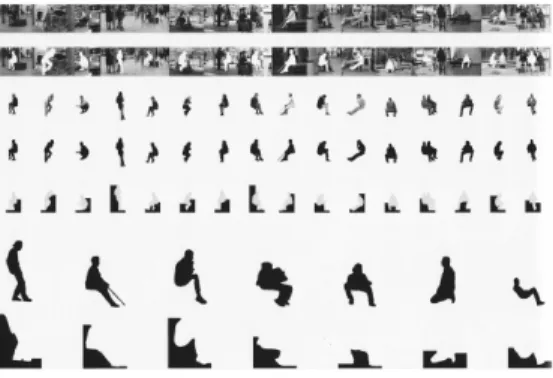
Fig. 1. Various situations can be explained via pos- tures and behaviors. Figure originated from: Seo, K.

W. BODYSCAPE_Guest editor, Jong Jin-Kim, DAMDI and DESIGNER, 2007, p.72.

merous movements of the user can be effectively reflected to the formation of the chair’s shape.

2. Theoretical Background

2.1. Definition of a Versatile Chair

In this context, ‘versatile’ means that the shape or characteristics of an object can be changed. In other words, the external shape of a chair can be altered when the environment or internal ele- ments are changed. The changeable design of an object allows performing varied functions, re- flecting the shape and structure that change. A versatile or changeable chair that has been de- signed to alter its shape can reflect an external factor, in other words, the user’s body that con- tacts when the user sits on the chair.

2.2. The Relationship between a Versatile Chair and Its users’Position

A flexible design to make a versatile chair that transforms its shape according to the behavioral changes of its user sitting on indicates not just the change of its position or appearance as ‘the body position changes’ but it is a visualized expression of language, in other words, the shape of body that can be expressed as the behavioral move-

ment triggered by the changes in sensation as the previous thought or condition has changed.

A versatile chair is presented by the concept that is the pursuit of free form, without the con- straints of space, design which can transform freely for user’s needs and it reflect a wide range of user behavior and you can pursue various interactions.

3. Analysis On Designs of Versatile Chairs that Can Change Shapes According to the Sitting Behavior of Their Users

3.1. Changes of Chair Designs

The designs of chair have continuously changed to reflect the wishes of users. The time-variant chair designs for different situations and spaces can be briefly summarized as follow;

The most representative feature of the chairs

produced during the 1920s to the 1940s was the

emphasis on their simple functions, in other

words, functions of a piece of furniture for sitting

and supporting the back. The chairs produced

during the period between the 1950s and the

1970s were made of various materials and fea-

tured free style and diversification in their

designs. In addition a dynamic movement func-

tion was adopted to ensure more comfort when

sitting or lying down. The diversity of chair de-

signs was intensified between the 1980s and the

1990s, allowing more varied positions to be

supported. In the 2000s, the shape of chairs has

begun reflecting the characteristics of the user’s

position or situational variety that occur when

the body sits on the chair. The recent trend of de-

signing chairs has resulted in a wide variety of

chairs to which the behavior of users is applied

and incorporated environment-friendly design

elements.

(3)

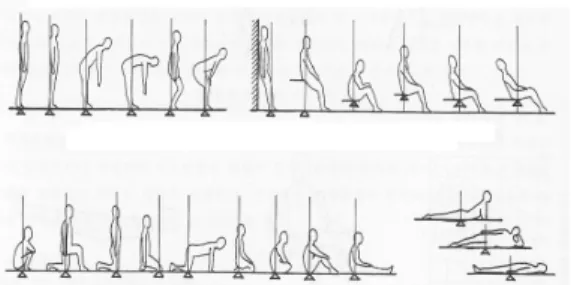
Fig. 2. Various postures in daily life.

3.2. Postures and Chair Designs

The basic postures of a person in living area consist of four postures including standing, sitting on a chair, sitting on the floor and lying down.

These four postures occur as linked movements constituting the daily activities. These positions along with body measurements and analytic data are used for an integrated determination when designing a chair. Results from examining or an- alyzing the worn out parts, the scope of move- ment, subjective judgment, amount of calories consumed, electromuscular level and the changes of postures caused by being worn out become the criteria for the determination (Fig. 2).

3.3. Types of Versatile Chairs That Reflect User’s Posture

A chair with organism-like features indicates a chair that supports various positions of the user and can freely transform its shape. The shape of such chairs is decided by reflecting various posi- tions and can be specified as follows;

3.3.1. A Versatile Chair Whose User’s Sitting Position Can Fix

A versatile chair whose user’s sitting position is fixed is made of a mass of organism-like form which can support the positions of the user.

When the body contacts the form, the form trans- forms its shape and the altered shape is fixed so that the user can sit on or lie down.

3.3.2. A Versatile Chair that Reflects the User’s Position in a Fixed Chair

A fixed-shaped versatile chair that reflects the user’s position is a chair whose form material supports the position of the user by surrounding it. Various positions of the body can be supported in an organism-like manner.

3.3.3. A Versatile Chair that Reflects the Position of the User by Maintaining the Shape of a Chair

This type of versatile chair refers to those chairs that their appearance is changed by adding vari- ous materials to create new images while main- taining the basic structural frames as a chair. The design is changed to reflect the user’s positions as if a cover is placed to have the dimensions and shapes that people want. These versatile chairs are explained in more detail in the Table 1.

3.4. Analysis on Versatile Chairs that Reflect the User’s Positions

A versatile chair means a chair that can support various sizes of human body, allowing the posi- tion of the user to be fixed. It refers to a chair whose dimensions can be extended or reduced to meet the size of the user’s body. If the user’s body is bigger or smaller than the average one, this er- gonomically designed chair can be adjusted ac- cording to individual difference. In addition, it is designed to support various sitting positions and body types, providing the user comfort and sense of stability.

3.5. Research Methods

An organism-like chair consists of the shape and form that can surround the user’s body re- gardless of its size under any environment.

Versatile chairs tend to be made of special forms

as follows;

(4)

Table 1. Types and characteristics of changeable chair designs Characteristics

Types

Characteristics

Image Methods to reflect user’s positions Features

A versatile chair whose user’s sitting

position can fix.

Fig. 3-1

The shape is subject to flexibly change de- pending on the position of the user (Fig.

3-1. Piero Gatti, Cesare Paolini, Franco Teodoro, ‘Sacco’, 1968: Charlotte & Peter

Fiell, 1000 chairs, TASCHEN, 2000). It can support various sizes of

human body.

Fig. 3-2

The gross area is changed according to the sitting positions (Fig. 3-2. Roger Dean, Sea Urchin, 1968: Charlotte & Peter Fiell, 1000 chairs, TASCHEN, 2000).

A versatile chair that

reflects the user’s position in a fixed

chair.

Fig. 3-3

The sitting area is extended to fit for the body when the user sits back (Fig. 3-3. Achizoom Associati, Mies, 1969: Charlotte & Peter Fiell,

1000 chairs, TAS- CHEN, 1997). An

organism-like shape that can support human body.

Fig. 3-4

It supports the body to shape a form (Fig. 3-4.

Felicerossi, RAM, No Picnic, 2008: Charlotte

& Peter Fiell, 1000 chairs, TASCHEN, 1997).

A versatile chair that

reflects the user’s position by changing

the shape of a chair.

Fig. 3-5

The shape of a chair is made by covering it with a piece of cloth (Fig. 3-5. Charlie davidson, Crunk chair, 2010 : http://www. wellz.co.kr).

Reflecting various movements, it main- tains a fixed shape providing comfort.

Fig. 3-6

A piece of cloth decorated with beads is cov- ered on the chair (Fig. 3-6. MOROSO, WOOD CHAIR, 2010: http://www.morosso. it.).

Fig. 3-7

A cover is placed (Fig. 3-7. Form us With Love,

Highway, Inside chair: http://www.naver.com).

(5)

Table 2-1. Analysis of versatile chairs

A versatile chair whose user’s sitting position can fix: Body measurements are applied.

Lower than the average Within the average Bigger than the average A versatile chair that reflects the user’s position in a fixed chair:

Body shapes are applied.

Sitting on

Sitting on in a correct posture Sitting back

A versatile chair that reflects the user’s position by changing the shape of a chair: Body’s movements are applied.

Moved Fixed Comfort

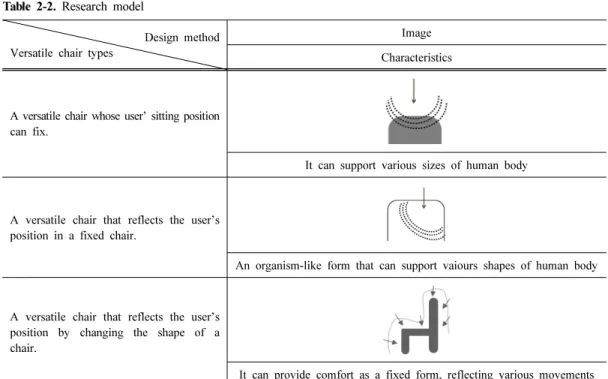
Table 2-2. Research model

Design method Versatile chair types

Image Characteristics

A versatile chair whose user’ sitting position can fix.

It can support various sizes of human body

A versatile chair that reflects the user’s position in a fixed chair.

An organism-like form that can support vaiours shapes of human body

A versatile chair that reflects the user’s position by changing the shape of a chair.

It can provide comfort as a fixed form, reflecting various movements

First is the form of the versatile chairs whose user’s sitting position is fixed. The form is shaped so flexibly that when the human body contacts the form, it alters its shape, allowing the user to sit on or lie down. The postures of human body are determined by the ways that the form is changed. The difference of individual human body can be reflected to the design.

Second is the form of the fixed-shaped versatile chairs that reflects the user’s position. It features its organism-like shape that can support varied

positions of the user’s body as if a piece of cloth covers an object.

Third is the form of the versatile chairs that re-

flect the user’s position by changing the shape of

a chair. The form is on the chair frame, allowing

it to change its shape according to individual

situation. It can have various shapes including

circular, rectangular, etc.

(6)

Fig. 5. Comparison drawing of human sizes for a ver- satile chair whose user’s sitting position is fixed.

Fig. 6-1. Comparison drawing of human sizes for a fixed-shaped versatile chair that reflects the user’s position.

Fig. 6-2. Comparison drawing of human sizes for a versatile chair that reflects the user’s position by changing the shape of a chair.

Table 3. Product concept

Design reflecting the size of posture

Design reflecting the shape of posture

Design reflecting the Movement of posture

Fig. 4-1. 3D modeling of the design of a versatile chair whose user’s sitting position is fixed.

Fig. 4-2. 3D modeling of another posture.

4. Suggestions of Versatile Chair Design whose Shape is Changed According to the Changes of User’’’’’’’’’’’’’’’’’’’ ’s Position

4.1. Product’s Concept

The key feature of this work is the design that allows the form to change its shape according to the human body that sits on or sits back on it. The form will be shaped as a lump so that it can reflect the size of human body. A material with ex-

cellent flexibility will be used and fabric features

will be applied in order to ensure its proper re-

flection of the user’s postures. In addition, the de-

sign will ensure that the chair has a good elastic

force using the changeable property of the

springs. The fabric shape of the versatile chair

can be freely altered as if a piece of cloth covers

an object, reacting to various movements.

(7)

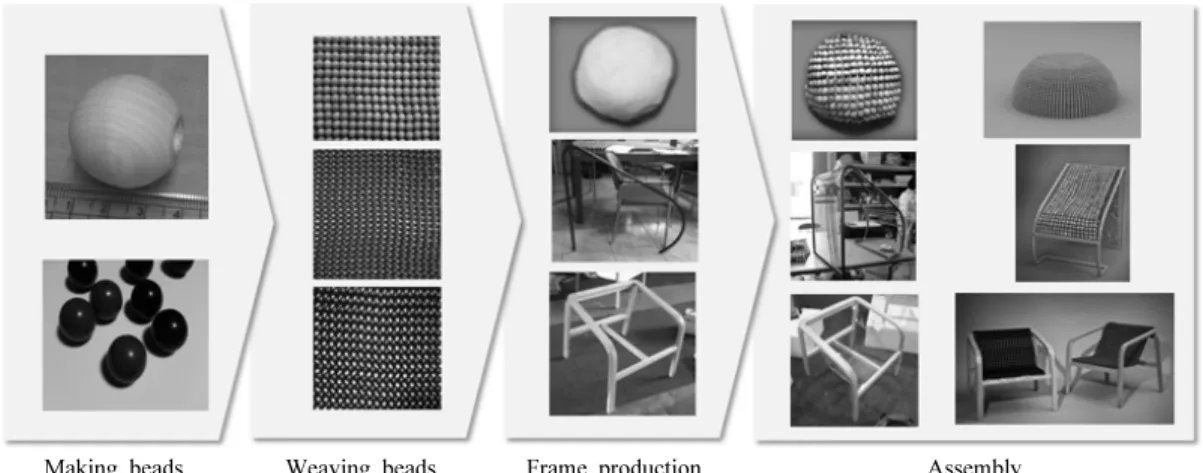
Making beads Weaving beads Frame production Assembly Fig. 7. Production process.

Fig. 8. Work 1. Wooden Bead Chair 01. 2010. sponge, wood, spring. 700 × 700 × 350.

Fig. 9. Work 2. Wooden Bead Chair 02. 2010. steel, wood, spring. 500 × 750 × 800.

Design to reflect the size of posture The size is altered by the elastic force of the springs

Design to reflect the shape of posture The woven beads cloth is changed its shape as if a

cloth covers an object

Design to reflect the movement of posture It is made of steel and wood to ensure a proper reaction

to movements.

4.2. Sketches: Bead Fabric Chair

It is a chair that is capable of determining and reacting to various situations more easily and has a shape and is made of materials that would not be restricted by the space where it is used. The sketch focuses on its circular lines that resemble

the human body so that people feel comfortable and relaxed when sitting on.

4.3. 3D Modeling

Fig. 4 is the computer graphic 3D images of the versatile chair. Ergonomic dimensions and a shape that can be modified in individual moment are applied to the modeling. It appears like a cir- cular sitting cushion that the user can sit on or lean back. The sensation of the cushion is changed according to the position of the user.

Fig. 5 shows a design of a chair whose shape re-

flects the user’s body as if a cloth covers an

object. Easily adjusted springs are placed under

(8)

Fig. 10. Work 4. Wooden Bead Chair4. 2010.thread, acrylic, wood, 600 × 600 × 550.

Fig. 11. Work 3. Wooden Bead Chair 03. 2010. thread, acrylic, wood. 600 × 600 × 550.

the sitting area so that the shape can be comfort- ably changed and reflect the line of the user’s body.

4.4. Production

4.4.1. Deciding Dimensions

The design ensures the proportion of the di- mensions to reflect the user’s behaviors on the ba- sis of the basic dimensions that have been de- termined ergonomically to support various body sizes are utilized. Fig. 6 is a design that a versatile chair is placed on various chairs whose design frame is not changed. It is made of beads fabric material that can alter its shape as the user wants.

For the design of the versatile chairs, an organ- ism-like form and the function to cover the pos- tures like a piece of cloth are utilized. The form features its function to change its shape according to various sitting positions of the user. The above-mentioned three types of versatile chairs have been produced according to the processes presented in Fig. 9.

5. Conclusion

The movement of human body is not just a be- havior but the ways and tools that reflexively ex-

press against external stimuli that are sensed and identified by the person.

The versatile chair whose user’s sitting position is fixed is made by covering the lump form with a piece of cloth ensuring that the content is firmly fixed and by placing the beads-woven wood fab- ric according to the shape. And then, it is covered with the external cover.

The second type chair - versatile chair whose user’s sitting position is fixed – features its form that has the function of a cloth that can cover an object to ensure proper a reflection of user’s postures.

Acknowledgement

This work was supported by the Korea Rese- arch Foundation Grant funded by the Korean Government (KRF-2008-411-J05001).

References

Kwon, Y. G. 2001. Space Design 16 Lectures, Kukjebooks.

Seo, K. W. 2007. BODYSCAPE_Guest editor, Jong Jin- Kim, DAMDI and DESIGNER.

Oh, I. W. 2000. Introduction of Space Design, Kimoon-

dang.

(9)

Charlotte & Peter Fiell. 1997. 1000 chairs, TASCHEN.

Charlotte & Peter Fiell. 2005. Design Now!, TASCHEN.

Hudson, J. 2006. 1000 Designs and Where to Find Them, Laurence King.

Gestalten Once Upon a Chair - Design beyond the Icon. 2009.

Vitra Design Museum, Verner Panton, The collection works. 2009.

Kim, S. T. 2002. Study on a shape-changeable furni-

ture – focused on chair design, Graduate School of Hongik Univ.

Min, C. H. and Y. A. Yoon. 1998. Study on the Symbolic Meaning on Chairs from the View of Natural Desires of Human Beings, Korean Institute of Interior Design Journal, Vol. 17, December in 1998.

http://www.wellz.co.kr/

http://www.moroso.it/

http://www.naver.com/

수치

Fig. 1. Various situations can be explained via pos- pos-tures and behaviors. Figure originated from: Seo, K
Fig. 2. Various postures in daily life.
Table 2-1. Analysis of versatile chairs
Fig. 6-1. Comparison drawing of human sizes for a  fixed-shaped versatile chair that reflects the user’s  position.
+3

참조

관련 문서

The purpose of this study is to establish and design the characteristics of summer resorts according to the design manual, develop cultural products using

In order to achieve the purpose of this study, we established a theoretical assumption that the variance of achievement goal orientation will affect the

Considering that design applying digital story-telling techniques of web ads sites helps such experiences, this study is to identify the web ads and marketing

The purpose of this study is to suggest a method of critical thinking education through literature discussion, as I consider that literary discussion

A Study on the Educational Modeling Contents for Introduction to Engineering Design by the Creative

This study introduces thermal design, analysis and control method to improve the current models and verifies its performance through real experiment.. The

□ The least-upper-bound property (sometimes called completeness or supremum property) is a fundamental property of the real number system. The least-upper-bound

□ The least-upper-bound property (sometimes called completeness or supremum property) is a fundamental property of the real number system. The least-upper-bound