DOI: 10.5345/JKIC.2011.02.1.009
www.jkibc.org
사례분석을 통한 아파트 골조공사의 공기지연 요인 도출 및 개선방안
Case Studies: Schedule Delay Factors and Delay Prevention Program for Concrete Frame Works in Apartment Construction Project
조 태 제7) 최 종 수*
Cho, Tae-Jea Choi, Jong-Soo*
Department of Architectural Engineering, Dongguk University-Seoul, Jung-Gu, 100-715, Korea
Abstract
Project delay is one of the most crucial impact factors in the construction process from a schedule and cost management perspective. This study focused on analyzing the causes of concrete frame work delay in the apartment construction project. According to the analysis of project cost composition, the direct cost of concrete works was highest in most samples. Actual delays of concrete works were analyzed for the six different construction components.
Causes of delay were grouped into two categories; preconstruction and construction phases and these two groups were further divided into sub-groups. Analysis results revealed that the most significant delay was occurred in the 1st. floor concrete skeleton work. For each delay factor, implications of delay as well as suggestion(s) for reducing the possibility of schedule delay are provided.
Keywords : Schedule Delay Factors, Concrete Frame Works, Delay Prevention Program
1. 서 론
1.1 연구의 목적
건설공사 규모의 대형화는 공종 및 작업의 종류가 대폭 증가됨 을 의미하며 이와 더불어 지반조건, 현장여건 및 주변상황과 상호 연관된 많은 공종들로 인한 불확실한 요인들의 영향 등으로 일정 관리의 부담으로 작용하게 되며 이에 따라 공기지연이 빈번하게 발생하고 있다.
건설공사에서 발주자와 시공자 간에 계약을 통해 결정된 공기 (工期)는 건설프로젝트 관리에 있어서 비용관리와 더불어 핵심 관 리사항이다. 대부분의 건설공사에서, 시공자는 계약조건에 명기 된 기간 내에 공사를 완료하기 위한 예정공정을 작성하여 발주자 로부터 승인을 받게 되며, 발주자와 시공자는 예정공정을 기반으 로 프로젝트의 일정을 관리한다.
Received : October 29, 2010
Revision received : November 24, 2010 Accepted : December 1, 2010
* Corresponding author: Choi, Jong-Soo
[Tel: 82-2-3360-3357, E-mail: [email protected]]
ⓒ2011 The Korea Institute of Building Construction, All rights reserved.
공기지연이 발생할 경우 시공자에게는 직·간접적인 추가 비용 이 발생하나 이에 대한 보상이 제대로 이루어지지 못하고 있으며 특히 전체 공사비의 20~30% 정도를 차지하고 있는 간접비의 경 우 공기 지연시 누적되어 손실 비용이 매우 큰 것으로 나타나고 있다. 또한, 공기지연에 대한 책임소재의 불분명, 발주자의 우월 적 지위에 따른 공사기간 중의 문서행위 미흡, 예를 들어 구두승 인 등으로 인하여 발주자가 공기지연에 대한 승인이 거부될 경우 지체상금의 부과 외에도 관리비 및 물가상승비의 추가부담, 공기 촉진에 따른 가속비용, 하도급자의 클레임 등 상당한 추가비용의 발생 가능성이 있다[1].
한편, 국내 건설관련 중재사례 중 공기지연과 관련된 사례가 약 33%를 차지할 정도로 건설 클레임(또는 분쟁)에서 공기지연 관련 부분이 상당한 비중을 차지하고 있고[2], 외국의 경우에도 건설 클레임의 약 60%가 공기지연과 관련된 것으로 나타났다[3].
이와 같이 건설프로젝트를 수행함에 있어 공기지연으로 인한 분 쟁이 빈번한 실정이지만 공기지연이 발생하는 원인과 형태가 복 잡하고 다양하여 명확하고 체계적인 분석이 어려운 실정이다.
따라서 본 연구에서는 분석 대상을 아파트 골조공사로 한정하 여 공기지연이 발생한 현장의 사례를 중심으로 실증적으로 원인 을 도출하고 원인별 공기지연 방지대책을 제시하는 것을 목적으 로 하였다.
Case Studies: Schedule Delay Factors and Delay Prevention Program for Concrete Frame Works in Apartment Construction Project
1.2 연구의 방법 및 범위
앞서 기술된 연구목적 달성을 위하여 먼저 문헌분석을 통해 국 내외 선행연구에서의 공기지연관련 연구동향을 분석하고, 아파트 신축공사의 공종별 공사비 분석을 통해 공기지연에 따른 영향수 준을 고찰하였다. 공종별 공사비 분석은 구체적으로 10개 아파트 공사 현장의 공종별 영향도 분석 및 아파트의 골조공사에서 공기 지연을 유발하는 핵심공종 및 원인 분석을 통해 예방대책을 제시 하였다.
2. 기존연구의 고찰
2.1 공기지연의 정의
건축공사의 공기(term of works)란 공사의 시공에 소요되는 기간을 의미하며[4], 공기지연(project delay)은 예기치 못한 환 경으로 인하여 전체 프로젝트의 일부분이 확장되거나 실행되지 않는 기간을 의미한다[5]. 유사한 개념으로 작업지연이란 ‘어떤 문제로 인해 계획된 작업 또는 업무를 정해진 시점까지 완료하지 못한 상황’을 의미하며 공기지연은 작업지연을 포함하는 개념으 로 볼 수 있다. 공기지연의 일반적인 분류체계는 다음 Table 1에 서와 같이 세 가지 기준으로 구분할 수 있다[3].
Group Type of delay
Approval Delay can be approved
Delay cannot be approved Compensation Compensation can be made
No compensation Point of delay
occurrence
Individual delay
Concurrent delay for several activities
Table 1. Classification of delay
건설환경의 동적특성(dynamic environment), 불확실성 (uncertainty), 복잡성(complexity) 등을 고려해 볼 때 건설 프 로젝트를 계획기간 내에 완료하는 것은 매우 어렵다. 따라서 건설 프로젝트에서 지연에 대한 클레임이 발생하는 것은 당연하다고 여기는 경향이 있으며, 공기지연은 항상 불확실성이 존재하는 건 설 프로젝트에서 어쩔 수 없는 상황으로 인식되기도 한다[6]. 그 러나 이러한 공기지연이 발생하여 프로젝트가 예정된 일정보다 지연되면 발주자와 시공자 모두에게 비용 또는 시설물의 활용 측 면에서 심각한 손실이 발생하게 되며 시공자의 신뢰도를 떨어뜨 리는 결과를 초래하기도 한다. 결국 건설공사의 공기지연은 시공 자에게 클레임에 의한 비용손실, 신뢰도 손상, 생산성 저하로 인 한 비용 증대와 같은 부정적 결과를 초래할 수 있는 것이다. 따라 서 공기지연이 발생하였을 때 시공자는 그 원인을 분명하게 밝히 고 빠른 시간 내에 문제를 해결하여 손실을 최소화하는 것이 중요
하다. 이를 위해서는 작업의 지연을 최대한 줄여 공기 경쟁력을 향상시키는 지속적인 노력이 요구되며 지연을 초래하는 요인을 파악하여 이를 최소화하기 위한 대책을 수립해야한다. 특히, 사전 대비를 통해 예방이 가능한 공기지연과는 달리 ‘생산성 손실을 초래하는 공기지연’은 지연 시점을 파악하기 어렵고 타 작업에 미치는 영향 및 관계를 분석하기 어렵기 때문에 특정 시점 또는 프로세스 상에서 생산성 손실을 발생시키는 지연인자를 도출할 필요가 있다.
2.2 공기지연관련 국내외 선행연구 분석
공정분석과 공기지연에 관한 연구들은 크게 세 분류로 나눌 수 있다[7].
1) 건설공사를 수행함에 있어 발생한 지연들에 대한 원인 분석 과 영향을 평가하는 연구
2) 일정관리에서 작성된 CPM(Critical Path Method) 분석을 통해 공기지연 영향을 측정하는 연구
3) 공기지연 일수를 산정하는 방법에 관한 연구
2), 3)에 해당하는 기존의 분석방법들은 주로 건설 클레임, 소 송 또는 분쟁이 발생하였을 때 CPM상의 공기지연 항목을 분석함 으로써 공기지연의 발생원인에 대한 책임소재와 지연된 일수를 비용으로 환산하기 위한 근거를 제시하기 위해 활용되어 왔다. 본 연구와 관련이 있는 국내외 선행연구를 요약하여 정리하면 다음 의 Table 2와 같다.
공기지연 원인분석과 지연영향 평가 연구에서는 주로 실제 프 로젝트를 담당하고 있는 전문가 인터뷰나 현장 실무자들을 대상 으로 한 설문조사와 경험적 평가를 통해 공기지연 인자를 도출하 고 정량화하는 연구가 수행되었다. 대표적으로 Chan and Kumaraswamy[8]은 홍콩의 건설 프로젝트에서 주요 공기지연 인자들의 상대적인 중요도를 측정하고 결정하기 위해서 사전에 8 개의 범주, 83개의 유형으로 정의한 공기지연인자에 대한 설문조 사를 실시하였다. 분석 결과 현장관리 감독의 미흡, 예상치 못한 현장조건, 프로젝트와 관련된 의사결정의 지체, 발주자의 설계변 경과 불가항력적인 작업변경으로 인한 5개 주요 공기지연 인자들 을 도출하였다. 이 연구는 먼저 공기지연 인자들을 분류하여 범주 화시키고 이를 설문조사에 반영하여 측정된 강도로부터 상대적인 중요도를 도출해내어 중요도 지수를 결정했다는데 의의가 있다.
이 외에도 Nasir et al.[9]은 문헌고찰과 사례분석을 통해 작업 지연을 일으킬 수 있는 9가지 요인들을 도출하였다. Assaf et al.[10]은 문헌연구와 전문가 인터뷰를 통해 작업지연 원인을 9가 지로 분류하고 각 주체별 중요도를 도출하였다. Elinwa and Joshua[11]은 건설분야 전문가를 대상으로 한 인터뷰와 설문을 바탕으로 23가지 주요 공기 및 기성초과 요인 및 우선순위를 도 출하였다. Majid and Mccaffer[12]은 선행연구의 분석을 통해
Autor Title Summary Type of research* Jung et
al. [13]
An analysis on difficulties and delay factors for the development and
application of technologies for reduction of construction duration
Investigate delay factors that can influence on schedule reduction and suggest possible solutions for each project participant from a non-technical point of view
A
Lee[14] Delay analysis using learning effect and linear scheduling in construction
Suggest a model that can be used in the analysis of cumulative
delay caused by learning effect and productivity change B
Kim et al.[15]
A study about influence of risk factors in relation to construction cost increase and schedule delay on the reinforced concrete construction
Analyze the reinforced concrete works adopting AHP analysis method by experts evaluation. Identify the influence factors and measure the level of impact on the project delay and
construction cost by analyzing the risks which were generated during the reinforced concrete works
C
Lee[16] Delay analysis using linear schedule in construction
Suggest a method that can be utilized in assessing the cumulative delay and concurrent delay due to the productivity loss in case of productivity change adopting linear scheduling technique
B
Kim and Lee [1]
Construction delay analysis utilizing system thinking approach
Suggest a method that can be utilized in estimating individual indirect delay and direct impact of natural event on schedule by combining CPM method and system thinking approach
B
Lee[17] Modified delay analysis considering production rates
Suggest a schedule delay analysis method in case of productivity
change due to the learning effect B
Kim et al.[18]
An analysis method for the concurrent delay using delay section concept
Suggest a systematic method that can be utilized in estimating
concurrent delay by adopting delay section concept B Kim et
al.[19]
A case study on delay analysis methods
in the construction project Conduct case study analysis utilizing various delay methods B Koo and
Lee[3]
Construction delay analysis method considering productivity
Suggest an objective method that can be used in estimating the level of delay and the starting point of delay in case of productivity loss
B
Kwon and lee [20]
Construction delay analysis method;
hierarchical planning process approach
Suggest a method that enable to assess an individual delay event on the overall schedule applying hierarchical planning process
C
Lee and Lee [21]
Improvement for liquidated damages according to the delay of domestic construction project
Suggest an improvement plan for the estimation of liquidate damage that is liable for the delay caused by contractor's responsibility
C
Han et al.[22]
An analysis on delay factors of major trades in apartment housing projects
Conduct questionnaire survey for the purpose of analyzing the cause of delays which are occurred during the apartment building construction projects
A
Nasir et al.{9]
Evaluating Risk in Construction-Schedule Model(ERIC-S)
Draw 9 delay factors based on the literature review and case
studies A
Lyu et al.[23]
A method of calculating schedule delay considering lost productivity
Suggest a delay estimation method considering various delay factors and productivity to prevent creating benefits neither to owner and contractor
B Elinwa
and Joshua[11]
Time-overrun factors in Nigerian construction industry
Assess the 23 priority factors and causes of cost and schedule overruns based on the experts interviews and questionnaire survey
A
Kartman[6 ]
Generic methodology for analyzing delay claims
Analyze the delay factors for the purpose of reducing delay claims according to the participants, possibility of compensation, and the starting point of delay etc.
A Majid and
Mccaffer[1 2]
Factors of non-excusable delays that influence contractors' performance
Analyze the causes of non-excusable delay based on the
fundamental delay factors that are drawn from literature review A Chan and
Kumaraswa my [8]
A comparative study of causes of time overruns in Hong Kong construction projects
Conduct questionnaire survey and interviews on the delay factors which are predefined 8 groups and 83 types for the purpose of assessing the factors' comparative importance
C
Assaf et al. [10]
Cause of delay in large building construction projects
Categorize and assess the importance of 9 type of delay factors
based on the literature reviews and experts' interviews A
* A: Cause of delay assessment & influence analysis, B: Estimation of delay term, C: Measure of delay influence
Case Studies: Schedule Delay Factors and Delay Prevention Program for Concrete Frame Works in Apartment Construction Project
기본 작업지연 원인을 도출하고 이를 토대로 보상 불가능한 작업 지연의 원인을 분석하였다. Kartman[6]은 공기지연 클레임을 줄 이기 위한 목적으로 지연의 주체, 보상가능성, 발생시점에 따라 공기지연 요인을 구분하였다.
전술한 선행연구 조사/분석 결과를 요약하면 공기산정 방법론 에 대한 연구가 주류를 이루며 일부 사례를 기반으로 한 연구에서 도 설문조사 등 간접적인 방법에 의한 지연의 원인, 영향 등을 파 악하고 대책을 제시하는 경향으로 연구가 수행된 것으로 나타났 다. 본 연구는 Han et al.[7]의 분류상 첫 번째 유형으로 분류될 수 있으며 공기지연에 대한 원인분석과 더불어 대책을 제시하였 다. 따라서 본 연구에서는 위와 같은 선행연구의 한계를 극복하고 자 보다 실증적인 사례를 기반으로 원인을 분석하고 도출된 각 원 인에 대한 대책을 제시하였다는 점에서 차별성의 의의가 있다고 사료된다.
3. 공종별 공사비 및 영향도 분석
3.1 공종별 직접공사비 구성분포 분석
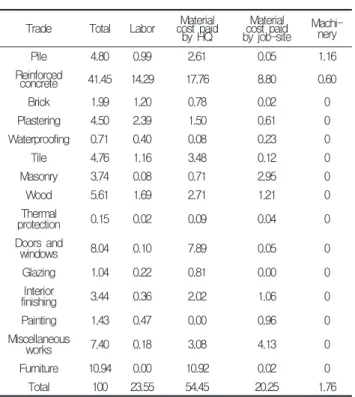
공기지연의 주요 인자를 도출하기에 앞서 아파트 신축공사의 공사비 비중을 분석하여 지연예방에 따른 효과가 높을 것으로 예 상되는 공종을 선정하였다. 공사비 비중 분석은 2007년 1월부터 동년 12월까지 착공된 아파트 10개 현장을 대상으로 총 건축공사 비 중 직접비를 대상으로 하였다(Table 3 참조).
Trade Total Labor Material cost paid
by HQ
Material cost paid by job-site
Machi- nery
Pile 4.80 0.99 2.61 0.05 1.16
Reinforced
concrete 41.45 14.29 17.76 8.80 0.60
Brick 1.99 1.20 0.78 0.02 0
Plastering 4.50 2.39 1.50 0.61 0
Waterproofing 0.71 0.40 0.08 0.23 0
Tile 4.76 1.16 3.48 0.12 0
Masonry 3.74 0.08 0.71 2.95 0
Wood 5.61 1.69 2.71 1.21 0
Thermal
protection 0.15 0.02 0.09 0.04 0
Doors and
windows 8.04 0.10 7.89 0.05 0
Glazing 1.04 0.22 0.81 0.00 0
Interior
finishing 3.44 0.36 2.02 1.06 0
Painting 1.43 0.47 0.00 0.96 0
Miscellaneous
works 7.40 0.18 3.08 4.13 0
Furniture 10.94 0.00 10.92 0.02 0
Total 100 23.55 54.45 20.25 1.76
Table 3. Direct cost composition by trade
(sum of 10 projects)
unit : %Pile (4.80%)
Reinforced concrete (41.45%)
Brick (1.99%) Plastering
(4.50%) Waterproofing
(0.71%) Tile
(4.76%) Masonry (3.74%) Wood (5.61%) Thermal protection
(0.15%) Doors and
windows (8.04%) Glazing (1.04%)
Inrerior finishing
(3.44%) Painting (1.43%)
Miscellaneous works (7.40%)
Furniture (10.94%)
Figure 1. Direct cost composition by trades
Table 3은 10개 현장의 15개 공종별 직접공사비 합의 구성비 율을 나타내며 이를 다시 인건비, 본사지불자재비, 현장지불자재 비, 중기비 등으로 세분하여 분석하였다. 총비용에서 인건비는 약 24%, 자재비는 약 75%로 나타나 인건비 및 자재비가 직접비의 대부분을 차지하는 것으로 나타났다. Figure 1은 Table 3의 공사 비 구성비를 그래프로 나타낸 것으로 철근콘크리트 공사가 약 41%로 가장 비중이 크고 다음으로 가구공사 약 11%, 창호공사 약 8% 등의 순으로 나타났다. Figure 2는 10개 현장에서 직접비 비율이 높은 상위 8개 공종에 대한 현장별 분포 및 평균값을 그래 프로 나타낸 것이다. Figure 2에 나타난 바와 같이 철근콘크리트 공사의 비중이 매우 높으며 현장별 편차도 매우 심한 것으로 나타 나 이는 집중관리의 대상임을 의미하는 것으로 해석할 수 있다.
0%
10%
20%
30%
40%
Plastering Tile Pile Woods Miscellaneous works
Doors and windows
Furniture Reinforced concrete Average
Figure 2. Distribution of direct cost by trade(10 projects)
한편, 각 현장별로 구체적인 공종별 직접비 비율을 나타낸 Table 4의 내용 및 기술통계량을 분석해 보면 현장별로 표준편차 가 큰 공종은 철근콘크리트공사, 가구공사, 파일 공사 등의 순으 로 나타났다. 이 중 파일 공사의 경우 각 현장의 지반상태에 따라 소요되는 직접비가 크게 영향 받을 수 있으며 가구공사 및 창호공 사의 경우 현장별로 선택하는 품질, 종류 등이 공사비에 큰 영향 을 미치므로 공사방법, 생산성 등의 요인에 의한 것으로 보기 어 려우며 현장특성에 기인한 것으로 분류할 수 있다. 그러나 철근콘 크리트 공사의 경우 현장 특성보다는 생산성 등 기술적인 요인에 의한 편차의 가능성이 큰 것으로 분류할 수 있다.
위와 같은 분석결과에 따라 본 연구에서는 영향도가 높은 아파 트 골조공사의 공기지연 예방을 핵심 분석대상으로 선정하였다.
(a) S-curve : planned vs. actual (b) Percent of completion over the project cycle
(c) Impact of concrete works on delay Trade
Job site Summary statistics
A B C D E F G H I J Max. Min. Ave. Med. Std.
Dev.
Pile 5.13 1.03 3.86 14.88 0.32 2.12 4.19 0.68 2.62 4.47 14.88 0.32 3.93 3.24 4.20
Reinforced
concrete - 34.82 32.84 28.92 33.25 34.65 30.11 37.14 33.59 26.54 37.14 26.54 32.43 33.25 3.31
Brick 0.75 2.33 2.58 1.70 2.61 3.24 1.93 2.92 2.48 2.04 3.24 0.75 2.26 2.40 0.70
Plastering 1.46 5.44 6.28 3.70 6.07 6.85 4.57 6.06 6.61 5.42 6.85 1.46 5.25 5.75 1.64
Waterproofing 0.24 1.18 1.00 0.61 0.88 0.98 0.78 0.88 1.03 0.84 1.18 0.24 0.84 0.88 0.26
Tile 1.39 5.87 4.81 5.57 5.95 6.43 11.08 6.10 4.13 4.79 11.08 1.39 5.61 5.72 2.41
Masonry 1.01 6.25 3.83 3.84 5.03 3.62 5.66 4.05 8.54 4.77 8.54 1.01 4.66 4.41 1.97
Wood 1.59 5.59 8.39 4.80 5.91 7.77 8.07 6.51 4.83 10.45 10.45 1.59 6.39 6.21 2.45
Thermal
protection 0.03 0.17 0.21 0.05 0.31 0.11 0.30 0.29 0.42 0.15 0.42 0.03 0.20 0.19 0.13
Doors and
windows 1.95 8.82 8.67 18.81 9.89 7.47 7.74 8.83 7.14 5.83 18.81 1.95 8.52 8.21 4.24
Glazing 0.32 1.31 1.36 0.95 1.61 1.23 1.36 1.54 1.02 1.24 1.61 0.32 1.19 1.27 0.37
Interior
finishing 1.01 3.89 4.81 3.16 5.74 4.21 3.19 4.81 3.79 4.49 5.74 1.01 3.91 4.05 1.29
Painting 0.49 2.08 2.06 1.70 1.51 1.88 1.36 1.60 2.10 1.71 2.10 0.49 1.65 1.71 0.48
Miscellaneous
works 12.15 7.13 6.07 2.88 5.88 4.79 4.90 4.72 8.80 9.64 12.15 2.88 6.70 5.97 2.78
Furniture 2.67 14.09 13.24 8.44 15.05 14.63 14.76 13.86 12.90 17.63 17.63 2.67 12.72 13.97 4.22
3.2 아파트 신축공사 시 골조공사의 중요성
10개 현장의 자료를 분석한 결과 아파트의 골조공사는 전체공 사비의 약 23%를 차지하고 건축공사 직접비에서도 약 41%로 매 우 비중이 높으며 공사기간도 전체 공사기간의 약 57%를 차지하 고 있는 것으로 나타났다. 골조공사가 공정에 미치는 영향을 본 연구의 샘플 분석결과에 따라 도시하면 Figure 3에 나타난 바와
같다. 먼저 Figure 3(a)는 계획공정 대비 실행공정율을 나타낸 S-curve이며 공사착공 이후 지하층 골조시점부터 지연이 발생하 기 시작하며 특히, 지상층 골조공사 착공 이후부터 지연의 폭이 점차 확대되어 가다가 막바지 단계에 계획공정에 근접하는 형태 를 나타내 골조공사가 공기 지연에 큰 영향을 미치는 단계임을 알 수 있다. Figure 3(b)는 (a)와 유사한 분석으로 공정소화율을 나
Case Studies: Schedule Delay Factors and Delay Prevention Program for Concrete Frame Works in Apartment Construction Project
타내며 계획선을 수평으로 보았을 때 소화가 골조에서 늦어져 마 감소화금액이 계획선 보다 높아지는 것으로 나타났으며 마감단계 에서 소화금액이 단기간에 급속히 이루어진 것을 의미한다. (c)의 경우 일반적으로 골조공사가 지연됨에 따라 지연의 정도만큼 엘 리베이터, 도배공사 등 대부분의 후속공정에 영향을 미치게 되어 준공 전에 공정 몰림 현상이 발생하는 것을 나타낸 것이다.
한편, 골조공사의 지연에 따른 후속공사 여유율((실행잔여공기 -계획잔여공기)/(계획잔여공기의 백분율))은 생산성을 나타내는 성과지표에 매우 큰 영향을 미치며 순수원가절감, 품질평가, 시행 청산율, 인당생산성과는 양의 관계, 하자보수와는 음의 상관관계 인 것으로 나타났다.
4. 공기지연 원인분석 및 예방대책
4.1 골조공사 지연사례 분석
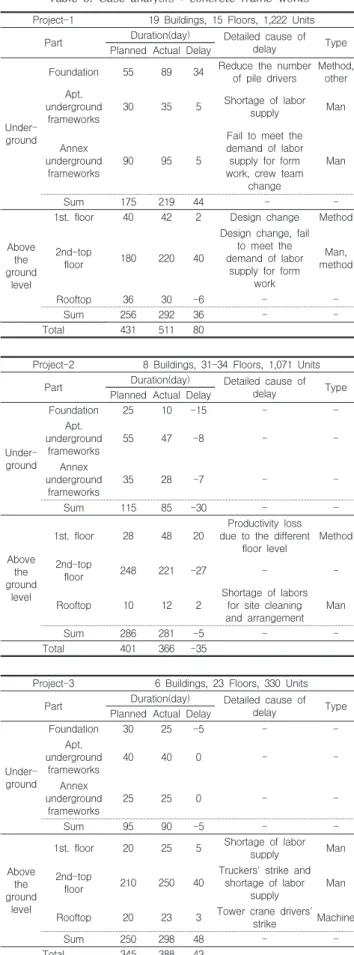
샘플현장(3개 현장) 중 골조공사가 지연된 현장의 지연원인을 작업일보를 통해 분석한 결과 지연 공정은 지상 1층 및 기준층(2 층~최상층)에 집중되어 있었으며 그 중 핵심 지연공정은 지상1층 골조공사인 것으로 나타났다. 다음의 Table 5는 대표적인 3개 현 장의 부위별 골조공사 지연사례를 분석하여 요약한 것이다.
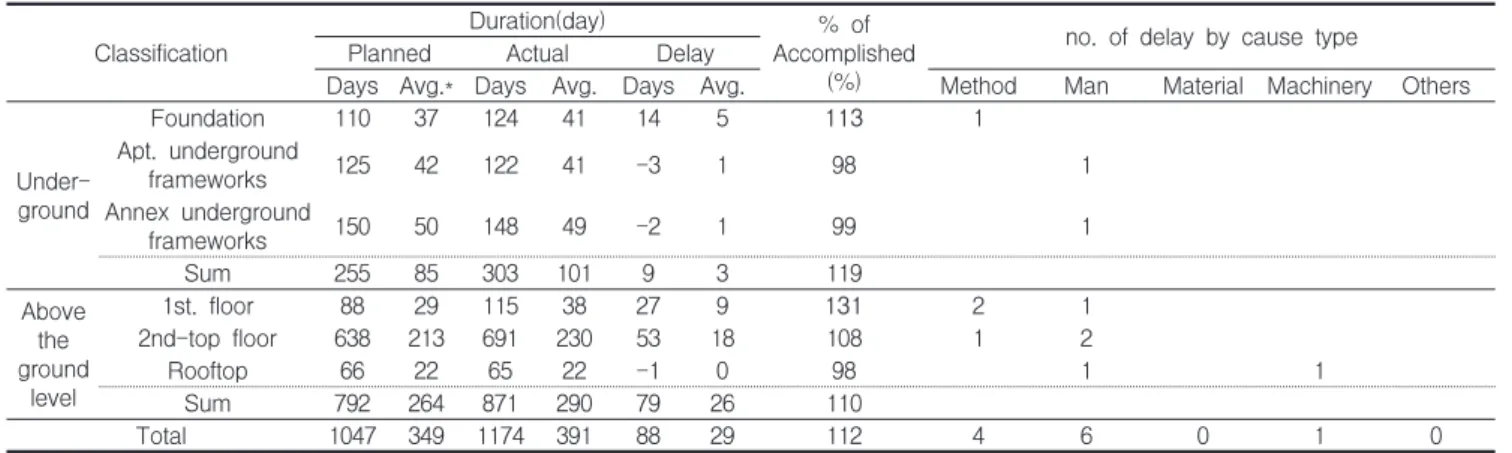
현장 1~3의 사례를 살펴보면 지상층 골조공사, 특히 1층 골조 공사에서 지연이 크게 발생한 것으로 나타났다. Table 6은 Table 5의 3개 현장 자료를 요약하고 지연일수 및 지연율의 산정결과를 나타낸 것이다. 계획, 실행, 지연의 평균값은 3개 현장의 일수를 샘플수인 3으로 나누어 산정한 값을 나타낸다. 시행비율은 실행 일수를 계획일수로 나눈 값이며 이를 지하층과 지상층으로 나누 어보면 전반적으로 지하층 골조공사가 높은 비율을 나타냈다. 그 러나 각 부위로 구분할 경우 1층 골조공사의 시행율이 가장 높아 주요 지연부위인 것으로 나타났다. Figure 4는 Table 5의 지연율 을 부위별로 보다 명확하게 나타내기 위하여 100%를 기준으로 각 부위별 공기가 어느 수준에서 지연 또는 단축되었는가를 나타 내는 것이며 예를 들어 1층 골조공사의 경우 131%의 의미는 실 행율 100%를 기준으로 31%가 지연된 것을 나타내며 따라서 타 부위의 공사에 비해 지연이 가장 크게 발생한 것으로 나타났다.
Figure 4. Delay ratio by parts
Project-1 19 Buildings, 15 Floors, 1,222 Units Part Duration(day) Detailed cause of
delay Type
Planned Actual Delay
Under- ground
Foundation 55 89 34 Reduce the number of pile drivers
Method, other Apt.
underground frameworks
30 35 5 Shortage of labor
supply Man
Annex underground
frameworks
90 95 5
Fail to meet the demand of labor supply for form work, crew team
change
Man
Sum 175 219 44 - -
Above the ground
level
1st. floor 40 42 2 Design change Method
2nd-top
floor 180 220 40
Design change, fail to meet the demand of labor
supply for form work
Man, method
Rooftop 36 30 -6 - -
Sum 256 292 36 - -
Total 431 511 80
Project-2 8 Buildings, 31-34 Floors, 1,071 Units Part Duration(day) Detailed cause of
delay Type
Planned Actual Delay
Under- ground
Foundation 25 10 -15 - -
Apt.
underground frameworks
55 47 -8 - -
Annex underground
frameworks
35 28 -7 - -
Sum 115 85 -30 - -
Above the ground
level
1st. floor 28 48 20
Productivity loss due to the different
floor level
Method
2nd-top
floor 248 221 -27 - -
Rooftop 10 12 2
Shortage of labors for site cleaning and arrangement
Man
Sum 286 281 -5 - -
Total 401 366 -35
Project-3 6 Buildings, 23 Floors, 330 Units Part Duration(day) Detailed cause of
delay Type
Planned Actual Delay
Under- ground
Foundation 30 25 -5 - -
Apt.
underground frameworks
40 40 0 - -
Annex underground
frameworks
25 25 0 - -
Sum 95 90 -5 - -
Above the ground
level
1st. floor 20 25 5 Shortage of labor
supply Man
2nd-top
floor 210 250 40
Truckers' strike and shortage of labor
supply
Man
Rooftop 20 23 3 Tower crane drivers'
strike Machine
Sum 250 298 48 - -
Total 345 388 43
Table 5. Case analysis : concrete frame works
Classification
Duration(day) % of
Accomplished (%)
no. of delay by cause type
Planned Actual Delay
Days Avg.* Days Avg. Days Avg. Method Man Material Machinery Others
Under- ground
Foundation 110 37 124 41 14 5 113 1
Apt. underground
frameworks 125 42 122 41 -3 1 98 1
Annex underground
frameworks 150 50 148 49 -2 1 99 1
Sum 255 85 303 101 9 3 119
Above the ground
level
1st. floor 88 29 115 38 27 9 131 2 1
2nd-top floor 638 213 691 230 53 18 108 1 2
Rooftop 66 22 65 22 -1 0 98 1 1
Sum 792 264 871 290 79 26 110
Total 1047 349 1174 391 88 29 112 4 6 0 1 0
* Avg. : Avg. of 3 projects
Classification Cause of delay
Design
Architectu-r al design
Insufficient reviews on the change of frame shape and dimension in both unit and building floor plan
Insufficient reviews on leveling, opening, location of electric box, lines of rainwater and sewage etc.
Structural design
Insufficient details for the change of structural types between underground and over the ground frames
Insufficient reinforcement bar arrangement and structural details for individual unit
Specialty design
Incomplete special drawings prior to construction start-up
Insufficient reviews on elevations, pilotis, main entrance etc.
Const- ruction plan
Duration estimate
Inadequate estimation of optimum duration for the connection of underground and over the ground works
Omission in estimating duration for structural changes
Selection of method
Delay in deciding form type due to the construction conditions
Delay and error in the selection of construction method for exterior wall and non-standard structures
Selection of sub-contrac
tor
Fail to secure the optimum subcontractors (expertise, financial capability, number of crews etc.)
Misjudgment on the supply of subcontractors
Table 7. Cause of delay at the 1st. floor concrete framework
(pre-construction phase)
Classification Cause of delay
mobilization
Insufficient in preparing access road, securing stack yard, safety facilities in advance Inadequate specification reviews for lifting machines and misjudgment on the supply time design
review
Insufficient cross check on drawings for each trade
Inadequate form work design and shop drawings
material procurement
Late decision-making and order on the selection of materials to be buried
Late inspection and owner's approval for the materials
sub- contractors
Insufficient number of workers, inadequate site administration, low level of technical expertise and craftsmanship etc.
Late material order, inadequate material checks, late supply of supplemental and non-standard materials
construction management
Inadequate scheduling analysis for the linked activities and failing in preparing optimum scheduling plan
Insufficient quality training and inspection for subcontracts' workers
others
Absence of counter plan for the public appeals on the such issues as noise, dust etc.
Delay due to the weather related factors including low temperature, rainy season etc.
Table 8. Cause of delay at the 1st. floor concrete framework (after the start up)
지연율이 높은 1층에 대한 원인분석 결과를 살펴보면 공사방법 이 2건, 인력관련이 1건으로 작업원의 수급 및 활용보다 설계변 경, 도면의 미확정, 특화설계의 지연, 시공성이 떨어지는 설계, 공법변경, 사용 거푸집공법 등이 지연의 주요 원인인 것으로 나 타났다.
4.2 지연원인에 따른 대책
4.2.1 아파트 1층 골조공사 지연원인 분석
1층 골조공사의 지연원인을 보다 상세하게 분석하는 과정으로 는 크게 착공전과 착공후로 구분하였으며(Table 7 및 Table 8 참 조) 먼저 착공전의 경우 건축설계사항으로 평면도의 미비 및 층별 골조변화형상 및 치수의 검토 미비, 부위별 레벨 및 개구부, 전기 공사와 설비공사에 필요한 박스의 크기 및 위치의 미확정이 주요
Case Studies: Schedule Delay Factors and Delay Prevention Program for Concrete Frame Works in Apartment Construction Project
원인으로 나타났다. 구조설계사항으로는 배근 상세의 미확정, 지 하구조물과 아파트 지상구조물 간 구조형식의 상이에 따른 전이 보(transfer girder) 등의 상세부족 등이 있으며 각 현장별 경쟁 력 강화를 위한 특화 디자인의 도면확정 지연도 주요 원인으로 나 타났다. 또한 공사계획 작성 시 공사의 복잡성을 고려하지 않고 반복 경험에 의한 개략적인 공기산정, 공사여건에 따른 사용자재 및 적용공법의 선정지연, 공사 수행능력을 갖추지 못한 저가업체 선정 및 사전 작업자 확인 및 투입시기 결정 지연으로 1층 골조공 기가 지연되는 것으로 분석되었다.
한편, 착공 후 지연원인으로는 각 공정별 사전 협의가 완료된 거푸집 도면의 검토지연 및 미확정, 각종 사용자재의 발주처 승인 지연, 양중장비의 적정배치 미비 등이 주요 지연원인인 것으로 나 타났다. 협력업체 사항으로는 영세성 및 기술력 부족, 적정 작업 인원 수급 미흡 등이 원인이었으며 시공사항으로 최적공정표 작 성 미비로 나타났다. 기타사항으로는 소음 및 비산먼지 등으로 인 한 민원대책 부족, 동절기, 우기에 따른 공사 지연이 주요 원인으 로 나타났다.
4.2.2 공기지연 개선대책
아파트 1층 골조공사의 지연을 방지하고 생산성을 향상시키기 위한 대책으로는 사전 예방을 위한 개선활동 강화와 사후 신속 대 응체계를 구축하여야 한다.
구체적으로 공사 착수 전 TFT 활동을 강화하여 초기 시행 공 종인 파일, 토목, 골조공사에 대한 실질적인 사전계획이 이루어지 도록 해야 한다. 또한, 가용 가능한 정보에 대한 공유가 이루어 져야 한다. 건설공사의 특성상 각종 자료가 기록 되지 않고 1회성 으로 사용 후 폐기되는 경향이 높으며 이를 방지하기 위해 단계별 표준화된 체크리스트를 작성하여 기록 및 유지가 가능토록하고, 피드백시스템(feed-back system)을 공유하여 반복적으로 발생 되는 하자 및 재시공 발생을 최소화 하여야 한다.
일반적으로 공기관리에 문제가 발생 할 경우 현장에서 자체적 인 노력으로 해결하려는 경향 때문에 전사적 지원 시점을 실기하 고 이를 만회하기 위한 돌관공사 실시로 추가비용 발생 및 품질저 하가 발생하고 있다. 따라서 이에 대한 대책으로 토공사, 기초공 사, 1층 골조공사 등 주요공정에 대한 진도율 관리 및 공기지연 단계별 지원프로그램을 운영해야 할 것이다. 특히, 현장 공정관리 정보화시스템을 구축하여 경험에 의존한 공정관리가 아닌 DB를 활용한 공정계획을 수립해야 할 것이다. 설치 및 해체가 용이한 거푸집의 사용 및 양중작업의 과부하 방지대책의 사전 수립, 철근 선 조립화/기계화공법의 적용과 더불어 설계의 단순화 및 표준화, 골조의 PC화 등 신기술 신공법에 대한 적극적인 검토 및 도입이 필요 할 것이다. 또한, 자재 발주 및 관리시스템의 개선을 위해 PMIS체계 구축 운영도 적극 검토 되어야 할 것이다.
민원관리 측면에서는 공사수행에 따른 피해수준을 사전에 명확 히 파악하고 민원인과 상호존중에 의한 신뢰감 형성 및 지속적인 대화로 해결 방안을 조기 도출하여 공사 진척에 문제가 발생하지 않도록 해야 할 것이다.
5. 결 론
건설프로젝트의 공기지연은 프로젝트의 성패를 좌우하는 매우 중요한 사항으로 본 연구에서는 사례분석을 통해 골조공사 지연 의 주요 원인을 분석하였으며 각 원인별 대책을 제시하였다. 그 중 핵심 지연요인으로는 1층 골조공사인 것으로 분석되었다. 아 파트 골조공사의 지연을 방지하기 위한 대책으로 1)사전 예방을 위한 개선활동 강화와 사후 신속 대응체계구축, 2)신기술, 신공법 의 적용 및 작업방법의 개선, 자재 수급을 위한 조기발주 및 효율 적인 자재관리 시스템 구축, 3)민원인과 상호 존중에 의한 신뢰감 형성 및 대화를 통한 문제 해결을 통해 공사의 진행을 원활하게 할 수 있을 것으로 판단된다. 본 연구는 공기지연의 분석대상을 골조공사로 한정하였으며 이를 착공전과 후로 구분하여 원인요소 를 규명하였고 각 원인에 대한 대책을 제시하였다는데 의의가 있 다. 그러나 제시된 대책의 실효성 검증 등 후속연구에서 보다 체 계적인 연구가 지속되어야 할 것으로 사료된다.
요 약
건설프로젝트에서 공기지연은 공정 및 공사비 관리 측면에서 핵심 관리사항에 해당된다. 본 연구는 아파트 건설공사에서 직접 비의 상당부분을 차지하는 골조공사를 대상으로 공사부위별 공기 지연 수준을 분석하고 대책을 제시한 실증연구로 10개 현장의 공 사비 비중분석 결과에 기반하여 골조공사에서 지연이 발생하는 부위의 순위, 원인 등을 분석하였다. 분석결과 1층 골조공사에서 가장 큰 지연이 발생하는 것으로 나타났으며 지연원인을 다양한 분류에 의거하여 분석하고 대책을 제시하였다.
키워드 : 공기지연 요인, 콘크리트 골조공사, 공기지연 예방대책 References