*
종신회원, 국립목포해양대학교 해양정보통신공학과 접수일자 : 2014년 3월 23일, 수정완료 : 2014년 4월 10일 게재확정일자 : 2014년 4월 11일
Received: 23 September, 2014 / Revised: 10 April, 2014 / Accepted: 11 April, 2014
*
Corresponding Author: [email protected]
Division of Electric and Communication Eng. Mokpo National Maritime University, Korea
http://dx.doi.org/10.7236/JIIBC.2014.14.2.59 JIIBC 2014-2-8
A study on WiMAX Backhaul in Mobile Communication Network
이동통신 네트워크에서 WiMAX Backhaul에 관한 연구박천관
*Chun-Kwan Park
*요 약 본 논문은 이동통신 네트워크에서 WiMAX 백홀 구현에 관한 것이다. 최근에 대부분의 ISP들은 T1/E1 및 디지털 가입자 회선(DSL)을 이용하여 Wi-Fi 백홀을 구축하고 있다. WiMAX가 이동통신 백홀의 대안으로 설치된다 면, 설치 및 운용비가 대폭 절감될 것이다. 그리고 유선통신 인프라가 구축되어 있지 않은 서비스 지역을 커버하기 위 한 비용 효율적인 솔류선중 하나가 될 것이다. WiMAX는 Base Station, Subscriber Station, 그리고 Relay에 사용될 수 있다. 본 논문에서 WiMAX 서버와 WiMAX SS를 구성하여 NAT 및 Port Forwarding 기능을 이용하여 상.하향 에서 성능이 측정되었다.
Abstract This paper address the scheme for WiMAX backhaul in mobile communication network. These days most ISPs has implemented Wi-Fi backhaul using T1/E1 and DSL. if WiMAX is installed as the alternative to the mobile backhaul, it can decrease the costs drastically for the installation and operations. And it will be one of the best cost-effective solutions to cover the service areas which has not the wired communication infrastructure.
WiMAX can be used for Base station, Subscriber Station, and Relay. In this paper, the performance is measured for downstream and upstream using NAT and port forwarding functions by configuring WiMAX server and WiMAX SS.
Key Words : WiMAX, Backbaul, Wi-Fi, DSL, T1/E1
Ⅰ. Introduction
These days as Internet and mobile communication technologies has been developed rapidly, the high-speed data can be transmitted and received in even the mobile environment. So it contributes to change the mobile communication services from just simple voice one to the diverse ones using the high-speed bidirectional data transmission
[1].
The mobile communication network started to be
developed from the dedicated network for voice in the
first generation(1G). In 2G, the network was changed
into the digital one, and can provide the voice service
as well as the low-speed data one. In 3G, the most
wireless technologies was standardized, and the diverse
services, such as web browsing, video downloading,
e-mail, and various Smartphone technologies, has been
appeared. The mobile WiMAX(WiBro) and the 4G
wireless broadband communication technology like LTE(Long term Evolution) has been commercialized, and then it is possible to provide the high-capacity multimedia services through these wireless networks
[1][2].
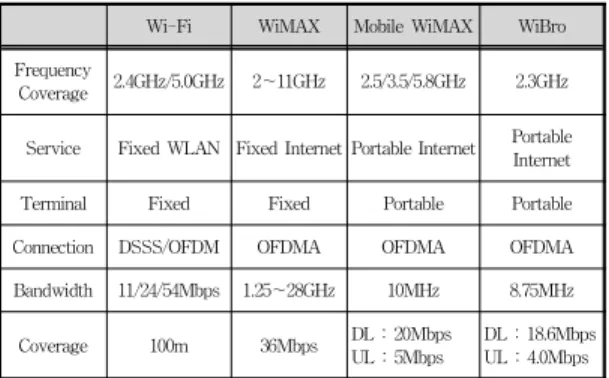
Table 1 shows the comparison of broadband wireless access technologies. Wibro and WiMAX have been developed in its own area. Wibro has been developed from the portable phone. WiMAX has been developed from the wireless LAN technology
[2][3].
Wi-Fi WiMAX Mobile WiMAX WiBro
Frequency
Coverage 2.4GHz/5.0GHz 2~11GHz 2.5/3.5/5.8GHz 2.3GHz Service Fixed WLAN Fixed Internet Portable Internet Portable Internet
Terminal Fixed Fixed Portable Portable
Connection DSSS/OFDM OFDMA OFDMA OFDMA
Bandwidth 11/24/54Mbps 1.25~28GHz 10MHz 8.75MHz
Coverage 100m 36Mbps DL : 20Mbps
UL : 5Mbps DL : 18.6Mbps UL : 4.0Mbps
1. 광대역 무선 액세스 기술
Table 1. Broadband Wireless Access Technologies
As Mobile Backhaul Network connects Base Station to the BSC(Base Station Controller), it can transfer the required bandwidth of the diverse generation technologies, such as 2G, 3G, 4G, WiMAX, and LTE.
PSN(Packet Switched Network) and TDM can be used for mobile backhaul network
[3][4].
WiMAX (Worldwide Interoperability for Microwave Access) is the wireless technology for the wide area and outdoor that expands the function and coverage compared to WiFi. WiMAX backhaul system includes two parts. One thing is the WiMAX tower like the cell phone. Another is WiMAX receiver, which works at higher rates and over larger distance than WiFi.
WiMAX Forum classifies WiMAX technology into the fixed and the mobile one. It has the merit that is easy to integrate with the wireless network as IP basic technology. These days WiMAX working group aims to describe the requirement of the carrier Ethernet
transport to use WiMAX as backhaul because of the vendor’s growing requirement. it can provide the other chance to the smaller operators who can’t install the optical transmission infrastructure
[5][6].
This paper address the scheme to use WiMAX as backhaul. WiMAX can be used for BS, SS, and Relay.
In this configuration, the performance is measured for downstream and upstream using NAT and port forwarding functions of WiMAX AP. This paper consists of the following. Section Ⅱ address the overview of WiMAX backhaul network. Section Ⅲ address the architecture RAN (Radio Access Network) system for WiMAX backhaul. Section Ⅳ has simulated the performance of RAN system. And SectionⅤ is the conclusion of this paper.
Ⅱ. WiMAX Backhaul Network
These days the growing packet traffics based on mobile communication network promote to evolve to the convergence network of both wire and wireless based on All-IP. When the data traffics using wireless Internet exceeds the voice one by introducing the data services in both 3G(HSPA, LTE) and 4G (LTE advanced, WiMAX), the bottleneck phenomenon in the backhaul network has occurred. So many ISPs have considered to introduce the backhaul transport network system, which have much advantages and flexibility and can integrate both wire and wireless based on IP, from viewpoint of CAPEX/OPEX
[1][5][6].
WiMAX is the interoperable implementations of IEEE 802.16 family of wireless network standards.
IEEE 802.16 standard is issued for the fixed WiMAX in 2001. IEEE 802.16e-2005 is the mobile WiMAX deployed in many countries. Therefore, WiMAX can be used for many areas, such as the broadband connections, the cellular backhaul, hotspots, and so on.
WiMAX is similar Wi-Fi, but can be used for longer
distance than Wi-Fi. it can support many services with
the different QoS and level of guarantees, such as data,
voice, VoIP, TCP/IP, and so on.
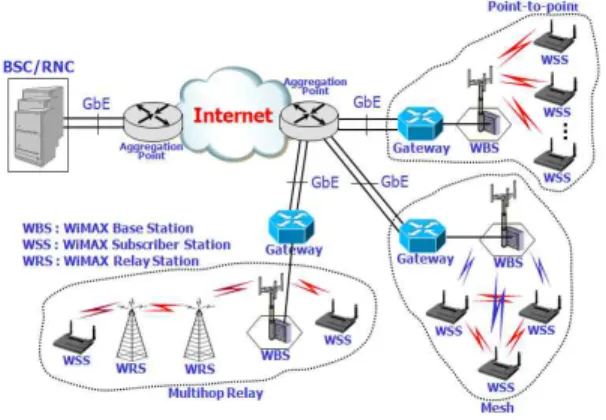
WiMAX entities include Base Station(BS), Subscriber Station(SS), and Relay Station(RS). BS includes mainly Physical (PHY) and Medium Access Control (MAC) layers. it plays a central role in PMP (Point-to-Multipoint) mode, and a coordination role in the resource management. it also plays connection or gateway points to other networks, such as backhaul, Core IP, and Internet. SS is for single user in the fixed station, and the multiple users in AP of LAN/WLAN.
RS can be used for the mobile multihop relay. Fig 1.
shows WiMAX backhaul network. The 802.16-2004 standard, which is the fixed connectivity applications, can be used for backhaul application. The fixed WiMAX provides the several services, such as point-to-point, point-to-multipoint, and mesh broadband access services. The mobile WiMAX is based on OFDMA(Orthogonal Frequency-Division Multiple Access) and provides 75Mbps data rate in 2~
10km cell size. WiMAX can be applied to the diverse applications, such as last mile broadband connections, hotspots and backhaul connectivity. Addition to supporting a single hop access to a broadband Internet Service, WiMAX technology can be applied to the wireless backhaul network. The diverse deployment methods include the large scale wireless coverage, backhaul connectivity for the connection between RNC (Radio Network Controller) and base stations
[7][8][9][10].
1. WiMAX Backhaul Network 그림 1. WiMAX 백홀 네트워크
Ⅲ. Subscriber Station System
WiMAX network includes the several systems, such as terminal, the base station managing terminal and particular area, ACRs(Access Control Router) interconnected by the backbone network, and many kind of servers for particular purpose
[9][10]. Backhaul network has to provide subscribers with high-speed data rates. WiMAX backhaul connects the base station (BS) to WiMAX Access service network gateway.
This can seamlessly carry WiMAX traffics from cell sites to WAN. Backhaul is the network element that connect the end users with the core switching and management section. From the several WiMAX deployments scenarios, the several WiMAX base stations can be connected to one another through the high speed WiMAX backhaul microwave links.
WiMAX backhaul system includes two parts. One thing is the WiMAX tower like the cell phone. Another is WiMAX receiver, which works at higher rates and over larger distance than WiFi
[11][12]. Fig 2. shows WiMAX backhaul protocol stack. This includes the diverse interfaces in physical layer, such as WLAN, WiMAX, and Wi-Fi.
Fig 2. Protocol Stack 그림 2. 프로토콜 스택
Ⅳ. Test the performance of Subscriber Station System
Fig 3. shows the simulation configuration to test the
WiMAX backhaul function. In this configuration,
WiMAX AP is certified by WiMAX server and then use IP address assigned by the server. Terminal also is certified by WiMAX AP and then use IP address assigned by WiMAX AP. For downstream, Client is connected to WiMAX AP through Ethernet or Wireless interface, and configures the private network with WiMAX AP through DHCP. In this network, the performance is measured for downstream and upstream using NAT and port forwarding functions of WiMAX AP. The measurement is based on bandwidth, RSSI, and CNIR using TCP.
Fig 3-a) is the real configuration, and Fig 3-b) is the configuration for simulation. it consists of WiMAX server, WiMAX AP, and terminal. Terminal generates TCP packets. Delay time is measured for each bandwidth, and also considers the window sizes.
3. The Configuration for Routing Test 그림 3. 라우팅 테스트를 한 구성도
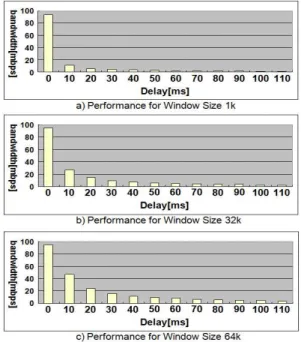
Fig 4. shows the performance of WiMAX AP for each window size, such as 1k, 32k, and 64k. As the data services exceeds the voice one in the network, it also is important to support TCP/IP packets in wireless network. As TCP congestion control function can not perceive the network state exactly because of the high error rates in wireless network, it can deteriorate the performance of wireless communication network. 32k window size is proper for this simulation.
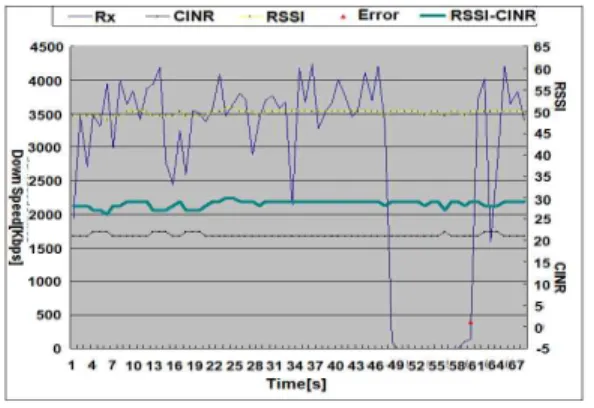
Fig 5. shows the upstream characteristics of WiMAX RAN system. The elements for performance measurement includes CINR (Carrier to Interface Ratio), RSSI (Received Signal Strength Indication), and
bandwidth. CINR is used as the standard that evaluates the signal quality in the system using OFDM (Orthogonal Frequency Division Multiplexing). RSSI (Received Signal Strength Indication) refers to the received signal strength, which is the amount of power received in the receiver. In Fig 5, the mobility is considered. it shows the transmission rate, CINR, RSSI, error, and the relationship between CINR and RSSI over time.
Fig 4. Performance for Windows Size 그림 4. 윈도우 사이즈별 성능
Fig 5. WiMAX Upstream performance 그림 5. WiMAX 상향 성능
Fig 6. shows the downstream characteristics of WiMAX RAN system. This also considers the mobility like Fig 6. it shows the communication performance for TCP. The bandwidth can be reduced sharply by the TCP packet retransmission because of the bandwidth measurement using TCP.
6. WiMAX downstream performance 그림 6. WiMAX 하향 성능