반복 MIMO 검출을 위한 저 복잡도 LSD 기법
아흐메드 살림, 김 수 영°
Low Complexity LSD Scheme for Joint Iterative MIMO Detection
Saleem Ahmed, Sooyoung Kim° 요 약
논문에서는 부호화된 MIMO 시스템에서 연판정 반복 검출 방식과 결합하여 효율적으로 사용될 수 있는 복잡도 가 감소된 리스트 구 복호 (list sphere decoding; LSD) 방식을 제안한다. 기존의 LSD 방식은 고정된 값의 반지름 을 이용하여 후보 신호들을 검색하였다. 그러나, 정해진 수 만큼의 후보 리스트들이 모두 채워지면, 이들에 대한 최대 또는 평균 반지름은 줄어들 가능성이 매우 크다. 반지름을 줄이게 되면 복잡도 또한 줄일 수 있게 된다. 본 논문에서는 LSD 기반의 MIMO 검출 시스템에서 효율적으로 사용될 수 있는 매우 간단한 반지름 갱신 방식 및 이를 이용한 연판정 반복 MIMO 검출 기법을 제안한다. 또한 터보 부호를 이용하여, 연판정 입출력을 이용하는 반복 MIMO 검출 방식에 대한 성능 평가 결과를 제시한다. 본 논문에서 제시된 시뮬레이션 결과에 따르면, 제안 된 방식은 기존의 LSD 방식을 사용하는 것에 비해 거의 유사한 비트오류율 성능을 유지하면서도 복잡도를 크게 감소시킬 수 있다.
Key Words : List sphere decoding (LSD), MIMO, 연판정 반복 검출, Coded MIMO.
ABSTRACT
This paper proposes a complexity reduced list sphere decoding (LSD) scheme for joint iterative soft detection scheme for coded MIMO system. The conventional LSD scheme is based on searching the candidates with a fixed radius. However, once the candidate list is full, it is highly probable that the radius can be reduced. By reducing the radius, the complexity can be also reduced. We propose a simple and efficient radius update method for complexity reduction of list version sphere decoding and its application to iterative soft MIMO detection. We evaluate the performance of the proposed scheme with a joint soft-input-soft-ouput iterative MIMO detection in combination with turbo codes. Simulation results show that the proposed methods provide substantial complexity reduction while achieving similar bit error rate (BER) performance as the conventional LSD scheme.
First Author:전북대학교 전자공학부 IT융합연구센터, [email protected], 학생회원
° Corresponding Author:전북대학교 전자공학부 IT융합연구센터, [email protected], 종신회원 논문번호:KICS2013-08-324, 접수일자:2013년 8월 5일, 최종논문접수일자:2013년 10월 11일
Ⅰ. Introduction
In most of wireless systems with multiple-input multiple-output (MIMO) technique, an iterative decoder is employed in order to meet the performance requirement. Turbo codes are typical
examples which require an iterative decoding algorithm to produce a capacity limiting performance[1]. In addition to this iterative loop inside the decoder, iterative principle can be extended to the outer loop, which is connected to the decoder and the MIMO detector. In this case,
the iterative principle can be employed in MIMO systems employing bit-interleaved coded modulation with iterative decoding (BICM-ID), where the extrinsic log-likelihood ratios (LLRs) are iteratively exchanged between MIMO detector and the channel decoder[2].
To detect transmitted information over MIMO systems, the optimal choice is the maximum a posteriori (MAP) detection. MAP detector computes the per-bit a posteriori probability (APP) considering all possibilities of the simultaneously transmitted symbol streams. A main problem with the MAP detector is that it is computationally complex even for a small number of antennas and modulation order, because its complexity increases exponentially by the number of antennas and modulation orders.
There are a number of less complex (sub-optimal) detection schemes proposed in the literature. One example of these is the soft interference-cancellation minimum mean squared error (SIC-MMSE), and it is a soft input soft output technique based on nulling and cancelling approach[3]. In list-sphere detector (LSD), only the P-symbol vectors that lie closest to the received signal vector, referred collectively as the candidate list, are used to produce the detector output[2]. However, with sphere of sufficiently large radius and list size, the LSD scheme is identical to the MAP detector.
The main issue of LSD scheme was that the radius usually could not be reduced due to fixed radius strategy during the search procedure[2]. In [4] and [5], radius updating schemes were employed during the search process in order to reduce the number of nodes. However, frequent update of the radius can be too much computational burden. Another drawback of LSD is that LSD is not applicable to produce soft information when all candidates in the list have only value of +1 (or -1) for a specific bit.
In this paper, in order to solve the above problem of the conventional LSD based MIMO detection scheme, we propose a new sub-optimal iterative MIMO detection scheme. We propose a
new radius initialization and update strategies to reduce the complexity and to improve the efficiency of search process compared to the conventional LSD scheme.
In the following section II, we introduce the system model and the concept of iterative MIMO receiver in combination with the conventional LSD scheme. Section III describes the proposed method. Simulation results are provided in section IV. Finally, the paper is concluded in section V.
Ⅱ. Iterative MIMO detection with LSD 2.1. System model
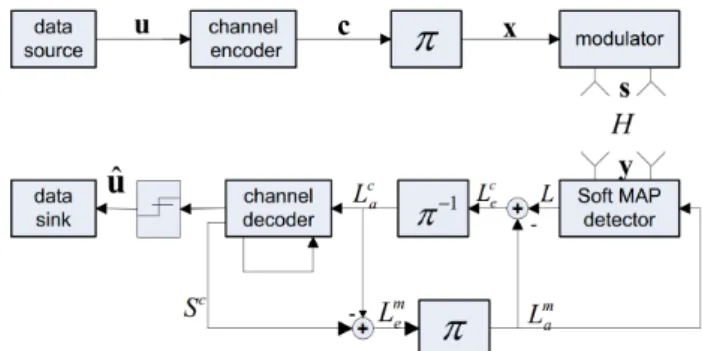
Fig. 1 shows the block diagram of transmitter and receiver structure of an iterative-MIMO system with transmit and receive antennas. The transmitter is based on a bit-interleaved coded modulation (BICM) transmission strategy. At the transmitter, the information bit vector, u is firstly channel encoded, and then encoded bit vector, c is bit-interleaved, and is denoted by x. After bit-interleaving, the coded sequence is divided into
independent streams. Each stream consists of
bits, where denotes the number of bits per transmit symbol. Total number of bits transmitted in a MIMO frame are . The block of encoded and interleaved bits can be represented as:
x ⋯ ⋯, (1) where represents th bit mapped onto th symbol.
Fig. 1. Block diagram of a MIMO system with BICM transmitter and iterative receiver.
Consider transmitted signal s ⋯
, where
is independently chosen from a complex constellation , whose cardinality is
. The received signal is denoted as y ⋯
, and it can be represented with an × complex channel matrix H as follows:
y Hs n, (2) where n is an × complex noise vector.
At the receiver, MIMO detector calculates the LLRs for bits from a received signal. LLR values are passed through deinterleaver. After deinterleaving, the LLR value is passed to a channel decoder. In iterative processing, either LLR values are used to make decision for information bits or the channel decoder feedbacks the extrinsic LLRs of all information bits to MIMO detector. With each iteration, LLR value improves. The information exchange between the channel decoder and MIMO detector continues until the desired performance is achieved. LLR values generated by the channel decoder are bit-interleaved before passing to MIMO detector.
As a MIMO detection scheme, the maximum likelihood (ML) detection is the optimal detection method which solves the closest lattice point problem by calculating the Euclidean distance (ED) between the received signal y and lattice point s and makes the decision of which lattice point minimizes the ED to received vector y. The ML detection determines the estimate of the transmitted signal vector s as:
arg
min∥y Hs∥. (3)
The ML detection scheme achieves the optimal performance as the MAP detection when all the transmitted symbol vectors are equally likely.
However, its complexity increases exponentially with the number of transmit antennas and
modulation order.
The complex representation of Eq. (2) can be transformed into an equivalent real representation of the system as follows:
y
y
H H
H H
s
s
n
n
, (4)
where ⋅ and ⋅ are the real and imaginary parts of a complex number. In case of 16-QAM, the new symbol alphabet is now
∈{-3,-1,1,3}, ≤ ≤. Furthermore, the dimensions of (2) are extended to and , as shown in (4).
The log-likelihood value (L-value) of the th bit of a th symbol, is given as:
y ln
y y
. (5) Eq. (5) can be calculated using max log MAP approximation as follows[2]: y ≈
min
min , (6) where can be found as follows:
∥ ∥
. (7)The LLR value passed to the decoder is the extrinsic information, , where is the intrinsic information in (5) and
is the a priori information used in the MIMO detector.
This extrinsic information is passed through the interleaver, and the channel decoder uses the interleaved a priori information to estimate the information sequence, and generate its soft output, . Subsequently, the extrinsic information for the MIMO detector, is estimated and interleaved to generate
.
2.2. SD and List Version of SD
The sphere decoding (SD), sometimes also referred as sphere detection method intends to find the transmitted signal vector with the minimum maximum likelihood (ML) metric, that is, to find the ML solution vector. SD is a suboptimal detection scheme in a way that it considers only a small set of vectors within a given sphere rather than all possible transmitted signal vectors. The SD method exploits the following relation:
arg
s
min∥y Hs∥
arg
miny Hsy Hs (8)
The above ML estimate can be written as:
arg
min∥y Hs∥
arg
mins sHTHs s (9)
where s HH Hy is unconstrained ML estimation for s. Consider the sphere with the radius of , then we have
s sHHs s≤ . (10) The SD search considers only the vectors inside a sphere of radius . The metric in Eq.
(9) can also be expressed as:
s sHTHs s
s sUTUs s
∥
Us s∥
, (11)where U is an upper triangular matrix of
×, obtained using the Cholesky factorization, such that UU HH. The factorization can be done using QR decomposition as well, then HH becomes RR, where R is an upper triangular matrix of ×. At the start, the value for
is considered in its own single dimension. The value is chosen from the point in the sphere
≤ .In other words, this value must be chosen in the
following range:
≤ ≤
. (12)
After choosing the point
, the sphere decoder chooses a candidate value for
and continues until . During the procedure of finding a candidate for each point
, if no candidate value exists for
, the decoder goes back to choose other candidate for
. In case still no candidate value exits for
after trying all possible candidate values for
, the decoder goes back to choose other value for
and so on. Once we found the values for
⋯, then the corresponding radius is calculated. Using this new radius, decoder proceeds to find better candidates.
In LSD, instead of searching for one best candidate, the best candidates are searched which fall inside the initial radius . Once the list is full, the search continues for better candidates. If the radius of new candidate is smaller than the candidate having largest radius in the list, then the list is updated by replacing the candidate having largest radius with new found candidate. Performance of LSD decoding depends on the size of . However, large size of
means higher search complexity. As is increased, the initial radius needed to be increased so that the sphere can contain the candidates.
If the radius is small, the decoder may fail to find any point inside the sphere.
The choice of initial radius in [2] is based on "trial and error" method by changing the value of constant. This method of finding the initial radius for lacks the efficiency. LSD algorithm slows down due to a fixed radius strategy during the search procedure[2][4]. The other main drawback of LSD is that it is not applicable to estimate soft information when all candidates in
the list have only value +1 (or -1) for a specific bit, and it may cause a serious problem in the iterative MIMO detection. We discuss this problem in the next section and propose an efficient solution.
Ⅲ. Proposed Iterative MIMO detection with complexity reduced LSD method
3.1. Concept of the proposed scheme
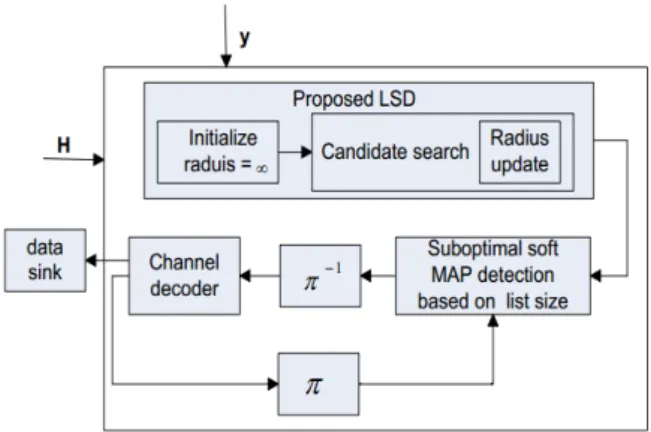
Fig. 2 shows the overview of LSD based detection flow with radius update strategy.
Initially, with a predetermined list size of , initial radius can be set to ∞. Then at the next step, the candidates are searched with the initial radius. If the list is full, then the radius is updated. Complexity and efficiency of the candidate searching step plays a vital role in the LSD based detection. The complexity can be controlled with better radius initialization and efficient radius update strategies, which can prune the unwanted candidates from the list. Once the list of the candidates is full, the radius is updated by using Eq. (13).
After completing the candidate search, the sub-optimal soft detection is performed by using
candidates. Then the result is sent to the turbo decoder. Decoder iteratively shares a reliability information with the MIMO detector.
From the second iteration, instead of searching the candidates again, we can use the same candidate list (stored during the first iteration)
Fig. 2. Block diagram of a LSD based detection with adaptive radius update strategy.
3.2. Complexity reduction of LSD with adaptive radius update
In LSD, radius initialization plays an important role in efficiency and complexity of searching the candidates. In [2], an initial radius could be found based on trial and error method. The main issues with LSD are initial radius setting and radius update. In LSD, the radius update can play a vital role in reducing the complexity by pruning the nodes with higher radius.
In our approach, we first set the initial radius to infinity, ∞, and update it during the searching process in order to reduce the complexity. Note that radius cannot be fixed to infinity until the end of the searching process. If this fixed radius was used during the whole search process without any radius update as in [2], then this results in searching all the points in search space. To overcome this problem we propose a radius update strategy. Our proposed method is based on the idea that after finding the
candidates, the new radius is set by taking the average radius of initial candidates. In other words, the new updated radius, can be estimated as soon as we find the first candidates as follows[6]:
′, (13)
where ′ is the radius of the th candidate.
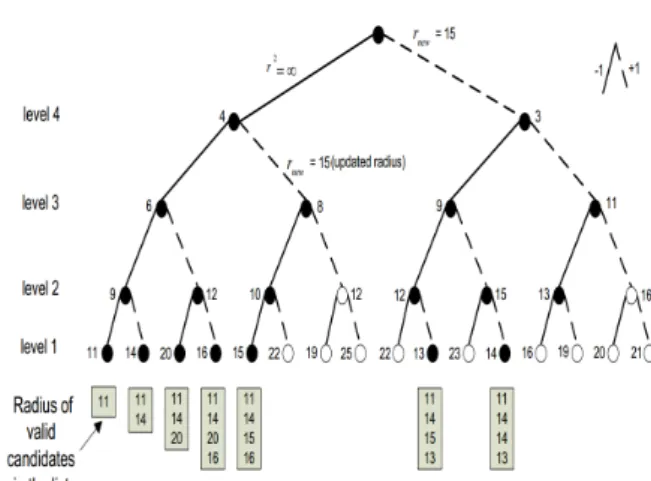
Fig. 3 explains the idea of the proposed radius update strategy, by using the example of 2×2 QPSK scheme with =4. The number at each node represents the radius of that node and each dark node is a valid lattice point within the sphere of radius r. Remaining nodes are not valid lattice points due to higher radius than r, therefore cannot be considered for MAP calculation. The Starting from the left, initially, the radius was set to infinity. After we found the 4 candidates based on initial radius then the radius is updated only once by using Eq. (13).
Referring to the example in Fig. 3,
. If newly found point has smaller radius than the one in the list, then it replaces with the existing one in the list.
Fig. 3. Tree diagram for radius initialization and radius update strategy for 2×2 QPSK system with = 4.
3.3. Allocating soft metric with LSD
One of the issues in LSD algorithm is that it is not applicable to estimate soft information when all candidates in the list have only value of +1 (or -1) for a specific bit. In such a case, Eq.
(5) cannot be evaluated because either
or is empty. In [2], a constant soft metric values of ± was allocated
to corresponding L-value, . In [7], the corresponding L-value was set to
± . However, allocating certain constant values invoke performance degradation problem in the iterative detection process. In addition, the choice of the constant value, i.e., clipping level has a significant effect on the system performance. In [8], a new approach was proposed, based on adding the fixed worst-case distance to an ML distance metric. Nevertheless this method could not solve the performance degradation problem in the iterative MIMO detection scheme.
In this paper, we provide a more efficient method to overcome this problem. We generate an opposite bit value for this situation. If there is a entry in the list only with , then we
generated a with all the other bits are the same. By referring to the example in Fig. 3, let us consider the case of producing soft L-value at level 4. We only keep four candidates in the list in this example, and among the four candidates in the list there is only a candidate with (-1) at level 4 which corresponds to the left most paths with (-1 -1 -1 -1) and radius of 11.
In order to evaluate soft L-value, opposite bit at level 4 (+1) was used, leaving the other bit values are exactly the same, i,e., the paths with (+1 –1 –1 -1) was used only for the soft bit calculation purpose. The same method is used whenever there is an entry in the list with only value of +1 (or -1) for a specific bit.
Ⅳ. Simulation Result
The performance of the proposed method was evaluated using a MIMO system over a Rayleigh fading channel. The 3GPP defined turbo code with information block size of 378 bits and the code rate of 1/3 was used, and the constraint length of each recursive systematic convolutional (RSC) component code was 4. Turbo decoder was employed with 16-QAM modulation scheme.
Fig. 4 shows the BER performance comparison of the proposed method with the full search MAP detector and conventional LSD. The number of candidate, was set to 16. The number of outer iterations (turbo decoder iterations), was set to 4 and number of inner iterations (MIMO detector iterations), was set to 2. As we can see, our proposed method produces the same BER as the conventional LSD method.
Fig. 5 represents comparison of the complexity between the proposed method and conventional LSD, in terms of the number of nodes visited during the candidate search process for a codeword, . It is shown that the proposed method reduces much higher complexity compared
to the conventional LSD by keeping the same BER performance. Comparing to the full search
Fig. 4. BER performance comparison for 2×2 iterative MIMO system with =16, =4, and =2.
ML method, the complexity of the proposed reduced search LSD for 2×2 MIMO with 16-QAM can be considered as about 16/256=1/16 in the iterative MIMO detection. In other words, the proposed LSD scheme achieves about 16 times of complexity reduction with about 0.1 dB BER performance degradation, compared to the full search ML scheme.
Fig. 5. Complexity Comparison of LSD schemes in terms of for 2×2 MIMO system.
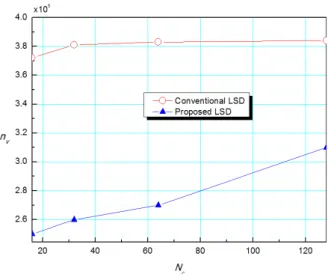
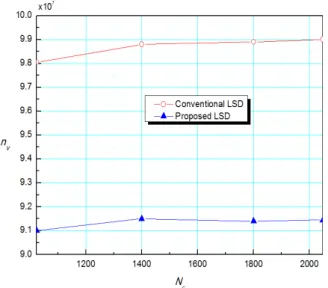
Fig. 6 shows comparison of complexity for the proposed and conventional LSD methods in terms of according to . at of 7 dB.
Across all values in Fig. 6, which is up to the half of the maximum list size, the proposed method visits much less number of nodes during
candidate search process compare to the conventional LSD. In terms of , the proposed scheme shows about 20% to 30% reduction compared to the conventional scheme.
Fig. 6. Complexity Comparison in terms of according to for 2×2 MIMO system at of 7 dB.
Fig. 7 shows the BER performance comparison of the proposed method with the full search MAP detector and conventional LSD. In this case, was set to 2048, which is 1/32 (2048/65536) of the full search candidates. The number of iterations, and are set to 4 and 2, respectively. Our proposed method produces the same BER performance as the conventional LSD schemes with complexity reduction for searching the candidates. Comparing to the full search ML method, the proposed LSD scheme for 4×4 iterative MIMO detection achieves about 32 times of complexity reduction with about 1.5 dB BER performance degradation.
Fig. 8 represents the comparison of complexity for the LSD schemes, in terms of . The proposed method shows about 10% of complexity reduction compared to the conventional LSD with the same BER performance across the all ranges. Fig. 9 shows comparison of according to . at of 8.5 dB. Similarly, the proposed scheme shows about 10% of complexity reduction consistently across the several values investigated.
Fig. 7. BER performance comparison for 4×4 iterative MIMO system with =2048, =4, and =2.
Fig. 8. Complexity Comparison of LSD schemes in terms of for 4×4 MIMO system.
Fig. 9. Complexity Comparison in terms of according to for 4×4 MIMO system at of 8.5 dB.
Ⅴ. Conclusion
In this paper, we proposed a new sub-optimal iterative MIMO detection scheme. Compared to the conventional LSD schemes, our method reduces the computational complexity about 10-30% during the candidate search process with the same BER performance. In addition, by adopting a suitable soft bit allocation method for the reduced search LSD for iterative MIMO system, the proposed scheme shows approximating performance to the ML scheme with much less complexity. In the simulation results investigated in this paper, a 2×2 16-QAM scheme shows about 16 times of complexity reduction with about 0.1 dB BER performance degradation, while a 4×4 16-QAM scheme shows about 16 times of complexity reduction with about 1.5 dB BER performance degradation.
References
[1] C. Berrou and A. Glavieux,. “Near optimum error correcting coding and decoding:
turbo-codes,” IEEE Trans. Commun., vol. 44, no. 10, pp. 1261-1271, Oct. 1996.
[2] B. M. Hochwald and S. Ten Brink,
“Achieving near capacity on a multiple antenna channel,” IEEE Trans. Commun., vol.
51, no. 3, pp. 389-399, Mar. 2003.
[3] J. G. Foshini, “Layered space-time architecture for wireless communication in a fading environment when using multi element antennas,” Bell labs Tech. J., vol. 2, pp.
41-59, Autumn 1996.
[4] W. Ping and T. Le-Ngoc. “A list sphere decoding algorithm with improved radius setting strategies,” J. Wireless Personal Commun., vol. 61, no. 1, pp. 189-200, Nov.
2011.
[5] J. Lee, B. Shim, and I. kang. “Soft-input soft-output list sphere detection with a probabilistic radius tightening,” IEEE Trans.
Wireless Commun., vol. 11, no. 8, pp.
2848-2857, Aug. 2012.
[6] S. Ahmed and S. Kim, “Complexity reduced LSD scheme for joint iterative MIMO detection,” in Proc. KICS Summer Conf. 2013, pp. 1082-1083, Jeju Island, Korea, June 2013.
[7] Y. L. C. de Jong and T. J. Willink, “Iterative tree search detection for MIMO wireless systems,” in Proc. IEEE VTC, vol. 2, pp.
1041-1045, Vancouver, Canada, Sep. 2002.
[8] C. Studer, A. Burg, and H. Bolcskei,
“Soft-output sphere decoding: Algorithms and VLSI implementation,” IEEE J. Select. Areas Commun., vol. 26, no. 2, pp. 290-300, Feb.
2008.
아흐메드 살림 (Saleem Ahmed)
2005년 3월 파키스탄
Quaid-e-Awam University 컴퓨터공학 학사졸업
2009년 2월 명지대학교 전자정 보공학부 석사졸업
2012년 3월∼현재 전북대학교 전자정보공학부 박사과정
<관심분야> 위성통신, 디지털 통신, 오류정정부호방 식
김 수 영 (Sooyoung Kim)
1990년 2월 한국과학기술원 전 기및전자공학과 학사졸업 1990년~1991년 ETRI 연구원 1992년 Univ. of Surrey, U.K
공학석사
1995년 Univ. of Surrey, U.K 공학박사
1994년~1996년 Research Fellow, Univ. of Surrey, U.K
1996년~2004년 ETRI 광대역무선전송연구팀장 2004년~현재 전북대학교 전자공학부 교수
<관심분야> 오류정정부호화방식, 이동/위성통신 전 송방식