1. Introduction
Marine ecosystems worldwide are undergoing significant changes on a range of scales caused by climate change, the direct and indirect effects of human activities (Andrefouet et al., 2003; Hochberg et al., 2003). In particular, many coral reefs have been threatened and degraded by disturbances to their local environments, including rising sea temperatures and increased anthropogenic stresses (Bruno and Selig,
2007; Scopelitis et al., 2009). Thus, the monitoring of changes in reef habitat is inevitable for rehabilitation and prevention of the reef environments.
Coral reefs in tropical or subtropical environments perform a number of key roles within these ecosystems, such as providing shelter from tropical storms, habitats for reef fish, and areas of elevated biodiversity, and supplying building materials (Mumby and Edwards, 2002). These reefs are known to be indicators of global climate change and have provided information that
Application of High-spatial-resolution Satellite Images to Monitoring Coral Reef Habitat Changes
at Weno Island Chuuk, Micronesia
Jong-Kuk Choi
1)·Joo-Hyung Ryu
1)†·Jee-Eun Min
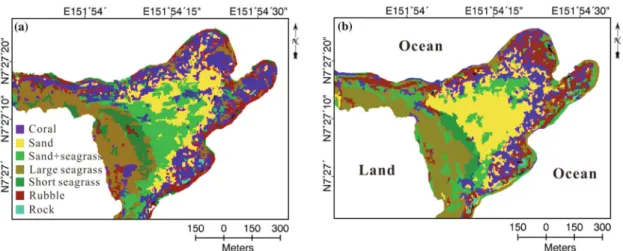
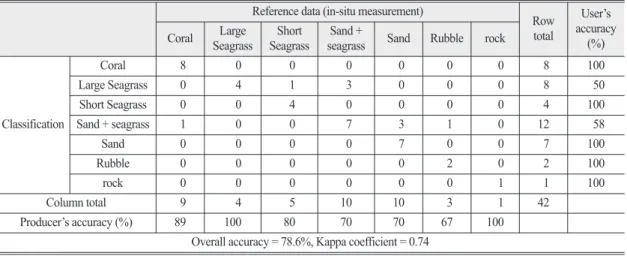
2)Abstract: We present quantitative estimations of changes in the areal extent of coral reef habitats at Weno Island, Micronesia, using high-spatial-resolution remote sensing images and field observations. Coral reef habitat maps were generated from Kompsat-2 satellite images for September 2008 and September 2010, yielding classifications with 78.6% and 72.4% accuracy, respectively, which is a relatively high level of agreement. The difference between the number of pixels occupied by each seabed type was calculated, revealing that the areal extent of living corals decreased by 8.2 percentage points between 2008 and 2010. This result is consistent with a comparison of the seabed types determined by field observations. This study can be used as a basis for remediation planning to diminish the impact of changes in coral reefs.
Key Words: Coral reefs; Kompsat-2 satellite image; Habitat mapping; Monitoring changes in habitat coverage;
Federated States of Micronesia, Weno Island Article
Received July 12, 2021; Revised July 26, 2021; Accepted August 3, 2021; Published online August 25, 2021
1)
Principal researcher, Korean Ocean Satellite Center, Korea Institute of Ocean Science and Technology
2)
Senior Researcher, Oceanic Research Division, Underwater Survey Technology 21
†