• 검색 결과가 없습니다.

Adopting Production System in Cognitive Psychology to Improve the Extraction Process of Persuasive Design Characteristics for Healthcare-related Applications

N/A
N/A
Protected

Academic year: 2021

Share "Adopting Production System in Cognitive Psychology to Improve the Extraction Process of Persuasive Design Characteristics for Healthcare-related Applications"

Copied!
18
0
0

로드 중.... (전체 텍스트 보기)

전체 글

(1)

Adopting Production System in Cognitive Psychology to Improve the Extraction Process of Persuasive Design

Characteristics for Healthcare-related Applications*

1)

Zhang, Chao**․Wan, Lili***

<Contents>

Ⅰ. Introduction

Ⅱ. Literature Review

A. Production Systems in Cognitive Psychology

B. Persuasive System Design Characteristics

Ⅲ. Research Approach

A. Stage-1: PDC Evaluation Process by Guideline

B. Stage-2: Production Rules Preparation Process

C. Stage-3: PDC Evaluation Process by Production System

D. Stage-4: Comparative Analysis for the Improvement of PDC Extraction Process

Ⅳ. Data Analysis and Result

A. Preparation of Production System in Stage-2

B. Evaluation Results by Two Approaches in Stage 1 and 3

Ⅴ. Discussion

A. Discussion for the Improvement of PDC Extraction Process

B. Discussion for PDC of Health and Fitness Applications

Ⅵ. Conclusion and Future Research Reference

<Abstract>

Ⅰ. Introduction

Mobile applications have been widely used

to help people with daily affairs, especially for medical and health care related applications.

Health and fitness application or medical

* This work was supported by the Ministry of Education of the Republic of Korea and the National Research Foundation of Korea (NRF-2017R1C1B5017880).

** College of Business, Hankuk University of Foreign Studies, [email protected]

*** College of Business, Hankuk University of Foreign Studies, [email protected], Corresponding

Author

(2)

application can be considered as a computer program running on smart mobile devices that can be used to assist people in handling their daily health care and physical exercises (Zhang et al., 2017). Twenty-four primary categories and more than 3.9 million applications can be approved on Apple iTunes Store. Among them, Both medical primary category and health and fitness primary category are two of the most important categories, which consist of those apps related to healthy living, stress management, recreational activities, fitness, medical education, health reference for patients, healthcare professionals, etc.

Generally, health and fitness category focused on people’s physical activities, such as muscle diagrams, yoga, workout tracking, running, cycling, stress management, Pilates, pregnancy, meditation, weight loss, eastern / Chinese medicine, acupuncture, acupressure, etc. And medical category focused on people’s medical activities, such as skeletal, muscular, anatomy, medical record-keeping, diseases, symptom reference, blood pressure devices, pulse devices, medical devices, health tracking, etc.

Many healthcare-related applications can be approved on different kinds of app platforms.

However, most of those apps have low review marks and very few downloads due to irrational user experience design, too simplified functional design, function or system errors, the widespread design plagiarism, etc. Furthermore, most of those

healthcare-related applications are lack of persuasion and user acceptance. The design features for all of those medical apps and health and fitness apps need to be checked and identified in order for better improvement or further empirical or experimental tests.

Especially, the representative persuasive design characteristics of top ten or top one hundred popular healthcare-related apps need to be evaluated for better design improvement. Some scholars have tried to describe and explain the concepts of all of those persuasive system design features. And what’s more, some researchers have also developed guidelines to identify and discover the persuasive system design features. However, due to the lack of relevant cognitive psychology analysis, we believe that the existing extraction process for persuasive system design features has defects and deficiencies.

The purpose of this study focused on

adopting production systems in cognitive

psychology to improve the extraction process

of persuasive design characteristics (hereafter

shorted as PDC) for mobile applications. A

research approach with four research stages

was performed. The most popular one hundred

apps from both medical category and health

and Fitness category were selected and

evaluated by two different evaluation processes

(Stage 1 and Stage 3). Based on cognitive

psychology theories and ACT-R (Adaptive

Control of Thought-Rational), we developed a

(3)

production system that consists of a collection of if-then rules to perform the information processing for each of the persuasive system design characteristics (Stage 2). By comparing the results of the two evaluation processes, we try to explain the usefulness and reliability of the production system in the PDC extraction process (Stage 4).

The results of this study showed a better extraction results from the production system architecture. It may be useful for app developers to develop and evaluate their healthcare-related apps in a better way, as well as for system researchers to improve their extraction process of PDC for mobile applications.

Ⅱ. Literature Review

A. Production Systems in Cognitive Psychology

Prior scholars introduced production systems into cognitive psychology as a method for human problem solving, such as puzzles in logic, chess, and cryptarithmetic (Newell and Simon, 1972). Protocols were used to reconstruct the problem-solving process of participants, and further participant’s behavior was observed and the regularities among the behavior were identified. Generally, it can be considered that production system is a model

of cognitive processing, consisting of a collection of if-then rules (called production rules). Each rule contains two parts: a condition part (“if”) and an action part (“then”). When the condition shows a true issue or fact and it has been satisfied and identified, the related action will be taken (called “fired”) and carried out. Condition rules are used to monitor the current situation, recognize the applicable rules, and trigger the act of carrying out the production rules.

Actually, a production system describes a computational process and it specifies a kind of programming language as similar as a computer. However, some properties show the different ways from computer programming languages, such as independence of the rules, parallel and serial processing, interruptible and flexible control, etc. All of these properties allow production systems to deal with the modeling of cognitive performance and skill.

Some scholars apply production systems with some production rules to perform subtraction correctly in children’s written and multi-column subtraction (Young and Shea, 1981). Production systems were also used to deal with the cognitive skills of reading and comprehension of single sentences and connected text (Just and Carpenter, 1987).

Based on the eye movement data, those models

were performed from the perspective of

production systems. Moreover, some

researchers used production systems to deal

(4)

with learning and cognitive development (Klahr et al. 1987; Simon and Halford, 1995).

Nowadays, production systems have become increasingly identified with some new topics of integrated cognitive architectures, such as Soar, ACT, etc. (Newell, 1990; Anderson and Lebiere, 1998)

Generally, a production system serving as a cognitive model has more than two production rules (Klahr et al., 1987; Simon and Halford, 1995). It can be operated as a recognize-act cycle. If a particular production system is performed or operated in an architecture with a definite structure of memories and processes, normally such architecture consists of two different kinds of memories. One is a long-term memory called “production memory” which holds the production rules. It can be considered that if such production rule is acquired, it cannot be forgotten from memory. Another is a short-term memory called “data memory” or “working memory”

(different with the psychological notion of

“working memory”) which contains the dynamic information about a task being worked on. Data memory consists of the information or contents that is tested by the condition part of production rules. A popular model called ACT-R has been used to organize and operate serial memory processing. ACT-R model is Adaptive Control of Thought- Rational. It is a production system theory that tries to explain human being’s cognition by

developing a model of the knowledge structures that underlie cognition. ACT-R defines the basic cognitive and perceptual operations that enable the human mind (Newell, 1994; Anderson and Matessa, 1997;

Anderson et al., 1998; Anderson and Reder, 1999). ACT-R consists of two different types of knowledge representation. One is declarative knowledge and the other is procedural knowledge. Declarative knowledge shows the things we are aware we know and normally it can be described or explained to others, such as “Seoul is the capital of South Korea”. Procedural knowledge explains the information which we display in our behavior but which we are not conscious of. For example, no one knows how to explain the rules for our language speaking, but we can speak it. In this paper, we tried to define the production rules for persuasive system design characteristics before we adopted ACT-R to do the further analysis.

B. Persuasive System Design Characteristics

Persuasive Technology is widely used in the

area of Human-Computer Interaction. It is

defined as any interactive technical system

designed for the purpose of changing people’s

attitudes or behaviors. In other words,

persuasive technology is developed and

designed to change user’s attitudes or

(5)

behaviors not by coercion, but through persuasion and social influence (Fogg, 2003).

“If persuasion is possible or available, a person or a group can receive an intervention from other people or group in a particular setting”.

A persuasive process is effective when the target behavior or target attitude changes in the desired way (Busch et al., 2013).

Persuasive technology, as a kind of interactive information technology, is a fast-growing research topic, especially for mobile app design. Persuasive technology in mobile applications can be used to change or influence the behavior or attitude of users (Fogg, 2003; Marks et al. 2006). Both researchers and mobile app developers are focusing on increasing the mobile app’s persuasive characteristics in order to motivate and influence users. These kinds of interactive technologies and persuasive technologies can absolutely change user’s attitudes and behaviors. In the past, behavioral psychology researchers and mobile app designers had to make guesses at solutions for changing behavior. However, most of their attempts failed.

Some scholars and researchers also focus on identifying distinct persuasive software features in order to confirm and evaluate the significance of persuasive systems and behavior change support systems (Oinas- Kukkonen, 2013). Actually, Fogg has provided a widely utilized framework to help developers

to understand the persuasive technology (Fogg, 2003). However, it cannot be used directly to evaluate the persuasive system design or even as a guide to lead developers to follow some effective principles to design a system with persuasion (Harjumaa and Oinas-Kukkonen, 2009). To evaluate a system or a mobile app, 28 principles that belong to four main categories should be followed. “Primary Task Support” category contains the principles of reduction, tunneling, tailoring, personalization, self-monitoring, simulation, and rehearsal.

“Dialogue Support” category includes the principles of praise, rewards, reminders, suggestion, similarity, liking, and social role.

System Credibility Support” category is consisted with the principles of trustworthiness, expertise, surface credibility, real-world feel, authority, third-party endorsement, and verifiability. “Social Support” category includes social learning, social comparison, normative influence, social facilitation, cooperation, competition, and recognition.

Persuasive technology comes into the domain of an interactive information technology combined with behavioral psychology. It focuses on the interaction between humans and intelligent devices, such as human-computer, human-smartphone, etc.

(Fogg, 1998; Fogg and Hreha, 2010;

Oinas-Kukkonen et al. 2008, 2009). In a sense,

persuasive technology can be considered as

some kind of design with the intent to persuade

(6)

people to change their attitudes or behaviors (Lockton et al. 2008). Oinas-Kukkonen and Harjumaa (2008, 2009) classified the persuasive technologies from another perceptive, which is about whether the persuasive technologies can change user attitudes or behaviors through direct interaction or as a mediating role. Persuasive technologies nowadays take the form of apps or websites that use new capabilities of devices to change user behavior rather than traditional ways that use information, incentives, and even coercion.

Persuasive technology can be found in mobile apps or websites with behavior-oriented designs like Amazon and Facebook, which can persuades users to buy more often or stay logged in. Many mobile apps, such as some health-oriented apps that incentivize weight loss and help to manage addictions and other mental health issues. Developers design their products by analyzing and evaluating the content, using established psychological research theories and methods. Most of these products or services have used persuasive design that focuses on making users feel comfortable in making decisions and helping them act on those decisions (Fogg & Hreha, 2010; Lehto and Oinas-Kukkonen, 2015;

Oinas-Kukkonen, 2013; Segerstahl and Oinas-Kukkonen, 2007). Until recently, some researchers tried to make a guideline for PDC in order to help researchers and developers to understand PDC and design new apps with

better persuasion (Lehto and Oinas-Kukkonen, 2015; Zhang et al., 2016a, 2016b).

Ⅲ. Research Approach

In this study, we tried to improve the extraction process for PDC of mobile applications by introducing the production systems approach. Figure 1 shows the research approach with four stages. In the first research stage, based on the prior studies, we developed and updated the evaluation guideline for PDC and proceeded the verification process for the reliability of the evaluation guideline. Top one hundred apps from both medical category and health and Fitness category were selected and evaluated. In the second research stage, according to the PDC evaluation guideline, we tried to summarize and analyze each of 28 PDC and prepared related production rules.

Further verification process was also

performed for those production rules. By using

those production rules, those top one hundred

apps were evaluated again in the third research

stage. In stage four, by comparing the results

of the two evaluation processes, we try to

explain the improvement and reliability of

introducing the production system in the PDC

extraction process. Especially, before all those

production rules can be used in the ACT-R

production system in the following research,

the feasibility of applying production rules for

(7)

PDC research and design need to be verified in this study.

A. Stage-1: PDC Evaluation Process by Guideline

The first research stage focused on preparing the PDC evaluation guideline and the further evaluation for the top one hundred selected apps from both medical category and health and fitness category on Apple iTunes Store.

Based on prior studies, we tried to update and improve the guideline for twenty-eight persuasive system design characteristics and we listed an updated example guideline for several PDC (only listed two samples, total 28 PDC) as follows (Zhang, 2015). Although prior studies have proved the reliability of the evaluation guideline for PDC, four researchers were asked to evaluate twenty-eight PDC for ten random selected apps from both medical

and health and fitness categories in order to verify the reliability of this new updated guideline. According to the evaluation guideline for PDC, three participants were asked to read and learn this guideline before they started the evaluation process for one hundred selected apps. All of the one hundred apps were downloaded and installed in three Apple iPad Pro (12.9 inch, 256GB, Wi-Fi with Cellular). Participants were asked to use all of the apps and tried to evaluate the PDC for each app based on their usage. Such try-out and usage were also adopted in the evaluation process by production system approach.

Self-monitoring Definition:

1. Applying computing technology to eliminate the tedium of tracking performance or status helps people to achieve predetermined goals or outcomes. (Fogg, 2003)

2. Allow people to monitor themselves to

Research Approach

Production Rules Preparation PDC

Guideline Preparation

Evaluation Process for PDC

Extracted PDC by Guideline

Productions Reliability Verification Evaluation

Process for PDC (If-Then) Extracted

PDC by Productions

Results Comparison Guideline

Reliability Verification

Improvement for PDC Extraction

Process Stage 1

Stage 2

Stage 3

Stage 4
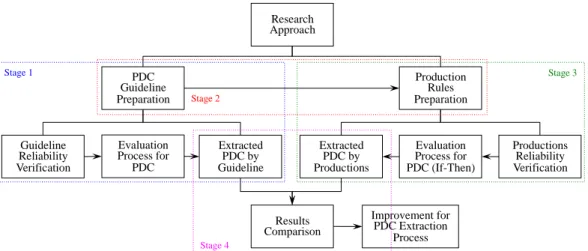
Figure 1: Research Approach

(8)

modify their attitudes or behaviors to achieve a predetermined goal or outcome.

3. Self-monitoring technologies work in real time, giving users ongoing data about their physical state (or inferences about their mental state, based on physical feedback), their location, or their progress on a task.

The goal is to eliminate the tedium of measuring and tracking performance or status. This makes it easier for people to know how well they are performing the target behavior, increasing the likelihood that they will continue to produce the behavior.

4. Providing means for users to track their behavior, performance or status. (Oinas- Kukkonen & Harjumaa, 2008&2009) 5. Mobile application can eliminate the tedium

of tracking performance or status and help users track their behavior, status, task schedule, or performance.

Example:

1. Heart rate monitors allow people to modify their exercise levels to achieve a target heart rate.

2. The Healthy Jump product tracks calories burned while jumping rope.

3. Parking applications allow users to follow the walking route on the map and use photos and notes to find out the parking car.

4. Car expenses monitoring apps allow users to note every fuel bill, toll, car loans, and etc.

5. Past behaviors / activities / measurements

presented on graphs; pie charts, timelines.

(Oinas-Kukkonen & Harjumaa, 2008 and 2009).

Reduction Definition:

1. Using computing technology to reduce complex behavior to simple tasks increases the benefit/cost ratio of the behavior and influences users to perform the behavior.

2. To make a complex task simpler.

3. To make target behaviors easier by reducing a complex activity to a few simple steps or ideally to a single step. Psychological and economic theories suggest that humans seek to minimize costs and maximize gains. The theory behind reduction technologies is that making a behavior easier to perform increases the benefit/cost ratio of the behavior. Increasing the perceived benefit/cost ratio increases a person’s motivation to engage in the behavior more frequently.

4. Reducing effort that users expend with regard to performing their target behavior.

(Oinas-Kukkonen & Harjumaa, 2008&2009) 5. Mobile application can increase user’s

perceived motivation and be more persuasive by making a behavior easier to perform or reducing complex behavior to simple tasks or a few simple steps.

Example:

1. Predefined habit library; mood improvement

tools; effortless goal setting. (Oinas-

(9)

Kukkonen & Harjumaa, 2008&2009) 2. Use diary tools to manage car daily expenses.

Use navigation map to locate a parking place or destination.

3. Reduce the complex of finding a parking place and easier to find out the parking price.

B. Stage-2: Production Rules Preparation Process

One of the most important issues in this study was to develop and identify the production rules (or productions) for each of twenty-eight PDC. Based on the updated evaluation guideline from the first research stage, three professional researchers from the first research stage were asked to analyze and develop the production rules for each of the PDC by introducing if-then model. For example, to describe the evaluation process for one of the PDC for medical or health and fitness apps, such as “self-monitoring”, the following rules need to be considered:

* Rule 1: if a system can supply the detected information about app user’s athletic status and performance, then self-monitoring feature can be identified.

* Rule 2: if a system can allow user to make it easier to know his or her behavior or performance and correct his or her performance to achieve the goal, then self-monitoring feature can be identified.

* Rule 3: If an app can count physical charts for users, then self-monitoring feature can be identified.

* Rule 4: If the user can write a log or note in the app which is about water intake, food health, sleep, running, heart rate, female physiology, body temperature, weight, exercise, or calories burned, then self-monitoring feature can be identified.

* Rule 5: If the user can view his or her sports or physical conditions in the app, then self-monitoring feature can be identified.

For each of twenty-eight PDC, all of the conditions need to be refined, concentrated, and summarized. Further verification process was also performed to identify the reliability of those production rules. Two professional researchers were asked to use the production rules to do the pilot test and the evaluation for ten apps.

C. Stage-3: PDC Evaluation Process by Production System

According to the developed production

system, the same three participants from stage

1 were asked to evaluate the top one hundred

apps from medical category and health and

fitness category. All of those participants

didn’t have any direct information or

knowledge about persuasive technology and

persuasive system design architecture. They

were asked to understand all of those

(10)

production rules first and then evaluate and identify the PDC from the apps. Based on the if-then production rules, the corresponding PDC can only be confirmed or identified if any of these conditions was met. Some conditions cannot implement the validation process separately. Some other conditions were required simultaneously to complete the validation process. All of the participants were asked to use and try out one hundred apps, which were downloaded and installed in three Apple iPad Pro (12.9 inch, 256GB, Wi-Fi with Cellular).

D. Stage-4: Comparative Analysis for the Improvement of PDC

Extraction Process

According to the evaluation results from stage one and stage three, the difference of PDC extraction results from two different ways can be recognized. By comparing the results of the two evaluation processes, it was possible to identify the feasibility of introducing production systems in cognitive psychology as an improvable alternative means for the PDC extraction process. If the evaluation result from the third research stage that all of the app’s PDC were evaluated by using the production system was found to be more precisely, reliably, and specifically, the production system could be accepted as an improvable and feasible way for the PDC extraction and

analysis process. Moreover, all of those production rules can be further developed and modified as a general principles that may be applicable to the judgment and analysis of the PDC of other mobile applications, thus providing a better reference and basis for improving the app design and user experience design. Especially, the results of this study can be used for the further development of ACT-R related research.

Ⅳ. Data Analysis and Result

A. Preparation of Production System in Stage-2

Total one hundred top popular apps from both medical category and health and fitness category were collected for further evaluation process. In research stage two, an “if-then”

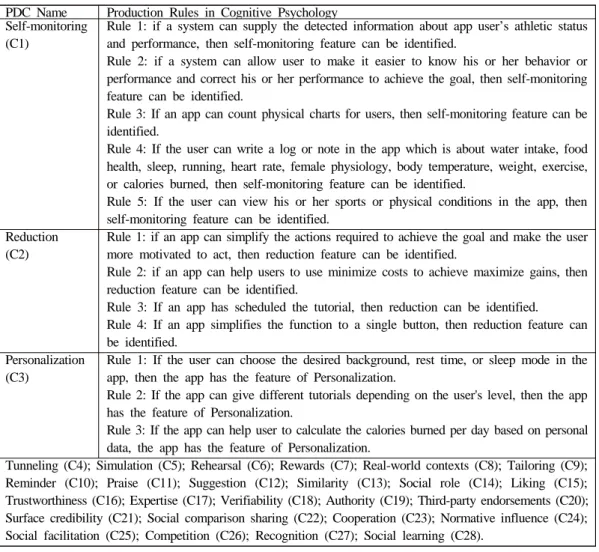
based production rules were developed. Table 2 only shows several samples of production rules.

B. Evaluation Results by Two Approaches in Stage 1 and 3

We evaluated the PDC for the top popular

one hundred healthcare-related apps by using

both production system approach (A1) and

guideline approach (A2). The first research

stage for guideline approach was started from

(11)

April 10, 2018 and ended on May 11, 2018.

The third research stage for production system approach was started from June 23, 2018 and ended on August 26, 2018. Total 97 valid data was collected. The results were listed in Table 3 as follows. For example, in the first research stage, by using guideline approach (A2), total 46 healthcare-related apps were identified to have the PDC of self-monitoring (C1).

However, in the third research stage, by using

production system approach (A1), total 53 healthcare-related apps were identified to have the PDC of self-monitoring (C1). The difference between both of two approaches are -7, which means comparing with guideline approach (A2), the number for PDC of self-monitoring extracted from total 97 valid apps by production system approach (A1) decreased seven apps.

Figure 2 shows the summary for PDC PDC Name Production Rules in Cognitive Psychology

Self-monitoring (C1)

Rule 1: if a system can supply the detected information about app user’s athletic status and performance, then self-monitoring feature can be identified.

Rule 2: if a system can allow user to make it easier to know his or her behavior or performance and correct his or her performance to achieve the goal, then self-monitoring feature can be identified.

Rule 3: If an app can count physical charts for users, then self-monitoring feature can be identified.

Rule 4: If the user can write a log or note in the app which is about water intake, food health, sleep, running, heart rate, female physiology, body temperature, weight, exercise, or calories burned, then self-monitoring feature can be identified.

Rule 5: If the user can view his or her sports or physical conditions in the app, then self-monitoring feature can be identified.

Reduction (C2)

Rule 1: if an app can simplify the actions required to achieve the goal and make the user more motivated to act, then reduction feature can be identified.

Rule 2: if an app can help users to use minimize costs to achieve maximize gains, then reduction feature can be identified.

Rule 3: If an app has scheduled the tutorial, then reduction can be identified.

Rule 4: If an app simplifies the function to a single button, then reduction feature can be identified.

Personalization (C3)

Rule 1: If the user can choose the desired background, rest time, or sleep mode in the app, then the app has the feature of Personalization.

Rule 2: If the app can give different tutorials depending on the user's level, then the app has the feature of Personalization.

Rule 3: If the app can help user to calculate the calories burned per day based on personal data, the app has the feature of Personalization.

Tunneling (C4); Simulation (C5); Rehearsal (C6); Rewards (C7); Real-world contexts (C8); Tailoring (C9);

Reminder (C10); Praise (C11); Suggestion (C12); Similarity (C13); Social role (C14); Liking (C15);

Trustworthiness (C16); Expertise (C17); Verifiability (C18); Authority (C19); Third-party endorsements (C20);

Surface credibility (C21); Social comparison sharing (C22); Cooperation (C23); Normative influence (C24);

Social facilitation (C25); Competition (C26); Recognition (C27); Social learning (C28).

Table 2: Production Rules for PDC of Healthcare Related Apps (sample)

(12)

PDC A1 A2 diff. PDC A1 A2 diff. PDC A1 A2 diff. PDC A1 A2 diff.

C1 46 53 -7 C8 55 52 3 C15 26 26 0 C22 45 42 3

C2 93 97 -4 C9 17 19 -2 C16 55 62 -7 C23 9 11 -2

C3 65 74 -9 C10 69 78 -9 C17 38 31 7 C24 19 17 2

C4 56 45 11 C11 15 13 2 C18 14 13 1 C25 17 18 -1

C5 30 28 2 C12 55 46 9 C19 0 3 -3 C26 15 12 3

C6 45 40 5 C13 0 0 0 C20 9 4 5 C27 16 13 3

C7 12 12 0 C14 10 4 6 C21 66 66 0 C28 13 8 5

Table 3: Summary for Evaluation Results by Two Approaches in Stage 1 and 3

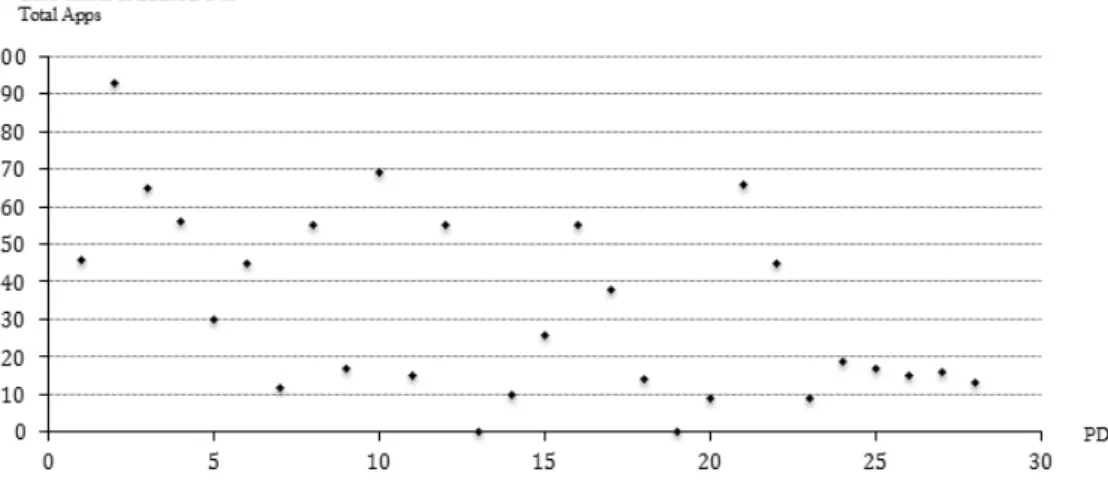
Figure 2: Summary for PDC Numbers in Each App for Total 97 Apps by Production System Approach

Figure 3: Summary for The Number of Each PDC in Total 97 Apps by Production System Approach

(13)

numbers in each app for total 97 apps by production system approach.

Figure 3 shows summary for the number of each PDC in total 97 apps by production system approach.

Ⅴ. Discussion

A. Discussion for the Improvement of PDC Extraction Process

According to the comparison results of two different approaches, table 6 showed three different types of results.

First, only Rewards (C7), Similarity (C13), Liking (C15), and Surface credibility (C21) have no change by applying two different approaches. Generally, the evaluation decision for Liking and Surface credibility came from participant’s personal subjective judgment.

Since the two evaluation processes were performed by the same participants, it was understandable if similar results occurred.

Reward was usually easier to be perceived and confirmed by the observer. The concept of Similarity refers to the system should imitate its users in some specific way because users are more readily persuaded through systems that remind them of themselves in some meaningful way. Therefore, for Reward and Similarity, the number of apps with PDC extracted by the two approaches was also

similar.

Second, all negative values indicate that the same three participants extracted PDC using production system approach less than that extracted by using guideline approach.

Especially for Self-monitoring (C1), Personalization (C3), Reminder (C10), and Trustworthiness (C16). All positive values indicate that the same three participants extracted PDC using production system approach more than that extracted by using guideline approach. Especially for Tunneling (C4), Suggestion (C12), Social role (C14), and Expertise (C17). After a more detailed analysis, we believe that almost all of the evaluations made by using guideline approach have been biased. From the guideline perspective, participants had to make their decision based on their short-term data memory from their personal understanding for the guideline descriptions of each PDC, and their personal long-term production memory.

However, from the production perspective, participants had to follow the if-then production rules to make a decision directly. If the condition exists, then the PDC can be identified. Therefore, production system can help participants to have an easier decision-making process. However, if the production rules were not specified or not defined well, the negative effectiveness may affect participant’s decision-making process.

To avoid such disadvantage, before proceeding

(14)

the evaluation process, the reliability verification process needed to be performed for both updated guideline and production systems.

In this study, the inter-rater reliability (Cohen Kappa=0.872) showed an almost perfect agreement between two professional researchers, which represented the reliability of the verification process for production rules.

Moreover, the inter-rater reliability (Fleiss’

Kappa=0.791) showed a substantial agreement between four professional researchers, which represented the reliability of the verification process for updated guideline for healthcare-related apps.

B. Discussion for PDC of Health and Fitness Applications

Based on Table 6, Figure 2, and Figure 3, it can be concluded that only 16.5% of healthcare-related apps have less than five PDC. More than 47.4% of healthcare-related apps have no less than ten PDC. Comparing with the prior studies about PDC in car-related mobile applications, app developers considered more human-computer interaction design and tried to apply more persuasive technology in the design process of healthcare related mobile applications (Zhang et al., 2016). Furthermore, some PDC have been well used in most of the healthcare related apps, such as Reduction (C2, 93 apps), Personalization (C3, 65 apps), Reminder (C10, 69 apps), Surface Credibility

(C21, 66 apps), etc. By using the production system in cognitive psychology, participants can easily identify the PDC from the evaluation and decision making process.

Especially for some characteristics, such as tunneling, normally it was very hard for researchers to identify this PDC and describe or explain the extraction process for it.

However, based on the production rules of Tunneling, participants can easily identify the related information and functions therefore complete the decision making process. By comparing the extracted results in Table 6, the same participants can identify eleven more apps that have Tunneling feature by applying production system approach. From such perspective, adopting production system for PDC evaluation and extraction will improve the ease-of-use and precision.

Ⅵ. Conclusion and Future Research

The purpose of this study focused on

adopting production system in cognitive

psychology to improve the extraction process

of persuasive design characteristics for

healthcare-related applications. By performing

a research approach with four research stages,

a PDC evaluation guideline for

healthcare-related apps was updated based on

prior studies and it was verified by applying

(15)

inter-rater reliability. Moreover, a production system in cognitive psychology for evaluating and extracting the PDC of healthcare related apps was also developed and verified. By comparing the extraction results, evidence showed that the production system in cognitive psychology could obviously improve the efficiency and decision making process as well as improving the precision of PDC evaluation process.

This study attempts to make several contributions to research and practice in the field of human-computer interaction design and persuasive user experience design. Especially, we tried to make a better evaluation process for app’s PDC design by introducing the production rules in cognitive psychology. The conclusion of this paper can help both researchers and app developers to follow appropriate PDC production rules to design more effective and more persuasive apps. It will be more accurate and easier for researchers to use the production rules and the following ACT-R model to identify and evaluate the PDC of relevant apps. Moreover, based on those production rules for each of 28 PDC, researchers can analyze, modify, update, or even redefine those persuasive design principles to have better persuasion. Some of those PDC have long-term persuasive effectiveness that brings the related apps longer useful live. By adopting production rules in cognitive psychology, researchers can make a

more precise evaluation. For app developers, all of the PDC production rules can be used as design criteria. The app developing process for a persuasive app with several PDC should follow the production rules, which may help app developers to understand the core access of each PDC. It is possible for app developers to make a persuasive user experience design by following the production rules for each PDC.

Further improvement is needed in the near future by applying ACT-R for the preparation process and the verification process. In our future research, we are going to develop and improve the production rules in order to discover a better way to apply the production systems to the evaluation process for mobile applications in different categories.

Reference

1. Anderson, J. R., and Reder, L. M., “The fan effect: New results and new theories. Journal of Experimental Psychology”, General, 128, 1999, pp. 186-197.

2. Anderson, J. R., and Matessa, M. P., “A production system theory of serial memory”, Psychological Review, Vol. 104, 1997, pp.

728-748.

3. Anderson, J. R., Bothell, D., Lebiere, C., and

Matessa, M., “An integrated theory of list

memory”, Journal of Memory and Language,

Vol. 38, 1998, pp. 341-380.

(16)

4. Busch, M., Schrammel, J., and Tscheligi, M.,

“Personalized Persuasive Technology – Development and Validation of Scales for Measuring Persuadability”, in PERSUASIVE 2013 (Sydney, Australia, 2013), Springer-Verlag Berlin Heidelberg, 2013, pp.

33-38.

5. Fogg, B. J., “Persuasive Computers:

Perspectives and Research Directions”, in Proceedings of the CHI 98 Conference on Human Factors in Computing Systems (Los Angeles, CA, USA, 1998), ACM Press/

Addison-Wesley Publishing Co, 1998, pp.

225-232.

6. Fogg, B. J., “Persuasive Technology: Using Computers to Change What We Think and Do”, San Francisco: Morgan Kaufmann Publishers, 2003.

7. Fogg, B., and Hreha, J., “Behavior wizard:

a method for matching target behaviors with solutions”, In PERSUASIVE 2010 (Copenhagen, Denmark, 2010), Springer- Verlag Berlin Heidelberg, 2010, pp. 117–

131.

8. Harjumaa, M., Segerståhl, K., and Oinas- Kukkonen, H., “Understanding persuasive software functionality in practice: a field trial of polar FT60”, in PERSUASIVE 2009 (Claremont, CA, USA, 2009); Article No. 2, 2009.

9. Lehto, T., and Oinas-Kukkonen, H.,

“Explaining and predicting perceived effectiveness and use continuance intention

of a behavior change support system for weight loss”, Behavior & Information Technology, Vol. 34(2), 2015, pp. 176-189.

10. Lockton, D., Harrison, D., and Stanton, N.,

“Design with intent: Persuasive technology in a wider context”, in Proceedings of the 3rd International Conference on Persuasive Technology (Oulu, Finland, 2008).

Persuasive ‘08. Springer-Verlag, Berlin, Heidelberg. Lecture Notes in Computer Science, vol. 5033, 2008, pp. 274-278.

11. Marks, J. T., Compbell, M. K., Ward, D.

S., Ribisl, K. M., Wildemuth, B. M., and Symons, M. J., “A comparison of web and print media for physical activity promotion among adolescent girls”, Journal of Adolescent Health, Vol. 39, 2006, pp.

96-104.

12. Newell, A., “Unified Theories of Cognition”, Cambridge, Massachusetts:

Harvard University Press. ISBN 0-674- 92101-1, 1996.

13. Oinas-Kukkonen, H. and Harjumaa, M.,

“Persuasive systems design: Key issues, process model, and system features”, Communications of the Association for Information Systems, Vol. 24(28), 2009, pp. 485-500.

14. Oinas-Kukkonen, H., & Harjumaa, M.,

“Towards deeper understanding of

persuasion in software and information

systems”, in Proceedings of the First

International Conference on Advances in

(17)

Human–Computer Interaction (ACHI, 2008), 2008, pp. 200-205.

15. Oinas-Kukkonen, H., “A foundation for the study of behavior change support systems”, Personal and Ubiquitous Computing, Vol.

17(6), 2013, pp. 1223-1235.

16. Segerstahl, K. and Oinas-Kukkonen, H,

“Distributed user experience in persuasive technology environments”, in PERSUASIVE 2007 (Palo Alto, CA, USA, 2007), New York: Springer berlin Heidelberg, 2007, pp. 80-91.

17. Zhang C., “Car Application’s Persuasive Effectiveness: From A Behavior Change Perspective” (Doctoral dissertation), Retrieved from Korea University, 2015.

18. Zhang C., Wan, L., and Min, D., “Car App's Persuasive Design Principles and Behavior Change”, Proceedings of the International Conference on Internet Technologies and Society 2016, ITS 2016 Melbourne, Australia, Dec 2016b, pp.

73-82.

19. Zhang C., Wan, L., and Min, D.,

“Persuasive Design Principles of Car Apps”, Proceedings of Business Information Systems, 19TH International Conference in BIS 2016, Leipzig, Germany, July 2016a, pp. 397-410.

Zhang, Chao

Chao Zhang is a professor of College of Business at Hankuk University of Foreign Studies. He received his Ph.D.

in E-Commerce System from Korea University (KU) in 2016. His current research interests include Human- Computer Interaction (HCI), behavioral psychology, individual information cognitive processing, data mining, in-car application design, and eye movement in system design.

Wan, Lili

Lili Wan is a professor of

College of Business at

Hankuk University of Foreign

Studies. She received her

Ph.D. in E-Business from

Korea University (KU) in

2012. Her current research

interests include Human-

Computer Interaction (HCI),

behavioral psychology,

Experience Design, data

mining, persuasive

technology, and wearable

system design.

(18)

<Abstract>

Adopting Production System in Cognitive Psychology to Improve the Extraction Process of Persuasive Design

Characteristics for Healthcare-related Applications

Zhang, Chao․Wan, Lili

Purpose

The purpose of this study focused on adopting production systems in cognitive psychology to improve the extraction process of persuasive design characteristics for healthcare-related mobile applications.

Design/Methodology/Approach

A research approach with four stages was developed. We developed and updated the evaluation guideline for persuasive design characteristics (PDC). We tried to summarize and analyze each of 28 PDC and prepared related production rules. Verification process for both guideline approach and production system approach were performed. Top one hundred apps from both medical category and health and Fitness category were selected and evaluated by two approaches. By comparing the results of the two approaches, we tried to explain the improvement and reliability of introducing the production system in the PDC extraction process.

Findings

Based on the updated guideline for healthcare-related mobile applications, a production system in cognitive psychology was developed. By comparing the PDC extraction results by two approaches, production system showed a better improvement for evaluation precision and efficiency for decision-making process. The findings of this study can be used for researchers and app developers to apply production system to analyze, evaluate, and develop better healthcare-related apps with persuasion.

Keyword: production systems in cognitive psychology, persuasive design characteristics,

* 이 논문은 2018년 9월 10일 접수, 2018년 9월 26일 게재 확정되었습니다.

수치

Figure  1:  Research  Approach
Figure 2 shows the summary for PDC PDC NameProduction Rules in Cognitive Psychology
Figure  3:  Summary  for  The  Number  of  Each  PDC  in  Total  97  Apps  by  Production  System  Approach

참조

관련 문서