• 검색 결과가 없습니다.

Enhancing the Creative Problem Solving Skill by Using the CPS Learning Model for Seventh Grade Students with Different Prior Knowledge Levels

N/A
N/A
Protected

Academic year: 2021

Share "Enhancing the Creative Problem Solving Skill by Using the CPS Learning Model for Seventh Grade Students with Different Prior Knowledge Levels"

Copied!
12
0
0

로드 중.... (전체 텍스트 보기)

전체 글

(1)

Enhancing the Creative Problem Solving Skill by Using the CPS Learning Model for Seventh Grade Students with Different Prior

Knowledge Levels

Kanyarat Cojorn*∙Numphon Koocharoenpisal∙Sunee Haemaprasith Pramuan Siripankaew

1

Abstract: This study aimed to enhance creative problem solving skill by using the Creative Problem Solving (CPS) learning model which was developed based on creative problem solving approach and five essential features of inquiry. The key strategy of the CPS learning model is using real life problem situations to provide students opportunities to practice creative problem solving skill through 5 learning steps: engaging, problem exploring, solutions creating, plan executing, and concepts examining. The science content used for examining the CPS learning model was “matter and properties of matter” that consists of 3 learning units: Matter, Solution, and Acid-Base Solution.

The process to assess the effectiveness of the learning model used the experimental design of the Pretest-Posttest Control-Group Design. Seventh grade-students in the experimental group learned by the CPS learning model. At the same time, students at the same grade level in the control group learned by conventional learning model. The learning models and students' prior knowledge levels were served as the independent variables. The creative problem solving skill was classified in to 4 aspects in: fluency, flexibility, originality, and reasoning. The results indicated that in all aspects, the students' mean scores of creative problem solving between students in experimental group and control group were significantly different at the .05 level. Also, the progression of students' creative problem solving skills was found highly progressed at the later instructional periods. When comparing the creative problem solving scores between groups of students with different levels of prior knowledge, the differences of their creative problem solving scores were founded at .05 level. The findings of this study confirmed that the CPS learning model is effective in enhancing the students' creative problem solving skill.

Key words: Creative Problem Solving (CPS) Learning Model, Five essential features of inquiry, Creative Problem Solving Skill

Srinakharinwirot University, Thailand∙

1
Institute for the Promotion of Teaching Science and Technology (IPST), Thailand

INTRODUCTION

Many factors could contribute to student's thinking, and learning achievement. Schwab (1966) argued that the deepened understandings in knowledge of learners will occur when it is students' own idea. National Research Council (2000) indicated that students' deepen conception understanding in science could promote by emphasizing questions, evidence, and explanations within a learning context. Several studies (Hammett, 2005, Dobbs, 2008) report that

students' deepen understanding of science concepts was promoted by using inquiry consisting of 1) learners are engaged by scientifically oriented questions, (2) learners give priority to evidence, (3) learners formulate explanations from evidence to address scientifically oriented questions, (4) learners evaluate their explanations in light of alternative explanations, and (5) learners communicate and justify their proposed explanations, in learning science.

Problem solving is a thinking skill that

*Corresponding author: Kanyarat Cojorn ([email protected])

**Received on 31 July 2012, Accepted on 23 September 2012

(2)

involves thinking processes, logical and sequential because it reflects the result of application of knowledge, and procedures to a problem situation (Ashmore, Frazer, & Casey, 1979). In other words, a good problem solver requires deepen concepts understanding and skills to apply knowledge solving the problems.

Greenwald (1982) stated that the suitable manner to solve problems in everyday life should come up with the process of right and left brain work together. A successful problem solver should learn to use both their creative and critical thinking abilities in harmony. The creative problem solving approach is one of several attempts to support creative and problem solving thinking work together. Creative and critical thinking are two complementary, mutually important ways of creative problem solving process (Treffinger, 2005). Therefore, the creative problem solving approach should be adopted as an instructional strategy to assist students in their thinking development, especially creative and problem solving thinking.

Many researches showed that creative problem solving approach is the suitable approach for adaptation into science instructional strategies to enhance thinking skills especially problem solving skill and creative thinking skill (Ditlhake, 2001, Susan, 2004, Wood, 2006, Cheng & et. al, 2007 Hamza, & Griffith, 2010).

As aforementioned, the researcher attempts to improve the science teaching and learning for enhancing the students' learning achievement and thinking. In this study, new science learning model using creative problem solving approach and the five essential features of the classroom inquiry was developed for enhancing the students' creative problem solving skill. This model is called, for convenience, the CPS learning model. It was designed to support the national science standards of Thailand for seventh grade students. The contents of this study are focused on matter and properties of matter. The CPS learning model emphasized on practicing students to think, analyse data, and

apply knowledge and learning skills into their real life. In other words, this invention concerning practices students creative thinking skills and problem solving skill emphasizing creative problem solving skill as well as developed deep understand in scientific concept.

METHODOLOGY

Research Purposes

This research is a part of research on a development the Creative Problem Solving (CPS) learning model on matter and properties of matter for seventh grade students. The purposes of this research were:

1. To develop the CPS learning model for seventh grade Thai students concerning matter and properties of matter

2. To study the effects of the CPS learning model on students' creative problem solving skill.

Research Design

The research design of this study was pretest- posttest control-group design, which the experimental group learned with the CPS learning model and the control group did not receive the treatment while they studied in the classroom.

Participants

This study consisted of 2 phases: (1) developing phase and (2) confirmatory phase

Developing Phase: the participants in this phase were two science teachers and two classrooms of seventh grade students participated in the step of developing the CPS learning model. Moreover, a classroom of seventh grade students participated in a step of pilot study.

Confirmatory Phase: the participants in this

phase consisted of two classrooms of seventh

grade students. One classroom was the control

(3)

group (48 students) and another one was the experimental group (46 students).

Variables

1. Independent Variables were (1) science learning models that categorized into two models: the CPS learning model and the conventional learning model and (2) students' prior knowledge levels that categorized in to 3 levels: high, medium, and low level.

2. Dependent Variables consisted of creative problem solving skill that considering in 4 aspects: fluency, flexibility, originality, and reasoning.

Research Instruments

1. There are 15 lesson plans based on the CPS learning model were developed by the researcher.

The content consisted of 3 units: Matter, Solution, and Acid-Base.

2. Creative Problem Solving Test was adapted from A Scientific Creativity Structure Model (SCSM) (Hu & Adey, 2002). This test consisted of the 5 items in written open-ended format which allow the students express their own ideas in writing the answer like shown in APPENDIX A.

The difficulty (p) and item discrimination (r) of items were between 0.20-0.80 and the internal consistency reliability of the test was 0.69.

3. Creative Problem Solving Self Assessment Form was developed by the researcher. This instrument consisted of 30 items of three- response Likert Scale and the internal consistency reliability of the test was 0.76. The example of this assessment form was shown in APPENDIX B.

4. Achievement Test was developed by the researcher. This instrument consisted of two sections: 25 multiple-choice questions, each of which has four alternatives and one correct answer and 5 opened questions. The example of this assessment form was shown in APPENDIX C.The difficulty (p) and item discrimination (r) of

items were between 0.20-0.80 and the internal consistency reliability of multiple choices and open-ended question was 0.79 and 0.94, respectively.

Procedures

The process of this study consists of 2 phases as a following:

Developing Phase: the purpose of this phase is studying the basic data and developing the CPS learning model, learning units, research tools, and instructional materials. The basic data was gathered not only from the literature review but also the science teachers' interview. The science teachers who were teaching in topic of matter and properties of matter were interviewed in the point of problems and needs for science instruction in term of 1) the content of science 2) the instruction/pedagogy 3) the instructional materials 4) the timing and 5) other comments and suggestions. The CPS learning model and other research instruments were developed and conducted a field trial with two classrooms of the seventh grade students to improve all instruments to be more suitable. All of research instruments were examined the efficiency by experts' panel. A pilot study was conducted with the seventh grade usual classroom for testing the feasibility of all instruments. The information was useful in improving the learning model.

Confirmatory Phase: this stage aims to

collecting evidences regards to how the CPS

learning model and instruction affects student

learning outcome. The data from this phase will

be used to confirm the effectiveness of the CPS

learning model. In this phase the 15 lesson plans

based CPS learning model were implemented

with the seventh grade students in the

experimental group while control group was

taught by the conventional learning model. In

the data collection, students in both groups took

a pretest and posttest of creative problem

solving test. The researcher asked the students

(4)

in the experimental group to do the achievement test before implementation. The students' achievement scores were used to classify the group of prior knowledge levels. Moreover, the students in the experimental group were asked to do the creative problem solving self assessment form 5 times: 1 time before implementing, 3 times during implementing by took the test in every two weeks, and 1 time after implementing.

In the analysis, the mean, standard deviation and the Analysis of Covariance (ANCOVA) were selected to analyze the difference between the experimental group and control group. The Moreover, the non-parametric tests were analyzed the data among each level of prior knowledge.

RESULTS

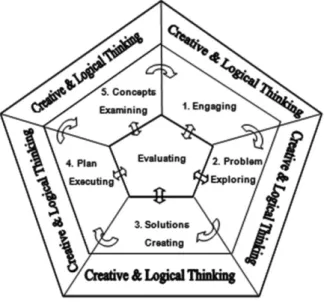
According to the developing phase revealed the effective CPS learning model that comprised of 5 steps: Engaging, Problem Exploring, Solutions Creating, Plan Executing, and Inspecting and Concepts Examining (Figure 1), which including Evaluating in every step.

Step I: Engaging: this is a phase for engaging students meanwhile exploring and revising the

basic concept of the students.

Step II: Problem Exploring: this step point out making the students aware in the problem and endeavoring to grasp the problem including identify the scope of the problem.

Step III: Solutions Creating: the activities served in this phase emphasize practicing the students' creative problem solving skill by developing the alternative solutions. The students have to ask themselves and search more knowledge from other resources for creating ideas and developing the solutions to solve the problem.

Step IV: Plan Executing: the students have to brainstorming in a small group in order to design the way to solve the problem and do the activities followed the plan until reaching to the answer of the problem. Finally, they should develop the concept or explanation that they have discovered from the activities.

Step V: Concepts Examining: the activities supports to inspect their concepts and adjust the concept harmonizing with the scientific knowledge including making the students getting deeper understand.

Regarding the confirmatory phase, the results showed that the CPS learning model had a

Fig. 1 The CPS learning Model

(5)

potential to enhance the students' creative problem solving skill. The mean scores of each aspect of creative problem solving were used to test the significance of the difference of gained scores, the results of which are shown in Table 1.

The results showed that the mean scores of students' creative problem solving in every aspect were significantly different at the .05 level. Moreover, the effect size (Eta Square) was in the medium level. Considering the mean scores in each aspect of creative problem solving skill of the students who had learned with the CPS learning model were significantly higher

than that of the students who had learned with the conventional learning model. These results indicated that the CPS learning model had intensely effect on all aspect of creative problem solving skill.

Additionally, the creative problem solving self assessment form was evaluated 5 times in the experimental group for finding the students' progressive in creative problem solving skill.

The mean scores of the students' creative problem solving self assessment were presented as mean ( Χ ~ ) and standard deviation (S.D.) in Table 2.

Table 1

Comparison of the posttest scores of students' creative problem solving skill between the experimental group and control group

Test Aspects N df

Χ

S.D. F p Eta Square

Creative problem solving

test

Overall

- Experimental group

- Control group 46

48

1 37.74 23.73 8.83

8.93 62.12* .000 0.406 Fluency

- Experimental group

- Control group 46

48 1 10.70

7.81 2.17 2.36

41.04* .000 0.311 Flexibility

- Experimental group

- Control group 46

48

1 9.57

8.08 2.04

2.20 18.39* .000 0.618 Originality

- Experimental group

- Control group 46

48

1 7.93

4.12 3.96

3.47 23.00* .000 0.352 Reasoning

- Experimental group - Control group

* p < 0.05

46 48

1 9.54

3.71 2.25

2.70 127.71* .000 0.584

Table 2

The descriptive statistics for the creative problem solving self assessment form

Timing Period N S.D.

Before implementing 46 63.17 3.60

During implementing

- The first time (D1) 46 63.59 4.69

- The second time(D2) 46 64.22 4.27

- The third time(D3) 46 65.48 3.85

After implementing 46 70.57 3.98

(6)

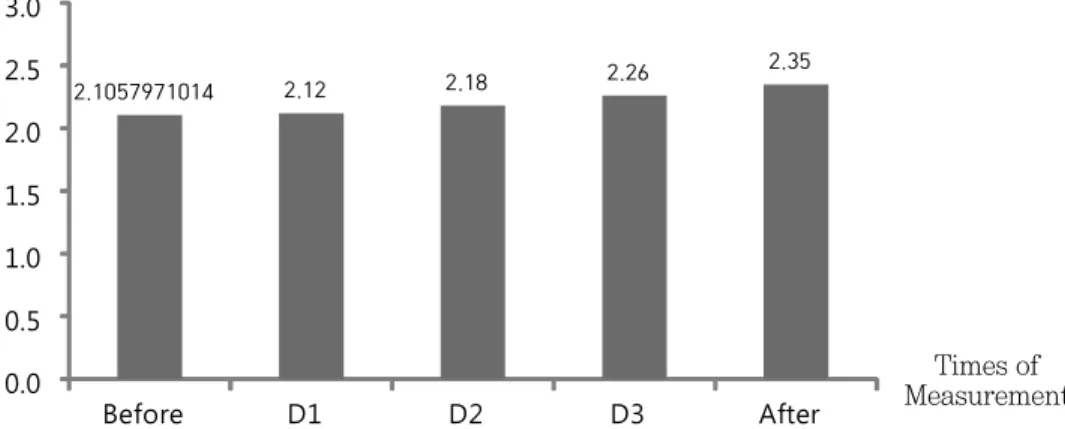
Regarding the mean scores and standard deviation of the creative problem solving self assessment found that the mean scores of before implementing, the first during implementing(D1), the second during implementing(D2), the third during implementing(D3), and after implementing(A) were 63.17, 63.59, 64.22, 65.48 and 70.57 respectively. The Figure 2 showed the different mean scores in each times of evaluation of creative problem solving self assessment form.

The mean score plot of creative problem solving self assessment showed that in the beginning of measurement the students' mean scores was slightly increasing while in the later of measurement the students' mean scores was considerably increasing.

The scores of the students' creative problem solving skill in each level of prior knowledge of

the students who learned with the CPS learning model were presented as mean ( Χ ~ ), standard deviation (S.D.), and tested by non-parametric Kruskal Wallis in Table 3.

The result indicated that the students mean scores in the group of high prior knowledge level, medium prior knowledge level, and low prior knowledge level were 44.00, 38.55 and 37.00 respectively. Moreover, it showed that the mean scores among the groups of prior knowledge levels were significantly different at the 0.05 level

The non-parametric Mann-Whitney test was used to determine the significant difference of the mean scores between each group. The data analysis was shown in Table 4.

According to the result, it showed that there were 2 pairs of significant differences at the .05

Fig. 2 The mean scores plot of the creative problem solving self assessment form in each time of measurement

Times of Measurement

Table 3

The descriptive statistics of creative problem solving scores of the students who have different prior knowledge level in the experimental group

Prior knowledge levels N

Χ

S.D. χ

2

p

Overall High

46 10

39.20 44.00

4.69 4.24

12.922* .002

Medium 20 38.55 4.32

Low 16 37.00 3.27

* p < .05

(7)

level: (1) high prior knowledge level and medium prior knowledge level, and (2) high prior knowledge level and low prior knowledge level.

CONCLUSIONS AND DISCUSSIONS

Considering creative problem solving skill, the mean scores in overall and all aspects of creative problem solving skill of the students who had learned with the CPS learning model were significantly higher than the students who had learned with the conventional learning model.

The activities based the CPS learning models emphasize providing the students opportunity working with their co-operative friends and proceed belong with the safe environment and friendly atmosphere that allows the students a freedom to think and share by deferring judgment as freedom of expression during the divergent or idea generation stages of CPS process. Therefore, the students have more comfortable with expressing unusual responses.

It is imperative that students can express themselves without fear of ridicule. Consequently, all students who had learned with the CPS learning model have significantly increased scores of creative problem solving skill. As a result, the CPS learning model can completely enhance the creative problem solving skill. This result agreed with the previous study indicating that the creative problem solving approach is the powerful approach for adaptation into science instructional strategies to enhance thinking skills especially creative problem solving skill (Sanfilippo, 1992, Abstract, Ditlhake, 2001.Kim, 2007, Abstract, Cheng, et al., 2007, p.569-591).

Furthermore, the result of analysis the creative problem solving self assessment form showed that in the beginning of measurement the students' mean scores was slightly increasing while in the later of measurement the students' mean scores was noticeably increasing. That may be because in the earliest period of implementing the CPS learning model that be regarded as the new learning model which the students do not familiar with the CPS learning model. The students remain familiar with the conventional learning model as results they still have shyness and also lack of courage to do the scientific activities. This statement was supported by Nittaya (2003), she claimed that in the first phase of using any learning processes, the students may have less experience, so they need more time to become familiar with the learning procedure, or to do more practice.

However, this result indicated that the students had a progression in creative problem solving skill although assessing with themselves. This finding can assure that the CPS learning model is an effective learning model.

Focusing on creativity, many previous studies indicating that creativity is the result of many types of mental processes working together. One must have enough knowledge of a field if hopes to produce something novel or originality (Mednick,1962, p.220-232, Weisberg,1999, p.226-250). Particularly, the person who has broad knowledge may have more potential in creative problem solving (Tang, 1986). This indicated that the creative problem solving skill can improve in every person with the different potential based on their cognitive knowledge Table 4

The comparison of the students' creative problem solving scores of each group of the prior knowledge levels

Pairs Z U p

High - Medium High -Low

-2.800 -3.459

36.500*

14.500*

.005 .001

Medium - Low -1.054 127.000 .292

* p < .05

(8)

background (Isaksen, Dorval, & Treffinger, 2000). Considering the result of this study, the students in the group of high prior knowledge level have a significantly higher score than the students in the group of medium prior knowledge and low prior knowledge. Whereas, the group of medium prior knowledge level and low prior knowledge level was not significantly difference in creative problem solving skill. This results support the aforementioned and the study of Hyung (2008) indicated that the creativity skill has a relationship with the person's intelligence quotient.

Additionally, the findings revealed that the CPS learning model was effective and could be used in the classroom that mixing with different prior knowledge levels. These outcomes will be used as basic knowledge for educators and science teachers to guide their thinking in developing teaching strategies or adapting to a conventional learning model. Moreover, the CPS learning model will be an alternative teaching methodology for science teachers to help students gain deepened knowledge, develop creative problem solving skill, that will prepare them with readiness to confront the social change and get higher quality of life in community as a whole.

RECOMMENDATIONS

1. Recommendations for teachers

1.1 The CPS learning model can be used for other science contents or topics and other levels such as physics, biology, astronomy, other chemistry, etc. This model can improve the students' learning outcomes such as learning achievement, creative problem solving skill, scientific creativity skill, and scientific attitudes.

In addition, this learning model focus on implementing the learning process belongs with the friendly atmosphere that makes the students happy and enjoys learning. However, the teachers should consider contents, situations and

learning objectives to be suitable to those topics or subjects.

1.2 Science teachers should study the CPS learning model documents first such as the lesson plans and the instructional materials in order to make instruction more effective.

Moreover, the teacher should prepare learning instruments and instructional materials supported the learning activities including make understanding in the activity and content before go to the classroom. Also, the teacher has to flexible timing fit with the activity in each step of CPS learning model.

2. Recommendations for further studies

2.1 Further studies should be also aimed to investigate learning achievement, scientific creativity and creative problem solving skill of students in group which includes the same level of prior knowledge level.

2.2 Further studies should integrate other subjects such as mathematics, physics, biology, social, etc into the problem situation in the activity. Because of the students should see the connection among the areas and integrate them to solve the problem. Due to the problem in the real life is more complex, so the good problem solver should integrate knowledge from many subjects to find the best solution of the problem.

ACKNOWLEDGEMENT

This research was financially supported by Graduate school of Srinakharinwirot University and the Institute for the Promotion of Teaching Science and Technology (IPST).

BIBLIOGRAPHY

Ashmore, A.D., Frazer, M.J., & Casey, R.J.

(1979). Problem-Solving and Problem-Solving Networks in Chemistry, Journal of chemical education, 55(6), 377-379.

Cheng, Y., Liu, K., & Chang, C. (2007). The

(9)

Effect of Creative Problem Solving Instruction on Elementary Schools Science Lessons, Chinese Journal of Science Education, 15(5), 569-591.

Ditlhake, B.M. (2001).The Facilitation of Creative Problem Solving Skills for Learners in Future Education and Training. Master of Education, Graduate School, University of Pretoria.

Dobbs, V.(2008). Comparing Student Achievement in the Problem-Based Learning Classroom and Traditional Teaching Methods Classroom. Doctor in Education, College of Education, Graduate School, Walden University.

Greenwald, N. L. (1982). Beyond Purely Divergent Thinking: Another Facet of Creativity.

From http://proquest.umi.com.

Hammett, K.(2005). Student-Centered Teaching in the Chemistry Classroom. Master of Science, Graduate School, Oklahoma State University.

Hamza, M. K., & Griffith, K. G. (2010).

Fostering Problem Solving & Creative Thinking in the Classroom: Cultivating a Creative Mind, National Forum of Applied Educational Research Journal-Electronic. 19(3), 1-30.

Hu, W., & Adey, P. (2002). A Scientific Creativity Test for Secondary School Students, International Journal of Science Education, 24(4), 390-403.

Hyung, H. K. (2008). Meta-Analyses of the Relationship of Creative Achievement to Both IQ and Divergent Thinking Test, Journal of Creative Behavior, 42(2), 106-130.

Isaken, S.G., Dorval, K.B., & Treffinger, D.J.

(2000). Creative Approach to Problem Solving.

Dubuque, IA: Kendall/Hunt.

Mednick, S. A. (1962). The Associative Basis

of the Creative Process, Psychological Review, 69(9), 220-232.

National Research Council. (2000). Inquiry and the National Science Education Standards: A Guide for Teaching and Learning. Washington, D.C.: National Academy Press.

Nitaya, K. (2003). The Development of Science Learning Process in Prathom 6 by Work Sheet. Retrieved May, 2 2011, from http://www.

thaiedresearch.org

Sanfilippo, Joseph A. (1992). An Assessment:

Models of Teaching and Creative-Problem Solving Style. Doctor in Education, College of Education, Graduate School, West Virginia University.

Schwab, J. (1996). The Teaching of Science.

Cambridge, MA: Harvard University Press.

Susan, F. (2004). Overview of Education in Creativity and Problem-Solving in Four-Year Colleges and Universities. Academy for Entrepreneurial Leadership: University of Illinois at Urbana-Champaign.

Tang, P. C. (1986). On Creativity and the Structure of Science, The Creativity and Science, 2(7): 167-173.

Treffinger, D.J., & Isaksen, S.G. (2005).

Creative problem solving: History, Development, Implication for gifted education and talent development. Journal of Creative learning, 49(4), 342-353.

Weisberg, R. W. (1999). Creativity and Knowledge: A Challenge to Theories. New York, NY: Cambridge University Press.

Wood, Colin. (2006). The development of creative problem solving in chemistry.

Chemistry Education Research and Practice.

7(2):96-113.

(10)

APPENDIX A:

Example of the Creative Problem Solving Test

IItte em m11:

………

………

………

………

Please design a packaging system for ice cream what will prevent it from getting soft or melting

and dripping all over you for at least a 30-minute trip from store to your house in typical hot

summer. Make a prototype of your solution and test it in the room temperature.

(11)

Items

APPENDIX B:

Example of Creative Problem Solving Self Assessment Form

Often Sometime Rarely

1. I prefer to work with people whose ideas are practical and down-to- earth rather than creative.

2. When faced with a familiar problem, I use the same solutions that have worked in the past.

3. After I’ ve made a decision, I find myself wishing I had chosen differently.

4. When dealing with a new project, I prefer having the freedom to do it my own way rather than be given specific instructions.

5. I believe that the old ways of doing things are the best ways.

6. I think problem-solving is a very serious matter - there’ s no room for humor or fun.

7. I enjoy trying to find a new things.

(12)

APPENDIX C:

Example of Achievement Test

1. Which of the following is NOT an example of matter?

a. Air b. Smoke

c. Heat d. Water vapor

2. What happens to the molecules of water when the water freezes?

a. Molecules of water become cold and hard.

b. Water molecules change into ice molecules.

c. Molecules of water slow down and fit together in a pattern.

d. Molecules of water get smaller.

3. What do you think whether there are the differences of pH values of the tap water in each house?

What are the differences of tap water in each house? If there are, please describe the reason of the differences and design the method to test your reasons.

………

………

………

………

수치

Fig. 1  The CPS learning Model
Fig. 2  The mean scores plot of the creative problem solving self assessment form  in each time of measurement

참조

관련 문서