Vol.14, No.2, pp.50-56 (2020)
Prediction of the Major Factors for the Analysis of the Erosion Effect on Atomic Oxygen in LEO Satellite Using a Machine Learning Method (LSTM)
You Gwang Kim
1,†, Eung Sik Park
1, Byung Chun Kim
2, Suk Hoon Lee
2and Seo Hyun Lee
31
Korea Aerospace Research Institute
2
National Institute for Mathematical Sciences
3
Insight Mining
Abstract
In this study, we investigated whether long short-term memory (LSTM) can be used in the future to predict F10.7 index data; the F10.7 index is a space environment factor affecting atomic oxygen erosion. Based on this, we compared the prediction performances of LSTM, the Autoregressive integrated moving average (ARIMA) model (which is a traditional statistical prediction model), and the similar pattern searching method used for long-term prediction. The LSTM model yielded superior results compared to the other techniques in the prediction period starting from the max/min points, but presented inferior results in the prediction period including the inflection points. It was found that efficient learning was not achieved, owing to the lack of currently available learning data in the prediction period including the maximum points. To overcome this, we proposed a method to increase the size of the learning samples using the sunspot data and to upgrade the LSTM model.
Key Words : Machine Learning, LSTM, ARIMA, Atomic Oxygen, Erosion, Factor Forecasting, Statistical Method, LEO
XXUUGGppGG
Recently, convergence research on technologies utilizing artificial intelligence (AI) and big data in various fields has drawn significant attention. In relation to this trend of convergence research, there has been an increasing interest in the optimized design of low-Earth-orbit (LEO) satellites.
Moreover, there was a recent report of a study using statistical techniques to predict the atomic oxygen erosion in satellite coating materials considering the effects of the space environment under the worst-scenario condition [1]. In this study, among the major factors related to the space environment affecting the erosion of the coating materials of LEO satellites by atomic oxygen, the index data of F10.7, which is a solar radio flux, were predicted. This was conducted by applying mathematical and statistical techniques used for big data analysis and machine learning. Based on the results, we aim to present a methodology that can be useful for determining the coating material thickness in satellite design in the future.
An LEO satellite is designed to perform its mission even when exposed to an unfavorable space environment, which is very different from the ground condition. Among the design
considerations, the erosion of polymer materials by the atomic oxygen species distributed in the low orbits of the Earth is a phenomenon not observed on the ground. These atomic oxygen species collide with the exterior of a satellite at a speed of approximately 7.8 km/s, which corresponds to the orbital speed of a low-orbiting satellite, resulting in the problem of degradation of the properties of the coating material [2]. The coating material of satellite parts is designed considering the various effects of the space environment;
however, the design of the protection against the atomic oxygen erosion employs a robust method [1] assuming the worst-case scenario. In this study, we aimed to present a basis for more realistic prediction-oriented design based on existing measurement data by mathematical/statistical techniques.
YYUUGGwwGG GG
Research on atomic oxygen erosion-related detailed technologies and prediction techniques has not been extensively reported or published worldwide, and even the advanced countries in the field of space sciences do not share technical details. Therefore, satellite designs in Korea, until recently, were based on a robust design that simply assumed the worst-case scenario. In our previous study [1], we aimed to establish an F10.7 prediction model by applying various Received: Jan. 13, 2020 Revised: Mar. 17, 2020 Accepted: Apr. 01, 2020
† Corresponding Author
Tel: +82-42-860-2535, E-mail: [email protected]
Ⓒ The Society for Aerospace System Engineering
mathematical and statistical techniques as a manner of trial and error, and focused on techniques producing small errors.
In this study, our objective was to predict highly detailed F10.7 data during the mission period. The F10.7 index is a necessary input variable for the calculation of atomic oxygen erosion using long short-term memory (LSTM) among the machine learning techniques that have rapidly developed in recent years. This is based on the analysis of the F10.7 data measured and published internationally.
This study focused on the prediction of F10.7 data; F10.7 is an important space environment factor in the calculation of atomic oxygen erosion during a satellite mission. In the future, we aim to further develop these mathematical and statistical prediction models, so that the results can actually be used for the calculation of atomic oxygen erosion of the satellite materials. However, such a research is considered to require additional experiments and cost as well as significant time consumption. Therefore, to organize the research outputs in a stepwise manner, first, we investigated the F10.7 data prediction method.
YYUUXXGGuu GGGGGG
The F10.7 and Ap indices, which are important factors in the space environment for the prediction of atomic oxygen erosion, serve as indicators related to solar activity and are affected by the solar cycle or solar magnetic activity cycle. Solar magnetic activity has been reported to change with a cycle of approximately 11.1 years. This change depends on the solar activities (including changes in the level of solar radiation and material ejection from the sun) and variation in the solar appearance (such as changes in the number of sunspots and size, flares, and other signs). These changes in the solar magnetic activities affect the atmosphere and the surface of the earth periodically or aperiodically.
Fig. 1 Forecasted Solar Cycle 25 (NOAA/NASA) [3]
The data released on December 9, 2019 by the Space Weather Prediction Center jointly hosted by National Oceanic and Atmospheric Administration(NOAA)/National Aeronautics and Space Administration(NASA) is shown in Fig. 1. According to it, Solar Cycle 25 has the highest point in July 2025 (± 8 months) and the lowest point in April 2020 (± 6 months), and the expected highest sunspot number (smoothed sunspot number (SSN)) is 115, which is expected to be similar to Solar Cycle 24 [3].
The prediction of the F10.7 value is necessary for the estimation of atomic oxygen erosion during the planned mission period of a satellite from the point of its launch, and the data analysis in a previous study [1] reported the periodicity and pattern in the data. Therefore, optimization of the design of the polymer materials considering atomic oxygen erosion was considered necessary.
YYUUYYGGk k G
As is known from numerous space environment studies, solar activity is an important factor in the space environment;
it has the largest effect on the atomic oxygen erosion of LEO satellite coating materials. The indices representing these solar activities are expressed in a variety of forms in each field.
However, among the indicators related to solar activity, the input variables used in the prediction calculation of the atomic oxygen erosion of an LEO are the solar radio flux (F10.7) and geomagnetic index (Ap) values provided by the SPace ENVironment Information System (SPENVIS) of the European Space Agency (ESA) [2].
The F10.7 index is known to be the most classical value in the methods for directly recording solar activity, besides those related to sunspots. F10.7 is a measure of the solar flux per unit frequency at a wavelength of 10.7 cm near the high point of the observed solar radiation. It is represented as the size of the 2,800-MHZ (10.7-cm) radio flux measured by day per solar flux unit (SFU) (1 × 10
-22W m
-2Hz
-1).
The Ap index is a measure of the mean daily level of the geomagnetic activity on the Earth during the corresponding one day of universal time (UT). Moreover, the values measured at various locations worldwide, for the change in the magnetic field of the Earth due to the current flowing through the ionosphere of the Earth, are determined at the GeoForschungsZentrum (GFZ) Institute in Potsdam, Germany.
Furthermore, they are presented on behalf of the International Service of Geomagnetic Indices (ISGI) of the International Association of Geomagnetism and Aeronomy (IAGA).
In this study, as described above, from the two important indices affecting the atomic oxygen erosion of a LEO satellite coating material, a prediction of the F10.7 index with periodicity was performed. Compared to the F10.7 index, the Ap index is known to have a weak periodicity or regularity in the pattern (the correlation coefficient between the Ap Index and SSN, which is a representative index of the solar activity, is reported as 0.32.). Moreover, because this change occurs irregularly, this index shows no difference depending on the technique used. Therefore, in this study, improving the existing prediction method of the Ap index was not considered.
YYUUZZGGwwGGGGGG
Assuming that the mission period of a satellite is 5 years
and the preparation period is 2 years, the period for the next 7
years from the present should be predicted considering these
periods. The actual data available under these assumptions are
up to 7 years before the launch date. Therefore, this study
predicted F10.7 over the next 7 years from a planned satellite
launch time, including a preparation period of 2 years and a
mission period of 5 years. Moreover, it was assumed that
among the currently collected data, there are no data for the recent 7 years, and the prediction was performed under this assumption. Following the prediction, the results were compared with real data, and the prediction performance was evaluated.
With regard to these assumptions, the mean design period of the satellites developed in Korea is typically approximately 5 years; therefore, adding 5 years of the mission period will require more than 10 years in total. Despite this, the satellite development period and mission periods were set as 2 years and 5 years, respectively. This was because the critical design review (CDR) of the Korea Multipurpose Satellite (KOMPSAT), which is a type of LEO satellite, was conducted 2–2.5 years before its launch. The final details of the design are confirmed at this CDR stage; therefore, the development period was set as 2 years. As for the mission period, those of the KOMPSAT or the next-generation middle-sized satellites are typically set as 3.5–5 years. Therefore, considering a buffer time of margin, it was considered that the prediction of the atomic oxygen erosion should be reflected in the design at least 7 years before the actual design work. Based on the start time of an actual satellite design, the design period of 2 years is not realistic. However, because the Korea Aerospace Research Institute (KARI) has numerous design heritages of the KOMPSAT program, the maximum period of the prediction was set as 7 years, to improve the prediction accuracy of the atomic oxygen erosion. (Specifically, it is empirically recognized that predicting for a period of 10 years or more is to some extent less accurate.)
Because the collected F10.7 data [4] were for the period from March 1947 to July 2019, the data used for the prediction were the data excluding those from the most recent time point to July 2012, excluding the period of the past 7 years. Using this, we predicted the F10.7 values for the next 7 years, and compared the predicted values with the actual F10.7 values.
The evaluation of the predicted value was performed using a five-year prediction error from August 2014 to July 2019, assuming that the period was the time for the actual mission period, excluding the preparation period.
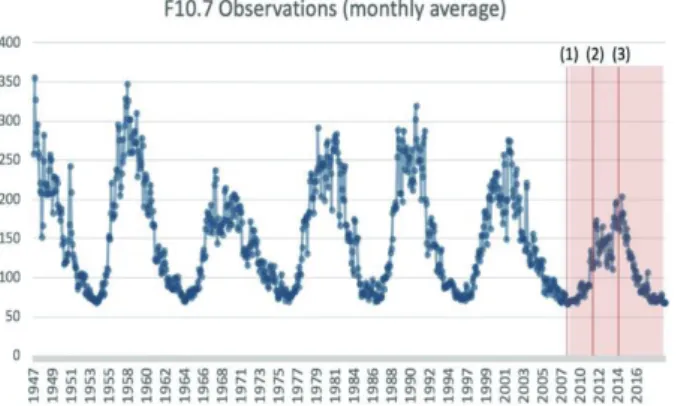
Fig. 2 F10.7 Monthly Averaged Data
Concurrently, when analyzing the past observation data presented in Fig. 2, the forecast period, from August 2014 to
July 2019, appears as a descending period from maximum to minimum in the cycle of the F10.7 index. To consider the effect of the period characteristics in a cyclic process, the predictions at the point with the increase from the minimum to the maximum and the midpoint of the descending from the maximum to minimum were added to compare the results.
Based on the graph of the F10.7 index, the period with the increase from the minimum to the maximum was from August 2008 to July 2013. Moreover, the period that starts from the midpoint of the rise from the minimum to the maximum, which includes the maximum point, was August 2011 to July 2016, and the starting points of the prediction are displayed in Fig. 2, where they are denoted as (1), (2), and (3)
ZZUUGGhhGGGGwwGGt tGG
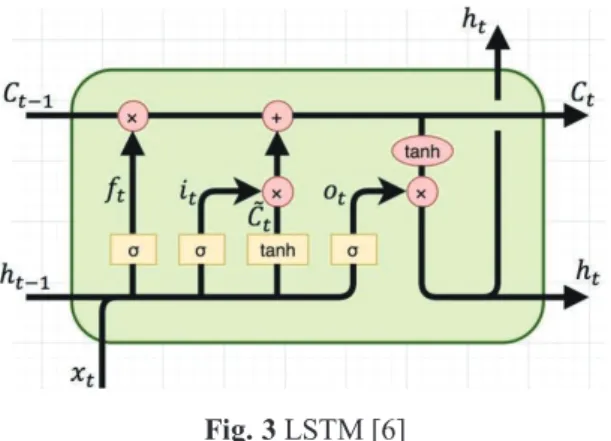
In this study, we applied the LSTM technique, which has been recently reported to present good performance as a machine learning technique for time series data. The results were compared to those of the autoregressive integrated moving average model (ARIMA), which is a representative statistical methodology for processing time series data.
Another comparison was performed with the results of a similar pattern searching method proposed in a previous study.
As a parameter for comparing predictive performance, a prediction error, which is the difference between the predicted and actually measured and internationally published F10.7 values, was used. As for the calculation of the prediction error, the root mean squared error (RMSE) and the mean absolute percentage error (MAPE) were used. The RMSE was obtained by averaging the square of the difference between the predicted and actual measured value. The MAPE was obtained by taking the mean value of the calculation of the percentage of the absolute value of the difference between the predicted and actual measured values divided by the actual value. The calculation formulas are given below.
RMSE = √
∑𝑛𝑛ℎ=1(𝑦𝑦̂𝑡𝑡+ℎ𝑛𝑛−𝑦𝑦𝑡𝑡+ℎ)2and (1)
MAPE =
∑ (|𝑦𝑦̂𝑡𝑡+ℎ−𝑦𝑦𝑡𝑡+ℎ|
𝑦𝑦𝑡𝑡+ℎ ×100) 𝑛𝑛ℎ=1
𝑛𝑛
![Fig. 1 Forecasted Solar Cycle 25 (NOAA/NASA) [3]](https://thumb-ap.123doks.com/thumbv2/123dokinfo/5101382.326649/2.892.85.421.704.929/fig-forecasted-solar-cycle-noaa-nasa.webp)