R E S E A R C H Open Access
Fractures of implant fixtures: a retrospective clinical study
Han-Chang Yu 1 and Young-Kyun Kim 1,2*
Abstract
Background: The aim of this study was to evaluate the factors that may affect implant fixture fractures.
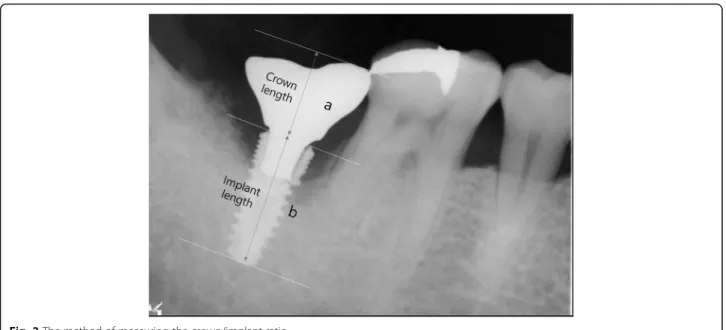
Methods: Patients who experienced implant fixture removal at Seoul National University Bundang Hospital from 2007 to 2015 due to implant fixture fracture were included. Implant/crown ratio, time of implant fracture, clinical symptoms before implant fracture, treatment of fractured implants, and the success and survival rate of the replaced implants were evaluated retrospectively.
Results: Thirteen implants were fractured in 12 patients. Patient mean age at the time of fracture was 59.3 years. Of the 13 implants, 7 implants were placed at our hospital, and 6 were placed at a local clinic. The mean crown/
implant ratio was 0.83:1. The clinical symptoms before fracture were screw loosening in five implants, marginal bone loss in five implants, and the presence of peri-implant diseases in five implants. All the fractured implants were removed, and 12 out of the 13 sites were re-implanted. Parafunctions were observed in two patients: one with bruxism and one with attrition due to a strong chewing habit.
Conclusions: Several clinical symptoms before the fracture of an implant can predict implant fixture failure.
Therefore, if these clinical symptoms are observed, appropriate treatments can be taken before more serious complications result.
Keywords: Dental implant, Implant fracture
Background
Mechanical complications are an issue in implant resto- rations. Among the complications, implant fixture frac- tures rarely occur, but when they do, they should be re- installed after removal, or only the broken upper part should be removed with the remainder of the fixture remaining in the bone. To completely remove a frac- tured implant, a trephine bur or surgical bur should be used to remove the surrounding bone. Severe bone defects often occur as a result after fixture removal. In Thomas et al. [1], the causes of implant fractures in- cluded defects in implant design or materials, improper
placement of the prostheses, and overload. As also shown in previous studies, 59% of fractured implants ex- hibited loosening or abutment or screw fracture, mar- ginal bone loss, and peri-implant inflammation before fracture [2]. Based on these findings, if precautions are taken by analyzing the phenomena that may occur be- fore implant fracture, it may be possible to prevent im- plant fracture to some extent. The purpose of this study was to evaluate the factors that may affect implant fix- ture fractures.
Methods
This retrospective clinical study was conducted after ap- proval from the IRB (Institutional Review Board, IRB no.
B-1910-568-112) of Seoul National University Bundang Hospital. From 2007 to 2015, patients who had fractured implant fixtures removed at the Seoul National Univer- sity Bundang Hospital were included in the study. Based
© The Author(s). 2020 Open Access This article is licensed under a Creative Commons Attribution 4.0 International License, which permits use, sharing, adaptation, distribution and reproduction in any medium or format, as long as you give appropriate credit to the original author(s) and the source, provide a link to the Creative Commons licence, and indicate if changes were made. The images or other third party material in this article are included in the article's Creative Commons licence, unless indicated otherwise in a credit line to the material. If material is not included in the article's Creative Commons licence and your intended use is not permitted by statutory regulation or exceeds the permitted use, you will need to obtain permission directly from the copyright holder. To view a copy of this licence, visit http://creativecommons.org/licenses/by/4.0/.
* Correspondence: [email protected]; [email protected]
1
Department of Oral and Maxillofacial Surgery, Section of Dentistry, Seoul National University Bundang Hospital, 82 Gumi-ro 173, 173beon-gil, Bundang-gu, Seongnam 13620, Korea
2