• 검색 결과가 없습니다.

Growth and physical properties of Sr<sub>x</sub>Ba<sub>1-x</sub>Nb<sub>2</sub>O<sub>6</sub> (x = 0.60, 0.75) single crystals

N/A
N/A
Protected

Academic year: 2021

Share "Growth and physical properties of Sr<sub>x</sub>Ba<sub>1-x</sub>Nb<sub>2</sub>O<sub>6</sub> (x = 0.60, 0.75) single crystals"

Copied!
4
0
0

로드 중.... (전체 텍스트 보기)

전체 글

(1)

Journal of the Korean Crystal Growth and Crystal Technology Vol. 20, No. 2 (2010) 65-68

Growth and physical properties of Sr x Ba 1 − x Nb 2 O 6 (x = 0.60, 0.75) single crystals

Bonghoon Kang

and Gi-Tae Joo *

Deptartment of Visual Optics, Far East University, Eumseong 369-700, Korea

*Materials Science & Technology Research Center, KIST, Seoul 136-791, Korea (Received March 16, 2010)

(Revised April 2, 2010) (Accepted April 9. 2010)

Abstract Sr

0.6

Ba

0.4

Nb

2

O

6

(60SBN) and Sr

0.75

Ba

0.35

Nb

2

O

6

(75SBN) single crystals were grown by Czochralski method.

Growing direction was <001>, and as-grown crystals has well-developed (001) plane. Temperature- and frequency dependence of dielectric constant represent relaxor ferroelectrics. 60SBN has wider optical transmittance than 75SBN.

Key words Crystal morphology, Czochralski method, Sr

x

Ba

1 − x

Nb

2

O

6

(SBN), Relaxor ferroelectric materials

1. Introduction

The tungsten-bronze type relaxor ferroelectric mate- rial strontium barium niobate Sr

x

Ba

1 − x

Nb

2

O

6

(SBN) is a interesting material due to the variety of its potential applications, particularly in the areas of pyro-electricity, piezoelectricity, electro-optics, photo-refractive optics and non-linear optics [1-4]. However it has been difficult to obtain high-quality SBN single crystals. Since the thermal conductivity of SBN is very small, approximately 1/60 of that of sapphire. In the conventional Czochralski growth of SBN crystals, a strong temperature gradient needs to be applied in order to maintain a plannar growth inter- face, which is necessary for the growth of large single crystals. To obtain SBN crystals of high compositional homogeneity, Stepanov technique or double crucible Stepanov technique [5-7] and vertical Bridgman tech- nique [8].

The nature of the relaxor phase transition can only be found out having detailed knowledge of the influence of internal charge carriers and electric fields in the paraelec- tric and ferroelectric regime [9, 10]. This influence is of paramount importance for the “random field Ising model”, which has been put forward to explain the relaxor behavior of SBN [11]. Relaxor ferroelectrics are charac- terized by a significant frequency dependence of their peak permittivity, persistence of the local polarization far above the phase transition temperature T

C

, and absence of macroscopic spontaneous polarization and

structural symmetry breaking after zero-field cooling.

Optical properties are dependent of the Sr/Ba ratio in the solid solution and of the temperature. In particular, the refractive index of the extraordinary wave n

e

is extremely sensitive both to compositional and to tem- perature change [12].

The purpose of this study is investigation of growing condition and morphology of Sr

0.60

Ba

0.40

Nb

2

O

6

(60SBN), Sr

0.75

Ba

0.25

Nb

2

O

6

(75SBN) single crystals. We discussed on the Sr/Ba ratio influence on temperature- and fre- quency-dependence of the dielectric properties in 60SBN and 75SBN single crystals. We also showed optical properties of 60SBN and 75SBN.

2. Experimental Procedure

SrCO

3

(99.99 %, Alfa Aesar), BaCO

3

(99.999 %, CERAC), and Nb

2

O

5

(99.999 %, H.C. Starck) were used as starting material. Sr

x

Ba

1 − x

Nb

2

O

6

was wet-ball mixed.

Mixing was preformed with ethyl alcohol for 24 hr, using Teflon balls. The mixed slurry were dried, pressed, and calcined at 1150

o

C for 5 hr. The phases in the calcined powder was identified by XRD (Rigaku Geigerflex X- ray diffractometer) using a CuK α radiation at 30 kV and 20 mA, and was identified by comparing spectra with standard data in JCPDS (39-0265) file index. Single phase calcined powder was re-pressed in a mold of 10 mm in- diameter under a uniaxial pressure, and the pressed discs were sintered at 1300

o

C for 4 hr.

Single crystals of 60SBN and 75SBN were grown from the Czochralski method. A Pt crucible with 40 mm in diameter, 40 mm in height and 1 mm in thickness

Corresponding author

Tel: +82-43-879-3709

Fax: +82-43-879-3730

E-mail: [email protected]

(2)

66 Bonghoon Kang and Gi-Tae Joo

was positioned under the suitable thermal conditions for crystal growth. Pt wires were used as seed. In order to grow good-quality crystals, growth conditions such as pulling rate and seed rotation rate were adjusted in range of 2~4 mm/hr and 8~15 rpm, respectively.

For dielectric properties and electrical conductivity measurements, polished specimens were electrode with silver paste (Dae-Joo, DS-0081IE) and were heat-treated at 400

o

C for 1 hr. The frequency and temperature depen- dence of dielectric and electrical properties were esti- mated from room temperature to 150

o

C, using a Hioki 3532 LCR HiTester at 50 Hz~5 MHz. Heating and cool- ing rate of specimens were 0.2

o

C/min.

For its optical transmittance measurement, specimens were polished using a UV/Vis spectrometer (OPTIZEN 2120UV).

3. Results and Discussion

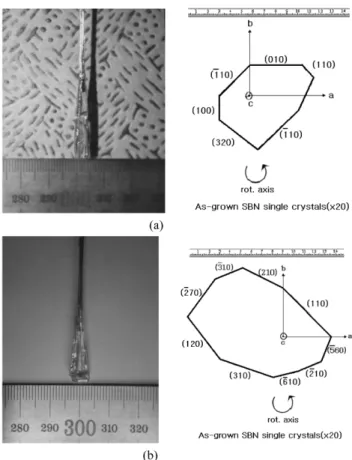
Fig. 1 shows as-grown 60SBN, 75SBN single crys- tals and its facets. As-grown crystals had a yellowish color. In Table 1, detailed condition of crystal growth was described.

In general, tetragonal tungsten bronze crystal, for example, Sr

x

Ba

1 − x

Nb

2

O

6

(SBN), Sr

2

KNb

5

O

15

(SKN), Ba

6

Ti

2

Nb

8

O

30

(BTN) etc, have a distinct cylindrical growth habit with 24 well-defined facets, each facet corresponding to a definite crystallographic orientation [13]. Growing direc- tion of 60SBN and 75SBN crystals was <001>, and as- grown crystals had well-developed (110) plane.

The conoscope image/XRD pattern for growing direc- tion and etch pit of as-grown crystals are shown in Fig.

2 and Fig. 3, respectively. Etching condition was HF : HNO

3

= 1 : 3 during 1 hr at 80

o

C. Etch pit of non-uni- form represents the internal stress of crystals for previ-

ous annealing process.

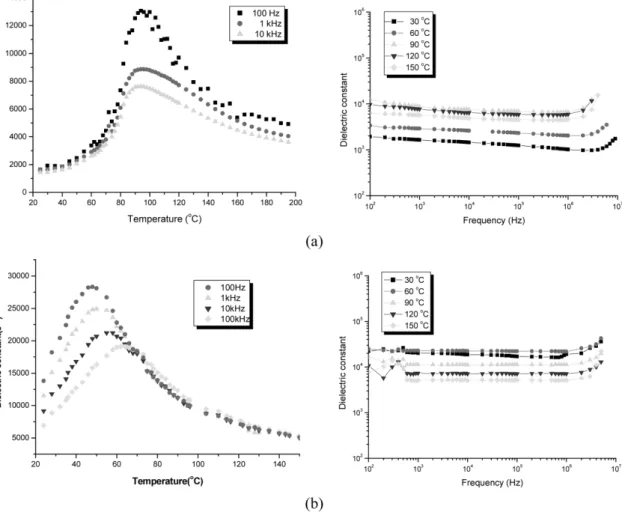
Fig. 4(a), (b) illustrate the temperature and frequency dependence of the dielectric constants of 60SBN and

Table 1

Growth condition of 60SBN and 75SBN

Pulling rate (mm/hr) Rotation rate (rpm) Atmosphere

60SBN 2 8 O

2

gas

75SBN 4 15 O

2

gas

Fig. 1. As-grown 60SBN (a) and 75SBN (b) single crystals and its facets.

Fig. 2. Conoscope image and XRD patterns of as-grown crystals (c-axis//pulling direction).

(3)

Growth and physical properties of Sr

x

Ba

1 − x

Nb

2

O

6

(x = 0.60, 0.75) single crystals 67

75SBN single crystals. Situation of the phase transition in SBN ceramics was explained by relaxor-type, that is to say “smeared” or “diffused”. To describe this situa- tion of the conventional transition behavior, a “random- field Ising model” as a consequence of structural and

compositional inhomogeneity was introduced. When the temperature is lowered below the transition, domains become more and more cooperative, until a ferroelec- tric state is reached [14]. The dielectric maxima peaks shift to higher temperature with increasing frequency that is similar to what is observed in typical diffusive phase transition (DPT) ferroelectrics.

Both specimens had almost same frequency depen- dence of the dielectric constants, but at high frequency above 100 kHz dielectric constants increase significantly [15, 16]. These results represent implying a promising candidate for electro-optics device applications.

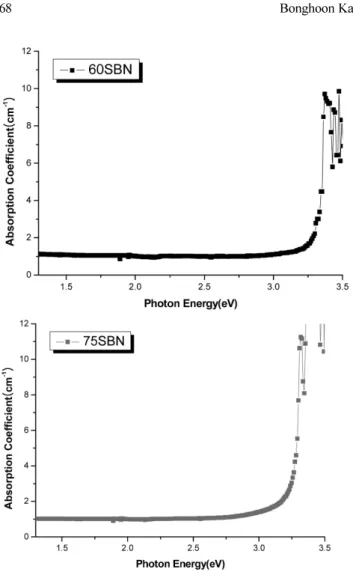
Fig. 5 shows the absorption coefficient of as-grown 60SBN and 75SBN single crystals. Optical transmittance of 60SBN has a wide range than 75SBN single crys- tals. These optical properties are being studied.

4. Conclusions

60SBN and 75SBN single crystals grown by Czo-

Fig. 3. Etch pit of 60SBN single crystals.

Fig. 4. Temperature- and frequency-dependence of dielectric constant for 60SBN (a) and 75SBN (b) single crystals.

(4)

68 Bonghoon Kang and Gi-Tae Joo

chralski method using Pt wire seed. Growing direction was <001>, and as-grown crystals had well-developed (110) plane. Situations of the phase transition in SBN crystals were explained by relaxor-type and dielectric properties of temperature dependence indicated a strongly diffused phase transition (DPT). From these results, we suggested implying a promising candidate for electro- optics device applications.

Acknowledgement

This work was supported by the research program of Korea Institute of Science and Technology (KIST).

References

[ 1 ] J.R. Oliver, R.R. Neurgaonkar and L.E. Cross, “A ther- modynamic phenomenology for ferroelectric tungsten bronze Sr

0.6

Ba

0.4

Nb

2

O

6

(SBN:60)”, J. Appl. Phys. 64 (1988) 37.

[ 2 ] R.R. Neurgaonkar and W.K. Cory, “Progress in photore- fractive tungsten bronze crystals”, J. Opt. Soc. Am. B 3 (1986) 274.

[ 3 ] R.R. Neurgaonkar, W.K. Cory, J.R. Oliver, M.D. Ewbank and W.F. Hall, “Development and modification of pho- torefractive properties in the tungsten bronze family crystals”, Opt. Engineering 26 (1987) 392.

[ 4 ] G.-T. Joo, B.-H. Kang and Y.-S. Paek, Study on Sr

1 − x

Ba

x

Nb

2

O

6

Materials for Optical Devices. KIST Report (2002).

[ 5 ] L.I. Ivleva, N.V. Bogodaev, N.M. Polozkov and V.V.

Osiko, “Growth of SBN single crystals by Stepanov technique for photorefractive applications”, Opt. Mater.

4 (1995) 168.

[ 6 ] S. Takekawa, Y. Furukawa, M. Lee and K. Kitamura,

“Double crucible Stepanov technique for the growth of striation-free SBN single crystal”, J. Crystal Growth 229 (2001) 238.

[ 7 ] E. Kubota, H. Yamazaki, M. Ono, M. Sasaura, Y. Yagi, T. Imai and A. Tate, “Large size SBN single crystal growth by the resistance-heating Czochralski technique using crucible-base cooling”, J. Crystal Growth 229 (2001) 217.

[ 8 ] H.S. Lee, J.P. Wilde and R.S. Feigelson, “Bridgman growth of strontium barium niobate single crystals”, J.

Crystal Growth 187 (1998) 89.

[ 9 ] D. Viehland and Y. Chen, “Random-field model for fer- roelectric domain dynamics and polarization reversal”, J. Appl. Phys. 88 (2000) 6696.

[10] D. Viehland, J. Powers, L.E. Cross and J.F. Li, “Impor- tance of random fields on the properties and ferroelec- tric phase stability of <001> oriented 0.7 Pb(Mg

1/3

Nb

2/3

)O

3

- 0.3 PbTiO

3

crystals”, Appl. Phys. Lett . 78 (2001) 3508.

[11] W. Kleemann, “Random fields in dipolar glasses and relaxors”, J. Non-Crystalline Sol. 307-310 (2002) 66.

[12] E.L. Venturini, E.G. Spencer, P.V. Lenzo and A.A. Ball- man, “Refractive indices of strontium barium niobate”, J. Appl. Phys. 39 (1968) 343.

[13] C.N.R. Rao, Chemistry of advanced materials (Black - well Scientific Publications, Boston, 1993) chap. 5.

[14] T. Granzow, U. Do"rfler, T. Woike, M. Wo"hlecke, R.

Pankrath, M. Imlau and W. Kleemann, “Influence of pinning effects on the ferroelectric hysteresis in cerium- doped Sr

0.61

Ba

0.39

Nb

2

O

6

”, Phys. Rev. B63 (2001) 174101.

[15] Y. Qu, A. Li, Q. Shao, Y. Tang, D. Wu, C.L. Mak, K.H.

Wong and N. Ming, “Structure and electrical properties of strontium barium niobate ceramics”, Mat. Res. Bull.

37 (2002) 503.

[16] Y. Xu, Ferroelectric Materials and Their Applications (North Holland, Amsterdam, 1991) 254.

Fig. 5. Absorption coefficient of 60SBN and 75SBN single

crystals.

수치

Fig. 1 shows as-grown 60SBN, 75SBN single crys- crys-tals and its facets. As-grown cryscrys-tals had a yellowish color
Fig. 3. Etch pit of 60SBN single crystals.
Fig. 5. Absorption coefficient of 60SBN and 75SBN single crystals.

참조

관련 문서