Hong Sang-Pyo··Kim Kwang-Yul*
Dept. of Environmental Engineering, Cheongju University, Dept. of Environmental Engineering, Chungbuk University*
(Manuscript received 22 October 2004; accepted 23 March 2005)
비위생매립지의 안정화 평가
- 노은 매립지 사례연구 -홍상표·김광렬*
청주대학교 환경공학과, 충북대학교 환경공학과*
(2004년 10월 22일 접수, 2005년 3월 23일 승인)
요 약
노은 매립지는 사용종료된지 5년이 경과된 비위생매립지로 최종복토는 되어 있으나 침출수 차집시설 및 매립가스 포집설비가 제대로 갖추어지지 않은 상태이다. 환경부의 사용종료 매립 지 정비지침에 의하면 침출수의 BOD/CODcr 비율이 1/10 수준임으로 침출수의 안정화 과정이 거의 완결상태로 진행되고 있는 것으로 판단된다. 매립지 가스의 안정화 측면에서는 CH4의 비 율이 5%정도이기 때문에 안정화가 거의 이루어진 것으로 볼 수 있다. 매립된 쓰레기 중에서 플 라스틱을 제외한 가연물 함량이 3.97 - 9.34%이기 때문에 매립폐기물은 안정화 기준에 미흡한 상태이다. 그리고 지하수는 대장균 항목이 지하수 수질기준 생활용수 기준에 미흡하여 안정화 기준을 충족시키지 못하고 있다. 노은매립지는 매립지 안정화의 속도가 평가 대상별로 상이하 게 진행되는 것으로 평가된다.
주요어 : 매립지 안정화, 침출수, 매립지 가스
Corresponding Author: Hong Sang-Pyo, Dept. of Environmental Engineering, Cheongju University, 36 Naedok-dong, Sangdang-ku, Cheongju City, 360-764, Korea Tel: 82-43-229-8576 Fax: 82-43-229-8432 E-mail: [email protected]
I. Introduction
Landfills have been the most common means of MSW(municipal solid waste) disposal in South Korea. Until 1980s, for the treatment of MSW generated in South Korea, approximately 85%
had been placed in municipal solid waste land- fills(MOE, NIER, 2004). Regardless of how much reuse, recycling, and energy recovery is achieved, some fraction of MSW must be disposed at the landfill(P. Aarne et al., 2002)
From the middle of 1990s, open-dumping landfill has been prohibited in South Korea.
Landfills which were closed are now being regu- lated strictly to be used as other land-uses such as residential buildings, farming, etc(KRRRC, 1995 ; Hwang et al., 2002).
In order to utilize a closed landfill site for other purposes, the assessment of the stabiliza- tion level of landfill is indispensable for the determination of the proper land-uses. In this study, among open-dumping landfills that were located at Chungbuk province, Noeun landfill at Chungju city which could impact Namhan river which flows into Lake Paldang was selected to assess the stabilization characteristics of an open- dumping landfill(CRETDC, 2004).
MSW which were deposited in landfills stabi- lize by a combination of physical, chemical, and biological decomposition. The landfill is a form of biochemical reactor, similar to anaerobic digestor in a wastewater treatment plant(Debra et al., 2002).
The progress toward final stabilization of land- fill, MSW is subject to the physical, chemical, and biological factors within the landfill environment, the age and characteristics of landfilled waste, the operational and management controls applied, as well as the site-specific natural conditions(Kanti, 2000 ; Sleats, 2000).
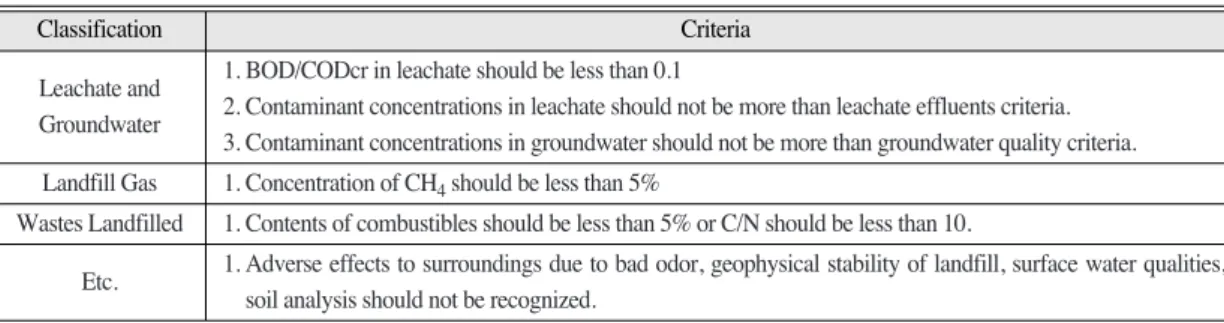
To assess the stabilization level of this open- dumping landfill for seeking the adequate method for post-closure management, landfilled waste was analyzed on the basis of physical components, after then characteristics of leachate, landfill gases, and groundwater were analyzed chemically. The analysis results were evaluated by “The Criteria of Landfill Stabilization” that promulgated by Korean Ministry of Environment (Table 1).
II. Materials and Methods
Noeun landfill is a type of depression landfill
Table 1. Criteria of Landfill Stabilization Classification Criteria
Leachate and 1. BOD/CODcr in leachate should be less than 0.1
Groundwater 2. Contaminant concentrations in leachate should not be more than leachate effluents criteria.
3. Contaminant concentrations in groundwater should not be more than groundwater quality criteria.
Landfill Gas 1. Concentration of CH4should be less than 5%
Wastes Landfilled 1. Contents of combustibles should be less than 5% or C/N should be less than 10.
Etc. 1. Adverse effects to surroundings due to bad odor, geophysical stability of landfill, surface water qualities, soil analysis should not be recognized.
<Source>: Ministry of Environment, Republic of Korea, Guidelines for Post-closure Management of Landfill, 2001.
Classification Criteria
located between small hills. Surface water from Noeun landfill flows through a small ditch which converge into Hanpo stream. Hanpo stream runs through 12km and then confluxing with Namhan river at the point of 90 km distant from Lake Paldang.
A small ditch which underdrains through a dike of Noeun landfill was dry in the dry season.
The reason that the ditch had little water was considered that coarse sands were prevalent at this site. Hydrogeological characteristics of this landfill seemed to result in infiltration of most precipitates.
Noeun landfill was operated from June, 1992 to June, 1999 for disposal of municipal solid waste which generated from this rural area.
Residential area(143 homes, 457 population) is about 4 km distant from this landfill(Table 2).
Noeun landfill site was dug out at 3 points into 4.5~5.0m by excavator to sample and ana- lyze waste and LFG. The depth of final soil cover and landfilled waste were 0.2~0.4m and 4.1~4.8 m each(CRETDC, 2004). Proximate analysis was proceeded with the waste excavated. Landfill gas(LFG) extraction device was installed for LFG sampling at the two excavated points. LFG such as CH4, CO2, O2, H2S were analyzed on the site, NH3was absorbed into solution and analyzed in the laboratory according to “Korean Standard Methods of Air Pollution”(MOE, 2002).
Leachate seemed to leak from landfill, and
groundwater could be contaminated(Phlip et al., 2002). Groundwater was sampled from 2 moni- toring wells at Noeun landfill site and leachate was sampled from the effluent of landfill which flowed out at the bottom of dike. Groundwater and leachate samples were chemically analyzed on the basis of “Korean Standard Methods of Water Pollution”(MOE, 2002).
III. Results and Discussion
An important characteristic of the organic com- ponent in MSW is that most of it can be biode- graded into leachate, gases and relatively inert and inorganic materials (Issa et al., 1998). At Noeun landfill(Table 3), the fraction of organic materials was 19.46 - 27.12% with food garbage already decomposed, and the fraction of inorgan- ic materials(incombustibles) such as glass, ceram- ics, dirt, and metals account for 72.88 - 80.54%.
Among combustible landfilled wastes, the ratio of plastics was as high as 73.69%.
Moisture content is considered the most important factor in MSW decomposition and landfill gas(LFG) production. From Table 4, the results of proximate analysis of landfilled waste at Noeun landfill were moisture 10.4 - 28.2%, total solids 71.81 - 89.59%, volatile solids 65.78 - 78.57%, fixed solids 21.43 - 34.22%, respectively.
The moisture content of textiles, waste papers, and timbers were relatively high.
Table 2. Outlines of Noeun Landfill
1. Location of Landfill : Noeun & Shinni, Chungju City, Chungbuk Province 2. Period of Landfill : 92. 6 ~ 99. 6
3. Area of Landfill : 9,034m2 4. Capacity of Landfill : 27,102m3
5. Average Daily Landfilled Quantity : 5ton 6. Average Waste Height : 4m 7. Landfilled Wastes(ton/day) : Briquettes Ash(0.5),Food Garbage(0.5), Waste Papers(1.0), Etc(3.0)
The more the quantity of easily digested nutri- ents, the higher the rate of LFG generation.
Numerous toxic materials, such as heavy metals, can retard bacterial growth and consequently retard LFG production. Within the optimum pH range, methanogenic bacteria grow at a high rate, so methane production is maximized(Vesilind et al., 2002).
Owing to the limitation of this study, the impact of toxic material into LFG generation was not considered fully. According to Table 5, at Noeun landfill, the concentration of CH4, CO2, H2S, and NH3 in LFG were 3.4 - 5.8%, 13.0 - 17.0%, 1.5 - 2.0 ppm, and 0.8 - 1.7 ppm, respec-
tively.
As a typical constituents of biologically active MSW landfill gas, CH4account for 45 - 60% and CO2makes up 40 - 60% by volume(P. Aarne et al., 2002), From this composition data, Noeun landfill seemed to be in the process of the final state of landfill stabilization. During this maturation phase, reappearance of oxygen may be observed(P.
Aarne et al., 2002). At Noeun landfill, oxygen rang- ing from 4.6% to 5.7% was found in LFG.
Based on the “The Criteria of Landfill Stabilization” that promulgated by Korean Ministry of Environment, if CH4in LFG is higher than 5%, the landfill waste is not sufficient for Table 3. Physical Characteristics of Landfilled Wastes
Components % by weight Site1 Site2 Site3 Average Range
Food garbage - - - - -
Waste papers 1.18 1.59 0.98 1.25 0.98 ~ 1.59
Textiles 2.84 3.24 2.92 3.00 2.84 ~ 3.24
Combustibles Plastics 18.59 14.42 19.26 17.42 14.42 ~ 19.26
Timbers 0.25 0.12 0.06 0.14 0.06 ~ 0.25
Rubbers, Leathers 4.26 0.09 1.12 1.82 0.09 ~ 4.26
Sub-total 27.12 19.46 24.34 23.64 19.46 ~ 27.12
Glass, Ceramics 4.22 1.53 2.31 2.69 1.53 ~ 4.22
Incombustibles Metals 3.24 0.42 0.12 1.26 0.12 ~ 3.24
Soil and etc. 65.42 78.59 73.23 72.41 65.42 ~ 78.59
Sub-total 72.88 80.54 75.66 76.36 72.88 ~ 80.54
Total 100 100 100 100
Components % by weight Site1 Site2 Site3 Average Range
Table 4. Proximate Analysis of Combustible Landfilled Wastes
% by weight Average Ratio in Moisture Total Solids TS
Component Combustibles (TS) Volatile Solids(VS) Fixed Solids(FS)
Food garbage - - - - -
Waste papers 1.25 27.05 72.95 78.57 21.43
Textiles 3.00 28.19 71.81 65.78 34.22
Plastics 17.42 14.05 85.95 75.08 24.92
Timbers 0.14 26.39 73.61 66.44 33.56
Rubbers, leathers 1.82 10.41 89.59 73.48 26.52
Total 23.64 - - - -
% by weight Average Ratio in
Moisture Total Solids TS
Component Combustibles (TS) Volatile Solids(VS) Fixed Solids(FS)
the completion of stabilization progress. From this criteria, Noeun landfill was still in the process of waste stabilization.
As water percolates through the landfill, conta- minants are leached from the solid MSW. The composition of landfill leachate is strongly influ- enced by wastes and environmental conditions such as precipitation rates, site hydrogeology, pH, moisture, redox potential, and temperature.
The rate and characteristics of leachate produced from a landfill reflect the microbial process and landfill conditions(Edward et al., 1995 ; Jay et al., 2002).
From Table 6, the pH of leachate at Noeun landfill was 6.9, at this pH the stabilization process of leachate could proceed easily.
BOD/CODcr in leachate was 0.13 - 0.18 which
means the waste stabilization of this landfill was still not completed. Based on the “The Criteria of Landfill Stabilization”, if BOD/CODcr in leachate is higher than 1/10, the leachate is in stabilization situation. Groundwater was sampled from 2 monitoring wells located at inside and outside of landfill. From this groundwater samples, all cont- aminants except E. coli were adequate for “The Criteria of Domestic Use in Groundwater Criteria”(MOE, 2003).
IV. Conclusion
In order to assess waste stabilization of an open-dumping landfill which is located at the upper drainage basin of Lake Paldang utilized Table 5. Results of Analysis of Landfill Gas
Date Types Site1 Site2
1st 2nd Average 1st 2nd Average
CH4(%) 4.1 4.3 4.2 5.7 5.8 5.75
21 Sep., CO2(%) 13.0 14.0 13.5 16.0 15.0 15.5
2003 O2(%) 5.7 5.6 5.65 4.9 5.3 5.10
H2S(ppm) 1.6 1.5 1.55 1.7 1.8 1.75
NH3(ppm) 0.8 0.9 0.85 1.0 0.9 0.95
CH4(%) 4.0 4.1 4.05 5.6 5.3 5.45
15 Oct., CO2(%) 15.0 14.0 14.5 16.0 17.0 16.5
2003 O2(%) 5.2 5.1 5.15 4.9 4.7 4.80
H2S(ppm) 1.7 1.7 1.7 1.8 1.9 1.85
NH3(ppm) 0.9 1.0 0.95 1.2 1.3 1.25
CH4(%) 3.9 3.8 3.85 5.1 5.0 5.05
16 Nov., CO2(%) 16.0 14.0 15.0 15.0 13.0 14.0
2003 O2(%) 4.8 5.0 4.9 4.9 4.9 4.90
H2S(ppm) 1.7 1.8 1.75 1.9 2.0 1.95
NH3(ppm) 1.4 1.3 1.35 1.5 1.5 1.50
CH4(%) 3.5 3.4 3.45 4.3 4.2 4.25
9 Dec., CO2(%) 16.0 15.0 15.5 17.0 16.0 16.5
2003 O2(%) 5.1 4.8 4.95 4.9 4.6 4.75
H2S(ppm) 1.6 1.6 1.6 1.9 1.9 1.90
NH3(ppm) 1.5 1.4 1.45 1.6 1.7 1.65
Date Types Site1 Site2
1st 2nd Average 1st 2nd Average
for Seoul Metropolitan water supply, the Noeun landfill site was surveyed. Leachate, groundwa- ter, landfill gas, landfilled wastes at this landfill were analyzed, and the analysis results were assessed from “The Criteria of Landfill Stabilization”.
From these results, this open-dumping landfill was not completely stabilized. Waste stabilization in landfills is accomplished through a complex sequence of biologically, chemically, and physi- cally mediated events. Based on results from this
study, it can be concluded that the criteria factors of waste stabilization is proceeded in different rates at different site-specific conditions.
From this result, the land-use of this landfill site for another purpose should be put off until the stabilization of landfilled waste will be com- pleted.
Acknowledgements
This work was supported by grant No.
(Chungbuk 03-1-50-74) from Chungbuk Regional Environmental Technology Development Center.
References
CRETDC(Chungbuk Regional Environmental Technology Development Center), Stabilization and Improvement Methods of Open-dumping Landfills, 2004.
Debra R. Reinhart, Phlip T. McCreannor, Timothy Townsend, 2002, The Bioreactor Landfill : Its Status and Future, Waste Management and Research, 20, 172-186.
Edward A.McBean, et al.,1995, Solid Waste Landfill Engineering and Design, Prentice Hall, 59-70.
Hwang Soon-Hong et al., 2002, The Variation of Water quality of Leachate and Neighboring Streamwater According to the Time After Closure and Landfill Amount, APLAS Seoul 2002, 790-794.
Issa S. Oweis, et al., 1998, Geotechnology of Waste Management, PWS Publishing. 295-299.
Jay Lerr, et al., 2002, Handbook of Complex Environmental Remediation Problems, Mc- Graw Hill, 2.4-2.17.
Kanti L. Shah, 2000, Basics of Solid and Hazardous Table 6. Analysis of Leachate and Groundwater
Types Leachate Groundwater 1 Groundwater 2
BOD5 2.7 - -
BOD10 2.9 - -
BOD15 3.5 - -
BOD20 3.8 - -
CODMn 11.3 1.2 0.2
CODCr 20.9 - -
PH 6.9 5.7 6.6
SS 4.2 - -
T-N 2.26 - -
T-P 0.130 - -
NO3-N 2.2 3.5 2.3
Cl- 3.8 14.1 11.4
NH3-N ND ND ND
Cd - 0.0005 0.0004
Cr - 0.001 0.001
As - ND ND
Hg - ND ND
Pb - 0.357 0.032
Cr+6 - ND ND
TCE - ND ND
PCE - ND ND
Organic-P - ND ND
Phenol - ND ND
CN_ - ND ND
E. Coli. - Detected Detected
TPH - ND ND
Types Leachate Groundwater 1 Groundwater 2 (mg/L, except pH and E.Coli.)
Waste Management Technology, Prentice Hall, 332-335.
KRRRC(Korea Resources Recovery & Reutilization Corporation), Adequate Post-closure Management Methods for Closed Landfills, 1995, 56-59.
MOE(Ministry of Environment), Republic of Korea, Guidelines for Post-closure Management of Landfill, 2001.
MOE, Korean Standard Methods of Air Pollution, 2002.
MOE, Korean Standard Methods of Water Pollution, 2002.
MOE, The Criteria of Domestic Use in Groundwater Quality, 2003.
MOE and NIER(National Institute for Environmental
Research), Nationwide Situation of Solid Waste Generation and Treatment, 2004, 14-15.
P. Aarne Vesilind, William Worrell, Debra Reinhart, 2002, Brooks/Cole, Solid Waste Engineering, 109-131.
Phlip B. Bedient, Hanadi S. Rifai, Charles J. Newell, 1999, Groundwater Contamination, Prentice- Hall, 85.
Sleats, R., 1989, “Activities and Distribution of Key Microbial Groups in Landfills”, In Sanitary Landfilling : Process, Technology and Environmental Impact, Academic Press.
최종원고채택 05. 04. 06