Received: December 14, 2017 Revised: January 2, 2018 Accepted: February 5, 2018 TRAUMA AND INJURY
Correspondence to Yang Bin Jeon, M.D.
Department of Trauma Surgery, Trauma Center, Gachon University Gil Medical Center, 21 Namdong-daero 774beon-gil, Namdong-gu, Incheon 21565, Korea Tel: +82-32-460-8316
Fax: +82-32-460-2372 E-mail: [email protected]
http://www.jtraumainj.org Copyright © 2018 The Korean Society of Trauma
Delayed Surgical Management of Traumatic Pseudoaneurysm of the Ascending Aorta in Multiple Trauma
Dae Sung Ma, M.D., Sung Jin Kim, M.D., Seok Joo, M.D., Sung Youl Hyun, M.D., Yang Bin Jeon, M.D.
Department of Trauma Surgery, Trauma Center, Gachon University Gil Medical Center, Incheon, Korea
Traumatic blunt aortic injury especially on proximal ascending aorta is a rare injury with a few reports. Generally emergency surgical management was performed. In this case, however, in multiple trauma with brain injury, emergency surgical management of aortic injury might result in unexpected secondary injury of the brain. Herein, we re- port a case of a 33-year-old man who was driving a truck was injured in a head-on col- lision. Evaluation revealed a pseudoaneurysm on his ascending aorta concomitant with epidural hemorrhage. He was treated by surgical management of his ascending aorta after 3 days from accident. There were no postoperative and neurologic complications and the patient was discharged after 18 days.
Keywords: Trauma; Pseudoaneurysm; Ascending aorta
INTRODUCTION
Blunt traumatic aortic injury, expecially non-isthmus aortic injuries is known lethal, and most of patients are died at scene, or within the first 24 hours in hospital [1,2].
In general, proximal ascending aorta injury is treated with emergency surgical repair.
However, multiply traumatized patient combined with proximal ascending aorta
injury and brain injury require careful approach to manage, because an emergency
surgical repair of ascending aorta is possible to result in secondary injury of CNS. We
report the case of a successful surgical repair of proximal ascending aortic injury with
brain injury after 3 days from trauma.
CASE REPORT
A 33-year-old man who was driving a truck was injured
in a head-on collision. He visited our trauma center com- plaining of facial and thoracic pain. Physical examination revealed lacerations on the forehead and right lower lip of about 6 cm and 5 cm, respectively, with bone exposure.
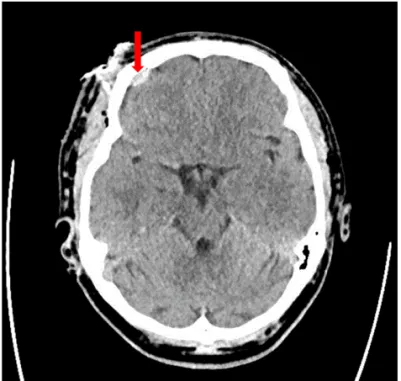
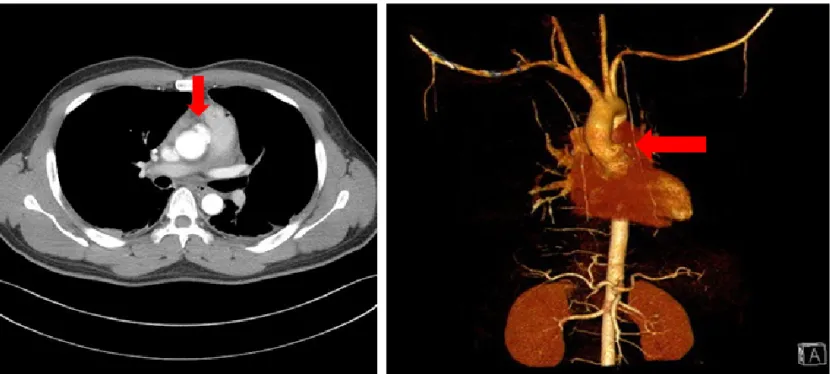
Initial vital signs were: blood pressure 145/87 mmHg, heart rate 86 beats per minute, and respiratory rate 21 breaths per minute. The patient was alert but slightly con- fused. Radiology workup included computed tomogra- phy (CT) of the brain, thorax, abdomen, and pelvis. The brain CT revealed slight localized epidural hematoma in the right frontal lobe area, slight pneumocephalus, and fracture in the right frontal bone (Fig. 1). The thoracic CT revealed a small pseudoaneurysm on the left side of the ascending aorta with an intramural hematoma on the ascending aorta and aortic arch, slight hemopericardi- um, and a longitudinal fracture in the manubrium with retrosternal hematoma. There was also bilateral pulmo- nary contusion (Fig. 2). Three hours after arriving to the hospital, a repeat brain CT revealed a slight increase in the localized epidural hematoma in the right frontal lobe, compared to the last examination. The patient was nearly alert and his vital signs were stable: blood pressure 120/74 mmHg, heart rate 81 beats per minute, and oxygen satu-
Fig. 1. Computed tomography of brain, Traumatic epidural hemor-rhage (arrow) .
Fig. 2. Computed tomography of thorax, pseudoaneurysm of ascending aorta (arrow) .
ration 98%, with O
2at 3 L/min via a nasal cannula. Pri- mary suturing was performed for the open wound on his forehead and lower lip and the patient was transferred to the Trauma Intensive Care Unit (TICU) for close moni- toring.
Repeat thoracic aorta CT was performed for a more de- tailed evaluation and another prominent pseudoaneurysm was found on the left side of the ascending aorta (Fig. 3).
Two days later, brain CT was performed to ascertain the feasibility of thoracic surgery and to evaluate the previ- ous lesion. However, there was no change in the epidural hematoma in the right frontal lobe. Surgical treatment
of the ascending aorta pseudoaneurysm was performed three days after the trauma, and a false aneurysmal sac was noted between the right coronary artery and pulmo- nary artery along the left ascending aorta. The aneurysm resection was performed after incision in side of false aneurysm adventitia. The intima tearing was observed di- rectly upper portion from L-R commisure, upper margin of right sinus of Valsava. The progressive dissection was observed in a surgical field. Thus, ascending aorta recon- struction with graft (hemashield 22 mm) and commissure resuspension of the left-to-right commissural were per- formed. Further, transesophageal echocardiography (TEE)
Fig. 4. Preoperative transesophageal echocardiography of ascending aorta pseudoaneurysm.Fig. 3. Computed tomography of thoracic aortography after 1 day. Pseudoaneurysm of ascending aorta (arrow) .