* These authors equally contributed to this study.
S. I. Lee ・ H. S. Roh ・ J. B. Kim ( ) 건국대학교 의료생명대학 생명공학과
(Department of Biotechnology, College of Biomedical and Health Sciences, Glocal Campus. Konkuk university, Choong-Ju, 380-701, Korea)
e-mail: [email protected] S. S. Lim
건국대학교 국제비즈니스대학 국제통상학과
(Department of International Trade, College of International business, Glocal Campus. Konkuk University, Choong-Ju, 380-701, Korea)
바이오에너지 개발용 스위치그라스의 조직배양 및 형질전환 최근 연구동향
이상일 ・ 임성수 ・ 노희선 ・ 김종보
Recent advances in tissue culture and genetic transformation system of switchgrass as biomass crop
Sang Il Lee ・ Sung-Soo Lim ・ Hee Sun Roh ・ Jong Bo Kim
Received: 22 December 2013 / Accepted: 26 December 2013
ⓒ Korean Society for Plant Biotechnology
Abstract Over the past decades, carbon dioxide concentration of the atmosphere of the world has increased significantly, and thereby the greenhouse effect has become a social issue.
To solve this problem, new renewable energy sources including solar, hydrogen, geothermal, wind and bio-energy are suggested as alternatives. Among these new energy sources, bio-energy crops are widely introduced and under rapid progress. For example, corn and oilseed rape plants are used for the production of bio-ethanol and bio-diesel, respectively. However, grain prices has increased severely because of the use of corn for bio-ethanol production.
Therefore, non-edible switchgrass draws attention as an alternative source for bio-ethanol production in USA. This review describes the shortage of fossil energy and an importance of switchgrass as a bio-energy crop. Also, some characteristics of its major cultivars are introduced including growth habit, total output of biomass yields. Furthermore, biotechnological approaches have been conducted to improve the productivity of swichgrass using tissue culture and genetic transformation.
Keywords Biomass, Callus, Regeneration, Switchgrass, Transformation
서 론
화석연료의 무분별한 사용에 따른 국제유가의 불안정과 환경문제로 지구온난화의 주범인 온실가스의 배출량을 억제하려는 노력이 세계 각국에서 진행 중이다(Chung et al. 2008). 이러한 문제점을 해결하기 위해 세계 각국에서 는 바이오연료, 풍력, 태양열 등의 대체에너지 개발에 박 차를 가하고 있으며(Lim et al. 2008), 그 가운데 바이오연 료는 수송용 원료의 대체재로서 관심을 받고 있다(Won 2008).
바이오연료에는 경유를 대체하는 바이오디젤(biodiesel) 과 휘발유를 대체하는 바이오에탄올(bioethanol)이 있으며, 바이오디젤의 경우 유지작물인 대두, 유채 팜오일(palm oil)을 이용하고, 바이오에탄올의 경우 전분계 원료인 옥 수수와 고구마등 주로 재생 가능한 바이오매스(biomass) 를 이용하여 생산한다.
옥수수나 고구마와 같은 전분계 원료는 식량작물로서 국제 곡물가격의 상승을 초래하여(American Society of Plant biologists 2005), 식용작물이 아닌 억새, 스위치그라스와 같은 초본성 작물과 목본성 작물인 포플러 등 셀룰로오 스계 비식용작물에 대한 관심이 증가하고 있다(Yang and Choi 2008). 국내에서도 이러한 상황에 맞춰 콩, 유채 및
억새에 대한 연구가 진행 중이며, 스위치그라스 외 바이 오 매스 작물에 대한 국내 연구현황에 대해 본문에서 일 부 소개하고자 한다.스위치그라스(Panicum virgatum L.)는 다년생 난지형(warm- season)잔디로 오레곤주, 워싱턴주, 캘리포니아주를 제외 DOI:http://dx.doi.org/10.5010/JPB.2013.40.4.185
Review
ISSN 1598-6365
Fig. 1 Cultivation areas of planting and managing of switchgrass as a biomass energy crop. USDA, NRCS 2009a
한 미국 전역에서 자생하며(Fig. 1), 줄기는 4미터까지 자 라고 짧은 지하경(rhizome)과 80 cm까지 깊게 자라는 뿌 리를 가지고 있다. 늦봄과 초여름에 생장하여 많은 바이 오매스를 생산하며, 지역에 따라 1 에이커당 225 ~ 700 파 운드의 많은 양의 종자를 생산한다. 척박한 환경과 토양 에서도 잘 생육하므로 1930년대부터 미국의 건조지역 토양을 보존하는 작물로 여겨져 왔다(National Resources Conservation Service: NRCS 2007; USDA, NRCS 2006; USDA, NRCS 2009a).
스위치그라스는 뿌리와 지하경 부근에서의 탄소고정 (carbon storage sinks)으로 인해 토양 내 탄소를 저장하여 온실가스의 주범인 CO
2의 발생을 감소시키는 역할을 한 다(Frank et al. 2004). 또한 헥타르당 14 ~ 18톤의 바이오매 스와 10,757리터의 바이오 에탄올을 생산하며 온실가스 배출량이 극히 적고 순 에너지 효율(생산에 투입된 에너 지 대비 생산된 에너지)이 540%로 매우 높고(Schmer et al. 2008), 화석연료에서 생산되는 플라스틱을 대체할 수 있는 바이오 플라스틱 원료인 poly-β-hydroxybutyrate (PHB) 의 생산이 가능해 미국 농무부(United States Department of Agriculture)와 미국 에너지부(Department of Energy)에서 스 위치그라스를 바이오매스 주요작물로 선정하기도 하였 다(McLaughlin et al. 1996).
국내 바이오매스작물 연구 현황
국내 바이오연료 시장은 바이오디젤을 중심으로 형성되 어, 2007년 전국적으로 바이오디젤이 보급되기 시작하였 으며(Sang 2013), 2010년 39만 kL가 시장에 공급되었다(MKE
2011). 또한 정부는 바이오 디젤을 포함한 재생연료 의무 혼합제도(Renewable Fuel Standards, RFS)의 입법화를 추진 중이며, “환경과 개발의 조화를 통한 지속발전”을 국가 전략과제로 선정하여 2020년까지 이산화탄소 배출량 30% 저감 및 2030년까지 총 에너지 소비의 3.3%를 바이 오에너지로 보급하여, 바이오에너지 수요를 2013년 대비 10 배 정도 증가시킬 것을 계획하고 있다(Sang 2013). 하지만 국내 바이오 디젤 산업은 생산량이 충분치 않으며 원료 작물 대부분을 수입에 의존하고 있다(Won 2008). 이에 따라 바이오매스 작물에 대한 관심이 높아져 국내에서는 유 채, 콩, 억새, 스위치그라스 등에 대한 연구가 이루어지고 있다.
유채는 바이오디젤 생산량과 밀접한 관계가 있는 올레 인산의 함량이 높으며 국내에서는 이모작이 가능하여 제 주도를 비롯하여 남부지역에서 시범 재배가 이루어지고 있다(Lee et al. 2010). 이러한 이점 때문에 Kim et al. (2010) 은 내한, 영산, 탐미, 한라 등 4가지 유채 품종을 이용하 여 올레인산 함량을 측정 후 가장 높은 한라 품종의 자엽 절편체를 Agrobacterium 매개법을 통하여 제초제 저항성 을 가진 형질전환체를 개발하였다. 그러나, 지난 10여년 간 유채를 대상으로 식물형질전환 기술을 이용하여 대학 및 연구기관 등에서 유채 수량증대 및 바이오디젤 함량 증진 목적의 형질전환 유채개발 연구를 수행한 결과, 실 험실 수준에서는 일부 성공하였으나, 아직 포장검정 단 계에는 이르지 못한 것으로 추측된다.
Jeon and Chung(2009)은 식량 작물이자 유지작물인 콩 에 대한 국내연구진에 의해 발표된 논문을 중심으로 콩 형질전환 기술의 국내 개발현황에 대해 고찰한 보고서에 의하면, 고효율 형질전환 기술을 위한 6가지 고려사항(형 질전환 순응형 품종의 스크린, 정확한 부위로의 유전자 도입, 형질전환 직후에서부터 약 4주 정도에 이르는 기간 동안의 신초 형성, 효율적인 선발조건, 효율적인 신초 성 장 유도, 효율적인 발근 유도)을 최적화 시키는 연구를 수행하여 효율적인 아그로박테리움 매개형질전환방법을 확립하는 연구를 진행 중에 있다. 이러한 방법을 통하여 온실 및 포장에서의 콩으로부터의 바이오에너지 관련 형 질이 제대로 발현되면 콩 역시 국내 시장에서 상당히 가 능성 있는 바이오매스용 작물로서 각광을 받으리라 생각 된다.
마지막으로 Seo et al. (2009)는 스위치그라스와 같은 셀 룰로오스계 비식용작물인 억새를 이용한 연구 동향에 대 해 보고하였는데, 억새는 성장속도가 빠르고, 수확량 및 관리 비용에서 현재까지 바이오에너지 생산에 이용되고 있는 다른 작물들과 비교할 때 경제성 면에서 우위를 점 하고 있고 억새는 국내 자생종으로서 유전자원 확보에서 도 유리하다고 보고하였다. 하지만 아직 억새의 일부 품 종에 있어서 대량증식 및 형질전환 체계 최적화 연구가
Fig. 2 Comparison of amount of produced biomass on switchgrass (Alamo and Kanlow). A. Amount of produced biomass on Alamo.
B. Amount of produced biomass on Kanlow (USDA, NRCS, 2009b)
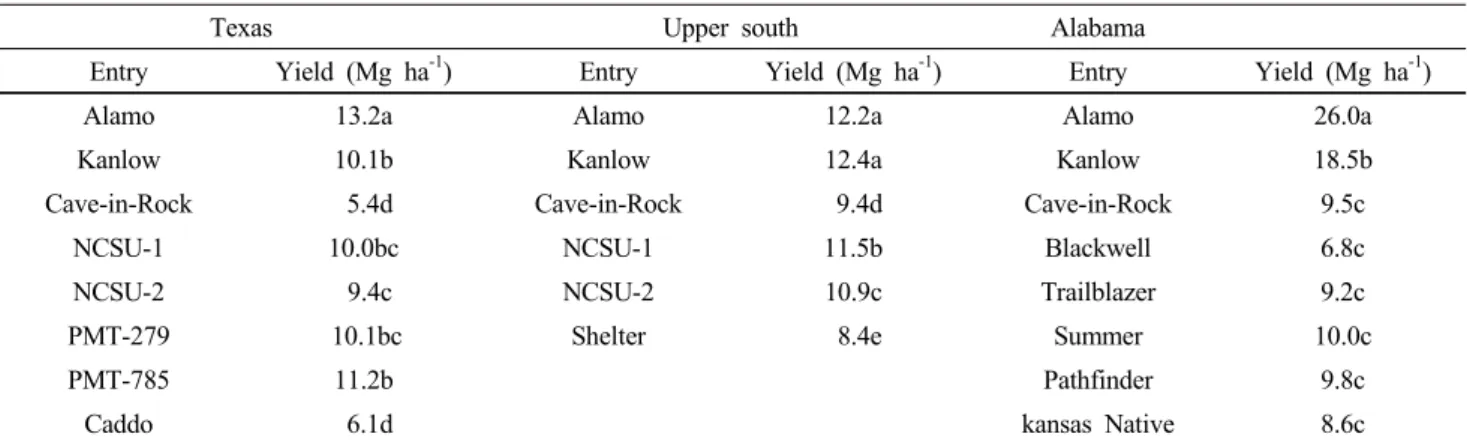
Table 1 Yields of several switchgrass cultivars and experimental line at several sites in the southern USA (Sanderson et al. 1996)
Texas Upper south Alabama
Entry Yield (Mg ha
-1) Entry Yield (Mg ha
-1) Entry Yield (Mg ha
-1)
Alamo 13.2a Alamo 12.2a Alamo 26.0a
Kanlow 10.1b Kanlow 12.4a Kanlow 18.5b
Cave-in-Rock 5.4d Cave-in-Rock 9.4d Cave-in-Rock 9.5c
NCSU-1 10.0bc NCSU-1 11.5b Blackwell 6.8c
NCSU-2 9.4c NCSU-2 10.9c Trailblazer 9.2c
PMT-279 10.1bc Shelter 8.4e Summer 10.0c
PMT-785 11.2b Pathfinder 9.8c
Caddo 6.1d kansas Native 8.6c
Texas yields are the averages of six locations and two years. (1993 and 1994, plots were established in 1992); Alabama yields are the averages two years and are taken from Bransby and Sladden. (1991); upper south yields are the averages of seven locations and two years. (1993 and 1994, plots were established in 1992) in four states [Virginia (three sites), West Virginia (one site), North Carolina (one site) and Tennessee (two sites)]. Means within columns followed by different letters differ at the 0.05 level of probability.
진행 중인 단계라서 비교 대상 작물인 콩이나 유채와 비 교하면 바이오에너지 작물 개발목적의 형질전환 연구에 있어서 초보적 단계라고 할 수 있다.
스위치그라스 품종별 특징분석 연구현황
스위치그라스로부터 바이오 매스의 효율적인 생산과 바 이오 에탄올 생산비용 절감을 위해 품종 별 생육특성과 유전적 특이성에 관한 연구가 이루어졌다.
스위치그라스는 생육특성에 따라 upland와 lowland 품 종으로 분류된다(Vogel 2004). Lowland는 일반적으로 4배 체이며 upland에 비해 줄기가 굵고 길게 생장하며 겨울철 기온이 비교적 온화한 지역에서 서식하고 바이오매스량 이 매우 높은 특징이 있다. Upland는 8배체이며 건조하고 추운 지역에서 생육하며 lowland보다 신장이 작고 바이 오매스 생산량도 적다(Bouton 2007).
미국 내에서 바이오매스 생산량을 비롯한 다양한 스위 치그라스의 특성에 관한 실험이 북중부지역(North Dakota, South Dakota, Minnesota, Missouri, Illinois, Iowa)을 중심으 로 이루어졌다. 연구결과 바이오매스 생산량은 연강수량 과 밀접한 관련을 보였으며 지역과 품종에 따라 바이오 매스 생산량에서 차이를 보였다(USDA, NRCS 2007, 2009b).
USDA, NRCS (2009b)에 따르면 미주리와 일리노이, 아이오
와에서 품종 별 바이오매스 생산량을 비교한 결과 Figure
2에서 보듯이 lowland 품종인 Alamo와 Kanlow가 가장 높
은 생산량을 보였다고 보고하였다. 이전 보고에서와 같
이 품종과 지역별로 상이한 바이오매스 생산량을 보여 효
율적인 바이오매스 생산을 위해서는 지역에 맞는 품종의
선택이 중요한 것으로 판단된다. Sanderson 등(1996)에 의
해 품종별 생산량에 관한 연구도 이루어졌다. Table 1을
보면 품종 별로 생산량에 많은 차이를 보였으며 lowland
가 upland에 비해 높은 생산량을 보였다. Molecular Marker를
이용한 upland와 lowland 품종들 간의 유전적 다양성에 관
Table 2 In vitro studies in switchgrass in last decades
Switchgrass cultivar Explant type Derived explants type Reference (Year) Alamo
1Mature caryopses. young leaf Callus, Plantlet Denchev et al. (1994) Alamo Mature caryopses. young leaf Callus, Plantlet Denchev et al. (1995)
Alamo Immature inflorescencse Callus, Plantlet Alexandrova et al. (1996)
Alamo, blackwell
2, trailblazer
2Mature caryopses Multiple shoots Dutta gupta and Conger (1998)
Alamo Immature inflorescencse Callus, Plantlet Odjakova and Conger (1999)
Alamo Immature inflorescencse Callus, Plantlet Burris et al. (2009)
Alamo
2Inflorescences of nodal segments Embryogenic callus Mazarei et al. (2011)
1
Upland cultivar,
2Lowland cultivar
한 연구도 이루어졌다(Huang et al. 2003; Missaoui et al.
2006). 그러나 효율적인 스위치그라스 품종개량을 위해서 는 형질 mapping에 관한 연구 등 추가적인 연구가 필요한 실정이다(Tobias et al. 2005, 2006).
스위치그라스의 조직배양 연구현황
전통적 육종을 통해 잡종강세를 보이는 스위치그라스 개 체의 상업적 이용을 위한 대량증식을 위해 조직배양 기 술이 필요하며(McLaughlin and Kszos 2005), 식물생명공학 기술에 의한 유용유전자가 도입된 형질전환 스위치그라스 의 개발을 위해서도 효율적인 조직배양 기술이 필요하다.
Table 2에서 보듯 스위치그라스 조직배양에는 주로 성 숙영과(mature caryopses)와 어린 잎(young leaf), 미성숙화 서(immature inflorescences)가 이용되었다. 조직배양시 캘 러스(callus) 발생 및 재분화 효율은 품종과 절편체, 사용 된 호르몬 조합에 의해 큰 차이를 보인다고 보고되었다 (Denchev and Conger 1995; Dutta Gupta and Conger 1998).
배지구성은 기본 MS배지에 sucrose 대신 maltose를 사용 하며 호르몬은 절편체와 목적에 따라 달리 사용하였다.
Denchev and Conger (1995)는 picloram과 2,4-D (2,4-Dichlor- ophenoxyacetic acid)를 이용하여 스위치그라스의 성숙영 과와 어린 잎 절편의 배발생캘러스 생성과 재분화율을 비 교한 결과 2,4-D가 picloram에 비해 더욱 효과적이며 사이 토키닌인 BA (6-Benzylaminopurine)의 혼용처리는 배발생캘러 스 생성 및 재분화에 필수적이라고 보고하였다. Alexandrova 등(1996)의 연구에서는 성숙영과가 아닌 미성숙화서를 이용 하여 실험한 결과 BA를 단독으로 처리하여 많은 spikelet 을 획득하였고 2,4-D와 BA를 혼용으로 처리하여 다수의 배발생캘러스와 재분화개체를 획득하였다. Dutta Gupta and Conger (1998)는 성숙영과에 2,4-D와 TDZ를 처리하여 품종 별 multiple shoot 유도 실험을 실시한 결과 기내에서 성공적인 multiple shoot를 유도하였지만 품종 별로 상이 한 결과를 나타내었으며 lowland 품종인 Alamo가 upland
품종인 Blackwell, Trailblazer보다 높은 효율을 보였으며 upland 품종에서도 Trailblazer가 Blackwell 보다 높은 효율을 보였다고 보고하였다. Odjakova and Conger (1999)은 캘러스 현탁배양 시 0.3 M sorbitol과 mannitol을 처리하여 배발생 캘러스를 유도하였고 Burris 등(2009)은 스위치그라스의 화서를 이용하여 기존에 사용된 MS배지가 아닌 LP9배지 를 이용하여 재분화율이 높은 캘러스를 유도하였다고 보 고하였다. Mazarei et al. (2011)에서는 Alamo 2세 품종 (Samdy, Fine milky, Ultrafine)의 배발생캘러스를 액체현탁 배양을 이용하였다.
현재까지 보고된 스위치그라스의 조직배양은 대부분이 lowland 품종인 Alamo를 이용하여 이루어져 왔다. 따라서 좀 더 다양한 품종에 적합하고 효율적인 조직배양체계의 확립이 필요하다고 판단된다.
스위치그라스 형질전환 연구현황
식물형질전환에는 주로 particle bombardment법과 Agrobacterium 매개 기법이 사용된다. Particle bombardment는 기주의 제 한이 없고 목적유전자를 단시간에 쉽게 도입할 수 있는 장점이 있으나 multicopy가 많아 유전자침묵이나 유전자의 재배열이 일어나는 단점이 있고 Agrobacterium을 이용한 형 질전환법은 경제적이고 multicopy가 적어 particle bombardment 를 이용한 방법보다 도입유전자의 발현이 효율적이나 복 잡한 과정과 단자엽에서의 이용이 어려운 단점이 있다.
단자엽에서 Agrobacterium을 이용한 효율적인 형질전환을 위해 Acetosyringone (AS)를 이용한다. AS는 Agrobacterium 의 식물세포 감염 관련 유전자인 vir 유전자를 활성화시 키는 페놀성 화합물로(Usami et al. 1987), 대부분의 단자 엽 식물조직에서 합성되지 않아 단자엽 식물의 형질전환 에서는 필수적으로 사용 된다.
스위치그라스에서도 이 두 가지 방법을 이용한 형질전
환 실험이 수행되었으며(Table 2) 최초의 형질전환 실험은
particle inflow gun을 이용한 논문으로 GFP (green fluorescent
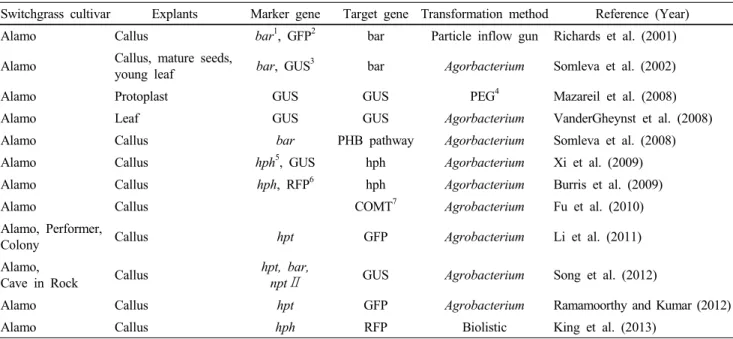
Table 3 Transformation studies in switchgrass via Agrobacterium tumefaciens and particle bombardment
Switchgrass cultivar Explants Marker gene Target gene Transformation method Reference (Year)
Alamo Callus bar
1, GFP
2bar Particle inflow gun Richards et al. (2001)
Alamo Callus, mature seeds,
young leaf bar, GUS
3bar Agorbacterium Somleva et al. (2002)
Alamo Protoplast GUS GUS PEG
4Mazareil et al. (2008)
Alamo Leaf GUS GUS Agorbacterium VanderGheynst et al. (2008)
Alamo Callus bar PHB pathway Agorbacterium Somleva et al. (2008)
Alamo Callus hph
5, GUS hph Agorbacterium Xi et al. (2009)
Alamo Callus hph, RFP
6hph Agorbacterium Burris et al. (2009)
Alamo Callus COMT
7Agrobacterium Fu et al. (2010)
Alamo, Performer,
Colony Callus hpt GFP Agrobacterium Li et al. (2011)
Alamo,
Cave in Rock Callus hpt, bar,
npt
ⅡGUS Agrobacterium Song et al. (2012)
Alamo Callus hpt GFP Agrobacterium Ramamoorthy and Kumar (2012)
Alamo Callus hph RFP Biolistic King et al. (2013)
1
bar bialaphos resistance gene,
2GFP green fluorescent protein,
3GUS β-glucuronidase,
4PEG polyethylene glycol,
5hph hygromycin phosphotransferase,
6RFP red fluorescent protein.
7COMT Caffeic acid 3-O-methyltransferase
protein) 유전자와 bar (bialaphos resistance)유전자를 도입하였다 (Richards et al. 2001). 그 후 Somleva 등(2002)은 Agrobacterium 을 이용하여 Alamo 품종의 genotype과 AS첨가에 따른 형 질전환효율 비교실험을 수행하였고, 그 결과 AS는 접종 시 50 μM, 공동배양 시 200 μM 처리하였을 때 무처리구 보다 높은 효율을 보였으며 genotype별로 효율차이를 보 였다고 보고하였다. Mazarei 등(2008)은 polyehtylene glycol (PEG)을 이용하여 스위치그라스의 원형질체를 형질전환 후 promoter별(35S, ubiA)로 GUS 발현을 비교한 결과 ubiA 를 이용하였을 경우 더욱 높은 GUS발현을 확인하였다.
VanderGheynst 등(2008)은 스위치그라스의 잎조각을 이용 하여 Agrobacterium 이용 시 낮은 진공압력(25 kpa)과 계면 활성제 처리가 높은 GUS발현율을 보인다고 보고하였다.
Xi 등(2009)는 Agrobacterium을 이용한 형질전환 시 균주 (AGL1, EHA105, LBA4404)에 따른 형질전환효율을 비교 하였으며 실험결과 EHA105와 AGL1이 LBA4404보다 높 은 형질전환 효율을 보였다. 또한 효율적인 형질전환체 선발에서 hygromycin을 이용한 선발 시 낮은 농도에서의 선발은 도입 유전자의 escape가 발생하여 선발강도와 기 간은 형질전환효율에 중요한 영향을 미치므로 최적화된 선발체계가 필요하다고 보고하였다.
현재까지 보고된 스위치그라스의 형질전환은 거의 선 발유전자인 bar, hph (hygromycin phosphotransferase), GUS 및 GFP 등 선발 유전자만이 도입된 연구이다. 바이오매스 로서 스위치그라스에 유용유전자를 도입한 연구는 Somleva 등(2008)에 의해 Agorbacterium을 이용하여 식물성플라스 틱원료인 PHB의 생산량을 높이는 PHB pathwaygene이 도
입된 형질전환 스위치그라스를 개발한 연구를 포함하여 2 ~ 3편에 불과 하다. 이렇듯 바이오원료용 형질전환 스 위치그라스에 대한 연구는 부족한 실정이다. 따라서 리 그닌 함량과 바이오매스 생산량 증대, 빠른 생육기간 등 의 유용 유전자가 도입된 형질전환 스위치그라스 개발에 대한 연구가 필요하다.
결 론
화석연료의 고갈과 환경문제로 인해 친환경원료인 바이 오매스를 이용한 바이오에탄올 생산과 같은 바이오리파 이너리(biorefinery) 에 대한 관심이 증가하고 있다. 그 때 문에 바이오에탄올 원료작물 및 바이오플라스틱 원료용 작물로서 스위치그라스에 대한 관심이 급증하고 있다.
스위치그라스를 바이오매스로서 효율적으로 이용하기
위해서는 바이오매스의 함량이 증가된 다양한 품종의 스
위치그라스 개발이 시급하다. 그러나 전통육종 방법으로
는 긴 육종연한과 유전자 범위의 한계가 있어, 아그로박
테리움 매개법 혹은 유전자 총과 같은 식물생명공학기술
도입이 필요하다. 그러나 현재까지 보고된 스위치그라스
의 형질전환 연구는 미미하며 특히 바이오에너지 작물로
서 유용 유전자가 도입된 연구는 거의 없는 실정이다. 또
한 현재까지 보고된 스위치그라스의 조직배양과 형질전
환에 관한 연구는 주로 lowland 품종인 Alamo를 이용한
보고에 편중되어있어, 기타 품종에서의 조직배양 체계와
형질전환법의 확립이 필요하다.
포브스(Forbes)지가 인터넷 판에 “미래로부터 온 소식(News from The Future)”이라는 제목의 2020년까지 예측 가능한 내용을 게재한 특별보고서(special report)에는 미국 내 에 서 스위치그라스를 이용하여 생산된 바이오에탄올이 보 조금이 없이 휘발유를 대체할 것이라 하였다. 최근 국내 에서도 바이오에너지에 대한 관심이 증가하여 바이오 연 료용 작물에 대한 연구가 활발히 진행되고 미국에너지부 (DOE) 핵심 바이오매스 작물로 선정하는 등 스위치그라 스가 바이오매스로서 중요한 작물로 인지되고 있다. 국 내에서도 이러한 식물조직배양과 형질전환기술을 이용 한 신품종 스위치그라스의 개발이 필요하며 앞으로 많은 연구가 필요하다고 판단된다.
References
Alexandrova KS, PD Denchev, BV Conger (1996) In vitro development of inflorescences from switchgrass nodal segments.
Crop Sci 36(1):175-178
American Society of Plant biologists (2005) President Bush cites importance of plant-based biofuels. ASPB News 32(4):16-17 Bouton JH (2007) Molecular breeding of switchgrass for use as a
biofuel crop. Curr Opin Genet Dev 17:553-558
Burris JN, DGJ Mann, BL Joyce, CN Stewart (2009) An improved tissue culture system for embryogenic callus production and plant regeneration in switchgrass (Panicum virgatum L.).
BioEnergy Research 2:267-274
Chung JH, GS Kwon, HS Jang (2008) Development of transportation and its future. Korea J Microbiol Biotechnol. 36:1-5 Denchev PD and Conger BV (1994) Plant regeneration from callus
of switchgrass. Plant Cell Tiss Org Cult 40:43-48
Denchev PD, Conger BV (1995) In vitro culture of switchgrass:
Influence of 2,4-D and picloram in combination with benzyladenine on callus initiation and regeneration. Plant Cell Tiss Org Cult 40:43-48
Dutta gupta S, Conger BV (1998) In vitro differentiation of multiple clumps from intact seedlings of switchgrass. In Vitro Cell Dev Biol Plant 34:196-202
Frank AB, JD Berdhal, JD Hanson, MA Liebig, HA Johnson (2004) Biomass and carbon partitioning in switchgrass. Crop Sci 44:1391-1396
Fu C, Mielenz JR, Xiao X, Ge Y, Hamilton CY, Rodriguez M, Chen F Jr, Foston M, Reqauskas A, Bouton J, Dixon RA, Wang ZY (2011) Genetic manipulation of lignin reduces recalcitrance and improves ethanol production from switchgrass.
Proc Natl Acad Sci USA 108(9):3803-3808
Huang S, X SU, R Haselkorn, P Gornicki (2003) Evolution of switchgrass (Panicum virgatum L.) based on sequences of the nuclear gene encoding plastid actyl-Coa carboxylase. Plant Sci 164:43-49
Jeon EH, YS Chung (2009) Development of genetic transformation method of Korean soybean. J Plant Biotechnol 36:344-351
Kim HJ, HJ Lee, YS Go, KH Roh, YH Lee, YS Jang, MC Suh (2010) Development of herbicide-tolerant Korean rapeseed (Brassica napus L.). J Plant Biotechnol 37:319-326
King ZR, AL Bray, PR LaFayette, WA Parrott (2013) Biolistic transformation of elite genotypes of switchgrass (Panicum
virgatum L.) Plant Cell Rep 1-10
Lee SI, YH Kim, DH Lee, SJ Park, JB Kim (2010) Current status of tissue culture and genetic transformation systems in oilseed rape plants (Brassica napus L.). J Plant Biotechnol 37:379-387 Li R, Qu R (2011) High throughput Agrobacterium-mediated switchgrass transformation. Biomass and Bioenergy 35(3):1046-1054 Lim, YK, SC Shin, ES Yim, HO Song (2008) The effect product
methods of biodiesel. J Korean Ind Eng Chem 19:137-144 Mazarei M, H Al-Ahmad, MR Rudis, BL Joyce, CN Stewart Jr
(2011) Switchgrass (Panicum virgatum L.) cell suspension cultures: Establishment, characterization, and application.
Plant Sci 181(6):712-715
Mazarei M, H Al-Ahmad, MR Rudis, CN Stewart Jr (2008) Protoplast isolation and transient gene expression in switchgrass,
Panicum virgatum L. Biotechnology J 3:354-359
McLaughlin SB, Kszos LA (2005) Development of switchgrass (Panicum virgatum) as a bioenergy feedstock in the United States. Biomass Bioenergy 28:515-535
McLaughlin, SB, R Samson, D Bransby, A Wiselogel (1996) Evaluating physical, chemical and energetic properties of perennial grasses and biofuels. Proc. Bioenergy '96-The Seventh National Bioenergy Conference: Partnerships to Develop and Apply Biomass Technologies, September 15-20, 1996. Nashville, TN. (
http://bioenergy.ornl.gov/papers/bioen96/
mclaugh.html
) Accessed July 31, 2009Ministry of Knowledge Economy (2011) Bio-diesel policy conference abstract, Cheon-An, Jan 20-21, 2011, Korea
Missaoui AM, AH Paterson, JH Bouton (2006) Molecular markers for the classification of switchgrass (Panicum virgatum L.) germplasm and to assess genetic diversity in three synthetic switchgrass populations.
Genet Res Crop Evol
53(6):1291-1302 NRCS (2007) Switchgrass Biomass Trials in North Dakota, SouthDakota, and Minnesota. NRCS
Odjakova MK, Conger BV (1999) The influence of osmotic pre- treatment and inoculum age on the initiation and regener- ability of switchgrass suspension cultures. In Vitro Cell Dev Biol Plant 35(6):442-444
Ramamoorthy R, Kumar PP (2012) A simplified protocol for genetic transformation of switchgrass (Panicum virgatum L.).
Plant Cell Rep 31(10):1923-1931
Richards, HA, VA Rudas, H Sun, JK McDaniel, Z Tomaszewski, BV Conger (2001) Construction of a GFP-BAR plasmid and its use for switchgrass transformation. Plant Cell Rep 20:48-54 Sang BI (2013) Trends in techniques of bioenergy production,
http://www.gtnet.go.kr/index.jsp
Sanderson, MA, RL Reed, SB McLaughlin, SD Wullschleger, BV Conger, DJ Parrish, DD Wolf, C Taliaferro, AA Hopkins WR Ocumpaugh, MA Hussey, JC Read, CR Tischler (1996) Switchgrass as a sustainable bioenergy crop. Bioresource Technology 56:83-93
Schmer MR, KP Vogel, RB Mitchell, RK Perrin (2008) Net energy of celluosic ethanol from switchgrass. Proc Natl Aca Sci USA 105(2):464-469
Seo SG, EJ Lee, SB Jeon, BH Lee, BC Koo, SH Suh, SH Kim (2009) Current status on Miscanthus for biomass. J Plant Bitechnol 36:320-326
Somleva, MN, KD Snell, JJ Beaulieu, OP peoples, BR Garrison, A Patterson (2008) Production of polyhydroxybutyrate in switchgrass, a value-added co-product in an important lignocellulosic biomass crop. Plant Biotechnol J 6:663-678
Somleva, MN, Z Tomaszewski, BV Conger (2002) Agrobacterium- mediated genetic transformation of switchgrass. Crop Sci 42:2080-2087
Song GQ, Walworth A, Hancock JF (2012) Factors influencing
Agrobacterium-mediated transformation of switchgrass cultivars.
Plant Cell Tiss Org Cult 108(3):445-453
Tobias, CM, DM Hayden, P Twigg, G Sarath (2006) Genic microsattelite markers derived from EST sequences of switchgrass (Panicum virgatum L.). Mol Ecol Notes 6:185-187 Tobias, CM, P Twigg, DM Hayden, KP Vogel, RM Mitchell
(2005) Analysis of expressed sequence tags and identification of associated short tandem repeats in switchgrass. Theor Appl Genet 111(5):956-964
Usami S, S Morikawa, I Takabe, T Machida (1987) Absence in monocotyledonous plants of the diffusible plant factors inducing T-DNA circularization and vir gene expression in Agrobacterium.
Mol Gen Genet 209(2):22-226
USDA, NRCS (2006) The Plants Database, National Plant Data Center, Baton Rogue, LA 70874-4490 available at: http://plants.
usda.gov. Accessed 18 December 2006.
USDA, NRCS (2009a) Planting and managing switchgrass as a biomass energy crop. USDA, NRCS. Technical note No.3 USDA, NRCS (2009b) Switchgrass for biomass production by
variety selection and establishment methods for missouri, illinois, and iowa. USDA iowa state office. technical notes.
VanderGheynst, JS, HY Guo, CW Simmons (2008) Response surface studies that elucidate the role of infiltration condition on Agrobacterium tumefaciens-mediated transient transgene expression in harvested switchgrass (Panicum virgatum).
Biomass and Bioenergy 32(4):372-379
Vogel KP (2004) Switchgrass. In warm-season(c4) grasses. Edited by Moser LE, Burson BL, Sollenberger LE. American Society of Agronomy; 2004:561-588
Won DH (2008) FTA confrontation-strategy via promotion of bioenergy industry - non-market valuation methods of biofuel, pp. 8-16, report of Energy Economics Institute, Korea Xi Y, Fu C, Ge Y, Nandakumar R, Hisano H, Bouton J, Wang ZY
(2009) Agrobacterium-mediated transformation of switchgrass and inheritance of the transgenes. Bioenergy Research 2(4):275-283
Yang, JK, Choi MS (2009) Production of bioethanol using food resources. Bulletin of Food Technology 22(3):413-429