Vol. 23, No. 10 (2013)
574
Milling and Particulate Characteristics of Al Alloy-Al
2O
3Powder Mixtures for Reaction-Bonded Al
2O
3(RBAO) Process
Hyun-Kwuon Lee †
School of Advanced Materials & Systems Engineering, Kumoh National Institute of Technology, Gumi 730-701, Korea
(Received September 17, 2013 : Received in revised form September 23, 2013 : Accepted September 23, 2013)
Abstract
The milling and particulate characteristics of Al alloy-Al2O3 powder mixtures for a reaction-bonded Al2O3 (RBAO) process were studied. A commercially available prealloyed Al powder with Zn, Mg, Cu and Cr alloying elements (7475 series) was mixed with a calcined sinter-active Al2O3 powder and then milled in centrifugal milling equipment for ~48 hrs. The Al alloy-Al2O3 powder mixtures after milling were characterized and evaluated in various ways to reveal their particulate characteristics during milling. The milling efficiency of the Al alloy increased with a longer milling time.Comminution of the Al alloy particles started with its elongation, showing a high aspect ratio. With a longer milling time, the elongated Al alloy particle changed in terms of its shape and size, becoming equiaxially fine particles. Regardless of the milling efficiency of the Al alloy particles, all of the Al alloy particles repeatedly experienced strong plastic deformation during milling, giving rise to higher density of surface defects, such as microcracks, and leading to higher residual microstress within the Al alloy particles. The chemical reactions, oxidation behavior and hydration behavior of the Al alloy particles and the hydrolysis characteristics of their reaction with the environment were also observed during the milling process and during the subsequent powder handling steps.
Key words
milling, Al alloy powder, plastic deformation, oxidation, RBAO.1. Introduction
Milling of ceramic-metal powder mixtures is an inevit- ably important processing to be carefully controlled for the particulate metal matrix composites(MMCs) and for the particulate ceramic matrix composites(CMCs) by sintering, in which the milling significantly affects overall processing and final properties of composites thereby. The composite fabrication process is, in general, processed in inert atmosphere to prevent passivation of metallic con- stituents. Otherwise, for reaction-bonded Si
3N
4(RBSN)
1)and Al
2O
3(RBAO)
2-6)ceramic process, milling of ceramic- metal powder mixtures also has to be precisely controlled for desired properties, where passivation of metallic con- stituents is utilized in the reaction bonding after milling of ceramic-metal powder mixtures. Unlike RBSN ceramics using less active Si particulate, highly reactive and ex- plosive Al particulate is incorporated in RBAO process where oxidation of Al, to some extent, should occur in
milling to inhibit possibly abrupt explosion during handling in air.
RBAO process utilizes oxidation of metallic Al powder that is mixed with Al
2O
3powder in green compact. During heat treatment in air, Al is fully oxidized to nanometer- sized Al
2O
3that sinter and bond the originally mixed Al
2O
3particles, and then fully oxidized body is sintered further at higher temperatures(post-sintering). The oxida- tion of Al usually takes place by solid Al/air and liquid Al/air reactions at temperatures below and above melting temperature(T
m= 660
oC) of Al, respectively. Because of bad wettability of liquid Al on Al
2O
3above T
m, the liquid Al is coagulated and is sometimes squeezed-out through open pore network of the body. The out-squeezed liquid Al is not completely oxidized even over 1550
oC, hence is detrimental for RBAO process. It was recommended that, therefore, as much as possible of metallic Al in Al- Al
2O
3powder compact should be oxidized by solid/gas reaction. It was also reported that the fraction of Al
†
Corresponding author
E-Mail : [email protected] (H.-K. Lee, Kumoh Nat'l Inst. Tech.)
© Materials Research Society of Korea, All rights reserved.
This is an Open-Access article distributed under the terms of the Creative Commons Attribution Non-Commercial License (http://creative-
commons.org/licenses/by-nc/3.0) which permits unrestricted non-commercial use, distribution, and reproduction in any medium, provided the
original work is properly cited.
oxidation below T
mis entirely dependent on Al particle size after milling, and that Al particle size should be reduced smaller than ~1 µm in order to oxidize most Al by solid/gas reaction.
2)Therefore, the milling of Al-Al
2O
3powder mixture is known to be decisive processing step controlling overall RBAO process, and it is generally accepted that intensive milling process such as attrition milling should be applied.
Important processing parameters controlling RBAO pro- cess are known to be particle size of Al, Al content in Al-Al
2O
3powder mixture, and green density of its powder compact.
3)These processing parameters are determined and influenced eventually by particulate characteristics of Al-Al
2O
3powder mixture after milling. In this study, the particulate characteristics of Al alloy-Al
2O
3powder mix- tures for RBAO process are investigated with respect to milling time. Addition of Al alloy powder instead of pure Al is intended to improve bad wettability of Al on Al
2O
3, by which relatively larger Al alloy particle from less in- tensive milling also could be fully oxidized for successful RBAO process. Effect of milling and particulate properties of Al alloy-Al
2O
3powder mixture on reaction-bonded Al
2O
3process will be separately presented later.
2. Experimental Procedure
Table 1 shows the chemical compositions of starting powders and their particulate characteristics. Al alloy powder is a commercially available prealloyed powder (Al7475) by atomization of liquid Al with Zn, Mg, and Cu. Main Al
2O
3source was a calcined sinteractive Al
2O
3powder, and an abrasive tabular Al
2O
3powder was also added to the powder mixtures for the enhancement of milling efficiency.
Powder mixture of 40 vol% Al alloy-60 vol% Al
2O
3were prepared by centrifugal ball milling up to 48 hr (Type S2, Retsch). Milling jar and milling balls used
were high Al
2O
3(> 99 %) jar and 3 mm diameter balls of zirconia(TZ-3Y, Tosoh), respectively. Acetone(> 99.5 %, max. 0.2 % H
2O, Riedel-deHan) was added as a milling fluid. Volume ratio of milling balls to precursor powders was fixed to 5.899. The milled powder slurry was dried at RT in air and then sieved through 200 µm of aperture size to remove extremely large agglomerates.
Particulate surface morphology of starting Al alloy and Al
2O
3powder was observed by SEM(JSM-U3, Jeol).
Cross-sectional morphology of agglomerates of powder mixtures after milling was observed to reveal morpho- logical changes of each constituent and its distribution during milling. Average particle size and size distribution of starting powders and powder mixtures after milling were determined by laser granulometer(Helos 12LA, Sym- patec). Specific surface area was measured by BET method using N
2gas adsorption(Areameter, Stroehlein).
Phase development during milling were conducted by X- ray diffraction(XRD) method(PW/729, Philips) using Co target and Fe filter. The lattice microstrain was also mea- sured by line broadening of the diffracted crystal planes.
7)Fourier transformed infrared(FTIR) spectrometry(5XSC, Nicolet) was applied to study the surface reactions of Al alloy powders with acetone during milling, and to identify their reaction products using KBr pellet method.
3. Results
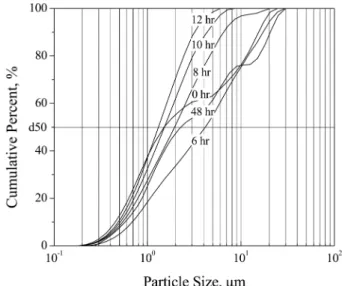
Fig. 1 shows particle size distributions of powder mix- tures according to milling time up to 48 hr. The powder mixture by mixing alone, i.e., 0 hr milling shows typical bimodal size distribution, which is observed in case two powders with different average particle size are phy- sically mixed. The average particle size corresponding to
Table 1. Chemical Compositions* (wt%) of Starting Powders and their Particulate Characteristics.
Al Zn Mg Cu Cr
Al alloy
190.35 5.7 2.25 1.5 0.2
Al
2O
3Na
2O SiO
2Fe
2O
3CaO MgO Al
2O
3299.84 0.07 0.03 0.02 0.01 0.03
Al
2O
3399.33 0.39 0.01 0.02 0.05 -
*chemical compositions from suppliers
1. Al7475 alloy powder, atomized, nearly spherical, 12.11 µm of average particle size, Aluminium Powder Company Ltd., England 2. A-16SG, calcined, sinteractive, agglomerated and rounded, 0.89 µm of average particle size, Alcoa, USA
3. T-60 low iron, sintered, abrasive, tabular, 2.20 µm of average particle size, Alcoa, USA
Fig. 1. Particle size distributions of powder mixtures with milling
time.
50 cumulative % (d50, horizontal line) increases rather during initial period of milling of 6 hr and its particle size distribution becomes to be widened. Thereafter, average particle size decreases with increasing milling time and their size distributions tend to be narrow and to follow log- normal distribution function. However, prolonged milling time, such as 48 hr, leads to the increase in d50 of the powder mixture again and its size distribution becomes complex and to be widened, especially in the fraction of larger particle sizes. The average and maximum particle
size of powder mixtures are 1.5 and 24.6 µm for 0 hr, 4.16 and 29.4 µm for 6 hr, 1.95 and 20.6 µm for 8 hr, 1.51 and 8.6 µm for 10 hr, 1.31 and 6.0 µm for 12 hr, and 2.26 and 30.0 µm for 48 hr milling time, respectively.
Fig. 2 shows variation of average particle size and specific surface area of powder mixtures with milling time.
The specific surface area increases continuously with increasing milling time, suggesting the particle size of powder mixture is proportionally reduced with increasing milling time. The value of specific surface area measured are 8.26 m
2/g for 0 hr, 16.02 m
2/g for 6 hr, 20.32 m
2/g for 8 hr, 22.11 m
2/g for 10 hr 25.56 m
2/g for 12 hr, and 30.53 m
2/g for 48 hr milling time. Considering, however, the specific surface area is theoretically inversely propor- tional to particle size in a powder system, it is interesting that, during milling for 6 hr and 48 hr, the specific sur- face area increases with increasing average particle size of powder mixture. This contradiction is thought to be due to the combined effect of comminution, plastic defor- mation Al alloy particles during milling and its chemical reactions with environments during milling and powder handling in air, which will be discussed later.
SEM photographs showing cross-sections of agglom- erated powder mixtures after milling and sieving are given in Fig. 3, showing morphological change of Al alloy powder clearly. In Fig. 3(a), the original spherical shape of 12 µm Al alloy particle(bright) are distinctly Fig. 2. Average particle size and specific surface area of powder
mixtures with milling time.
Fig. 3. SEM photographs of cross-sections of agglomerated powder mixtures after milling and sieving; (a) 0 hr, (b) 6 hr, (c) 8 hr, (d) 10 hr,
(e) 12 hr, and (f) 48 hr milling time, respectively.
observed and are mostly confined within large agglom- erated granules formed between Al alloy and Al
2O
3particles. During milling for 6 hr in Fig. 3(b) the spherical Al alloy are plastically deformed heavily into elongated needle shape particles with high aspect ratio by centrifugal milling. During milling for 8 to 48 hr, Fig. 3(c) to Fig.
3(f), thickness and length of the needle-shaped Al alloy are effectively reduced with concurrent decrease in its aspect ratio, indicating the comminution of metallic Al alloy powder. In Fig. 3(e) and Fig. 3(f), the needle-shaped Al alloy can hardly be observed and the particle size of Al alloy powder is clearly showed to be reduced equiaxially, especially in 48 hr milling. It is shown that, with in- creasing milling time, the agglomerated granules become gradually denser and stronger accompanying with increas-
ingly homogeneous distribution of Al alloy particles.
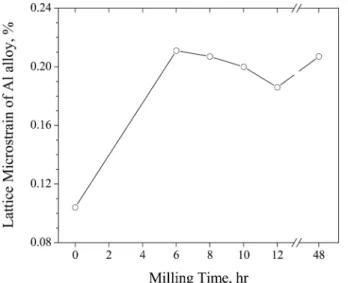
Lattice microstrain of Al alloy particles in powder mix- tures during milling is showed in Fig. 4 with milling time. The lattice microstrain is a local elastic lattice microstrain within the stress field generating in the vicinity of plastically deformed region of Al alloy during milling, therefore, lattice microstrain is equivalent to elastic lattice microstress. Up to 6 hr of milling time, lattice microstrain of Al alloy particles increases sharply, and then decreases gradually to 12 hr, but increases again after 12 hr of milling time. It is of great interest that change of lattice microstrain coincides fairly with that of average particle size in Fig. 2.
In order to observe the phase evolutions during milling process, the powder mixtures after respective milling time were analyzed with XRD method, and the result is shown in Fig. 5. All the powder mixtures show only Al and α-Al
2O
3phases, and tetragonal ZrO
2phase is add- itionally observed in the powder mixture of 48 hr milling, Fig. 5(d). No crystalline compound such as inter- metallic or hydroxide of Al, Zn, Mg, and Cu is detected by this diffraction method. The tetragonal ZrO
2is thought to come from wearing of the 3Y-TZP milling balls during milling.
5)The content of tetragonal ZrO
2from the wearing is believed to increase with increasing milling time, despite the powder mixtures of 6 hr in Fig. 5(b) and 12 hr in Fig. 5(c) milling time show no noticeable trace of tetragonal ZrO
2phase. The tetragonal ZrO
2is likely to be in disordered state such as amorphous state considering the peak broadening shown in Fig. 5(d).
Fig. 6 shows variation of intensity ratios of Al (111) (2 θ ≅ 45.0
oI/I
o= 100) to Al
2O
3(113) (2 θ ≅ 50.8
oI/I
o= Fig. 4. Lattice microstrain of Al alloy particles in powder mixtures
with milling time.
Fig. 5. XRD patterns of powder mixtures with milling time (a) 0 hr, (b) 6 hr, (c) 12 hr, and (d) 48 hr, respectively.
Fig. 6. Intensity ratios of Al (111) (2θ ≅ 45.0
oI/I
o= 100) to Al
2O
3(113) (2 θ ≅ 50.8
oI/I
o= 100) from the diffraction patterns shown in
Fig. 5 (normalized to the ratio value for 0 hr milling time).
100) from the diffraction profiles shown in Fig. 5. For intensity measurements, the integrated area of each dif- fraction profile was measured following base line correc- tion. The calculated value of intensity ratios was nor- malized to the value for 0 hr milling time and then plotted. It is evident that the intensity of Al to Al
2O
3decreases with increasing milling time, which indicates the content of Al alloy in powder mixture is reduced during milling and powder handling thereafter. The re- duction of Al alloy content during milling and powder handling can be attributed to the consumption of Al alloy content, which means chemical reactions of Al alloy par- ticle with milling environment(moisture, air, and acetone in milling jar) and also with air during powder handling.
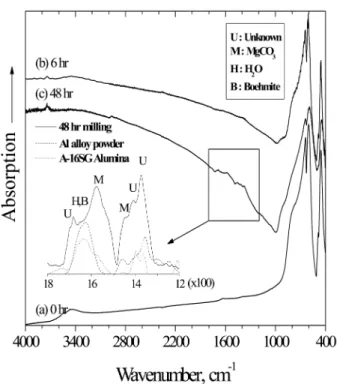
Fig. 7 shows the result of phase analysis of powder mixture after milling by FTIR method. For comparison, the results of Al alloy powder, Al
2O
3powder, powder mixtures after milling for 0 hr and 6 hr are also given.
The overall absorption band of (a) 0 hr, (b) 6 hr, and (c) 48 hr is nearly similar, however change of absorption patterns according to milling time is observed in wave- numbers between 1300 cm
−1and 1700 cm
−1(marked as square), which is noticeable in powder mixture after 48 hr milling, Fig. 7(c). The enlarged absorption band of Fig. 7(c) is presented with absorption bands of Al alloy and A-16SG Al
2O
3starting powders for references after base line correction. From the analysis, absorption bands of boehmite( γ-AlOOH, B), MgCO
3(M), adsorbed H
2O(H), and unknowns(U) are revealed. It is probable that two
unknown absorption bands are correlated to Al-containing phases considering absorption bands of Al alloy and Al
2O
3starting powders, and that the evolution of Al- containing phases increases with longer milling time.
4. Discussion
It was revealed that three important changes concerning Al alloy particle take place during milling process, i.e., size reduction, plastic deformation, and chemical reactions of Al alloy particles. The chemical reactions of Al alloy particle also take place during subsequent drying and powder handling.
The size reduction of Al alloy particle in this study proceeds as follows. Al alloy particle experiences the e- longation with high aspect ratio during initial milling stage, as in Fig. 3. The thickness and length of elongated Al alloy particle begin to decrease with increasing milling time, and shape and size of Al alloy particle finally reaches to the form of equiaxially fine size in Fig. 3(e).
However, in the case of shorter milling time, this elon- gated Al alloy particle remains itself as an relatively shorter and thinner needle-like form after milling in Fig.
3(d). This elongated and needle-like particle shapes cause increase in apparent particle size(6 hr in Fig. 2). It is, therefore, believed that the specific surface area is more reliable evaluation criterion than the average particle size in this study. The milling efficiency is undoubtedly of great concern. From the result of specific surface area measurements and microstructural observations, the milling efficiency of Al alloy powder increases with longer milling time.
The external mechanical stress applied on milling is principally consumed by elongation(plastic deformation) and by fracture(comminution) of Al alloy particle, and is also stored as internal microstress within Al alloy particles.
The extent of plastic deformation of Al alloy during milling can be understood by measuring lattice micro- strain of Al alloy. The lattice microstrain is a local elastic lattice microstrain within the stress field generating in the vicinity of plastically deformed region of Al alloy during milling, therefore is equivalent to an elastic lattice micro- stress. It is interesting that the variation of lattice micro- strain in Fig. 4 coincides well with that of average particle size in Fig. 2. At the beginning of milling, plastic defor- mation is a predominant process, by which average particle size increases and microstrain also increases. Thereafter, the local elastic lattice microstrain is gradually reduced with milling time to 12 hr. This is caused by dissipation of elastic lattice microstress according to the comminu- tion(fracture) of the Al alloy, which is concurrent with size reduction. As the particle size reduction, however, is saturated during prolonged milling time, excess mech- Fig. 7. FTIR absorption bands of powder mixtures after (a) 0 hr, (b)
6 hr, and (c) 48 hr milling time.
anical milling energy is either stored as strain energy, i.e., lattice microstress within Al alloy, or consumed to make strong bonding between Al alloy and Al
2O
3particles.
Thereby, formation of dense and strong agglomerated granules in Fig. 3(e) and Fig. 3(f) is resulted, which is in agreement with the size increase of 48 hr milling in Fig.
2 and with the lattice microstrain of Al alloy.
Chemical reactions of Al alloy in this study may be very diverse. Besides Al, alloying elements, Zn, Mg, and Cu, can take part in the chemical reactions during milling.
Moreover, reacting environments could be milling fluid (acetone), H
2O(moisture), and O
2. Acetone(CH
3COCH
3) is dissociatively adsorbed on Al.
8)H
2O and O
2are soluble in acetone, and they can always have a direct contact with fresh Al alloy during milling and subsequent powder handling in air. The complex combination of reactants and environments makes full understanding of incorp- orated chemical reactions of Al alloy during milling very difficult. The oxidation and hydrolysis of Al alloy and hydration of so-formed surface Al
2O
3oxide are all ther- modynamically favored and spontaneous at room tem- perature in air. During milling of Al Alloy powder, the content of Al alloy decreases as seen in Fig. 6. The decrease in Al alloy content is more predominant with increasing milling efficiency. This means that Al alloy particle may reacts with its environments resulting in loss of Al content after milling process and that this kind of chemical reactions in Al alloy has a close relation to milling process. Therefore, it is thought that the chemical reactions during milling and powder handling principally take place on freshly new surfaces of Al alloy particles formed by comminution. This new surfaces can even comprise surface cracks or flaws forming by plastic de- formation of Al alloy at low milling efficiency. The further study on chemical reactions of Al alloy particle during milling and handling and on its effect on reaction- bonding process is needed and will be presented later.
5. Conclusion
In present study, milling and particulate characteristics of Al alloy-Al
2O
3powder mixtures for reaction-bonded Al
2O
3(RBAO) process were studied. Milling efficiency
of Al alloy increases with longer milling time. Commi- nution of Al alloy particles is started with its elongation with high aspect ratio. With longer milling time, the elongated Al alloy particle changes its shape and size into equiaxially fine particles. Regardless of milling efficiency of Al alloy particles, all the Al alloy particles repeatedly experience strong plastic deformation during milling, which gives rise to higher density of surface defects such as microcracks and to higher residual microstress within Al alloy particles. Chemical reactions, oxidation and hy- dration of Al alloy particles and hydrolysis of their reaction products, with environment are also observed during milling and thereafter powder handling.
Acknowledgement
This paper was supported by Research Fund, Kumoh National Institute of Technology.
References
1. R. Pompe, L. Hermansson and R. Carlsson, Proc. Br.
Ceram. Soc., 32, 65 (1981).
2. S. Wu, D. Holz, and N. Claussen, J. Am. Ceram. Soc., 76, 970 (1993).
3. D. Holz, S. Wu, S. Scheppokat and N. Claussen, J. Am.
Ceram. Soc., 77, 2509 (1994).
4. N. Claussen, S. Wu and D. Holz, J. Eur. Ceram. Soc., 14, 97 (1994).
5. S. M. Goushegir, P. O. Guglielmi, J. G. P. da Silva, M.
P. Hablitzel, D. Hotza, H. A. Al-Qureshi and R. Janssen, J. Am. Ceram. Soc., 95, 159 (2012).
6. P. Mechnich and W. Braue, J. Eur. Ceram. Soc., 33, 2645 (2013).
7. P. Rama Rao and T. R. Anantharaman, Z. Metallkde., 54, 658 (1963).
8. A. G. Akimov and Y. B. Makarychev, Poverkhnost, 6, 126 (1983).